Oswin Hirst
Oswin Hirst
At the table
Voice
A chest-led, weather-rough voice with a Yorkshire cadence, steady and practical in ordinary conversation. Cold mornings leave it rasped at the edges. His name, Oswin, sounds softer than the rest of his speech. When the Barghest nature presses close, his voice keeps its human texture but seems to arrive from a little farther away, as though heard across an empty yard.
His speech carries the plain, rounded cadence of a Yorkshire farmer: measured vowels, firm consonants, and an instinct to describe what can be seen, touched, or mended. Years among travelers and old spirits have left him with an occasional archaic turn of phrase, which he usually disguises as a family saying. His voice is produced low in the chest and has a faint rasp from cold air and nights spent outdoors. When angry, he becomes direct and clipped, not softer; when afraid, he may speak too quickly and over-explain ordinary details.
Speech patterns
How to play them
Treat Oswin as a capable, guarded farmer rather than a monster in disguise. He is more forthcoming while working beside someone than when directly questioned. Kindness to William earns trust; threatening Mary or the boy brings out his inhuman nature immediately. Evidence that Thomas is investigating him may make Oswin seek the party's help, though he will initially describe the problem as a family disagreement.
Goal
Tell Mary enough truth to let her choose her future, protect William from being feared, and keep the old powers of the dales away from their home.
Motivation
He wants to build a safe, ordinary home with Mary and William, though his need to hide his nature and his past keeps making that home less honest.
Appearance
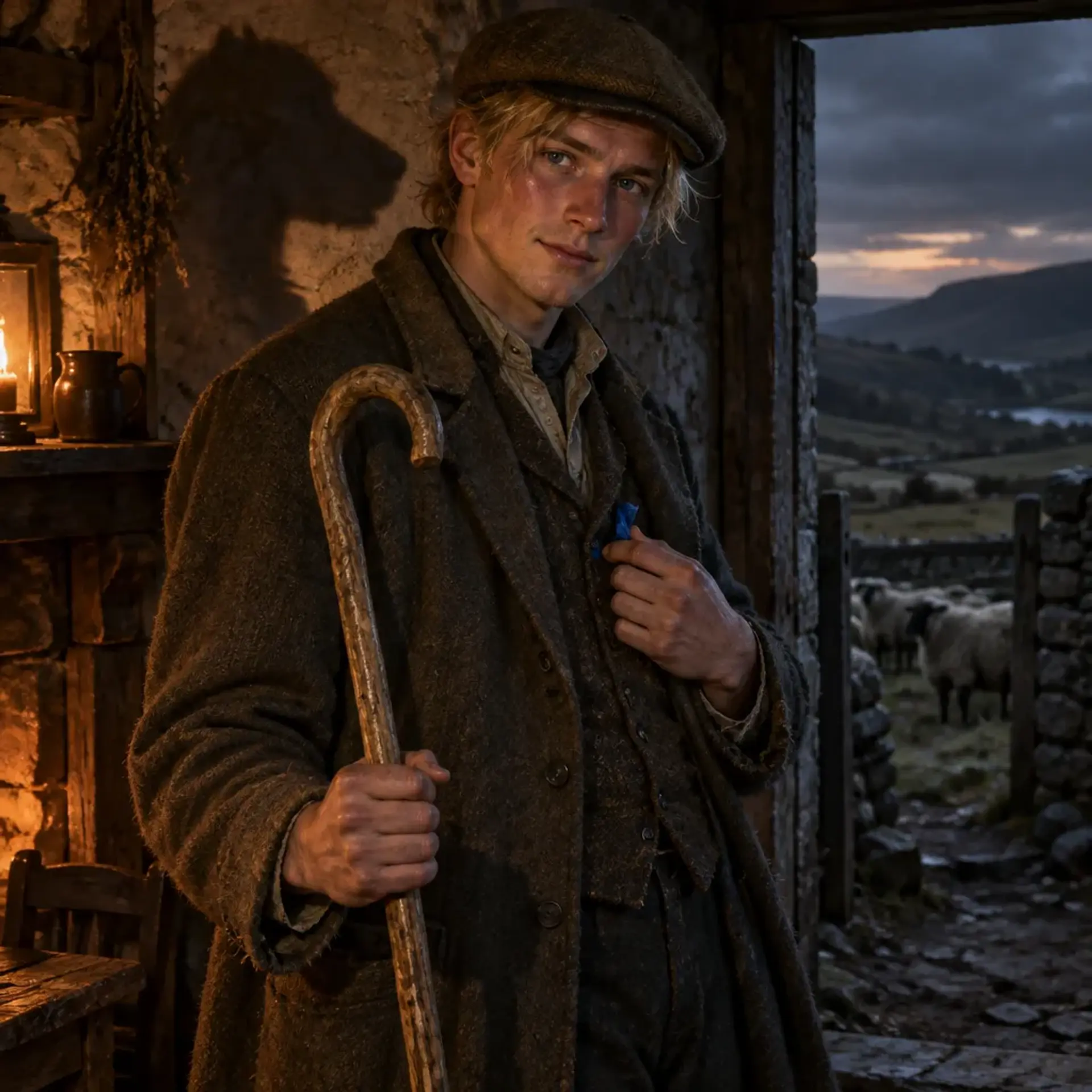
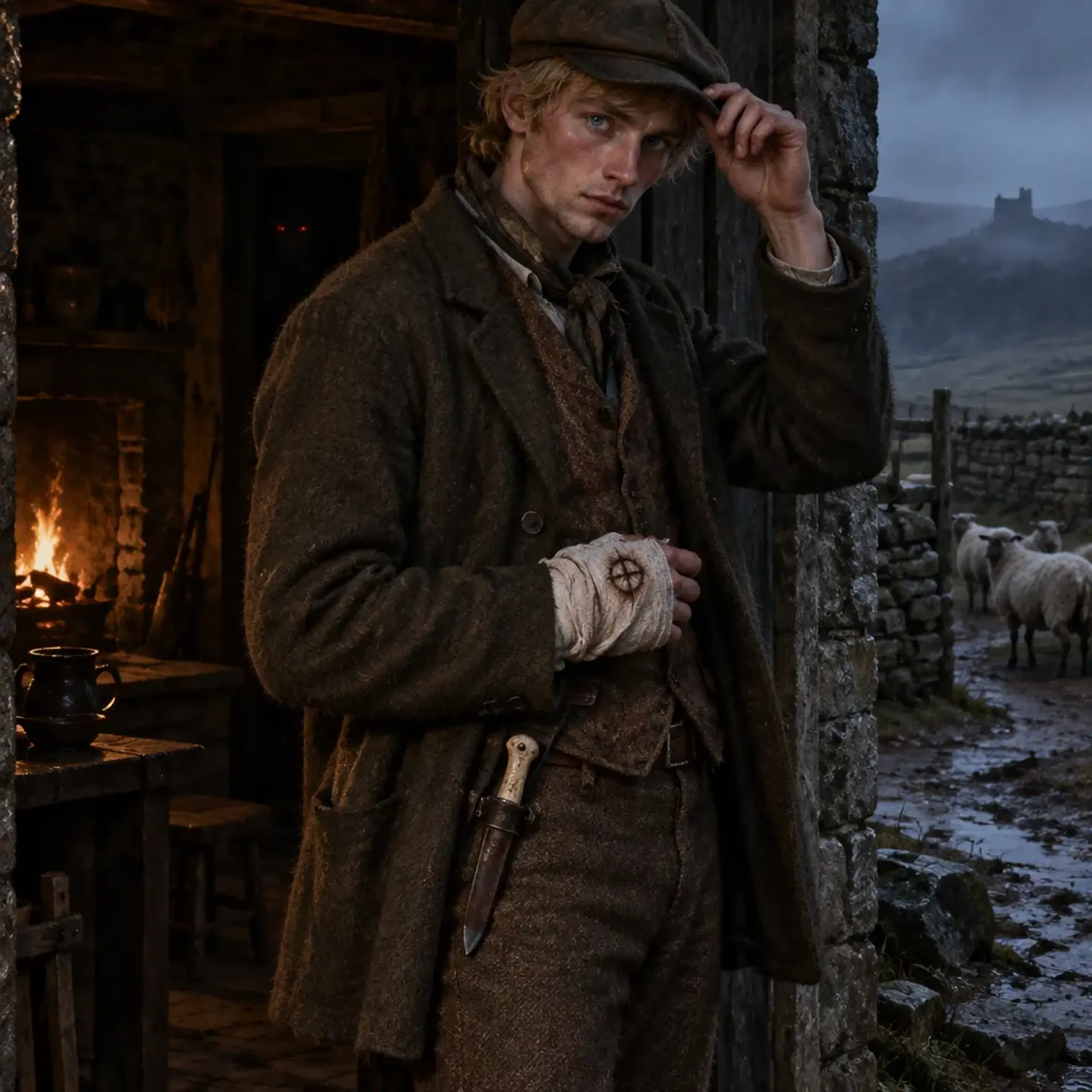
Oswin stands exactly six feet, with a handsome, youthful face that seems preserved in the moment Mary first loved him. His pale blond hair lies straight and fine beneath a common flat cap, though wind lifts it in a stiff, straw-bright fringe. His eyes are a clear, burning blue, too vivid in lamplight; when his temper or hunger stirs, the blue seems to flare from within. His skin is pale and weathered by open air, with a faint wind-reddened cast across his nose and cheekbones. He moves with a shepherd's quiet economy, placing his feet carefully even on familiar floors, and sometimes turns his shoulders as if listening to something behind him. He smells of lanolin, damp wool, hearth smoke, and, after rain, the cold mineral scent of a stream. An unexpected detail for a farmer is the immaculate, almost courtly way he folds and mends small pieces of cloth, learned during his long years among strangers. His presence is reassuring until he becomes still; then he looks like a man waiting for a funeral procession only he can hear.
Clothing
A well-kept but plainly cut wool coat, waistcoat, sturdy trousers, and a common flat cap. His boots are carefully resoled. He favors leather and bone fastenings over iron wherever possible and keeps a weather-darkened neck cloth tucked into his collar.
Body language
He keeps his hands occupied with a cap brim, a gate latch, or the edge of a sleeve. When uncomfortable, he angles himself away from iron rather than making a show of fear. With William, he lowers himself to the child's height and waits through silences without finishing his sentences. When a threat appears, his posture becomes unnaturally motionless, as if the rest of him has gone somewhere else.
- Height
- 6 ft
- Build
- Tall and lean, with the strong back and forearms of a man accustomed to sheep, gates, and wet hills.
- Eyes
- Clear, intensely bright blue
- Hair
- Pale blond, straight
- Skin
- Pale, with a weather-reddened cast across the nose and cheekbones
- Age
- Appears 21; claims to be 28, though his birth dates to the late Danelaw era and he has lived for centuries.
- Gender
- Male
- Size
- Medium in human form; Large in black hound form
Distinguishing features
Personality
20 traits and drivesOswin is gentle in a way that takes effort. He notices when a child is cold, when a ewe is limping, and when a visitor has been standing too long without being offered a chair. He does not make a performance of kindness; he simply moves the stool closer or lays a dry cloth within reach. Yet that gentleness has a guarded edge. He can spend an hour patiently helping William learn a simple task and then give Mary only half an answer about where he went before dawn. He believes he is sparing people fear, but he also fears what they might decide if they know him. He is practical, shrewd, and difficult to surprise. Oswin checks a bargain for its hidden cost, a gate for its weak hinge, and a story for the part the teller has left out. This can make him seem suspicious of ordinary affection. He knows how easily hospitality becomes obligation among the fae, so he sometimes hesitates before accepting even a harmless gift. In calmer moods, he laughs at himself for this. In a bad season, when he has not slept, the old caution takes over and he treats a neighbor's kindness like a trap. His love of farm life is real, but incomplete. Oswin likes the work because it has visible consequences: a fence stands, a lamb is fed, a roof keeps out rain. He likes the rhythm of days that belong to no court, spirit, or road. At the same time, the farm can feel like a life he chose because he was tired of being feared, rather than because he was ready to stop roaming. Memories of the dales call to him with the force of a road he has not finished walking. He is embarrassed by that longing. He tells himself that restlessness is selfish when Mary and William need him, then sometimes watches the hills until dusk as if they might answer. Oswin has a quiet pride in being competent. He can mend a fence, judge a sick sheep, and bargain for feed without being cheated. He dislikes being treated as helpless or uncanny, and dislikes even more being treated as a source of miraculous answers. He will not casually use his powers to settle a village dispute or find a lost object. If someone presses him to perform, he becomes dry and evasive. If a life is in danger, however, that reserve can vanish at once. He will accept the cost afterward rather than stand aside while another person suffers. He is affectionate with Mary in habitual, domestic ways: a hand at her elbow over a muddy patch, an extra piece of bread saved for her, a quiet check that the fire is safe. He remembers small preferences and forgets to explain his own. He loves her confidence and her ability to call him out when he is being foolish. He also fears her judgment more than he fears the old spirits. That fear has made him lie by omission and then build further omissions around the first one. He wants her not to be afraid of the dark, not to fear the fae, and not to see him as a monster. He has not understood that she cannot make those choices honestly while he controls what she knows. With William, Oswin's patience is at its most visible. He never rushes the boy's words or finishes a task for him just because it would be quicker. He makes a game of counting sheep, naming tools, and finding the safest way around a muddy yard. He fears William's slowness may be blamed on the child's unusual blood, so he refuses to speak of it as a defect. Yet Oswin is alert to every strange sign: a too-bright gaze, a sudden stillness, a dog refusing to approach. He watches William with tenderness and vigilance, and sometimes his vigilance is so intense that Mary mistakes it for proof of a curse. Oswin's temper is not loud. When hurt, he first becomes courteous, then practical, then frighteningly still. He asks one direct question and waits for an honest answer. If none comes, he stops trying to persuade. Anger can reveal the creature under the farmer: his eyes shine, his movements become too smooth, and the space around him feels suddenly empty. He hates this effect. He does not always control it. He is more likely to show it when someone threatens his family or mocks William than when he himself is insulted. He is not merciful in every circumstance. Oswin can be ruthless toward a person who knowingly endangers a child, and he has little sympathy for someone who makes a bargain with a spirit and then expects another person to pay the cost. He knows too much about how such bargains work to accept excuses easily. In other situations he is unexpectedly forgiving. He may shelter a thief who stole food for a child, but he will remember the theft and quietly repair the damage. He distinguishes desperation from cruelty, though his judgments are not always fair. He is ashamed of his wedding-night deception, but shame tends to make him defensive rather than honest. If Mary asks directly, he may answer the practical part of her question and evade the heart of it. If confronted with undeniable proof, his first reaction is likely to be stillness, followed by an admission that sounds too small for what he has done. He will not claim that she should forgive him. He will say that he was afraid, and he will mean it, but fear does not erase the harm. Oswin is a man who has learned to survive by changing shape, and who now wants to be loved without changing. He is warm but withheld, protective but controlling, homesick for a dangerous freedom, and sincerely devoted to a domestic life he has not yet learned to inhabit honestly. In a good mood, he can be wry and unexpectedly playful, especially with William. In a restless mood, he watches the weather and forgets to eat. In a frightening mood, he becomes the warning villagers tell stories about. The same man contains all three, and he knows that knowing this is not the same as being trusted.
- Alignment
- Neutral, with a strong protective streak and a growing fear that concealment has become cruelty.
Quirks
Habits
Traits · 5
Flaws · 5
Fears · 5
Wants and needs · 5
Combat
AC 13 · HP 38 · 30 ft. walking; 50 ft. in black hound formOswin tries to prevent a fight, using calm words, cover, and misdirection. If Mary or William is in danger, he shifts into black hound form, closes distance quickly, and targets the most immediate threat. He uses Hex to weaken a dangerous opponent and Misty Step to escape restraints or reach a family member. He avoids displaying the headless form unless he needs to frighten enemies into retreat. He does not pursue fleeing foes unless they threaten his household.
Oswin Hirst
Spells
Actions
Reactions
Services they sell
Rewards they can give
Equipment
- Shepherd's knife (weapon)A plain, serviceable blade kept for cutting cord and emergencies.
- Flat cap (clothing)A worn flat cap with a polished crease where his thumb repeatedly rubs the brim.
- Linen handcloth (possession)A small, carefully folded cloth used to wrap his iron-burned palm.
- Bone fastenings (gear)A leather thong and carved bone toggle he uses in place of iron fastenings.
Possessions
Background
Oswin Hirst was born in the Danelaw, the child of a Yorkshire woman taken by Viking raiders. His mother never told him who his father was. She raised him in a place of wet stone, stubborn sheep, and stories that treated the hills as inhabited country. As a little boy, Oswin had a habit of waking outdoors with no memory of leaving his bed. His mother blamed the wind, then the neighbors, then the old tales. When he was still young, she died during a hard winter. No kin came to claim him, and the household that had sheltered them dispersed. Oswin began sleeping in barns, ruined steadings, and hollows where the snow did not settle. At first he believed the strange company he met in those years were ordinary travelers. Some were not. He shared fires with the dead who remembered their own names, followed a white cat that spoke like an old woman, and accepted food from beings who called the hills by names no living map recorded. In childhood, he began to change without understanding what he was. He would wake with black fur under his nails, or find that he had run for miles on four legs. Once, after a shepherd struck him with a staff, Oswin fled into the night and later remembered only the taste of blood and the sound of chains dragging over frozen ground. He did not become a Barghest in one dramatic moment. He grew into it by degrees, as a child grows into a language. The dead taught him to recognize the smell of a grave before it was dug. The fae taught him that a promise could be a door, and that a kindly gift might come with a hook hidden inside. Devils taught him to bargain and to notice the cost someone had not thought to ask about. Oswin learned to pass among people, sometimes as a boy, sometimes as a dog, and sometimes as the headless figure whose red eyes appeared where a face should have been. The old Yorkshire stories named such a thing a Barghest. Oswin did not know whether the name described him or had called him into being. For years he roamed the dales. He escorted lost children home while pretending to be a stray dog, warned one village of a flood by howling at the river, and watched another village mistake his appearance at a funeral for the cause of the death. He tried to be useful, but usefulness did not make him safe. People who glimpsed him clearly expected death; those who saw him only in passing still feared the omen. He learned to leave before gratitude curdled into suspicion. A wound from a blade of worked iron once opened across his palm and refused to close properly for months. Since then, he has avoided iron when he can, though he never tells people why. Eventually the roving life became a refuge from the question of whether anyone could love him and know him at once. He met Mary Pickles when he was already far older than his face suggested. She was blonde, blue-eyed, practical, and more curious than frightened by his stories. Oswin told her about his journeys in fragments, making them sound like a farmer's tall tales. Their affection became a home, and he believed a home might teach him how to live as a human being. He never told her that the man she knew was a shape he had chosen, nor that his years could not be counted as hers could. On their wedding night, Oswin tried to consummate their marriage in his human form. Fear and unfamiliar tenderness made him falter. He felt ashamed, and more afraid of losing Mary's affection than of being discovered. He changed into the headless form she had heard described in local warnings, then approached her as the creature she feared. Mary believes a rogue Barghest came to her bed. Oswin knows it was him. He has never confessed, telling himself that the truth would only hurt her and that he can make the marriage real through all the ordinary days that follow. That excuse is wearing thin. Mary's father, Thomas Pickles, is suspicious. Mary has told him about the night, though Oswin does not know it. Thomas has begun to collect observations: the unaging face, the way Oswin avoids iron, the odd black hair and burning eyes of their son William, and the failed pregnancies that followed. Thomas has two sons, Hugh and Edward, and remembers his eldest daughter Alice, who died of a winter fever. He is frightened for Mary and William, but he is also a practical man who sees that Oswin's nature might be turned to the family's advantage. Thomas has not yet decided whether to expose him, control him, or ask him for help. William is called Black William, or Blackby, by local children because his hair is dark as a rook's wing while both parents are blond. He has Oswin's brilliant blue eyes. He is slower to speak and learn than other children his age, and Oswin gives him unhurried attention: feeding the sheep together, showing him the gate latches, and sitting beside him while he works through a word. Mary loves their son but fears that he is the Barghest's spawn. She carries iron scissors and keeps an iron thimble near him, believing the objects may protect him. She watches both husband and child especially during the seasons when the unseen things of the dales grow restless. Oswin now owns a fine house for his class and tends sheep with an attention that is both competent and tender. He makes time for Mary and William even when old seasonal disturbances keep him awake. Certain nights bring back the roaming years: the sense of watching eyes beyond the sheepfold, the remembered clatter of chains, and dreams of the dales as they were before roads and boundaries. He wants Mary to stop fearing the dark and to believe the old tales cannot reach their door. Yet he keeps the central truth from her, and every precaution he takes against the fae reminds her that he knows more than he admits. Recently, a lamb was trapped beneath a fallen gate, and an iron hinge pinned its leg. Oswin heard it bleating and found Mary struggling to lift the timber. Without thinking, he seized the hinge with his bare hand and hauled it free. The iron burned him with a sharp, cold pain. He did not cry out, but his hand trembled and blackened at the point of contact. Mary saw him wrap it in a cloth and asked what had happened. He told her the hinge had caught his skin. The mark healed slowly, leaving him with a private reminder that love can make him touch what fear has taught him to avoid. His current problem is not simply hiding what he is. He must choose whether to tell Mary the truth about their wedding night and his nature before Thomas makes his own use of the secret. He wants William to grow up without being treated as a curse, and Mary to love him without having to pretend the thing she saw was someone else. He also fears that if he gives up the lies, the family he has built will finally see him clearly and turn away.
Role in the story
A devoted husband and father concealing that he is the very Barghest Mary fears. Oswin can become an ally, a source of local supernatural knowledge, or the center of a family crisis when his secrets come to light.
“She raised him in a place of wet stone, stubborn sheep, and stories that treated the hills as inhabited country.”
- Faction
- No formal faction. He has old, uneasy ties to the restless dead, the fae, and infernal powers of the Yorkshire dales, but serves none of them willingly.
Known connections
Media
0 imagesNo images yet.
Turn Oswin Hirst into a sheet
A high-res, share-ready sheet you can post or print.