Friedreich
Friedreich
At the table
Voice
The sound begins in the chest and carries a slight rasp, like air pushed through a dry throat. Before the rite he had no dependable breath, so his borrowed voices could sound too placed, as if each word had been set carefully on a table. Now breath catches behind certain consonants and gives his German a physical weight. He does not grow quieter when angry; he becomes more exact, with every word delivered as if it must be recorded.
He speaks German with a strong Prussian accent and careful, old-fashioned diction. Military habits make him favor direct statements and concrete verbs. His voice carries a dry edge from years of trying to make the living hear him. When he is with friends, football and market prices loosen his phrasing; when Wilhelm's wartime past comes up, he returns to precise, repeated questions.
Speech patterns
How to play them
Treat Friedreich as a person rather than a trick or a uniform. Offer concrete choices and keep promises. He responds well to practical inclusion, such as inviting him to a match or giving him a task that is genuinely useful. Do not press him to forgive Wilhelm or to accept the coven's ritual as a gift. If he becomes angry, name the immediate problem plainly and give him room to decide whether he will stay.
Goal
Learn what truly happened in his life and in the wars, discover what the Walpurgis rite made of him and his friends, and find a way to live among the living without surrendering his identity.
Motivation
Family, chosen duty, and a longing to be physically present in an ordinary life. He wants answers, but fears that discovering them may make him hate Wilhelm or himself.
Appearance
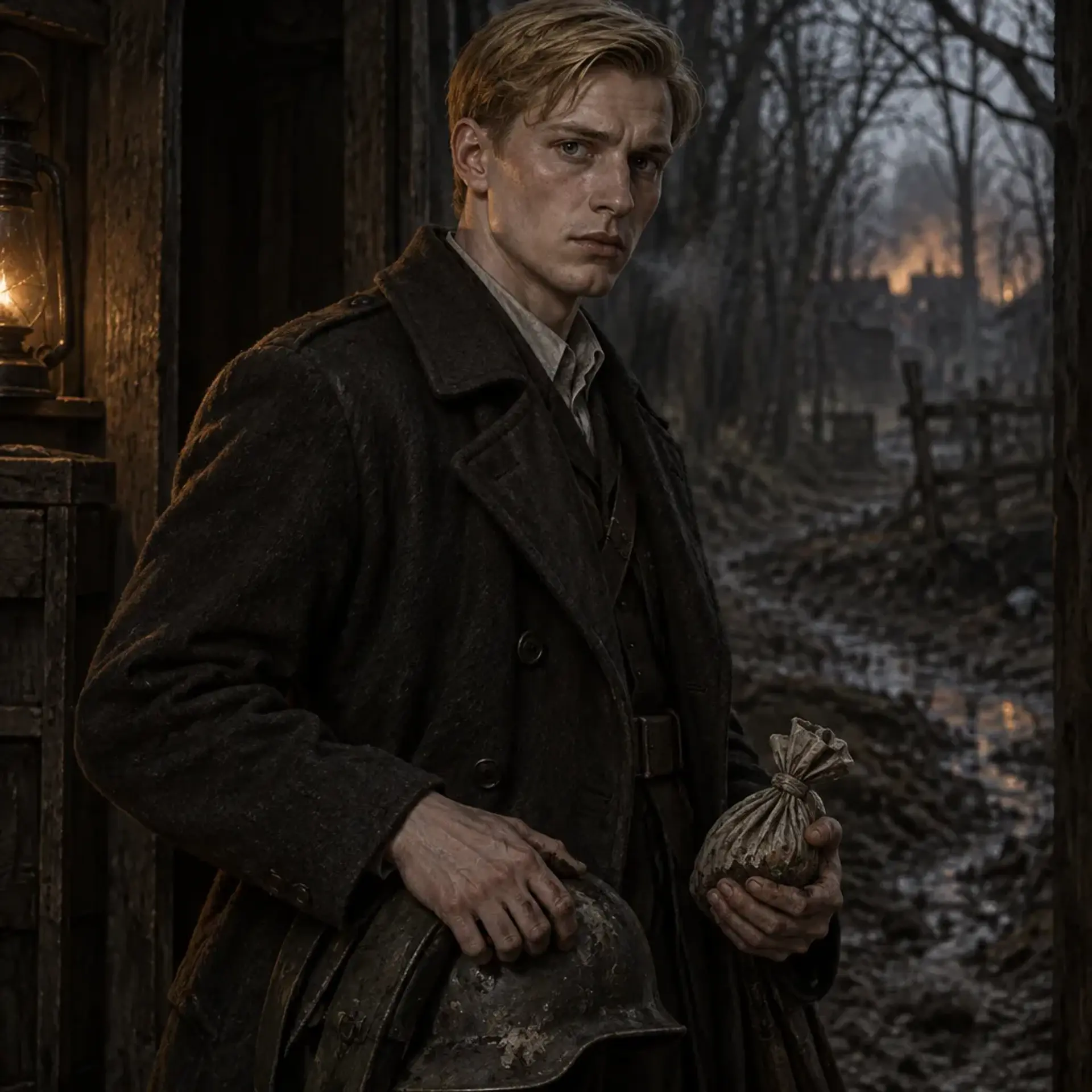
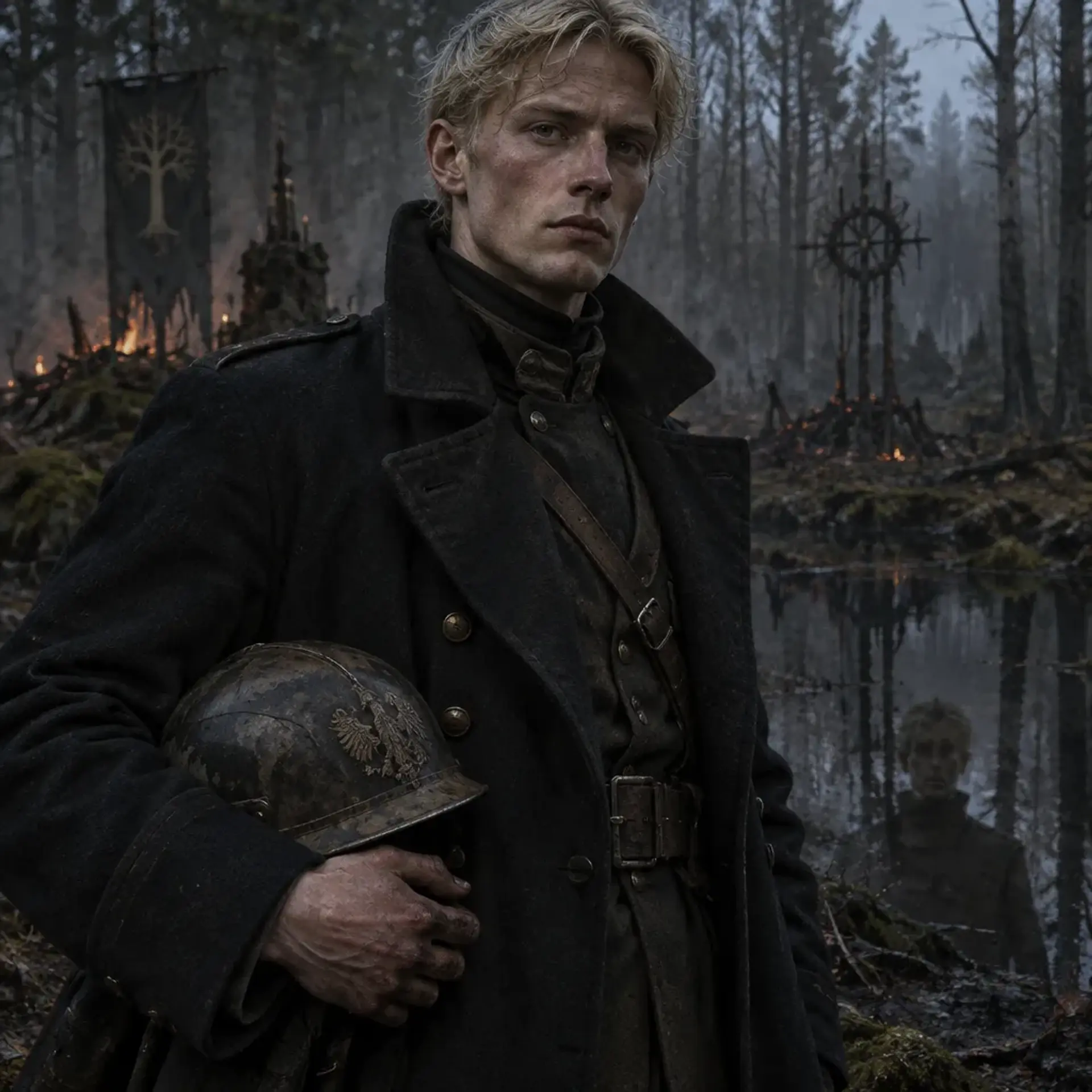
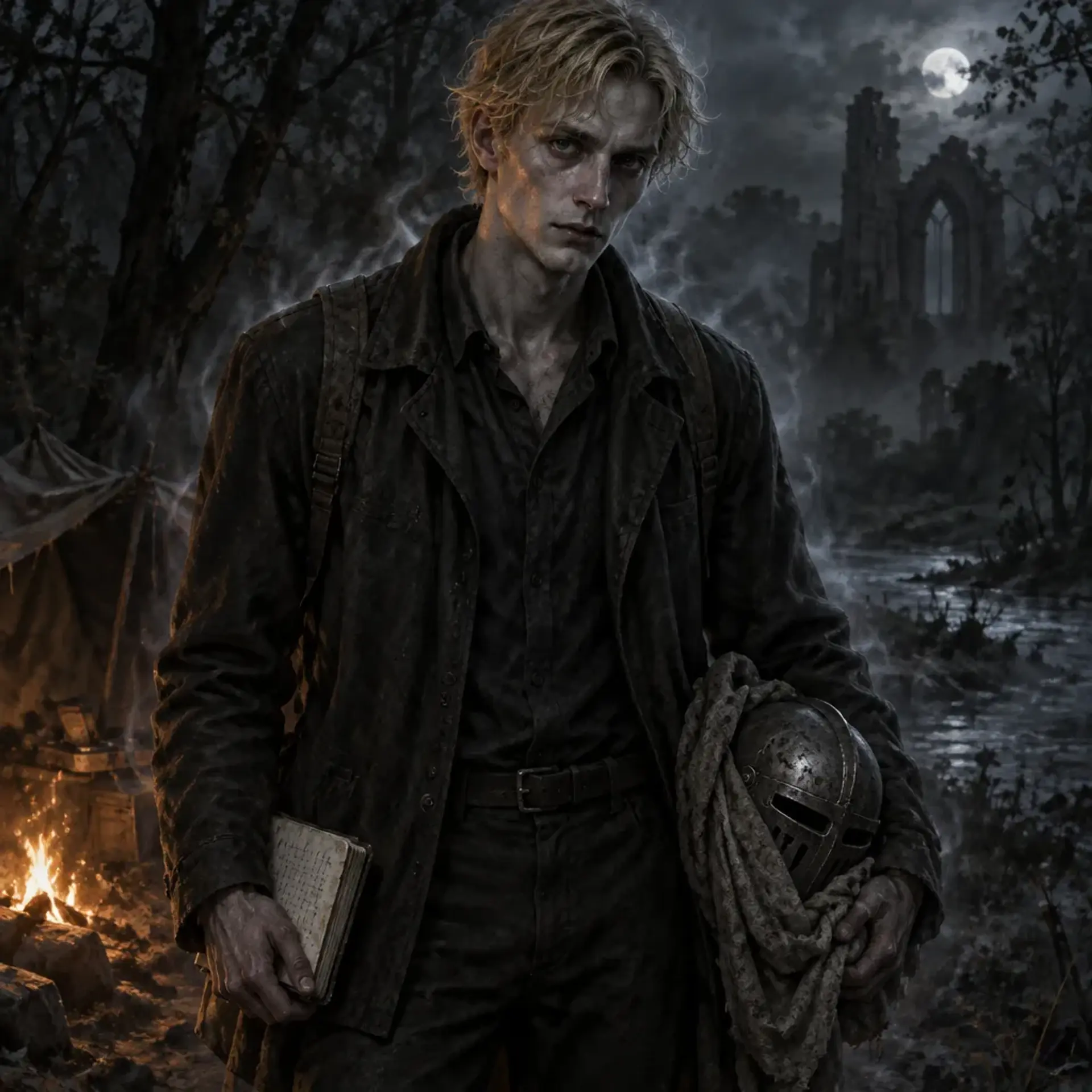
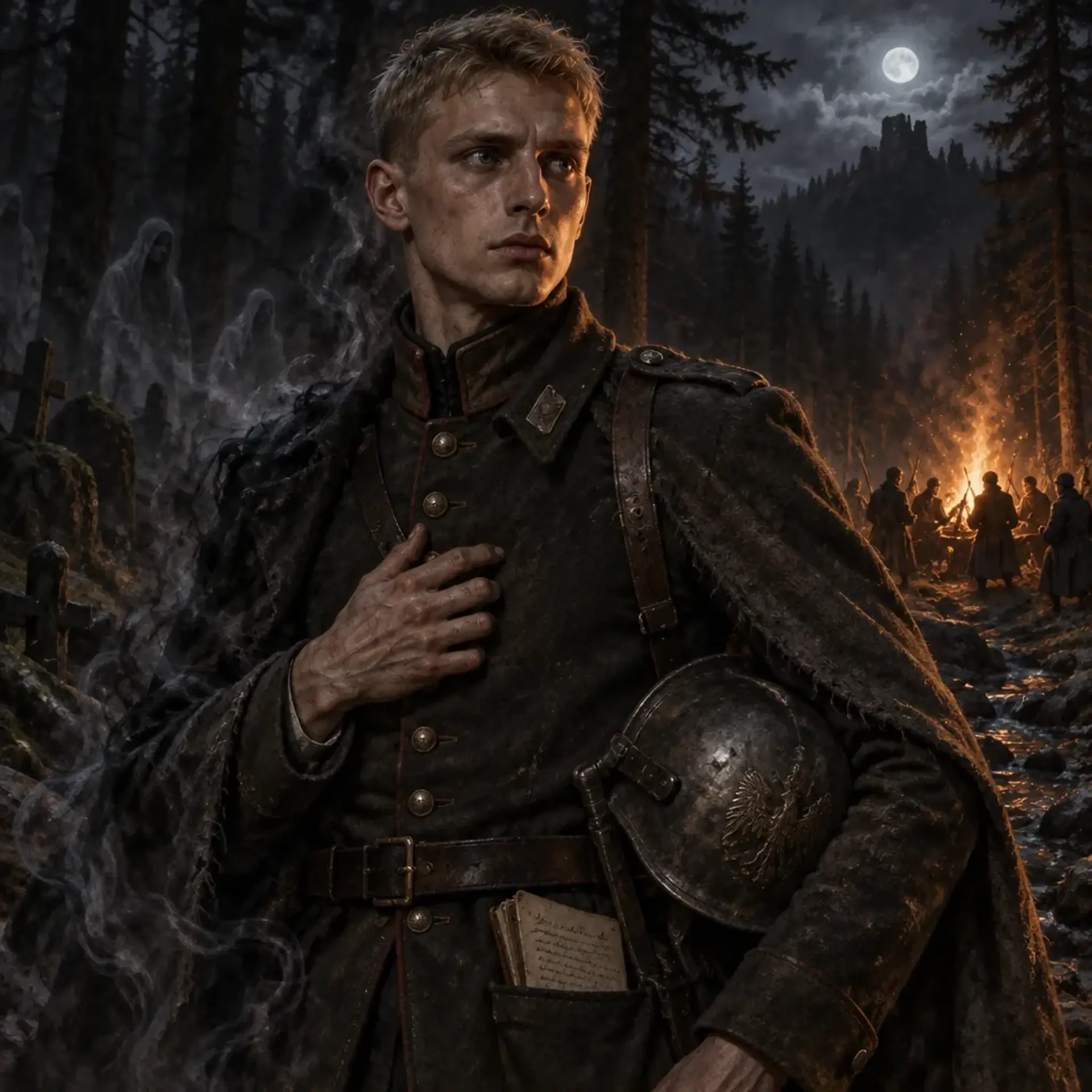
Before the Walpurgis rite, Friedreich is a young German man who can seem almost absent: an indistinct, smoke-soft silhouette until he borrows a face or the boundary between worlds thins. His preferred borrowed faces are young men with close-cropped hair, military bearing, police uniforms, or the composed look of minor nobility. He favors faces that seem plausibly related to the one Wilhelm says was his own: blond hair and grey eyes, though Friedreich distrusts that account. When the world unbinds itself from the dead, his outline resolves sharply, as if a wet charcoal drawing has suddenly dried. After the rite, the face Wilhelm described is his own again: pale skin, naturally blond hair, and grey eyes. His hands are conspicuously kept in military order, nails trimmed square, knuckles held stiffly; even when relaxed, he looks ready to receive an inspection. He moves with drilled economy, turning his whole body before changing direction. The unexpected detail is that he is an avid, meticulous football supporter who will interrupt a tense conversation to argue over a referee's call.
Clothing
Before the rite, he favors a severe, old-fashioned military coat and plain dark clothing, often mismatched or visibly out of date. Afterward he needs ordinary clothes and accepts them reluctantly. He is particular about fit, clean seams, and properly fastened buttons.
Body language
He stands as if a drill sergeant might inspect him at any moment, feet aligned and shoulders squared. Before the rite, his outline can flutter like smoke when he is ignored. With a borrowed face, he tests his mouth and hands as if checking a uniform. After the rite, he breathes deliberately, sometimes placing a palm against his sternum to confirm that his heart is still working.
- Height
- About 183 cm after the rite; his wraith form has no reliably measurable height.
- Build
- Lean, erect, and trained-looking, with the controlled bearing of a young man accustomed to orders and marching. After the rite, he is taller and solidly embodied.
- Eyes
- Grey after the rite; the color of his original eyes is uncertain.
- Hair
- Blond after the rite; before it, his hair is unclear or concealed by borrowed faces.
- Skin
- Pale, with a natural living complexion after the rite; in the Shadowlands his appearance may blur or take on the grey cast of a wraith.
- Age
- Appears 17 or 18 when the Shadowlands thin; his actual age and birth date are uncertain because of memory loss. He died during the First World War.
- Gender
- Male
- Size
- Medium
Distinguishing features
Personality
18 traits and drivesFriedreich is disciplined without being emotionally steady. He likes routines because routines give him a shape to return to, yet he resents being treated as a tool of anyone else's plan. Around strangers he is watchful and formal, scanning exits and weighing whether his face will be believed. With the coven, he can be unexpectedly playful: he argues about football, enjoys cards, and is delighted by the small authority of recommending a good Christmas-market purchase. That warmth does not erase his temper. When people cannot see or hear him, frustration can flare into sharp, disproportionate anger, followed by a distant shame once the moment passes. He is protective by instinct and suspicious by practice. He considers Mila family and will guard her without calling her weak. With Klaus he accepts abrasive remarks more readily than he would from anyone else, because Klaus's hesitation around him feels honest. Gunther's curiosity once seemed like an invitation to trust; their failed possession taught Friedreich that curiosity does not make an intrusion harmless. He now treats boundaries as a kind of discipline. Wilhelm is the contradiction he cannot resolve. Friedreich thinks Wilhelm is ashamed of the First World War and guilty about the Second, and he demands explanations while continuing to stand beside him. He can be tender in action and merciless in judgment. He does not want an apology in place of an answer, yet he remembers that Wilhelm apologized when no one else did. His military bearing is partly performance, partly comfort, and partly an attempt to prove he existed before he became a ghost. The borrowed faces let him eat, sleep, touch, and be seen, but each successful use carries a faint danger: he may admire the face, envy its life, or forget which preferences belong to Friedreich. He is curious about ordinary intimacy and sometimes flirts, but is wary of being liked only because someone else's face is attractive. He longs for a job or hobby group while fearing that routine will expose him as an impostor. After the rite, his emotional range has grown more immediate and more volatile. He can feel breath, soil, hunger, and exhaustion, but also carries memories and impulses that do not feel entirely human or entirely his. He presents the transformation as manageable because the others are frightened. Privately, he is not sure where Friedreich ends and Brändle begins. Duty remains his safest language, and his most dangerous excuse.
- Alignment
- Protective and duty-bound, but neither obedient nor morally uncomplicated. Wraith: The Oblivion does not use D&D alignment.
Quirks
Habits
Traits · 5
Flaws · 5
Fears · 4
Wants and needs · 4
Combat
HP 7 · Use the movement rules of Wraith: The Oblivion for a wraith. After the rite, ordinary movement is plausible, but the transformed state has no established canonical speed rating.Friedreich fights to protect an ally or make an escape possible, not to win a fair contest. In his wraith state he uses concealment, a borrowed face, and the confusion of sudden visibility. He favors cover, surprise, and disabling an opponent. The violence of his past means he can cross into lethal force quickly when a member of the coven is threatened. After the rite, the Storyteller should decide how his altered body and spirit interact with ordinary weapons and supernatural defenses rather than assume standard wraith rules still apply.
Friedreich
Actions
Reactions
Services they sell
Rewards they can give
Equipment
- Old helmet (personal relic)A keepsake from his former life, used as a focus for memory and identity. Its history is incomplete.
- Face list (notebook)A private record of borrowed appearances, false names, and where each face is safe to use.
- Utility knife (weapon)A plain, maintained knife for emergencies. It is a mundane tool, not a supernatural weapon.
Possessions
Background
Friedreich remembers Brandenburg in fragments: damp wool, boots on frozen ground, a horse's breath, and the repeated order to keep moving. He has no reliable account of his childhood, his family, or the name he bore before death. He believes he was seventeen or eighteen when he died in the First World War. Wilhelm, the German Tzimisce from Mecklenburg who has become his closest companion, has said that Friedreich had blond hair and grey eyes. Sometimes Wilhelm offers only an implication; once he said it plainly. Friedreich wants to believe him and distrusts him for knowing so much while refusing to explain himself. The first memory Friedreich can identify as face-stealing came after his death, when he tried to make himself visible to the living. He had been watching a young sentry, a man whose name he never learned, and reached for the shape of his face as if pulling a damp veil from a hook. For a few unsteady minutes, he felt skin tighten around his mouth and the weight of a body settle onto him. He could speak, touch a rifle stock, and smell the man's tobacco. Then the borrowed face slipped, and he was left with the humiliating certainty that the sentry had seen nothing. The experience taught him that visibility was not the same as being recognized, and that a face could be shelter as well as theft. He began keeping a list. The people on it are dead or safely out of the local area, and he changes their names in his notes so that no one can trace the originals. The list is practical, private, and increasingly intimate. One face is a young infantryman, used when he wants to stand among men who understand drill. Another is a policeman's, useful for crossing a public place without drawing questions. He has a carefully groomed young clerk's face for errands and quiet conversations, and a minor Junker noble's composed features for moments when he wants to remember a world of inherited manners he cannot prove he ever knew. A broad-faced railway worker helps him eat in public without being stared at. He experiments with each face for ordinary things: sleeping in a rented room, ordering food, bathing without vanishing from the mirror, and flirting with women he finds pretty. He has begun to wonder if one of these identities could let him hold a part-time job or join a hobby group. He insists this is an experiment, not longing. Wilhelm is the person Friedreich calls brother, though neither can explain the feeling. They endured the world wars together as much as Friedreich could, meeting across the barriers between the living and the dead. Friedreich remembers a breath during the First World War, a flash of flight, and Wilhelm's desertion. Wilhelm apologizes for that period, but rarely explains it. Friedreich is angrier about Wilhelm's actions in the Second World War. He believes Wilhelm committed crimes and then buried the reasons beneath shame and silence. Friedreich will not excuse him, yet still steps between Wilhelm and danger. He suspects their histories are joined in ways neither can remember. Their coven is an irregular family rather than a formal supernatural organization. Gunther is a changeling who spent long stretches in Arcadia and now sells clothing made with moss. Klaus is a taciturn ronin Get of Fenris, or perhaps a Skin-dancer; he refuses to settle the question. He is cutting to nearly everyone but hesitates around Friedreich, a hesitation Friedreich has learned to recognize as care. Mila, a mage from Bremen, can see and touch Friedreich even when he wears no borrowed face. He treats her as a little sister and protects her not because he thinks her helpless, but because caring for her feels like a duty he can choose for himself. The four make time for cards, fishing, hunting, drinking, holidays, and football. Friedreich prizes these occasions because they make him feel less like a haunting and more like a person with a seat at the table. At Christmas markets he advises the others on bargains, then points out something he cannot buy or eat unless his face holds. He sometimes asks Mila to take him to a church service, including one on Walpurgis night, when the old memory of a cathedral fight returns with the cold certainty of a command. He has defended his family with violence. A Get of Fenris tried to kill Klaus, and Friedreich killed the attacker to protect him. He has killed three Hunters who were searching for Wilhelm or the others, and has fought vampires who threatened Wilhelm and changelings who threatened Gunther. He does not boast. He remembers the instant when protection became killing, and knows that calling it duty does not make it clean. The most intimate experiments involved possession. Friedreich and Wilhelm agreed to try it while the coven played cards. Friedreich entered Wilhelm with both men's permission, hoping to offer him feelings Wilhelm seemed unable to experience and perhaps to uncover shared memories. At first the card game gave them a focus: suit, rank, turn, breath. Friedreich felt Wilhelm's deadened body from within as a rigid chamber, while Wilhelm experienced Friedreich's presence as an unwanted pressure and a spill of emotions that were not his. They tested whether Wilhelm's vampiric body could drink alcohol. The taste reached Friedreich as a sharp ghost of warmth, but Wilhelm's body rejected the ordinary idea of drunkenness. The cards stopped being a game. Klaus watched, alarmed; Gunther asked more questions than either of them could answer. Friedreich withdrew when the sensation of being a guest in his brother's body turned into a fear that he could not find his own edges. Their later, explicitly agreed final attempt did not produce the lost memories they wanted. It did leave Wilhelm with a clearer sense of Friedreich's grief, and Friedreich with the knowledge that care cannot simply be forced into another person. He tried possession with Gunther because Gunther wanted to know what their lives shared and whether memories could be exchanged. It went badly. Gunther's changeling nature resisted the intrusion in a way Friedreich could not predict. Their impressions collided: Friedreich felt a reality that shifted according to imagination and old bargains, while Gunther felt a cold military insistence that made the world seem narrow and dangerous. They both lost track of whose sensations belonged to whom. Gunther emerged with questions, but Friedreich ended the experiment and said, 'Never again.' He meant it. Klaus once explained the opening of Friedreich's Caul in a way that sounded like a warning disguised as folklore. A spirit of land and people had hidden its intentions: shaped by the Wyld, born among the Weaver's blessed adopted children, carrying the Wyrm's spoils and a trace of Luna. Klaus said that after Friedreich awoke from his Caul, only a willow-wisp remained from the old, repetitive marching. Friedreich now suspects Klaus knows more than he said. He cannot tell whether the spirit freed him, used him, or merely left him where he could be useful. The Shadowlands remain familiar in sensation but increasingly strange in meaning, and he has never been sure whether his unusual face-taking is an individual talent, an Arcanos, or a wound in the rules of the dead. On April 30, Walpurgis night, in the Harz Mountains, his friends attempted to give him life again. They believed they were making him a Risen, or at least easing him out of the terror of death. The ritual joined Brandenburg soil, human blood, selected metals, Friedreich's old helmet, and a human-shaped body carved and prepared through their different practices. Mila brought reality-warping magic. Wilhelm used Vicissitude and Koldunic sorcery. Gunther contributed Glamour and gifts that could make miracles seem possible. Klaus supplied knowledge of spirits and rites associated with the Garou and other changing breeds. The body lay naked beside a large bonfire, breathing softly as though asleep. They meant it as a gift. None of them understood what had been invited. As the rite progressed, Friedreich felt something familiar deep beneath the earth, welcoming him with an insistence that was not kindness. A willow-wisp watched. The ritual's boundaries shifted; the assembled wills were bent toward a service no one had agreed to. Friedreich's soul and Shadow were worked over by a force that seemed to know the shape of his duty better than he did. The body lurched up, twisted, and felt to him like melting earth. He remembered his family, his youth, his death, and then memories that could not have been his: Brandenburg frozen, flooded, cultivated, marched over, and rebuilt across centuries. He could smell soil and grass. Air moved through his lungs. His mouth was bloody; his eyes dimmed; his heart faltered. Something had crawled into him during the rite. He spoke German as if it were older and more familiar than the language he had used before. The spirit had given him a gift, but also a command. He looked at his frightened friends and knew what the command demanded. He did not kill them. He told himself they had a service and a duty to their homes, just as he had. The name Brändle, a name for Brandenburg's land and people, rose in his mind. His thoughts became cold and orderly. The coven's choices and the ritual's purpose were taken from them and made into a new rite. Exactly what happened is not fully understood by any of them. The result was not the promised return of a wraith, nor a confirmed Risen. A weak, local spirit of Brandenburg had become entangled with Friedreich and used the ritual to bind the others' spirits to new identities and wills. Wilhelm gasped as his body shuddered into life. Mila recoiled as her magic failed. Gunther lost his guise and was brutally changed into a form shaped by whatever spirit answered him. Klaus stayed very still, eyes blank, and was the first to speak when silence finally broke. Mila wiped blood from Friedreich's eyes and mouth. Wilhelm pushed the others back and reached for him. Friedreich, now taller than he remembered being, said, 'Don't touch me. Bring me some clothing.' He finished the rite before dawn. He did not explain what had happened. He told them to be at ease and rest, that it had hurt only this once, and that now they truly were family. He sounded almost teasing, but did not smile. He remembers his old life, yet the boundary between Friedreich and Brändle is thin. He deliberately kept the name Friedreich, and dismisses any suggestion that his new nature belongs to an old political ideology. He believes the spirit was neither the great spirit of the woods nor a fully conscious being, only a small land-and-people presence made powerful by the rite and that sacred night. He is not certain this is true. The dawn air, the soil under his bare feet, and the force that now lives in his breath are all too vivid to dismiss. His friends may have gained new lives, but none yet knows what price was paid or what Brändle will demand next.
Role in the story
A companion, moral counterweight, and living mystery. Friedreich can be a valuable guide to the Shadowlands and the coven's tangled history, while the rite that changed him threatens to turn the group's private loyalty into an obligation imposed by the land.
“He has no reliable account of his childhood, his family, or the name he bore before death.”
- Faction
- The coven, an informal gathering of supernatural friends. He is also entangled with a local spirit of Brandenburg through the Walpurgis rite. Neither is a formal Wraith faction affiliation.
Known connections
Media
0 imagesNo images yet.
Turn Friedreich into a sheet
A high-res, share-ready sheet you can post or print.