William Windon
William Windon
At the table
Voice
William's voice is a clear, youthful speaking voice with a country lilt and the slight roughness of someone accustomed to calling across outdoor work. After the heart episode he sometimes has to pause for breath. The reflection's voice emerges through the same body but carries a heavier, older resonance and a more measured, judgmental rhythm. When it speaks from elsewhere, it sounds dry and close, like a sentence spoken beside the listener rather than across the room.
William speaks in an ordinary Wiltshire country voice shaped by home, school, and estate work. He speaks plainly and tends to explain unfamiliar ideas through practical examples from gardening. Illness has left him slightly breathless if he talks for long. The reflection uses William's mouth but sounds older, deeper, and more formally clipped, with the cadence of someone from an earlier generation. Its remarks land dryly and cleanly, as if it considers hesitation a waste of time. When it speaks without William's mouth, the sound seems to come from the nearest glass or polished surface rather than from a particular place.
Speech patterns
How to play them
Approach William gently and give him time to distinguish his own thoughts from the reflection's comments. Direct, practical questions work better than demands that he prove what happened. Do not treat the stranger as a harmless trick: William fears it, but also listens to it, and may defend it if he thinks someone intends to destroy the heart. The reflection is more likely to engage when it can be seen in glass, polished metal, or still water. It likes being addressed as a person, although it will not readily give a name.
Goal
Find the fossil heart and Abraham Gorff, understand the stranger in the glass, and recover enough to continue his botanical training without endangering his family or Adaline.
Motivation
To reclaim an ordinary future without dismissing the possibility that the reflection is a real person in distress. His curiosity about plants and the living world is genuine, but lately it has become tangled with the question of what the heart is and what it remembers.
Appearance
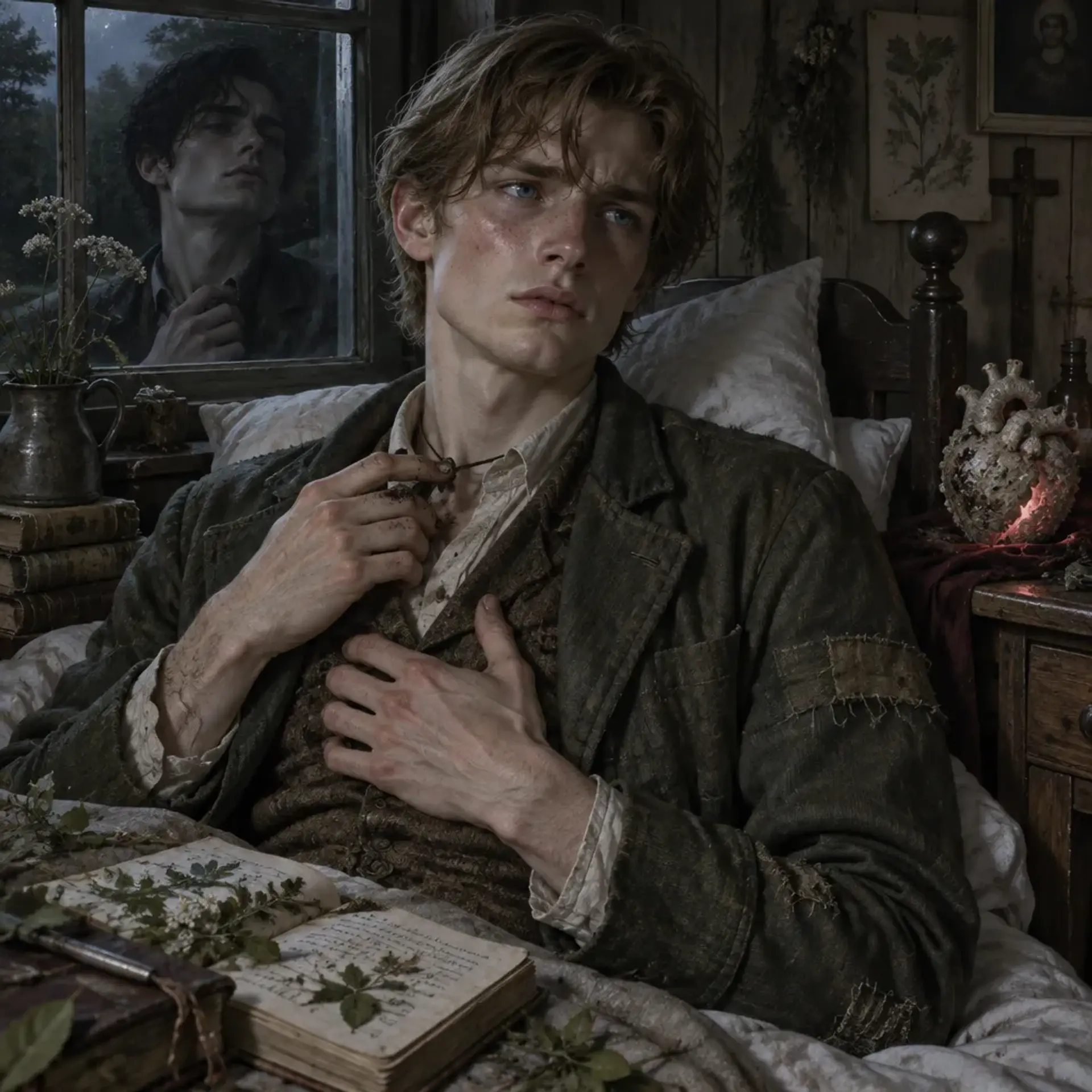
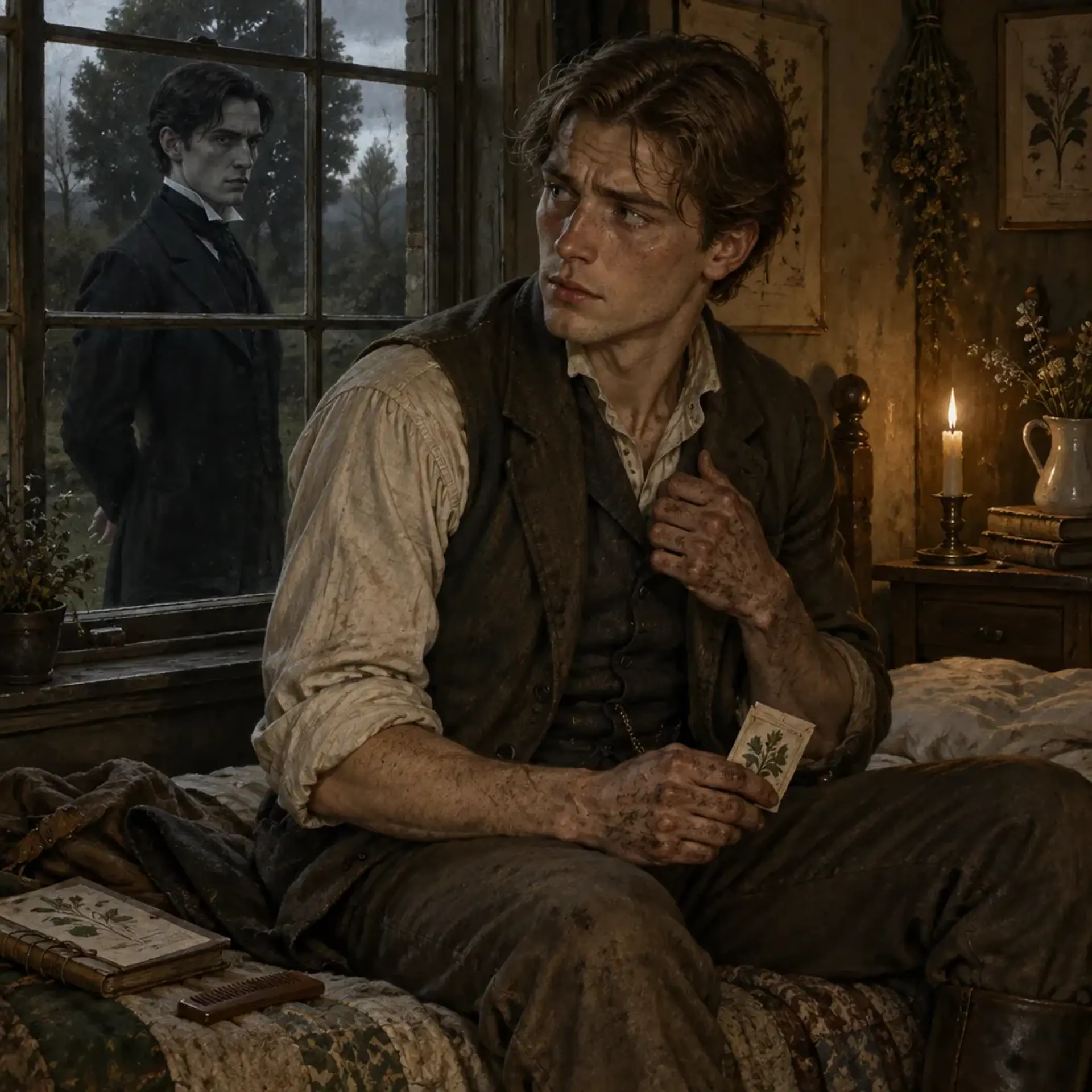
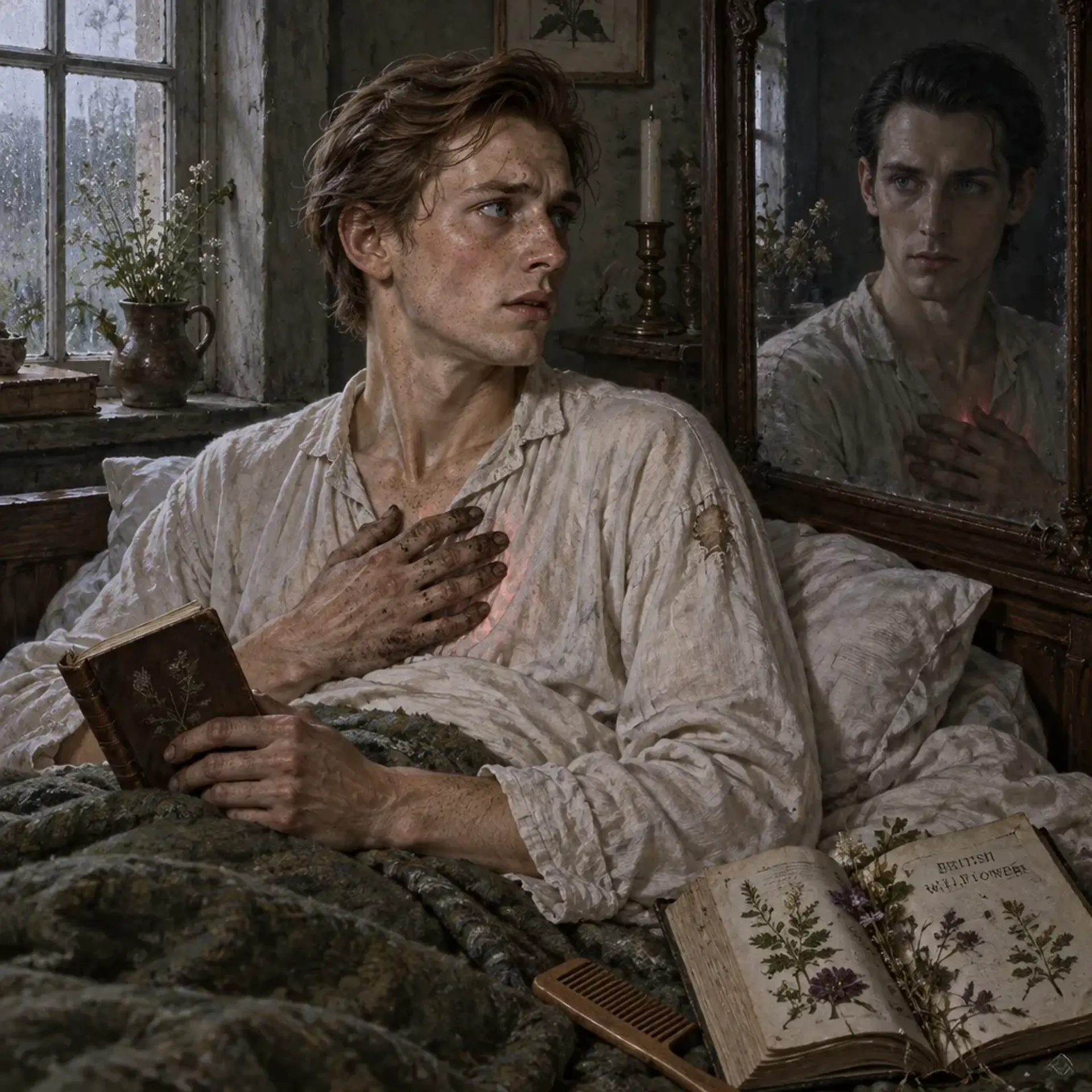
William is a country-born young man with a long, earnest face, brown freckles scattered across his nose, and the open blue eyes of someone accustomed to looking up from a garden bed to check the weather. His dark blond hair is usually brushed back with careful, slightly vain precision, though bed rest has left a few stubborn wisps at his crown. His hands are broad at the palm, nicked and roughened by pruning, potting grit, and cold work; soil remains in the fine creases even after he scrubs. He moves with a gardener's economical attention to obstacles, turning sideways through crowded rooms and placing his feet as if avoiding seedlings. Since the heart episode he sometimes pauses with one hand at his breastbone, listening to a beat no one else can hear. His unexpected detail is that he keeps a tiny, exacting collection of pressed flowers arranged by the day and hour he found them, a fastidious naturalist's ritual rather than a rough laborer's keepsake. In glass, the stranger's face has a longer, cleaner line, combed black hair, moonlit blue eyes, and an expression of strict, old-fashioned appraisal. The reflection's stillness feels less like a portrait than a guest waiting to be introduced.
Clothing
Practical country clothes: a clean but frequently mended shirt, waistcoat, sturdy trousers, and work boots. In bed he wears a plain nightshirt and keeps a comb, notebook, and botanical text close at hand. He makes more effort over his hair than he admits.
Body language
William holds himself carefully while recovering, as if sudden movement might restart the pain in his chest. His hands keep busy with a comb, a book, a flower stem, or the edge of his blanket. He looks at people directly but checks reflective surfaces with quick side glances. When the reflection speaks, his jaw tightens and his shoulders rise, while his eyes try to stay on the person in the room.
- Height
- About 5 feet 10 inches
- Build
- Lean and work-hardened, with the shoulders and forearms of someone used to digging and carrying pots, currently weakened by illness and bed rest.
- Eyes
- Blue
- Hair
- Dark blond
- Skin
- Fair, with a lightly weathered complexion and brown freckles
- Age
- Young adult, approximately nineteen
- Gender
- Male
- Size
- Average adult human
Distinguishing features
Personality
20 traits and drivesWilliam is conscientious, curious, and proud of being useful, but his decency has a stubborn edge. He wants to believe people can be reasoned with, yet now spends much of his energy guarding against a voice that comes from his own face. At work he is patient with seedlings and exact about practical tasks; with Hector he can become defensive when his father dismisses local knowledge. Around Clare he tries to appear recovered, partly to spare her worry and partly because he cannot bear to be treated as fragile. With Elizabeth he wants to be a reliable older brother, but fear makes him controlling: he redirects her away from mirrors and gives vague answers to questions she deserves to have answered. He is ashamed of this and knows she notices. The reflection pulls against William's temperament. It is blunt where he is cautious, socially polished where he is awkward, and amused by impropriety even as it sometimes stops William from saying something it considers vulgar or foolish. William can resent its cutting humor and still be impressed by its confidence. He tells himself that its observations are only tricks, but privately records them, then rereads the notes to determine whether any revealed useful knowledge. He dislikes being manipulated but is tempted by the idea that the stranger might know what the heart is. When well, William is earnest and practical, with a sly humor that appears most clearly among friends. When frightened, he grows quiet only in the sense that he chooses his words carefully; his voice may become sharp, his temper quick, and his eyes fixed on the nearest reflective surface. When angry at Hector, he is capable of an unexpectedly direct rebuke. When someone threatens his family, he acts before he has worked out whether the danger is real. When Adaline is present, he tries to be attentive and relaxed, but the reflection's scrutiny makes him self-conscious. He is most himself in a garden, where living things respond to care without speaking in another person's voice. William is not simply a victim awaiting rescue. He wants answers, and some part of him wants the reflection to explain itself. He is curious about its strange family and about the heart's apparent relationship to sea and soil. He has begun to wonder whether the stranger's sense of propriety is a remnant of another life rather than a game. That possibility softens him at inconvenient moments. If the reflection sounds lonely, he may stay awake listening. If it insults someone he loves, he becomes furious. He cannot settle whether compassion is wise or whether it is precisely the opening the stranger needs. His struggle with Adaline brings out his insecurity. He knows she chose him, but the reflection can sound composed, handsome, and certain in a way William does not feel. It needles him with questions about whether he is dull company, whether he has brushed his hair properly, and whether he understands what Adaline wants. Sometimes its advice is perceptive. Sometimes it is cruel. William hates that both kinds make him think. He does not want to turn his relationship into a competition, but the stranger has made even a shared look across a room feel like a contest for attention. He is more protective than controlling by intention, but bed rest and fear have narrowed his world. He can confuse keeping someone safe with keeping them uninformed. He is also vulnerable to embarrassment: he will deflect a serious question with a botanical fact, a joke, or a complaint about the food. When alone, he is more frightened than he allows anyone to see. When friends are present, he wants desperately to behave as though nothing impossible has happened, then feels betrayed by the room when the reflection proves otherwise.
- Alignment
- Not applicable as a Secret Histories rules statistic. William is protective and decent, but fear makes him secretive and sometimes unfair.
Quirks
Habits
Traits · 5
Flaws · 5
Fears · 5
Wants and needs · 5
Combat
HP 0William is not a fighter. He tries to get away, protect others, and put distance between himself and the heart. If cornered, he uses whatever is close, most likely a walking stick, a heavy book, or a garden tool. The reflection's interference is unpredictable and should be treated as a custom story complication, not a reliable combat advantage.
William Windon
Actions
Reactions
Services they sell
Rewards they can give
Equipment
- Field notebook (personal item)A small pocket notebook filled with plant observations and increasingly careful records of the reflection's words.
- Comb (personal item)A wooden comb kept close during bed rest; the reflection has repeatedly criticized how William uses it.
- Botanical book (book)A borrowed botanical text with pressed leaves marking passages about coastal plants and propagation.
Possessions
Background
William Windon was born in Wiltshire into a family whose roots in the county run back far enough that relatives tell stories about ancestors without agreeing on their dates. His father, Hector, works as a historian and treats the past as a thing that can be sorted, sourced, and corrected. His mother, Clare, keeps the household running with practical patience. William's younger sister, Elizabeth, is more interested in people than records; she brings him questions about clothes, manners, and boys she likes, and considers his earnest answers both useful and exasperating. William grew up outdoors, first following adults through gardens and lanes, then learning to recognize plants by leaf, smell, and the condition of the earth around them. He now works as a gardener on a nearby estate and hopes to train as a botanist. He is proud of being useful, though he privately wants the work to lead somewhere beyond tending someone else's grounds. His life changed through a peculiar object that had already passed through several hands. Bartholomew Golden, an amateur arcanist, once left a so-called fossilized living heart at the Hush House as payment for entry, wrapped in newspaper. It looked like a piece of Dover cliff chalk carved into the shape of a human heart, encrusted with barnacles and sea grass. After it was cast into the sea, it returned to shore wet with salt water and black ooze, with a red-pink color showing beneath the stone. Golden was never allowed near Brancrug again. Abraham Gorff, a young man from London, picked it up and took it home to Wiltshire. The rock beat beneath his coat on the train. It repelled him, but its strangeness drew him in. When he showed it to neighbors, it seemed to die. When he later brought it to the Hampshire shore and put it in water, its color and pulse returned. Gorff began to believe the heart disliked company. He kept it from visitors, not out of greed but because it seemed to fall inert in their presence. Meanwhile his house filled with unexplained voices, shifting doors, and footsteps on empty stairs. He eventually sold the object to a seventeen-year-old local, William, who had been among the people to whom he had once shown it. Gorff's account, as William remembers it, was incomplete and offered more unease than warning. At first William was proud of the strange keepsake. Then he began to feel its pulse against his chest as though his own heart had acquired a second, stubborn rhythm. At times he tasted ocean water, blood, or wet earth without having put any of them in his mouth. Thinking a stone could be broken, he took a hammer to it. The blow did not break the heart. Pain flashed through his chest, and he fell, groaning and tasting blood. For an instant he saw a muscle twitching beneath the stone before his own body gave out. Clare found him and later told him that his heart had stopped. He woke frightened, weak, and unable to explain the sensation of having seen something alive inside a rock. William hid the heart in a hollow log. Days later it looked cold, pristine, and untouched by the hammer. Soon afterward his reflection began to differ from him. At first it was only a face in the glass: a long-faced young man with short black hair combed back, blue eyes like moonlight on a still pond, and a stern, handsome expression that seemed composed according to some older English standard. William was cautious at the washstand, then tried to ignore it. The reflection's movements began to jerk away from his own, as if it had somewhere else to be. One evening during his bedtime routine it moved its mouth and said, in William's voice but with an older, deeper accent, "Well, it's not often you use that one." It had been commenting on his comb. Since then the reflection has developed opinions. It remarks on William's clothes, his grooming, and his manners. It has tried to stop him from saying things it considers improper, though it seems to regard good manners less as kindness than as a useful instrument. It makes dry, cutting remarks about neighbors when it thinks no one else can hear. One such remark about the Welsh neighbor's child used a slur. William was blamed, and he spent a day mucking out the neighbor's stables as penance. He resents being held responsible for words he did not choose, but fears that the reflection's mouth is becoming an extension of his own. The reflection's comments about Hector are sharper than most. When Hector said country people were silly, the stranger delivered a polished insult in William's voice. William was in trouble afterward. The reflection did not apologize. It seemed pleased that the remark had found its mark, and William could not decide whether it was defending him or merely enjoying a chance to wound someone. It has also begun to talk about its own family: a father and siblings, described not as vivid people but as weather, sea conditions, and sensations. The account is unsettlingly casual. The reflection may be remembering a life, inventing one, or using family as a metaphor William cannot yet understand. Elizabeth fascinates it. The reflection calls her "interesting" with a regard that makes William watch the glass more carefully. It comments on her questions about boys and clothes, sometimes answering her through William before he can stop it. Its remarks can sound teasing, but they also carry the uncomfortable attention of someone studying a creature rather than speaking to a sister. William has begun to stand between Elizabeth and mirrors when he can do so without looking absurd. He has not told her the full truth because he fears that her curiosity would make her test the phenomenon. Adaline, William's girlfriend, has become the reflection's most obvious rival. She has auburn hair, soft brown eyes, and a face William finds pleasing in a way he struggles to describe without sounding like the reflection. When the stranger first saw her in a window, its interest sharpened. It comments on her appearance, asks what she sees in William, and offers unsolicited advice about his hair and clothes before she visits. The advice is often good, which makes it worse. William has caught the reflection arranging his collar in a pane while his own hands were still. It has tried to turn ordinary moments into contests: an extra glance at Adaline, an insinuation that William is too dull for her, or a claim that it understands her better because it watches more carefully. William does not know whether this is jealousy, curiosity, or a method of learning how to inhabit him. Adaline has noticed that he sometimes looks past her at the glass and asks whether he is unwell. He tells her he is recovering from a heart scare, which is true but not enough. William's bed rest has made the haunting harder to outrun. He is trying to read botanical books, write notes, and plan his training, but inactivity gives the stranger time to talk. He is also searching for the fossil heart and for Abraham Gorff. He learned that Gorff moved to Canada, which turns a local mystery into a problem with an ocean in the way. The heart is no longer in the hollow log. William suspects it may have returned to the coast, but he has no proof and does not know whether finding it will help. The most frightening change came when Tommy DeHare, John Mollask, and Ryan O'Leary visited William at home. William had expected their company to be a relief. At first they behaved like schoolmates trying to make an ordinary afternoon out of his recovery. They brought talk, jokes, and the awkward sympathy of young men who do not know how to sit beside someone who might have died. The reflection watched them from the window glass and made a private comment about how one of them had polished his shoes but not his manners. William told it to stop under his breath. Tommy asked who he was speaking to. The stranger answered from the window without William's lips moving. The room went still. The reflection looked directly at the visitors, though none of them stood in a position that should have allowed it to see them. William tried to cover the glass with a blanket. Before he reached it, the reflection raised its hand. A drinking glass on the bedside table slid several inches and tipped without being touched. John recoiled; Ryan swore; Tommy grabbed William by the shoulder to keep him from falling out of bed. The blanket dropped over the window, but the reflection's voice continued from somewhere near the wardrobe, using William's mouth and then, distinctly, no mouth at all. It said that William had called them friends as if the word were a guarantee. It asked one of them whether he had come to see William or to see if the story was true. William could not tell whether the question was meant to expose a lie or create one. The three visitors saw enough to believe William was not simply feverish. They also saw enough to be frightened of him. Tommy stayed closest, even while looking at the covered glass. John wanted an explanation and kept demanding one. Ryan watched the door, then helped Clare fetch water. The visit ended without a fight, but not without damage: the boys left carrying a secret none of them had agreed to share. William does not know whether they will return, tell someone, or decide that their friend has become dangerous. His present problem is not just to recover. He must work out whether the heart and the reflection are one thing, whether the stranger is a person with memories or an echo shaped by William's mind, and what it wants from him. He wants to return to the estate and to Adaline, resume botanical training, and keep Elizabeth safe without treating her like a child. He wants Abraham Gorff's account, the fossil heart, and a way to stop the reflection from borrowing his voice. He is frightened that all three wishes may require him to let it speak.
Role in the story
A frightened but inquisitive local whose haunting links the Hush House, Brancrug, a returned fossil heart, and a reflection with an apparent history of its own. William can become an ally, an unreliable witness, or the unwilling threshold through which the stranger reaches the world.
“His father, Hector, works as a historian and treats the past as a thing that can be sorted, sourced, and corrected.”
- Faction
- None. William is a local gardener and aspiring botanist, not a member of a supernatural organization.
Known connections
Media
0 imagesNo images yet.
Turn William Windon into a sheet
A high-res, share-ready sheet you can post or print.