Kent
Kent
At the table
Voice
Mary's voice has the worn, matter-of-fact quality of someone accustomed to calling children in from another room and answering adults who are only half listening. Kent's is a newly borrowed sound: clear, slightly breathless, and careful with consonants. At the pub he copied the measured manners of the men around him, but his interest kept breaking through in quick questions.
Mary speaks in a practical, local voice shaped by household work and the need to be heard over children and arguments. She clips explanations short when tired. Kent's voice is lower and unfamiliar to her, with a breath-catching hesitation at the start of a sentence and unusually precise diction learned by listening to strangers. He does not sing or whisper when angry; he speaks faster, overexplains, and becomes formal at exactly the wrong moment.
Speech patterns
How to play them
Approach Mary through practical help rather than grand promises. Give her a choice that does not demand she abandon her siblings. Kent responds to respectful curiosity and specific invitations, but recoils from being treated as an exhibit. Do not assume the two share every thought.
Goal
Keep the Bell children safe, understand the heart, and discover what Kent wants before the appearances become impossible to conceal.
Motivation
Mary wants a life that is not merely a chain of duties. Kent wants to be recognized as someone with preferences of his own, though he is not sure what that would mean.
Appearance
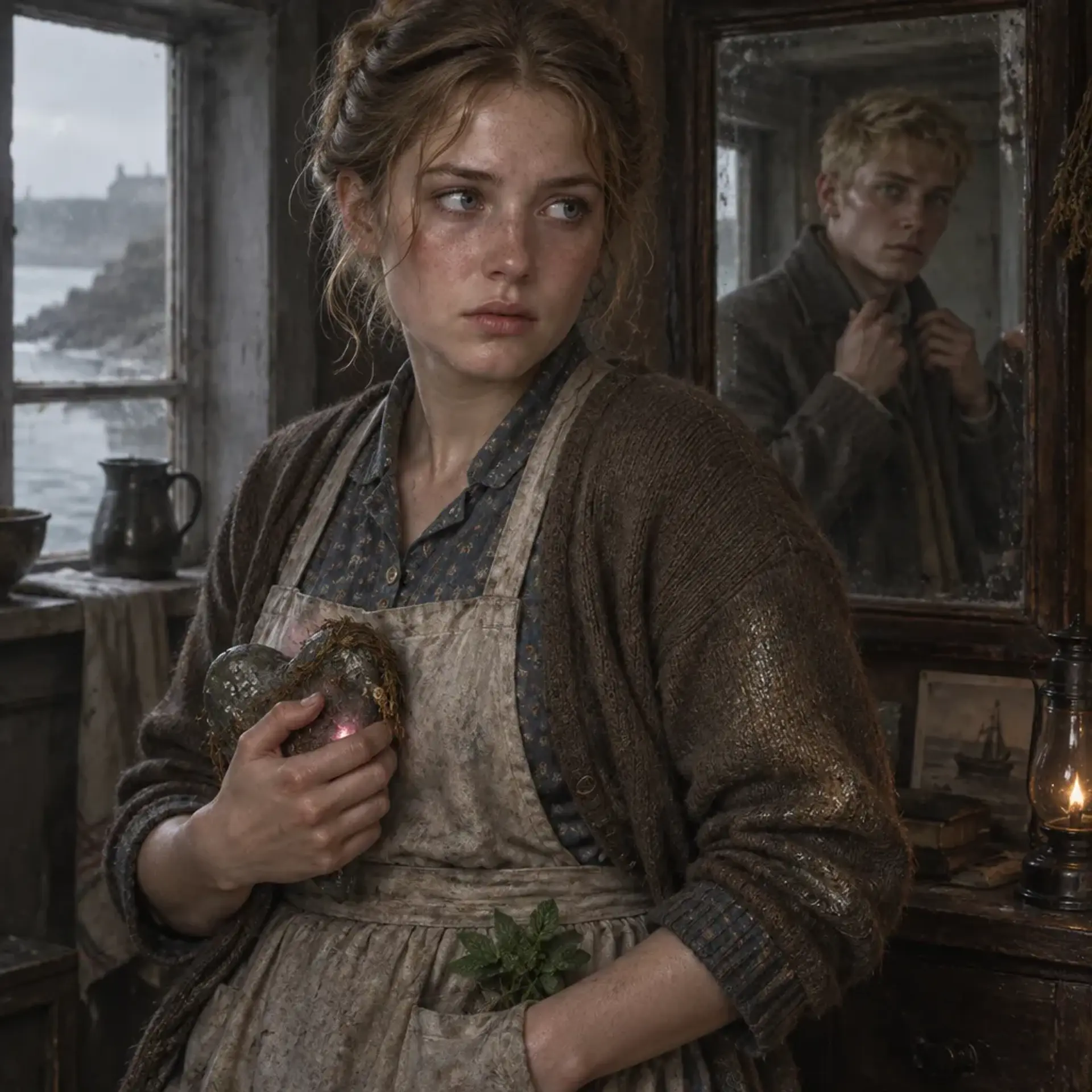
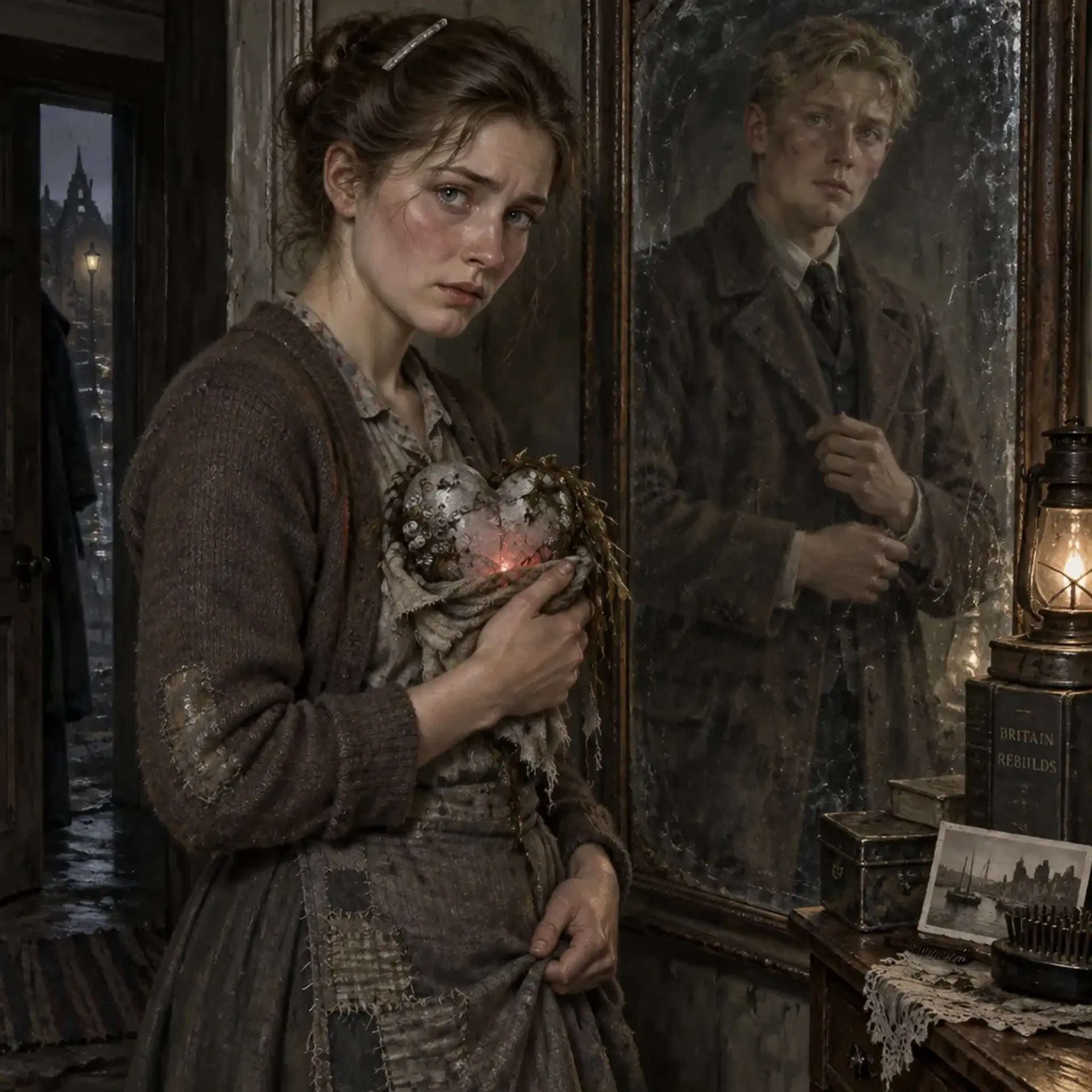
When Mary is herself, she is a dark-blond, blue-grey-eyed young woman with the habitual forward lean of someone listening for the next household demand. As Kent, the reflection becomes a taller young man with short, bright blond hair, malachite-green eyes, and a handsome, open face that can look peculiarly watchful. The change has the unnerving quality of a portrait remembered incorrectly: the features are clear, but the impression is that they belong to a place as much as a person. Kent stands with his weight on one heel, as if waiting at a station platform, then shifts sharply when he realizes someone is watching. His hair will not stay neatly combed for long. His unexpected detail is that he keeps a small, dog-eared illustrated book of wildflowers tucked inside his jacket, and treats it with the solemn care of a school prize.
Clothing
Mary wears practical, mended clothes suitable for work and chores. Kent borrows whatever can be found, usually a jacket that pulls at the shoulders and trousers too short or too loose. He tries to dress with an earnest, middle-class neatness that the circumstances rarely allow.
Body language
Mary stands as if braced to be called away, shoulders forward and hands already busy. Kent shifts his weight onto one heel and holds his chin too level, imitating the composed young men he has observed. When embarrassed, he squares his cuffs or presses a palm against his jacket pocket.
- Height
- Mary is of average height; Kent appears noticeably taller.
- Build
- Mary is slight from long work and uneven meals; Kent appears taller and lean, with the unsettled proportions of an image forced into a body.
- Eyes
- Mary: blue-grey. Kent: malachite green.
- Hair
- Mary: dark blond. Kent: short, bright blond.
- Skin
- Mary has fair skin; Kent's appearance is fair, with a faintly cold, reflected cast.
- Age
- 18, the apparent age of Kent; Mary is also 18
- Gender
- Mary is female; Kent presents as male during the strange appearances.
- Size
- Medium, when appearing as Kent
Distinguishing features
Personality
16 traits and drivesMary is dutiful without being meek: she will quietly take on a whole household's work, but becomes startlingly stubborn when an adult tries to make Matilda the next unpaid caretaker. She is grateful for small kindnesses and suspicious of large promises. She can be warm and funny with the younger children, then abruptly cold when someone treats her labor as inevitable. Her naivety is not stupidity; she simply has little experience imagining that she is allowed to want something for herself. Kent is attentive and shy, but not content to remain unseen. He can watch a stranger for ten minutes before speaking, then say something unexpectedly direct because he cannot bear to let the moment pass. He reaches for politeness when frightened, and can sound prim or self-important without meaning to. In a crowd he wants to be included and fears being examined. At the pub he found that people could interest him for their own sake, not only as potential threats or obstacles. He is more curious than brave, but curiosity repeatedly gets him into situations that bravery would have handled better. Mary's and Kent's needs pull against each other. Mary sees the appearances as a useful escape and would rather not think too hard about their meaning. Kent wants Mary's attention and, increasingly, the right to be treated as more than a convenient disguise. Mary is protective of him when others might discover him, yet resents that his existence gives her one more secret to maintain. Kent enjoys the freedom she cannot safely claim, but has begun to understand that each night away leaves Mary with the consequences. Neither is a villain to the other; both are young, frightened, and not yet practiced at asking for what they need.
- Alignment
- Not assigned. Kent is self-interested in small, human ways, but his loyalties are unsettled.
Quirks
Habits
Traits · 4
Flaws · 4
Fears · 4
Wants and needs · 4
Combat
HP 0Kent is not a trained fighter and should not be run as a combat-focused character. He avoids violence, uses obstacles and exits, and tries to distract or appeal to an opponent's decency. For Secret Histories play, treat the following profile as custom, system-neutral descriptive guidance rather than canonical statistics. Resolve risky actions using the table's chosen rules.
Kent
Rewards they can give
Equipment
- The Heart (mysterious object)A chalky, barnacled, heart-shaped stone that sometimes beats and glows beneath its surface when wet. Its powers and limits are not established.
- Wildflower booklet (personal keepsake)A small illustrated guide to wildflowers, with a softened, worn corner and several pages marked by careful folds.
- Ill-fitting jacket and clothes (clothing)Borrowed, patched clothing that rarely fits Kent's apparent height and shoulders.
Possessions
Background
The first thing Kent remembers is not a birth but a beating. A hammer struck a heart-shaped stone in a log in Wiltshire, and the beat inside it stopped. It had been passed from hand to hand after Bartholomew Golden, an amateur alchemist, left it as payment for entry to the Hush House. Golden called it the Heart of England and claimed it could bring nonhuman laborers out of man's shadow, from chalk cliffs and borderlands. No one trusted that explanation. The stone was thrown into the sea, came back to shore in a miserable crust of salt and black ooze, and later began to glow red-pink beneath its chalk when wet. Abraham Groff took it home, found it dead among curious visitors and alive again by a Hampshire shore, and eventually sold it to a seventeen-year-old local, William Windon. William hid it in a log and struck it with a hammer. Its beating stopped. Mary Bell received the stone on her eighteenth birthday. Her mother, Malinda Bell, had found it in the log and brought it home because Mary liked odd stones. The present was small and thoughtless, but Mary was grateful. She had learned not to expect a birthday to change anything. She was the oldest of eight children in an isolated house in Rochester, Kent, and the child most often expected to make the household function. Her father, Simon, took work far from home whenever he could. Malinda drank heavily and, when sober, could be cruel in the casual, grinding way of someone who had decided that disappointment was a permanent condition. The children included Henry, fourteen, whose growing cleverness had made his resentment harder to manage; Matilda, twelve, Mary's closest comfort and the sibling Mary most fiercely refused to let the adults exploit; Olympia, ten; Chrissy, nine; Abigail, four; and Jonas and Belladonna, both five. The family histories were tangled with affairs and old resentments, but to Mary the immediate question was always who needed feeding, watching, or rescuing from an argument. Oswald, two, followed her with a blanket when he could. For a while the stone was only a strange possession. Then it beat in time with Mary's heart. A face appeared in mirrors: a handsome, short-haired young man with green eyes who was not quite looking at her. Mary thought it was a joke, then a trick of exhaustion. She was too busy to investigate. The reflection started to change expression independently, and sometimes turned away when she looked directly at it. Mary found this frightening, but also resented the intrusion. She had spent years being made responsible for other people's needs; she did not want a mystery demanding her attention as well. Her first night as Kent began after a bad dream. She woke disoriented in an unfamiliar body, with a man's face in the glass and a voice that came from somewhere behind her own. Terror gave way to practical panic: she had to get out before anyone woke. She found a jacket that almost fit, slipped past the household's creaking stairs, and went outside. Cold air, damp lanes, and the freedom to choose a direction made the change feel less like a haunting and more like an illicit holiday. At dawn she returned home, exhausted and frightened, and was Mary again. She never thought of it as a second life. She called it a way out. At first Kent's nights were simple adventures: walking the shore, climbing trees, and exploring empty buildings. He learned the embarrassment of clothes that fit badly, the sudden, bewildering hunger that came with his borrowed body, and the fact that people addressed him as a young man without asking permission. He also learned that Mary could not always predict when he would appear. A daytime episode once forced her to lock a door and pretend she was sick. The household's routine made concealment difficult; the house was full of people, and private space was a luxury. One early adventure became dangerous when Simon came home earlier than expected. Mary had just managed to get away as Kent. She heard Simon's key, the front door, and his heavy work boots on the stairs. Kent was outside with no safe explanation for being on the road at that hour. He ducked behind a wall and watched Simon cross the yard, carrying a parcel and looking tired enough to miss a ghost. Mary, trapped in Kent's body, could not run home without risking a meeting. She spent hours in a shed until Simon left again, cold and hungry, and returned at dawn with a new and unpleasant understanding: escape could leave the people she loved exposed to consequences she did not control. Another night, Henry saw Kent in town. Henry had slipped out, too, but had no idea who he was looking at. He challenged the taller stranger with the swagger of a boy trying to prove that he could no longer be ordered about. Kent tried to answer as Mary would, which made him sound strangely formal. Henry mocked his jacket, then asked why he was looking at him as if he knew him. Kent, startled by the question, asked whether Henry was always so angry. Henry went white with fury and told him to mind his own business. They parted without recognition, but Henry later described the encounter at home, and Mary had to pretend not to know the stranger he had met. The conversation stayed with her. She had heard Henry's insults before; she had not heard him sound so lonely. Malinda's drunken event was worse. One night she came upon Mary awake and the stone in her hands. She was drunk enough to confuse tenderness with accusation. She said Mary had always been the one who thought herself special, then laughed at the stone and demanded to know whether it was another precious secret. When Mary tried to take it back, Malinda grabbed her wrist. The stone beat between them. Malinda's expression changed. For a moment she looked frightened, and she asked Mary, very quietly, whether the thing was alive. Then she began sobbing and told Mary she had once wanted to be a different kind of mother. Mary could not comfort her and could not leave her. By morning Malinda remembered the argument only in pieces and turned her shame into anger. Mary kept the stone hidden after that, not because she believed her mother would steal it, but because she could not bear to hear her call it a curse. The pub adventure began when Kent, restless and curious, walked into a local pub Mary had passed many times but had never felt welcome entering alone. The warmth, tobacco, spilled beer, and overlapping talk were almost overwhelming. He tried to order without knowing what Mary could afford, then settled for a small bitter and a packet of crisps. An older regular asked where he was from. Kent gave a vague answer and listened as the man talked about the river, the local jobs, and how the town had changed. A young woman at the bar recognized him as the stranger Henry had mentioned. She asked if they were friends. Kent said, after a pause, that he hoped so. The answer surprised him as much as it did her. A burst of laughter at a nearby table made Kent flinch. The people were only telling a story, but he felt himself becoming the subject of their attention and enjoyed it, then hated himself for enjoying it. He wanted to be noticed and wanted the room to forget him. When a man made a crude remark about his appearance, Kent answered with an exact, prim correction about manners that drew more laughter than the insult had. He left before the attention could settle into something harder. Outside, he kept thinking about the story the old regular had told, about a worker who had returned to the river after years away. It was the first time Kent recognized a thought as his own rather than Mary's fear, curiosity, or duty: he wanted to know whether places remembered people. Mary is still learning the difference between her own wants and Kent's. The change gives her brief liberty, but each return leaves questions behind: what Kent remembers, whether he has wishes she cannot hear, and whether her life is slowly making room for him at her expense. The heart remains a damp, chalky secret, sometimes dark with black residue and sometimes warmly pink beneath the crust. Mary has not told the family what it can do. She is trying to keep her siblings safe, keep her work, and find out whether the handsome stranger in the mirror is a companion, a trespasser, or something neither of them has words for.
Role in the story
A young caretaker with a dangerous, liberating mystery: a potential ally, witness, or source of complications whose nightly freedom exposes the costs of Mary's constrained life.
“A hammer struck a heart-shaped stone in a log in Wiltshire, and the beat inside it stopped.”
- Faction
- No known faction. The stone was once connected to the Hush House through Bartholomew Golden's attempted payment.
Known connections
Media
0 imagesNo images yet.
Turn Kent into a sheet
A high-res, share-ready sheet you can post or print.