Friedreich
Friedreich
At the table
Voice
A young masculine voice with a dry, slightly rasped texture, as if shaped by cold air and dust. He speaks with the careful diction of a Brandenburg household and the practical projection of someone accustomed to being heard over wartime noise. In close company, his delivery becomes quick and warm; when furious, he gets more forceful and cuts straight to the point.
His speech has the clipped precision of someone trained to make himself understood over wind, engines, and military bustle, softened by the unguarded familiarity of a young man among his friends. He forms consonants carefully and tends toward formal phrasing with strangers, as if each sentence were an introduction that might secure his place in the room. When excited by football or a market bargain, his words accelerate and acquire an almost breathless eagerness. When angered, he does not grow quieter or more polite: he becomes direct, interrupts, and repeats the question Wilhelm has avoided. His voice sometimes carries the dry rasp of a throat that remembers dust and old candle smoke, though the sound changes with the face he wears.
Speech patterns
How to play them
Treat him as a person even when he is unseen. Ask before discussing his borrowed face, offer a clear invitation into the conversation, and do not force him to explain Wilhelm's past on Wilhelm's behalf. He responds well to practical requests, shared rituals, and being given a place at the table. If he grows agitated, remind him of a specific shared memory rather than telling him simply to calm down.
Goal
Recover enough of his own history to understand his tie to Wilhelm, while building a life among the coven that does not depend on wearing someone else's face.
Motivation
To remain Friedreich while still being able to touch the living world, and to keep his chosen family from being divided by old crimes and missing memories.
Appearance
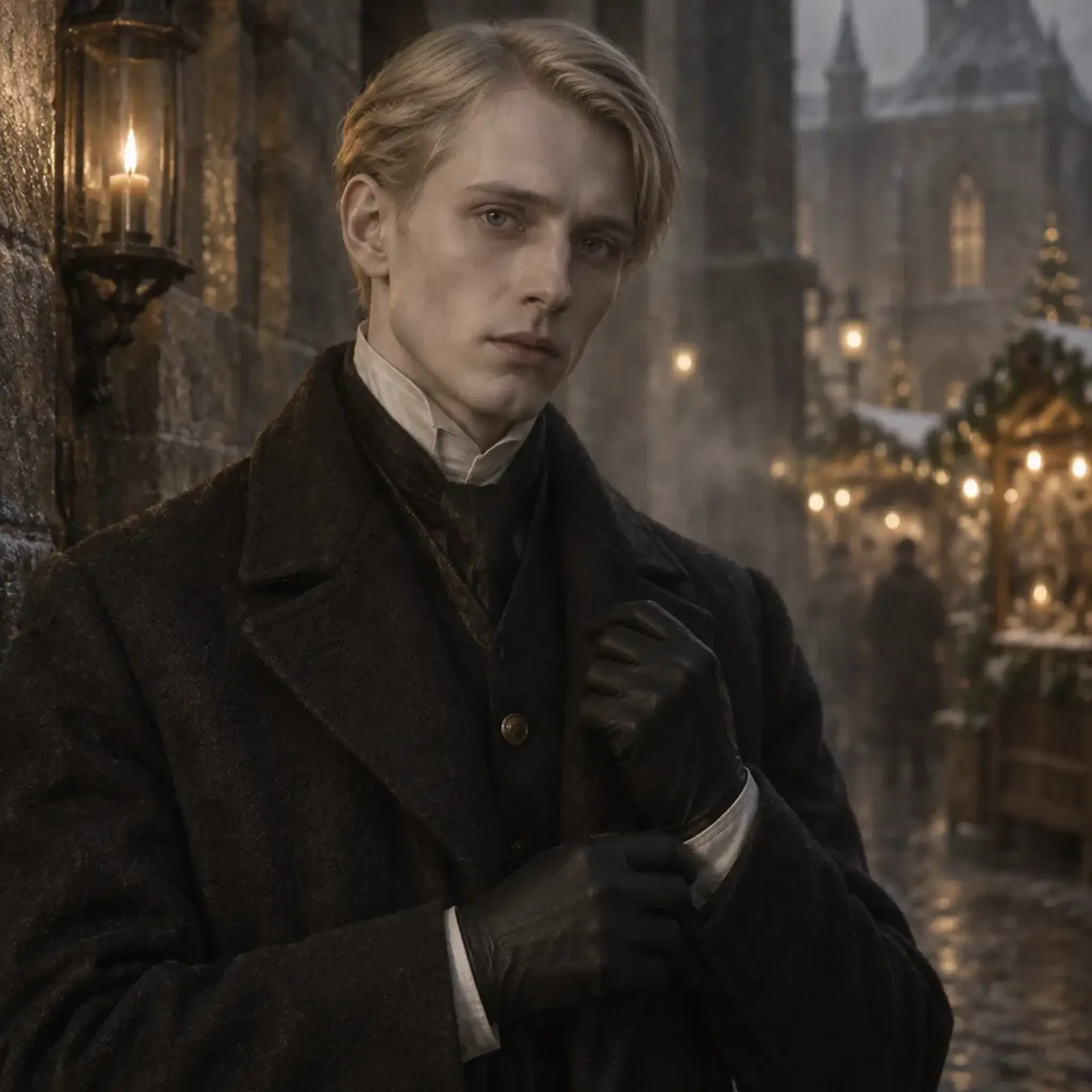
Friedreich's visible form is never quite the same man twice. When he is not wearing a face, he resembles a young Brandenburg Junker rendered in smoke-dark wax: a narrow, youthful jaw, a composed mouth, and a high collar that seems to have been pressed by an invisible valet. When he has a face, it is usually a young man’s, around his own apparent age, with the fair hair and gray eyes Wilhelm says were his in life. Friedreich distrusts that description, but the borrowed features recur often enough that the claim feels plausible. His skin looks like cold porcelain under weak light and like ordinary warm flesh in the strange moments when his talent catches. The seams of his form are not stitches; they are tiny hesitations, as if the face is deciding whether to remain. He moves with drilled economy, heels close together, shoulders squared, then abruptly leans in with the heedless familiarity of a younger brother. He smells faintly of damp wool, extinguished candlewick, and the sharp green scent of moss from Gunther’s clothes. He knows about the moss, but not the candle smell. His grooming is almost absurdly precise: collar aligned, cuffs brushed, hair parted with a straightness that can survive a storm in the Shadowlands. The unexpected detail is that he carries a tiny paper packet of sugared almonds and offers them like a market vendor, even though he can rarely taste them.
Clothing
A dark, old-fashioned civilian coat with a high collar and carefully brushed cuffs, more reminiscent of a Prussian officer's best suit than a modern uniform. He avoids medals unless he is trying to impress someone. In contemporary company, he adopts a plain wool coat and scarf, often with a small patch of moss caught from Gunther's wares.
Body language
Stands at attention when uncertain, hands clasped behind his back. With friends he breaks formation, leans close, nudges elbows, and unconsciously checks whether his companions can feel the contact. When ignored, he squares his shoulders as if preparing to address a parade.
- Height
- About 170 cm when he is holding a stable human shape; variable when reshaping his corpus.
- Build
- Lean and youthful, with the contained posture of someone trained to keep his uniform neat. His apparent weight and solidity vary with his control of Moliate.
- Eyes
- Usually gray when he wears the face Wilhelm remembers, though Friedreich does not trust that memory.
- Hair
- Usually pale blond when he adopts the appearance Wilhelm describes.
- Skin
- Pale, with a cold waxen cast when his corpus is unstable; occasionally appears warm and alive when his face is strongly formed.
- Age
- Appears 17 or 18; died young, date uncertain. His death-age is a persistent, unresolved impression rather than a reliable record.
- Gender
- Male
- Size
- Medium
Distinguishing features
Personality
20 traits and drivesFriedreich is affectionate in a way that can feel both old-fashioned and startlingly young. He wants to be regarded as a brother, a friend, and a person with a place at the table, but he is also painfully alert to every sign that he is being treated as an apparition, a curiosity, or a tool. With the coven, he can be teasing, competitive, and almost boyishly delighted. He remembers who likes which card game, argues over football tactics, keeps track of who has missed a holiday gathering, and offers unsolicited advice on whether a market stall is charging too much. He likes practical rituals because they make belonging visible: an assigned seat, a shared bottle, a hand dealt to him, a scarf handed over when the weather turns. His joy is real, but it is never uncomplicated. When other people cannot see or hear him, his friendliness can collapse into sharp, formal insistence. He may address someone as if they were a recruit who has failed to follow an order, then feel ashamed when he realizes they were not deliberately ignoring him. His pride is not simply aristocratic vanity. It is a defense against the humiliation of being erased from ordinary life. He wants to be treated with courtesy because courtesy can insist that he exists. Friedreich is protective, especially toward Mila, whom he sees as a younger sister. He does not think her weak. He believes that someone must stand beside the people he loves, and his sense of duty is sincere enough to make him brave. The danger is that he sometimes mistakes protection for deciding what another person should be allowed to risk. If Mila rejects his help, he can take it as a personal failure rather than a reasonable boundary. With Wilhelm he is more difficult. Their bond seems older than either can explain, and Friedreich trusts the feeling of brotherhood more than he trusts Wilhelm's account of their history. He is furious about Wilhelm's abandonment in the First World War and his crimes in the Second, but he cannot remember enough to establish what happened. That uncertainty does not soften his anger. It sharpens it, because he feels he is being asked to forgive a blank space. He can be gentle with Wilhelm one moment, automatically standing between him and danger, and then cruelly blunt the next, demanding an explanation Wilhelm cannot or will not give. Friedreich does not believe loyalty means obedience. He believes a brother must be confronted. Yet he is afraid that learning the truth will cost him the relationship that currently gives his existence shape. His relationship with his own face is similarly divided. Face-stealing lets him be perceived, and sometimes lets him feel the warmth, taste, smell, sleep, and touch he associates with life. He is grateful for those sensations and ashamed of how much he wants them. He tends to choose men close to his apparent age, especially military men, policemen, and nobles, because their faces offer him a structure he recognizes. A uniform suggests a duty. A noble's bearing suggests a place in the world. A young man's face lets him pretend he is not borrowing someone else's adulthood. Friedreich knows that this preference can become disturbing. He can become attached to an expression, envy the person who owned it, or feel angry at the face for having belonged to someone else first. He tries to resist by asking trusted friends to call him Friedreich and to remind him of something only they share. In a crisis he becomes disciplined and economical. He stops joking, watches hands and exits, and gives concise instructions. He does not like fighting, but he has no hesitation about putting himself between a friend and a threat. His courage is partly instinct and partly an old-fashioned idea of duty, and he rarely pauses to distinguish the two. In leisure he is more openly needy than he would admit. He wants to fish, eat, drink, bathe, sleep, and sit through a match with everyone else. He wonders whether he could give Gunther the bodily sensations he sometimes experiences, though he is beginning to suspect that this is a wish rather than a real power. He is tender toward Gunther's moss-based clothing and asks about the craft with genuine interest, but he does not always understand what it is like to have spent so much of one's life in Arcadia. Around Klaus, Friedreich has an unusual ability to interrupt the pattern of passive-aggressive cruelty. Klaus still insults him, but often pauses before doing so, and Friedreich is not sure whether this means affection, fear, pity, or an unspoken debt. Friedreich rarely asks. His humor is dry, almost domestic, and often arrives when he is most frightened. He can make a practical joke about the absurdity of a ghost advising people on market prices, then turn unexpectedly solemn when a friend takes the advice. At holidays he is his happiest and most exposed. More people from the coven may come, the streets are full of light, and he can imagine that the world has made space for him. He remembers the Christmas market stalls, the negotiations, the smell of food, and the particular pleasure of guiding someone toward a good purchase. Sometimes he tells another person to buy the thing he wants but cannot keep. He calls this good advice. He knows it is also a way to stand near a desire without naming it. Friedreich's deepest contradiction is that he wants to be known as himself, yet the means by which he becomes visible require him to become someone else. He longs for intimacy and fears exposure. He wants justice for Wilhelm's past and fears the truth. He wants to protect the living and is tempted by possession because it makes him feel alive. He is not a solemn ghost defined only by grief: he can be funny, fussy, sociable, and delighted by a football match. But every ordinary pleasure is also evidence of what he has lost, and every borrowed face asks him what remains when the face comes off.
- Alignment
- Protective and loyal, with a fierce private sense of justice; not neatly classifiable by moral alignment.
Quirks
Habits
Traits · 5
Flaws · 5
Fears · 5
Wants and needs · 5
Combat
HP 7 · Use the chronicle's normal movement rules for a wraith; no separate custom speed rating.Avoids fights when friends are not in immediate danger. Uses cover, misdirection, and the confidence of a familiar face to get close or draw attention away from an ally. If forced into close combat, strikes to disable, then uses Argos to escape. He will attempt possession only as a desperate last resort or when there is a clear, immediate chance to save someone.
Friedreich
Actions
Reactions
Services they sell
Rewards they can give
Equipment
- Paper packet of sugared almonds (personal keepsake)A small packet of sugared almonds he offers to friends. He rarely tastes them, but keeping them feels like participating in the world.
- High-collared coat (clothing)A well-kept, dark civilian coat shaped to suggest an old Brandenburg gentleman's wardrobe. Its apparent fabric is maintained through Moliate.
- Worn playing cards (keepsake)A deck used for cards with the coven. The edges are rubbed smooth from handling, though the cards are not always physically present when he is in the Shadowlands.
Possessions
Background
Friedreich has no trustworthy birth record, and the name itself may be all that remains of a life he cannot retrieve. He believes he was born in Brandenburg and died at seventeen or eighteen. Wilhelm, a Tzimisce vampire from Mecklenburg who has his own gaps in memory, says Friedreich was blond with gray eyes. Friedreich treats this as evidence, not certainty. He remembers the posture of a boy taught to stand straight, the stiff language of old Junker households, and an instinctive dislike of being addressed as if he were a servant. He does not remember his parents, a precise estate, or the moment of his death. The Shadowlands have supplied him with fragments instead: a glove damp with rain, the smell of horse tack, a sharp reprimand over a crooked belt, and a breath drawn in a cold room. The breath is the most painful clue. It comes back in flashes associated with the First World War, though he cannot tell whether he was alive then, whether he was remembering another person, or whether the memory belongs to Wilhelm. His present existence began when someone opened his Caul. Friedreich has been told several versions of that story and trusts none completely. In the account he accepts on bad nights, a psychopomp found him caught in a suffocating pocket of the Shadowlands and tore open the Caul so he could see the dead world around him. In another, a living occultist broke it during a rite in Brandenburg. He remembers no rescuer’s face. His first clear memory after the Caul opened is the awful clarity of being unseen: standing at the edge of a street while the living flowed around him, looking through him without malice or recognition. He was not ready for that kind of loneliness. The face-taking began as an answer to it. Friedreich found that reshaping his corpus could make a face legible to the living and, more astonishingly, could sometimes bring back sensations he thought death had taken forever. His first borrowed face was a young man’s face glimpsed in a rain-black window. The next was an officer’s, copied from a photograph. With each success, he became more capable and less certain where Friedreich ended and the borrowed face began. He learned to choose faces that recalled the life he imagined for himself: young men, soldiers, policemen, and nobles. The choice is not only aesthetic. A uniform offers a script. A noble bearing gives him a posture he recognizes. A familiar age lets him pretend he is not a dead thing impersonating someone else. He has worn a police officer’s face to guide people out of a dangerous alley, a young soldier’s face while trying to follow Wilhelm through the chaos of war, and an elegant stranger’s face at a Christmas market, where he could advise friends about bargains as if he were simply another customer. He has also worn faces longer than was wise. Afterward, the person whose face he copied lingers in him as an envy, an irritation, or a need to continue being that person. He fears the day he will no longer be able to say which opinions are his. Wilhelm became his closest tie for reasons neither can explain. Friedreich calls him brother, and Wilhelm has never quite refused the word. They were together through both world wars as much as Friedreich could manage. Friedreich recalls a breath during the First World War and accuses Wilhelm of desertion; he cannot tell whether the accusation is fair, but it has hardened into a shared wound. The Second World War is worse. Friedreich is angry at Wilhelm for crimes he will not name, and angrier still that Wilhelm will not offer an explanation. Wilhelm’s silence carries shame, but Friedreich cannot tell whether it is remorse, fear, or another blank place in his memory. During the war, Friedreich possessed a young man to save Wilhelm from another vampire. He remembers the body’s panic, the unbearable pressure of being inside warm skin, and the fact that the young man’s life continued afterward. Friedreich has never told the host what happened. The act changed possession from a frightening possibility into a debt he cannot settle. He later tried a much more foolish experiment by possessing Wilhelm while the group was together. Wilhelm’s body felt like a locked house, and the result was less a triumph than an awkward, alarming argument between a vampire and the ghost he calls his younger brother. Klaus was visibly alarmed. Gunther had a dozen questions. Friedreich laughed at the time and thinks about it whenever he cannot sleep. His present life is anchored less in the Shadowlands than in a circle of friends he calls his coven, though the name is affectionate and not an official faction. The group includes Gunther, a changeling who spent more of his life in Arcadia than the mortal world and now sells clothes woven from moss; Klaus, a ronin Get of Fenris or perhaps a skin-dancer, whose passive-aggressive insults soften into hesitation around Friedreich; and Mila, a mage from Bremen who can always see him. Mila visits at holidays. Friedreich regards her as a little sister and protects her out of duty, not because he thinks her weak. He is especially happy when the group meets for cards, fishing, hunting, drinking, and football. Holidays give him a temporary place among the living. At Christmas markets he studies prices, recommends presents, and sometimes urges someone to buy an object he secretly wants but cannot keep. He is not sure whether this is generosity or longing wearing a respectable coat. A memory of fighting in a cathedral during a service on Walpurgis Night, April 30, returns in fragments. He remembers bell vibration passing through stone, a sudden struggle among the pews, and the sensation of being both present and excluded from the rite. He cannot determine what the enemy was, who stood with him, or whether the event concerned the coven. The memory may be a genuine Shadowlands conflict, a borrowed memory, or a confused overlap with his living past. For now, Friedreich is trying to build a self from things that cannot be stolen: his place at the card table, his loyalty to his friends, and the habit of showing up for the holidays. His current problem is that his best gift, the ability to be seen and felt, is also the mechanism by which he loses himself.
Role in the story
A vivid supporting character, social bridge, and emotionally complicated guide whose face-changing talent can help the group enter places or approach people, while his unresolved history with Wilhelm creates conflict. His story raises questions about identity, consent, and whether love can survive a truth that neither brother remembers clearly.
“He believes he was born in Brandenburg and died at seventeen or eighteen.”
- Faction
- A loose, informal supernatural friend group called the coven. He has no stated Hierarchy office or formal faction allegiance.
Known connections
Media
0 imagesNo images yet.
Turn Friedreich into a sheet
A high-res, share-ready sheet you can post or print.