Friedreich
Friedreich
At the table
Voice
A dry, slightly grainy voice that sounds as though it has crossed a long, cold corridor before reaching the listener. The rhythm is deliberate and officer-like, with a Brandenburg German accent shaped by military habits and decades of interruptible existence. When borrowing a face, his pronunciation can imitate its owner, but his measured pauses and habit of arranging facts remain distinctly Friedreich's.
His speech carries the clipped precision of someone trained to give concise instructions, softened by Brandenburg vowels and the rough edge of a voice that has spent too long forcing itself through the boundary between worlds. When embodied, the borrowed person's voice is convincing, but Friedreich's careful timing remains: he places names and key words as if reporting facts for the record. With friends he uses warmer, more colloquial German. He does not become quieter when angry; he becomes more exact, driving each question home without raising his volume much.
Speech patterns
How to play them
Treat Friedreich as a person first, not as a mask or a tool. Make an effort to address him directly, especially when he is not visibly embodied. He responds well to practical respect, shared activities, and being included in ordinary plans. Do not press him to forgive Wilhelm or to possess someone; let him explain his own boundaries. He is likely to offer help, market advice, or a place in the coven before he offers his history.
Goal
Recover a truthful account of his death and the cathedral fight, while preserving his chosen family without becoming dependent on stolen faces.
Motivation
Friedreich wants belonging that does not depend on imitation. He tries to turn old military ideas of duty into care freely given, yet still craves the certainty and recognition that a uniform, a brother, and a familiar face once promised.
Appearance
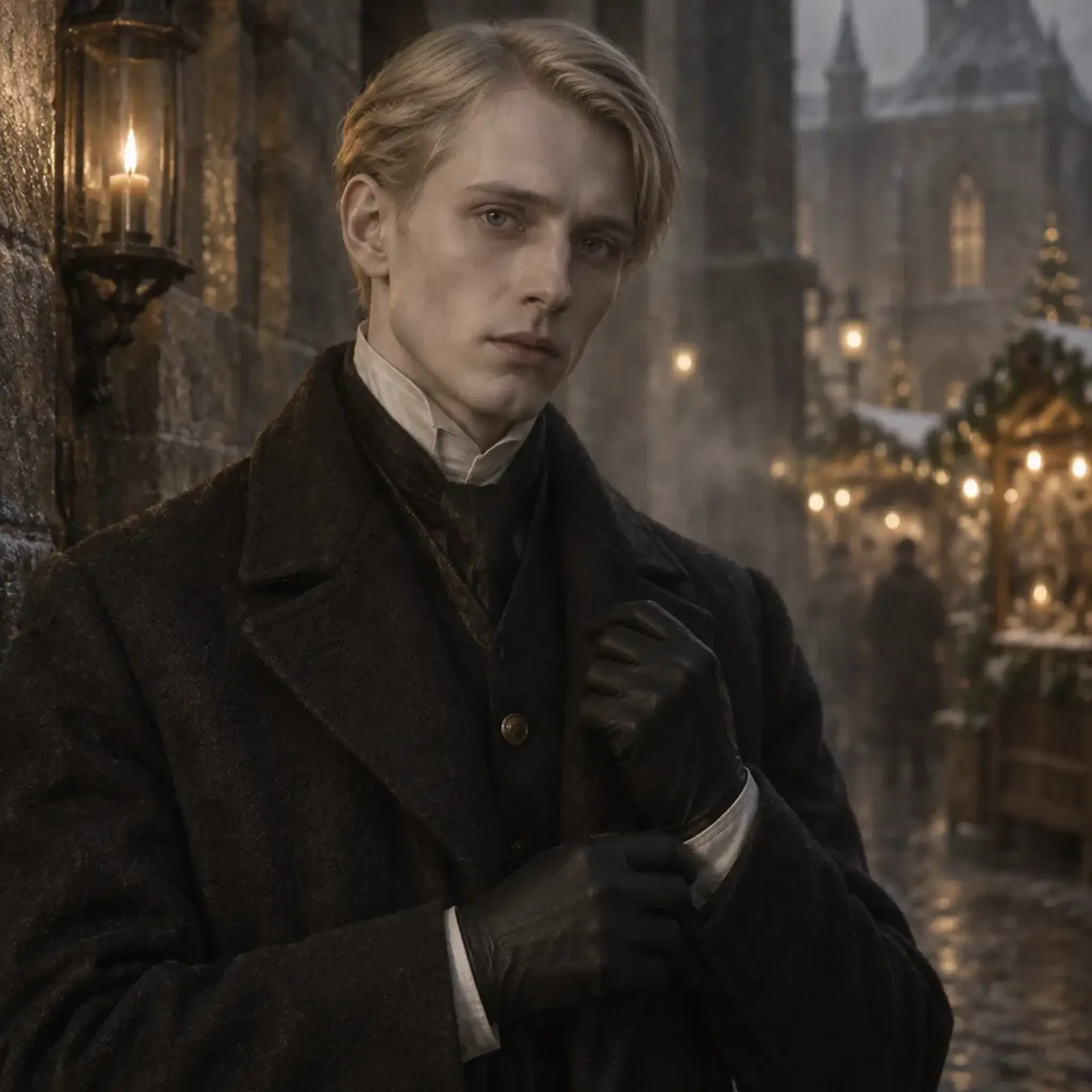
Friedreich looks like a young Brandenburg man in an old portrait that has been left too long in damp air. His borrowed face is usually a fair, narrow one with a careful mouth, a straight nose, and gray eyes Wilhelm says are his own. Friedreich does not trust that description. His hair, when he can make it visible, is pale blond, combed with the exacting side part of a minor Junker officer. His apparent skin has the matte pallor of candle wax over old paper, with a faint, shifting grain beneath it, as if his features were pressed into soft material and never quite dried. When his concentration slips, the edges of his jaw and ears ripple like a reflection struck by rain. He stands with his heels close and his shoulders squared, but he moves in brief, decisive glides that make him seem to arrive a fraction before his shadow. In a crowded room he unconsciously leaves a narrow lane beside himself, as if expecting an orderly to pass. His unexpected detail is an almost fussy delight in Christmas-market bargains: he can spend ten minutes earnestly comparing the price and stitching of a child's knitted mittens, then recommend the pair he most wishes he could wear.
Clothing
Favors a dark, well-brushed wool coat with an old-fashioned cut, a high-collared shirt, plain gloves, and trousers that suggest a junior officer rather than a grand aristocrat. His clothes are part memory and part borrowed impression; he mends imaginary creases even when the garment is only plasm. At Christmas markets he is drawn to knitted scarves and mittens that he cannot keep.
Body language
His posture is trained and contained, chin level and shoulders squared, but his stillness is not restful. He makes small corrections to his cuffs, turns toward footsteps before others hear them, and subtly angles his body to leave room for people who are not there. When irritated, he becomes more rigid and starts measuring the room with his eyes. When pleased, he leans in and forgets to maintain the careful distance he usually keeps.
- Height
- Approximately 173 cm when fully embodied; his apparent height shifts slightly with the face he borrows.
- Build
- Slender and youthful, with the held-together posture of someone taught to stand inspection. His body is convincing when his borrowed face holds, but its outlines can ripple at the edges like softened wax.
- Eyes
- Gray when he can sustain the face; he relies on Wilhelm's description and does not trust it.
- Hair
- Pale blond when manifested, according to Wilhelm; Friedreich is unsure whether it is truly his.
- Skin
- Pale, wax-matte when embodied, with a faintly rippling surface at the edges of a borrowed face.
- Age
- Appears 17 or 18; his actual age at death and the time elapsed since death are uncertain to him.
- Gender
- Male
- Size
- Medium
Distinguishing features
Personality
20 traits and drivesFriedreich is pulled between the discipline he associates with his lost life and the tenderness he has built since death. He likes rules when they protect people from being abandoned, but distrusts rules that protect an institution from scrutiny. He is capable of patient, almost ceremonial attention: he will listen while Mila explains a complicated problem, remember which market stall overcharges, and wait through an entire football match without interrupting. Yet patience is not the same as calm. When he feels invisible, he can become sharp and insistent, demanding acknowledgment as though a room's failure to notice him were a deliberate slight. He knows this is unfair, but knowing does not always stop him. His affection is practical. He checks that his friends are warm, keeps watch, offers directions, and positions himself between a loved one and danger. He does not assume that kindness means weakness. This is especially true with Mila: he respects her capacity and still feels responsible for her, a combination that can make him overprotective. He likes Gunther's clothes and the work that goes into them, and tries not to treat Gunther's life in Arcadia as a strange curiosity. He wants to give Gunther something valuable, but his inability to share his embodied sensations leaves him with a quiet, helpless frustration. With Wilhelm, affection and anger are inseparable. Friedreich believes Wilhelm is his brother, though he cannot explain why. The belief is strong enough to draw him through wars and strong enough to make Wilhelm's failures feel personal. Friedreich is angry about Wilhelm's desertion in the First World War and his crimes in the Second. He does not excuse either because Wilhelm feels ashamed. He wants reasons, not absolution, and the longer Wilhelm refuses to explain, the more Friedreich imagines that the missing explanation implicates them both. He can be tender toward Wilhelm one moment and coldly interrogative the next. If Wilhelm is in immediate danger, Friedreich will still act before he has finished being angry. Friedreich's relationship with duty is complicated by the fact that he no longer has a regiment, a family, or even a trustworthy memory of his own name. He uses manners and military bearing as scaffolding. They let him feel continuous from one day to another. When relaxed, he is more playful than his posture suggests, particularly during cards and football. He can debate the quality of a knitted scarf with absurd seriousness, or complain about a referee as if the referee had personally betrayed the coven. At holidays, when many friends arrive and the market lights make him easier to perceive, his reserve lifts. He is warm, eager, and almost boyish, though he dislikes being treated as a child. His face-stealing gives him a dangerous intimacy with the living. He can feel a borrowed person's breath, warmth, appetite, fatigue, and scent. He is grateful for these sensations and ashamed of how much he wants them. He prefers faces that match his imagined self: men around his apparent age, with military, police, or noble bearing. He tells himself this is practical because such faces help him move through certain spaces. He also knows the preference is vanity, grief, and envy mixed together. While wearing a face for too long, he can start to borrow more than appearance. Another man's habits and emotional inclinations cling to him, while Friedreich's own memories weaken. The risk makes him cautious, but the promise of feeling fully present makes caution difficult. Friedreich is not naturally cruel, but he can make a moral case for frightening choices. During the Second World War he possessed a young man to save Wilhelm from another vampire. He remembers the host's panic and has not forgotten it. Even so, he has considered doing it again. His Shadow exploits this contradiction, telling him that protecting someone excuses any intrusion and that a person who cannot be seen has no obligation to respect the living. Friedreich resists by refusing to pretend the first possession was harmless. He will admit that it saved Wilhelm and that it hurt the host. Both things remain true. His memory loss makes him both curious and defensive. He wants to know what happened before death, who opened his Caul, and what occurred in the cathedral during the Walpurgis Night service. But he fears that his recovered history might disprove the dutiful, decent person he is trying to become. He sometimes speaks as though his impressions are facts, then corrects himself when challenged: "I remember it. That is not the same as knowing it." In a good mood he welcomes questions and helps others find information. In a frightened mood he changes the subject, becomes formal, or insists that some questions can wait. The part of Friedreich that is easiest to like is also the part he fears losing: he cares about ordinary things. A place at a card table, a warm drink, a fair price, the company of friends, a match with a disputed call. These do not erase the dead or the violence he has witnessed. They remind him that his life, whatever its original shape, is more than war and borrowed faces. He wants his friends to see him as Friedreich, even when he has to wear somebody else's face to make that possible.
- Alignment
- Protective, dutiful, and increasingly judgmental; he is not reliably obedient to any faction or moral code.
Quirks
Habits
Traits · 5
Flaws · 5
Fears · 5
Wants and needs · 5
Combat
HP 7 · Custom quick-use measure: ordinary movement while embodied; can glide through the Shadowlands at a purposeful walking pace. No canonical numeric speed assigned.Friedreich prefers misdirection, concealment, and intervention over a direct fight. He uses a familiar face to approach, distract, or get close to a threat, then manifests only as much as needed. He avoids using Puppetry except when someone is in immediate danger, because he remembers the host's terror. Against wraiths he uses his plasmic form to obstruct or strike, then withdraws before an enemy can exploit his limited physical force. His greatest combat risk is prolonged embodiment: a borrowed identity can cloud his judgment and feed his Shadow's envy.
Friedreich
Actions
Reactions
Services they sell
Rewards they can give
Equipment
- Old-fashioned wool coat (clothing)A phantom officer's coat and gloves, part of the familiar silhouette he rebuilds when he can manifest.
- Market-worn playing cards (personal item)An apparently ordinary deck used for cards with the coven; whether it is physical or briefly embodied varies.
- Unidentified brass button (keepsake)A small brass token from an unknown uniform or railway, one of the few objects he carries between appearances.
Possessions
Background
Friedreich remembers Brandenburg in fragments: flat fields under a hard sky, a horse sweating through its harness, the square geometry of a barracks courtyard, and someone calling him by a surname that will not come back. He has the appearance of a young man of seventeen or eighteen, but cannot establish when he died or how many years his soul has endured. The history he tells is pieced together from his own impressions, from Wilhelm's guarded corrections, and from the habits that remain in his hands when he borrows a body. He thinks he may have been a minor Junker, or the son of one: an educated young man raised to believe that order was a form of virtue and that a uniform could make a person worthy of being obeyed. He remembers drills more clearly than family. He remembers being cold in a station, and once remembers taking a breath during the First World War. Whether that breath belongs to his living life, a borrowed body, or a memory Wilhelm gave him, he cannot tell. His death left him in the Shadowlands, the bleak reflection of the living world, with a Shadow that knows how to make every blank in his memory feel like an accusation. His Caul, the cocoon that held him after death, was opened by a wraith he recalls only as a woman with a workman's red scarf and a voice that sounded tired rather than kind. Friedreich has never recovered her name. She cut him free in a ruined station passage and told him, in effect, that he could either keep moving or let the dark decide what he was. He remembers her hand at his shoulder, and not her face. That first act of mercy is one reason he still believes a duty can be chosen, even when no authority remains to enforce it. His earliest attempts to be seen in the Skinlands were humiliating. He could press a hand against a window and watch a child look straight through it. He could shout until the effort tore at his plasm and still fail to turn a living head. Then, while following a young man in a military coat through a passage between worlds, Friedreich discovered that he could make the man's face his own. The change was not a simple mask. He felt the rasp of the collar, the pull of the man's breath, and the dampness in his eyes. For a few minutes the living world accepted him. The experience thrilled and frightened him. He used that face to speak to a sentry, then abandoned it before the man's friends could notice what had happened. This capacity became his custom Arcanos, Borrowed Visage, a talent that appears to combine the reshaping of Moliate with the manifesting reach of Embody. It is exceptional, possibly unnatural even by wraithly standards, but Friedreich does not know whether it marks unusual talent, a wound in his death, or a trick his Shadow has taught him. When he is especially good at it, he can taste, smell, sleep, bathe, and feel ordinary warmth. Those sensations are real enough to ache for when they vanish. He has wondered whether he could share them with Gunther, who cannot experience the living world as Friedreich does. He has not found a way, and the possibility that he might fail Gunther makes him reluctant to attempt it. He met Wilhelm in the churn of the First World War, though neither can agree on the sequence. Wilhelm is a Tzimisce vampire from Mecklenburg who also cannot remember his life before death. Friedreich followed him through the war as much as his access to the Skinlands allowed. Their connection feels older than their recoverable memories. Friedreich thinks of Wilhelm as a brother, and acts like one: he keeps watch, complains when Wilhelm goes silent, and stays near when the vampire's self-disgust becomes dangerous. At the same time, he is furious that Wilhelm deserted in the First World War and will not explain why. Friedreich is no less angry about Wilhelm's crimes during the Second World War. Wilhelm's shame is evident, but shame is not an explanation, and Friedreich believes the silence has made the crimes part of their shared burden. He sometimes suspects that his own lost memories are tangled with Wilhelm's, but has no proof. A memory of a fight in a cathedral during a Walpurgis Night service, on April 30, recurs with the sharpness of a shard under the skin. He recalls candle smoke, a congregation that did not understand what had entered the building, and a struggle above the nave's stone floor. He cannot say who the enemy was, who stood beside him, or whether the cathedral belonged to the living world or its reflection. He has never learned whether this was the night he died, a later battle, or a memory altered by his Shadow. During the Second World War, Friedreich's fear for Wilhelm overcame his reluctance to use Puppetry. A vampire opponent had cornered Wilhelm, and Friedreich seized the body of a young man nearby long enough to interfere and save him. Friedreich remembers the host's panic more vividly than the fight. He has considered possessing a living person again, and that thought disgusts him because it is also reassuring: if he can take control, he need not watch someone he loves be destroyed. He avoids making the decision until circumstances force it. Friedreich now belongs to an informal, recurring gathering his friends call the coven, though it is not a formal occult organization. The group includes supernaturals of different kinds who meet for cards, hunting, fishing, drinks, and football. Gunther is a changeling who spent much of his life in Arcadia and now sells clothes made with moss. Friedreich enjoys watching Gunther work and tries not to ask whether the moss is alive. Klaus is a ronin Get of Fenris, or perhaps a skin-dancer; the uncertainty is Klaus's own business, and Friedreich will not force it. Klaus is passive-aggressively cruel to most people, but hesitates around Friedreich. Friedreich does not know whether this is affection, guilt, or fear. Mila, a mage from Bremen, visits for holidays and is always able to see him. He treats her like a younger sister and protects her out of a sense of duty, not because he thinks her weak. She is kind without being foolish, a distinction Friedreich respects. Holidays are a relief from the work of being dead. When more members of the coven arrive, Friedreich's excitement is difficult to hide. He especially loves the Christmas market, where he advises friends about good prices, sturdy goods, and which stalls are taking advantage of tourists. Sometimes he recommends a lovely thing he cannot use because he wants it himself. On the best days, when the boundary between worlds loosens, he is visible enough to join the crowd. On worse days, he is ignored by people he loves and must watch them respond to the empty place where he is standing. His present problems are practical and intimate. He has begun to favor the faces of men around his apparent age, especially soldiers, police, and nobles whose bearing resembles his remembered ideals. Wearing one too long blurs the distinction between the borrowed man's desires and his own. The resulting envy and anger are not always his, or not entirely. His Shadow presses on the fear that he is only a collection of other men's expressions. He still has no reliable account of his own death, his family, or what happened at the cathedral. He wants to learn those truths, but part of him fears that an answer will show him he was never the dutiful young man he imagines. Until then, he keeps attending the gatherings, saving a place in the card game, and insisting that everyone take the warmer route home.
Role in the story
A recurring ally whose exceptional face-stealing can solve problems and create moral complications. Friedreich offers access to the supernatural coven and a personal route into Wilhelm's concealed history. His story asks whether identity is a memory, a body, a duty, or a relationship, and whether protecting someone can justify taking control of another person's life.
“He has the appearance of a young man of seventeen or eighteen, but cannot establish when he died or how many years his soul has endured.”
- Faction
- A member of an informal supernatural coven of friends. In the afterlife, he is an independent wraith with no confirmed affiliation to a Stygian legion or other formal faction.
Known connections
Media
0 imagesNo images yet.
Turn Friedreich into a sheet
A high-res, share-ready sheet you can post or print.