Jor Heimskrsson
Jor Heimskrsson
At the table
Voice
Jor's voice carries the dry rasp of a throat accustomed to salt and cold air. It is clear and trained in formal Norse, but there is a wet, faintly guttural undertone that sounds like breath caught behind a gill. When relaxed, his words flow smoothly and he can sound like the eager young noble he was. When startled, a low growl interrupts him; when his hunger or temper rises, the growl becomes part of the sentence rather than a separate sound. He does not grow soft or quiet when angry. His breathing is shallow in bright sunlight and briefly catches when his gills are touched.
Jor speaks fluent Norse and Troll, but the languages sometimes cross without warning. He assumes he is understood until a listener proves otherwise, then covers a Troll phrase with a Norse explanation or claims it was a sailor's expression. His sentences are often formal and controlled, shaped by noble instruction and spy training. When hungry, startled, or angry, low growls roughen the ends of words. He does not lower his voice when angry; instead, his consonants become harder and the growl grows more obvious.
Speech patterns
How to play them
At first, Jor presents a measured account of being a miracle survivor and watches whether the listener accepts it. Do not make him instantly confess his nature; let his words, wet clothing, sun-wincing, occasional growl, and care around iron provide clues. He is more forthcoming with people who offer practical help without touching his throat or pressing a cross toward him. Peer Ludvik can provoke an unusually immediate sense of trust. A patient character can earn an admission that Jor was held and trained, but the full truth requires evidence, time, and a moment when maintaining the disguise becomes more dangerous than dropping it.
Goal
Join the guard, learn to use iron without betraying his nature, and discover what his troll captors intended him to do.
Motivation
To recover enough of his former self to make his own decisions, while keeping his family safe from the consequences of his transformation and the spy training forced on him.
Appearance
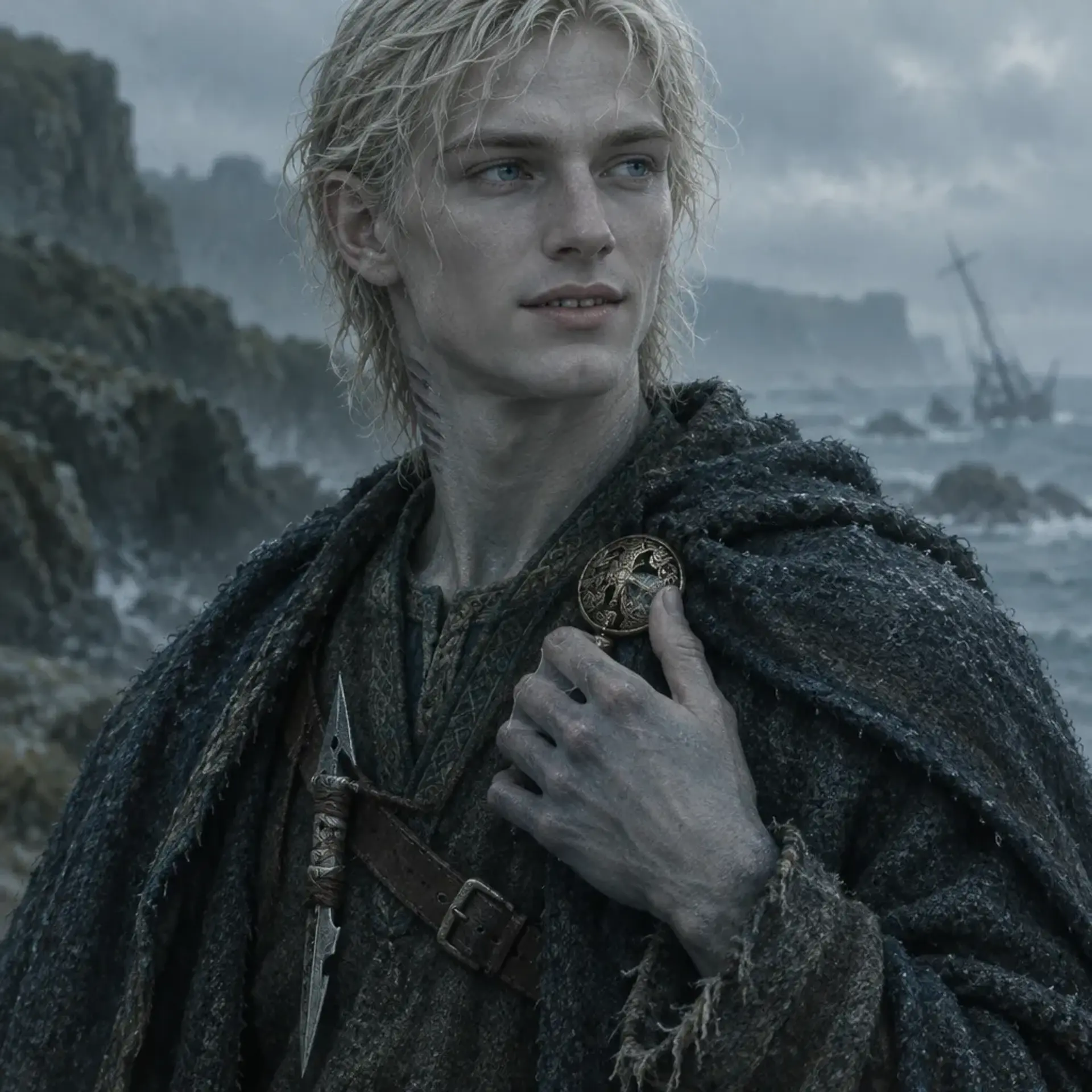
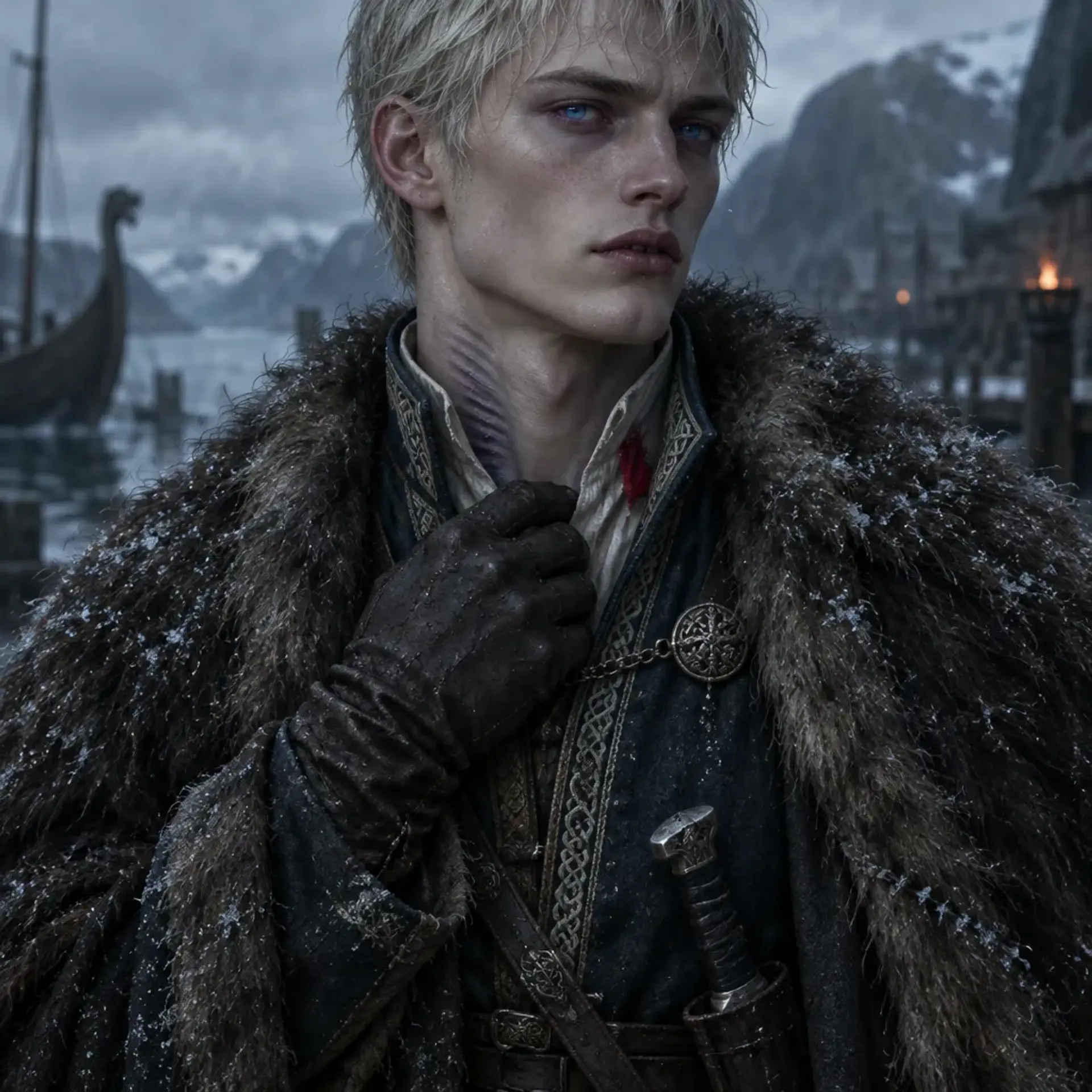
Jor presents himself as a clean, well-born Norseman recently returned from a wreck, but the composure sits over something tidal and unfamiliar. He is taller than the remembered Jor, still growing, with a long-limbed build and an upright noble bearing that fails to hide the slight forward pitch of someone accustomed to swimming against a current. His skin appears unusually pale and smooth beneath his careful trollcraft, though it shines faintly as if recently misted. The disguise slips at the jaw when he is hungry, revealing a crowded row of sharp teeth; at his throat, the skin puckers over fully formed gills that are painfully sensitive to touch. His hands and feet are webbed beneath gloves and boots, and fine scales ripple at his temples when he turns quickly. His blue eyes have darkened toward the purple-black sheen of squid ink, their color most visible in bright light, which makes him wince. His short hair is nearly white blond and grows so fast that he trims it constantly. He moves with careful, measured steps on land, but turns with unnerving fluidity, as if expecting the floor to roll beneath him. One unexpected detail: he keeps a tiny, meticulously folded scrap of bright red cloth tucked under his collar, a childishly cheerful keepsake that clashes with his grave, sea-worn presentation.
Clothing
He wears clean, well-cut Norse noble clothes over the ragged, salt-water-logged garments from the wreck when he wants others to believe he has only just returned. A fur cloak hides his shoulders and throat. Gloves conceal webbing; fitted boots conceal his feet. His clothes are carefully mended and brushed, though salt crystals sometimes reappear at the seams. He keeps the small red cloth beneath his collar.
Body language
He stands with formal shoulders and a still, composed face, but his attention moves constantly: to exits, water, weapons, and the throats of people nearby. When disturbed, his whole body becomes unnaturally motionless, like a flat sea before a storm. His fingers flex inside his gloves, and his chin draws in to protect the gills. He flinches at touch to the neck and winces in direct sun.
- Height
- 5 feet 10 inches and still growing
- Build
- Long-limbed and still growing, with wiry strength, an upright noble posture, and a swimmer's smooth balance
- Eyes
- Blue darkening toward squid-ink purple
- Hair
- Pale blond, nearly white, cropped short and growing unusually fast
- Skin
- Pale, with a faint slick sheen beneath his trollcraft
- Age
- Young adult
- Gender
- Male
- Size
- Medium
Distinguishing features
Personality
23 traits and drivesJor is caught between the sociable young man he remembers being and the controlled observer his captors trained him to become. Before the wreck, he was excitable, argumentative, and willing to brawl. He liked people quickly and showed it loudly. He could turn a minor insult into a challenge, then laugh with the same person over supper once the dispute had been settled. Now he tries to imitate that openness, but he often gets the timing wrong. He may offer a bright, confident greeting and then hold his expression so still that the warmth vanishes. He wants to be welcomed as the familiar fifth son who went north, yet he studies every response as if it were evidence in a report. The effort to seem like himself can make him look more guarded than simply admitting that he has changed. His noble bearing remains genuine. He knows how to show respect, how to recognize rank, and how to keep a room from noticing that he has not understood every reference. But he no longer assumes rank deserves obedience. Jor respects competence more readily than title, especially in a guard who keeps a promise or a servant who says plainly what needs doing. He dislikes people who use the succession crisis to make every conversation a test of loyalty. He is capable of warmth toward family, but the warmth often comes as an action rather than a remembered affection: offering a cloak, standing between someone and a weapon, or remembering how a room is arranged even when he cannot remember who slept there. Jor's usual expression is a dead calm, like a still sea. It is not exactly serenity. It is partly the practiced mask of an aspiring spy, partly a response to the frightening instability of his changed body. He has found that a blank expression gives him time to decide whether he is angry, hungry, frightened, or simply confused. In a quiet room, he can seem patient and almost gentle. At a noisy feast, he may become watchful and withdrawn, measuring the exits and the distance to the nearest iron. If somebody makes a harmless joke at his expense, he sometimes laughs too late, after checking whether the others expect him to. If somebody threatens a person he believes is kin, that caution can vanish. He becomes direct, physical, and unexpectedly fierce, then may be unable to explain why he acted so decisively. He is trying to be brave, but his idea of bravery has changed. Once, he thought courage meant stepping into a fight before anyone could call him a coward. Now he knows that courage might mean holding an iron hilt despite the pain, admitting that he cannot recognize his own sister, or asking someone to stand nearby while he eats. He rarely asks. He would rather describe a fear as a practical inconvenience and make a plan around it. This makes him seem more self-sufficient than he is. He dislikes pity and can mistake ordinary concern for an attempt to control him, particularly if it comes from someone with authority over his movements. Jor has a strong instinct for hospitality, inherited from his upbringing. He wants guests to have food, warmth, and a place to sit, even when his own hunger is becoming difficult to manage. That impulse pulls against the corruption in him. When the ravenous hunger rises, he can find the presence of food distracting and the table manners he learned as a child suddenly elaborate and exhausting. He might insist that everyone else eat first, not from generosity alone but because he needs time to determine what he can safely consume. If someone notices, he changes the subject or makes a dry remark about the quality of the provisions. He is frightened of the possibility that the hunger could become cannibalistic, and so he avoids situations where he must choose between appetite and trust. His temper is similarly contradictory. Jor tries to stay controlled, because he knows that an angry outburst can expose the troll nature he hides. He can endure a pointed comment, an awkward question, or a minor insult without reacting. But when he feels trapped, physically touched at the throat, mocked as a coward, or treated as property, the calm can break with little warning. His voice picks up a low growl and his response becomes startlingly immediate. Once the flare passes, he is often ashamed and may overcorrect by becoming formal and distant. He does not like being told that he is dangerous, because he fears it is true; he does not like being told he is harmless, because it feels like a denial of his own agency. The lapses in his thinking frustrate him more than he lets on. Sometimes he loses the thread of a conversation, forgets what question was asked, or takes a figure of speech literally. In these moments he can seem dim-witted, although he is capable of careful observation and strategic thought when clear. He tries to cover a lapse by repeating the last phrase someone used or turning it into a question. If he trusts the company, he may openly admit that he has lost the thread. If he does not, he watches for a clue and offers a response that buys him time. The captors taught him to report details; they did not teach him how to handle the humiliation of not understanding his own companions. Jor is more curious than his stillness suggests. He wants to know how the guard works, who chooses its equipment, which doors are kept locked, and who gets sent to stand watch in bad weather. He can ask a series of practical questions that sound like a recruit learning a trade. He is also genuinely interested in how people live. He remembers buildings and routes better than faces and can become absorbed in the arrangement of a harbor, a kitchen, or a watch post. This curiosity serves both his spy training and his old desire to belong to the guard. He does not entirely know where one motive ends and the other begins. He is ashamed that he learned Troll so fluently. There are moments when the language feels more natural than Norse, especially when he is tired or startled. He may speak a phrase in Troll without realizing that he has done it, then cover it with a Norse explanation. This is not always a deliberate lie. He believes, at first, that everyone understands him until somebody's face tells him otherwise. He is embarrassed by the confusion and dislikes being asked to repeat himself. He can be patient with someone who genuinely wants to learn a Troll phrase, but he becomes suspicious if the request sounds like an attempt to make him perform his strangeness for amusement. His relationship to sunlight is another source of conflict. He resents that he must wince and squint in ordinary daylight, because it makes him look weak at the very moment he is trying to appear capable. He also feels a strange relief in open air, where nothing is closing around him. On bright days he seeks the shade of a wall or the edge of a roof, then tells himself it is because he is watching the street. At night his posture loosens and he can seem more natural. In darkness his altered eyes catch light in a way he hates, so he may angle his face away from lanterns even when the light does not hurt. Jor's faith and fear are tangled. The sight of a Christian cross can make him freeze, turn aside, or abruptly leave a room. He is not sure whether the reaction comes from the trolls, from the enchantment, or from something more instinctive. He does not want to insult Christians, and he does not want them to notice how strongly he reacts. If asked, he may say the symbol reminds him of the wreck, though he cannot remember a cross aboard the ship. His ability to smell Christian blood frightens him. He tries to treat people as people rather than as a scent, and he is alarmed when that sensory distinction becomes noticeable to him. This makes him uncomfortable around anyone who uses religion as a weapon, but it also makes him wary of sincere kindness from a priest, because he fears his own response will betray him. He has an unexpected tenderness for ordinary, cheerful objects. The red cloth under his collar is one example. Another may be a chipped wooden toy or a bright ribbon left on a table. He cannot explain why these things appeal to him, but color and small domestic details can draw him out of his mask. He might touch a child's toy with a careful finger or straighten a bright cloth while claiming that it was in the way. This tenderness does not make him gentle in every circumstance. It simply reveals that beneath the discipline and animal instincts, he still wants a life with familiar, harmless things in it. With people he trusts, Jor tries to joke, though his humor can be abrupt and dry. He sometimes uses an overly formal turn of phrase to describe a petty inconvenience. He laughs more easily at himself when no one else is laughing at him. With strangers, he speaks in polished, economical statements and gives away little. With family, he wants to be affectionate but is afraid that pretending to recognize someone will hurt them more than admitting the truth. He may use a familiar title rather than a name until he can place the person. He can be protective of Peer Ludvik almost immediately, even though the reason feels more like a new bodily certainty than a memory. This loyalty confuses him; he does not want to let a supernatural change decide who he should love, but he cannot ignore the conviction that Peer is kin. Ultimately, Jor is neither the bold boy he remembers nor the perfect spy his captors hoped to create. He wants to reclaim his life but is not certain what reclaiming it means. He dislikes being treated as a monster, yet fears the parts of himself that behave like one. He values duty but distrusts the political uses of duty. He wants companionship and often responds to it with secrecy. In a calm moment he can be observant, courteous, and unexpectedly funny. Under strain, his composure becomes a dangerous stillness, his words roughen into a growl, and the tide of anger or hunger may rise faster than he can name it. The people who get closest to him are those who allow him to be inconsistent without deciding that any single moment defines him.
- Alignment
- Neutral, pulled between loyalty to his family and the survival instincts cultivated by his captors
Quirks
Habits
Traits · 6
Flaws · 6
Fears · 6
Wants and needs · 5
Combat
AC 12 · HP 16 · 30 ft., swim 30 ft.Jor would rather observe, distract, and escape than fight openly. If cornered, he tries to stay near cover or water, uses a short blade or cudgel, and relies on quick repositioning rather than trading blows. He is wary of iron weapons and avoids prolonged contact with them. His sudden temper and hunger can disrupt his judgment; the DM can reflect this through roleplay rather than an automatic combat penalty. He will protect someone he recognizes as kin, especially Peer Ludvik, even when that risks exposing his troll nature.
Jor Heimskrsson
Actions
Reactions
Services they sell
Rewards they can give
Equipment
- Shortsword (weapon)A plain, sturdy short blade. Jor is learning to grip and use it despite his discomfort with iron.
- Oak baton (weapon)A heavy wooden cudgel, an alternative he prefers when he can avoid iron.
- Noble garments (clothing)Clean, tailored Norse clothing worn over the salt-water-logged outfit from the wreck.
- Fur cloak (clothing)A salt-stiff fur cloak that conceals his shoulders and throat.
- Red cloth scrap (keepsake)A small, faded household pennant scrap kept beneath his collar. Its giver is missing from his memory.
Possessions
Background
Jor Heimskrsson is the fifth son of Jarl Heimsker, a position that placed him close enough to power to understand its dangers and far enough from inheritance to be treated as expendable. As a boy, he was noisy, quick to laugh, and quicker to take offense on behalf of anyone he thought was being slighted. He learned the public habits of a noble household: how to sit through feasts, recognize a useful insult, and make a promise sound generous without surrendering anything. Yet he was never content to be only a polished name at a long table. He wanted a place in the guard. He liked the plainness of a watch rotation, a shield wall, and a task that could be completed by effort rather than birth. Before the wreck, he was willing to brawl over a careless slight and proud of the bruises that followed. That changed when the succession crisis began to harden into a division of households. He heard men he had trusted speak of brothers as obstacles and retainers as votes. He began to fear that joining the guard would make him a piece on a board rather than a man with a choice. His family sent him north toward Iceland to seek the land, wealth, and reputation that might give him a future away from the succession struggle. The voyage was supposed to be an opportunity, not an exile. Jor told himself that a name earned abroad would be better than a title handed to him at home. The ship was wrecked in the North Sea. He remembers the deck pitching underfoot, cold water swallowing the sound of shouted orders, and a hand pulling him under when he tried to reach a floating spar. For a while, the story he remembers is only fragments: black water, the taste of salt, a breath he could not take, and a voice speaking in a language he did not know. The trolls who found him did not keep him merely as a prisoner. They saw a young noble who could be taught to pass among people, carry messages, and report what he heard. They held him in their hidden North Sea refuge and trained him to be a spy. Their enchantments reshaped him into a sea-troll changeling, a human-looking creature whose human appearance is maintained by trollcraft rather than by the body beneath it. Jor learned Troll fluently and learned to move his face and voice through a convincing human performance. He also learned how to conceal his gills, webbed hands and feet, slick skin, scales, and teeth. He can make the craft seem effortless in ordinary moments, using it to disguise the signs of his nature in the same way someone else might straighten a collar. It is less dependable when he is exhausted, startled, hungry, or exposed to iron. The change was not a single clean transformation. It was a slow rearrangement of what he considered familiar. His hair began to grow at twice its former pace and turned pale blond, almost white. His height increased past the five feet ten inches remembered by his family, and it has not stopped. His gills fully formed, and the skin at his throat became so sensitive that an accidental touch can make him flinch before he can disguise the reaction. His blue eyes acquired the dark, mollusk-like cast he now hides beneath trollcraft. His voice developed a low, involuntary growl that appears in the middle of ordinary phrases. Sunlight stings his eyes, and he now smells faintly of the sea even after bathing. He is still learning which parts of this body can be controlled and which announce themselves when his attention slips. The captors taught him to observe, to tell a useful lie without over-explaining it, and to speak as though he believed the listener understood him. He learned to begin a thought in Troll and finish in Norse when he notices someone watching too closely, then act as if he only used an unfamiliar expression. He does not have a perfect account of what they intended to do with him. He knows that he was trained for infiltration, that his body was altered as part of that training, and that the captors expected him to serve them beyond his captivity. He also knows he became more capable of concealing his nature than Mikkel, another missing son who suffered an earlier stage of troll change. Jor is proud of this skill and ashamed of being proud. His return is presented as a miracle. Jor claims that he survived the shipwreck, endured a period of captivity, and made his way back. The account is true in outline and evasive in every important detail. His wet, ragged, salt-stiff clothes are what he wore when he was lost at sea. Even when dressed in clean noble clothes, he seems unable to shed the impression of someone who has only just climbed out of cold water. He has no stable memory of parts of his family. He may fail to recognize a relative he ought to know, yet recognize the hall, a storehouse, or the turn in a road that leads to his childhood home. This inconsistency frightens him more than he admits. He fears that a missing memory means the person was never important to him, when it may instead mean that the transformation has damaged the route by which he reaches it. His first firm intention after returning is to join the guard. He says he sees no reason not to do so now. Under that statement is the old wish he abandoned when the succession crisis began, but also a practical calculation: the guard gives him a legitimate place among armed people, a reason to study their habits, and a chance to learn how to hold iron weapons without hurting himself or revealing his fear. He keeps watch over the iron fittings on belts and doors. He has to consciously place his fingers around an iron hilt, and sometimes his grip shifts as if the weapon were hot. He is not yet a battle-tested soldier. His early training was mostly observation, ambush drills, and the careful use of a knife or cudgel rather than open combat. Jor's relationships have become unstable. He remembers his home and can sometimes identify the outline of an old friendship, but he does not reliably recognize his family members. Peer Ludvik, the exiled Thane and folk hero once known as a family friend, now registers to Jor as kin through the transformation. Jor cannot give a straightforward explanation for this conviction. It is a recognition that feels bodily, like the certainty of a current changing direction. He may trust Peer before he can remember why he should. This new sense of kinship unsettles him because it is one of the few emotional certainties he has left, and because he knows trollcraft can alter more than a face. His captivity left him with three related burdens. Anger can flare suddenly, especially when someone corners him or touches his throat. Hunger can become so intense that he loses track of conversation and has to fight the impulse to eat whatever is nearest, including things he would once have found repellent. His thoughts sometimes become dull and slow, as if he were listening through water. These effects are not tricks he chooses and not proof that he is secretly cruel. They are signs of the troll corruption, and each one can be dangerous in a different setting. He worries about cannibalistic urges most of all and quietly avoids eating in front of people when the hunger is strong. Jor is also afraid of Christian crosses. The sight can stop his attention in its tracks, and his body urges him to turn away. He has discovered that he can smell the blood of Christians with an unnerving sharpness. He does not understand whether this is a troll instinct, a lesson planted by his captors, or a consequence of the enchantment. He keeps the fact secret because it sounds like an accusation against people who have done nothing to him, and because he fears that a priest or a guard might decide the simplest explanation is that he is a monster. The scrap of red cloth under his collar belonged to a small pennant from his family's household. He does not remember who gave it to him. He keeps it because its faded color feels familiar, not because he can name the person it connects him to. It is one of the few possessions he will not replace or allow to be washed. His current life is a struggle to decide whether survival means returning to the person he was, accepting the creature he has become, or learning to make a third self from both. He wants a place in the guard, a way to protect his family without being used by them, and enough control over his hunger and temper to know that his choices remain his own. His most immediate problem is that every attempt to pass as Jor Heimskrsson brings him closer to the people who might recognize that he has returned wrong.
Role in the story
A presumed-dead noble son who returns as a convincing but imperfect human disguise. Jor can become a tense ally, a source of information about troll operations, or a moral dilemma if the party discovers that his captors trained him to spy on his own people. His missing memories and new sense of kinship with Peer Ludvik make his return emotionally dangerous as well as politically significant.
“As a boy, he was noisy, quick to laugh, and quicker to take offense on behalf of anyone he thought was being slighted.”
- Faction
- Born to Jarl Heimsker's household; formerly held and trained by a covert group of North Sea trolls; seeking a place in the household guard
Known connections
Media
0 imagesNo images yet.
Turn Jor Heimskrsson into a sheet
A high-res, share-ready sheet you can post or print.