Mark Bell
Mark Bell
At the table
Voice
A clear, dry, naturally deep young voice, with a little rasp after poor sleep. He sounds as though he has learned to be careful with words in a house where arguments could begin without warning. His English middle-class formality is sincere but sometimes overdone; when caught off guard, a Kentish local cadence slips through.
His voice is naturally deeper than Mary's was, with a dry, clear texture and a faint catch when he has not slept. His careful diction comes from a desire to sound respectable and from years of listening more than speaking at home. Work has begun to roughen the edges of his voice. He does not become softer or more polite when angry; his words get shorter, his consonants firmer, and his local English cadence more pronounced. When discussing tea, clothes, or a practical task, he sounds unexpectedly assured.
Speech patterns
How to play them
Approach him with plain honesty and do not insist that he is either simply Mary or simply an impostor. Offer practical help, respect his chosen name, and make clear that the children are safe. He responds better to quiet conversation than interrogation. Mentioning the heart, the sea, or the strangers searching for him will make him guarded.
Goal
Keep the younger Bell children safe, hold on to the life he has built with Trudy, and learn what the vanished heart and the people seeking him want.
Motivation
To be treated as a person rather than a medical puzzle or a stolen daughter, while preserving the love and responsibilities Mary carried for the Bell children.
Appearance
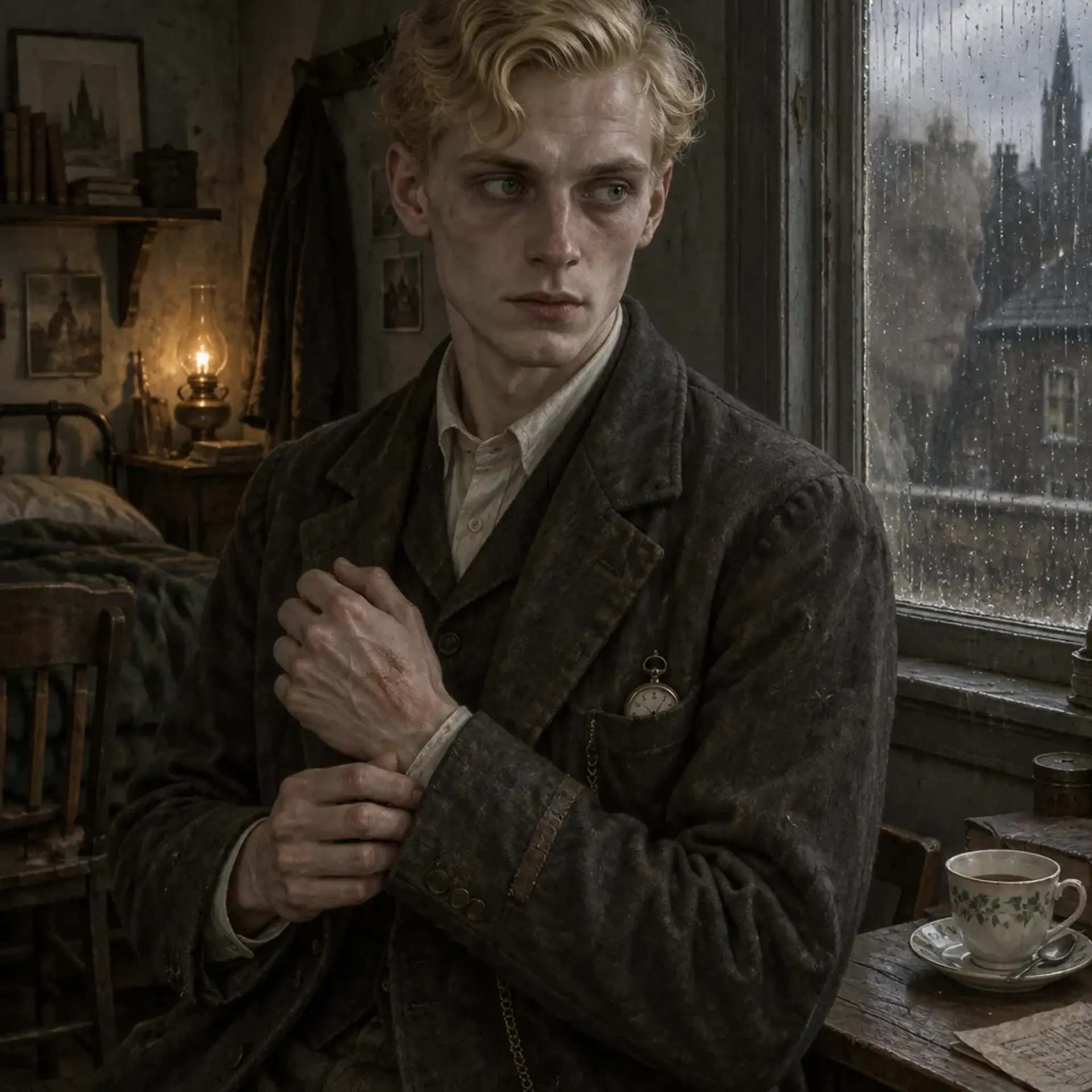
Mark is a young man of average-to-tall height with a lithe, work-hardened frame, broader through the shoulders than Mary had been, and a way of standing as if he is trying to take up less room than his body requires. His bright blond hair lies in close, uneven waves, as though it has been cut with household scissors and then carefully combed into respectability. His eyes are a striking malachite green, alert but often turned aside from direct scrutiny. His skin is pale, with the tired cast of someone who has not slept well for months. He moves with a careful, almost domestic economy: placing his feet quietly, avoiding the creak in a stair, checking a door before committing to it. When waiting, he shifts his weight onto his heels and touches the left cuff of his sleeve as if confirming that his hand is still there. The unexpected detail is his fastidious attention to tea: even in a cramped rented room, he arranges cup, spoon, and pot with the dignity of a well-appointed drawing room. His presence leaves an impression of a young man dressed for a life he has not yet managed to afford.
Clothing
A mix of clothes chosen for necessity rather than taste: work trousers, a plain shirt, a secondhand jacket, and shoes Trudy bought him that he finds poorly made but wears gratefully. He wants better-fitting clothes and keeps them unusually neat.
Body language
When waiting, he settles his weight onto his heels and touches his left cuff. He holds his shoulders carefully, trying to appear composed, and often looks at people through glass or from the edge of a room before meeting their eyes. Under threat, his stance becomes square and economical.
- Height
- Above average for a young woman; taller than Simon Bell
- Build
- Lithe but strong, with a taller, broader frame than Mary had. His hands show the beginnings of practical work.
- Eyes
- Malachite green
- Hair
- Bright blond
- Skin
- Pale, with a tired, slightly salt-washed cast
- Age
- 18
- Gender
- Male
- Size
- Medium
Distinguishing features
Personality
17 traits and drivesMark is shy in company but not meek. He wants to be seen as respectable and capable, yet hates being scrutinized as a curiosity. He can be deeply patient with children and startlingly impatient with adults who mistake his restraint for permission. His manners are careful, even stiff, and his pride is real, but it sits beside a practical willingness to mend a sock or carry a toddler. At home, he relaxes into quiet routines and enjoys television and picture shows with a private, almost studious curiosity. Outdoors, he is drawn to the sea and to old places, though he is more of a homebody than his earliest adventures suggested. Before 30 May, Mary and Kent pulled against each other: Mary wanted to return to the family and Kent wanted time, clothes, and experiences that belonged to him. Their desires could make each other feel trapped. Since the change, those wants have softened into one person's mixed temperament. Mark keeps Mary's solemn devotion and Kent's preference for neatness, decent tea, and a respectable appearance. He is less driven to take control of every outing and less distressed by sharing his past, but he still resents being treated as a woman or as an object. He can be formal when frightened, tender with the children, and quietly curious about cars and new technology. He is not wise about himself. He can acknowledge that something impossible happened, but often puts off the larger questions in favor of rent, work, and breakfast.
- Alignment
- Protective and stubbornly decent, though increasingly willing to use force when family is threatened.
Quirks
Habits
Traits · 4
Flaws · 4
Fears · 4
Wants and needs · 5
Combat
HP 0Avoids fights where possible and tries to get children and friends away from danger. If cornered, he uses whatever is at hand and commits decisively. The response that injured Simon frightened Mark as much as it frightened the family. Mechanics are custom and noncanonical because no Secret Histories combat rules were supplied.
Mark Bell
Actions
Reactions
Services they sell
Rewards they can give
Equipment
- Work coat (clothing)A secondhand coat with repaired cuffs, worn for work and to hide how poorly some of his clothes fit.
- Pocket watch (personal item)A plain, affordable pocket watch that he checks more often than necessary.
- Family and appointment note (personal item)A small folded paper listing the children's names and the doctors' appointment dates.
- Shaving razor (tool)A cheap shaving razor that he has been asked repeatedly not to leave beside the shared sink.
Possessions
Background
Mark's story begins with an object that looked too humble to be dangerous. Bartholomew Golden, an amateur alchemist, left a small, crudely carved stone heart wrapped in newspaper as payment for entry to Hush House. It was shaped like an anatomical heart, rough as a fragment of Dover chalk, with barnacles and scraps of sea grass clinging to its hollows. Golden called it the Heart of England and claimed it could bring laborers out of man's shadow from the chalk cliffs and borderlands. He was not allowed near Brancrug again. The heart was thrown into the sea, and came ashore later, wet with salt and weeping black ooze. Beneath the rock, a reddish-pink light seemed to pulse. Abraham Groff, a young Londoner visiting Wiltshire, picked it up and carried it home. It beat under his coat after the train ride. In company it seemed to go dead; alone with Abraham, especially near water, it stirred again. He grew frightened by the footsteps, voices, and moving doors that followed it, and sold it to William Windon, a local seventeen-year-old. William struck it with a hammer. The beating stopped. He hid it in a log. Mary Bell was eighteen, eldest of eight children, and had more immediate problems than an odd stone. Her family lived in Rochester, Kent, in a comfortable house whose money did not make it kind. Her father Simon took work away from home whenever he could. Her mother Malinda drank, neglected the children, and could turn vicious when crossed. Mary had become a substitute parent by habit, keeping meals and schooling going and protecting her siblings where she could. Henry, fourteen, was growing sharp and defiant. Matilda, twelve, was Mary's closest ally among the children, and Mary was determined that she would not inherit the same burden. Olympia, ten, and Chrissy, nine, were inseparable. Chrissy's father was unknown. Abigail, four, had red hair and green eyes Simon associated with his own family. Jonas, five, was Simon's son from elsewhere, and Malinda's resentment toward him was open. Oswald, two, followed Mary with a blanket and wanted her comfort even when she had nothing left to give. The family was English middle class by income, but their household ran on neglect, secrets, and the labor of children. On Mary's eighteenth birthday, Malinda found the stone heart in the log and gave it to her. Mary was grateful, though not impressed. She kept it because it was a gift and because the small, unlovely object seemed lonely. When it began beating in time with her own heart, she tried to ignore it. She was exhausted, working part time, and could not afford to indulge fear. At first the change appeared in reflections. A handsome young man with close bright-blond hair and green eyes looked back from windows, mirrors, and still water. Sometimes he seemed to look away when Mary watched him. The reflection's face altered expressions independently. Then, after a frightening dream, Mary woke in his body. She could leave the house without being recognized as herself, so she began using the episodes as stolen hours: a walk to the shore, climbing a tree, exploring abandoned buildings, or visiting a pub. She called the young man Kent, after the county, without knowing why that name felt right. He was not merely a disguise or a second voice. His preferences came through as bodily instincts, scraps of local knowledge, discomfort, and opinions that grew clearer with every appearance. He was shy, proud, and more at home indoors than Mary expected. He wanted decent clothes, good tea, and to be treated like a gentleman. He disliked being made to perform femininity and wanted romantic experiences Mary did not want. At first she treated those differences as strange conveniences rather than a life taking shape. The first night she became Kent began with panic. Mary woke to unfamiliar shoulders, longer limbs, and a voice that came from her throat but did not sound like hers. The room was dark; her siblings slept nearby. She touched her face, then found the small heart pulsing through the cloth beside her. She nearly woke Matilda, but the thought of frightening her stopped her. She dressed in whatever would stay on, then slipped downstairs and out. The night air felt immense. She walked to the river, climbed a tree with awkward confidence, and spent hours exploring a disused building where moonlight silvered the broken panes. She came home before dawn. When she woke as herself again, the borrowed night had left her with a stubborn, private certainty that the world outside the house was still hers. On a later outing, Kent ventured into a Rochester pub. He ordered tea first, then, when teased, insisted he was waiting for a friend. His posture was too upright and his manners too careful for the rough room, but he watched the bar, the door, and the other patrons with growing curiosity. A motorcar outside rattled close to the pavement. Kent startled at its noise, then stared after it with frank wonder. The pub adventure ended when he caught sight of Henry. Henry noticed the resemblance between the reflected young man and the figure he had seen around Mary, and grew watchful. He did not expose her. Instead he asked, bluntly, whether Mary was safe. Kent answered with a stiffness that made the question sound like an insult, then surprised himself by staying to walk Henry home. His first return journey came after Simon arrived unexpectedly and Mary, as Kent, had gone farther than intended. He had to find his way home through streets he knew by sensation but not by ordinary memory. Simon was on the road nearby. Kent hid in an alley, then followed the familiar turn of the Medway and a sequence of old lanes until he found the family house. He arrived shaken and wet, with no convincing explanation for his absence. Simon did not recognize him as Mary, but Kent's manner and resemblance to a family portrait unsettled him. Mary later told herself the journey had been luck. Kent insisted, without quite saying it aloud, that the county had guided his feet. Another night, Malinda caught Kent trying to leave. She had been drinking and mistook his presence for a stranger's. Her anger sharpened when he would not answer her questions as Mary would have. She blocked the back door, grabbed his coat, and demanded to know who he was and what he had done with her daughter. Kent froze, humiliated and frightened. Mary, somewhere behind the eyes, tried to make him yield. He did not. He pulled free and got out, but the encounter left him with a deepening dislike of the house and an equally deepening concern for the children still inside it. Trudy, a short, wiry young woman with dirty-blond hair and hazel eyes, had already been helping Mary with the children. She called herself a rebel, dressed in an alternative style for the period, and urged Mary to pursue college rather than be consumed by the household. One evening she saw Kent in person. She recognized his clothes as Mary's improvised choices, but his posture and voice were wrong. She did not scream or call for help. She asked whether Mary was hurt. Kent gave his name and spoke with an awkward formality. Trudy listened, then insisted that whatever was happening, Mary deserved help and Kent deserved to be treated as a person. After the heart disappeared, the changes accelerated. Kent began speaking aloud even when no one else could hear him. His reflection appeared in windows, water, polished metal, and other surfaces. He became more particular about tea, clothing, and how his time was spent. He began to alter plans when he went out, choosing what he wanted rather than merely granting Mary a temporary escape. Cars still astonished him, though he flinched if one came too close. He was becoming more alive, more opinionated, and more distressed by being treated as an image. Strangers began asking after a blond young man with green eyes. At night, a sea-drowned-looking woman with straw-colored hair and near-black eyes came from the water, called Kent her brother, and promised that others would follow. She was independent of the groups searching for him. Her visits unsettled both Mary and Kent. Neither understood what she was, and neither knew why her presence made the heart's absence feel like a wound. Four months after the first changes, on 30 May, Mary lost her face. She was washing at a basin when the reflection would not return her own expression. A tightness moved over her skin, like the seam of a garment coming undone. There was no dramatic burst of blood. Instead, the old appearance loosened and stripped away with the quiet inevitability of a layer of damp paper peeling from glass. Beneath it was the young man who had been waiting in reflections. By morning, there was no simple division between Mary and Kent. His memories and Mary's had mingled. Her solemn devotion to the children remained, alongside his standards of neatness, preference for decent clothes, and desire for a quiet home. His romantic wants no longer pushed so insistently; he felt less need to seize experience from Mary. He began using Mark Bell as a name, though at different times he tried Mark, Marven, or Marcus, uncertain which sat most comfortably. He was still becoming familiar with the name and with the fact of his body. He walked downstairs that morning in clean clothes and began preparing breakfast. He lifted Oswald, who was reaching for him with his blanket, and carried him to a chair gently but firmly. Simon came down ready for work and stopped. He looked at the body, the face, and the way the child settled against it. He asked where Mary was. Mark answered that he was here. Simon's first reaction was not rage but a frightened, practical insistence that this had to be explained. Malinda, hungover and pale, came to the doorway. She took in Mark's face and called him a changeling. Her fear quickly curdled into anger. She said her daughter had been taken, and that the thing standing there was wearing her. Mark tried to tell her that Mary's love for the children was still his. Malinda could not accept it. Simon brought in two private doctors, hoping for an explanation that would preserve the family's normal appearance. Dr Bronson, a London psychologist, began with skepticism but became more careful as he saw how Mark's memories, speech, and reactions did not fit a simple delusion or impersonation. Dr Maylor, a physician from East Anglia, examined Mark with professional restraint. He documented that Mark's body was physically male, with no female breasts and with male reproductive anatomy, and recognized that the transformation could not be explained by clothing, performance, or the ordinary medical conditions he knew. Simon asked both doctors not to let the town decide that Mary was pretending to be a man or had deliberately changed her sex. The doctors could offer no treatment that reversed the change. Mark began regular check-ins with them, partly to reassure Simon and partly to establish what could be known about his health and identity. Henry's reaction was more complicated than Malinda's. He watched Mark carefully, angry and protective in equal measure. He demanded to know whether Mary had been hurt. Mark could not give him a clean answer. He remembered Mary's love for Henry, and he remembered Kent's frustration with his tricks and resentment. Henry said that if Mark was going to claim Mary's place, he had better still care about the younger children. Mark replied that he did. Henry did not apologize, but he began showing Mark which household tasks Malinda was neglecting. Mark's relationship with his parents deteriorated. Simon wanted a remedy and clung to the hope that Mary might return. He was not cruel, but normalcy was a pride he could not surrender. Malinda turned to illegal, darker sources of understanding, drank more, and became more hostile. She treated Mark as a changeling who had stolen her child. The fight came after one of her accusations became physical. Simon, frightened and furious, struck Mark hard in the head. Mark stumbled and nearly fell. Blood ran down his face. For a moment he did not react as Mary had: no retreat, no attempt to smooth things over, no careful protection of the person who had hit him. His eyes went dark and his posture changed, feet set, shoulders turned, every part of him intent on stopping the next blow. He seized the nearest object and struck Simon hard enough to bring him down in front of Jonas and Oswald. Mark shouted that his father would kill them, meaning the father in the heart, though he could not explain the thought clearly. The children were terrified. Henry moved first, putting himself between Malinda and the younger ones. Mark saw Simon on the floor and came back to himself. He called an ambulance, kept pressure on Simon's injury, and went with him to the hospital. Simon survived. Mark was kicked out of the house afterward. Trudy brought him to the small rented flat she was already struggling to afford. He resisted at first, insisting he would only make her life harder. She told him that he could either help with rent or spend the night on a station bench, and he chose the flat. The place was cramped, with a narrow kitchen, an overused couch, and barely enough room for two people to move past each other. Mark slept on the couch and began clearing a small space for himself from a pile of boxes and Trudy's odds and ends. He sorted them with careful, almost ceremonial neatness. Trudy bought him socks, undergarments, a pair of shoes, and a few serviceable clothes. They were not up to his standards: the shoes pinched, one shirt had a crooked collar, and the socks were too thin. He thanked her anyway and folded the clothes with visible care. He found a job doing stock and deliveries for a small shop, work that suited his new body and paid enough to contribute to rent. Trudy treated him neither as Mary in a man's disguise nor as a stranger who had replaced her. She set rules: he had to tell her if he would be late, wash his own cups, and keep the razor blades away from the sink where she might cut herself. Mark left shaving razors out more than once. He still sleeps badly. At night he paces the narrow room, stops at the window to study his reflection, and sometimes sleeps as if caught in a fit, twisting the sheets and speaking fragments of names. Trudy learned not to grab him awake. She sits on the floor nearby and says his chosen name until he returns to the room. They disagree about money, his insistence on decent tea, and his tendency to keep the flat too orderly. They also share a quiet loyalty. Trudy continues to insist that he and Mary had deserved the chance to go to college; Mark has not decided whether that hope belongs to him, but he keeps the prospectus she brought him. Once, trying to test Malinda's claims about supernatural beings, he touched cold iron. Pain seared through his left hand, leaving a lasting scar. He has not repeated the experiment. The drowned woman eventually stopped appearing and went back into the waves. Mark misses her, though he does not know whether the feeling is grief, longing, or a memory that belonged to Kent alone. As the months pass, Mark grows more at ease with himself. He is still private, proud, and a homebody. He is no longer fighting for each hour of existence. He has begun to speak of the Bell children as his family without hesitation, and to think of the small rented room as a place he might keep.
Role in the story
A sympathetic, unsettled ally whose identity and family ties place the characters between a dangerous supernatural history and ordinary domestic need. He can offer clues about the missing heart, the strangers seeking him, and the sea-drowned woman, but his immediate priority is keeping his siblings safe.
“Bartholomew Golden, an amateur alchemist, left a small, crudely carved stone heart wrapped in newspaper as payment for entry to Hush House.”
- Faction
- No formal faction. Entangled with the Heart of England, Hush House's history, and the Bell family.
Known connections
Media
0 imagesNo images yet.
Turn Mark Bell into a sheet
A high-res, share-ready sheet you can post or print.