
How to Run Solo D&D With AI Tools: A 2026 Guide
How to run solo D&D with AI in 2026: the AI game masters compared on price and rules, the analog oracle method, and a full sample solo session walkthrough.
You don't need four friends and a free Saturday to play Dungeons & Dragons any more. Learning how to run solo D&D with AI is the fastest it has ever been, because two things happened at once: the ruleset went free, and the tools that stand in for a Dungeon Master got good enough to hold a story together. The D&D System Reference Document 5.2.1 went up as a Creative Commons Attribution 4.0 download on 1 May 2025, so the rules you'd build a solo game on cost nothing. And the AI game masters that were a novelty in 2023 now run persistent campaigns with spell slots, initiative, and memory that lasts across sessions.
I play in a weekly group, but I also run a solo game most weeknights when everyone else is asleep. It scratches a different itch: no scheduling, no session prep for other people, just me and a world I can poke at for twenty minutes before bed. This guide is the honest map of what actually works in 2026, what each tool costs, where the AI still falls over, and the exact workflow I use to keep a solo campaign from turning into aimless improv.
What solo D&D actually is
Solo D&D is the same game with the seats collapsed. Normally you have several players and one Game Master. In a solo game there is one player and one GM, and they are the same person. That sounds like it shouldn't work, because half the fun is being surprised by the world. The trick every solo system uses is a source of surprise you don't control: an oracle, a set of random tables, or an AI that answers "what happens next" for you.
There are two broad ways to get that surprise, and they map cleanly onto the tools you'll pick.
The first is the oracle method: you keep GMing yourself, but you outsource the yes/no questions and the plot twists to dice and tables. The second is the AI game master method: a program narrates the world, plays the NPCs, and adjudicates the rules while you play your character. Plenty of people mix the two, and by the end of this guide I'll show you why the mix beats either one on its own.
The AI game masters, compared
This is the category that changed most between 2024 and 2026. A handful of dedicated platforms now run structured D&D 5e campaigns rather than freeform fiction. Here's how the main options stack up, with prices checked in July 2026. Always click through to the live pricing page before you subscribe, because several of these tools changed tiers in late 2025.
| Tool | What it is | Rules accuracy | Free tier | Paid from |
|---|---|---|---|---|
| Friends & Fables | AI GM ("Franz"), solo or group | D&D 5e combat, tactical battlemaps | Yes, a daily turn allowance | ~$19.95/mo |
| AIDungeonMaster.ai | Purpose-built 5e AI DM | Full 5e engine (checks, spell slots, conditions) | Yes, free to start | Pro (see pricing page) |
| RoleForge | AI GM, any ruleset | System-agnostic, 5e supported | Free during alpha, no limits | Paid tiers planned |
| AI Dungeon | Freeform AI fiction | Loose, not rules-accurate | Yes, small memory bank | ~$9.99/mo |
| ChatGPT / Claude | General assistant as a GM | Only as good as your prompt | Limited free use | ~$20/mo (Plus/Pro) |
A few notes that the table can't hold.
Friends & Fables is the most complete "sit down and play" option. Its AI game master is named Franz, it runs turn-based combat on the D&D 5e chassis, and it draws tactical battlemaps so you're not tracking positions in your head. It supports solo and multiplayer campaigns, and it has world-building tools for homebrew NPCs, monsters, items, and spells. The free plan gives you a set number of turns each day, which is enough to test whether the loop clicks for you. Paid plans start around $19.95/month and climb to roughly $39.95/month at the top tier, after an across-the-board price rise in December 2025.
AIDungeonMaster.ai is the one I'd point a rules-first player at. It's built on D&D 5e from the ground up, so ability checks, spell slots, combat, and conditions are handled by an actual engine rather than the AI guessing. It runs solo or with up to five players, keeps persistent campaign memory, and has a creator marketplace where people publish adventure modules. It's free to start with a Pro upgrade when you're hooked.
RoleForge is worth watching because, as of mid-2026, it's free during its alpha with no limits, no credit gates, and no per-session fees. It's system-agnostic rather than 5e-locked, which is a plus if you play Pathfinder or Daggerheart on the side. The paid tiers, when they arrive, are set to add stronger models plus built-in image, scene, and video generation.
AI Dungeon is the granddaddy of the category and the one to be honest about. It's brilliant for freeform, improvisational storytelling, and the free tier lets you start immediately with a small memory bank of around 2,000 tokens. But it is not a rules engine. It won't stop you casting a spell you don't have, and it forgets details once they fall out of its memory window. Paid plans, roughly $9.99 to $49.99/month depending on the tier, buy you better models and a much larger memory. Treat it as a story generator, not a referee.
ChatGPT or Claude deserve a mention because a lot of people run solo D&D in a general chatbot with a good system prompt, and it works better than you'd expect. You'll pay about $20/month for a Plus or Pro subscription to get the strong models and enough context. The catch is the same as AI Dungeon: no rules enforcement, and memory that fades unless you keep pasting a running summary back in. If you enjoy being your own rules lawyer, this is the cheapest flexible option going.
One tool that keeps appearing on these lists but shouldn't be mistaken for a game master: LoreKeeper. It's a prep and world-building toolkit, not an AI DM. It generates characters, monsters, maps, and sourcebook content and stores your campaign world, with a free tier that's genuinely useful. Good for prep, wrong category for "run the game".
The analog oracle method still holds up
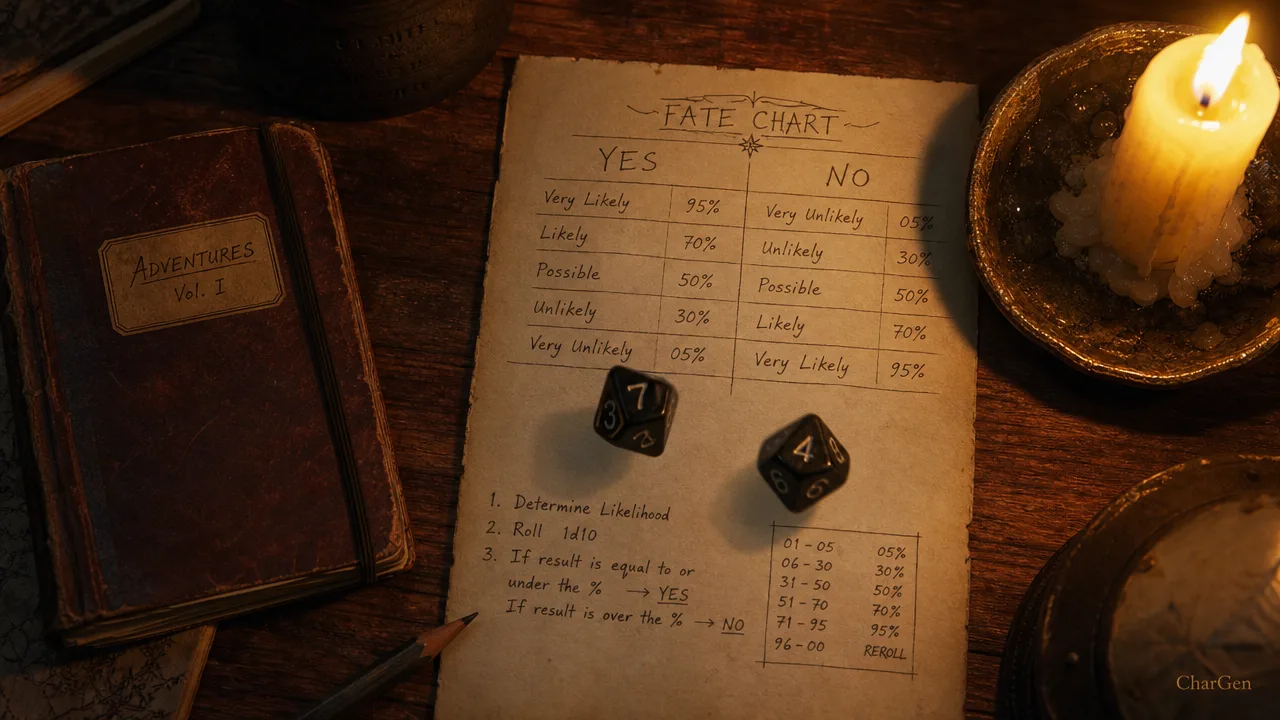
If you want the AI to help but you'd rather keep your hand on the wheel, the oracle method is older than any chatbot and still the backbone of solo play. The gold standard is the Mythic Game Master Emulator, which introduced oracle-style solo play back in 2003 and split the GM-emulation rules into their own book in 2006. The second edition refined it further. The core mechanic is simple: you ask the oracle a yes/no question weighted by how likely you think the answer is, roll, and read the result, with "exceptional yes" and "exceptional no" swings plus random events to throw you off your own script.
Around Mythic you'll see the same supporting cast recommended again and again: the Universal NPC Emulator (UNE) for generating people on the fly, the Tome of Adventure Design for seeding plots, and any of the solo-focused oracle decks. None of it needs a screen. What changed in 2026 is that you can now bolt AI prep onto this analog loop and get the best of both, which is where CharGen comes in.
Where CharGen fits: the prep layer
I'll be straight with you, because it's the fastest way to be useful. CharGen is not a live AI dungeon master. It won't sit across the table and narrate the goblin's turn. What it does is the job that makes a solo session actually playable: it builds the world you're about to explore, so you're not staring at a blank page trying to invent a town, six NPCs, and a dungeon at the same time you're meant to be enjoying playing.
Here's the split that works. The AI GM or your oracle handles what happens live. CharGen handles what exists before you start. Concretely, before a session I'll spin up:
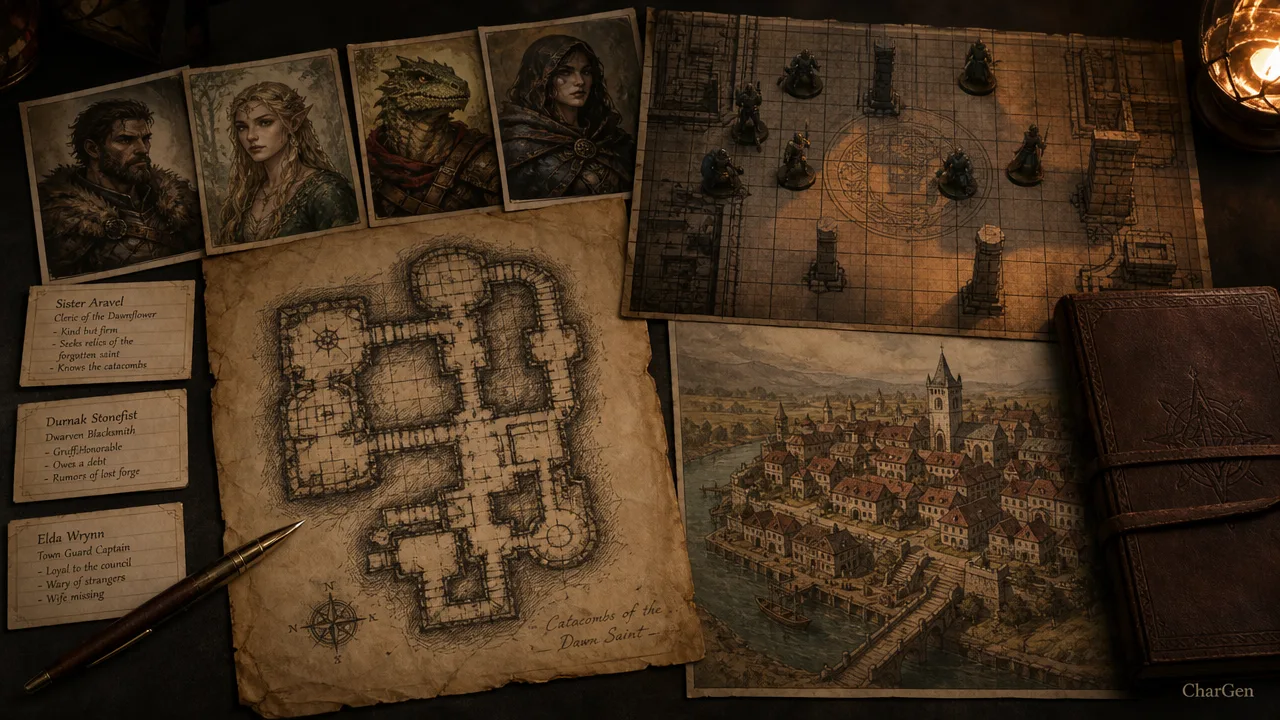
- A settlement and the people in it with the NPC generator, so the tavern keeper, the suspicious guard, and the quest-giver all have names, motives, and a face rather than being "generic villager #3".
- A crawl to actually explore with the dungeon generator, which gives me rooms, contents, and structure instead of a shapeless void.
- A battlemap for the fights, so when combat kicks off I've got a grid to run it on rather than guessing distances.
- Portraits with the character art generator for my own character and the important NPCs, which sounds like a nicety until you realise how much a face helps you care about a person you invented ten seconds ago.
CharGen carries a free tier built on gold rather than a hard credit wall: you get 25 gold when you sign up, 10 more every day you log in, and bonus gold for engaging and entering competitions, so a consistent solo player generates plenty without paying. The toolkit spans 15+ generators and 160+ AI models, and it's produced over 830,000 images for 43,000+ creators, so the world-building side is well past the experimental stage.
The point isn't that you need CharGen to play solo. It's that the single biggest reason solo campaigns fizzle is the prep tax, and offloading that tax to a generator is the difference between playing tonight and "I'll start the campaign properly next week" for the fourth week running. If you want the full prep stack in one place, the RPG workshop chains the generators together.
A sample solo session, start to finish
Theory is cheap, so here's an actual short session I ran, compressed. It shows how the prep layer and the play layer hand off to each other.
Prep, about ten minutes. I generated a small coastal town called Saltmarrow, plus five NPCs. The one that stuck was Edda Vane, a harbourmaster with a gambling debt and a reason to look the other way when smugglers dock. I generated a portrait for her so she felt real, and I built a flooded sea-cave dungeon under the docks with the dungeon generator. Total prep: one town, five people, one crawl, a battlemap for the cave, roughly ten minutes.
Session zero of the night. I set the hook myself: my character, a down-on-her-luck investigator, takes a job to find out why ships keep vanishing off Saltmarrow. That's the only bit of authoring I did. Everything after this I handed to the oracle.
Playing it out. I ask the oracle: "Is Edda hiding something when I question her?" I rate it likely, roll, and get a yes with a random event that introduces a second party, a rival investigator already poking around. I didn't plan that person. The oracle invented them and I ran with it, generating a quick NPC for the rival on the spot. When I finally reach the sea-cave, I switch to running combat properly on the battlemap, rolling initiative and tracking the smugglers' hit points against the SRD stat blocks. The oracle tells me whether reinforcements arrive; the rules tell me whether my crossbow bolt lands.
Where it went sideways, honestly. Twice the oracle handed me a "yes" that contradicted something I'd already established, and I had to overrule it, because the oracle has no memory and doesn't know the town's mayor is already dead. That's the real limitation of the analog method: continuity is your job. An AI game master like AIDungeonMaster.ai holds that continuity for you, which is exactly the trade-off between the two approaches.
That session took about forty minutes to play after ten minutes of prep, and it produced a rival character and a smuggling twist I'd never have written on purpose. That's the whole appeal.
Which setup should you pick?
There's no single best answer, so here's a straight recommendation by what you actually want.
You want to sit down and just play, rules handled for you. Start with AIDungeonMaster.ai for strict 5e, or Friends & Fables if you also want tactical battlemaps and a slicker interface. Both have free tiers, so try both across a week before paying.
You want maximum freedom and don't mind being your own rules lawyer. Run it in ChatGPT or Claude with a solid system prompt, or use AI Dungeon for pure improv. Budget about $20/month if you want the strong models.
You want the classic solo-RPG feel with real dice. Use the Mythic GM Emulator with the SRD 5.2.1 rules, and lean on CharGen to prep the NPCs, maps, and portraits so the analog loop isn't slowed down by world-building.
You're on a tight budget. The SRD is free, RoleForge is free during its alpha, and CharGen's gold-based free tier covers your prep. You can run a full solo campaign in 2026 for nothing if you're willing to do the GMing yourself.
Whatever the live tool, the prep layer is the same, and it's the part people underestimate. A solo game lives or dies on having something to explore. Build the town, stock it with people, draw the map, then let the oracle or the AI surprise you inside it.
Frequently asked questions
Can you really play D&D alone? Yes. In solo D&D you play both your character and the Game Master, and you use an oracle, random tables, or an AI game master as your source of surprise so the world can still push back against you. The rules are identical to group play; only the seating changes.
What's the best AI for solo D&D in 2026? For rules-accurate 5e, AIDungeonMaster.ai and Friends & Fables are the strongest dedicated options, both with free tiers. For freeform storytelling, AI Dungeon or a general assistant like ChatGPT or Claude works well. There's no universal winner, so match the tool to whether you care more about rules or freedom.
Is solo D&D free? It can be. The D&D SRD 5.2.1 has been free under a Creative Commons licence since May 2025, RoleForge is free during its alpha, and CharGen's free tier handles prep on a gold system with no card required. You only start paying if you want a premium AI game master or heavier usage.
Do I need an AI dungeon master, or can I use dice? Either works. The Mythic GM Emulator, an oracle system from 2003, lets you run a full solo game with dice and tables and no AI at all. AI game masters add continuity and rules enforcement that the analog method leaves to you, at the cost of a subscription. Many solo players use both: dice for the oracle, AI for the prep.
How is CharGen different from an AI dungeon master? CharGen is the prep layer, not a live game master. It generates the NPCs, settlements, dungeons, battlemaps, and character art you explore, then you play through that world with whichever AI GM or oracle you prefer. It removes the world-building tax that makes most solo campaigns stall before they start.
If you take one thing away, make it this: pick any live tool from the table above, then spend ten minutes building a town and a dungeon before you play. Try the RPG workshop for the prep, keep the SRD open for the rules, and let the oracle handle the surprises. That's a complete solo setup, and you can start tonight.