
Best AI Dungeon Generators for D&D in 2026: 8 Tools Tested
Tested 8 dnd dungeon generator tools for 2026. CharGen, cros.land, donjon, DunGen, Dungeon Scrawl and more compared on maps, room content, and price.

For ten years the fastest way to build a dungeon was to open the 2014 Dungeon Master's Guide to Appendix A: Random Dungeons, around page 290, and start rolling d10s. The 2024 revised DMG quietly deleted that appendix. In its place is Appendix B: Maps, a set of ready-made black-and-white maps drawn by cartographer Dyson Logos. Good maps, but a fixed library is not a generator. That single change is why a dnd dungeon generator is now a genuine gap in the official toolset, and why I have spent the past fortnight running eight of them before sessions to see which ones actually save prep time.
The tools split into three camps, and knowing which camp you are in matters more than any single feature. There are procedural map makers that draw you a layout and stop (donjon, DunGen, Dungeon Scrawl). There are AI narrative engines that write you rooms, monsters and hooks (AI Dungeon, and partly CritForge). And there is a small group that does both in one pass: an actual map plus the room-by-room content to run it. That last camp is where the real time saving lives, because the thing that eats a Tuesday evening is not drawing corridors, it is deciding what is in room 7 and why the players should care.
Why the 2024 rules make a generator more useful, not less
Worth being clear about what changed. The 2014 DMG's Appendix A gave you dice tables for starting areas, passages, chambers, and stocking, plus a warning that it could spiral into a sprawling megacomplex if you did not set a size limit first. It was fiddly but complete: you could build a whole dungeon from rolls. The 2024 book reorganised everything around the session-to-campaign flow and swapped those tables for the Dyson Logos map toolbox in Appendix B. The maps are lovely and reusable, but you now supply every room's contents yourself.
So the job a generator has to do in 2026 is different from the one it did in 2016. A layout alone is the easy 20 percent. The hard 80 percent, the part the official rules no longer hand you, is stocking: monsters scaled to the party, traps with real mechanics, treasure that fits the fiction, and a reason the place exists. The tools below are ranked on how much of that 80 percent they actually do.
What separates a useful dungeon generator from a maze drawer
Before the table, here is what I check when I open one of these on a Tuesday night.
Does it stock the rooms, or just draw them? A blank map is a colouring book. I want monsters, traps, treasure and a line of read-aloud text per room. Sly Flourish's Lazy Dungeon Master method is built on prepping the minimum that survives contact with players, and a generator that fills rooms for you is that method automated.
Is the layout designed or random-noise? Watabou's One Page Dungeon uses a "local symmetry" algorithm specifically so maps look partly hand-drawn rather than like maze static. That readability matters. The Angry GM argues that a good dungeon reads as connected "neighbourhoods" players can navigate, not a flat grid of identical boxes.
Does it export to your VTT? If you run on Roll20 or Foundry VTT, grid alignment and file size decide whether a map drops in cleanly or fights you for ten minutes.
Visual output you can show the table. A described room is fine. A described room with an image of it is better, and cuts the "so what does it look like?" questions.
Does it connect to the rest of prep? A dungeon needs the monsters inside it and often a settlement above it. A tool that generates in isolation leaves you stitching.
Quick comparison: 8 D&D dungeon generators tested
| Tool | Type | AI-powered? | Map output | Stocks rooms (monsters/traps/loot)? | Price (2026) |
|---|---|---|---|---|---|
| CharGen | Map + narrative | Yes (hybrid) | Dyson-style SVG, PDF/PNG, painted battlemap | Yes (full content + hooks) | Free to start / Plus £8/mo |
| cros.land | Map + narrative | Yes | Downloadable map images | Yes (statblocks capped free) | Free / Premium $5/mo |
| donjon | Procedural map | No | SVG, PDF, JSON | Partial (contents, no art) | Free, no signup |
| DunGen | Procedural map | No | High-res VTT map (70px tile) | No (map only) | Free / Patreon tiers |
| Dungeon Scrawl | Manual map maker | No | VTT-ready battlemaps | No (you draw + stock) | Free, no signup |
| Watabou One Page Dungeon | Procedural map | No | PNG, SVG, JSON, Markdown | Light (hint text only) | Free / pay what you want |
| AI Dungeon | AI text adventure | Yes | None (text only) | Narrative, not statted | Free / paid ~$9.99–$49.99/mo |
| CritForge | AI GM toolkit | Yes | Multi-level dungeon maps | Yes (CR-balanced) | Solo $15/mo, Pro $25/mo |
CharGen is my top pick because it is the tool that closes the gap the 2024 DMG opened: it draws the map and stocks every room in one pass, with art you can show the table. The rest of the list is genuinely useful, and for some jobs a free single-purpose tool beats it, so I have been honest about where.
1. CharGen: the best D&D dungeon generator for complete, playable crawls

The CharGen Dungeon Generator is the only tool here that gives me a finished, runnable dungeon in under a minute. It combines a procedural layout engine with AI-written content, so the output is a map and everything that goes in it.
The map itself uses a tree-growth algorithm with locally symmetric branches, rendered in a Dyson-style look: thick wall outlines, diagonal hatching, a grid floor, and a warm parchment palette. That is not a coincidence, it is the same visual language the 2024 DMG's official Appendix B maps use, so a CharGen map sits comfortably next to WotC's own cartography at the table.
I generated a level 5 undead crypt to test it. The output ran to roughly a dozen rooms and corridors and included, per room, read-aloud descriptions with sights, sounds and smells, monsters scaled to the party level, traps and hazards with mechanical effects, treasure tied to the dungeon's lore, a handful of secrets, three to five plot hooks, and a one-paragraph history for the site with a proper name. The whole thing took about 20 seconds.
What makes it stand apart from the procedural crowd:
- It stocks the rooms. This is the headline. Where donjon and DunGen hand you a layout, CharGen hands you a layout plus the monsters, traps, treasure and read-aloud text to run it. That is the 80 percent the 2024 rules stopped doing for you.
- Regenerate a single room. If room 7 comes out flat, you re-roll just that room instead of the whole dungeon. That is the feature I did not know I wanted until I had it.
- It connects to the rest of prep. The dungeon links into CharGen's other generators. Need a boss with a face? The monster generator is one step away. Building the region the dungeon sits under? The RPG Workshop ties settlements, factions and sites together.
- Export and save. Maps export to PDF and PNG, and dungeons save to your World Codex with public shareable pages. CharGen's community has generated 830,000+ images across 43,000+ creators, so the model has a lot of fantasy art behind it.
- Pathfinder 2E as well as 5E. The system defaults to D&D 5E but supports Pathfinder 2E, which most single-purpose 5e generators do not.

The honest limitation: CharGen's primary map is clean SVG cartography, not a photoreal top-down VTT battlemap with lighting baked in. There is a second output that closes part of that gap. The dungeon view has a Battlemap panel that takes the generated SVG layout and paints it into a textured top-down battlemap image, so you get both the readable line map and something you can drop on a VTT. That shipped in April 2026 and it is on by default for a generated dungeon. What it still does not give you is Foundry dynamic-lighting wall data, so if you want walls and line-of-sight computed for you on import, a dedicated map tool like DunGen does that one job better. CharGen is stronger when you want the whole dungeon, map and contents and hooks, rather than a beautiful empty floor.
The free tier runs on gold: 25 gold when you sign up, 10 more for each daily login, and extra from commenting, posting and competitions. No credit card to start. The Plus tier is £8/month and opens up the premium models across every generator. Elite is £16/month and Ultimate is £32/month, and unused subscription gold rolls over for up to six months.
2. cros.land: the closest AI rival, and genuinely good
Kenji's Dungeon Generator 2.0 on cros.land is the tool that comes nearest to what CharGen does. It is AI-powered and, in its own words, produces "not just a map, but room-by-room descriptions, NPCs with backstories and relationships, monsters with full statblocks, traps, treasure, and boss encounters." That is the right ambition, and it delivers.
The AI-powered version launched in January 2024. Map generation, room descriptions and NPCs are free. The catch is that full monster statblock generation is capped at five per day on the free tier, which for a large dungeon is limiting. Premium is $5 a month and lifts the limits while adding save/load and export to Homebrewery markdown, structured HTML, or plain text.
If you prep in Homebrewery and want tidy markdown out, cros.land's export is a real advantage. It is the tool I would reach for if CharGen did not exist, and at $5/month it is the cheapest way to get AI-statted rooms.
3. donjon: the free workhorse that has run since 2009
donjon's 5e Random Dungeon Generator is the tool most DMs cut their teeth on, and its copyright notice reads 2009 to 2026, so it has outlasted two edition changes. It is procedural, not AI, and the depth of its controls is still unmatched: you set dungeon level, party size and a motif (Abandoned, Aberrant, Giant, Undead and more), then tune size from Fine to Colossal, room density (Sparse, Scattered, Dense, Symmetric), corridor style (Labyrinth, Errant, Straight), door lethality up to "Deathtrap", and grid type (square, hex, or none).
It exports to SVG, a print-upscaled version, HTML, PDF and JSON, with about fifteen map styles from Parchment to Steampunk to Infernal. It stocks rooms with contents and monsters from the tables, but there is no art and no AI narrative, so the descriptions are functional rather than evocative. It is completely free with no signup, and donjon runs parallel generators for 5e, the d20 SRD, the 2024 revision and even AD&D.
For raw speed on a clean page with no account and no cost, donjon is still the default. What it will not do is write you a room worth reading aloud. I went wider on donjon specifically, beyond just its dungeon tool, in my donjon alternatives comparison.
4. DunGen: high-resolution maps built for the VTT

DunGen is the tool for when you need the map to look properly good on a virtual tabletop. It is procedural, not AI, and per its FAQ it uses a custom algorithm that produces a "more logical map" than maze-based generators, ready to import into Roll20, Foundry VTT, Fantasy Grounds or Astral.
Free maps generate at 70 pixels per tile, which is the Roll20 and Astral standard, and DunGen keeps free files under 5MB so they clear the free-tier VTT upload limits. Its Patreon tiers (Dungeon Designer, Architect and Merchant) add double-resolution 140px-per-tile downloads, plus automatic Dynamic Lighting for Roll20, Walls for Foundry (.json) and Line-of-Sight for Fantasy Grounds Unity. If dynamic lighting that just works on import is your priority, DunGen earns its keep.
What DunGen does not do is stock the dungeon. You get a gorgeous, VTT-ready floor and nothing on it. Pair it with a content generator and you have a strong combination.
5. Dungeon Scrawl: the free map maker Roll20 bought
Dungeon Scrawl is a free, browser-based map maker built by Keir "ProbableTrain". It is not a generator in the random sense, it is a fast manual drawing tool with square, hex and isometric grids, layers with opacity and blend modes, and exports optimised for Roll20, Foundry and Owlbear Rodeo. No download, no signup.
The telling detail for 2026 is ownership: Dungeon Scrawl is now part of the Roll20 family, with a live Roll20 integration that launched in February 2025. That consolidation says Roll20 sees the free-map-maker space as strategic. Use Dungeon Scrawl when you have a specific layout in your head and want to draw it precisely rather than roll for it. It will not invent a dungeon for you, and it stocks nothing.
6. Watabou One Page Dungeon: the elegant procedural sketch
Watabou's One Page Dungeon is a small piece of craft. Built for a 2019 procedural-generation game jam and still updated (v1.2.7 shipped in January 2026), it uses a local-symmetry algorithm so its maps look partly designed rather than randomly generated. It produces rooms, corridors and doors plus short location notes that hint at a story, and exports to PNG at custom print DPI, SVG, JSON and Markdown. It is seed-based, so a given seed always regenerates the same dungeon, and it has colourblind and high-contrast options.
It is free or pay-what-you-want with no minimum and no registration. The trade-off is scope: it gives you a beautiful one-page layout with flavour hints, not statted encounters. As a fast, attractive skeleton you then flesh out, it is hard to beat.
7. AI Dungeon: brilliant for improv, not for prep
AI Dungeon is worth including precisely because people confuse it with a dungeon generator, and it is not one. It is an AI text-adventure engine. Created by Nick Walton at a 2019 hackathon on OpenAI's GPT-2, it famously hit 100,000 players within a week of launch. It generates infinite improvised story, not a map or a statted encounter you can prep from.
Pricing is freemium: a free Wanderer tier plus paid plans running roughly $9.99 to $49.99 a month for larger context windows, better models and image credits. An account is required. For solo play or for riffing on ideas it is genuinely fun, and it can spark a dungeon concept. But you cannot hand its output to a group and run it as written, because there is no map, no grid and no statblock. Treat it as inspiration, not prep.
8. CritForge: the AI GM suite with dungeon maps attached
CritForge is the most feature-dense AI option, aimed at GMs who want a whole toolkit rather than a single generator. It can generate multi-level dungeon maps with terrain, furniture, traps and encounter zones, and it wraps them in GM-ready statblocks and read-aloud text. Its encounters are CR-balanced with action-economy warnings and a one-click rebalance, and every plot it builds follows the Three-Clue Rule, so the design thinking is sound.
Pricing is subscription-only: Solo at $15/month and Pro at $25/month, with all plans including its nineteen generator types, VTT export to Roll20, Foundry, Fantasy Grounds and Owlbear Rodeo, and SRD 5.2 compliance. That is a real commitment compared with cros.land's $5 or CharGen's free tier. If you want one paid subscription that does dungeons, encounters, villains and modules together, CritForge is a serious option. For dungeons specifically, it is pricier than it needs to be.
Balancing what is inside: the 2024 XP budget
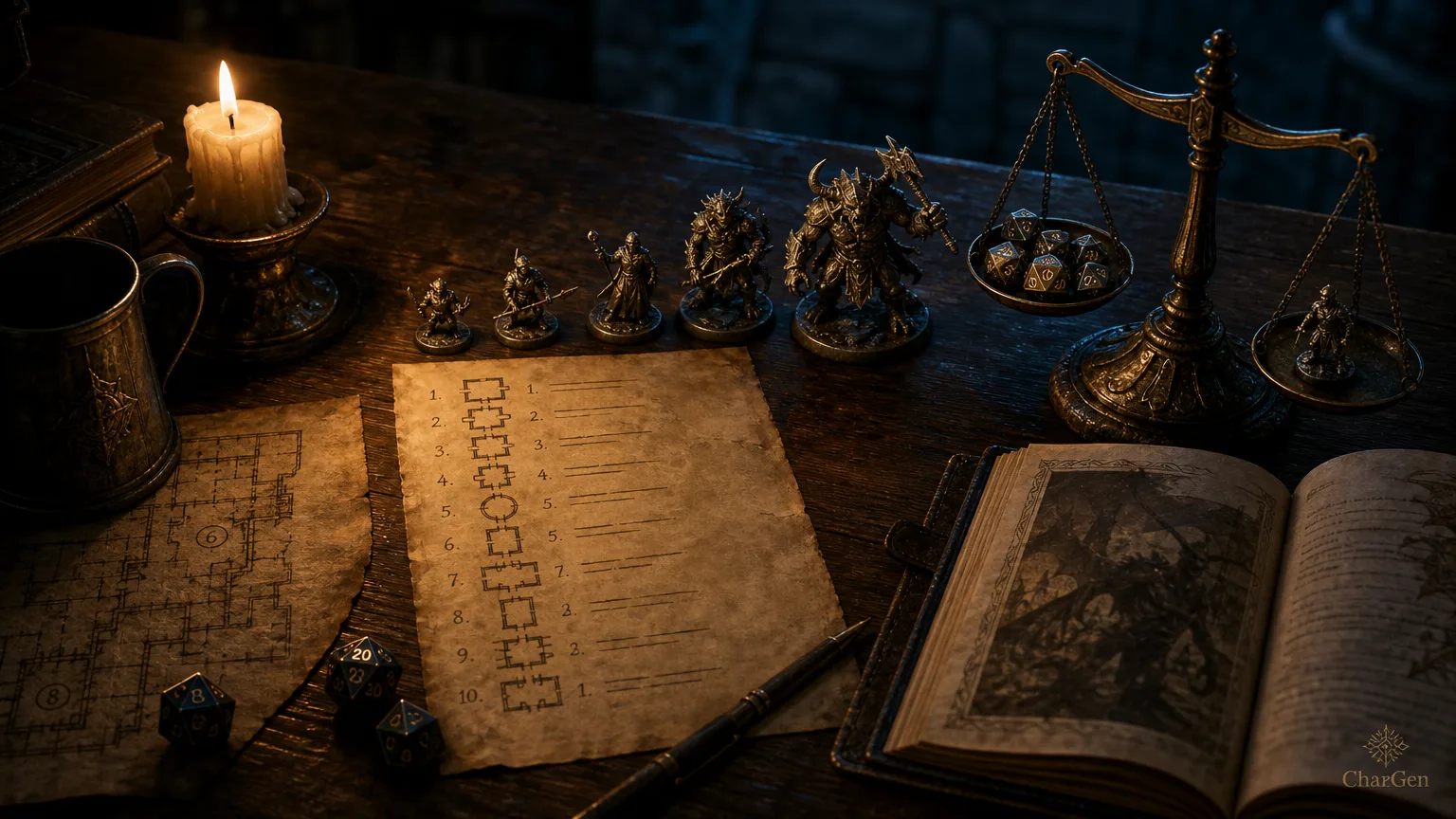
A stocked room is only useful if the fight in it is survivable. The 2024 rules changed how you check that, and most generators have not caught up.
The 2014 DMG gave you four difficulty bands: Easy, Medium, Hard and Deadly. You added up the monster XP, then multiplied it by a factor based on how many monsters were in the fight. The 2024 DMG cut both of those things. There are now three bands, Low, Moderate and High. The multiplier is gone. You take the XP budget for one character, multiply it by the number of characters, and spend as much of that budget as you can without going over.
Here is the part of the official XP Budget per Character table I check most often.
| Party level | Low | Moderate | High |
|---|---|---|---|
| 1 | 50 | 75 | 100 |
| 3 | 150 | 225 | 400 |
| 5 | 500 | 750 | 1,100 |
| 10 | 1,600 | 2,300 | 3,100 |
| 20 | 6,400 | 13,200 | 22,000 |
Multiply by party size and you have the number. Four level 1 characters on a low-difficulty fight get 50 times 4, so 200 XP. Five level 3 characters on a moderate fight get 225 times 5, so 1,125 XP. That is the whole calculation now.
Losing the multiplier matters for dungeons in particular. Under the old maths, eight kobolds in one room cost you far more of your budget than their raw XP suggested, because the multiplier punished large groups. Under the 2024 maths they cost exactly their XP. The rules do add one piece of guidance in place of the multiplier: if an encounter has more than two creatures per character, include fragile creatures that can be beaten quickly. That is a design note, not a sum.
So how do the eight tools handle it?
CritForge is the only one here that does the arithmetic and shows its working. Its encounters are CR-balanced, it warns you about action economy, and it rebalances in one click. donjon takes a dungeon level and pulls monsters from tables scaled to it, which gets you close without stating a budget. CharGen scales monsters to your stated party level and system, and I have not had a level 5 crypt hand me a level 12 boss. What it does not print is an XP total per room, so I still tally the big fights myself.
That tally takes about a minute. Open the room, add up the XP of what is in it, and compare it against your party's budget. If a generator drops a High-difficulty fight three rooms into a dungeon your players will run for a week, move it to the end. This is the one bit of prep I would not hand to any tool on this list without checking.
Room keys: the output format that decides whether you can run it
A room key is the format published adventures have used since the earliest modules: a numbered map, then one keyed entry per number. It sounds trivial. It is the single biggest difference between a generator you can run from and one you have to rewrite.
What I want in a keyed entry is three things. Read-aloud or boxed text I can speak to the table without paraphrasing. The mechanics under it, meaning the monsters, the trap DC and damage, and the treasure. And a reason the room exists, so it connects to the room next door instead of sitting there as a box with a goblin in it.
Measured against that, the eight tools split cleanly. CharGen produces the full three: read-aloud text covering sights, sounds and smells, then statted monsters, traps with mechanical effects, treasure tied to the site's history, secrets, and three to five plot hooks for the dungeon as a whole. cros.land produces room-by-room descriptions with NPCs and statblocks, capped at five statblocks a day on the free plan. donjon gives you contents and monsters in a functional list, so you get the mechanics but write the prose yourself. Watabou's One Page Dungeon gives short location notes that hint at a story, which is a prompt rather than a key. DunGen and Dungeon Scrawl give you nothing, because they are map tools and do not claim otherwise.
The practical test I use: can I read the entry aloud, cold, with the map on screen and no other notes? With a keyed entry the answer is yes. With hint text the answer is that I improvise, which is fine when I want to and a problem when I am tired on a Tuesday.
One habit worth stealing. When a generated room comes out flat, do not rewrite it, re-roll it. On CharGen you regenerate that single room rather than the whole dungeon, which keeps the rooms either side untouched. On donjon and Watabou you re-roll the seed and get a different dungeon entirely, so keep the map you liked and swap the contents by hand.
Getting a generated dungeon into Foundry VTT, Roll20 or onto paper
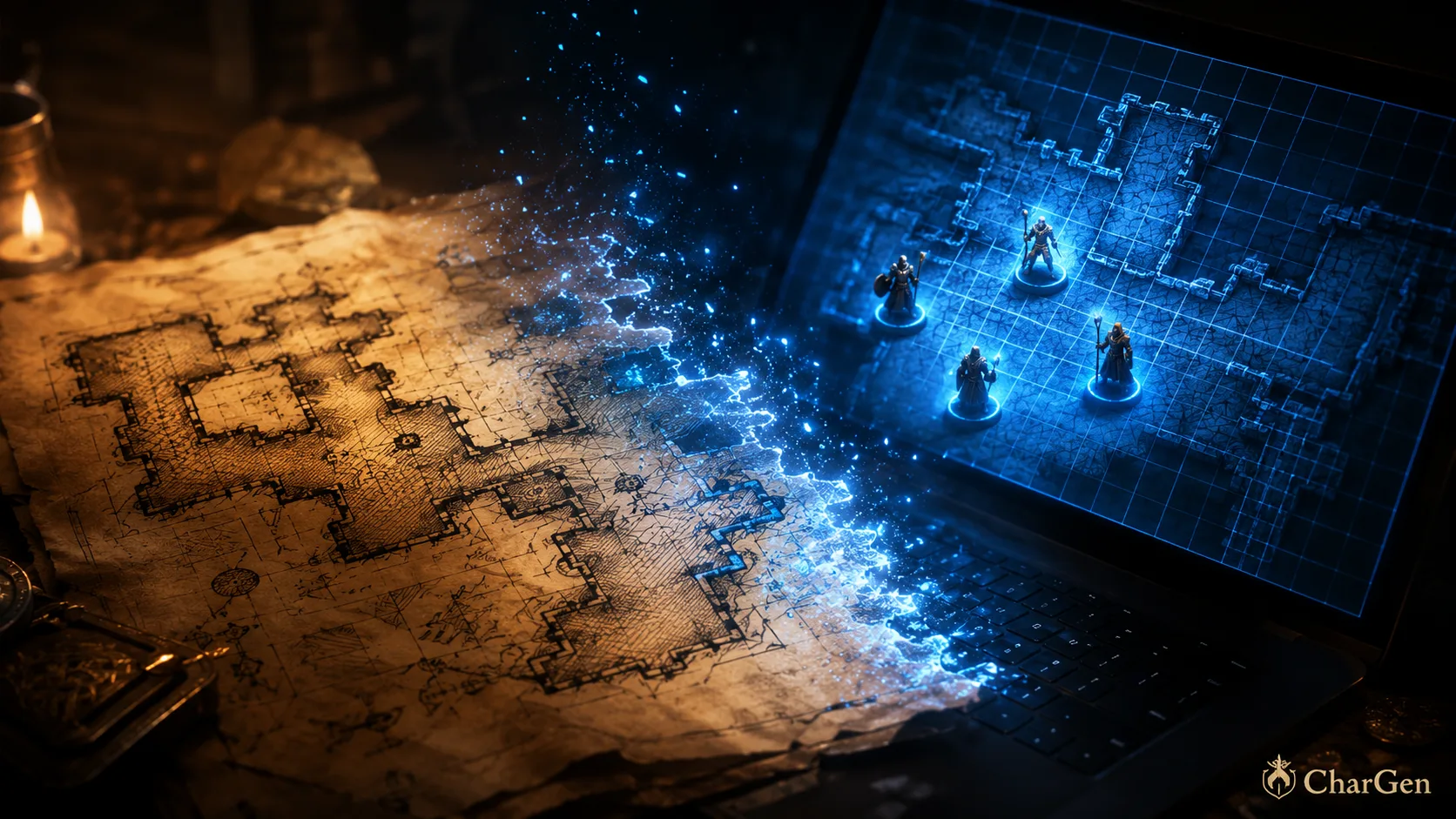
Export is where a lot of good prep dies. You generate something excellent, then spend fifteen minutes fighting a file format. Here is what each tool actually hands you.
| Tool | Map export | Room text export | VTT walls or lighting |
|---|---|---|---|
| CharGen | SVG, PNG, PDF, painted battlemap | Foundry VTT .json, Fantasy Grounds .xml, Obsidian and Homebrewery markdown, plain JSON, PDF | No |
| donjon | SVG, PDF, HTML, JSON | HTML and JSON | No |
| DunGen | PNG at 70px per tile, 140px on Patreon | None | Yes, Roll20 lighting and Foundry walls on paid tiers |
| Dungeon Scrawl | VTT-ready image exports | None | Partial, via Roll20 integration |
| Watabou One Page Dungeon | PNG, SVG, JSON | Markdown | No |
| CritForge | Multi-level dungeon maps | GM-ready text | Yes, to Roll20, Foundry, Fantasy Grounds and Owlbear Rodeo |
CharGen's text export is the piece most people miss, because the dungeon generator page leads on PDF and PNG. Every generated entity, dungeons included, has an export menu. Foundry VTT .json and Fantasy Grounds .xml both shipped in mid-2026, in June and late June respectively, and both are free. The Foundry file imports as a JournalEntry, so what lands in your world is the room key as readable text, not a lit scene. You still place the map image as a scene and draw the walls yourself. That is worth knowing before you expect a one-click battlemap. If you want the whole campaign as an installable package instead of one file at a time, the bulk module exports, a Foundry .zip module and a Fantasy Grounds .mod, need Plus or above.
For Roll20 the binding constraint is storage, not format. The free plan gives you 100MB of total storage and a 5MB cap on any single upload. That is why DunGen deliberately keeps its free maps under 5MB, and it is why a 4000-pixel-wide battlemap PNG will bounce off a free account. Compress before you upload, or accept a smaller map. Plus and Pro raise the per-file cap to 10MB.
For Foundry the constraint is money once, then nothing. A licence is a one-time $50 purchase and only the host needs one, so a group of five pays $50 in total rather than five subscriptions. After that, importing a JSON journal or dropping a PNG as a scene costs nothing per session.
And for paper, do not overlook PDF. donjon exports a print-upscaled map, CharGen exports the dungeon as a PDF including the room key, and Watabou lets you set a custom print DPI. I run about a third of my games in person, and a printed room key with a map on the reverse beats a laptop at the table every time.
How I actually use a dungeon generator in prep

The workflow I have settled on after a year of weekly sessions: I generate the whole dungeon, map and contents, on CharGen's Dungeon Generator first, because the stocked rooms and hooks save the most time. I regenerate any room that comes out bland. If the climactic fight needs a properly textured VTT battlemap with lighting, I export that one room's concept and rebuild it in DunGen for the pixel-perfect grid. If I want the dungeon to sit under a real place, I build the settlement and its factions in the RPG Workshop and drop the crawl beneath it.

The point of all this is not to replace your judgement, it is to skip the blank-page tax. The 2024 DMG stopped rolling your rooms for you. A generator that draws the map and stocks it hands that back, and leaves you the fun part: deciding which of the three hooks your players will actually chase. For a broader look at map tools specifically, I have a companion piece on the best D&D map generators, and for tactical combat maps see the AI battlemap generators roundup.
FAQ
What is the best free D&D dungeon generator?
For a complete dungeon with a map, stocked rooms and hooks, CharGen offers the most in a free tier. For a free procedural layout with contents and no signup, donjon has run since 2009 and is still excellent. For a free VTT-ready map image, DunGen generates at 70px per tile under 5MB. cros.land generates AI rooms free, though full monster statblocks are capped at five per day on the free plan.
Does the 2024 Dungeon Master's Guide still have a random dungeon generator?
No. The 2014 DMG's Appendix A: Random Dungeons, with its d10 dice tables, was removed in the 2024 revised DMG. It was replaced by Appendix B: Maps, a library of ready-made maps by Dyson Logos. You now supply room contents yourself, which is exactly the gap third-party and AI generators fill.
Which dungeon generators export to Roll20 and Foundry VTT?
DunGen exports VTT-ready maps at 70px per tile (140px on its paid tiers) with dynamic lighting and walls for Roll20, Foundry and Fantasy Grounds. Dungeon Scrawl, now part of Roll20, exports to Roll20, Foundry and Owlbear Rodeo. CritForge exports to those same VTTs. CharGen exports the dungeon's room key to Foundry VTT .json and Fantasy Grounds .xml free, plus Obsidian and Homebrewery markdown, and the map to SVG, PNG and PDF. The Foundry file arrives as a JournalEntry, so it carries the text rather than a pre-lit scene.
Which dungeon generator balances encounters to the 2024 XP budget?
CritForge is the only tool tested here that states CR-balanced encounters with action-economy warnings and one-click rebalancing. CharGen and donjon both scale monsters to a stated party or dungeon level without printing an XP total. Under the 2024 DMG you multiply the per-character budget by party size, so a moderate fight for five level 3 characters is 225 times 5, or 1,125 XP. The encounter multiplier for large monster groups was removed in the 2024 revision, so eight kobolds now cost exactly their listed XP.
Is there a free dungeon map generator for D&D with no signup?
Yes, three of them. donjon has run since 2009 and needs no account. Dungeon Scrawl is free and browser-based with no download. Watabou's One Page Dungeon is free or pay-what-you-want with no registration and no minimum. DunGen is free for 70px-per-tile maps kept under 5MB, which is what a free Roll20 account can accept.
What is a room key, and why does it matter?
A room key is a numbered map paired with one written entry per number, the format published adventures have used for decades. A useful entry carries three things: read-aloud text you can speak without paraphrasing, the mechanics underneath it (monsters, trap DC and damage, treasure), and a reason the room exists. Map-only tools like DunGen and Dungeon Scrawl produce no key at all. That is the difference between a generator you run from and one you rewrite.
What is the difference between an AI dungeon generator and a random one?
A random (procedural) generator like donjon or Watabou uses algorithms and dice tables to draw a layout and, sometimes, list contents. An AI generator like CharGen, cros.land or CritForge writes bespoke room descriptions, monsters, traps and hooks in natural language, tailored to your prompt and party level. In practice the strongest tools are hybrids that draw a procedural map and then use AI to stock it.
Can I run a dungeon straight from a generator without editing it?
With a map-only tool, no, you still stock every room. With a hybrid like CharGen you can run the output nearly as-is: the rooms come statted with monsters, traps, treasure and read-aloud text. I still read it through once and re-roll any flat room, which takes a minute or two rather than an evening. Sly Flourish's Lazy Dungeon Master approach pairs perfectly with this: prep the minimum, let the table fill the rest.
Pick your tool by which camp you are in. If you only need a floor plan, donjon is free and DunGen makes it VTT-pretty. If you need the rooms written for you, that is where the AI hybrids pull ahead, and the 2024 rules made that the part worth automating. Generate a full crawl on CharGen's Dungeon Generator, re-roll the room that comes out flat, and spend the time you saved on the encounter your players will actually remember. The monster generator and RPG Workshop are right there when you want to build the world around it.