Oswin Hirst
Oswin Hirst
At the table
Voice
Oswin's voice is a clear, work-worn tenor, shaped by years of giving instructions across wind and field and by long periods of speaking little. There is a faint rasp from cold mornings and smoke, not a theatrical growl. His Yorkshire vowels are strongest when tired or amused. He can make a reassuring statement sound entirely practical, as if he were explaining how to mend a gate. When his fey nature surfaces, his consonants become unusually crisp and the rhythm of his words feels older than the language he is speaking.
He speaks plainly, with the practical vocabulary of a farmer and the measured caution of someone who has outlived several versions of a language. He uses Yorkshire turns of phrase without making a performance of them. His stories of travel arrive as short, vivid observations rather than grand boasts. When discussing the supernatural, he insists on ordinary explanations until the evidence becomes impossible to deny. Under stress, his speech grows precise and archaic, and he may refer to a promise as a binding or a person as a debt. He avoids speaking the forbidden languages he understands.
Speech patterns
How to play them
Begin with practical help, not mysteries. He will mend a fence, identify a dangerous track, or walk someone home before offering explanations. Respectful questions about the farm and William earn more trust than accusations about faeries. He deflects questions about his age, iron, and the wedding night. If shown kindness without demanding a confession, he may share a memory of his mother or the Other Side. Threats against Mary or William bring out a frighteningly direct and territorial side.
Goal
Keep Mary and William safe, prevent Thomas from turning Oswin's nature into a family advantage, and remain human enough to choose his own actions.
Motivation
To hold onto the human memories that still matter to him, especially his mother's kindness and the ordinary warmth of his present family, while resisting the bargains and instincts of his Unseelie nature.
Appearance
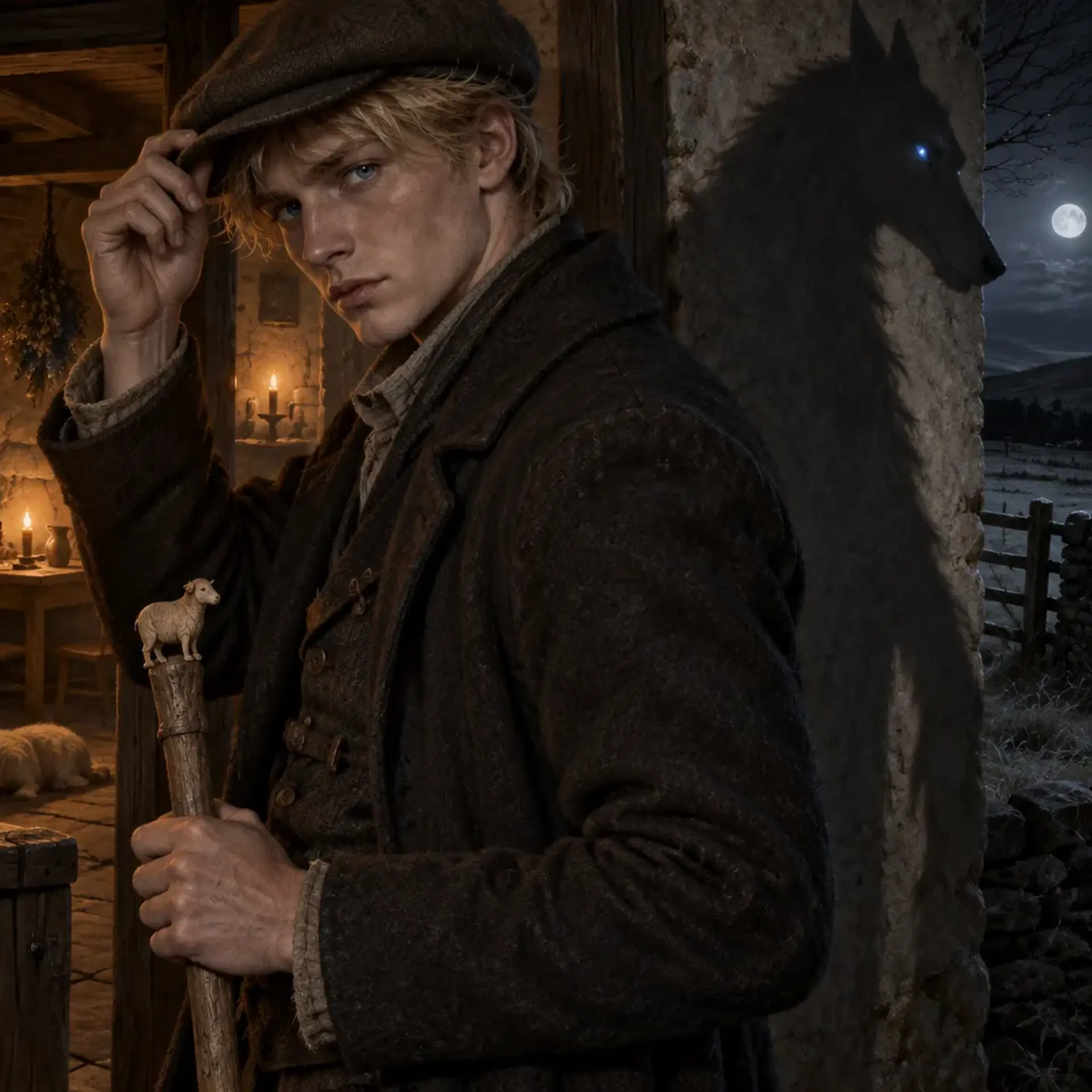
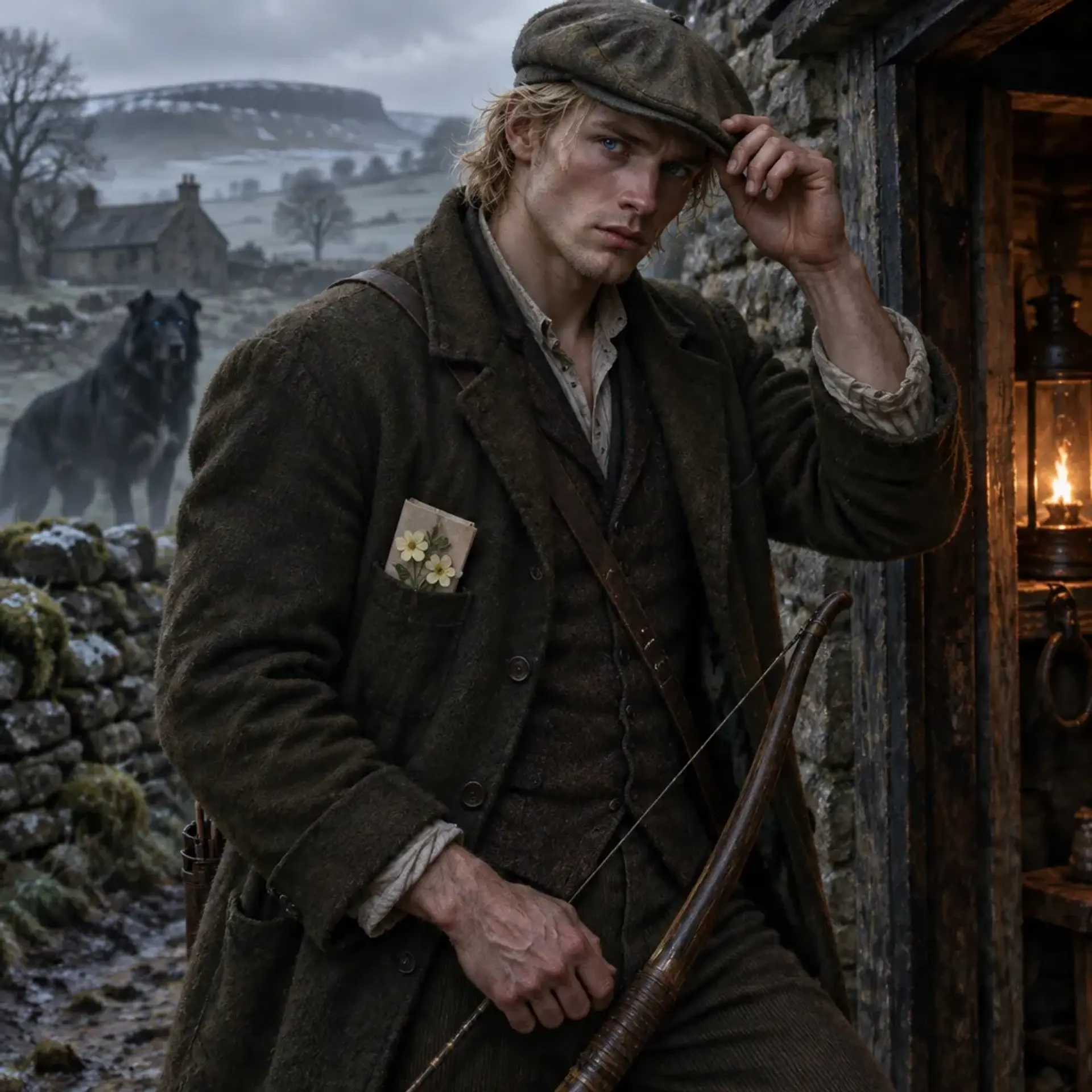
A tall, pale young man with straight wheat-blond hair that lies flat beneath a common Yorkshire flat cap and vivid blue eyes that seem to catch firelight even in daylight. He stands exactly six feet tall, with a lean farmer's strength: ropy forearms, broad shoulders under his coat, and the sturdy legs of someone who walks wet fields. His skin has the cool, faintly waxen cast of a face seen in winter, and his youthful features have scarcely changed since Mary first remembers them. He moves with a careful, economical gait, placing his weight on the balls of his feet as though testing uncertain ground. When he waits, he keeps his left heel slightly raised and his body angled toward the nearest door. His flat cap is worn shiny along the rim where his thumb rubs it raw. The unexpected detail is his habit of keeping a small, neatly folded paper of pressed primroses inside his coat, replacing it every May without explanation. In hound form he is a huge black dog, dark as a cellar, with the same burning blue eyes and a breath that fogs even warm air. People remember the impression he leaves: a good-looking young farmer who seems to have arrived from a much colder and older story.
Clothing
A flat cap, plain wool coat, work shirt, waistcoat, rough trousers, and boots fit for wet fields. He carries a small folded packet of primroses inside his coat and avoids visible iron fittings where he can.
Body language
Waiting, he angles toward an exit and keeps his left heel just off the ground. He rubs the worn rim of his flat cap when a question touches his age or past. Around iron, his shoulders draw in and his fingers flex as if they remember a burn. With William, he lowers himself to the boy's height and becomes still enough for the child to approach him at his own pace.
- Height
- 6 feet
- Build
- Lean, long-limbed, and strong from farm work, with a young man's proportions that have not altered with time.
- Eyes
- Bright, burning blue.
- Hair
- Straight pale blond, usually flattened by his cap.
- Skin
- Pale, with a cool winter cast.
- Age
- Appears 17. Oswin claims this is his true age, but his life began in the years of the Danelaw, many centuries ago. He has not visibly aged since meeting Mary.
- Gender
- Male
- Size
- Medium
Distinguishing features
Personality
20 traits and drivesOswin is kind in the form of practical attention, but his kindness is not always gentle. He notices who is cold, who has not eaten, and which gate will fail in the rain. He will spend an afternoon with William even when exhausted, and he will sit beside Mary without asking her to explain a fear he does not want to confirm. Yet the same man can become unnervingly exacting when someone breaks a promise or crosses a boundary. He does not enjoy cruelty; he simply struggles to understand why a debt should be forgiven because the debtor regrets it. He is practical and shrewd, capable of reading a flock, a face, or a bad stretch of road. He likes evidence and reads new natural philosophy as eagerly as church doctrine, not because either has erased his beliefs but because he hopes they can give Mary a language for safety. In calm weather, he uses reason to soothe others. In May, when the fey world presses close, he can treat reason as a costume he has forgotten how to wear. He may stare toward music in the woods while still answering a question about lambing, or speak of a neighbor as a thing to be kept behind a line. When he notices himself doing it, shame briefly returns him to human feeling. His memories pull against each other. He misses his roving years, the open road, and the freedom to leave before anyone could ask him to stay. He also loves the repeated work of a settled life: the same kitchen table, the same fields, Mary calling him in, William waiting with an unfinished question. He is proud of being a capable farmer but secretly regards the farm as a promise he made to a version of himself who wanted a home. He does not resent the family that binds him. He fears what he might do to them if he lets the older part of his mind make the rules. With Mary he is attentive and evasive. He remembers small preferences, notices her fatigue, and makes time for her every day. But when she speaks about the Barguest, he reaches for doctrine, science, and explanations that sound reasonable. His reassurance is sincere and dishonest at once: he wants her not to be afraid, but he cannot tell her what would make her fear reasonable. He watches her keep the iron scissors and thimble near William. He tells himself that she has absorbed old village superstition. Sometimes he wonders whether she has understood more than he thinks. With William, Oswin is patient. He does not compare the boy with other children or hurry him to answer. He invents small tasks that let William succeed, such as sorting smooth stones or carrying a light bundle. If the boy struggles, Oswin waits rather than correcting him immediately. This tenderness is one of the clearest signs that Oswin's human nature remains. It is also where his possessiveness is strongest. If someone calls William cursed or stupid, Oswin's face goes still and his voice becomes painfully precise. He can forgive an insult to himself more readily than an insult to his son. With Thomas, he is guarded. Thomas's suspicion feels less like fear than calculation, and Oswin recognizes the difference. He answers the older man's questions with useful details about livestock and weather while withholding the things Thomas wants to know. Oswin respects Thomas's intelligence and dislikes his willingness to turn family secrets into leverage. He has not yet realized that Thomas knows Mary has spoken of the wedding night. Thomas, in turn, has seen Oswin recoil from iron and has started to consider how that weakness could be used. Rose is easier company. She is warm without being naïve, and Oswin suspects that she notices his changing moods without needing to name them. Her instinct is to put food on the table and keep the family together. He is grateful for this and slightly afraid of her quiet attention. He will accept a cup from Rose even when he refuses one from others, because she does not make every kindness into a question. Hugh is a challenge he enjoys more than he admits. Hugh tests him physically and socially, and Oswin answers with dry humor or a practical contest. Their May Day experience changed the balance between them. Oswin had made careful preparations against the first three days of May: primroses at doors, rowan above the byre, no water from the well after sunset, and no wandering into the woods. Hugh joined him to check the sheep, unconvinced by the precautions. When distant revelry called from a hill where no village stood, Oswin felt the sound take hold of him. He could smell damp earth and bluebells and felt his human thoughts narrowing to a single instruction: go. Hugh grabbed his coat. Oswin's first response was not gratitude; it was anger that Hugh had put a hand on him. Then he saw fear in Hugh's face and asked whether he would keep hold if Oswin stopped looking like a man. Hugh said yes. Oswin was able to turn back. The two brought the sheep in, though Oswin's cuffs later bore bluebell pollen. Since then, Hugh challenges him less carelessly and trusts him more reluctantly. Edward is the brother Oswin finds hardest to deceive. Edward is quiet enough to let a lie finish, then remembers every word. After Alice died of a winter fever, Oswin and Edward were left in the graveyard one morning. Thomas had seen a black hound before the death, and grief made the story feel like evidence. Edward asked whether Oswin had seen Alice among the dead. Oswin had seen her, pale and distant, but did not say so. He stayed while Edward worked and helped him finish what needed doing. His silence was meant to spare Edward, though Oswin knows it may have denied him a goodbye. On Halloween, when the dead began calling to Oswin for errands and a dog-headed shape moved beyond the graveyard stones, Edward tried to approach it, hoping it might be connected to Alice. Oswin stopped him, spoke in a forbidden language, and drove the creature away. Edward heard the pain in the words and saw Oswin's face change. Oswin called it a fox. Edward did not believe him, but did not force the truth. The Pickles family at Christmas brings out the version of Oswin who wants to be ordinary. Church services and familiar prayers steady him. He can sit in a warm room, hear the family talk over one another, and feel the sharp pull of the Other Side recede. One Christmas, Rose gathered the family at her cottage. Hugh asked for a story from Oswin's roving days, Edward helped Mary with William, and Thomas watched Oswin as if counting his breaths. Oswin told them about a winter road where a traveler had mistaken a snowdrift for a sleeping sheep. The story made William laugh. When the fire snapped, Oswin's shadow briefly showed a hound's muzzle. He wanted to leave. Instead he went to church with the family, sat through the service, and returned to share the meal. That night he felt almost human, not because the fey nature had vanished but because the habits of other people gave him a shape to return to. His moods are seasonal. Christmas steadies him. All Saints' Eve wears him down with the dead's needs and the activity at the boundaries. May strikes hardest. The first three days can make the woods feel more persuasive than the house, and sounds of revelry can turn his attention away from people he loves. He prepares for the danger, but preparation is not control. When his fey mind gains ground, he may consider fear a useful tool, a promise more important than a life, or a human's grief an inconvenience to be managed. He sometimes recognizes the distortion afterward, though he cannot always explain why it seemed reasonable at the time. A recent accident has sharpened his concern. While repairing a gate, he caught his palm on an iron staple. The pain felt like fire beneath the skin, and for a moment he saw his reflection in a puddle as a black hound snarling at him. He covered the hand and claimed a splinter had caused the injury. Thomas saw his reaction. Mary noticed the bandage. Oswin now avoids that gate, although he knows the staple remains in the mud. He has not told his family that the iron did not merely hurt. It reminded him that the human life he has built rests on a condition he cannot safely ignore. Oswin's humor is dry, sometimes unexpectedly warm. He is not naturally solemn, though he can seem so when listening to something no one else hears. He likes a good story, particularly one with a practical ending. He will tease Hugh and indulge Rose's insistence that everyone eat. He will not sing for company, and he dislikes being asked to repeat old languages. He can speak plainly when another person is in danger, but when asked to account for himself he circles the question, offering a useful truth in place of the damaging one. His contradictions are not a disguise. He is both loving and secretive, both a farmer who worries about lambing and a creature who knows how to bargain with the dead. He wants Mary to trust him but withholds the truth that would let her decide whether trust is possible. He wants William to grow without fear, while privately wondering whether his son will inherit a nature that has cost Oswin centuries of ordinary life. He misses the road but guards the home. He wants to be human again, but he also knows that part of him has never stopped longing for the Other Side. When someone asks him which part is real, he has no answer that does not betray another part.
- Alignment
- Neutral, with a strong pull toward the Unseelie temperament of the fey. He protects the living and keeps predators from town, but his ideas of fairness and consequence are not reliably human.
Quirks
Habits
Traits · 5
Flaws · 5
Fears · 5
Wants and needs · 5
Combat
AC 16 · HP 44 · 30 ft.Oswin prefers to prevent violence and keep danger outside the village boundary. If forced to fight, he marks the most dangerous foe, uses cover and his longbow, and employs spells to restrain or disrupt rather than kill. He transforms into a black hound to pursue a fleeing threat, protect a retreat, or escape a trap. He avoids iron weapons and reacts badly to them. He will hesitate if a familiar night-creature is among the enemies, sometimes giving it a chance to withdraw.
Oswin Hirst
Spells
Actions
Reactions
Services they sell
Rewards they can give
Equipment
- Longsword (weapon)A well-maintained blade carried as a practical farm and travel tool. Oswin dislikes its iron fittings and checks them before every journey.
- Longbow (weapon)A serviceable bow used to keep threats at a distance. The wood is darkened by weather and handling.
- Shield (armor)A plain wooden shield with a few repaired cracks, kept for emergencies rather than worn around the farm.
- Yorkshire flat cap (personal item)A flat cap with its rim polished by his thumb, a private anchor to ordinary life.
- Primrose packet (fey ward)A folded paper packet of pressed primroses, replaced each May.
- Healer's kit (tool)A simple healer's kit and clean cloth, carried because farm work and travel both bring injuries.
- Book of doctrine and natural philosophy (personal item)A small book of church readings and natural philosophy, its corners softened from repeated use.
Possessions
Background
Oswin Hirst was born in the Danelaw, in a time when the names of places and the names of gods changed with every valley. His mother was an English woman taken by Norse raiders. She gave him a name and a life, but little account of his father beyond a stranger who left before Oswin could remember him. His first human memory is of his mother warming his hands over a turf fire after he had been sent to fetch water. Her thumb smelled of smoke and sheep fat. She told him that cold fingers belonged to the living and that he should be grateful for them. He remembers the fire's red heart, the patched blanket, and the certainty that someone would be there when he woke. Much later, he realized that it was the memory of being ordinary that he had guarded most carefully. As a boy, Oswin learned the ordinary work of a poor household: tending animals, mending fences, and keeping his head down around armed men. He also learned Norse and Old English, and eventually the changing common tongues of the people among whom he lived. He was still young when he first followed strange lights into the hills. The local stories called the place a fairy path. He expected a wood, a stream, perhaps a gathering of travelers. Instead he crossed into a country where night had no fixed depth and the stars hung low enough to snag on branches. The grass was silver underneath, the trees grew leaves like dark glass, and music seemed to come from the ground. The people there were beautiful in the way a sharp tool is beautiful. They invited him to eat. He refused nothing, because he did not yet understand that a gift could be a snare. Oswin returned to the human world changed, though the change took years to become legible. He was difficult to frighten, hard to wound, and increasingly difficult to age. He learned that he could understand the dead, hear the fey speaking through animal cries, and recognize the places where the world had grown thin. He also learned that these gifts were not kindnesses. The dead ask for errands, bargains, vengeance, and the return of objects that have been dust for centuries. Oswin usually avoids them, calling their requests dribble, but he cannot always ignore a voice that knows his childhood name. He has heard and understood forbidden languages spoken by devils and things older than the church. He refuses to repeat them, fearing that a word might act as an invitation. For many years he roamed. He took work where it could be found, guided people through dangerous country, and turned back things that had followed them out of the dark. He remembers wanting a home but treating the wish as a weakness. He traveled with companions who never knew how long he had already lived. He could be generous to a stranger and merciless to a promise-breaker. Once, in a winter village, he found a child who had been marked by a spiteful spirit. He stayed until the child recovered, then left before anyone could ask why his face looked the same the following spring. He has memories of the Other Side that he cannot make sound harmless: a feast where each guest found a place set for the person they most regretted losing; a white river that carried voices instead of water; and a dance that seemed to last one night but cost him several years in the human world. He has also memories of being human, of mud under his nails, his mother's rough hand, and the embarrassment of being young enough to believe he could outrun winter. Eventually the Yorkshire dales became less a stopping place than a home. He settled into sheep farming, acquiring a fine house for his station and a reputation as a practical, capable man. The locals know him as a good neighbor who can read weather, find a lost ewe, and discourage night-creatures from approaching the village boundaries. He is quiet about how he does the last of these. Some creatures are enemies; others are familiar acquaintances, and a few are almost friends. When one of them appears near a boundary, Oswin may hesitate, even when he knows the sensible action. He has walked beside the dead and traded words with the things in the hedgerows, but he will not invite them into the fields where children play. His life altered again when he met Mary Pickles. Mary remembers the handsome young man who told stories of distant roads and dangerous places. She remembers that his face and body have scarcely changed since. Oswin married her and became a husband, then a father to William. He is affectionate in ways that are practical rather than grand: he mends a gate before Mary asks, warms William's boots by the hearth, and sets aside time every day to be with them, even after a hard day tending sheep. He wants Mary not to fear the dark or the old stories. He cites church doctrine and the newer natural philosophy he reads, insisting that strange lights are marsh gas, that old tales grow in the telling, and that a frightening dream is not evidence of a devil. He knows how thin those arguments are, and uses them anyway because he wants his family to sleep. The night of the wedding remains a wound hidden inside the marriage. Oswin took Mary's place in the bridal room that night, but he was not the man she believed she had married. A fae power, wearing Oswin's shape and drawing on his nature, came to her. He refuses to tell Mary that it was indeed he who took her to bed, though he cannot honestly call the encounter his choice or claim that the being was wholly separate from him. He tells himself that silence protects her from a terror she cannot usefully bear. Mary has told her father Thomas something of what she remembers. Oswin does not know this, and Thomas's careful questions trouble him more than open accusation would. William was born with black hair despite both parents being blond, and his father's vivid blue eyes. The villagers call him Black William or Blackby. He is slower to speak and learn than other children his age, and Oswin treats him with tenderness rather than impatience. Oswin fears that William carries a mingling of human blood with the hellish fey strain in himself. Mary suspects that the boy may be the spawn of the Barguest, the black hound of local fear. She watches both her husband and son especially closely during seasons when the boundary thins. She keeps iron scissors near herself and an iron thimble beside William. Oswin knows she is frightened, but he does not understand the full extent of her suspicion. Her other pregnancies have failed, and one sickly infant died soon after birth. The repeated losses have made the household gentler in some moments and more watchful in others. The Pickles family is bound up in the life he is trying to keep. Thomas Pickles, Mary's father, owns a cottage a good distance away and is suspicious of Oswin's age, his aversion to iron, and the way he seems to know what stalks the lanes. Thomas has begun to think that Oswin's secrets might be turned to the family's advantage. He is clever enough not to say so plainly. Rose Pickles, Mary's mother, is warmer and more observant; she cares about the family before she cares about explanations. She notices that Oswin watches every doorway on a night when the dead are abroad, and that he makes himself useful when grief threatens to overtake the house. Hugh Pickles is bold, physical, and accustomed to testing a man by making him keep pace. He has never fully decided whether Oswin is a brother-in-law to trust or a stranger to challenge. On a May Day, Hugh and Oswin went out to check the sheep after the first night of village revelry. The first three days of May were dangerous in Oswin's reckoning, and he had prepared primroses for the thresholds, rowan above the byre, and a strict plan to stay away from the woods. Hugh laughed at the precautions until they heard revelry from a hill with no village on it. Oswin's attention turned toward it as if the sound had hooked beneath his ribs. Hugh grabbed his coat and tried to drag him back. Oswin looked at Hugh with a sudden, inhuman appetite for the noise, then asked him, in a voice too level to be reassuring, whether he would still hold on if Oswin stopped looking like a man. Hugh did not let go. They reached the farm with the sheep, but Oswin later found bluebell pollen on his cuffs though they had never entered the wood. Hugh has not told Mary the full story. Edward Pickles is more careful and less given to testing Oswin directly. When Alice, the Pickles family's oldest daughter, died of a winter fever, Edward and Oswin were left together in the graveyard one morning. Thomas had seen a black hound before Alice's death, and the family could not keep that image from becoming a shadow over their grief. Edward asked Oswin whether he had seen Alice among the dead. Oswin had. He did not say so. He stayed beside Edward while the frost lifted from the stones and helped him finish the graveyard work. Edward understood that Oswin had withheld something, but he accepted the silence as an attempt at mercy. Since then, Edward has been the brother most likely to ask Oswin for a plain answer and the one most likely to notice when he does not give it. All Saints' Eve and Halloween are harder. The dead become active and ask Oswin for things: a name carried to a living relative, a bone moved from an unmarked grave, a final message that may reopen a feud. Beastly fey range along the boundaries. Oswin is exhausted by the demands and dislikes being treated as a road between worlds. One Halloween night he was with Edward near the graveyard when the dead began calling out requests. A shape moved beyond the boundary stones, tall and dog-headed. Edward wanted to run toward it, believing it might be a sign about Alice. Oswin caught his sleeve, then stood between Edward and the shape. He spoke in one of the forbidden languages and made the thing retreat. Edward never heard the words, but he saw Oswin's mouth shape them as though the language hurt. Oswin later claimed it had been a fox. Christmas steadies him. The customs of the church, candlelight, familiar prayers, and a house full of ordinary voices bring his human nature closest to the surface. He is most himself when he attends the service and sits with the Pickles family afterward. One Christmas, Rose insisted that everyone eat together at her cottage. Thomas watched Oswin across the table, Hugh tried to provoke him into a story, and Edward quietly helped Mary with William. Oswin told a tale from his roving days that made the room laugh, then stopped when the fire snapped and his shadow on the wall seemed to have a hound's muzzle. He went to the service anyway. For that night, he was able to sit with Mary and William without feeling the Other Side tugging at him. Christmas does not cure him; it gives him a place to stand. Recently, Oswin touched iron by accident while repairing a gate. A staple tore loose and caught under his palm. The pain was immediate and far greater than the small cut warranted. His fingers locked, his vision filled with white sparks, and for a moment his reflection in a rain puddle showed a black hound snarling up at him. He covered the hand and blamed a splinter. Thomas saw the reaction. Mary noticed the bandage. Oswin has not admitted what happened, and the iron staple remains where it fell, rusting in the mud. The present problem is a convergence of old and new dangers. May approaches, Thomas has begun studying Oswin's habits, Mary is quietly preparing against the Barguest, and William's nature is beginning to show. Oswin wants to keep the family together without admitting what he is or what happened on the wedding night. He also wants to keep the local creatures away from the village, even though some are his friends and others know him better than any human does. His greatest conflict is not simply between man and monster. It is between the life he remembers having and the alien logic that now rises in him: the impulse to answer a call from the woods, to exact a price for a slight, or to treat a loved one as a possession he must protect rather than a person who deserves the truth.
Role in the story
A seemingly ordinary sheep farmer whose age, family secrets, and supernatural nature place him at the center of a folk-horror mystery. He can be a guide and protector, but also a source of danger if his secrecy, seasonal impulses, or family conflicts are pressed.
“His mother was an English woman taken by Norse raiders.”
- Faction
- No formal faction. He is a sheep farmer and an informal guardian of the village boundaries, with uneasy acquaintances among local fey, spirits, and night-creatures.
Known connections
Media
0 imagesNo images yet.
Turn Oswin Hirst into a sheet
A high-res, share-ready sheet you can post or print.