Oswin Hirst
Oswin Hirst
At the table
Voice
A dry, weathered voice, shaped by cold air, outdoor labor, and a life spent giving practical instructions across fields. His accent is rooted in Yorkshire, and his pace is measured rather than theatrical. In a calm mood he sounds wry and reassuring. Under stress, he becomes more precise and formal, as if every sentence were a clause in a bargain. The name Oswin itself is spoken plainly; any uncanny quality comes from the way he pauses before answering.
His voice has a dry, breath-warmed rasp from years of cold mornings, outdoor work, and speaking over wind. Yorkshire vowels and plain rural phrasing ground his speech; Norse and old English emerge more readily when he is tired. He shapes words carefully when discussing church doctrine, as though repeating something learned for its usefulness. When fae influence rises, his consonants become exact and his courtesy sounds like a formal bargain. He does not lower his voice when angry: he becomes more explicit, naming what he believes the other person has done and what must happen next.
Speech patterns
How to play them
Meet Oswin as a useful, courteous farmer rather than an openly sinister monster. He will offer practical help and answer direct questions about local dangers, but deflect questions about his age, iron, and family with scripture or natural philosophy. Be patient with his silences. If the party threatens Mary or William, his warmth vanishes. If they treat the dead or fae as tools, he becomes coldly hostile. Earn his trust by protecting the family without demanding that Mary accept his lies.
Goal
Keep the Barguest and other night creatures from crossing into the town, protect Mary and William, and find a way to tell the truth without destroying the family he built.
Motivation
Oswin wants to believe that a person can choose kindness even when their instincts and nature pull elsewhere. He remains on the farm because Mary and William make his life feel chosen rather than merely endured. He also keeps the boundaries because he knows what can come through them, and because guilt has taught him to mistake constant vigilance for atonement.
Appearance
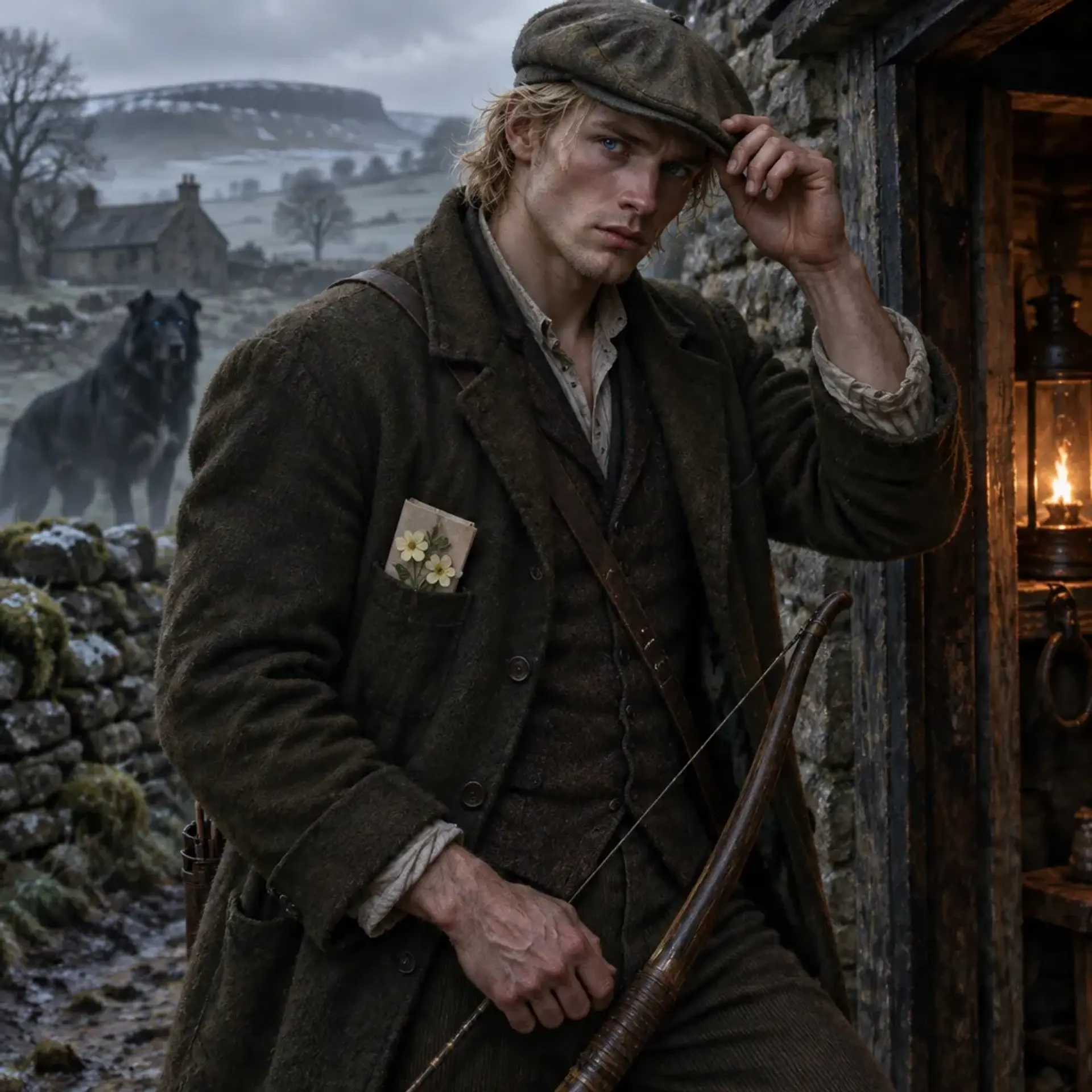
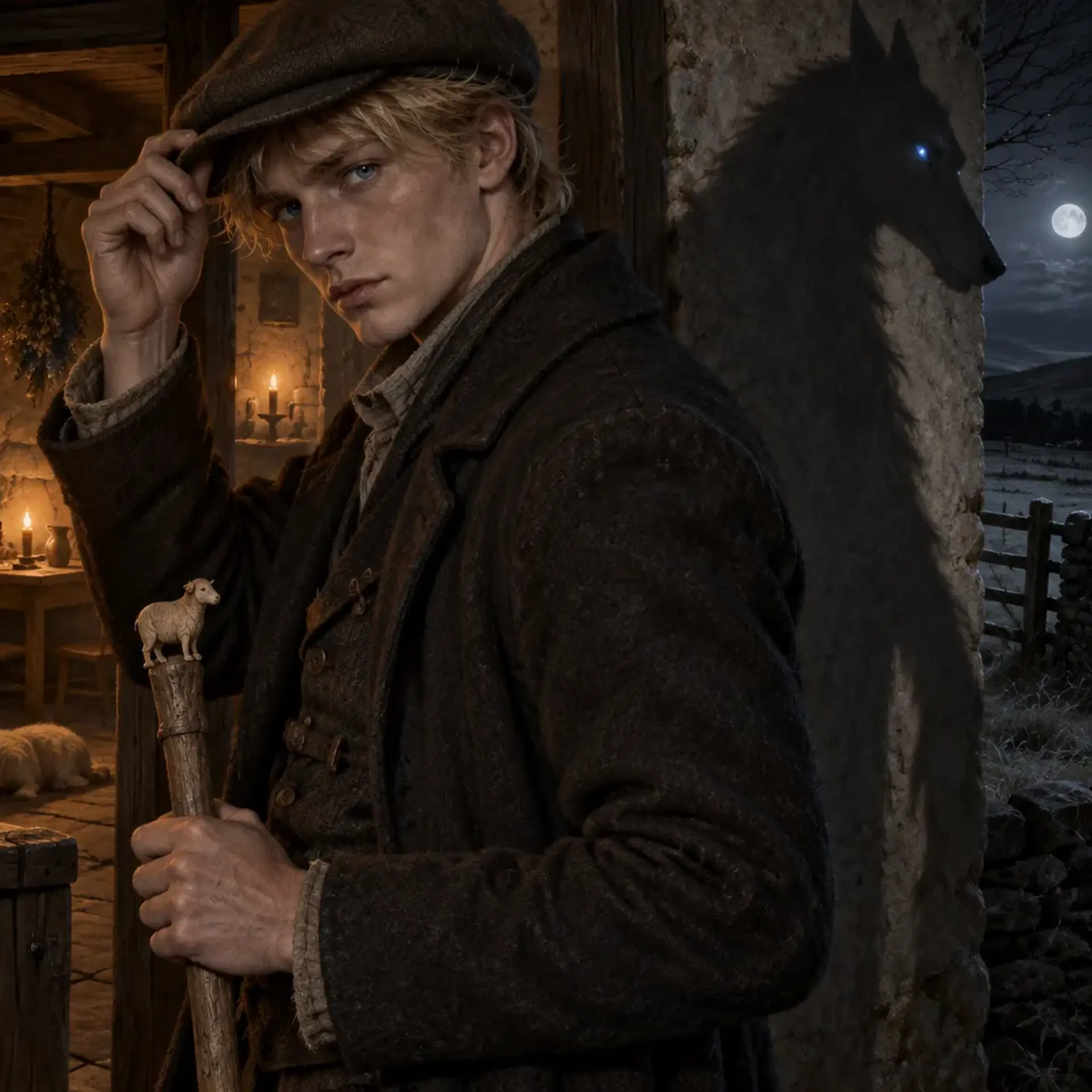
Oswin Hirst stands a full six feet, tall and spare rather than broad, with the deceptively healthy proportions of a young farmhand. His pale blond hair lies straight and fine beneath a common flat cap, usually combed back but never quite staying there; at the temples it catches the light like dry straw. His skin is winter-pale, lightly weathered at the nose and knuckles, and his clear blue eyes seem too bright when the room is dim. He moves with economical certainty, placing his weight on the balls of his feet as though prepared to step over a stile or vanish through a gate. When waiting, he checks the cap's brim, then the same two buttons at his cuff, without seeming to notice. He has a handsome youthful face that makes his settled life look like a costume worn by someone who has not yet grown into it. His unexpected feature is a habit of carefully repairing small toys and making delicate wooden animals for William, despite the roughness of his work and the fearsome hound stories told about him. As a black hound, he is long-backed, silent-footed, and so dark that his outline seems to swallow moonlight; only the blue fire of his eyes gives him away.
Clothing
A plain flat cap, well-kept wool coat, waistcoat, sturdy trousers, and worn boots suitable for sheep work. He dresses better than many local farmers, but not ostentatiously. He avoids iron fastenings when he can and uses wood, bone, or leather instead.
Body language
He stands lightly on the balls of his feet, with his shoulders relaxed and his weight angled toward the nearest exit. His thumb repeatedly tests the edge of his cap or the two buttons at his cuff. Around Mary and William, he sits lower than necessary and keeps his hands visible. When iron is near, his posture stiffens before his expression changes. When the fae nature takes hold, he becomes unnaturally still and watches the room as if measuring who belongs in it.
- Height
- 6 ft
- Build
- Tall, lean, and work-hardened, with the balanced legs of a man accustomed to uneven pasture and long walks.
- Eyes
- Clear, burning blue
- Hair
- Pale blond, straight
- Skin
- Pale, with a faint weathering from wind and farm work
- Age
- Appears about 17; claims to be a young adult. His true age spans many generations, and his apparent age has scarcely changed since he met Mary.
- Gender
- Male
- Size
- Medium
Distinguishing features
Personality
19 traits and drivesOswin is kind in practical, often unshowy ways: he mends a gate before its owner asks, carries a lamb through bad weather, and makes time for William even when the work is unfinished. Yet his kindness is mixed with a troubling appetite for control. He wants Mary safe, but he decides what she is allowed to know. He wants William accepted, but quietly watches the boy as if assessing a dangerous inheritance. He is patient with children and animals, but impatient with people who ask questions he has already decided are unsafe. In ordinary company he is reserved, wry, and grounded. He listens before speaking and often turns a frightening subject into a practical one: a bad road, a sick ewe, a rule about keeping the hearth lit. With Mary, he is gentle but evasive. He tries to calm her fear of the dark by explaining it away, and can become brisk if she asks about his age or his avoidance of iron. He is not angry because he is quiet; he becomes more direct, more exact, and more difficult to interrupt. With Thomas, he is civil and guarded, aware that each man's politeness is a kind of fencing. With Rose, he is more willing to accept care. With Hugh, he bears the embarrassment of having nearly abandoned him in the May Day wood, though he does not know how to make an apology large enough. With Edward, he shares silences that can be more honest than conversation. Oswin's mind is not wholly human. When the fae side presses forward, he can treat hospitality as a binding law, a promise as a physical tether, and a grieving person's need as a nuisance that should have been settled earlier. He may call a friend an obstacle without intending cruelty. He notices a boundary violation before he notices someone's hurt feelings. These moments frighten him afterward, but in the instant they feel rational, even merciful. The people around him see the change in his stillness and the precision of his speech. Mary sees him pause at a doorway as though waiting for permission from something invisible. Hugh remembers that strange smile in the May Day wood. Oswin recognizes the signs and tries to interrupt them with chores, church, food, or the familiar weight of William in his arms. His most human memories are not grand. He recalls his mother's wool around his hands, the smell of wet earth, and the shame of being frightened by a dark lane. His memory of the Other Side is equally vivid: a green-lit orchard, doors in trees, music that made thought feel borrowed, and beings who treated him as a curiosity. The contrast leaves him longing for the ordinary and distrustful of anything that calls itself beautiful. He longs for the Dales of his roving years, but knows that his longing is partly for a version of himself who had not yet understood what he was. Season changes make his contradictions visible. In the first days of May, he plans carefully and may still be drawn toward revelry by a force that feels like joy until he sees fear on Hugh's face. Around Halloween and All Saints' Day, the dead ask him to settle their unfinished business. He dislikes their demands, yet he listens and often helps. Christmas steadies him, especially when he goes to church; with the Pickles family around the hearth, he can seem almost entirely like a young husband and father. This seasonal reprieve is not a cure. It is a borrowed stretch of human calm that he tries to spend well. Oswin is therefore neither a hidden villain nor a harmless guardian. He loves his family, but his love has a possessive edge. He fears becoming a monster, but can excuse monstrous choices as necessary protection. He wants people to trust him, but keeps the facts that would let them judge him. If confronted with this, he does not deny the contradiction. He says, honestly, that he does not know how to keep them safe without deciding things for them. The next question is whether he can learn to let them choose.
- Alignment
- Neutral, with a protective instinct that can be overshadowed by the cold, rule-bound impulses of an Unseelie nature.
Quirks
Habits
Traits · 5
Flaws · 5
Fears · 4
Wants and needs · 5
Combat
AC 14 · HP 38 · 30 ft.Oswin prefers to warn, misdirect, and drive enemies from the village rather than kill them. He opens with Faerie Fire or Eldritch Blast from cover, uses Misty Step to leave a dangerous position, and reserves his hound form for pursuit, intimidation, or escape. He prioritizes threats to children and bystanders. He may hesitate against creatures he knows from the night roads, giving enemies an opening. He does not carry iron weapons.
Oswin Hirst
Spells
Actions
Reactions
Services they sell
Rewards they can give
Equipment
- Wooden quarterstaff (weapon)A stout walking stick used for farm work and defense; he avoids metal fittings.
- Flat cap (clothing)A plain flat cap, worn and adjusted whenever he is uneasy.
- Boundary sprigs (folk charm)A small bundle of rowan and primrose kept for seasonal protections and household customs.
- Farm notebook (tool)A pocket notebook containing farm accounts, scraps of church doctrine, and observations about night creatures.
- William's toy (keepsake)A wooden toy sheep he made for William, polished smooth from the boy's handling.
Possessions
Background
Oswin Hirst was born in the Dales in the age of the Danelaw, the child of an English woman taken by Viking raiders. His mother did not tell him every detail of his father's absence, and Oswin learned early that a person could be loved and still arrive in the world through cruelty. The memory he holds most clearly from his human childhood is a winter morning when his mother wrapped his hands in a scrap of wool before sending him to bring water. The bucket handle bit his palms. She laughed at his solemn complaint, warmed his fingers against her apron, and told him that being frightened did not make a person weak. In his mind, this memory is still small, warm, and stubbornly human. It is one of the few recollections that can interrupt the distant, inhuman calculations that come over him. He grew up among working people, learning weather, livestock, fences, and the careful arithmetic of a household with too little grain. He also learned Norse and old English, then picked up the common tongues of the English lands as he traveled. Much later he came to understand that his long exposure to the dead, devils, and the fae had altered him. At first he thought he was merely lucky to return from places where other travelers disappeared. Then he began to see that he could cross boundaries without losing his way, hear the dead as plainly as living neighbors, and feel the approach of certain nights in his bones. He calls the stranger languages he understands forbidden languages and refuses to speak them. He says the words make the world answer in ways a person cannot take back. The Other Side is not, to Oswin, a dream-country of pretty lights. He remembers a place that felt like a winter orchard beneath a green sky, where every tree had a door in its trunk and none opened onto the same time twice. He recalls music that seemed to explain the shape of his own thoughts, and a feast where he was offered a bowl of milk that reflected his face as a black hound. There was no sense of welcome or threat in the beings around him. They regarded him as a useful, curious thing. He was there long enough to lose track of how long he had been gone. He returned with no convincing account of where he had been and a certainty that the world was not arranged for human comfort. As he roved, Oswin learned the habits of the creatures of night in the Yorkshire countryside. Some he drives away from the boundaries of settled places; some he bargains with or leaves alone. He has friendly relations with a few, and those connections make him hesitate when he ought to strike. He rarely explains the difference between a dangerous creature and an old acquaintance. People hear his warnings as superstition, then notice that the thing he warned them about has not come near their homes. The first days of May are his most difficult season. He plans ahead: secures the stock, avoids bluebell woods, keeps the household within the village, and arranges for someone else to watch the gates. Even so, the fae pressure can hit him like a hammer. Once, during May Day, he went with Hugh Pickles to check the upper pasture and found the path ringed with fresh hawthorn. Oswin had urged Hugh to stay away from the old wood, but Hugh insisted that a missing ewe could not wait. At the first sound of distant revelry, Oswin stopped answering questions. He walked toward the trees as if following a familiar call. Hugh caught his sleeve. Oswin turned on him with a smile too wide and said, in a voice Hugh later described as courteous but not human, that Hugh was being rude by interrupting the dance. For a moment Oswin seemed to consider Hugh not as his wife's brother but as an obstacle to be moved. Then Hugh struck a match and held it to a bundle of dry brush. The small flare brought Oswin back to himself. He helped Hugh find the ewe, and afterward admitted that he had wanted to leave him in the wood. Hugh has not forgotten the admission, and Oswin has not asked him to. All Saints' Eve and Halloween bring the dead close. They come with requests, complaints, and unfinished business. Oswin avoids them when he can, calling their concerns dribble, but he often answers despite himself. On one such night, Edward Pickles was with him in the graveyard after the family had lost Alice to a winter fever. They had gone there in the morning to leave flowers. Near dusk, a dead child appeared beside Alice's grave and asked Oswin to find a missing shoe. Edward heard only Oswin's side of the conversation. He watched Oswin address the empty air, then heard him promise that the child would be remembered. Oswin and Edward searched the churchyard and found a small shoe lodged beneath a fallen stone. Edward never explained why he kept the shoe afterward, and Oswin never pressed him. Since then, Edward has been the brother-in-law most likely to stand beside Oswin when the dead gather, though he dislikes the price of doing so. Christmas steadies Oswin. The fae impulse loosens if he attends church and keeps to the service. One Christmas, he spent the evening with Mary, William, Thomas, Rose, Hugh, and Edward. Rose made him sit close to the hearth and eat, while Thomas watched him over the rim of his cup. William was small and slow to answer, and his black hair made the neighbors whisper. Oswin spent most of the evening making a wooden sheep for the boy, patiently showing him how to turn it in his hands. When the church bell sounded, Oswin's face softened into something Mary recognized from the early years of their marriage. Thomas saw that too, and it did not remove his suspicion. The family shared a brief, ordinary peace. Oswin remembers it as proof that he can still choose a human life, not proof that the danger has passed. Oswin met Mary Pickles while traveling, and his stories of roads, strange lights, and distant places made him seem older in experience than in face. They married, and he settled as a sheep farmer in a house finer than most people of his station would expect. He works hard to keep it and sets aside time for Mary and William even on days when he is tired or troubled by the season. Mary remembers that he has scarcely aged since she first knew him. She also notices that he avoids iron. She keeps iron scissors near her and an iron thimble close to William, partly from fear and partly because she has no other explanation for the child's oddities. Mary believes William may be the Barguest's child, or the devil's. William has black hair despite both parents being blond, and his eyes burn with the same vivid blue as Oswin's. He is slower than other children his age to understand instructions and join their games. Oswin loves him without reservation, but his efforts to reassure Mary often sound rehearsed. He cites church doctrine or the new sciences he reads, telling her not to fear the dark and insisting that the Barguest is only a story. He has not told her that he can become the hound. He also has not told her what he believes William's blood means. Several of Mary's pregnancies have failed, and one child died sickly soon after birth. This grief has made the household's quiet places feel crowded with questions. The wedding night is the wound Oswin most carefully conceals. On the night of the wedding, Mary believes Oswin took her to bed. He refuses to tell her that it was not him. The truth is bound to a bargain and a substitution he has never explained, and he is afraid that telling her would make her see her marriage as a trap. He wants her to feel safe with him, but the lie denies her the chance to decide what safety means. He does not know that Mary has told her father what she remembers. Thomas Pickles is suspicious of Oswin and, covertly and cleverly, hopes to turn knowledge of Oswin's nature to the advantage of his family. Mary has not told Oswin that either. Thomas's suspicion is practical rather than theatrical. He has seen a black hound and connected it with Alice's death, though Oswin does not believe the hound caused her fever. Thomas regards Oswin as a danger to his daughter and grandson, but also as a possible shield against worse dangers. Rose Pickles is more openly kind. She sees the strain in Oswin's face and tries to make a home where he can be a husband and father. Hugh is blunt, brave, and still angry about the May Day incident. Edward is quieter, linked to Oswin by the graveyard morning and the things neither man says about Alice. Oswin wants all three to trust him, but he knows they have reasons not to. Recently, while helping repair a gate, Oswin grasped a new iron latch before he remembered what it was. The pain was brief but sharp, like a thought being torn out of his skull. He dropped it, and the farmer working beside him saw his hand shake. Oswin blamed a cramp. Mary noticed the blackened skin at the base of his thumb and later found a smear on the latch. The encounter has made him more cautious, but also more certain that his hidden nature is not as securely hidden as he pretends. Oswin's present problem is not simply to keep the Barguest out of town. It is to learn whether that work is protection, penance, or a habit that lets him avoid explaining himself to the people he loves. He wants William to have a childhood, Mary to sleep without listening for paws outside the door, and Thomas not to turn his family's secrets into leverage. He also dreams of the Dales as they were before his long wandering, though he knows that the place he longs for may no longer exist. Each spring he plans for the first three days of May. Each winter, he tries to remember what it felt like to be a human boy warmed by his mother's apron.
Role in the story
A protective but compromised ally, a source of local supernatural knowledge, and a family mystery whose secret has real consequences. The party can help him guard the village, uncover Thomas's intentions, investigate the wedding-night truth, or decide whether Mary deserves the truth before Oswin is ready to give it.
“She laughed at his solemn complaint, warmed his fingers against her apron, and told him that being frightened did not make a person weak.”
- Faction
- No formal faction. He keeps an uneasy, informal watch over the boundaries of the local settlement and has personal understandings with several nocturnal creatures.
Known connections
Media
0 imagesNo images yet.
Turn Oswin Hirst into a sheet
A high-res, share-ready sheet you can post or print.