Friedreich
Friedreich
At the table
Voice
His voice seems to come from the chest and throat of whichever face he wears, but his cadence remains his own: measured, clipped, and faintly formal. In the Shadowlands it has a dry, distant quality, like speech heard through a closed door. In the new body his breathing is audible between phrases; when a memory catches him, he sometimes stops mid-sentence to take a breath he does not need to prove he can.
His German has a pronounced Brandenburg-Prussian quality, with crisp consonants and formal turns of phrase. He speaks as if words ought to stand in formation, though slang and current expressions slip in through his friends. When rattled, breath catches audibly in the embodied body and his sentences become clipped; in the Shadowlands, the same strain sounds like a dry interruption in the air rather than a breath.
Speech patterns
How to play them
Treat him as a person, not as a haunting or an instrument. Let him choose whether to wear a borrowed face, and do not assume his new body makes him safe or settled. He responds well to practical companionship, shared football, and honest questions asked without demanding that he forgive Wilhelm. If he becomes angry, give him a clear boundary and a concrete choice rather than trying to soothe him with empty promises.
Goal
Learn what the Walpurgis rite made him, discover what Klaus knows about the spirit and the opening of his Caul, and build an ordinary routine that does not depend on borrowed identities.
Motivation
To keep his chosen family together, recover a trustworthy sense of himself, and find out whether the new life is a gift, a possession, or another kind of death.
Appearance
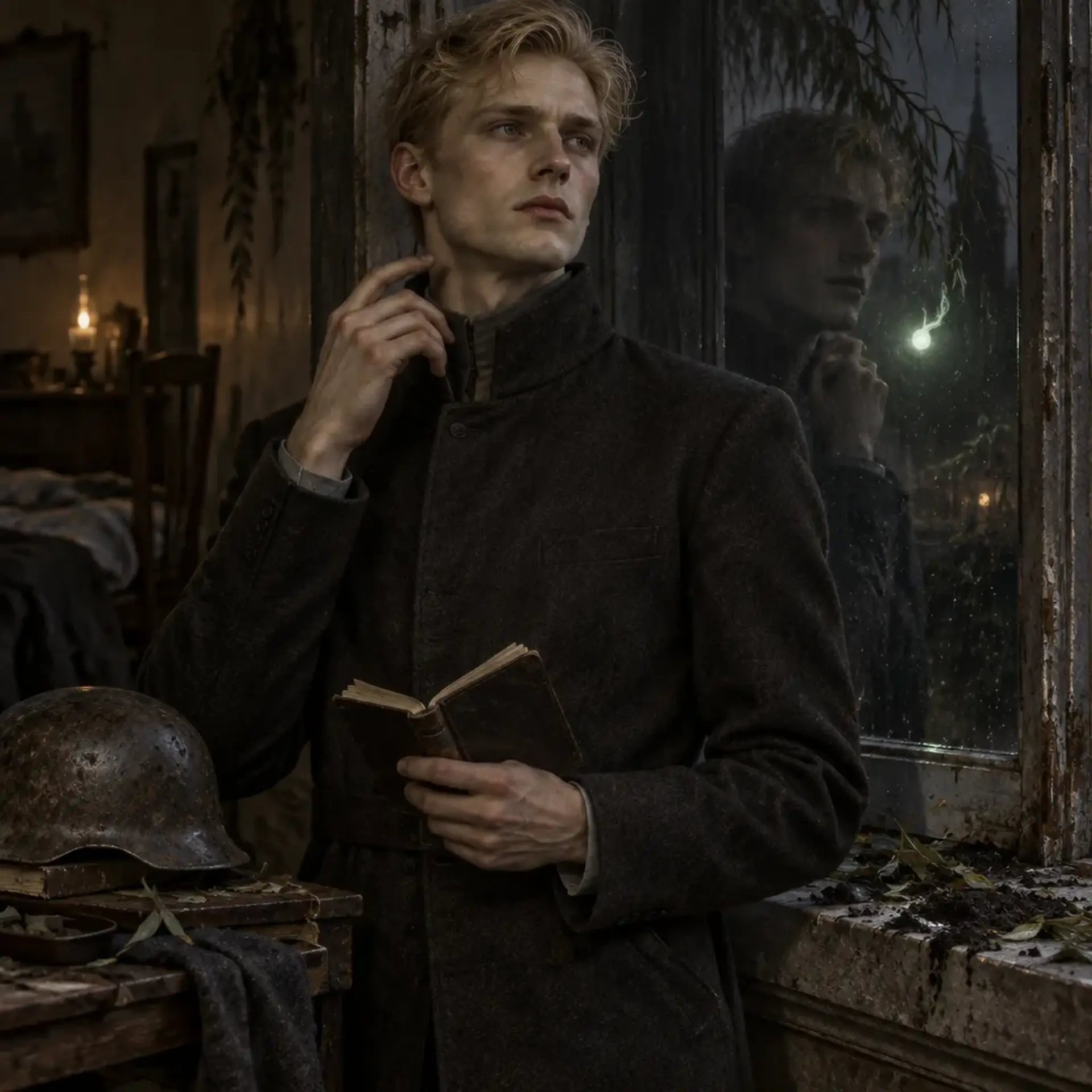
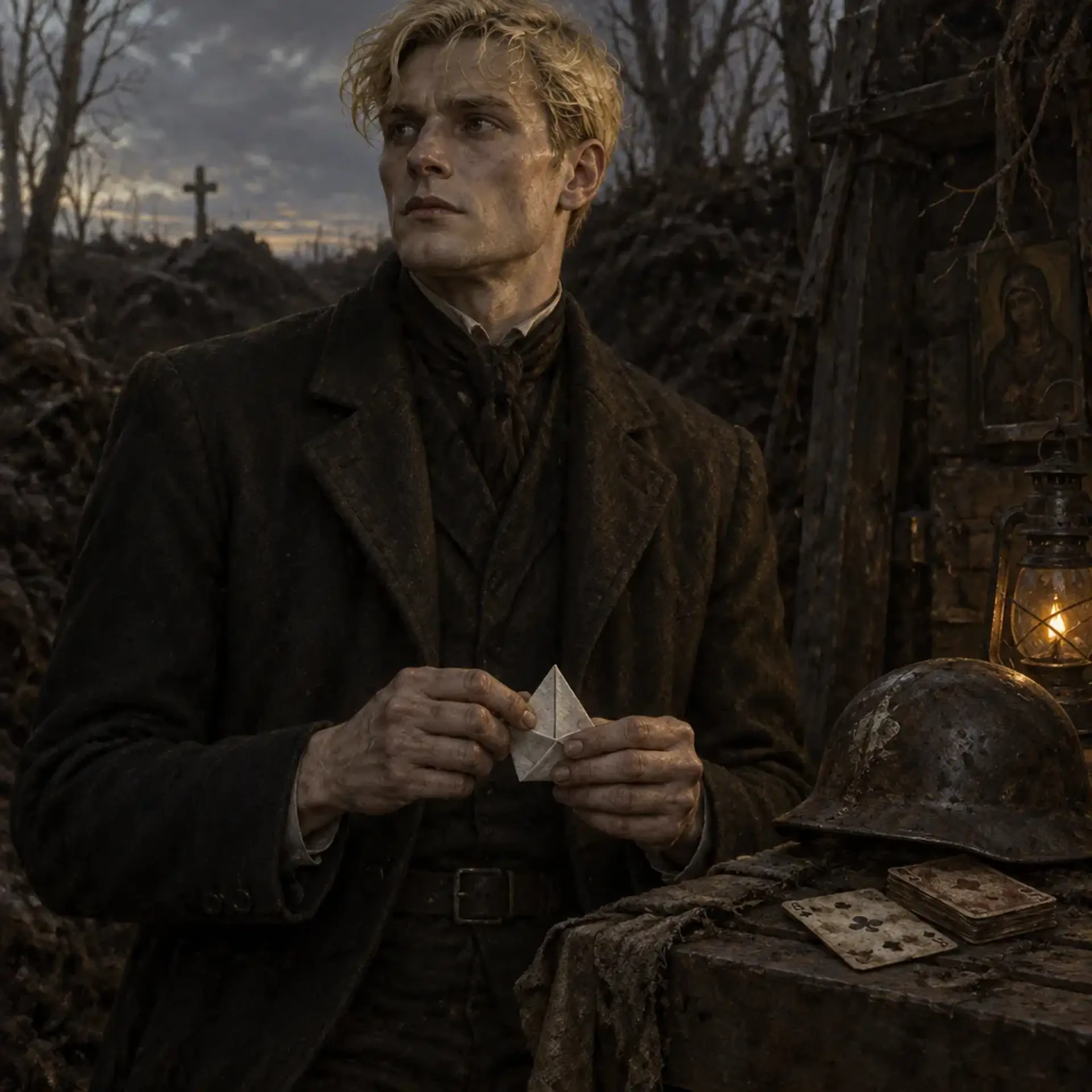
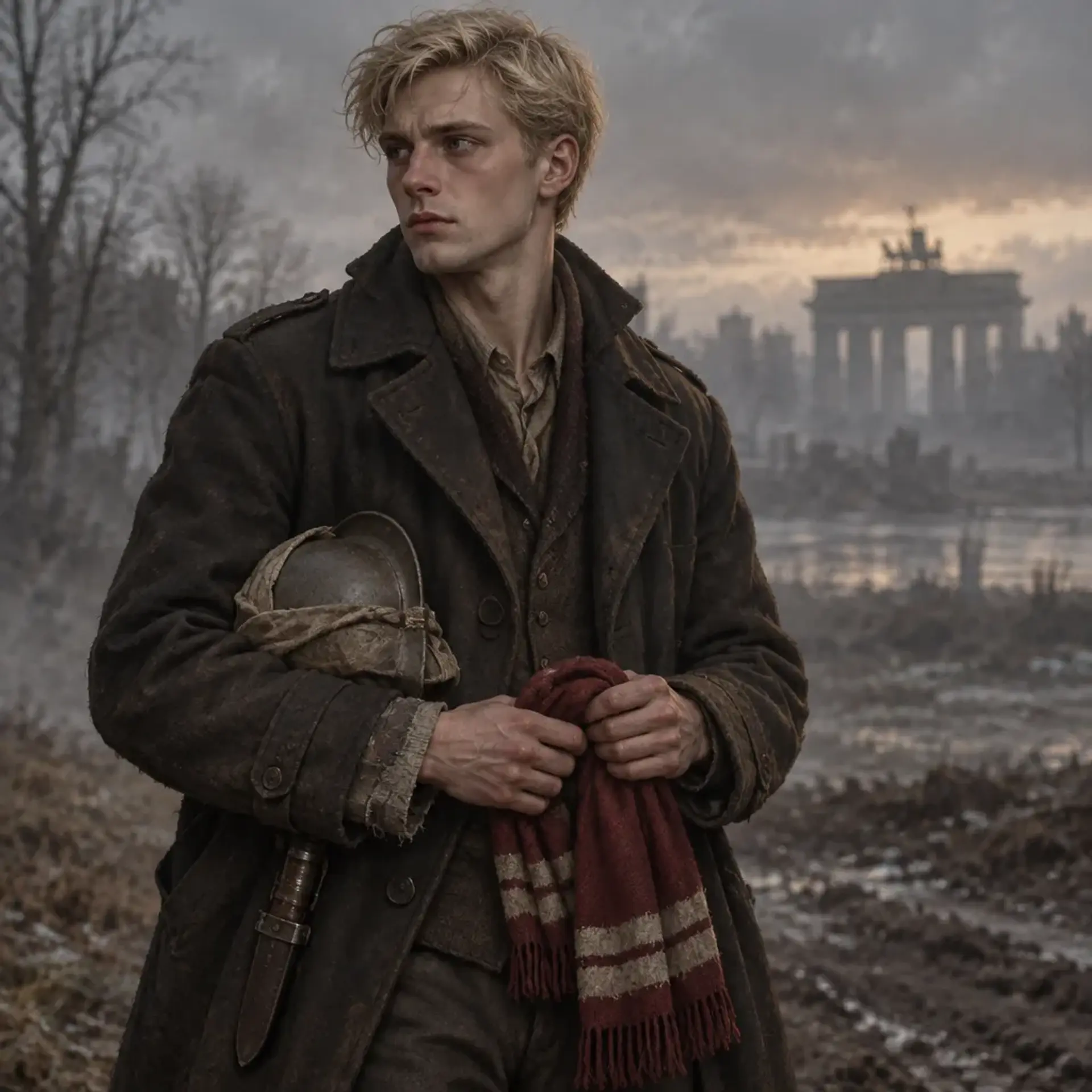
In the Shadowlands Friedreich is a young German man whose outline seems to have been cut from smoke and old uniform cloth. His features are incomplete until he borrows a face: the cheeks blur, the mouth has no reliable shape, and his eyes resemble two dim reflections on dark water. When he manifests through one of his practiced visages, he moves with an old-fashioned soldier's contained precision, shoulders squared and steps measured, though he sometimes pauses as if listening for boots marching somewhere behind him. His borrowed clothes never sit quite right: cuffs are too clean, collars too stiff, and hems may flutter as if caught in a wind nobody else feels. Since the rite, his living body has blond hair, grey eyes, and the unsettlingly ordinary warmth and breath of a sleeping man waking from a bad dream. An unexpected detail is that he is scrupulous about football scarves, folding and refolding them with the care he once reserved for military kit.
Clothing
Favors practical civilian clothes with a military cut: a dark, repaired coat, plain trousers, sturdy boots, and scarves for football weather. He keeps his old helmet wrapped and stored rather than wearing it. One cuff is always carefully mended, while the rest of his clothes are allowed to become shabby.
Body language
He holds his shoulders as if a uniform still fits, and turns his head before his torso when someone speaks. While wearing a borrowed face, he checks his expression in windows and polished metal. When angry he does not become genteel or subdued: his jaw sets, his hands curl, and he begins speaking with clipped precision. Since becoming embodied, he sometimes presses a bare foot to soil as if testing whether the ground recognizes him.
- Height
- About 178 cm when embodied; his Shadowlands manifestation has no consistently measurable height.
- Build
- Lean, disciplined, and wiry in his wraithly manifestations; his new body is taller and more substantial than the young form he expected.
- Eyes
- Grey in the new body; borrowed faces retain their owners' eyes.
- Hair
- Blond in the embodied form, according to what he and Wilhelm have said; borrowed faces vary.
- Skin
- Pale, with a living flush since the rite; his Shadowlands form appears smoke-grey and indistinct.
- Age
- Appears 17 or 18 in the Shadowlands; his exact age at death is uncertain. His embodied form appears to be a young adult.
- Gender
- Male
- Size
- Medium
Distinguishing features
Personality
20 traits and drivesFriedreich is disciplined but not naturally obedient. He likes clear rules because they give fear a shape, yet he resents anyone who uses rules to excuse cruelty. With strangers he is formal, observant, and faintly old-fashioned; with the coven he can be teasing, competitive, and unexpectedly boyish, especially during football or cards. He is protective of Mila and fiercely loyal to Wilhelm, but that loyalty is tangled with anger over Wilhelm's actions in the wars. He can condemn Wilhelm in one breath and defend him in the next, then hate himself for both. His temper has not disappeared; it has become distant and slow to arrive, as if anger must travel a long road to reach him. When it does, he is not quieter or more polite. He becomes clipped, specific, and frighteningly decisive. He is most easily rattled when people cannot see or hear him, because the experience repeats his helplessness in the living world. A borrowed face makes him sociable and capable of enjoying ordinary pleasures, but it also tempts him to mistake access for belonging. He wants to be recognized as Friedreich, yet has spent years practicing how to be someone else. He is curious about intimacy and ordinary life: eating at a table, sleeping through the night, flirting, joining a club, having a job with a name badge. At the same time, he fears that each new pleasure will be another identity he has to surrender. His recent embodiment has intensified this contradiction. He feels breath and soil, but also carries a duty that may have been imposed by the land. He tells his friends they are family, and means it, while quietly wondering whether the rite made that bond into a command.
- Alignment
- Protective and duty-bound, but not reliably obedient to authority; his personal ethics are shaped by loyalty and regret.
Quirks
Habits
Traits · 5
Flaws · 5
Fears · 5
Wants and needs · 5
Combat
HP 7 · Use the normal movement rules for the current Wraith edition and scene. His embodied movement is that of an ordinary young adult; his Shadowlands travel depends on Arcanoi and circumstances.Avoids a fair fight when he can. He uses cover, ambush, and the shock of sudden manifestation to protect allies or create an escape. Against a threat to his coven he can become frighteningly decisive, but his anger may override caution. He is wary of physical combat in his new body because he does not yet trust what the rite made him.
Friedreich
Actions
Reactions
Services they sell
Rewards they can give
Equipment
- Old helmet (personal relic)A kept memento of the war years and the life he cannot fully remember. It is wrapped and stored, not worn as a badge of ideology.
- Face list (notebook)A small, private record of favorite faces, invented names, uses, and checks meant to ensure the original is dead or outside the area. It is a safeguard, not proof that his practices are harmless.
- Utility knife (weapon)A plain, well-maintained military knife, carried as a tool and last resort.
- Match scarf (keepsake)A football scarf folded with unusual care, usually brought to gatherings and matches.
Possessions
Background
Friedreich remembers Brandenburg in fragments: damp wool, a brass buckle cold against his palm, a low house with a yard, and the sensation of being expected to stand straight. He has no dependable birth record and cannot say whether Friedreich was the name he was given or one he recovered from someone else's mouth. Wilhelm, the German Tzimisce from Mecklenburg, has occasionally told him that his lost hair was blond and his eyes grey. Friedreich wants to believe this, but Wilhelm's silences have made every offered memory feel like evidence from a compromised witness. Before either of them could explain what they were, Friedreich and Wilhelm were caught in the great upheavals of the twentieth century. Friedreich remembers the First World War as intermittent impressions of breath, mud, and a terrible wait for an order that never came. He believes Wilhelm deserted, though he does not know what happened or why. Wilhelm has apologized for that period, and almost never for anything else. During the Second World War Friedreich accompanied Wilhelm as best he could, a wraith trying to affect a world that could not reliably perceive him. He is furious about Wilhelm's crimes and ashamed of how much of his own anger feels like grief for a brother. Wilhelm will not discuss what he did. Their arguments often end in a silence neither is willing to break. Friedreich's first clear memory of stealing a face is not a triumph. He had been trying to warn a living man near a station, but his voice and hands passed through the world without consequence. A young man in a military-style coat had died nearby; Friedreich found the face through an instinct he did not understand and wore it by force of need. The sensation was almost unbearable: air pressed into lungs that were not his, the tongue found words, and a cup had weight and taste. He cried into the cup, then laughed when he realized he could feel the tears. He has never decided whether the man was a stranger or a reflection of a life he had lost. Over years he developed a private list of faces, used intermittently and recorded under altered names so that nobody could trace a pattern. He prefers young German men close to the age he believes he had been, especially soldiers, police, or men with a Junker bearing. He tries to confirm that a face's owner is dead or far from the area before using it. A square-jawed former reservist's face, entered as “Marten,” is for short conversations and errands. A narrow-faced police trainee, called “Heller” in the list, is used only when he needs to be taken seriously in public. A young estate clerk with the neat posture of a minor noble, called “Riedel,” is for formal situations. He also keeps a plain, tired face for sleeping in borrowed rooms, and a handsome, smiling one he uses when flirting with women he finds pretty. He changes details and names often, both to protect the dead and to remind himself these are not his own identities. The borrowed faces allowed him to share small pieces of life with his chosen family. The coven gathers for cards, fishing, hunting, drinks, football, and holidays. Gunther, a changeling who spent much of his life in Arcadia before returning to the ordinary world, sells clothes made with moss. Klaus is a ronin Get of Fenris, or perhaps a skin-dancer; he refuses to clarify, and his passive-aggressive contempt for most people becomes an awkward hesitation around Friedreich. Mila, a mage from Bremen, has always been able to see and touch him even when he wears no face. He loves her as a little sister and guards her from danger not because he thinks her helpless, but because protecting one's family is what he knows how to do. At Christmas markets he advises the others on bargains, then sometimes recommends an extravagant thing he cannot have. He has gone to church services with them, though he is never certain what he expects to hear. His attempts at possession began as curiosity and a wish to share what he had lost. With Wilhelm's consent, they tried it during a card game. Friedreich focused on the cards and pushed into the vampire's body while Wilhelm held himself open to the attempt. The first contact felt like pushing into a locked room whose furniture had been removed. Then came a rush of cold, old hunger, and a body that did not breathe or respond as a human body should. Wilhelm's hand moved against his will; Friedreich felt the tension in the tendons and the alien certainty of fangs. They tested alcohol. The liquid crossed Wilhelm's mouth and became an exercise in bloodless taste and disgust rather than the warm, ordinary pleasure Friedreich wanted to give him. Wilhelm could sense Friedreich's emotions as pressure and intrusion, but not as a gift neatly passed from one person to another. They ended the attempt by mutual agreement. Klaus was alarmed, Gunther asked questions, and Friedreich was left with the knowledge that affection did not make possession harmless. He tried once with Gunther, who wanted to know whether a wraith and a changeling could share memories. The crossing was worse. Gunther's thoughts arrived wrapped in images, sudden color, and the feeling of being watched by something vast and playful. Friedreich could not tell which impressions belonged to Gunther, which were memories, and which were the dangerous echo of Arcadia. Gunther felt crowded by a cold, disciplined presence, while Friedreich felt his own identity dissolving into an unfamiliar dream. They broke contact quickly. Friedreich said “Never again,” and meant it. He later made one final attempt with Wilhelm after they had agreed it would be the last. It yielded no recovered memories, only a painful moment of mutual recognition and the sense that neither could repair the other by force. Friedreich's origins as a wraith remain uncertain. His Caul was opened not by a wraith, mage, or occultist, but by the deliberate act of a spirit of land and people. Klaus once described the force behind it in cryptic Garou terms: touched by the Wyld, born among the Weaver's adopted children, bearing the Wyrm's spoils and a trace of Luna. A willow-wisp was all that remained of the spirit's apparent presence after Friedreich awoke. He has since wondered whether the spirit had hidden its intentions, or whether the wisp was only a sign of a much larger presence. He has suffered Harrowings in which he marched endlessly through a Brandenburg that changed with each turn, while a faceless officer demanded a name he could no longer provide. In another, the marching ground flooded and every face on his list floated away, calling him by the names he had invented for them. Stygia remains a distant and frightening power in his understanding of the Shadowlands; he has no settled allegiance to it, and fears that its officials would regard him as property, a resource, or a violation of their order. Spectres trouble him because their rage resembles his own when he thinks of Wilhelm, and because he fears his Shadow could learn to speak in the same voice. On April 30, Walpurgis Night, in the Harz mountains, the coven tried to bring him back to life. They gathered Brandenburg soil, human blood, metals, his old helmet, and a human-shaped body made through the coven's practices. Wilhelm used Vicissitude and Koldunic sorcery; Mila altered reality; Gunther lent Glamour and gifts that made a miracle seem possible; Klaus supplied knowledge of spirits and rites. They promised to return Friedreich as a Risen, believing they could ease his terror of death. As the ritual progressed, he felt something in the earth welcoming him with a demand. The willow-wisp watched. His soul and Shadow bent beneath a will that did not feel like his own, and the new body rose breathing as if asleep. Friedreich remembered everything, his mouth bloody, his sight dim, and his heart faltering. Something had entered the rite and taken charge. He spoke as though called to service, with a certainty that frightened his friends. He called himself Brändle, a name tied to Brandenburg, and said that the land had called him to duty. He did not attack the coven, but compelled or bound them into new identities connected to their homelands: Mila to Bremen, Wilhelm to Mecklenburg, Klaus to Bavaria, and Gunther to Thüringen. The details remain unclear even to them. Their wills were caught in the rite and reshaped by forces none of the participants fully understood. Klaus was unnervingly quiet, as though he knew more than he would say. By dawn, Friedreich was cleaning the ritual space and reassuring them it had hurt only once. Mila wiped blood from his face. Wilhelm looked at him as if his plan had worked, until Friedreich spoke. He was breathing, felt grass and soil under bare feet, and remembered the cold and floods of the land across centuries. Whether this was truly Friedreich, Brändle, a spirit wearing his life, or a fusion of all three is unresolved. He insists that his choice of Friedreich's name was deliberate, and rejects any claim that his new duty makes him an adherent of historical ideologies. The coven has not agreed on what to call what happened. Since then he has experimented with ordinary life: joining hobby groups, keeping a schedule, buying food, sleeping in a real bed, and deciding whether a part-time job is possible. His face list has become both a practical tool and a record of the self he is trying not to lose. He is no longer sure he needs to steal faces, but he still uses them when the world seems easier to enter through someone else's name.
Role in the story
A haunted ally whose attempt to reconnect with life has become a supernatural mystery. Friedreich can provide a bridge between the Shadowlands and the coven, while the consequences of his resurrection threaten to turn family loyalty into an imposed duty.
“He has no dependable birth record and cannot say whether Friedreich was the name he was given or one he recovered from someone else's mouth.”
- Faction
- The coven, a loose supernatural found-family rather than a formal organization. In the Shadowlands, Friedreich has no declared allegiance to Stygia and distrusts both its authority and the predations of Spectres.
Known connections
Media
0 imagesNo images yet.
Turn Friedreich into a sheet
A high-res, share-ready sheet you can post or print.