Friedreich
Friedreich
At the table
Voice
A firm German voice with careful consonants and a dry, breath-worn rasp. His work and military habits lend it a clipped cadence; his long years of being unheard made him over-articulate. He does not lower his voice when angry. Instead, his words become more direct and his consonants harder, while his breathing stays controlled.
His German is precise and formal, shaped by Prussian upbringing and years of military habits. He chooses practical words and can sound stiff when trying to be kind. His borrowed-face voices once varied with the people he wore; after the rite, his speech has a new roughness, as if dust and cold air catch in his throat. At times he uses archaic, commanding phrasing that feels older than his apparent age.
Speech patterns
How to play them
Treat him as a person rather than an apparition or miracle. Ask before touching, especially when he is overwhelmed by physical sensations. Invite him into ordinary plans instead of making him prove his usefulness. Do not assume the coven's consent during the rite was uncomplicated. If discussing Wilhelm, acknowledge Friedreich's anger without forcing reconciliation.
Goal
Discover what the spirit wanted from the Walpurgis rite, learn whether his coven can freely choose him again, and find a way to live among people without becoming their commander.
Motivation
To belong to his chosen family without losing his own will, and to understand whether duty can exist without obedience.
Appearance
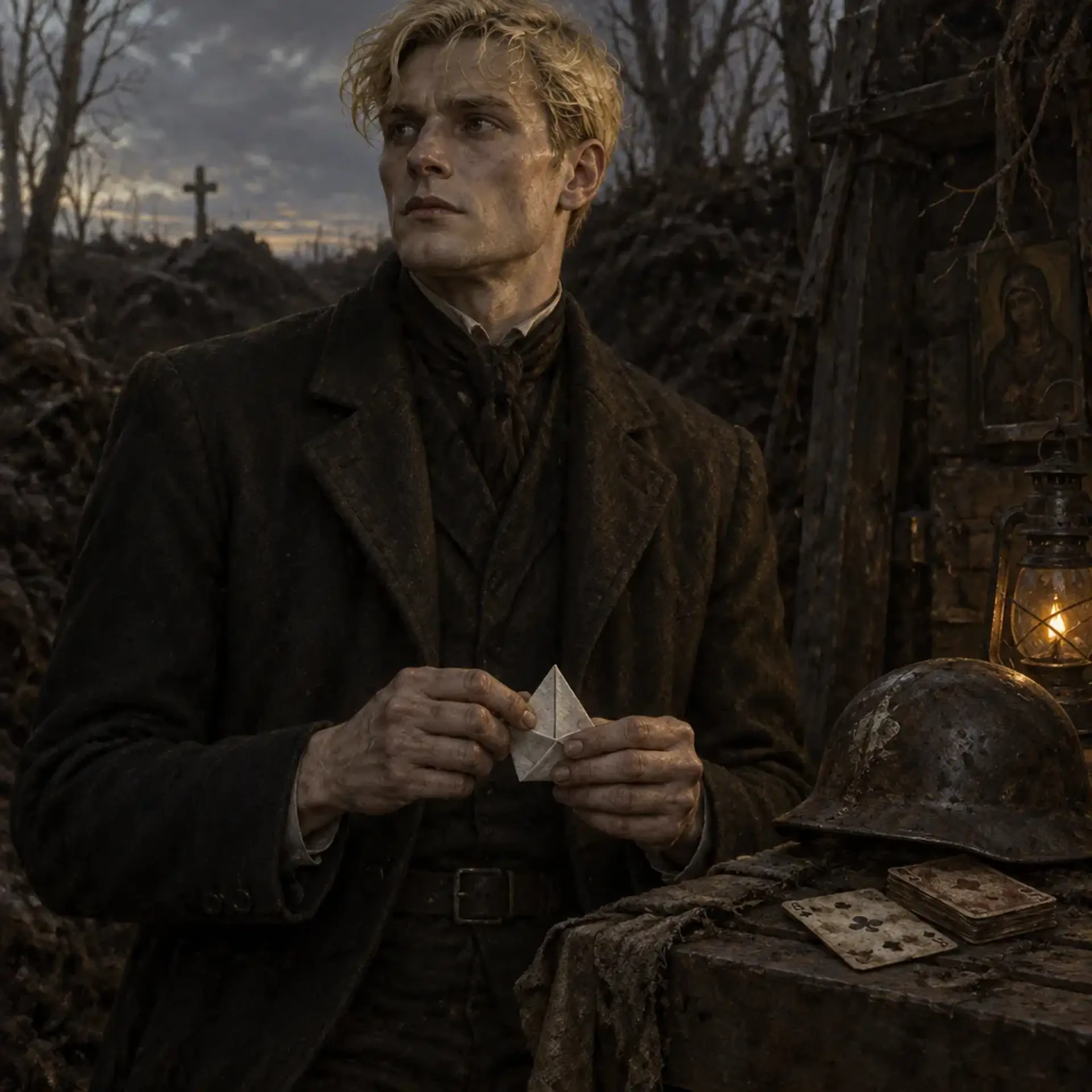
Friedreich now stands taller than the youth Wilhelm remembers, with a straight-backed Junker bearing that seems learned rather than chosen. His body is bare when first seen after the rite, slick with dried blood and earth; afterward he dresses with severe, almost ceremonial neatness. His skin has the pallor of someone newly returned to daylight, crossed by a faint, soil-dark cast at the knuckles and soles. His blond hair lies in stiff, uneven strands as if combed with a military hand. Grey eyes look alert but remote, fixing on people as if measuring their place in a formation. He moves economically, heel-to-toe, never quite relaxing his shoulders. He smells of damp Brandenburg earth, old wool, and iron. His square jaw works visibly when he eats, and his broad, slightly crowded teeth show in a brief, startlingly boyish grin that vanishes almost at once. The unexpected detail: he is meticulous about folding paper napkins into tiny sailing boats, then leaves them beside other people's drinks without comment.
Clothing
He now favors well-brushed civilian wool, a high-collared shirt, dark trousers, and a plain belt, chosen to echo old Prussian respectability without wearing a uniform. In his former wraith life he appeared in inconsistent fragments of military-style clothing and whatever face he had taken.
Body language
Formerly, he held himself as though trying to convince the living there was a person where they saw empty air. After the rite, his posture is erect and practiced; he places himself between danger and his chosen family. His hands are precise when folding or cleaning, but pause over unfamiliar sensations such as warm bread or rain on his face.
- Height
- Approximately 185 cm after the rite; former manifestations varied with the face he wore.
- Build
- Tall, lean, and newly solid, with squared shoulders and the trained carriage of someone raised to value parade-ground discipline.
- Eyes
- Grey
- Hair
- Blond
- Skin
- Pale, with a newly returned, faintly earth-dark cast at his knuckles and soles
- Age
- Appears 17 or 18 in his former wraith manifestations; his embodied body appears the same age. His memories include eras far older than his apparent life.
- Gender
- Male
- Size
- Medium
Distinguishing features
Personality
17 traits and drivesFriedreich is simultaneously a disciplined young man and someone who has spent too long being unable to participate in the world. He wants rules because rules once made him feel less lost, but he distrusts anyone who uses duty to excuse cruelty. He is protective without wanting to be patronizing, especially with Mila, and has to remind himself that guarding someone is not the same as deciding for them. He can be warm in practical ways: checking whether a friend has eaten, finding a better market price, or staying beside someone who is frightened. He struggles to say that he cares. When he feels unseen, he can flare into sharp frustration. Years of distance have worn that anger down, but they have not erased it. With Wilhelm he is more openly wounded than he is with anyone else. He longs for brotherhood and resents being given fragments instead of answers. Wilhelm's apologies about the First World War matter to him, yet the silence around the Second World War remains a splinter he cannot remove. Friedreich thinks Wilhelm may be ashamed, evasive, or both. His former face-taking brought joy and corruption together. A borrowed face let him taste food, sleep, flirt, and be recognized. Each success made ordinary life feel possible, while prolonged use threatened to make the borrowed identity more vivid than his own. He catalogued faces with an almost military care, telling himself that checking whether a person was dead or absent made the practice harmless. He knows this was not always true. Possession was another attempt to bridge the distance. With Wilhelm, he wanted to offer sensations and perhaps recover memories; with Gunther, he wanted to understand what made their lives different. Both attempts revealed that intimacy without clear boundaries could become an invasion. After the rite, a colder certainty has entered him. The old Friedreich can still be tender, embarrassed, curious about football, and eager to advise on Christmas gifts. Brändle can speak of service and obligation with a confidence that makes his friends afraid. He does not smile as often, though his voice can sound teasing while his expression remains grave. The conflict between these selves is not resolved; it is the central danger of the character.
- Alignment
- Protective and duty-bound, but no longer reliably his own judge of what duty requires.
Quirks
Habits
Traits · 5
Flaws · 4
Fears · 4
Wants and needs · 4
Combat
HP 6 · Use the table's Wraith movement rules for his former wraith state. In his current custom embodied state, use ordinary human movement; no special speed rating is established.Protect the coven first, seek cover and a route of escape second, and fight only when those fail. He uses disciplined movement and whatever weapon is available rather than grand gestures. His past kills trouble him, but he can become frighteningly decisive when a friend is threatened. His spirit-bond is not a reliable combat power.
Friedreich
Actions
Reactions
Services they sell
Rewards they can give
Equipment
- Old helmet (personal relic)The old helmet recovered for the Walpurgis rite. Its provenance and relation to his living past remain uncertain.
- Face list (personal record)A pocket notebook of face aliases, remembered features, safe-use locations, and purposes. He has not needed it since becoming embodied, but cannot bring himself to destroy it.
- Worn playing cards (memento)A plain deck used during the possession attempts with Wilhelm. The cards are now kept as a reminder of consent, limits, and failure.
Possessions
Background
Before the dead claimed him, Friedreich was a Brandenburg boy raised among the habits and expectations of old Junker families: posture before comfort, duty before explanation, and a belief that a uniform could make a confused world legible. He remembers fragments rather than a continuous childhood: a cold room, a family voice correcting his stance, the repeated rhythm of marching, and the sensation of drawing breath during the First World War. Wilhelm, the German Tzimisce from Mecklenburg who cannot remember his own life before death, sometimes insists Friedreich had blond hair and grey eyes. Friedreich wants to believe him and suspects him at the same time. Wilhelm's silence about the wars has made every recovered detail feel like testimony from an unreliable witness. Friedreich's death and the opening of his Caul are tangled with a spirit that was neither a wraith nor a mage nor an occultist. He remembers the end as a break in repetition, not a clean story. When the Caul opened, the Shadowlands gave him no familiar family or orderly military afterlife. A willow-wisp remained where the old marching rhythm had been. Klaus later offered an explanation in the language of the changing breeds: the spirit was marked by the Wyld, born of the Weaver's blessed adopted children, gifted with the Wyrm's spoils, and carrying a trace of Luna. Friedreich accepted the account because Klaus knew more than he said, not because it made sense. He now suspects the spirit concealed its purpose from him from the beginning. As a wraith, Friedreich could usually be overlooked, unheard, and untouched. On rare days when the world seemed to unbind itself from the dead, people saw him more clearly. Mila of Bremen was an exception: she could see and touch him even when he wore no borrowed face. Her kindness delighted him. He thought of her as a little sister, and protecting her became a duty he chose rather than one assigned by blood or uniform. He also guarded Wilhelm, Gunther, and Klaus. He fought in both world wars as far as his uncertain existence allowed, and he carries anger toward Wilhelm for his crimes in the Second World War and for deserting in the First. Wilhelm apologizes for that earlier desertion, but gives no explanation. Friedreich believes there is truth in Wilhelm's shame and still cannot forgive the evasions. His first successful face-taking began as an answer to being unseen. In a crowded place, a living man's features became available to him like a door left ajar. Friedreich remembers the shock of skin, weight, breath, and the smell of hot food. He could speak, touch, drink, sleep, and be recognized. The first face taught him that being perceived could feel almost like being alive. It also taught him the danger: the longer he wore another identity, the more his own memories slipped out of focus, while envy and anger gathered beneath the borrowed expression. He began a private list, changing names to protect the people whose faces he used. He favors young German men around his apparent age, especially military personnel, police, or people with a Junker bearing. He tries to choose people confirmed dead or safely absent from the area. One face, recorded under the alias 'M.' and remembered for a neat side part and a chipped front tooth, is for errands and public transport. 'K.' has a broad jaw and is reserved for football gatherings where he wants to look like somebody's ordinary cousin. 'R.' is a police-like face used only when he needs to pass unnoticed near danger. A soft-featured young man's face, 'S.', is the one he uses to flirt, awkwardly, with women he finds pretty. He changes the aliases and the purpose notes whenever he fears the list has become too much like a roster. The coven gave him a life between crises: cards, fishing, hunting, drinking, holidays, and football. Gunther, a changeling who spent much of his life in Arcadia and now sells clothes made with moss, makes ordinary conversation seem possible. Klaus, a ronin Get of Fenris or perhaps a skin-dancer, refuses to identify himself and is mean in a way that often stops short around Friedreich. Mila visits from Bremen, especially at holidays, and takes him to Christmas markets. He advises on bargains, sometimes urging friends to buy things he privately wants but cannot keep. He has tried church services and considered taking a job or joining a hobby group, not because he needs wages but because he wants a place in the world that does not depend on borrowing someone else's face. His attempts to understand possession became intimate and frightening. During one card game, Friedreich and Wilhelm agreed to let Friedreich try to possess him. They set terms, kept the cards as a focus, and watched each other for signs of lost control. Friedreich pushed into Wilhelm's body and found not the simple warmth he expected but a body that resisted ordinary human experience. Wilhelm's vampiric nature made the experiment strange: Friedreich could feel the body's boundaries and movement, but the deadness underneath did not become human. Wilhelm's hands moved with Friedreich's urgency while Wilhelm remained aware inside, a second will pressing against him. Friedreich tried to make Wilhelm feel the pleasure of a drink and the comfort of being warm; the bloodless body offered neither as he imagined. Their shared attention split over the cards, each man trying to follow the game while also monitoring the other's thoughts and reflexes. Klaus became alarmed, Gunther asked more questions than either could answer, and the brothers ended the attempt by mutual agreement. Friedreich felt ashamed of treating Wilhelm like an instrument, but Wilhelm later admitted that he had wanted to know whether the attempt could return anything of his lost humanity. Friedreich tried once with Gunther because Gunther wanted to know what separated them and whether memories could be shared. The attempt was worse. Gunther's changeling nature made the boundary between self, story, and spirit feel unstable. Friedreich encountered impressions that arrived with the force of a tale being performed rather than memories being recalled. Gunther felt an alien pressure in his thoughts and a terrible crowding of identity; Friedreich felt as though every borrowed feeling could become a role he was expected to play. Neither could tell whose reaction belonged to whom. They stopped quickly. Friedreich said, 'Never again,' and meant it. He and Wilhelm later tried once more under a final agreement, more cautiously and without the cards. That attempt yielded no recovered past, only an exhausted silence and Wilhelm's quiet admission that he could not promise to let Friedreich in again. Friedreich has killed to protect the people he calls family. He killed a Get of Fenris who was trying to kill Klaus, and has killed three Hunters who pursued Wilhelm or the others. He has defended Wilhelm from vampires and Gunther from other changelings. These acts did not make him feel heroic. They made violence resemble an old duty, which frightens him more than the blood itself. Everything changed on Walpurgis night, April 30, in the Harz Mountains. The coven tried to make him alive again, hoping to give him respite from the terror and horror of death. They prepared Brandenburg soil, human blood, metals, Friedreich's old helmet, and a breathing human-shaped body formed through their combined arts. Wilhelm used Vicissitude and Koldunic sorcery; Mila brought her reality-warping magic; Gunther brought Glamour and gifts that could make miracles happen; Klaus used knowledge of spirits and rites of the Garou and other changing breeds. They meant to make a Risen, and promised Friedreich he would be safe. As the rite progressed, Friedreich sensed something familiar deep in the earth, welcoming him with a demand hidden inside the welcome. The willow-wisp watched. His soul, psyche, and Shadow were bent by another will, not simply brought home. The body lurched from the earth. He felt flesh, melting, breath, and a heart faltering all at once; his mouth filled with blood and his eyes dimmed. He feared dying again. Then something crawled inside him during the rite. He spoke German with a fluency and force he had never possessed. The coven crowded close, panicked and shouting. Mila wiped blood from his eyes and mouth with a small cloth; Wilhelm pushed the others back, his eyes bright with what he had thought was success until Friedreich spoke. The spirit had given the new being memories of family, youth, and death, and immense older memories of frozen land and floodwater. Friedreich, now taller, blond, and grey-eyed as Wilhelm had claimed, understood himself as Brändle, called to service from the earth. He believed the coven had a service and a duty to their nation, and completed what he thought the rite required. What happened next remains difficult to describe: his companions remember being compelled and their wills broken into service by the same force that had taken hold of Friedreich. He did not kill them. He insists it hurt only once and that they are family. Their memories of that night do not agree on how much choice they had. By dawn he was calmly cleaning up, breathing and feeling grass beneath bare feet, while the coven looked at him as both miracle and violation. The transformation is not a happy ending. Friedreich no longer needs borrowed faces, but he may no longer be entirely Friedreich.
Role in the story
A wounded brother and former wraith whose attempted return to life has become an uncanny transformation. He can offer a personal connection to the Shadowlands and the coven, while the spirit's concealed agenda makes him both a potential ally and a source of danger.
“Friedreich wants to believe him and suspects him at the same time.”
- Faction
- The informal supernatural coven of Wilhelm, Klaus, Gunther, Mila, and their holiday visitors. Formerly a wraith connected to the Shadowlands; now bound to a land-spirit by a custom, compromised rite.
Known connections
Media
0 imagesNo images yet.
Turn Friedreich into a sheet
A high-res, share-ready sheet you can post or print.