Friedreich
Friedreich
At the table
Voice
A young German man's voice shaped by cold air, formal instruction, and years of being unheard. It has a dry edge and deliberate consonants, with breath now audible after the ritual. When he is angry, he does not automatically become quiet or polite: his delivery turns blunt and impatient, as if he is issuing an order he already regrets.
His German carries the clipped, formal rhythm of a Prussian upbringing and military drilling. He articulates consonants carefully, as if each sentence has to pass inspection. With the coven he slips into practical banter, dry teasing, and quick opinions about football or market prices. His voice now has breath and roughness; when Brändle's influence presses close, a second cadence seems to sit beneath his words, old and rooted rather than openly supernatural.
Speech patterns
How to play them
Treat him as a person rather than a disguise or a problem to solve. Offer clear choices, ask before touching him, and do not treat his protective instincts as consent to decide for the group. He responds well to practical invitations such as a football match, a meal, or help with a hobby. If the Walpurgis rite comes up, gently separate Friedreich's intentions from Brändle's demands and ask what he remembers feeling.
Goal
Discover what Brändle did during the Walpurgis rite, determine whether the coven can be freed from its influence, and learn which memories are truly his.
Motivation
Belonging without having to earn it through violence or obedience, and recovering enough of his past to understand why Wilhelm feels like family.
Appearance
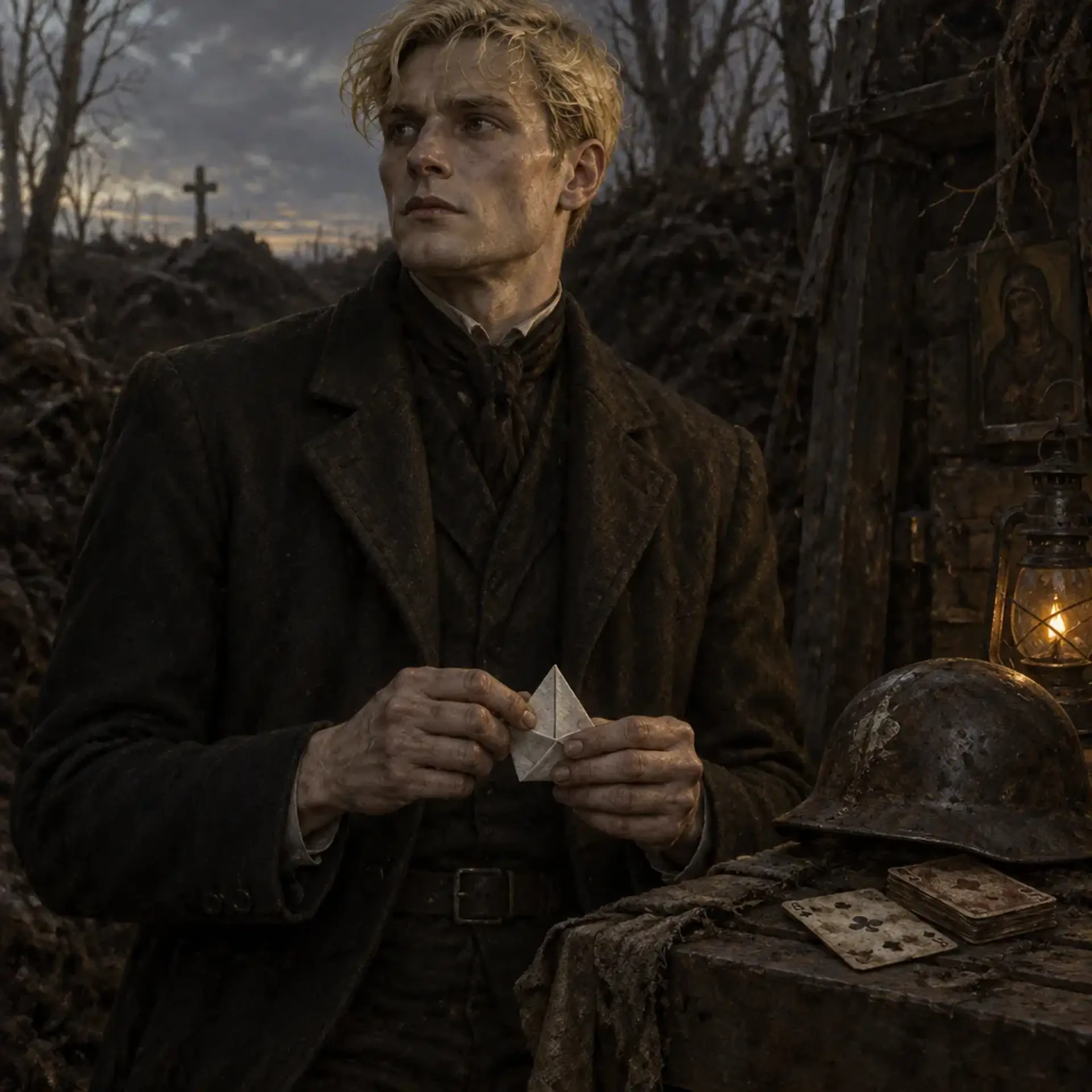
Before the ritual, Friedreich looks like a young Prussian man assembled from incomplete recollection: lean, straight-backed, and slightly too still, as if waiting for an order no one else can hear. When he has no borrowed face, his features are blurred to the eye and hard to hold in memory. On nights when the boundary thins, he becomes clearer: a narrow young face, a disciplined jaw, and eyes that seem to be looking past the room. Since the rite, he has a living body with pale skin, wheat-blond hair, and grey eyes, the appearance Wilhelm once insisted he had in life. He moves with the habitual economy of a drilled marcher, but pauses at thresholds as though listening for the ground beneath them. He smells unmistakably of wet Brandenburg soil, crushed willow leaves, and old wool. He knows this and is faintly embarrassed by it. He takes up more space than his slight build suggests, standing close to those he considers family and leaving an empty, watchful gap around strangers.
Clothing
Prefers plain, well-maintained clothes with a Prussian military silhouette: dark wool, high collars, fitted jackets, and sturdy boots. He avoids insignia and anything that could be mistaken for a real uniform. Since gaining a body, he has also accepted modern civilian clothes from the coven, though he folds them with parade-ground precision.
Body language
Stands as if inspected by an unseen officer, shoulders squared and chin level. He crowds the people he loves, but leaves a deliberate empty space beside strangers. His hands hover near his face when discussing identity. Since the rite, he sometimes presses bare fingertips into soil, then looks startled by the sensation.
- Height
- About 173 cm in his new body; his apparent height varied with borrowed faces.
- Build
- Lean, narrow-shouldered, and upright, with the wiry posture of someone trained to keep formation.
- Eyes
- Grey
- Hair
- Wheat blond
- Skin
- Pale, with the living warmth of a body newly returned to circulation.
- Age
- Appears 17 or 18; dead for roughly a century, then returned to a living body on Walpurgis Night.
- Gender
- Male
- Size
- Medium
Distinguishing features
Personality
19 traits and drivesFriedreich is disciplined but not truly calm. He can keep his posture and voice under control while anger builds behind his eyes, especially when people fail to see or hear him. The anger is often followed by a sudden collapse into distance, as if he has spent the last of his force merely proving he exists. Among the coven he is more relaxed: competitive over football, opinionated at markets, and willing to laugh at a bad card hand. With strangers he performs the stiff courtesy of a young officer, partly from habit and partly because manners give him a script when he cannot trust his own memories. He is protective without being gentle in every moment. Friedreich assumes responsibility quickly, particularly for Mila, whom he loves as a little sister, and for Wilhelm, whom he can scold more fiercely than anyone else. He does not consider Mila weak; he simply believes that family should place itself between danger and one another. That conviction has saved people, but it also makes him prone to deciding what others need before asking. He can be generous with advice and stubborn about accepting it. His need for a face is both practical and emotional. He selects people who resemble the young German man he thinks he once was, especially men with military or police service and minor nobles. When a borrowed face lets him eat, sleep, bathe, smell, flirt, or hold a glass, he can become almost giddy with gratitude. Then envy creeps in. He may begin to feel that the face's life should have been his, or that the borrowed habits are more authentic than his own. He fears losing himself, yet keeps returning to the faces because being unmistakably absent is worse. Friedreich's affection for Wilhelm is complicated by anger. He believes Wilhelm deserted in the First World War and cannot accept that his brother's later crimes are harmless simply because Wilhelm is ashamed. Still, Wilhelm's rare apology matters to him. He wants the truth, but also dreads that it will confirm he has loved someone whose choices he cannot forgive. He suspects Wilhelm's claim about his blond hair and grey eyes is true, though he treats it like evidence offered by an unreliable witness. After the possession attempts, Friedreich became more cautious about the borders between selves. With Wilhelm, he hoped to give his brother human feelings or recover memories; instead, he learned that sharing a body does not make a person whole. With Gunther, curiosity became frightening as alien experience and identity tangled together. Friedreich now asks more often before crossing a boundary, though the urge to help can still make him forget. He is proud that he stopped the experiment with Gunther, and embarrassed that he needed to learn consent through fear. The Walpurgis rite has made his contradictions more dangerous. He has warmth, breath, touch, and vivid memories again, but a spirit's demand runs through the gift. The new body feels miraculous when grass brushes his feet and horrifying when he wonders whose will moved it. He is not simply grateful or furious. He can comfort the coven in the morning and privately fear that he was made into their jailer. His rough, teasing manner after the rite is partly an attempt to reassure them and partly a defense against the possibility that Brändle is speaking through him. He wants an ordinary life, perhaps a job or a club, but does not know how to ask for one without framing it as a duty.
- Alignment
- Unaligned; his devotion is personal and familial, not a political allegiance.
Quirks
Habits
Traits · 6
Flaws · 5
Fears · 4
Wants and needs · 4
Combat
HP 7 · Walking pace appropriate to a living adult; use the Storyteller's edition-specific movement rules.Avoids fair fights. Uses cover, surprise, and the appearance of a familiar face to misdirect opponents, then fights only to create an escape or protect someone. He is dangerous when a loved one is threatened, but not a veteran combat superhuman. His Shadow and the spirit in his new body may pull him toward service and violence; the Storyteller should make those pressures consequential rather than treating them as free combat bonuses.
Friedreich
Actions
Reactions
Services they sell
Rewards they can give
Equipment
- Face List (personal record)A pocket notebook of studied faces, aliases, safety checks, and the situations in which each is used. It is a practical record, not a list of people he intends to impersonate locally.
- Old Helmet (ritual object)His old helmet, incorporated into the Walpurgis rite. It is now a relic of his death and transformation, and he avoids wearing it.
- Civilian Wallet (personal equipment)A small wallet of ordinary cash and transit tickets, useful for trying to live among the breathing.
Possessions
Background
Friedreich remembers Brandenburg as a taste of cold air and the straight line of a road, not as a complete childhood. He believes he was born to a minor Junker household and trained for military service, but his memories have holes large enough to swallow names, faces, and the reasons he made the choices he did. Wilhelm has told him that he had blond hair and grey eyes. Friedreich distrusts the detail because Wilhelm has withheld so much else, yet it fits the body he has now, and some buried part of him recognizes it. His death did not lead him gently into the Shadowlands. He remembers waking as a wraith with a Caul between himself and the world, unable to understand why the familiar things of life would not answer him. A spirit of land and human habit, tangled in powers Klaus later described through Garou terms, opened that Caul. Klaus said the being was marked by the Wyld, born of the Weaver's blessed adopted children, and gifted the Wyrm's spoils with a trace of Luna. Friedreich cannot tell how much of that was truth, metaphor, or Klaus trying to make an unknowable event bearable. The spirit concealed its purpose. When Friedreich emerged, only a willow-wisp remained of the repetitive marching he had done before. It led him toward the living world, then vanished. The wars became the scaffolding around his broken memory. He tried to stay near Wilhelm through both world wars, appearing when the barriers allowed and borrowing whatever face let him be heard. During the First World War, he sometimes remembers drawing breath. The memory is so vivid that he cannot decide whether it belongs to him, Wilhelm, or some wound in their shared history. Wilhelm deserted; Friedreich is angry at him for it, even as Wilhelm's rare apology for that act keeps the anger from settling into certainty. In the Second World War, Wilhelm committed crimes he will not discuss. Friedreich is furious and ashamed by association, but also suspects Wilhelm's silence conceals more than cowardice. Their bond feels like brotherhood without a reliable account of how it began. The first face Friedreich stole was not chosen with care. After a long spell of being unseen, he found a dead young soldier whose body had been left where the living would not look for it. He pressed close, reached for the shape of the man's face, and discovered that the world could suddenly feel him. The borrowed skin brought weight, breath, warmth, and hunger. He ate bread too quickly, cried over the taste, then slept for hours. The exhilaration turned to panic when he could not remember whether he had always liked the bread or had inherited the dead man's preference. From then on he kept a list of faces, using aliases rather than their names and noting where each face was safe to wear. His list is practical and intimate. One is a young railway auxiliary, useful for errands and crowded stations. Another is a police clerk he believes dead, suitable for moving through official spaces without claiming a real living person's identity. A third is a young man with a military bearing, reserved for conversations with Wilhelm and other veterans. He has a face resembling a minor nobleman for formal occasions, and one softer, ordinary face for eating in public or attempting to flirt with women he finds pretty. He selects men near his own apparent age, preferably German, with military, police, or Junker associations. He checks that they are dead or well away from the area, changes the names in his notes, and records what he used each face for. He is trying to learn whether this gift could support a job or, at least, let him join a hobby group without becoming a spectacle. The irregular little coven gave him a life beyond war and haunting. Wilhelm, a Tzimisce vampire from Mecklenburg with his own missing past, became the brother Friedreich would protect and accuse in the same breath. Gunther, a changeling who spent so long in Arcadia that ordinary life still seems strange, sells clothing made from moss. Klaus is a ronin Get of Fenris, or perhaps a skin-dancer; he refuses to clarify, and his passive-aggressive cruelty usually falters around Friedreich. Mila, a mage from Bremen, can see and touch him without a borrowed face. Friedreich calls her his little sister in his heart, though she is long-lived and not helpless. He protects her because he feels responsible, not because he doubts her strength. They meet for cards, hunting, fishing, drinking, and football. Holidays matter to them, especially visits to Mila and the Christmas market. Friedreich advises everyone on prices and gifts, then sometimes tells them to buy the thing he wants but cannot keep. He has tried church services, not because he has resolved what he believes, but because the living go there together. He has fought to defend Wilhelm from vampires, Gunther from changelings, and Klaus from a Get of Fenris who came to kill him. He has killed that attacker and three Hunters who were pursuing Wilhelm or the others. These acts haunt him less as violence than as proof that he can become useful enough to be loved. His curiosity about possession produced three experiments. First, he and Wilhelm agreed to try it during a card game. Friedreich entered Wilhelm with consent, hoping to share human feeling and perhaps stir up memories. He found no simple human warmth waiting inside. Wilhelm's vampiric body was a disciplined, cold territory, and Friedreich's own emotions arrived as pressure rather than a gift. Their hands moved over the cards with competing intentions; Friedreich felt Wilhelm's restraint, while Wilhelm felt an alien urgency to breathe, taste, and be moved. They tested alcohol. The vampire body could not enjoy it as a living person would, and Friedreich's pleasure became an echo that made Wilhelm feel more aware of his deprivation, not less. Klaus watched in alarm. Gunther asked questions until the game collapsed. They stopped by mutual agreement, shaken but still close. Later Friedreich tried with Gunther, who wanted to know what separated their kinds and whether memories could be shared. The attempt was worse. Gunther's presence did not feel like a single private self but like a door opening onto an elsewhere that Friedreich could not safely name. Glamour, alien memory, and Friedreich's own need to belong tangled together. Gunther experienced the wraith as a cold insistence intruding on his identity; Friedreich felt himself slipping toward a borrowed story that was not his. They broke contact quickly. Friedreich said, 'Never again,' and meant it. He later agreed to one final attempt with Wilhelm, under clear terms. It brought neither recovered memories nor a cure for Wilhelm's deadness. It did give them a shared, difficult recognition that intimacy could be real without either of them being able to repair the other. The worst change came on April 30, Walpurgis Night, in the Harz Mountains. Mila, Gunther, Wilhelm, and Klaus intended to give Friedreich a living body, believing they could return him as a Risen and ease the terror and isolation of death. They used soil from Brandenburg, human blood, worked metal, Friedreich's old helmet, and a male body shaped through their different practices. Wilhelm brought Vicissitude and Koldunic sorcery; Mila brought reality-bending magic; Gunther brought Glamour and a talent for making miracles feel possible; Klaus brought spirit knowledge and rites associated with the Garou and other changing breeds. The body lay naked beside a great bonfire, breathing softly as if asleep. During the rite, Friedreich felt something familiar far beneath the mountain, a presence welcoming him with a demand rather than an invitation. A willow-wisp watched. The ritual's changes bent his soul, psyche, and Shadow under an alien will. He remembered everything at once, and more than everything: the cold and floods of Brandenburg across centuries, the changing weight of the land, and the habits of its people. He woke with blood in his mouth, dim eyes, and a failing heart. Something had crawled into the rite and answered it. The new being called itself Brändle, a local spirit made from Brandenburg's land and people, weaker and narrower than the spirit that had opened Friedreich's Caul. It had used the coven's loving intentions as an opening. Friedreich's will was forced toward service. He had a living body, could smell grass and feel soil under bare feet, but the gift came with a command: his friends were now bound into a rite of service, their wills pushed toward the same purpose. When the others crowded him, Mila wiped blood from his eyes and mouth; Wilhelm shoved the others back, his eyes briefly bright with hope before Friedreich spoke. Friedreich, now also Brändle's instrument, completed the rite. What he did remains uncertain to the coven. The moment was brief to him, but the compulsion was real, and their wills were caught in its wake. At dawn he cleaned the ritual site and told them to rest, insisting that it had hurt only once and that they were truly family now. He did not smile. His voice had become rough with a teasing edge that sounded almost like Friedreich and almost like someone using his mouth. The coven must decide what the rite actually did, how to undo it, and whether the new body is salvation, possession, or both. Friedreich has regained vivid memories, but cannot trust all of them. He no longer needs a borrowed face to touch the world, yet he still keeps his list. Some days he uses an old favorite simply to feel that he has chosen who to be.
Role in the story
A brother, witness, and unreliable survivor whose apparent return to life has become a new supernatural crisis. He can connect characters to the Shadowlands and to a mixed supernatural community, while the question of Brändle's influence makes his presence both a source of comfort and a danger.
“Wilhelm has told him that he had blond hair and grey eyes.”
- Faction
- A loose supernatural coven of friends, not a formal faction. Formerly a wraith of the Shadowlands; now customarily entangled with Brändle, a spirit of Brandenburg.
Known connections
Media
0 imagesNo images yet.
Turn Friedreich into a sheet
A high-res, share-ready sheet you can post or print.