Eber
Eber
At the table
Voice
His voice has a dry, slightly rough edge, as if shaped by workshop dust and years of speaking over tools. It is not especially deep, but it carries easily through a room. He clips the ends of practical instructions, stretches a pause while deciding whether to trust someone, and has a small breathy snort when a joke catches him off guard.
Eber speaks in measured, practical sentences shaped by years around tools and family work. He often describes a problem before naming how it makes him feel, as though the right diagnosis will make the feeling manageable. He asks short questions, waits for the answer, and dislikes being interrupted. With children he uses more humor and gives objects little personalities. When embarrassed about food or his body, he turns abruptly to technical detail; when angry, his words become exact and unsparing.
Speech patterns
How to play them
Approach him through a shared task rather than demanding a personal confession. Give him time to answer and do not make a spectacle of his meals. He responds well to direct questions, practical kindness, and people who listen without treating him as a curiosity. He will discuss craft, family, and village needs readily; he reveals fear or resentment only after trust is established.
Goal
Develop a dignified meal aid and learn what is driving the high-blood transformations, without letting the village's factions claim him as their proof or their warning.
Motivation
To remain a loving son and brother without pretending his changed body is easy, and to make something practical that gives other high-blood descendants more control over their lives.
Appearance
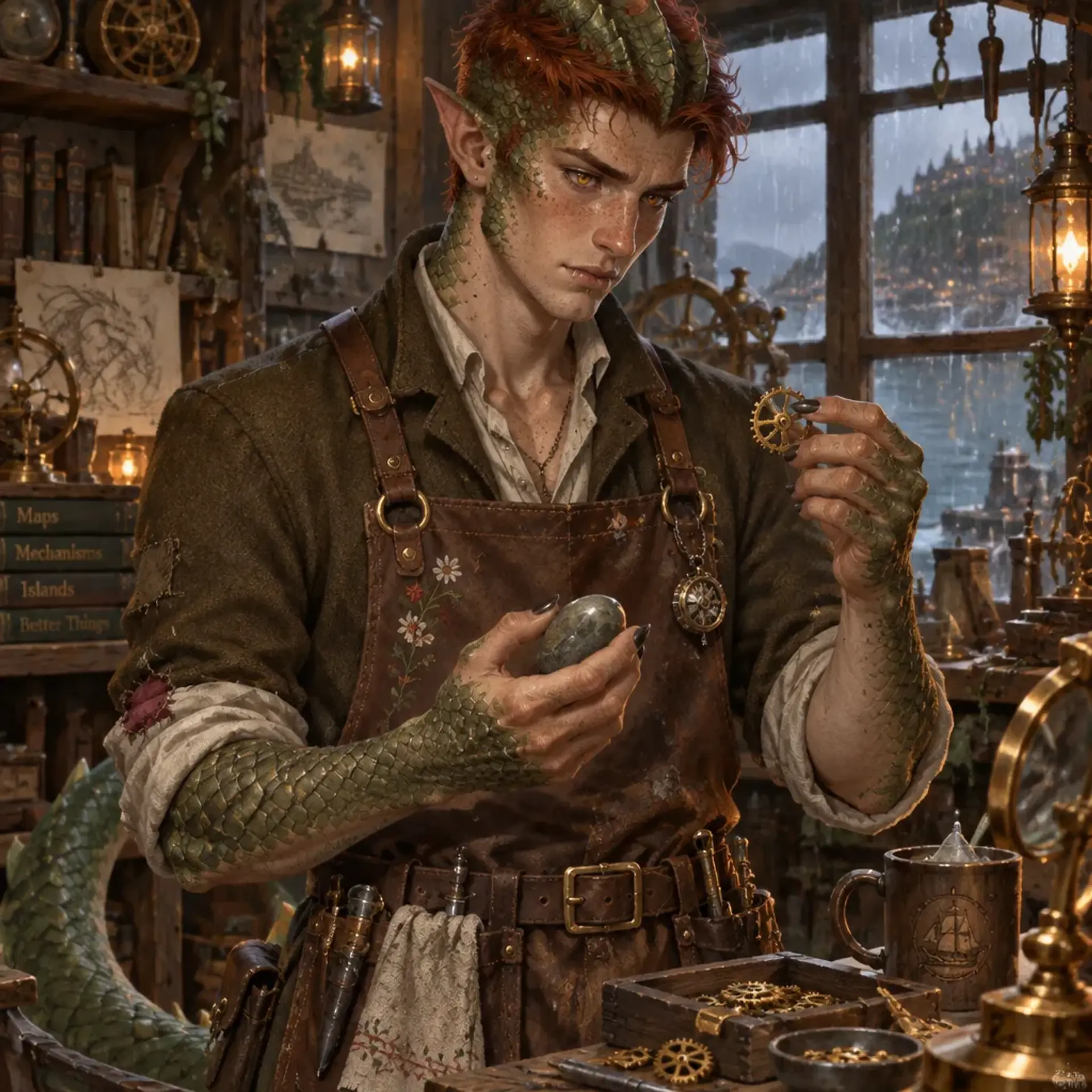
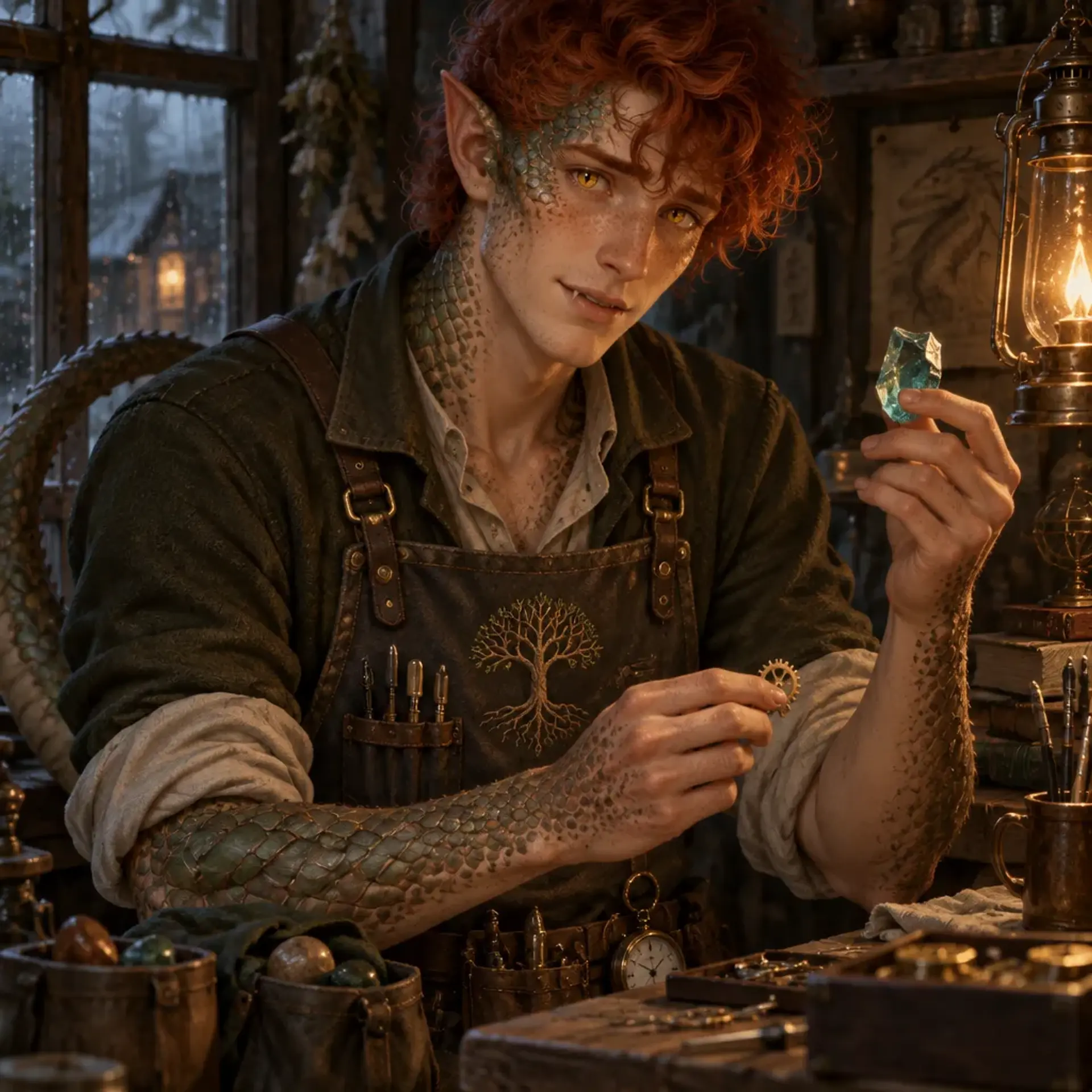
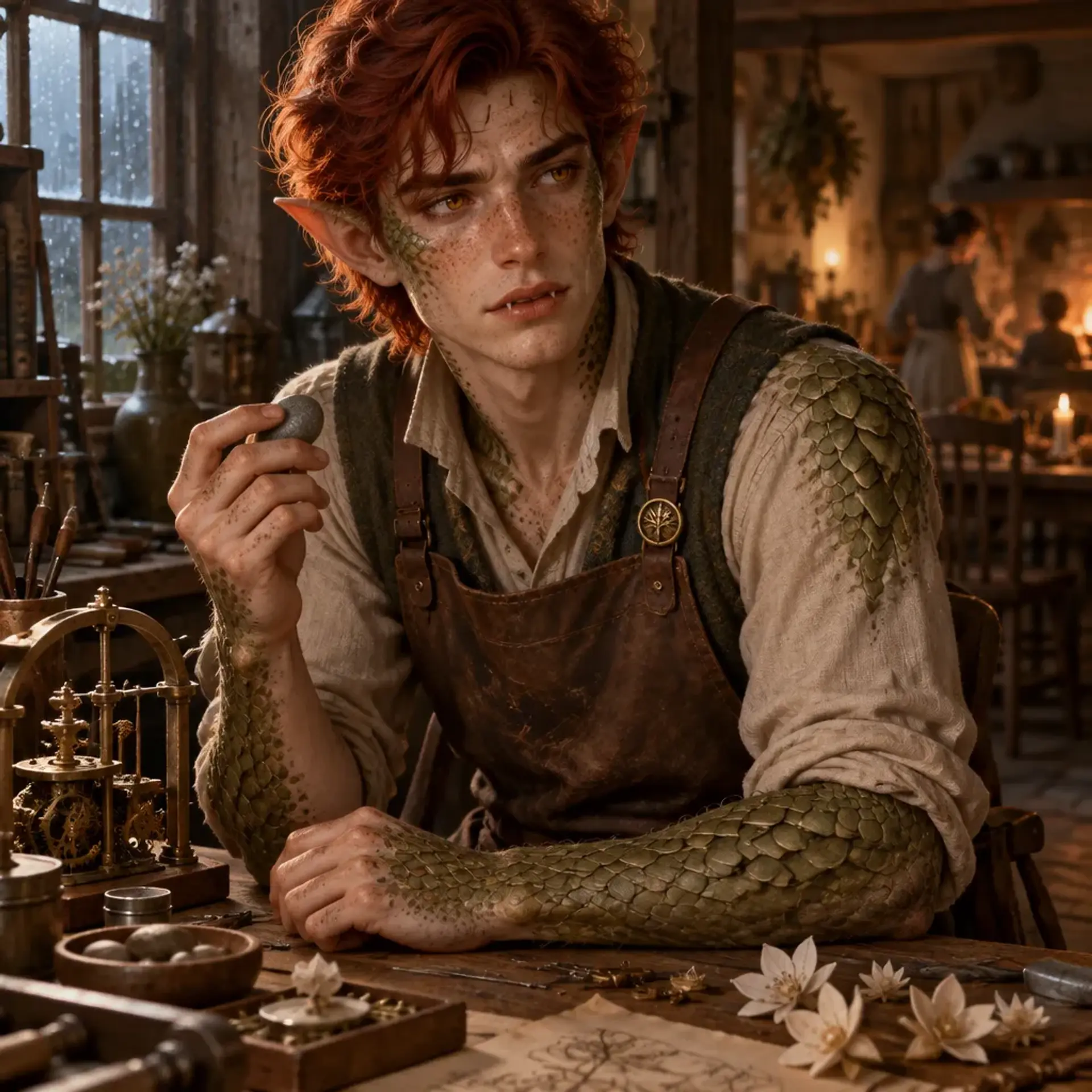
Eber is five feet ten inches tall, an imposing height in a stout-halfling household, with fair skin freckled over the bridge of his nose and shoulders. Olive-green scales cover him in irregular, flexible plates: small and close-grained along his cheeks, larger and faintly ridged at his shoulders, ribs, and forearms. Their color deepens in damp weather and pales where his work apron rubs them. He moves with a careful, economical quiet, shoulders slightly drawn in as if trying not to loom over people he loves. His red hair is auburn at the roots and startlingly vivid toward the ends, a change that followed adolescence. His pointed ears angle toward every sound. His amber eyes have narrow, dark pupils and a watchful, glassy gleam. When he laughs, his green-dragon teeth show: sharp and strong, but poorly suited to cutting or grinding food. At meals he takes small portions, swallows slowly, and keeps smooth pebbles beside his bowl. He looks like a young craftsman assembled from two incompatible lives: a halfling family’s practical warmth, stretched around a dragon’s long reach and guarded gaze. Unexpectedly, he keeps tiny paper flowers pressed in his tool case, each folded by one of his nieces or nephews.
Clothing
Practical island workwear with strong German-inspired craft traditions: a fitted linen shirt, wool vest, leather apron, sturdy trousers, and boots built for wet lanes. His clothes are altered at the shoulders and sleeves to fit his height. He wears a small brass clasp made by Trogi and keeps a folded cloth pouch of smooth digestion stones tied inside his apron.
Body language
Eber folds himself inward in crowded rooms, lowering his head to avoid looming over shorter relatives. His amber eyes track small movements, especially hands near tools or food. He touches the edge of a workbench when he needs reassurance and rolls a smooth pebble between finger and thumb when a conversation turns personal. When comfortable, he leans against doorframes and lets his shoulders loosen; when ashamed, he keeps his mouth closed even when he wants to laugh.
- Height
- 5 feet 10 inches
- Build
- Tall for a halfling-descended family, lean and long-limbed with a craftsman's shoulders and more strength than he knows how to use gently.
- Eyes
- Molted amber with narrow dark pupils; his eyes were deep brown before adolescence.
- Hair
- Unusually vivid red, with auburn visible at the roots and in some strands.
- Skin
- Fair skin with freckles, mostly covered by flexible olive-green scales. The scales are close-grained on his cheeks and more ridged over his shoulders and ribs.
- Age
- 19
- Gender
- Male
- Size
- Medium
Distinguishing features
Personality
21 traits and drivesEber is clever and guarded, but not cold. He notices the small things people overlook: a hinge that has started to sag, a child who is pretending not to be afraid, or a family member who skipped a meal. He can be funny when he feels safe, though his humor is dry and often aimed at himself before anyone else can aim at him. Around his parents, he tries to act like the youngest child they remember, then stiffens when their concern makes him feel like a patient rather than a son. With nieces and nephews he is unexpectedly playful, making toys from scraps and allowing them to climb onto his boots. With strangers he is watchful, measured, and more interested in what they do than what they claim. He wants closeness but dislikes being crowded. He wants advice but resents being managed. He is proud of his strength, especially when carrying a heavy part nobody else can move, and embarrassed by the same strength when it makes a room feel too small. He admires the low-blood traditions of communal care and sometimes aches to belong to them as naturally as his parents do. Yet he has no desire to deny the high-blood parts of himself, and distrusts people who call those changes either a blessing or a curse without asking the changed person. In a workshop, he is patient and methodical, willing to take apart a mechanism several times to understand its failure. In a family disagreement, he is less patient: he may retreat to the garden rather than argue, then return later with a carefully reasoned proposal. If someone mocks his eating, his temper rises quickly because the insult reaches a private grief. He does not usually shout. Instead, he grows very still, sets down whatever he is holding, and speaks with exactness that can cut deeper than anger. He worries that this controlled manner is not kindness but fear of his own strength. Eber has a habit of calculating the space around other people, choosing seats and paths that let him avoid knocking into anyone. This makes him seem aloof. In truth, he is often trying to protect people from the consequences of his size. He is also curious about the village's history, especially the old ritual, but dislikes being treated as a representative of all high-blood descendants. His loyalties are personal before ideological: family first, then neighbors who show up when needed. He can be persuaded by evidence and honest vulnerability, but not easily by grand claims of destiny, purity, or strength.
- Alignment
- Neutral Good, though his caution and private calculations can look self-serving to people who do not know him.
Quirks
Habits
Traits · 5
Flaws · 5
Fears · 5
Wants and needs · 6
Combat
AC 14 · HP 17 · 30 feetEber avoids a fair fight. He uses cover, tools, and spells to obstruct enemies while retreating toward allies. He prefers fire bolt or a crossbow from a safe distance, uses grease to disrupt a rush, and saves his mallet for an enemy who reaches him. If a family member is threatened, his careful restraint can break; afterward he is ashamed of how easily strength came to him.
Eber
Spells
Actions
Reactions
Services they sell
Rewards they can give
Equipment
- Workshop apron and tool roll (tools and clothing)A tough leather apron worn over fitted work clothes; its pockets hold pliers, a file, a folding rule, spare screws, and digestion stones. The apron provides no armor by itself.
- Light crossbow (weapon)A sturdy light crossbow kept for defense on the island paths. It deals 1d8 piercing damage and has range 80/320 feet.
- Iron mallet (weapon)A short-handled iron mallet used for fitting and hammering. In combat, treat it as a warhammer dealing 1d8 bludgeoning damage.
- Craft tools (tools)A small set of tinker's tools, smith's tools, and a few watchmaking instruments borrowed from Kasper. Tinker's tools are his primary craft tools.
- Digestion stones and cup (personal necessity)A pouch of smooth pebbles selected for safe swallowing and a tin cup of water he keeps near his workbench.
Possessions
Background
Eber was the eighth child and the youngest, the late, much-carried baby of Trogi and Wilma. His first memories are crowded ones: a stool pulled close to the workbench, a warm hand steadying his elbow, and older siblings arguing over who had to keep him out of the gears. The family workshop was the household’s heart. Trogi, a black-haired low-blood craftsman now turning grey, could spend a whole afternoon repairing a hinge without saying more than a dozen words. Wilma, fair-haired and sharp-minded, preferred the garden and chicken yard, where she could watch the children come and go. Their home held the habits of the Greenwake Kin: shared work, remembered dead, food offered before questions, and the conviction that no child should have to manage alone. Eber’s early childhood looked like his parents’ life. He had fair skin, freckles, auburn hair, and deep brown eyes. His height was ordinary for a child, his appetite ordinary, and he ran between the workshop and garden as freely as the rest. He adored the older children, though each had begun building a life beyond the family table. Windle, the eldest, was already the steady one, balding and practical, and would eventually take over the workshop. He married later and found contentment in his two young children, Otto and Anika. Karl loved tools and gears but carried the unease of a rocky marriage to Leanora, a sailor often away from home. Their son Hansel and Leanora’s pale, white-haired child Ragni were a complicated household that Eber never judged. Yonda, the only sister, seemed to know every person in the village; she was beautiful, kind, and forever nudging Eber toward people rather than projects. Her five children filled the lanes with noise. Alder could be a part-time guard when he was not swept up in merriment, while his clever, scaled son Black Alder became a frequent visitor with adventure stories. Kasper repaired watches and tended the family’s chickens and garden, happiest with his wife and two daughters, Wonda and Ilse. The family’s low-blood children carried few visible marks of the old dragon-blood ritual that had helped their ancestors survive a catastrophe. The high-blood line carried more. Eber grew up knowing that Rodrick and Ignatz were different, though as a child he did not know how much difference adolescence could bring. Rodrick was auburn-haired and yellow-eyed, bigger than Eber, already blunt and competitive. Ignatz, with light hair and green eyes, was gentler and became Eber’s closest brother. They shared work, jokes, and a bedroll when the house was full. Eber thought of them as brothers first and high-blood descendants second. At adolescence, his own change arrived without drama at first. His brown eyes clouded amber. His hair became an unusually vivid red. Olive-green scales surfaced, first like rough patches beneath his collar, then spreading over most of his body. His ears sharpened. He grew quickly, reaching five feet ten inches, and strength came into his shoulders before he knew how to use it. He was grateful that no tail or wings emerged. He was also frightened by how grateful he felt, as if he had been bargaining with a body that had already taken too much. Then came the meals. His teeth could not chew properly. Food had to be swallowed in careful pieces, and his altered digestion demanded small stones to grind it down. The first time he tried to eat the family’s familiar dumplings, he gagged, panicked, and pushed away from the table. He hated the shocked looks more than the physical discomfort. Wilma stayed beside him, calm despite her tendency to faint at the sight of violence, and Trogi quietly fetched clean pebbles from the stream. No one told him to be grateful. That small mercy mattered. A few nights after the changes became impossible to hide, Rodrick, Ignatz, and Eber fell asleep together in the kitchen. There was not enough space in the family bedrooms for three newly oversized young men, and the kitchen floor was the warmest place near the stove. The brothers had dragged quilts between the table and the pantry. Rodrick complained about the cramped room until he fell asleep with one arm flung across a flour sack. Ignatz arranged the blankets so Eber could stretch out without bumping the chairs. Eber woke before dawn to find both brothers still there, their breathing steady, and Wilma setting out a kettle without comment. For years afterward, the kitchen meant embarrassment and safety at once. The family’s care could not erase the difference. Eber was too large for some chairs, too strong for delicate work, and increasingly aware of how he had to stand aside so his smaller parents could pass. His body no longer fit their beds, clothes, or eating customs. He loves them, yet their warmth sometimes makes him feel like a visitor. He envies the ease with which they share bread and stew. His new appetite is not merely inconvenient; it marks a daily separation from a family whose bond is built around shared meals. Rodrick teased him about eating, at first as if it were harmless. The teasing stopped when Eber, overwhelmed and furious, snapped a workbench brace in his hands. Rodrick admitted he had not understood how much it hurt, then went back to being blunt and occasionally arrogant. He is convinced his sorcery makes him special and is forever looking for work beyond the workshop. Ignatz’s own transformation became more severe: grey-green scales brightened, a tail and claws emerged, and he developed a predator’s flexibility. One day he killed a chicken with his bare hands after a sudden hunting urge overtook him. The shame afterward frightened him more than the act. He has kept close to the workshop since, and he remains Eber’s quiet ally. Eber found direction in making things. He became fascinated by small mechanisms, especially devices that could help people whose bodies or circumstances made ordinary tasks difficult. He repairs latches, builds adjustable stools, modifies kitchen tools, and tries to make reliable watches from scarce parts. His apprenticeship is informal, split between Trogi’s patient instruction and Kasper’s careful watch repairs. He is not yet a master, but he has a knack for noticing where a device’s failure began rather than merely where it ended. His practical work has become personal. Eber is making a feeding-and-grinding apparatus that could help him manage meals without turning every family dinner into a spectacle. He hopes it might also help other high-blood kin whose bodies are changing in unexpected ways. He is reluctant to call this public service. A public demonstration would invite questions about his physiology, his family, and the old ritual. He wants to be useful without becoming a symbol. The village itself is changing. There are roughly 447 Greenwake Kin, crowded into timber houses with stone footings and steep roofs built for rain and ash. Only three generations have passed since the survivors reached the island after drowning, hunger, dangerous forests, and a volcanic eruption. The dragon-blood bargain is still present in living memory, though different generations interpret it differently. Low-blood elders preserve communal customs and fear that the bargain has left their descendants in danger. Many high-blood youths see it as the start of a stronger people. A few favor hierarchy, hunting prestige, strict gender roles, and displays of dragon identity. The growth of secret rites devoted to a fivefold dragon goddess troubles Eber, as does the rumor that a returning green dragon patriarch is using the village’s divisions for his own purposes. Eber’s own family argues about the future without agreeing on what it is. Windle fears his children might change as Eber did, a fear he masks as stoicism. Yonda tells Eber, gently and often, to be more social. Kasper thinks the practical answer is to repair what can be repaired and feed the family well. Trogi says he wants to retire but keeps returning to the shop. Wilma worries that the high-blood children lack adequate clothes, beds, and food, and that the village is not planning for their needs. Eber hears all of them, and resents the expectation that he should represent every changed child simply because he is the youngest and easiest to watch. He has made friends with no faction. He is wary of dragon worship, but not convinced that every high-blood youth who embraces it is cruel. He distrusts the secret circle, though he has not found proof of its plans. He wonders whether the original ritual was incomplete, or whether the descendants’ changes are the result of a dragon’s bloodline, a hidden rite, or both. His questions are not abstract. If he learns how to help his kin, he may also learn that someone in the village has been shaping their bodies and beliefs. Now Eber divides his days between the workshop, the garden, and a small bench of his own near the kitchen window. He repairs tools, tests simple magical infusions, and listens more than he speaks. His family remains his home, even when he feels physically and emotionally apart from it. He would like to share a meal with them without planning each swallow. He would like to sleep in a bed that fits. More than that, he wants to decide what his changed body means before ambitious people decide for him. He is still learning how to accept help without feeling small, and how to offer it without making himself responsible for everyone.
Role in the story
A family-centered young artificer caught between halfling communal traditions and the isolating physical changes of green-dragon inheritance. He can provide practical help, a personal window into the costs of transformation, and a careful lead into the village's contested history.
“Trogi, a black-haired low-blood craftsman now turning grey, could spend a whole afternoon repairing a hinge without saying more than a dozen words.”
- Faction
- No formal faction. Eber belongs to a close low-blood family whose traditions favor shared labor and mutual aid. He distrusts both the village's growing dragon-worship secret circle and those who would use fear of high-blood descendants to control them.
Known connections
Media
0 imagesNo images yet.
Turn Eber into a sheet
A high-res, share-ready sheet you can post or print.