Eber
Eber
At the table
“a seized hinge.”
Voice
Eber’s voice has a dry, lightly rasped edge from long hours speaking over tools, dust, and workshop noise. It carries clearly without booming, with an occasional breathy catch when he has been concentrating over a mechanism. His words are shaped by family conversation and practical instruction; when excited, he speeds up and clips the ends of explanations, then backtracks to make sure the important detail was understood.
He speaks in a practical, measured way, with workshop vocabulary and the habit of describing people as if they were mechanisms. His family’s halfling cadence remains in familiar company, but his consonants have grown more clipped as he learned to make himself understood from a taller frame. He uses pauses to think, not to intimidate, and his jokes arrive dry and unexpectedly precise.
Speech patterns
How to play them
Approach Eber through a useful task, a respectful question about his work, or an offer that does not presume he needs rescuing. Do not make his meals a spectacle. He warms quickly to people who treat his adaptations as ordinary and give him room to decide when to discuss his family. If players show interest in his invention, he will explain its practical value and ask what they know about the village’s changing politics.
Goal
Build practical devices that improve food storage and water access for the growing village, while finding a way to be independent without severing his place in his family.
Motivation
To make his changed body and cleverness useful without letting either become the only thing people see when they look at him.
Appearance
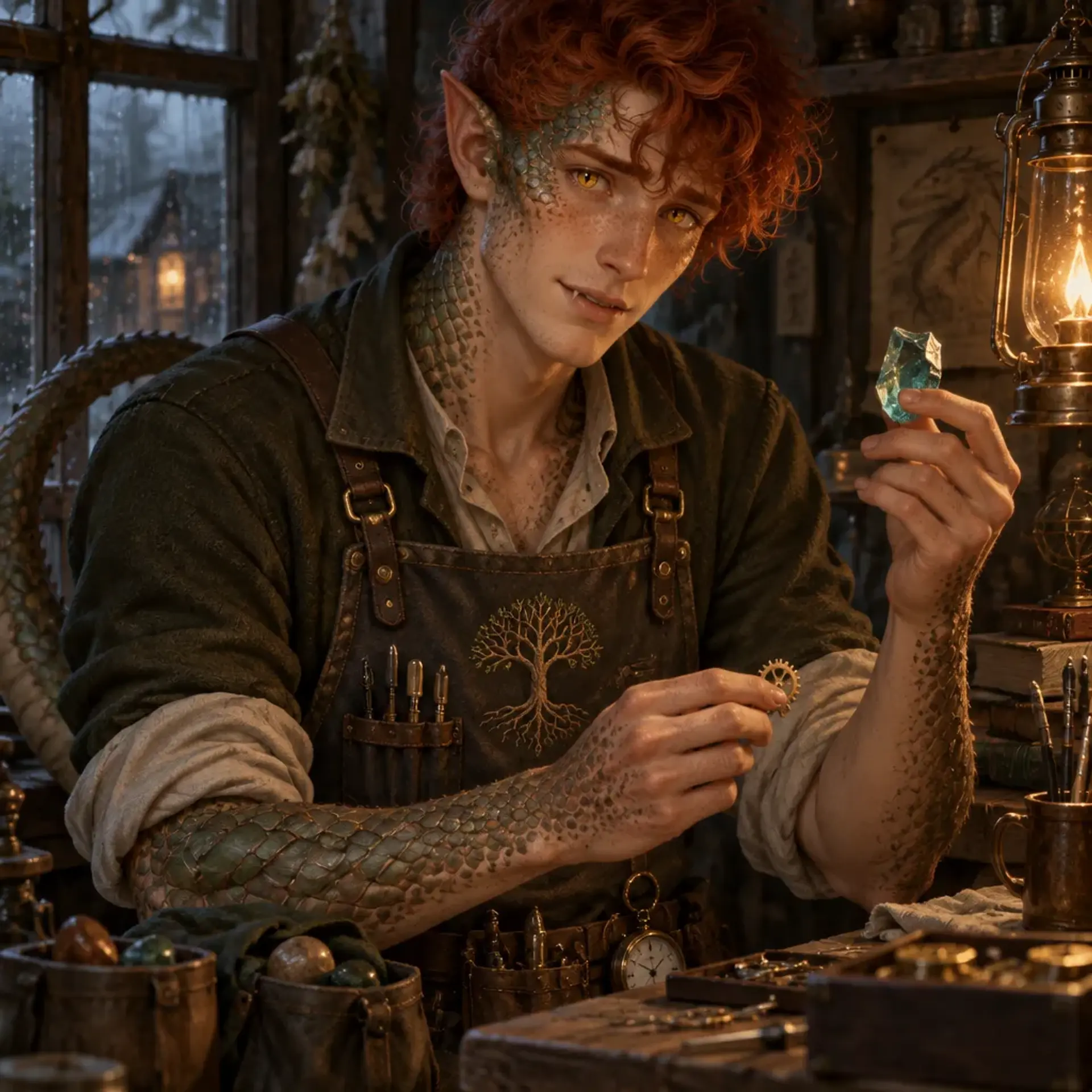
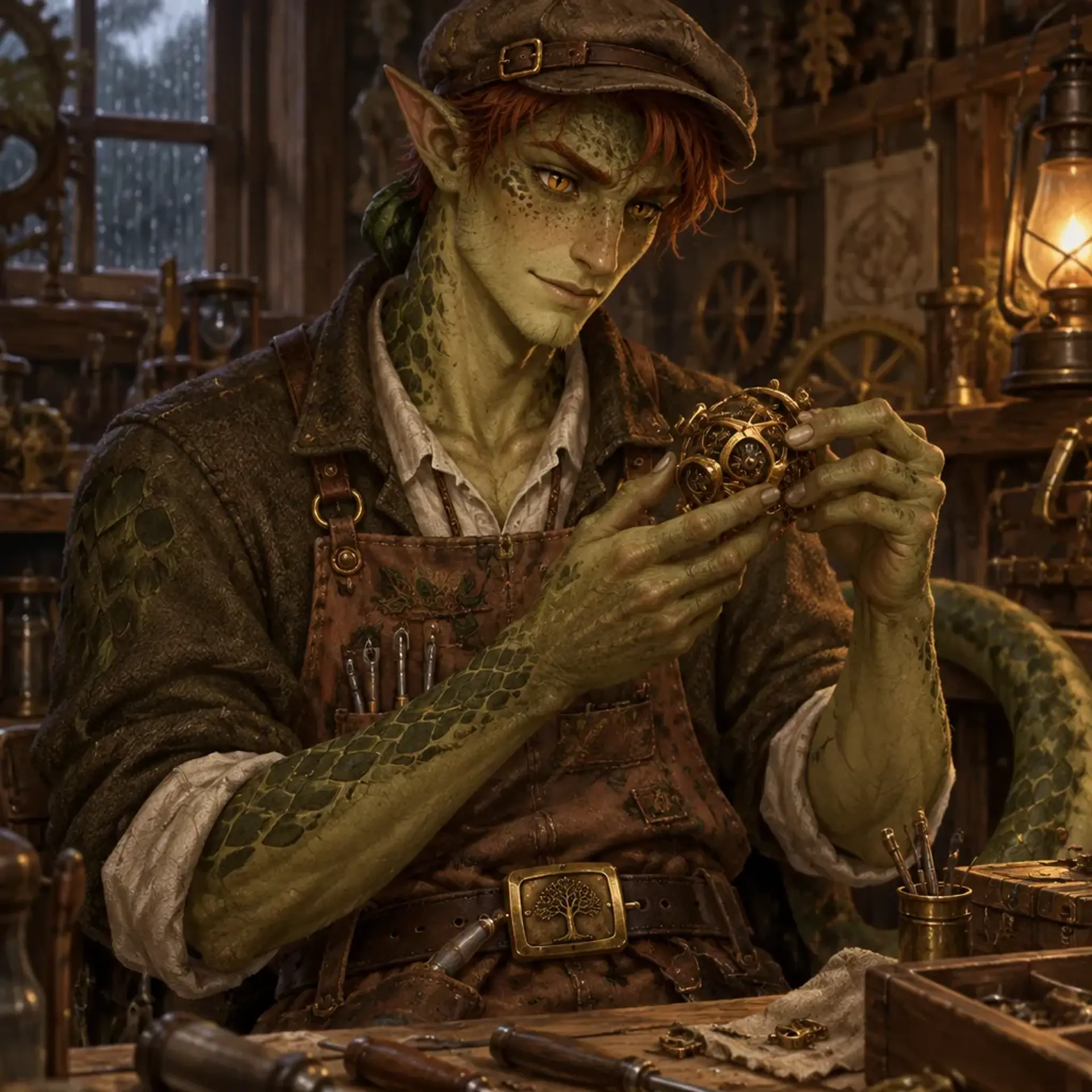
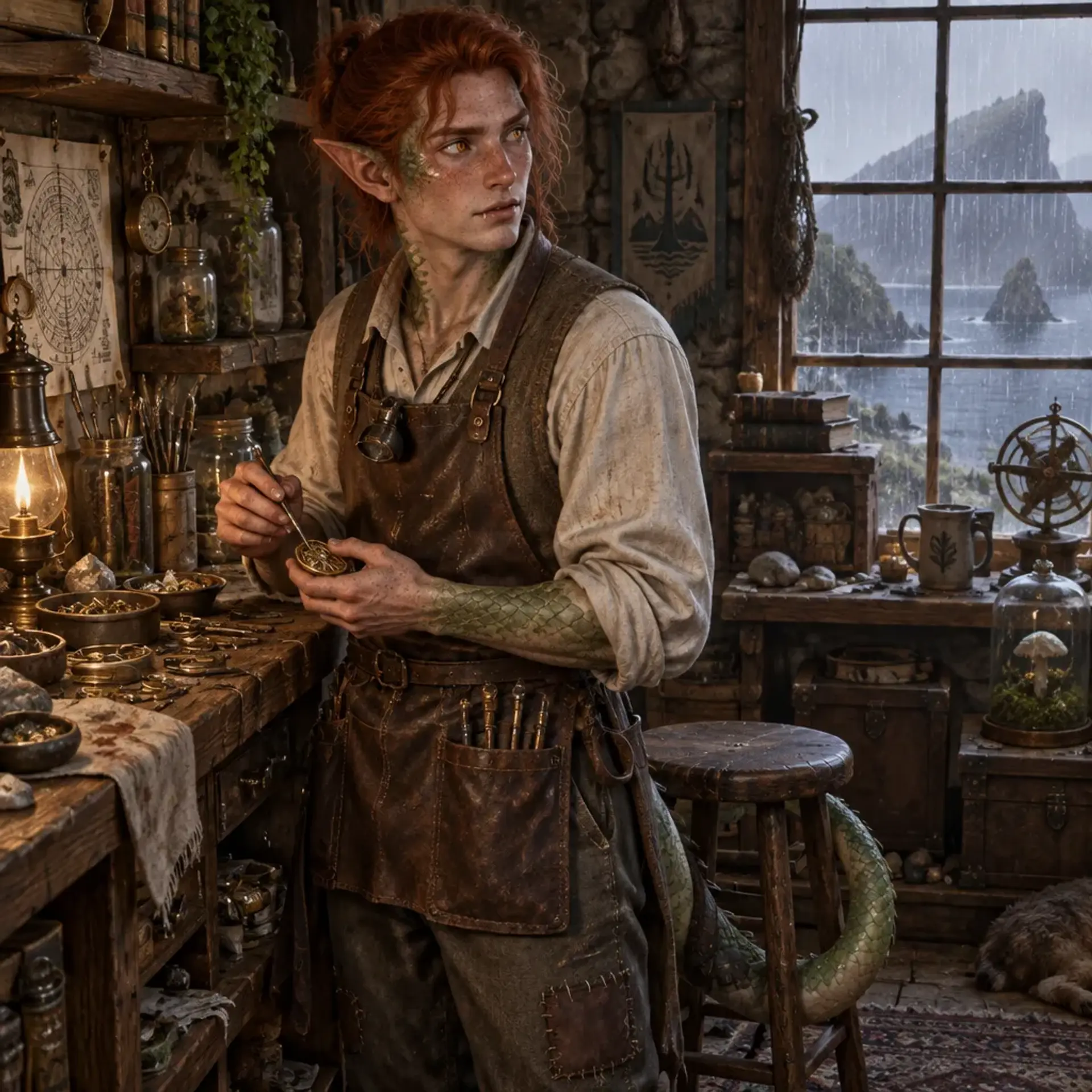
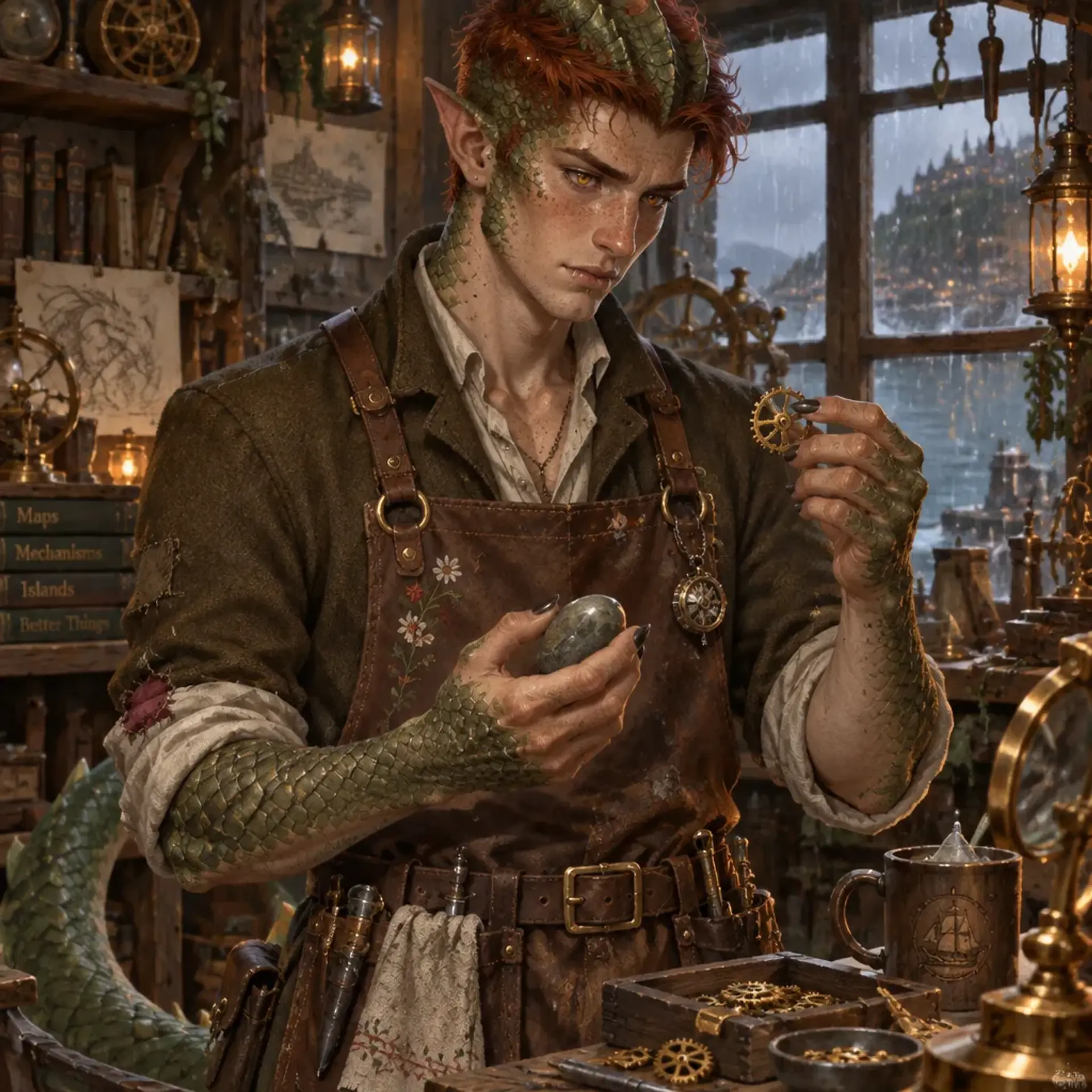
Eber stands five feet ten inches, towering over the stout-hobbit-sized parents who raised him. Fair skin dusted with familiar red freckles shows between olive-green scales, which overlap like supple, finely grained leaves along his jaw, shoulders, forearms, and tail. His red hair is thick and stubborn, cut short at the sides so it will not snag on tools; a narrow ridge of flexible green crest-scales runs from his brow over his crown and lies flat when he ducks beneath rafters. His pointed ears angle toward small sounds, and his molted amber eyes hold a dark, slit-like focus that makes people feel examined. His green-dragon teeth are sound but poorly shaped for chewing. He moves with a careful, sinuous economy, folding his tail close in the crowded workshop and turning sideways through doorways rather than asking others to move. He smells distinctly of oiled brass, damp wool, and the mineral dust of his pocket stones; he knows this and keeps a little pouch of dried mint in his coat, but the scent never quite wins. The unexpected detail: his work apron is embroidered with tiny, painstakingly neat flowers, a gift from his mother that he repairs whenever a thread comes loose.
Clothing
German-influenced craftsman's clothes adapted from stout-halfling patterns: a fitted wool jacket with embroidered family motifs, linen shirt, leather apron, sturdy boots, a belt of tools, and a reinforced tail slit. His cuffs are patched with mismatched thread, and his mother’s little flower embroidery is carefully maintained.
Body language
Eber angles his shoulders to make room in tight spaces, though his tail often reveals how much space he is actually taking. His hands move quickly and precisely around tools, but he pauses before touching another person. When uneasy, he rolls a smooth pebble between thumb and claw. When angry, he becomes still rather than looming, eyes fixed on the person who has crossed a boundary.
- Height
- 5 feet 10 inches
- Build
- Tall and long-limbed for his family, with a sturdy craftsman's shoulders, a flexible tail, and the compact, balanced posture of someone accustomed to crowded workrooms.
- Eyes
- Molted amber with dark, narrow pupils; they were dark brown before adolescence.
- Hair
- Red, thick and cut short at the sides.
- Skin
- Fair skin with freckles, overlaid by supple olive-green scales that are darker along the spine and lighter toward the claws.
- Age
- 19
- Gender
- Male
- Size
- Medium
Distinguishing features
Personality
18 traits and drivesEber wants the comfort of being treated as the youngest child, but resents the way his family’s care can make him feel like a problem they are managing. He is observant and inventive, especially when a mechanism or a person is behaving in a way that does not fit the obvious explanation. He likes cleverness as a tool, not a performance, and grows impatient with people who confuse confidence for competence. In a workshop, he can be generous with his knowledge and almost playful, setting a broken object right while explaining every choice. Around strangers, he is reserved and measures what they notice: the scales, the size, the pouch of stones, the fact that he cannot eat normally. He will answer honest questions, but he dislikes being treated as a curiosity. His affection is practical. He adjusts a chair, repairs a toy, sharpens a tool, or remembers which sibling dislikes a certain food. He is less skilled at saying that he misses someone. When he feels safe, he can be wry and warm, especially with children, who tend to accept his body without making it into a subject. With his parents, he is both tender and defensive. Their accommodation helps him, but he sometimes hears their concern as proof that he is an extra burden. He does not want to be ungrateful, so he postpones difficult conversations until he is already angry. Eber’s relationship with his brothers pulls him in opposing directions. Ignatz makes him feel understood without requiring explanations; Eber also worries that Ignatz has mistaken self-denial for safety. Rodrick’s strength and sorcery impress him, even as Rodrick’s blunt teasing provokes him. Eber wants Rodrick’s respect and hates that he wants it. When teased about his eating, he may respond with an overly precise observation meant to wound, then feel ashamed once the moment passes. He knows Rodrick does not always intend harm, but intention cannot make a humiliating joke harmless. He is not naturally solitary so much as newly unsure of how to belong. Family gatherings are noisy, crowded, and full of familiar affection, yet Eber cannot sit or eat as he once did. He often leaves early and tells himself he prefers quiet. In truth, he watches the doorway after leaving, hoping someone will notice he is gone and come find him. Yonda’s gentle pressure to socialize annoys him because it is often right. He values her kindness and still resists being managed, especially when she tries to solve loneliness by introducing him to another person before asking what he wants. He is cautious around the village’s emerging dragon traditions. Eber has no simple answer to whether his inherited traits are a curse, a gift, or merely part of his body. He refuses to let others turn that uncertainty into a political slogan. He can respect the elders’ fear without accepting their assumptions, and he can see why High-blood youths want pride without endorsing hierarchy or hunting prestige. When pressed to choose a side, he asks who benefits from the division. This can make him seem evasive, but he is trying to preserve relationships while he decides what he believes. His moods change his manner rather than erasing his character. In a calm mood, he is patient, curious, and willing to explain a complicated repair more than once. When anxious, he sorts small objects into exact rows and gives clipped answers. When embarrassed, he becomes funny at someone else’s expense or changes the subject to a tool. When angry, he grows still and direct, and his usual cautious phrasing disappears. When frightened, he looks for exits and counts the people he would need to get through them. When delighted by an elegant mechanism, he forgets to guard his enthusiasm and talks with quick hands, bright eyes, and a tail that taps the floor. Eber is capable of selfishness, especially when he has spent too long being considerate. He wants a room of his own, good clothes that fit, private meals that do not require explanation, and the right to keep a bright object simply because he likes it. He can hoard shiny things when he is overwhelmed, then rationalize the habit as collecting useful materials. Yet he does not want freedom at the cost of leaving his family behind. He is trying to discover whether independence can be an addition to belonging, not its opposite. His best quality and his most difficult flaw come from the same place: he notices what people need, but has not learned to trust that they might want to meet his needs too.
- Alignment
- Neutral Good, though his guarded habits and calculating attention can make him seem more self-interested than he is.
Quirks
Habits
Traits · 5
Flaws · 4
Fears · 4
Wants and needs · 5
Combat
AC 14 · HP 17 · 30 ft.Eber prefers to stay behind a sturdier ally, use cover, and make one well-chosen attack rather than charge. He uses Faerie Fire to expose hidden threats or Grease to disrupt a rush, then fires his crossbow or uses Shocking Grasp if an enemy reaches him. He will retreat to protect a family member, but becomes stubborn if someone mocks or threatens his changed body.
Eber
Spells
Actions
Reactions
Services they sell
Rewards they can give
Equipment
- Reinforced leather work-armor (armor)Fitted leather armor, reinforced for his frame and infused with Enhanced Defense; it grants AC 14.
- Workshop rapier (weapon)A practical rapier with a plain leather grip, carried for defense rather than display.
- Light crossbow (weapon)A compact crossbow with a padded stock and a carefully maintained string.
- Gizzard-stone pouch (personal item)A pouch of boiled, rounded stones for his adapted gizzard, kept separate from his metal fittings.
- Craftsman's tools (tools)A collection of small files, pliers, awls, wire, spare gears, and a folding screwdriver.
Possessions
Background
Eber was born the youngest of eight children in a family whose life was measured in tools sharpened, roofs mended, meals shared, and children passed from one pair of hands to another. His parents, Trogi and Wilma, are stout halflings of the Greenwake Kin, descendants of refugees who survived a dragon’s massacre, a desperate bargain, and the perilous founding of their island village. In their kitchen, there was always room for one more bowl. Eber grew up as the baby, with older siblings who knew his jokes, stole his crusts, and caught him when he fell. He was a red-haired child with freckles and dark-brown eyes, small enough to sit beside his mother in the garden and watch her sort seed from husk. Trogi taught him to fit tiny gears into watches and tools, while Wilma taught him that a repaired object was more useful when its owner knew how to care for it. His childhood was not entirely ordinary. The family had seen signs of the old dragon-blood bargain in other descendants. Their people call those with faint, ancestral traits Low-blood and those whose bodies change more strongly High-blood. Eber’s brothers Rodrick and Ignatz were already High-blooded, with scales, altered eyes, and bodies that grew beyond the customary halfling size. Eber’s red hair had always drawn speculation, but his eyes stayed brown and he remained small. He was happy to be the little one who could sleep in the warm kitchen, wedged between siblings and the smell of bread. He did not imagine that his body might one day make him a stranger in his own home. In adolescence, his eyes changed first. Their brown darkened, then broke into bright, molted amber. Green scales pushed through his skin, his ears sharpened, and his bones lengthened rapidly. The growth hurt. His jaw changed in a way that left his teeth strong but badly suited to chewing. He could swallow food, but not manage it the way his family did. A village healer and a family acquaintance who studied dragon lore helped him work out that smooth stones and small metal fragments could serve as gizzard grit. Eber learned to choose rounded river pebbles, boil them, and keep a clean supply in a cloth pouch. Meals became deliberate: small bites, careful swallowing, a sip of water, then a discreet check that he had the right stones. He hated needing a routine that separated him from the easy bustle of family supper. The first week after his changes, Rodrick and Ignatz began sleeping in the kitchen with him. Their new bodies had outgrown their beds, and the crowded room was warmer than the drafty loft. They laid blankets between the table and the flour chest. Eber remembers waking to the soft rasp of Ignatz’s tail across the floorboards and Rodrick snoring with his mouth open, showing green-dragon teeth. The brothers made room for him without ceremony. Rodrick teased him about his strange meals until Eber’s anger became unmistakable; then the teasing stopped, though Rodrick never admitted that he had gone too far. Ignatz, ashamed of a chicken he had once killed with his bare hands during an uncontrolled hunting urge, understood Eber’s fear better than he could explain. He sat beside Eber through awkward meals, offering stones and water without making a spectacle of it. The memory is precious to Eber and embarrassing to his brothers, who insist they were only sleeping there because the beds were too short. The changes altered the family’s practical life as much as its feelings. His parents worried about clothing, bedding, food, and how to fit a growing young man into a house built for stout halflings. Trogi made a wider bed and lengthened a bench, saying only that good joinery should outlast the person who needs it. Wilma began setting aside stones and softer foods. They are loving, but their kindness can make Eber feel even more unlike them: he is too tall to sit comfortably beside his mother, too broad to be casually gathered into Trogi’s arm, and no longer able to share a meal in the same manner. He sometimes resents the distance his body creates, then resents himself for blaming the people trying to bridge it. Eber works in the family workshop, where he is learning to be an artificer rather than merely an extra pair of hands. He enjoys the exactness of gears, the satisfying resistance of a screw that finally seats correctly, and the small triumph of making a broken mechanism work again. He has a talent for noticing what others overlook: a watch that loses time only in damp air, a hinge whose pin is slightly warped, or a visitor who stares too long at his pouch of stones. He studies simple arcane principles and applies them to tools. At second level, he has learned to infuse equipment with small, practical enchantments. His experiments are modest, but he treats them as proof that his altered body can make something useful rather than merely demand accommodation. His siblings remain central to his life, though the family’s warmth is not uncomplicated. Windle, the oldest, is a Low-blood who works in the shop and is expected to inherit its management. He has a wife and two young children, Otto and Anika; his stoicism hides fear that his children might someday change as Eber did. Karl, the second-oldest, loves tools and gears, but his marriage to Leanora, a sailor and descendant of famous dragon hunters, is strained by her frequent absences and old family stories. Their son Hansel is not the only child in Karl’s household: Leanora’s other child, Ragni, has pale hair, milky-blue eyes, and unusual skin, and the tangled circumstances of that child’s parentage are a source of private tension. Eber cares for Ragni and resents the way adults treat the child as an argument. Yonda, his only sister, is a bright social presence with five children. She is gentle with Eber, but keeps urging him to attend gatherings and make friends beyond the workshop. Her sons Hans and Birke show signs that may be High-blood, while her daughters Willow, Trude, and Liesel remain close to their mother’s familiar halfling features. Alder, a part-time guard who is often distracted by merriment, has a High-blood son, Black Alder, who visits with stories of adventure. Kasper divides his time between watch repairs, the family garden, and the chickens. His daughters Wonda and Ilse are a small, affectionate orbit of their own. Rodrick is taller and more imposing than Eber, with reddish-tipped green scales, yellow eyes, and sorcery drawn from his draconic heritage. He is blunt, proud of his strength, and often careless with jokes. Eber loves him and wants to prove himself to him, which makes Rodrick’s teasing sting more than Eber admits. Ignatz is his closest brother and quietest ally. His scales have grown more vivid over time, and his build is flexible and predatory. After his frightening attack on a chicken, he withdrew from anything that might encourage the hunting impulse and concentrated on workshop work. Eber recognizes the effort this takes and worries that Ignatz is trying to become harmless rather than learning how to live with his strength. The village itself is changing. The Greenwake Kin preserve traditions of shared food, mutual labor, and remembrance for the dead, but many younger High-bloods are drawn to dragon identity, hunting prestige, and social rank. Some elders blame the old green dragon whose blood altered their people. Others suspect her daughter or a ritual left unfinished. A secret circle and the return of a green-dragon patriarch are exploiting those fears. Eber has not joined a faction. He is wary of anyone who claims that a person’s blood dictates their place, whether that claim comes from a dragon devotee or a frightened elder. He is also reluctant to stand publicly against his own kin. His present problem is concrete: the workshop’s crowded beds, limited food, and scarce clothing are not enough for the village’s growing High-blood population. Eber is designing compact mechanisms that could help expand a shared water-powered mill and improve food storage, but the project needs materials and permission from people who disagree about what the community should become. He has been quietly testing a brass device that can regulate a small pump. He wants the invention to help everyone, yet a private part of him wants a door that locks, a room of his own, and a life not measured by how much his body inconveniences his parents. He hopes he can claim independence without abandoning the people who made room for him. The question he cannot answer is whether belonging requires him to stay small in spirit, or whether he can grow into someone his family has never had a name for.
Role in the story
A young craftsperson whose body embodies the Greenwake Kin’s generational change. Eber can give the party a personal view of family life, practical needs, and the pressures dividing the village. His workshop project may lead the characters to clues about the forces manipulating the community, while his own choices test whether they respect his independence.
“In their kitchen, there was always room for one more bowl.”
- Faction
- No formal faction. Eber is part of the Greenwake Kin and works in his family’s workshop. He resists both dragon-worshipping hierarchy and the assumption that Low-blood traditions must exclude High-blood people.
Known connections
Media
0 imagesNo images yet.
Turn Eber into a sheet
A high-res, share-ready sheet you can post or print.