Friedreich
Friedreich
At the table
Voice
A young man's German voice with a strong Prussian accent, dry at the edges and shaped by cold air, military habits, and years of speaking to people who often could not hear him. It has a faint delay in his unborrowed form, as if an echo must catch up. In an embodied face, his breath and resonance become convincing, but the disciplined cadence remains. When the spirit in his new body asserts itself, his voice gains a crisp, commanding certainty that makes his friends uneasy.
He speaks German with a strong Prussian accent, precise consonants, and the clipped cadence of someone trained to give concise instructions. His voice sounds as if it comes from a chest accustomed to cold air and shouted orders, though the breath behind it can arrive a fraction late. With friends his sentences loosen into dry jokes and football arguments. When the new body's alien duty takes hold, his German becomes startlingly assured and archaic in its formality.
Speech patterns
How to play them
Treat him as a person, not as a disguise or a specimen. Ask before touching his keepsakes, be candid about what you know of Wilhelm's history, and give him time to answer when a memory catches him. Mila's ability to see him without a face is precious to him. He responds well to practical inclusion, such as offering him a place at the card table, a scarf to inspect, or a real task, but reacts badly to being ignored or spoken about as if absent.
Goal
Recover a trustworthy account of his mortal life, understand the spirit and body created on Walpurgis Night, and find a way to belong among the living without surrendering himself to a borrowed identity.
Motivation
To be recognized as Friedreich without having to steal recognition from the dead, while keeping the coven safe and finding the truth beneath his missing memories.
Appearance
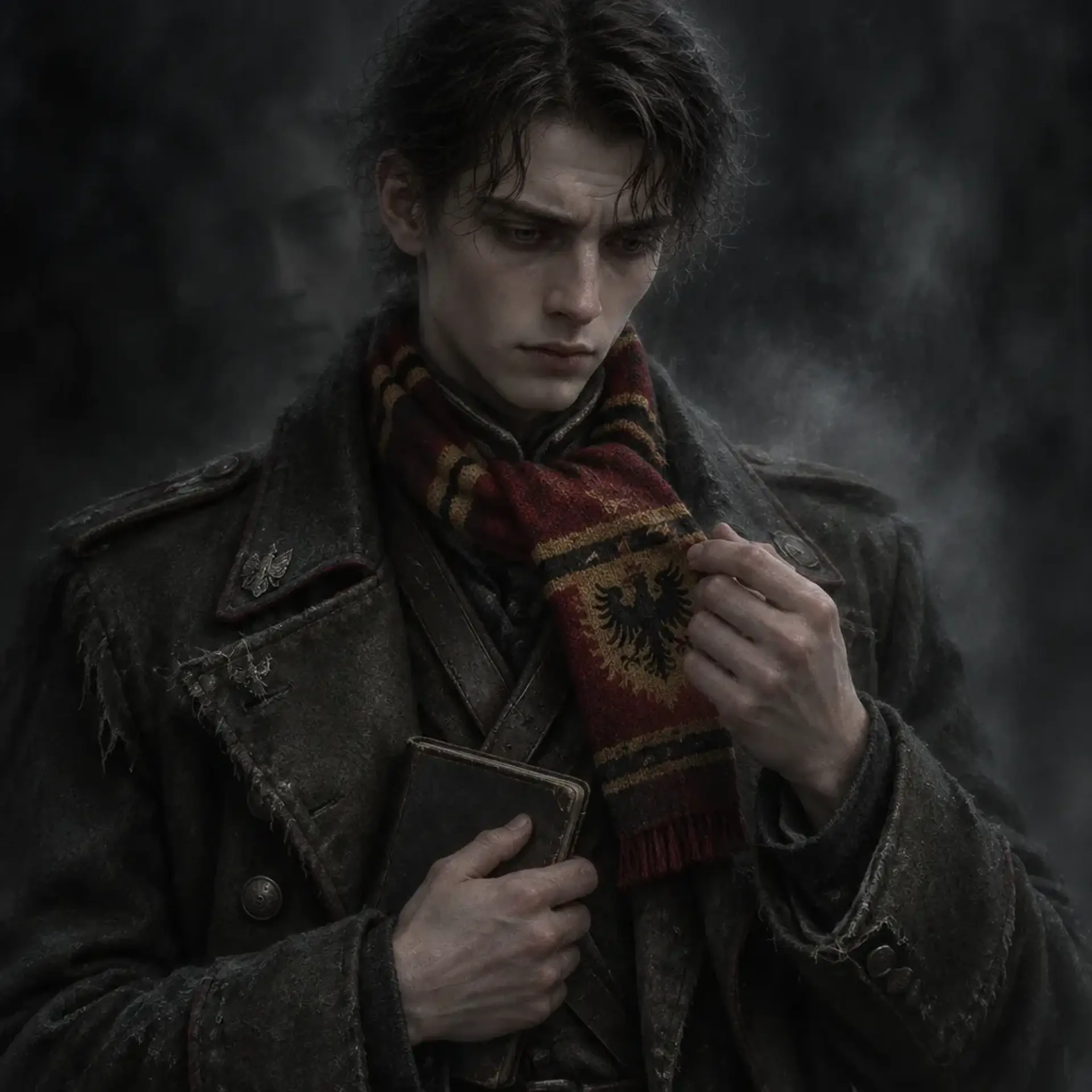
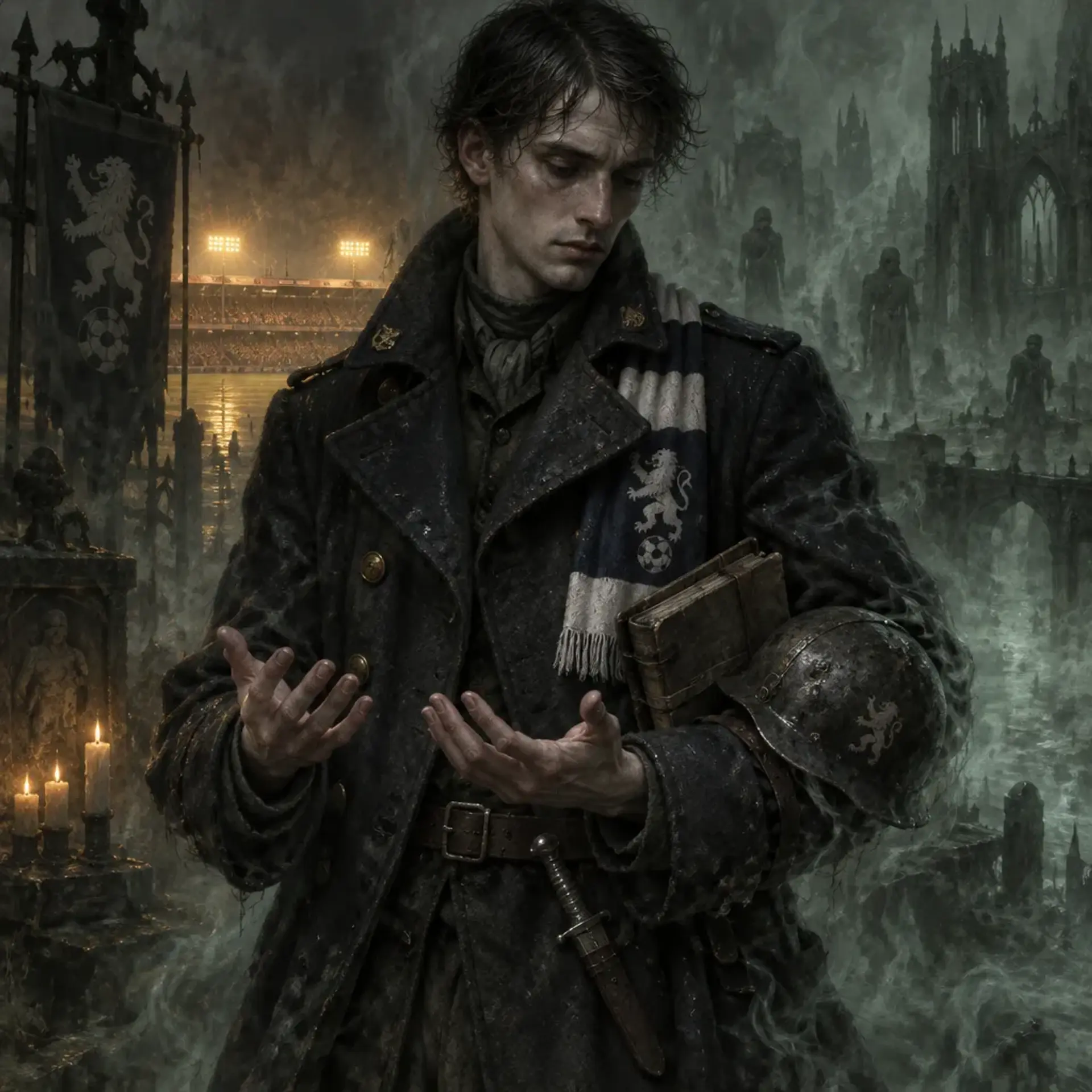
Unborrowed, Friedreich is the blurred suggestion of a young Prussian man in a worn officer's coat, his features incomplete as if seen through breath-clouded glass. On rare days when the boundary between worlds loosens, he resolves into a pale, narrow-faced youth with a straight nose, severe brow, and the fixed expression of an old portrait. His movements are heel-first and exact, like a march remembered by the body after the mind has forgotten its orders; when he stops, he becomes so still that people mistake him for a coat on a stand. His unborrowed form smells faintly of wet wool, extinguished lamp oil, and cold soil. The coat's right cuff is rubbed almost smooth from a repeated, precise adjustment he no longer remembers learning. Unexpectedly, he is fussy about football scarves: he folds them into perfect squares and judges their stitching with the gravity of a quartermaster. In a borrowed body he feels convincingly warm and solid, but watches his hands as if checking they still belong to him.
Clothing
A shadowy, carefully brushed officer-style coat of plain old cut, dark trousers, and boots that seem damp at the seams. When embodied, he favors practical civilian layers and sometimes adds a football scarf folded too neatly.
Body language
He stands as if awaiting inspection, shoulders squared and chin level. His heel-first steps have a measured marching rhythm. When frightened, he becomes unnaturally still; when confused by an emotion, he studies his hands and flexes his fingers as if checking for borrowed ownership.
- Height
- About 173 cm when embodied; his unborrowed outline varies with the Shroud.
- Build
- Narrow-shouldered and spare in his unborrowed outline; his embodied form is lean, compact, and more resilient than his youthful appearance suggests.
- Eyes
- Unborrowed: indistinct grey shadows. Wilhelm insists his living eyes were grey; Friedreich does not fully trust the claim.
- Hair
- Unborrowed: no stable hair, only a blurred dark suggestion. Wilhelm says Friedreich had blond hair.
- Skin
- Unborrowed: a pale, smoke-blurred suggestion rather than a stable complexion. His embodied skin is warm and convincingly human, with the pallor of someone who has spent too long indoors.
- Age
- Appears 17 or 18; died at approximately that age. His actual birth date and much of his mortal life are lost.
- Gender
- Male
- Size
- Medium
Distinguishing features
Personality
20 traits and drivesFriedreich is disciplined because routine gives shape to a self that keeps dissolving, but he is not naturally cold. Around strangers he is watchful, formal, and exact; with the coven he can be dryly funny, fond of football, and unexpectedly eager to discuss market bargains. His protectiveness is sincere, yet it carries the hard edge of someone who has repeatedly decided that another person's safety was his responsibility. He dislikes Wilhelm's silences and resents his wartime actions, but is more wounded by the possibility that Wilhelm remembers Friedreich better than Friedreich remembers himself. He can be gentle with Mila without treating her as fragile, and patient with Gunther until questions turn into an attempt to define him. Klaus's evasions make him suspicious, though he still trusts Klaus in a fight. The face-stealing ability gives him sensations he misses: food, warmth, sleep, touch, and the ordinary pleasure of being noticed. That pleasure can become envy. If a borrowed identity lasts too long, Friedreich begins to feel the other person's absence as an accusation and his own identity as a thin uniform. His temper used to flare when people could not see him; now it often feels burned down to a remote, exhausted anger. The new body's sense of duty has made him more decisive and more frightening. He fears that this is not his old character returning, but an outside will learning how to speak through his virtues.
- Alignment
- Protective and dutiful, but capable of frightening violence when he believes his chosen family is threatened.
Quirks
Habits
Traits · 5
Flaws · 5
Fears · 5
Wants and needs · 5
Combat
HP 7 · Use the movement and travel rules of the chosen Wraith edition. When embodied, move at an ordinary human pace; his disciplined stride is not a special speed rating.He avoids fair fights and positions himself between danger and the coven. He prefers a surprise strike, a borrowed face that lets him approach, or an Outrage attack from the Shadowlands. He has military habits but incomplete training memories, and the new body's patriotic compulsions make him dangerously liable to mistake a crisis for a call to duty.
Friedreich
Actions
Reactions
Services they sell
Rewards they can give
Equipment
- Face-use notebook (personal record)A battered pocket notebook listing aliases, where each face is safe to use, and the occasions for which Friedreich has rehearsed it. He records people as confirmed dead or absent, never as a casual source of disguise.
- Old helmet (ritual keepsake)An old helmet from his lost mortal life, used in the Walpurgis rite. Its surface bears traces of soil and metal from the ritual, and Friedreich is reluctant to let anyone handle it.
- Football scarf (personal keepsake)A football scarf kept carefully folded, with stitching he considers particularly sound.
- Military knife (weapon)A plain military knife he carries in embodied form. It is practical rather than ceremonial.
Possessions
Background
Friedreich remembers Brandenburg as a smell before he remembers it as a place: damp earth, horse sweat, smoke in winter, and the close, comforting stink of wool kept too long in a chest. He believes he was born to a minor Junker household and raised among military expectations, but his memories are broken, and some may be his Shadow's embroidery. Wilhelm, the German Tzimisce from Mecklenburg who lost his own mortal memories, has told him that Friedreich had blond hair and grey eyes. Friedreich wants to believe this, distrusts Wilhelm's certainty, and knows there is a painful truth behind the older vampire's solemn silences. He died young, with the details obscured by a Caul: the spiritual cocoon that separated his mortal life from the Underworld. The Caul was opened not by a wraith, mage, or occultist, but by a spirit of land and humanity whose nature Friedreich still cannot fully parse. Klaus described it in Garou terms: a being marked by the Wyld, born among the Weaver's blessed adopted children, carrying the Wyrm's spoils and a trace of Luna. Friedreich has since realized Klaus knew more than he admitted. When the Caul opened, the spirit hid its intention. A willow-wisp remained where Friedreich's old, repetitive marching had been, a tiny light that seemed to know the road out. The event left him with a strange affinity for earthly thresholds and a persistent sense that something below the ground is waiting to welcome him back. In the Shadowlands he found the world as a bleak, distorted echo of the living one. The familiar streets were stripped of warmth; human grief left its stain on places and objects. He learned that being dead did not mean being invisible in every circumstance, but the living usually passed through him without seeing or hearing him. On certain days when the worlds seem to unbind, his outline sharpens. Mila, a mage from Bremen, is a rare exception: she can see and touch him even when he is unborrowed. Her ordinary kindness delighted him so much that he began treating her like a little sister, though she is long-lived and quite capable of defending herself. His first face theft was an accident born from wanting one person to look at him. In the aftermath of a war, he tried to get the attention of a living young man in a station crowd. His yearning and instinctive Moliate work caught on the man's image; Friedreich felt a face settle over his own like a wet glove. The crowd stopped looking through him. The borrowed breath scraped his throat, the man's eyes stared back from a shop window, and for the first time Friedreich tasted hot coffee and felt the weight of a boot on stone. He fled before the living man noticed the theft. He has never decided whether the act was a gift or a violation. He later built a private list of useful faces, selecting people he has confirmed dead or safely absent from the region, then changing their names in his notes. He favors young German men near his apparent age, especially former soldiers, police, and men with the neat bearing of minor nobility. One is a deceased reservist he calls 'Heller' in his notebook, used for errands and public conversations; another, a dead municipal clerk renamed 'Kamm,' is his market-day face, good for asking prices without being ignored; a former officer he labels 'the Sunday coat' is reserved for church services and formal gatherings. He uses a broad-faced football supporter, given the private alias 'Pfeil,' for matches and for blending into a crowd. These aliases protect the dead and Friedreich alike, though he worries that each borrowed life leaves a little residue in him. He tracks which face he used, where, and for what, as carefully as another man might keep a work schedule. Wilhelm became the closest thing Friedreich has to a brother. They were together through both world wars as far as Friedreich could manage, sometimes on opposite sides of the Shroud, sometimes close enough for Friedreich to feel a breath that should not have been there during the First World War. The memories come without explanation. Friedreich is angry at Wilhelm for deserting in that war and for what he did in the Second World War. Wilhelm will not explain the latter and is ashamed of the former; his rare apology only makes Friedreich more suspicious. Friedreich has killed to protect him. He killed three Hunters who pursued Wilhelm or the others, and defended Wilhelm from other vampires. He killed a Get of Fenris who was trying to kill Klaus. He also defended Gunther from hostile changelings. He does not boast about these deaths. He tells himself that duty made them necessary and fears that duty is an excuse he inherited from a life he cannot remember. Their chosen family is an informal coven of supernatural outsiders. Gunther is a changeling who spent much of his existence in Arcadia before returning to the mortal world and now sells clothes made from moss. Klaus is a ronin Get of Fenris, or perhaps a skin-dancer; he refuses to clarify and can be passive-aggressively cruel to most people, but often hesitates around Friedreich. Mila visits from Bremen, especially for holidays. The group plays cards, hunts, fishes, drinks, and treats football as a near-sacred obligation. At Christmas markets, Friedreich advises them on bargains and what to buy, sometimes recommending an object he secretly wants but cannot keep. He has tried church services too, attracted by their ritual and the chance that a room full of people might briefly feel like a home. Curiosity led to several careful attempts at possession. During one card game, Friedreich and Wilhelm agreed to try a controlled possession, hoping to learn what the experience might offer: perhaps human feeling for Wilhelm, perhaps buried memories for them both. The cards were their focus and timer. Friedreich entered by force of concentrated will, following the opening of Wilhelm's awareness rather than treating his body as an unlocked door. Wilhelm's undead body resisted the ordinary expectations of breath, pulse, and appetite; Friedreich felt the absence as a hollow pressure and tried to lend him the remembered rhythm of being alive. The cards slid under Wilhelm's fingers. For a few turns, Friedreich could feel the table grain and the weight of the cards through him, while Wilhelm felt an unwanted crowding in his thoughts. They tested alcohol. It tasted sharp to Friedreich through the borrowed senses, but Wilhelm's body did not respond like a living drinker's, and neither gained a recovered memory. Klaus watched, alarmed and ready to intervene. Gunther asked so many questions that Wilhelm called the experiment. Both men were left shaken, and Friedreich learned that sharing a body did not mean sharing a self. The attempt with Gunther went worse. Gunther volunteered from curiosity about what divided wraith and changeling, and whether either might glimpse the other's memories. Friedreich found the changeling's inner life bright, mutable, and crowded with meanings he could not hold still. Gunther felt Friedreich's cold discipline and the pressure of the Shadow at the edge of his thoughts. The crossing became an argument without words: Friedreich's instinct to impose order against Gunther's shifting, living imagination. Gunther's glamour and identity pushed back; Friedreich could not tell which impressions were memory and which were a performed possibility. They broke contact before either was harmed, but Friedreich came away feeling that he had nearly mistaken someone else's wonder for his own. 'Never again,' he said. Gunther accepted that, though he still has questions. Friedreich and Wilhelm later tried once more under an explicit one-last-time agreement, with a shorter duration and clearer signals. They hoped the prior attempt had taught them enough to avoid confusion. It did not give them a miracle. Friedreich felt Wilhelm's old shame as an iron-tight refusal to open, and Wilhelm sensed Friedreich's anger without learning its source. They ended the attempt by mutual choice. Their relationship survived, but the experiment made Friedreich more careful about calling possession intimacy. In recent years, Friedreich has tried to enter ordinary life rather than only borrow it. He practices his faces, keeps his list, tests whether he can hold a steady identity through a meal, a bath, a night's sleep, or a flirtation with a woman he finds pretty. He wonders if he could take a part-time job or join a hobby group without turning every introduction into a small deception. When he is successful, he can smell food, eat, drink, sleep, bathe, touch, and be touched. He is not sure whether this is unusual among wraiths; he has not asked enough others to know. Then came the ritual that changed everything. Wanting to ease the horror of death, Mila, Gunther, Wilhelm, and Klaus tried to make Friedreich a body from Brandenburg soil, human blood, metal, his old helmet, and a human male form shaped through their combined arts. Wilhelm used Vicissitude and koldunic sorcery; Mila worked reality-bending magic; Gunther supplied glamour and gifts that could make seeming miracles; Klaus brought knowledge of spirits, rites, and changing-breed gifts. They intended a safe return to life, a Risen, and promised Friedreich he would be protected. At the witching hour on April 30, Walpurgis Night, in the Harz Mountains, they began the rite beside a great bonfire. As it progressed, Friedreich felt something familiar deep in the earth, welcoming him. He saw a willow-wisp in the sky. The changes hurt in ways his borrowed faces had never hurt: his soul, Psyche, and Shadow bent against his will, while something crawled up from the soil and into him. He remembered everything and nothing at once. His mouth was bloody; his eyes dimmed; his heart faltered. He feared dying again. When the body lurched awake, it was not the clean return they had promised. The spirit and rite had twisted together into a result none of them recognized. Friedreich spoke German with a fluency and authority he had never possessed in life. Looking at his friends, he believed they had a service to perform, a duty to their nation. 'Mark Brandenburg,' he said, as if the land itself had called him to muster. He did not attack them, but they heard the change in him and panicked. Friedreich now carries a living body and an alien sense of command, yet remains uncertain whether the earth-spirit saved him, used him, or merely found a convenient door. His coven's gift may be the most loving thing they have done for him and the most dangerous mistake any of them has made.
Role in the story
A haunted ally whose face-stealing gift lets him cross social boundaries but threatens his sense of self. His new body transforms a personal mystery into a crisis for the whole coven: a promised return to life has made him the possible vessel of an unknown land-spirit's command.
“Wilhelm, the German Tzimisce from Mecklenburg who lost his own mortal memories, has told him that Friedreich had blond hair and grey eyes.”
- Faction
- The informal supernatural coven of Wilhelm, Gunther, Klaus, Mila, and their holiday companions. Wraith society and Stygia are not his current allegiance; his relationship with the Shadowlands is wary and unsettled.
Known connections
Media
0 imagesNo images yet.
Turn Friedreich into a sheet
A high-res, share-ready sheet you can post or print.