Kent
Kent
At the table
Voice
The sound is shaped by a body that seems larger than Mary's: a low, dry resonance with a slight rasp, and a breath that catches after long sentences. It carries a faintly formal, careful quality, like someone trying to sound at home in respectable company. When frightened, he does not become meek; he loses the polish and speaks in blunt, clipped phrases.
Kent's voice seems to come from a larger chest than Mary's and carries the dry, slightly rough edge of someone unused to speaking at length. There is a breathy catch after certain words, like cold air caught in the throat. He chooses careful, middle-class English when trying to be taken seriously, but his phrasing becomes plain and direct when startled. Mary's familiar turns of phrase sometimes surface in the middle of his sentences. When rattled, his breath catches rather than dropping to a whisper; he may speak too quickly, repeat a practical question, or stop mid-thought as if listening to another voice.
Speech patterns
How to play them
Treat Kent as a person with agency, not as a puzzle or a costume. Offer choices and ask who is answering when the distinction matters. He responds to plain respect, privacy, clean clothes, and honest explanations. Do not assume Mary consents to Kent's choices, or that Kent understands the consequences of taking over. A calm conversation may earn more than threats; threats make him look for a threshold and an exit.
Goal
Claim a stable life and an identity of his own without destroying Mary's place in her family, while learning who is searching for him and what the sea-woman means.
Motivation
To be recognized as a person rather than a mistake, a symptom, or a reflection, while preserving a home and the few relationships that feel like his.
Appearance
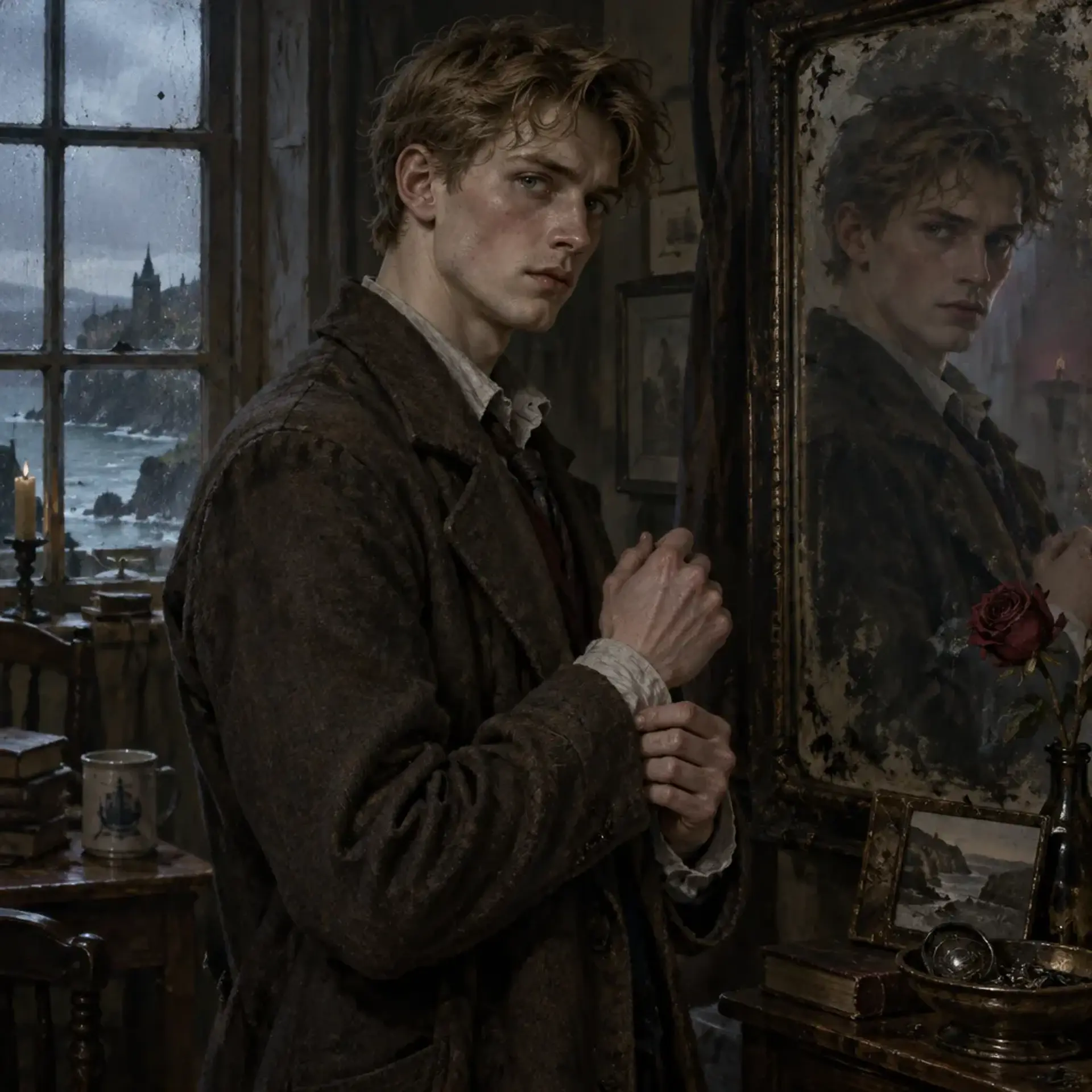
Kent is the young man who appears in Mary's reflections and, more often now, in the body she inhabits. He looks eighteen, with short dark-blond hair that refuses a neat part, vivid malachite-green eyes, and a handsome, carefully composed face. His complexion is pale beneath a faint, uneven flush, as if he has just come in from cold sea air. He is taller than Simon and markedly larger than Mary's undernourished, below-average-height frame: long in the leg, narrow at the waist, and lithe rather than bulky, with a strength that shows when he lifts a chair or braces a door. His walk is measured and inwardly watchful, heel-first, with his shoulders held as though he has just remembered that people are looking. When anxious, he checks every pane and polished surface rather than turning his head. The unexpected detail: though he wants to look like a respectable young gentleman, he is fascinated by motorcars and watches them with an open-mouthed child's wonder until one comes too close, whereupon he flinches hard. He leaves the impression of someone trying to pass an inspection he never agreed to attend.
Clothing
Initially whatever Mary can borrow or adapt, often ill-fitting at the shoulders and strained at the seams. Kent now wants decent men's clothes: a clean shirt, proper trousers, a wool coat, and shoes that fit. He dislikes conspicuously feminine garments and is frustrated that sudden changes leave him wearing Mary's things.
Body language
Kent holds his shoulders carefully and walks with a measured heel-first stride, as if trying to appear well-brought-up. He looks toward reflective surfaces instead of turning fully toward a speaker. He adjusts cuffs and collar whenever he feels observed. Around cars he leans forward in wonder, then jerks back if they approach.
- Height
- Taller than Simon Bell; substantially taller than Mary
- Build
- Lithe and notably stronger and taller than Mary's slight, undernourished frame; not visibly athletic, but capable of surprising leverage.
- Eyes
- Malachite green
- Hair
- Short dark blond
- Skin
- Pale, with a faint uneven flush
- Age
- 18
- Gender
- Male
- Size
- Medium
Distinguishing features
Personality
20 traits and drivesKent is not a single temperament. He wants to seem composed, educated, and respectable, yet his curiosity repeatedly breaks through the polished manner he tries to maintain. He can be shy in company and hungry for attention in the same evening: at the pub he disliked the noise, watched the door, and still returned a woman's smile because he wanted to be wanted. He prefers the safety and order of home, but he also resents being confined to Mary's house and will redirect an outing toward his own plans. He is protective of the younger children in ways that resemble Mary's devotion, then grows bitter when others assume he will perform her duties without question. His pride is sincere but brittle. He wants good clothes and proper tea because these things make him feel legible to other people, not simply because he enjoys luxury. He can sound snobbish about drunkenness, messy rooms, or rough behavior, although the Bells' home has taught him how unfair such judgments can be. When calm, he speaks carefully and notices small courtesies. When anxious, he becomes abruptly literal, naming the nearest door, the person who is missing, or the exact thing that has changed. He does not reliably soften his manner when angry. Anger can make him stiff, blunt, and unexpectedly forceful, especially if someone treats him as though he is not present. Kent's feelings toward Mary are contradictory because the boundary between them is no longer dependable. He thinks of her as someone close to him, sometimes as a sister, sometimes as an earlier self, sometimes as a voice inside his own recollections. He can resent her for resisting his wishes and feel protective of her in the same breath. Mary has no desire to pursue women as he does; Kent's attraction is his own, but the shared body makes every attempt to act on it a moral complication. At his better moments he understands that wanting a life does not give him permission to make Mary's choices. At worse moments he changes plans before she can stop him, insisting that he needs to experience something for himself. He is increasingly capable of noticing other people's motives. He sees Simon's absences as both provision and abandonment. He recognizes Malinda's drunken cruelty, but also sees the moments when she notices a child's distress. He distrusts Henry's watchfulness because Henry is clever enough to use a secret. He likes Matilda's kindness and shares Mary's wish to keep her from being exploited. Oswald's dependence unsettles him: the child reaches for Mary, but Kent feels the urge to pick him up and comfort him. These are not clean judgments. Kent's impressions arrive braided together with Mary's history, and he may feel personally wounded by events he only remembers secondhand. His curiosity is most visible around technology and the wider world. A car can make him stare with delighted wonder, yet its speed and closeness frighten him. Television captivates him because images move inside a domestic room without asking anyone to go outdoors. He enjoys looking at the pictures and asks practical questions about how they work. The pub showed another side: he could choose a seat, assess a room, and try to behave like a young man of the middle class, but the noise and social expectations made him self-conscious. He is not a natural adventurer. Mary was the one who first used the changes to escape the house and climb trees or explore abandoned buildings. Kent's own impulse is to return home, improve his clothes, and make the home feel like somewhere he belongs. Since the heart disappeared, his temper and presence have become more definite. He can speak independently, interrupt Mary, and hold a preference through an entire conversation. Yet that independence is not stable. Under stress, his voice may start as his and finish with Mary's cadence; memories can arrive with the wrong ownership. He sometimes claims not to know who felt an emotion, only that it is there. This uncertainty makes him defensive. He wants other people to accept him as Kent, but resents being asked to prove that he is not Mary. He is frightened by the searchers and the sea-woman, though he may hide fear behind stiff manners and questions about what they intend. The most important thing about Kent is that he is learning to want things before he knows how to ask for them. His wants can be ordinary, even vain: a coat that fits, tea made correctly, the freedom to go to a pub, the pleasure of being desired. They coexist with a fear that asserting himself will erase Mary. He is not a villain in waiting, nor a harmless passenger. He can be tender, possessive, curious, evasive, and self-absorbed, often within the same hour. How he behaves depends on whether he feels invited into a life, trapped inside one, or watched as an inexplicable problem.
- Alignment
- Not usefully classified; protective in some moments, self-serving in others, and increasingly governed by competing needs.
Quirks
Habits
Traits · 5
Flaws · 5
Fears · 5
Wants and needs · 5
Combat
HP 0Kent is not a trained fighter and avoids violence. He uses a door, chair, or sudden shove to create an exit, then runs. When trapped, he watches reflections and thresholds for an escape route. Do not treat the custom narrative features as guaranteed combat powers; use the table's normal resolution method.
Kent
Actions
Reactions
Rewards they can give
Equipment
- The absent heart (missing uncanny object)The small, crudely carved heart-shaped stone once given to Mary by Malinda; it has since gone missing. Its former presence is associated with the first changes.
- Borrowed clothes (clothing)A borrowed or secondhand men's shirt and trousers, often an imperfect fit; Kent is trying to acquire better clothes.
- Change record (evidence)A small notebook used by Trudy and Mary to record dates, changes, and the questions asked by the doctor and psychologist.
Possessions
Background
Kent's story began with an object that looked too ordinary to deserve a story. It was a small, crudely carved stone heart, shaped after an anatomical heart and rough as a fragment of the Dover cliffs. Barnacles and dried sea grass clung to it. Bartholomew Golden, an amateur alchemist, had once presented it at Hush House as a supposedly fossilized living heart, a gift in payment for entry. He claimed it could bring servants from man's shadow, born of the chalk cliffs and borderlands to labor for the house. The people at Brancrug refused him further access. The heart was thrown out to sea. It came ashore again, inglorious and weeping salt water and black ooze. Beneath its stony crust a red-pink hue appeared, like blood or a lamp behind a shutter. Abraham Groff, a young Londoner returning by train, found it and slipped it into his pocket. It beat beneath his coat. He carried it home to Wiltshire and showed it to neighbors. In their presence it promptly seemed dead; alone with Abraham, or returned to a Hampshire shore and dipped in water, it stirred again. Abraham grew fascinated and protective. The house around him answered with footsteps on empty stairs, doors moving, and voices he could not place. He sold the heart to William Windon, a local seventeen-year-old, one of the people who had seen it fail to move. William had once struck it with a hammer and hidden it in a log when its beating frightened him. The stone passed through Malinda Bell's hands and became an awkward birthday present for her eldest daughter. Mary was eighteen, tired, and grateful that anyone had remembered the date. She did not tell her mother the gift was jewelry; Malinda was often too drunk to care what Mary said. The Bells lived in Rochester, Kent, in a house whose respectable middle-class income concealed its disorder. Simon Bell took work far away whenever he could. Malinda and Simon were cruel to one another in alternating bursts of anger, absence, and self-pity. Mary cared for the younger children, managed what schooling she could, and found part-time work to keep small needs from becoming emergencies. There were eight children and never enough quiet. Henry, fourteen, had started to turn resentment into a clever, cutting kind of mischief. Matilda, twelve, tried to take chores from Mary, and Mary tried just as stubbornly to keep her from being made a replacement parent. Olympia, ten, kept close to Chrissy, nine, whose Jamaican father's identity was unknown. Belladonna, five, had black hair and green eyes; her father was uncertain, though Simon suspected his coworker Todd. Jonas, five, was Simon's blond, blue-eyed son by another woman, a fact Malinda had never forgiven. Abigail, four, with red hair and bright green eyes, resembled Simon's favored grandmother. Oswald, two, clung to Mary and his blanket. Their names and needs crowded Mary's days until even an extraordinary stone could wait. At first the heart merely beat in time with her pulse. Then it began to change what a reflection showed. Mary saw a short-haired blond young man with malachite eyes and a handsome face where her own should be. The image looked away when she stared too directly. She told herself it was a trick of exhaustion. The heart seemed to go quiet around other people, so she kept it hidden. She was not hoarding it for money; it appeared to dislike company, and Mary had no energy to explain a thing she barely understood. On 30 May, after a difficult day of work and household errands, Mary woke into Kent's body. The transition did not arrive as a grand revelation. She opened her eyes to unfamiliar shoulders, longer limbs, and a voice that seemed to come from the wrong place in her chest. Her first panic was practical: how could she get home, and what would happen if anyone recognized her? Kent's clothes were not there. She borrowed what she could, kept her face turned from reflective shop windows, and made it back to Rochester by routes she knew from years of walking. The body smelled of wet stone, cold air, and something faintly metallic, unlike Mary's own. It was a new body and a familiar county at once, though she had no words for the distinction. That first night became an adventure mostly because Mary was unwilling to waste the chance to leave the house. She walked through streets she knew but saw them from a taller height, tried climbing a tree near an abandoned building, and explored the building's dusty rooms. In a dark window, the young man's reflection watched her with a look that was not quite her own. She found the experience frightening, then exhilarating, then frightening again. Near dawn, she was herself. She told no one. She had discovered a way out of the house, not a second life, and she was too busy to examine the difference. The first serious complication came when Simon returned from work earlier than expected. Mary, still Kent, had been trying to get home. Simon looked at the stranger standing near his road and demanded to know what he was doing there. Mary gave a stumbling explanation about being lost and needing to reach town. Simon studied him with the suspicion of a man who had spent years learning to mistrust whatever his household could not afford to accommodate. Mary knew his habits and the names of his children, but speaking them would have made the explanation worse. Simon eventually let him pass after warning him away from the house. Mary reached home before the change reversed, shaking from the strain of nearly being recognized by her own father. Malinda's drunken encounter was less easy to escape. On a later night, Mary-as-Kent tried to slip out quietly. Malinda was awake, unsteady in the hallway, and mistook him for a young man come to call on Mary. She demanded to know what he wanted with her daughter, then alternated between suspicion, wounded humor, and a sudden, tearful complaint that Mary never told her anything. Mary stood in the borrowed body, unable to explain that she was the daughter in question. Malinda caught his sleeve. Kent's larger frame pulled the seam; a button snapped and fell into the hall. Mary apologized with a man's voice that startled them both. Malinda stopped crying long enough to stare. Mary escaped only when one of the little children called from upstairs. The broken button became a private reminder that these escapes could damage clothes, relationships, and trust. Trudy was the first person outside the family to notice that Mary's absences and exhaustion had a pattern. Short, wiry, dirty-blond, and proudly self-described as a rebel, Trudy dressed in alternative clothes that made cautious adults disapprove. She already helped with the children when she could. One afternoon she saw Kent in a shop window while Mary stood beside her. The reflected young man turned his head before Mary did. Trudy noticed, then saw Mary's face blanch. Mary eventually told her enough to make the danger real, though not enough to explain it. Trudy did not laugh. She insisted that Mary apply to college with her, arguing that a future outside the house was not selfishness. Now she helps keep a spare shirt and a plausible story ready, while insisting that Kent does not get to make Mary's decisions for her. The pub adventure was Kent's first clear act of preference. Mary intended only to cross town and return. Kent, becoming more capable of steering the body, changed the plan and took them into a pub. He chose a seat with a view of the door, held himself with stiff middle-class dignity, and ordered tea before Mary could object. He was particular about its preparation: not stewed, not too weak, and served in a clean cup. He looked uncomfortable at the noise and at the expectation that he should flirt, yet studied the room with an old-fashioned curiosity. When a woman smiled at him, he returned it and seemed to want the attention. Mary did not. Their disagreement was felt as a tightening behind the eyes and a hand that would not quite move as she intended. Kent did not force the encounter into anything more, but the wish was his, and Mary understood that he had plans of his own. He watched the television as if the pictures were a new kind of window. The first daytime change proved that darkness and sleep were not rules. Mary was at work when her reflection in a shop window became Kent's face. Her posture lengthened; her voice came out lower; a customer asked whether she was all right. Mary covered by claiming illness and went home before anyone could ask a second question. A motorcar rolled past, and Kent turned to marvel at its moving parts, nearly stepping into the road. Mary yanked the body back. He recoiled from the car's nearness, then argued in their shared thoughts that it was magnificent. Afterward, she had to explain the abrupt departure to her employer. Daylight made the changes more dangerous, not more controllable. Over the following months the heart disappeared. Its absence did not end the changes; it made Kent more alive. He began speaking without Mary intending the words, and his opinions about the family grew clearer. Henry watched carefully, noticing that Mary sometimes answered a question before her face had finished changing. A stranger began asking around for a blond young man with green eyes. Neither Mary nor Kent knew whether the stranger wanted to help, study, or take him away. At night, a second stranger appeared from the sea: a woman with straw-like blond hair and near-black blue eyes, resembling a ghost drowned long ago. She called herself Kent's sister and said she would bring the others. She kept apart from the men searching for him and vanished before daylight. Kent would not explain what she meant by family. By Christmas, four months of confused alternation had become an ordeal. Kent appeared in windows and water even when Mary was plainly present. Bathing became difficult because he watched from the water's surface and had begun to speak. He wanted better clothes, tea made precisely to his taste, and more say over where they went. Mary tried to ignore his presence when it felt intrusive, but he could no longer be treated as a trick of light. He also had a strong preference for home, pictures on television, and orderly rooms, despite his earlier interest in escape. He was shy, proud, and uncomfortable with what he considered feminine habits. The preferences were his, not Mary's, and that distinction hurt them both. One night before Christmas, something like an old skin seemed to strip away. Mary woke without her face. In the mirror stood Kent, not as a reflection but as the face and body she now wore. By morning, the change had settled. Kent walked downstairs in clothes he had selected, readying breakfast for the children. Simon came down to leave for work and stopped. He was not simply angry; he was frightened for the daughter he thought he had lost. Kent was confused by Simon's reaction and did not understand that he appeared profoundly different. Malinda, sober enough to see the change, was frightened too. Their first response was to ask where Mary was, not to accuse the figure of theft. Simon brought in a private physician and a psychologist. The physician checked Kent's pulse, temperature, strength, and general health, while trying to establish whether there had been injury, illness, or drugging. Kent answered questions in a measured manner and asked for his own clothes. The psychologist tried to establish what he remembered, whether he recognized Mary and the family, and whether he felt safe at home. Kent claimed Mary was present in his memories, but those memories came in confused pieces: a childhood comfort, a household chore, an argument that belonged to one of them and felt like both. Neither clinician could explain the face, the alternating recollections, or the family's certainty that the person before them was both familiar and wrong. The visit left the family with no diagnosis, only a recommendation to keep records and avoid leaving Kent alone while distressed. Since that day Kent has settled into Mary's place without fully understanding what he has taken or what has been taken from him. He sometimes speaks as Mary, sometimes as Kent, and increasingly cannot tell which memories or feelings began with whom. He has begun to form opinions about Simon, Malinda, Henry, and the younger children. Some are compassionate; others are sharp and possessive. He wants to protect Matilda and Oswald, but resents being expected to do Mary's work. He wants a respectable wardrobe and a life with women, though Mary does not share that desire. Trudy knows the truth as far as either can explain it, Henry suspects more than he says, and the sea-woman still calls from the dark. Kent is not a solved mystery. He is a young man trying to claim an ordinary place in a family that is afraid of losing someone it loves.
Role in the story
A character caught between identity, family obligation, and the growing attention of occult strangers. Kent can be a vulnerable ally, a source of unsettling clues, or the center of a conflict over who has the right to inhabit Mary's life.
“It was a small, crudely carved stone heart, shaped after an anatomical heart and rough as a fragment of the Dover cliffs.”
- Faction
- No known faction. The heart's former association with Hush House and Bartholomew Golden is unverified history, not a confirmed affiliation. Unknown seekers and the sea-woman may have their own purposes.
Known connections
Media
0 imagesNo images yet.
Turn Kent into a sheet
A high-res, share-ready sheet you can post or print.