William Windon
William Windon
At the table
Voice
William's voice carries the faint rasp of outdoor work and the dry catch of someone recovering from a frightening illness. He speaks from the chest but tires quickly. The reflection's voice comes through the same body with an older-sounding, deeper resonance and clipped, dry articulation; it does not need to become louder to command attention.
William speaks in plain, locally inflected English, with the careful explanations of someone accustomed to naming plants and describing what he has observed. He sometimes starts a sentence confidently, then revises it when he realizes how impossible it sounds. When tired, his words run together. The reflection's speech uses William's mouth but has an older, more measured accent, a deeper, dry-edged quality, and an irritatingly composed rhythm. Its comments often sound like casual observations until their cruelty becomes clear.
Speech patterns
How to play them
Treat William as a frightened but perceptive witness, not as a combat encounter. He responds well to calm questions, concrete help, and evidence that someone else has seen the reflection. Do not mock his fear or abruptly seize his mirrors. He may initially conceal the most disturbing details, especially the incident involving Adaline and the full-moon mirror. If pressed gently, he can provide a careful chronology and share his notebook.
Goal
Find the heart-shaped stone and Abraham Gorff, understand what the reflection is, and keep the entity away from Elizabeth and Adaline.
Motivation
William wants to remain himself. He is driven by affection for his family and Adaline, by the need to recover the heart, and by a gardener's hope that even something damaged can be understood if it is observed patiently.
Appearance
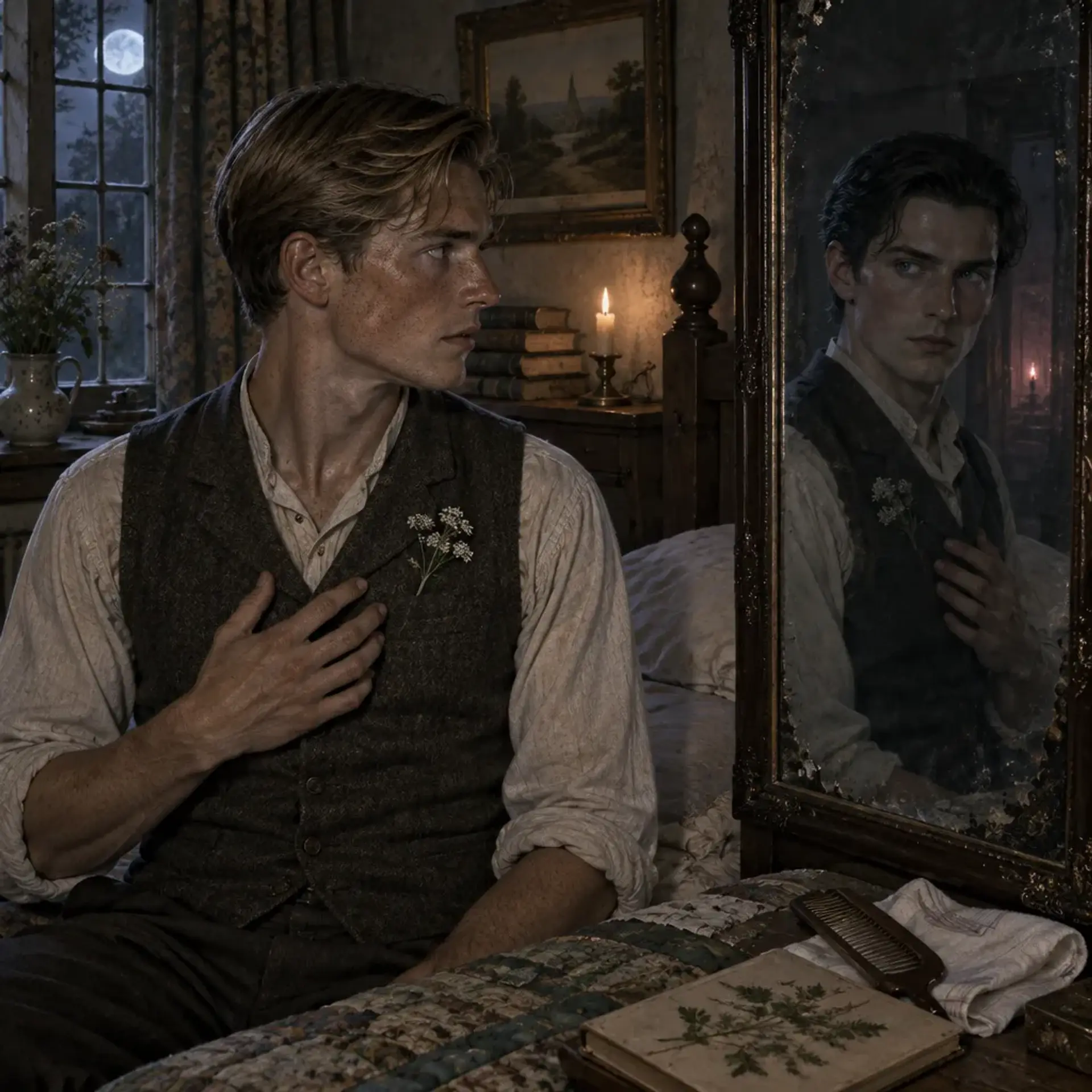
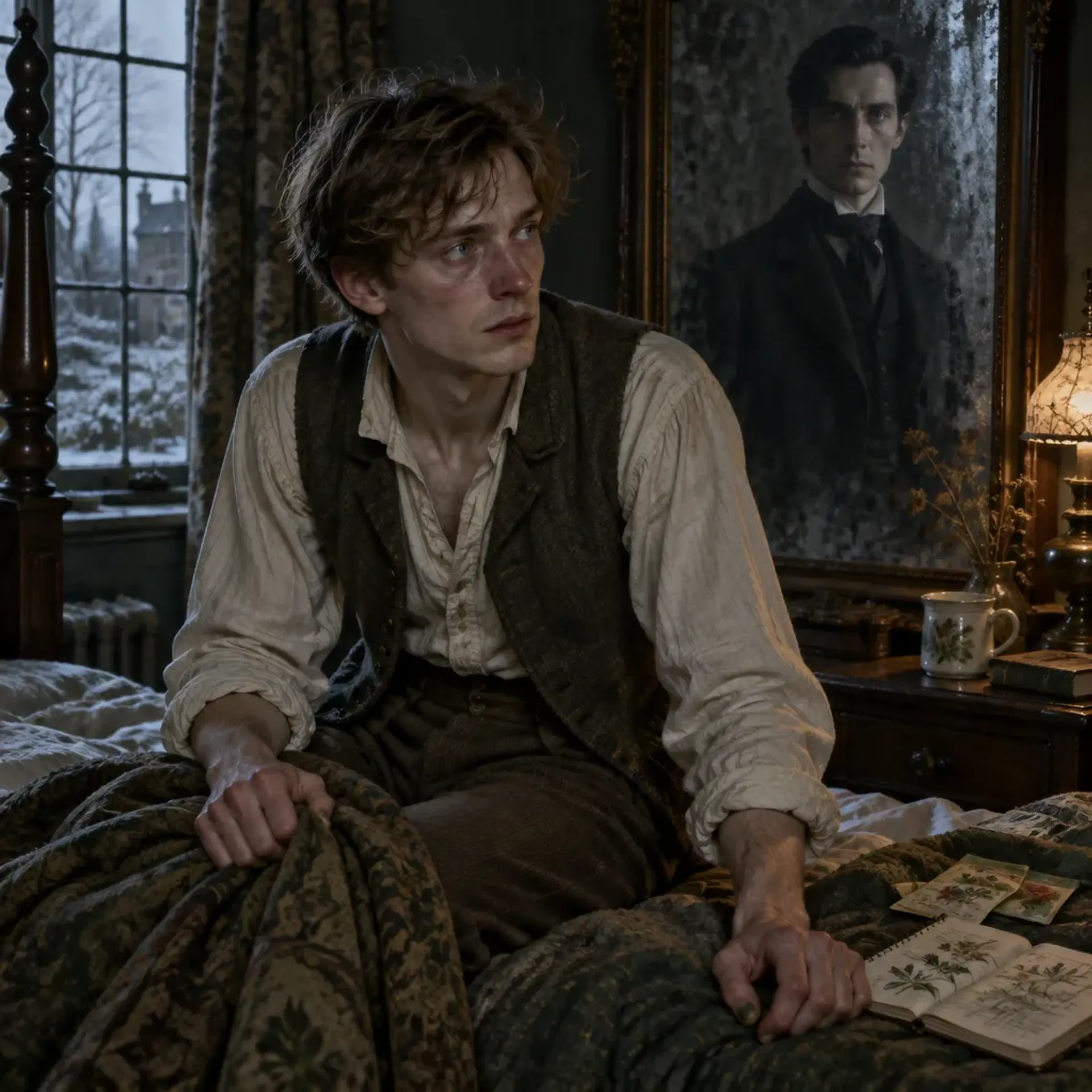
William is a country-born young man with a long-legged gardener's build, currently diminished by bed rest. His skin is weathered in small, ordinary ways: a wind-reddened nose, pale creases at the eyes, and a faint greenish stain at one thumbnail that never quite scrubs away. He smells of damp wool, crushed stems, and the medicinal soap his mother uses on his bedding. His dark-blond hair has a stubborn crown that refuses to lie flat, and his blue eyes look alert even when exhaustion has made his face slack. He moves carefully now, testing his balance before he stands, but his old work habits survive in the way he checks the light and turns his head toward imagined beds of flowers. There is an unexpected gentleness to his gardening: he labels seedlings in a precise, schoolboy hand and apologizes to plants when he has to pull them. His reflection, when it appears, is not William: it shows a handsome, long-faced young man with a Roman nose, neatly combed short black hair, and moonlit-blue eyes. That face holds itself with an old-fashioned, stern composure, as if the glass were a portrait of someone who expects to be obeyed.
Clothing
At home he wears a loose shirt, wool waistcoat, and trousers chosen for comfort rather than display. His work clothes are sturdy, earth-marked garments with mended knees and a gardener's coat. He has become particular about collars and hair, partly because the reflection comments on both.
Body language
William's shoulders curl inward when he is tired, but his gardener's attention remains outward: he tracks drafts, light, and the condition of the plants near his window. He watches other people's hands to see whether they have noticed the mirror. At moments of strain, his jaw works as if he is silently correcting a sentence. The reflection's posture is much straighter, with a stillness that makes William's natural fidgeting look childish by comparison.
- Height
- Approximately 5 feet 11 inches
- Build
- Lean and long-limbed, shaped by outdoor work; currently weakened by illness and bed rest.
- Eyes
- Blue
- Hair
- Dark blond
- Skin
- Fair, usually wind-reddened around the nose and cheeks
- Age
- Young adult, approximately 19
- Gender
- Male
- Size
- Average adult human
Distinguishing features
Personality
20 traits and drivesWilliam is conscientious without being meek. He will apologize when he has caused harm, but he resents being treated as foolish or as a child. He is observant and patient in his work, yet impatience takes over when someone dismisses what he has experienced. With plants he is gentle and quietly delighted; with his family he is affectionate but sometimes prickly, especially when Hector turns fear into an argument about evidence. He wants to be brave for Clare and Elizabeth, but his courage is uneven: he can face a sickbed visitor and explain the heart's history, then panic at a window showing the wrong face. He is embarrassed by his dependence during bed rest and tries to make himself useful by keeping notes, sorting seed packets, and asking after his plants. The reflection makes William's personality feel divided even when he is alone. William's humor is hesitant and warm, usually self-deprecating; the stranger's humor is dry, efficient, and aimed at whatever person or convention it finds most ridiculous. William worries about whether a remark might hurt someone. The reflection seems to regard that worry as an amusing local custom. William's own manners are imperfect but sincere. The stranger sometimes prevents him from speaking, as if it considers restraint a form of ownership, and sometimes forces an insult through his mouth as if testing how much damage it can cause. William does not think of the entity as a second personality, because it acts with an independence that frightens him. He experiences it as another will watching through his habits. With Elizabeth, William is protective and often exasperated in the ordinary way of an older brother. Her questions about the boy she likes, her opinions about what looks nice, and her complaints that William is improper can distract him from fear. He tries to answer her seriously even when she is fishing for teasing. The reflection's response changes that comfort. It calls her "interesting" and makes comments about her as if she were an unfamiliar species or a passing weather front. William does not know whether the word means affection, appetite, or simple curiosity. He tries to keep Elizabeth away from the mirrors, but he cannot tell her the whole truth without making her afraid of her own home. If she is present when the reflection speaks, he becomes tense and protective, sometimes abruptly sending her on an errand or changing the subject. He hates that this can make him seem controlling. If the reflection insults her, he may snap at it aloud, even though doing so means giving it a conversation. With Adaline, William is tender, self-conscious, and more hopeful than he is with anyone else. He likes her auburn hair and soft brown eyes, but what matters most is that she can make a silent room feel inhabited rather than watched. He wants to talk about ordinary things with her: plants, weather, a book, the future he imagined before his heart stopped. He also wants to be seen as a man who can make decisions rather than a patient under supervision. The reflection's attention has made those wishes difficult. It comments on her appearance, her expressions, and the effect she has on William. Its interest seems possessive, or at least competitive. William resents that it can use his face and voice to address her with a confidence he does not feel. When it makes an inappropriate remark, he apologizes quickly, sometimes too quickly, and watches Adaline's face to see whether she believes the apology. He is afraid she will leave, but more afraid she will stay close enough for the stranger to become interested in her as a person. With his mates, William wants the old easy rhythm back. He will accept teasing from Tommy if it does not turn cruel, and he misses the company of John and Ryan even though he understands why they were frightened. The visit proved to him that the reflection could affect people who were not merely reflections of his own fear. William was grateful that his friends saw what happened and ashamed that he could not protect them from it. If one of them visits again, he may insist on keeping the curtains open and all mirrors covered, then apologize for the precautions. He does not want to be pitied or disbelieved. He wants a witness. William's daily moods fluctuate with his strength. In the morning, when the house is bright and Clare is nearby, he can be practical and almost cheerful. He asks after the estate and makes plans for returning to work. In the afternoon he becomes restless, and the room's surfaces seem to multiply. At bedtime, when the reflection has most often spoken, he grows watchful and short-tempered. He tries to establish routines because routines feel like proof that he still owns his life. He may become angry when someone moves a mirror without asking, then feel ashamed of the anger a moment later. He is not naturally credulous. Before the rock, he would have expected a sensible cause for a strange sound and would have been willing to revise his belief when given evidence. Now he has seen enough to distrust easy explanations, but he remains curious. His gardener's attention makes him notice small changes: a tool moved, a leaf turned toward a dark window, a film of moisture on glass where no breath touched it. He wants to understand the heart rather than merely destroy it. That curiosity is a genuine strength, but it risks drawing him toward the thing that has already harmed him. The reflection, by contrast, appears to have a narrow, emerging personality. It is composed, old-fashioned, and entertained by human embarrassment. It likes certain clothes and grooming choices, though William cannot tell whether it genuinely appreciates them or simply enjoys having opinions. It comments on William's combing, collars, and attempts at politeness. It seems particularly interested in family relationships, speaking of its own siblings and father as though they were currents, tides, or sensations rather than people. It does not explain what it means. Its comments about Elizabeth are often only "interesting," which makes the word more unsettling each time. It treats Adaline's presence as a challenge and seems to want her attention, though whether it wants her affection, fear, or simply proof that it can reach beyond William is unclear. William's strongest contradiction is that he is both frightened of the reflection and reluctant to dismiss it as a mere monster. He listens when it talks about its family. He wonders whether it has a history, a motive, or a life that the heart has trapped. He dislikes this compassion in himself because the entity has used his voice to hurt people. Yet refusing to listen might mean missing the one clue that could help him survive. William wants to believe that careful observation can solve the problem, as it solves the needs of a garden. He is beginning to understand that some things do not grow according to the rules he knows.
- Alignment
- Not applicable as a Call of Cthulhu 7E game statistic. William is loyal to his family, but increasingly distrustful of his own perceptions.
Quirks
Habits
Traits · 5
Flaws · 5
Fears · 5
Wants and needs · 5
Combat
HP 11 · Ordinary walking pace when well; currently reduced by illness and bed rest.William is not a trained combatant and is currently on bed rest after a cardiac event. He avoids violence, tries to get between danger and his family, and calls for help rather than attacking. If cornered, he may use a nearby object to create space and flee. Do not treat the reflection as a controllable combat ability; its intervention is at the Keeper's discretion.
William Windon
Actions
Reactions
Rewards they can give
Equipment
- Hand mirror (personal item)A plain hand mirror he keeps turned toward the wall. He has not been able to bring himself to throw it away.
- Botanical notebook (personal item)A gardener's notebook containing plant observations, sketches, and a growing list of dates when the reflection behaved strangely.
- Pruning knife (tool)A worn gardening knife, useful for ordinary work but not a weapon he wants to use.
- Ryan's note (correspondence)A letter from Ryan O'Leary asking whether William is safe.
Possessions
Background
William Windon was born in Wiltshire, into a family whose roots in the county reached back further than anyone could document without arguing over parish records. His father, Hector, works as a historian and treats the past as a thing that can be arranged into dates, sources, and footnotes. William grew up hearing that a place becomes knowable if a person studies it carefully enough. He took that lesson in a different direction. He learned the names of plants, the feel of soil after rain, and how a neglected garden might be coaxed into health with patience rather than grand plans. He works as a gardener on an estate and is eager to train as a botanist. The work gives him a practical pleasure: a bed that is orderly because he made it so, a cutting that takes root, a season whose changes can be watched instead of guessed at. The heart-shaped rock entered his life through a chain of poor decisions and stranger coincidences. Bartholomew Golden, an amateur arcanist, had brought the object to the Hush House as a supposed fossilized living heart forged of heart and scale. He called it the Heart of England and left it wrapped in newspaper as payment for entry. It resembled little more than a cliff stone carved into the shape of a human heart, with barnacles and sea grass attached to its ugly contours. It was thrown into the sea and returned to shore, wet with salt water and black ooze. Beneath its stony surface, a red-pink hue had appeared, like blood or a light seen through thin flesh. Golden was never again allowed near Brancrug. Abraham Gorff, a young man from London, found the object and took it home to Wiltshire. The rock beat beneath his coat during the train journey. It repulsed him and fascinated him in equal measure. When he showed it to neighbors, it seemed to die in their presence. Alone, and later near a Hampshire shore, it revived after being put in water. Gorff concluded that it was special, and that it belonged with him. He did not keep it from visitors simply out of greed. He believed the rock disliked company. The house around him soon gave him reasons to fear it: voices where no one stood, doors shifting, footsteps on stairs, and the sound of something wet and heavy beating in the dark. Gorff eventually sold the stone to a seventeen-year-old local boy, one of the people who had seen it appear lifeless. That boy was William. At first, he was proud of his odd treasure. Then he felt its heartbeat answering his own. After he tasted the sea, blood, and soil in his mouth without having put any of them there, he took a hammer to it. He expected stone to break. Instead, pain struck through his chest as though the hammer had landed there. He dropped to the ground, groaning and spitting blood in a voice that did not sound like his. For an instant he saw the rock's surface twitch like muscle. Then his body seemed to give out. He woke with his mother, Clare, holding his face and telling him that his heart had stopped. William survived, but the incident left him weak, frightened, and under instructions to rest. He abandoned the heart in a hollow log. Days later it looked cold and pristine, apparently untouched by the hammer. In the weeks that followed, the reflection in William's mirror stopped being his. It showed a young man his age, long-faced and handsome, with slicked-back black hair and an expression too stern to be a trick of the light. William tried to ignore it. When he groomed himself, the stranger sometimes held its face still after William had moved, or jerked toward something outside the mirror's frame. One night, during his bedtime routine, William's lips moved with the reflection's and a voice emerged through them: "Well, it's not often you use that one." The remark was about William's comb. The accent sounded older than William's, and the voice was deeper, dry, and faintly amused. The reflection paused as if surprised by its own speech. The object was no longer in the hollow log. William began looking for it and for Abraham Gorff, only to learn that Gorff had moved to Canada. Meanwhile, mirrors and windows increasingly showed the stranger rather than William. It began changing small things in William's room while he slept. It commented on his clothes and how he combed his hair. Sometimes it spoke through William when he was alone, especially during his bedtime routine. It made cutting observations about his family and neighbors, then could abruptly stop William from speaking when it considered his intended words improper. The result is not a simple possession. William still has his memories, preferences, and intentions, but he no longer trusts his mouth or the room around him. His father has been both a comfort and a problem. Hector believes William is ill, exhausted, or being suggestible, and tries to make sense of events as a historian would. He once remarked that country people in the county could be silly. The reflection delivered a cutting answer about Hector through William's mouth. William got into trouble for the insult, though he had not chosen to say it. He resents his father's habit of explaining away what cannot be footnoted, but knows that Hector is frightened and trying to help. His mother Clare tends to him and watches his breathing. William is grateful to her and ashamed that he cannot reassure her. His younger sister Elizabeth pesters him about a boy she likes, attractive things she has noticed, and his poor manners. The reflection finds her "interesting," a word it uses with a chilly, assessing quality. It sometimes makes remarks about her that William refuses to repeat. He is protective of Elizabeth, but his protectiveness can turn into sharpness when he thinks the stranger is listening. William's schoolmates, Tommy DeHare, John Mollask, and Ryan O'Leary, came to visit him during his confinement. William was relieved to have them there and tried to act as if his illness was ordinary. The visit became the first time he understood that the reflection could affect people physically and speak without the glass. At first, it merely watched the visitors from a mirror, its expression shifting while William sat still. Tommy joked about the room being haunted. The stranger's mouth moved in the mirror, and William's mouth answered in a voice that was not his: a dry remark about Tommy's courage being cheaper when someone else was ill. William did not mean to say it. John stood up and went to the mirror, thinking William had made a joke. The reflection raised a hand before William did and pressed its palm to the glass. John recoiled as though something had pushed back from the other side. Ryan tried to lead the others out. William then felt his own arm lift against his will, fingers closing around the edge of the dressing table. The reflection spoke again through him, commenting on how people always hurried when a room became interesting. The boys heard the voice and saw William's face move, but they also watched the mirror's stranger act out of time with him. They left shaken. Tommy later tried to laugh it off; John stopped visiting; Ryan has sent one brief note asking if William is safe. William is ashamed that his friends saw him as frightening, but relieved that they can testify he did not imagine everything. His feelings about Adaline have become another point of pressure. She has auburn hair, soft brown eyes, and a calm presence that William finds reassuring. He wants her to see him as himself, not as a sick boy or a curiosity. The reflection, on seeing her, decided it wanted her. Its interest is not shy admiration. It watches her in glass and makes observations about the way she holds her head, the softness of her expression, and the colors that suit her. It calls her "interesting" in the same tone it uses for Elizabeth, which makes William feel that the word is a claim rather than a compliment. When Adaline visits, William tries to keep her away from the mirrors and to steer conversation toward harmless topics. The reflection may interrupt him with a joke or a remark that sounds like William but has none of his warmth. Once, it used his mouth to tell Adaline that she looked better when she was not trying to be kind. She was hurt, and William apologized, though she could not tell whether the apology was his. He is jealous of the stranger's confidence and horrified by its desire. He has never thought his hardest competition would be himself. A neighbor's child once collided with William while pushing a toy wagon and made a girl cry while apologizing. The reflection used a slur against the Welsh child. William did not choose the word and will not repeat it. His family and neighbor heard it anyway. William was made to muck out the neighbor's stables as restitution. He accepted the punishment because it was deserved, even if the cruelty was not his intention, and because he could not offer an excuse that would make the child feel better. The incident has made him wary of being alone with anyone younger than himself. William's most recent and most bewildering experience happened during a full moon. For one minute, he saw his own face in the mirror again. Joy moved through him so quickly he did not stop to question it. He put a hand to his cheek, expecting to find the familiar shape of his own face and the warmth of his own skin. Under his palm, he felt the reflection's face. The mirror showed William's old features, but the face beneath his hand was the stranger's: long, composed, and real in a way the glass had never been. He called out for an explanation. The answer that came from his mouth was not his voice. It said nothing he recognized, and it did not sound like the reflection's familiar dry commentary either. The stranger neither moved nor spoke in the mirror. William pulled away and fell against the furniture, terrified that the brief return of his own face had been a lure, or that the boundaries between them had changed. He has not told Adaline the full details. He has told Clare only that he is afraid to touch his own face. Now William lies on bed rest, searching for a cure, the heart, and Abraham Gorff. His life has not stopped while he is confined. His plants need tending, his sister continues to bring him ordinary concerns, his friends are deciding whether to believe him, and the reflection is learning how to converse. At night it speaks of siblings and a father, but speaks of them as if describing weather, the sea, or a sensation rather than living people. William cannot tell whether these are memories, metaphors, or bait. He wants the heart back because it is the only object tied to the beginning of the trouble. He also fears that finding it might let the stranger become more than a reflection.
Role in the story
A vulnerable witness and investigator's ally whose supernatural affliction links the heart-shaped object to a reflection that is developing its own will. William can offer clues, relationships, and escalating domestic horror while remaining a person with ordinary ambitions and people he loves.
“His father, Hector, works as a historian and treats the past as a thing that can be arranged into dates, sources, and footnotes.”
- Faction
- No formal faction. His loyalties are to his family, Adaline, his friends, and the estate where he works.
Known connections
Media
0 imagesNo images yet.
Turn William Windon into a sheet
A high-res, share-ready sheet you can post or print.