Friedreich
Friedreich
At the table
“That one. Buy that one,”
Voice
His voice has the dry, controlled resonance of someone used to giving a report in a cold room. It catches slightly on certain consonants, as though the sound has to cross a distance before reaching the listener. His own voice is youthful but not sweet; borrowed faces can alter its pitch and texture, while the cadence remains brisk and carefully enunciated.
He speaks German with Brandenburg phrasing and an old-fashioned, educated formality that sounds learned rather than effortlessly aristocratic. His sentences are sharply articulated, with clipped consonants and occasional military terms he cannot explain. Under stress he drops the polish and speaks in direct, youthful bursts. When manifesting, his voice can reproduce the cadence of a borrowed face, but his habitual pauses and precise word choices often give him away. He does not become quieter or more polite when angry; he becomes more exact, naming the offense and the person responsible.
Speech patterns
How to play them
Recognize him deliberately if he is present, and let him know when you can see or hear him. He responds best to ordinary inclusion rather than pity. Ask before touching or asking him to manifest a particular face. If discussing Wilhelm's past, do not demand a confession in front of the coven; Friedreich needs candor but will interpret a public confrontation as humiliation. Treat his possession attempts as serious boundary violations, even when he describes them as experiments.
Goal
Recover enough of his own identity to choose a face freely, and learn what Wilhelm did during the Second World War without losing their brotherhood.
Motivation
Love for the coven and a desperate wish to be seen as himself, not merely as a convincing face. He wants to make Wilhelm feel human sensations, though he is beginning to understand that closeness cannot be forced into another person.
Appearance
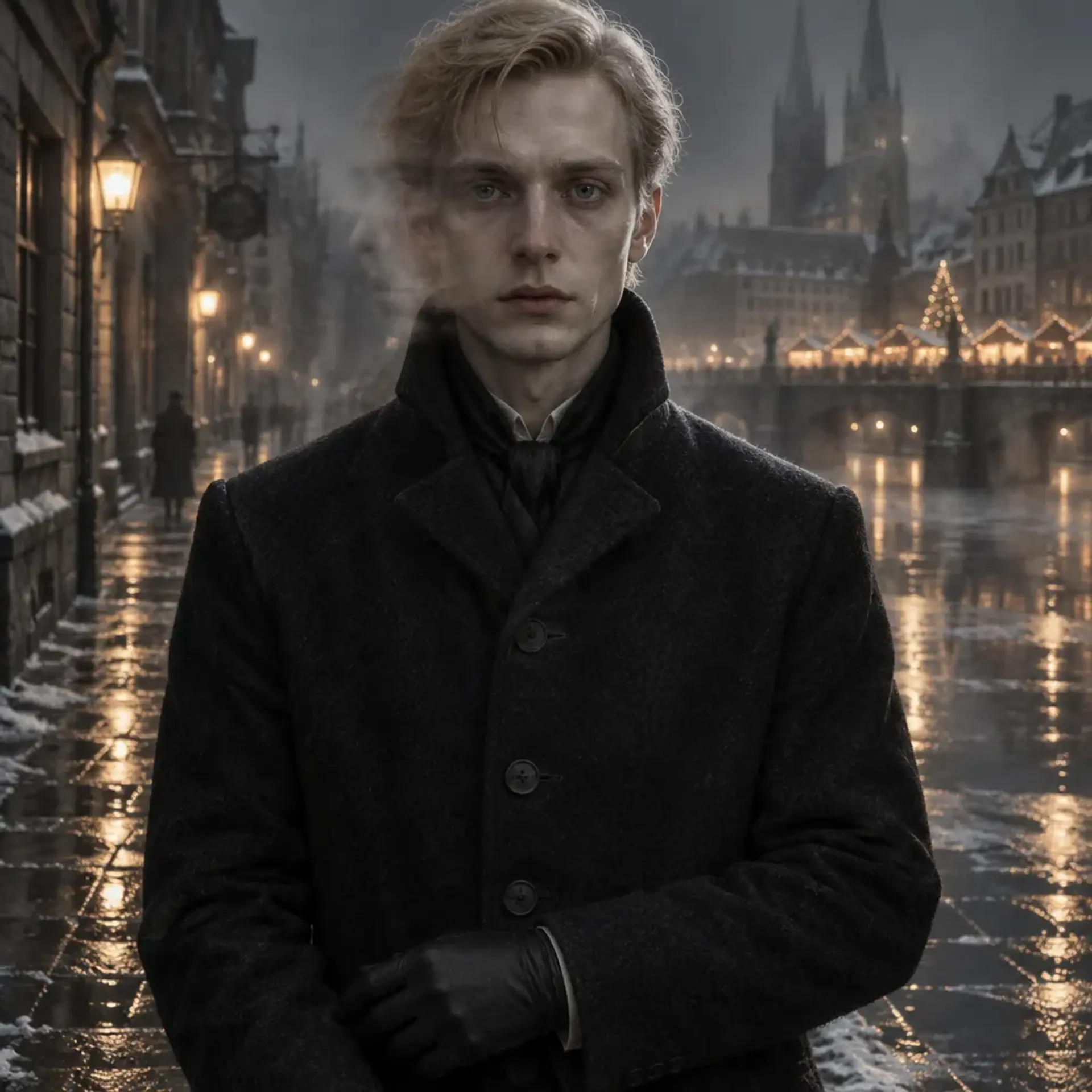
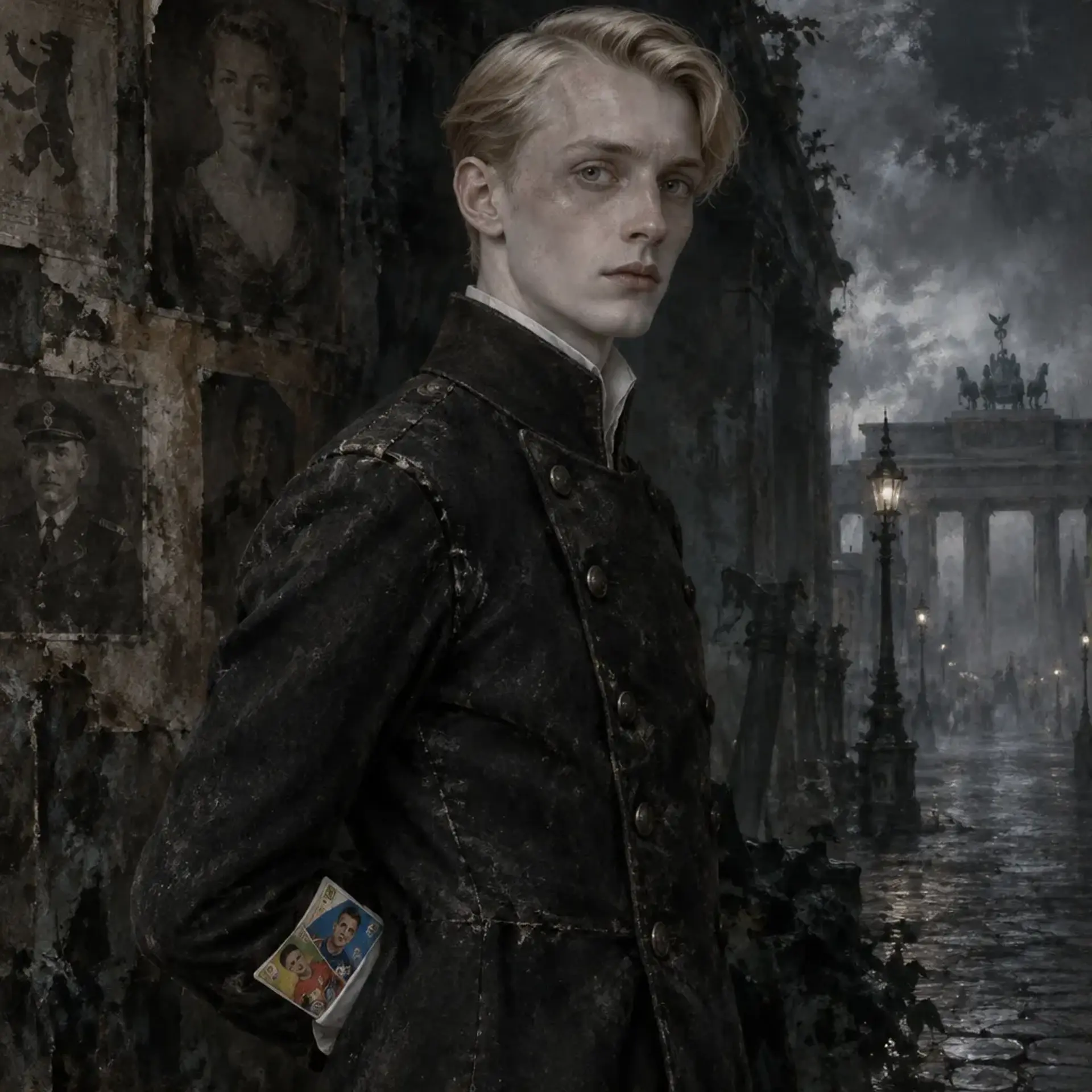
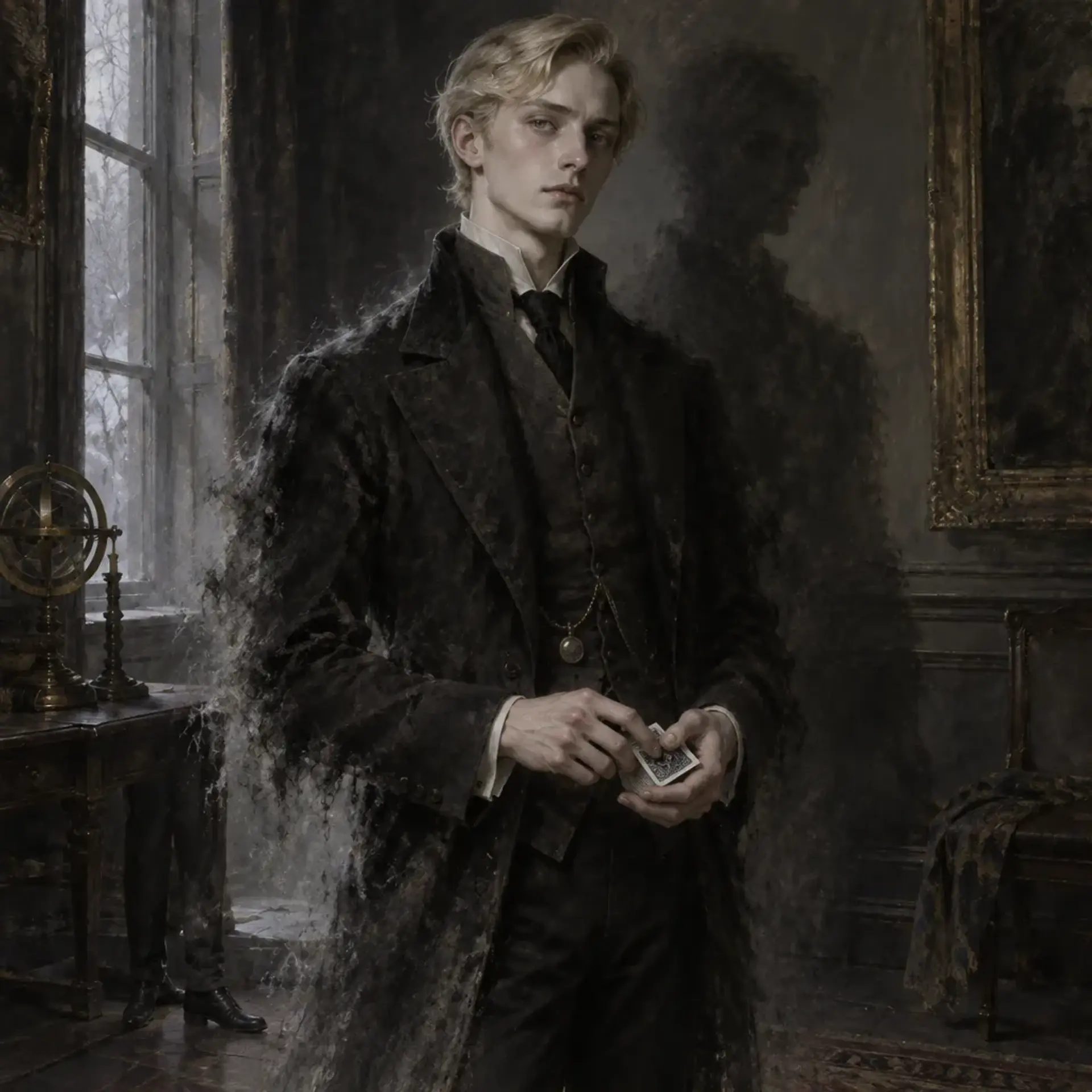
Friedreich looks like a Brandenburg boy caught between a cadet's portrait and a half-remembered photograph: narrow, youthful features, a straight nose, a mouth set in careful restraint, and gray eyes Wilhelm insists are his. Friedreich distrusts that claim. His hair, when he is visible enough to inspect it, is pale blond and combed with an old-fashioned side part. The apparent skin has the faint, dry texture of paper left too long in a drawer, but his borrowed faces can become so convincing that a friend feels warm breath against their cheek. His true outline is difficult to hold in the eye. At the edges, it seems rubbed away, as if a charcoal drawing had been smudged by a thumb. He moves with a clipped, drilled precision, favoring his left foot by a fraction, then abruptly goes motionless when he realizes nobody is looking at him. The unexpected detail is his hands: he keeps them folded as though at a formal inspection, yet his fingertips are always busy making tiny, deft card shuffles, a schoolboy's dexterity incongruous with his military bearing. His presence leaves people with the impression of having recognized him from a family album they cannot quite place.
Clothing
Favors a dark, high-collared coat cut in an old-fashioned civilian style, neat shirt, plain waistcoat, and polished boots. He dislikes visible military insignia and avoids dressing as an exact historical soldier. When borrowing a face, he adjusts clothing to suit the period and status of the person represented.
Body language
He stands with his shoulders squared as if awaiting inspection, hands folded at his belt. His left foot edges forward when he is anxious. When ignored, he makes a small, crisp gesture to attract attention, then freezes if it fails. Borrowed faces make his posture more fluid, but his fingers continue their tiny card-shuffling motions.
- Height
- About 170 cm when strongly embodied; his outline and apparent height waver when he is not.
- Build
- Slim and adolescent, with a carefully held, almost cadet-like posture. His apparent body has little physical weight until Embody is working strongly.
- Eyes
- Usually presented as gray; Wilhelm's certainty is a source of distrust. A borrowed face has that person's eyes.
- Hair
- Pale blond when his own appearance is visible, according to Wilhelm; uncertain to Friedreich.
- Skin
- A pale, paper-dry translucence when his own manifestation is weak; a borrowed face reproduces the original's complexion convincingly.
- Age
- Appears about seventeen or eighteen when visible; his actual time dead is uncertain, and he remembers fragments spanning both World Wars.
- Gender
- Male
- Size
- Medium
Distinguishing features
Personality
20 traits and drivesFriedreich's manners are more composed than his feelings. He can greet a stranger with the crisp courtesy of a young Junker, remember who takes sugar in their coffee, and arrange a card game so everyone gets a fair hand. Under that discipline is a boy who wants to be invited without having to announce himself. When ignored, he can turn from patient to sharp in a breath: he will repeat his name, step into the way, or borrow a face that makes people look. Afterwards he is embarrassed by the need and may retreat into formality, as if impeccable manners could erase the moment. He is protective, but not gentle in every expression of care. With Mila he takes responsibility for her safety while respecting her competence; he will warn her about a dangerous place, then bristle if anyone calls his concern childish. He treats Gunther's curiosity with a mixture of affection and wariness. Gunther's questions make Friedreich feel interesting, but the disastrous possession experiment taught him that curiosity can become an excuse to enter someone else's inner life. With Klaus he has unusual patience. Klaus's passive-aggressive remarks would irritate Friedreich from anyone else, but the hesitation in Klaus's manner makes him suspect there is a reason for their connection. He would rather wait for Klaus to tell him than force an answer, though he sometimes tests the silence with pointed jokes. Wilhelm is the contradiction at the center of Friedreich's emotional life. Friedreich sees him as a brother and feels safest near him, yet distrusts his account of their shared past. He is angry about Wilhelm's desertion in the First World War and the crimes he committed in the Second. He believes Wilhelm's evasions are connected to Friedreich's own missing memories. But even when furious, he watches Wilhelm for signs of distress, and wants to give him warmth, breath, food, sleep, and ordinary sensation. His first possession attempt grew from that desire. The impulse was loving and controlling at once: he wanted to share something, but he also wanted to decide what Wilhelm should feel. Friedreich is ashamed of that. He does not easily admit that the host's resistance was not a failure of affection but a valid refusal. His relationship to his own body is equally conflicted. Borrowed faces are a practical way to be heard and touched, and a source of joy. On days when the world loosens its hold on the dead, his manifestation can feel startlingly complete. He can smell wet earth, taste food, feel the drag of a coat at his shoulders, and sleep. Those sensations make him grateful, then grieving. He wants to keep them, but knows that wearing a face too long invites envy and confusion. He favors men close to his apparent age, especially soldiers, police, or nobles who resemble his idea of the person he might have become. A face can make him feel dignified, safe, or desirable; it can also turn him into a jealous observer of someone else's life. His carefully kept list is both a tool and a private shrine. He is not solemn all the time. At coven gatherings he enjoys cards, fishing, hunting, drinking, and football with an intensity that surprises people who expect a ghost to brood. He takes holidays seriously because they bring people together without requiring an emergency as an excuse. Christmas markets are his particular delight. He has sharp opinions about quality, price, and which stalls are trying to cheat visitors. Sometimes he advises a friend to buy something he wants himself, then watches them carry it away with a smile that is almost convincing. He can be playful and vain about a good face, and he likes being the person who knows what to do. His pride is both a resource and a trap. It gives him a way to hold himself together when memories collapse, but it makes asking for help feel like surrender. He can be exacting about manners and then suddenly blunt about grief. He is brave when protecting someone else and evasive when a question concerns his own death. He wants the truth from Wilhelm but fears the answer. He wants to discover who opened his Caul, but fears that the spirit's intervention means he belongs to something beyond his chosen family. He longs to be a brother, a friend, and a person with a stable face. He has not yet decided whether those are three different wishes or one.
- Alignment
- Protective and loyal, with a growing capacity for resentment. He is not reliably virtuous: he has borrowed faces without consent and has considered taking a host's body.
Quirks
Habits
Traits · 5
Flaws · 5
Fears · 5
Wants and needs · 5
Combat
HP 10 · As a wraith, movement and interaction follow the chronicle's Shadowlands and Arcanos rules; no D&D speed is assigned.Friedreich avoids direct combat. He tries to become visible long enough to distract, misdirect, or draw an enemy away from his friends, then uses cover and the Shadowlands to escape. He will attempt Skinriding only as a desperate measure or with clear consent. He does not use a face as a guaranteed disguise, and he cannot assume that supernatural foes are susceptible to his powers.
Friedreich
Actions
Reactions
Services they sell
Rewards they can give
Equipment
- Worn playing cards (personal keepsake)A small deck of cards he uses at coven gatherings. The cards are an anchor for his social habits, not a magical artifact.
- Face list (private record)A handwritten list of favorite faces, recorded under altered names with reminders of where the originals were last seen. It is incomplete and not proof that every original is safely absent.
- Phrase slip (personal keepsake)A scrap of paper on which he has copied a few phrases from a Christmas-market bargaining conversation, hoping to remember his own voice rather than a borrowed one.
Possessions
Background
Friedreich remembers Brandenburg as a geometry of flat fields, damp roads, and trees that seemed to stand at attention. He was seventeen, perhaps eighteen, when he died. Even that is a conclusion assembled from his face, a handful of sensations, and Wilhelm's insistence that the two of them are of an age. Friedreich has no dependable memory of parents, a home, or the name he used before death. He remembers the pressure of a collar at his throat, the bitter taste of cold air, and a command to keep his chin up. He suspects he was raised among people who thought discipline was a form of love. He also suspects he was not particularly good at obeying. His first clear memory in the Shadowlands is of waking beside a willow tree, with a pale light bobbing between its hanging branches. The Caul, the cocoon that had held him between death and the afterlife, had been opened by no human occultist and no wraith. The presence that did it was a spirit of land and man, marked by the Wyld and born, in Friedreich's uncertain vision, of the Weaver's blessed adopted children and the Wyrm's soils, with a trace of Luna. It did not explain itself. He saw a vague image of a blond young man with clear blue eyes, then the spirit vanished. Only a will-o'-the-wisp remained, receding among the willows. Friedreich woke with no account of the death that brought him there and no certainty that the spirit had helped him, claimed him, or simply made a mistake. The Shadowlands were not a second Brandenburg. They were its grief, exposed. Friedreich wandered through the remains of places he recognized without knowing why, drawn to battlefields and ruined crossings. His first Harrowing came when he followed the sound of marching into a trench that was not in the Shadowlands and could not be escaped. The dead men there wore faces he almost knew. Each ordered him to identify himself. When he could not, they called him a deserter, a thief, and a coward. At the end of the ordeal, a faceless officer offered him a face and told him to wear it or be erased. Friedreich took the face, not because it was safe, but because it let him answer. He emerged from the Harrowing able to manifest with an unsettling fluency that he still does not understand. The face was gone, but the lesson remained: being seen could feel like survival. He learned the Shadowlands through repeated, costly mistakes. A face borrowed from a dead sentry helped him pass a pack of Spectres long enough to escape a ruined station. In another Harrowing, he wore the image of a young clerk he had seen near a battlefield and found himself trapped in a false home, expected to explain a life he did not possess. He survived by admitting, aloud, that he did not know who he was. That admission became a small anchor. He does not know whether his ability is an unusually strong use of Embody, a private expression of his Corpus, or a strange gift connected to the spirit that opened his Caul. In this chronicle it is treated as a custom knack, not as a universal rule of Wraiths. Friedreich found Wilhelm around the time of the First World War, though the exact sequence shifts whenever he tries to recall it. Wilhelm was a German Tzimisce from Mecklenburg, a living-seeming boy with a dead man's hunger and the same missing history. Friedreich attached himself to him with the certainty of a younger brother finding an older one. He remembers the rattle of a breath during the war, a moment of warmth and panic so vivid that he cannot tell whether it belonged to Wilhelm, to himself, or to some soldier nearby. Wilhelm served as a German shock trooper and deserted toward the war's end. Friedreich was with him as often as he could be, but he cannot tell whether he helped, watched, or simply followed. Wilhelm's shame about desertion has never been enough to satisfy Friedreich's questions. They remained close through the Second World War. Friedreich saw enough to know Wilhelm committed acts he considers unforgivable, but not enough to understand the whole story. Wilhelm will not discuss his exact role. He says Friedreich would not understand, which Friedreich hears as both a refusal and an accusation. Friedreich is angry at Wilhelm for his wartime crimes and for leaving in the First World War, yet cannot stop feeling that the two acts are somehow his responsibility too. Wilhelm claims Friedreich is blond, gray-eyed, and recognizably himself. Friedreich wants to believe him, but suspects Wilhelm may be protecting a memory, inventing one, or confusing him with somebody else. The two built a life around a peculiar group they call a coven, though it is not a formal Wraith organization. Gunther, a changeling who spent much of his existence in Arcadia before returning to the world, sells clothing made from moss and other plant matter. Klaus is a ronin Get of Fenris, or perhaps a Skin-Dancer; even his friends are not certain which account is true. He is passive-aggressively unkind to most people and noticeably hesitates around Friedreich, as if some old instinct tells him not to strike. Mila, a mage from Bremen, visits for holidays. She can see and touch Friedreich even when his own face is not manifest, and he has decided this makes him her protective older brother. He guards her without mistaking her for helpless. Their gatherings involve cards, fishing, hunting, drinking, and, above all, football. Holidays bring more of the coven together and make Friedreich conspicuously joyful. At Christmas markets he gives confident advice about bargains, then sometimes urges a friend to buy the beautiful thing he wants but cannot own. Friedreich keeps a changing list of favorite faces. He favors men near his apparent age: a dead railway constable whose severe brows made Friedreich feel dependable; an absent reservist with a soft, crooked smile; a nobleman's son from an old portrait whose high collar suited Friedreich's ideas of dignity; and a vanished market porter with broad cheeks and an expression that made strangers answer him. He uses invented names for the list and checks that each person is dead or has left the area before borrowing the face. That precaution is imperfect. The faces let him talk to the coven, but long use can make him forget which preferences, expressions, and memories belong to him. Envy and anger follow, particularly when he sees a face enjoying a life he cannot have. Once, out of curiosity and a wish to give Wilhelm emotions he could not access, Friedreich asked to Skinride him. Wilhelm consented. They tried while the coven was together, with Klaus watching tensely and Gunther asking questions. Friedreich did not simply slide into Wilhelm. He felt resistance like pressing his face against a locked door, then the strange, cold density of the vampire's body and a hunger that was not his. Wilhelm felt a foreign will behind his own thoughts and fought it. Friedreich tried to lend him warmth, breath, and the immediate human impressions he could create while embodied. Instead, they both clenched around control. Wilhelm's hunger sharpened; Friedreich tasted dirt, blood, and the sensation of chewing the dead through Wilhelm's recollection, without understanding it as an ordinary appetite. Their limbs jerked out of sequence. The attempt ended when Wilhelm forced Friedreich out. Wilhelm was furious and shaken, while Friedreich felt ashamed that his gift had become an invasion. Klaus had been ready to intervene. Gunther, alarmed but fascinated, asked whether either of them had experienced shared memories. Neither had. Later, Friedreich tried a second time with Gunther, who wanted to know whether a wraith and a changeling could share memories or discover what separated their inner lives. The attempt went worse. Gunther's consciousness did not feel like one door but a house of rooms opening onto impossible places. Friedreich encountered images and sensations that might have been memory, glamour, or Arcadia's aftertaste. Gunther felt the dead weight of Friedreich's longing and the sudden absence of a reliable body. Their perceptions overlapped without becoming shared memories. Friedreich lost his grip on his own face and felt, for a frightening instant, that he was only the shape Gunther expected him to be. Gunther experienced the intrusion as a trespass into an already strange and crowded inner world. Friedreich broke contact and said, "Never again." He meant it. He and Wilhelm made one last agreement to try once more. This time they set boundaries and stopped sooner, but the familiar struggle returned. Wilhelm could not make sense of the sensations Friedreich offered, and Friedreich could not translate a vampire's unlife into the human comforts he wanted to give him. They ended it deliberately, without a victory. Friedreich now considers the attempt a failed act of love, not proof that the two are strangers. He still wants a job. He thinks his faces might let him help people, pass messages, or act as a guide between the living and the dead, but he knows his identity can fray if he makes a life out of borrowed selves. He is furious when people cannot see or hear him, and embarrassed by how quickly that frustration becomes pleading. His current problems are practical and intimate: finding a way to be recognized without taking someone else's face, learning what Wilhelm did in the war, and deciding whether he is prepared to learn more about the spirit that opened his Caul. The will-o'-the-wisp has not returned. Friedreich is afraid that if it does, it will ask for something he has already given away.
Role in the story
A socially vivid Wraith companion whose uncanny gift lets him bridge the dead and living, while his missing identity and conflicted loyalty draw the characters into Wilhelm's buried wartime history. He can provide warmth, humor, and a witness to supernatural events, but his borrowed faces and uncertain memories should create complications rather than function as effortless disguise or exposition.
“Even that is a conclusion assembled from his face, a handful of sensations, and Wilhelm's insistence that the two of them are of an age.”
- Faction
- Part of an informal supernatural coven of friends, not a formal Wraith faction. His relationship to the Hierarchy, Renegades, and Heretics is currently undefined.
Known connections
Media
0 imagesNo images yet.
Turn Friedreich into a sheet
A high-res, share-ready sheet you can post or print.