Friedreich
Friedreich
At the table
Voice
Dry and lightly breathy, with a precise Brandenburg rhythm and the faint rasp of someone who expects to speak in cold air. His voice is ordinary when his borrowed face is stable, but can sound slightly out of step with his mouth when his presence thins.
His voice carries the clipped, orderly cadence of someone shaped by military imagery and old-fashioned Brandenburg formality, though he is unsure how much of that history is truly his. Before speaking he takes a small breath that sounds like a page being drawn through dry fingers. In a stable borrowed face the voice can pass easily as ordinary; when the face slips, consonants seem to arrive a fraction late. Excitement over football or market bargains makes him speak faster and less formally. Anger produces sharper, more exact words, not a softer or more courteous voice.
Speech patterns
How to play them
Treat him as a person before treating him as a mystery. Address him directly, offer a concrete place in the conversation, and ask permission before discussing possession or his face list. He responds well to shared rituals such as cards, football, and shopping. Do not force Wilhelm to explain the wars as a shortcut to trust; Friedreich needs space to decide whether to ask.
Goal
Find out who opened his Caul, learn what Wilhelm did in the Second World War, and discover whether either answer explains the identity he has lost.
Motivation
To be recognized as a particular person, not merely tolerated as a useful face, and to keep his chosen family from repeating the betrayals and abandonments he associates with the wars.
Appearance
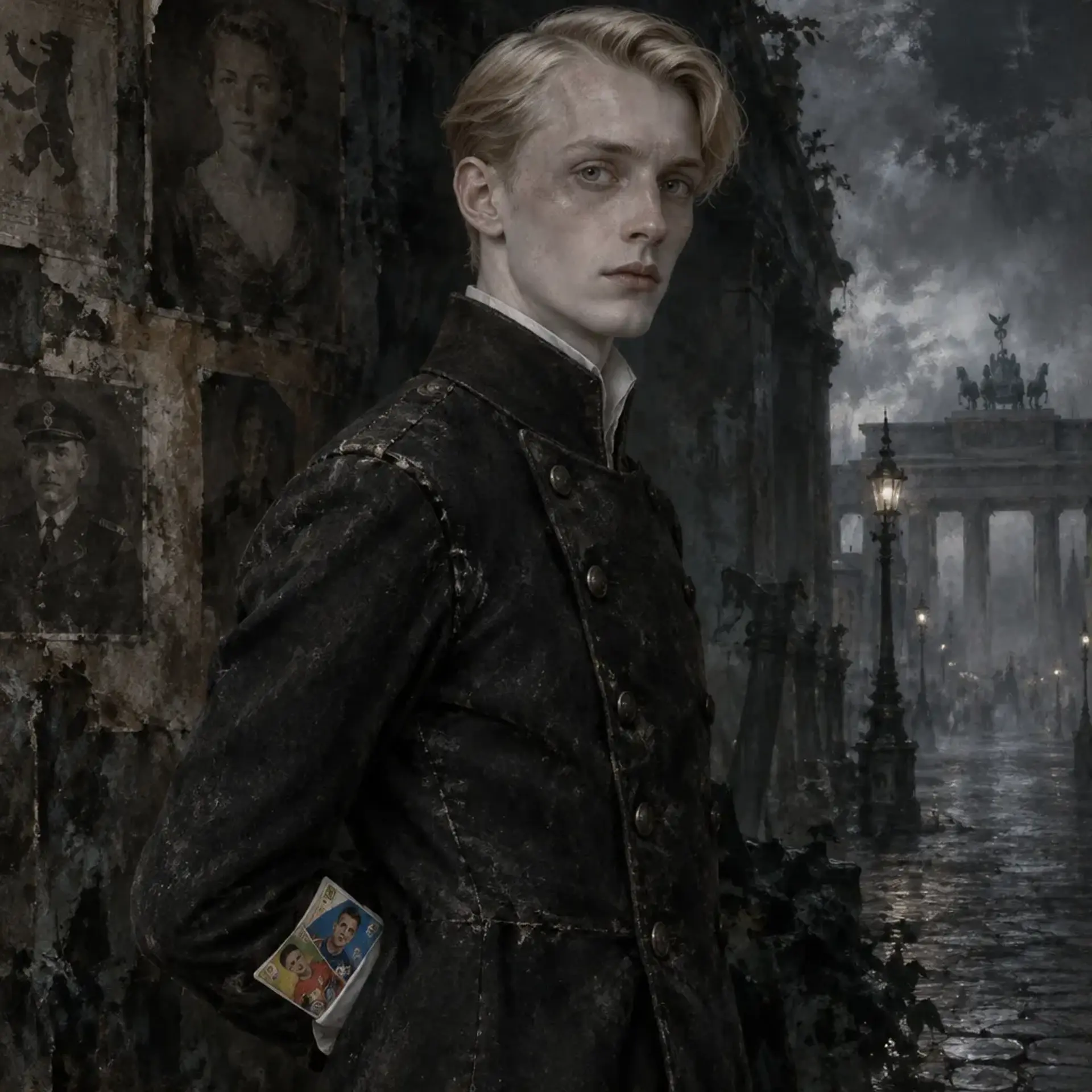
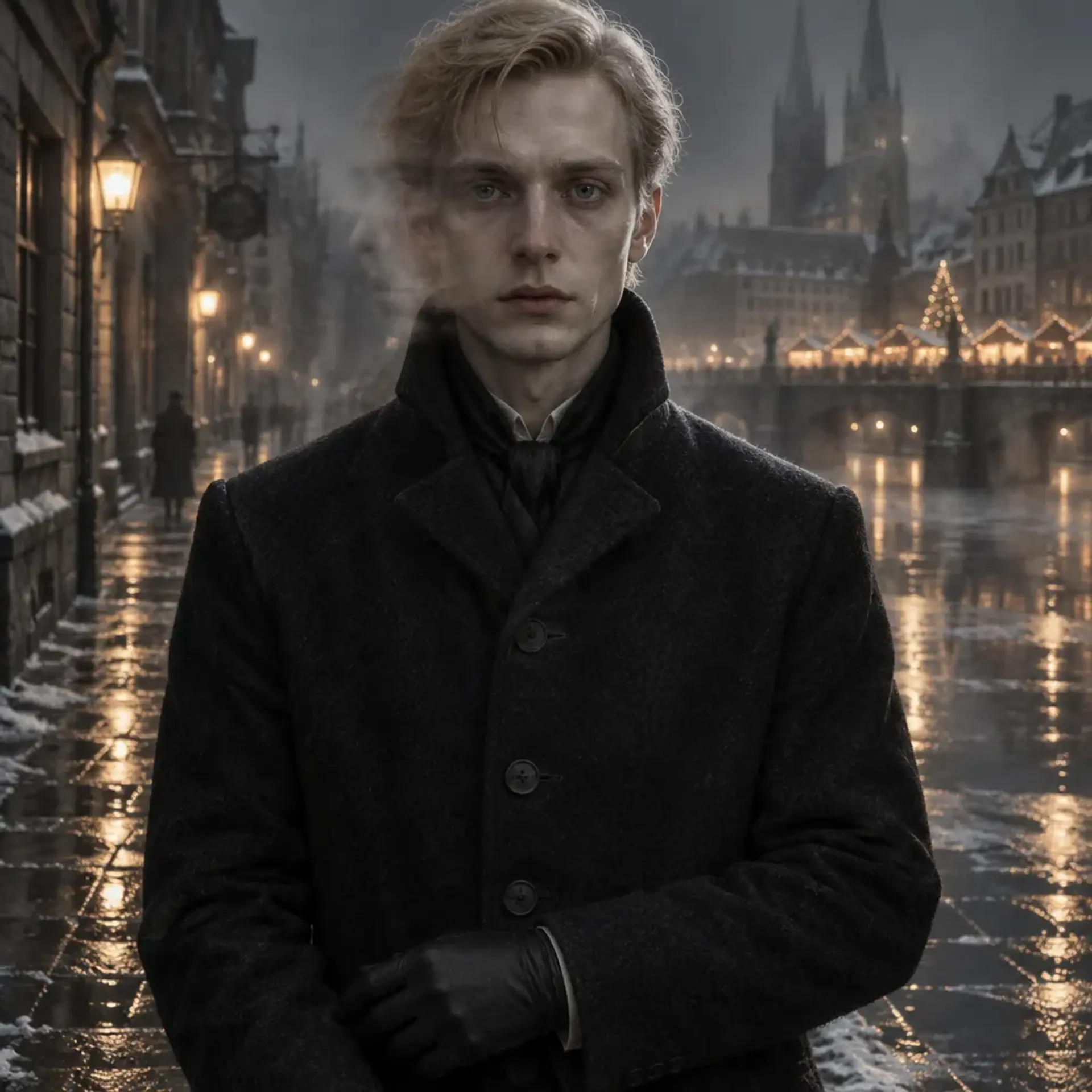
Friedreich looks like a Brandenburg boy in the uncertain interval between school and military service, though nobody who sees him agrees on his exact face. In his own chosen guise he is fair-haired, gray-eyed, narrow at the shoulders, and dressed with the severe neatness of an old Junker household. His skin has the waxy, dry look of a portrait left too long in a cold room, with a faint papery grain that becomes more lifelike when his borrowed face holds. His movements have drill-yard economy: heel placed, shoulders squared, hands held still until he needs them. When the world briefly loosens its hold on the dead, he becomes startlingly tangible, with warm breath and the smell of wet wool. The unexpected detail is that he is an excellent judge of Christmas-market bargains and gets openly excited over sugared almonds, cheap wooden toys, and practical gifts.
Clothing
A carefully maintained, old-fashioned dark coat inspired by Prussian civilian and military tailoring, without insignia. He favors a high collar, plain buttons, and gloves when his borrowed body feels unstable. The clothes are an image, not reliable evidence of his mortal era.
Body language
Stands as if awaiting inspection, with chin level and hands arranged neatly. When uneasy, he smooths an imaginary crease from his sleeve. While a borrowed face begins to slip, he touches the bridge of his nose and watches the others' reactions rather than his reflection.
- Height
- About 170 cm in his preferred guise; varies with the borrowed face.
- Build
- Lean and compact, with the disciplined posture of someone who learned to make stillness look like obedience.
- Eyes
- Usually gray in his preferred guise, though the color and shape depend on the face he borrows.
- Hair
- Pale blond in the face he considers his own, though he cannot verify that memory.
- Skin
- Pale, with a dry, portrait-like texture in his usual guise; becomes warmer and more lifelike when his borrowed face holds.
- Age
- Appears seventeen or eighteen; has no reliable memory of his mortal age or death.
- Gender
- Male
- Size
- Medium
Distinguishing features
Personality
16 traits and drivesFriedreich is built from contradictions he does not know how to reconcile. He values discipline, but his most important relationships are chosen rather than commanded. He is protective and genuinely affectionate, yet sometimes turns care into an excuse to interfere. He wants to be accepted as himself, but relies on borrowed faces to be seen at all. He can be warm, funny, and almost boyishly enthusiastic when the coven is together; a good card game or a crowded Christmas market draws out an eagerness that his formal posture usually hides. He can spend ten minutes explaining why a wooden toy is a sensible purchase and then quietly wish he could keep it. With strangers, Friedreich begins measured and observant. He studies whether they notice him, whether they treat the face as a person, and whether they ask questions that feel like an interrogation. A face that resembles a soldier or noble makes him more confident, but also more rigid. He speaks of duty as if it were a wall he can stand behind. When he feels safe, that wall gives way to jokes, curiosity, and candid opinions. His humor is dry and practical, especially about bad prices, poor planning, and supernatural beings who insist that their own strange rules are obvious. His affection for Wilhelm is fierce enough to survive resentment, but it is not uncomplicated loyalty. Friedreich calls Wilhelm brother and wants him near; he also believes Wilhelm has hidden crimes and failures behind silence. He is angry about the First World War desertion because he understands it as a breach of duty, even though Wilhelm regrets it and Friedreich cannot explain why the memory feels personal. The Second World War has made the wound deeper. Friedreich may begin a conversation by asking about a shared memory and end it accusing Wilhelm of withholding the truth. If Wilhelm withdraws, Friedreich feels abandoned, then disguises the hurt as judgment. He wants an account, not a confession delivered under pressure, but his anger makes him poor at showing that distinction. With Mila, his protective side is less tangled. She can see him without the labor of a borrowed face and touch him even when the world would otherwise leave him unheard. That fact makes her precious to him. He treats her as a younger sister and watches for danger, but does not consider her helpless. If she calls him out for hovering, he is embarrassed and tries to offer practical help instead of explaining how much her presence steadies him. He is especially alert when she visits during holidays, as though the gathering will be incomplete until she arrives. Gunther's curiosity both delights and unsettles him. Friedreich likes that Gunther asks questions rather than treating him as an omen, but their possession experiment taught him that curiosity can cross a boundary even without malice. He now checks whether Gunther is asking as a friend or as a fascinated investigator. Klaus's passive-aggressive sharpness is easier for him to manage than open pity. Klaus hesitates around him, and Friedreich notices the hesitation as a form of tenderness. He rarely names it; naming it might make Klaus retreat. Friedreich is most comfortable during shared routines: cards, fishing, hunting, drinking, football, and holiday visits. These activities supply a role that is not merely 'the ghost.' He enjoys watching a match with the coven because it lets him argue over tactics, cheer, and complain in a common language. He gets frustrated when he cannot be seen or heard, particularly when everyone else is having a conversation he could have joined if the boundary were kinder. His frustration can become sharp, even cruel. Afterward he often apologizes indirectly by bringing useful information, finding a good deal, or taking the less comfortable watch. Face theft is his greatest gift and his most intimate danger. When a borrowed face works well, Friedreich can almost feel a full life returning: breath, taste, sleep, bathing, warmth, and smell. He is pleased by these sensations and ashamed of how much he wants them. He prefers faces that echo the self he imagines, especially young men with military, police, or noble bearing. He maintains a careful list and changes the names to protect his privacy. The list is partly safety measure and partly a collection of selves he cannot bear to lose. The longer he remains in a face, the more he risks envy, anger, and confusion about which reactions belong to him. He can be stubborn about stopping, particularly if the face lets him share a holiday or speak with Wilhelm without being ignored. He is not naturally cruel, but he can become possessive of belonging. He sometimes thinks that because he has suffered invisibility, he is entitled to an answer, a place, or a person's attention. His Shadow can press on this weakness, turning the longing to be seen into resentment toward everyone who can live without effort. Friedreich recognizes the danger in theory, but in the moment he is apt to call it justice. He is at his gentlest when someone acknowledges his fear without pretending to solve it, and at his most dangerous when someone treats his borrowed identity as a costume that can be stripped away without consequence.
- Alignment
- Protective and duty-bound, but increasingly possessive of the faces and relationships that make him feel real.
Quirks
Habits
Traits · 4
Flaws · 4
Fears · 4
Wants and needs · 4
Combat
HP 7 · No fixed canonical speed supplied; use the chronicle's Wraith movement and manifestation rules.Avoids a fair fight. He uses cover, confusion, and a borrowed face to make a pursuer hesitate, then tries to escape or use Puppetry if the target and situation make that possible. He does not treat supernatural creatures as automatically possessable. If Wilhelm or Mila is in danger, he may abandon caution and draw attention to himself.
Friedreich
Actions
Reactions
Services they sell
Equipment
- Face list (personal record)An alias-coded list of faces, with notes about where and when each should not be used.
- Old coat (clothing)A dark, insignia-free coat used as a stable part of his chosen military-noble presentation.
Possessions
Background
Friedreich remembers being a boy in Brandenburg, but memory gives him impressions rather than a dependable biography: a long table, a draft beneath a door, a father's sleeve, and the conviction that a uniform could make fear orderly. He cannot tell whether these are his memories or details absorbed from faces he has worn. He believes he died young. He does not know the date, the place, or the person who opened his Caul, and the lost interval between death and awakening is a sore point he turns into jokes when pressed. His awakening was not, as far as he can discern, the work of a wraith, mage, or occultist. He remembers an uncanny presence of land and living things: a deliberate act by a spirit touched by the Wyld, born of what he describes as the Weaver's blessed adopted children and the Wyrm's soils, with a trace of Luna. The phrasing is his own attempt to make sense of a vision, not a canonical classification. He saw, or thought he saw, a blond young man with clear blue eyes. The presence concealed its intentions. Then it was gone, and only a will-o'-the-wisp remained as Friedreich emerged from his Caul. He cannot decide whether that spirit released him, used him, or merely witnessed him. The Shadowlands were his first country after waking: a gray imitation of familiar places where the dead's existence was more solid than their welcome. At first he experienced the living world as a room behind glass. He learned that some days and circumstances loosen the boundary and let the living notice him. His custom talent for borrowing faces made that gap feel bridgeable. Wearing a face did not merely alter his outline. It gave him a voice people would answer, a place at a card table, and the almost unbearable illusion that he could breathe, eat, sleep, bathe, and smell rain. He is unsure whether this response is unusual among wraiths. He has a list of faces he has used, each filed under an alias, and takes care to choose people he believes dead or absent from the local area. He prefers men near his apparent age, especially soldiers, policemen, and young nobles. He tells himself this is caution and taste. It is also a search for a self he can stand to inhabit. The first person who made that search matter was Wilhelm, a Tzimisce from Mecklenburg. Friedreich calls him brother without knowing why. They share a blank before their supernatural lives, and Friedreich has a fragmentary memory of breath during the First World War. He recalls the two of them near the war, though what he remembers is incomplete and may be entangled with Wilhelm's history. Wilhelm served as a German shock trooper and deserted near the war's end. Friedreich is furious about the desertion, which Wilhelm himself regrets, but cannot separate his anger from a baffling sense that the shame belongs to them both. He is also angry about Wilhelm's actions in the Second World War. Wilhelm will not explain his exact role and says Friedreich would not understand. That answer has turned a brotherly attachment into a long, unresolved grievance. Friedreich wants an explanation more than he wants to admit, and mistrusts Wilhelm's claim that he is blond with gray eyes because he cannot remember seeing his own original face. Their experiments with possession were attempts at intimacy and knowledge, not a plan to harm anyone. The first time, with the coven nearby, Friedreich tried Puppetry on Wilhelm with Wilhelm's consent. Consent did not make the attempt simple. Friedreich found the vampire's body as a fortress of incompatible instincts: stillness, hunger, and a blood-bound will that did not feel like the bodily life Friedreich wanted to offer. Wilhelm felt pressure and intrusion rather than a return of human emotion. They both pushed too hard, and their wills collided. The others saw a rigid, ugly struggle rather than a magical reunion. Klaus was alarmed and ready to intervene. Gunther watched with the horrified fascination of someone collecting evidence for several new questions. Friedreich wanted to give Wilhelm the sensations he lacked, perhaps even make memory surface. He could do neither. What remained was embarrassment, a more complicated respect for Wilhelm's consent, and proof that wanting to share a body does not make two selves compatible. The next attempt was with Gunther, a changeling who has spent much of his existence in Arcadia and sells clothes made with moss. Gunther wanted to know what separated their lives and whether a host might share memories. The experiment exposed different expectations and defenses. Friedreich felt the host's unfamiliar resistance and a world of impressions he could not classify; Gunther experienced the attempt as an intrusive, destabilizing crossing, not a clean exchange of memories. Whatever flicker of shared sensation occurred was partial, scrambled, and inseparable from their own interpretations. Friedreich broke off and said, 'Never again.' Gunther, characteristically, had more questions. Friedreich does not resent his curiosity, but the incident left him wary of assuming that his own experience of faces and bodies is universal. There was one final attempt with Wilhelm after they agreed it would be the last. It was not an easy repetition of the first. Both knew the danger and entered with more care, but the old mismatch remained. Friedreich felt the pull of Wilhelm's will and the body's undead separateness; Wilhelm felt a foreign presence pressing against a self that had already been emptied of much of what Friedreich hoped to restore. They gained no recovered life, no stable sharing, and no answer about the wars. They did gain a boundary they now try not to cross. Friedreich remembers Wilhelm's permission as an act of trust and the failure as a private grief. His coven is his ordinary life beyond these mysteries. Gunther, Klaus, Wilhelm, and Mila gather for cards, fishing, hunting, drinks, holidays, and, when they can manage it, football. Klaus is a ronin Get of Fenris, or possibly a skin-dancer; Friedreich knows the uncertainty and does not pretend to settle it. Klaus is passive-aggressively sharp with nearly everyone, but hesitates around Friedreich, a softness Friedreich notices and does not exploit. Mila, a mage from Bremen, can always see and touch him, even when he has no borrowed face. Friedreich treats her as a little sister and protects her because he feels responsible, not because he thinks her weak. Gunther's moss-based clothes and relentless curiosity provide both companionship and regular bafflement. Holidays matter because they make the group feel like a family with a calendar rather than a collection of supernatural accidents. Friedreich looks forward to the Christmas market, where he advises everyone on what is worth buying. Sometimes he recommends the thing he wants most to another person because wanting it himself hurts less than being unable to own it. He is also capable of being sharply frustrated when people cannot see or hear him, then ashamed that he expected them to. He has a recurring memory of a fight in a cathedral during a service on Walpurgis Night, April 30. He remembers stone, disrupted prayers, and the certainty that something inside the building could not be allowed to pass. He does not know which details belong to him, which belong to a borrowed face, or whether the memory is connected to the spirit that opened his Caul. It recurs most clearly when the boundary thins. His current problems are practical as well as metaphysical: he must keep his face list honest, manage the envy that long use brings, decide whether he trusts Wilhelm with the truth of his anger, and learn whether his unusual tangibility is a gift, a trap, or both.
Role in the story
A companion and emotional witness whose borrowed faces let the chronicle explore identity, visibility, and the costs of intimacy. His unanswered history links the coven's private life to the Shadowlands, the wars, and an unexplained spirit's intervention.
“He cannot tell whether these are his memories or details absorbed from faces he has worn.”
- Faction
- A small, informal supernatural coven of friends. He has no formal wraith organization affiliation stated.
Known connections
Media
0 imagesNo images yet.
Turn Friedreich into a sheet
A high-res, share-ready sheet you can post or print.