Friedreich
Friedreich
At the table
Voice
A dry, forward voice with crisp consonants and the faint grain of a recording played through a damp speaker. It has the controlled projection of someone accustomed to calling instructions across a yard, though the sound can blur at the edges when the Shroud thickens. His borrowed voices are persuasive, but under strain his own rigid cadence returns.
His speech sounds like a young man trying to keep old lessons intact: carefully articulated German, clipped consonants, and a faint Brandenburg character that surfaces more strongly when he is irritated or relaxed. His voice seems to arrive a fraction late when he is barely manifested, as if sound has to cross the Shroud after his words. When using a borrowed face, he studies the dead person's remembered rhythm, but his own formal phrasing leaks through. At football matches he speaks faster and raises his voice without becoming hushed or ceremonious when angry.
Speech patterns
How to play them
Meet him with direct acknowledgment, even if he is difficult to see. Ask before touching or attempting supernatural contact. Do not treat his borrowed face as proof that he has become the person depicted. He responds best to patience, shared routine, and honest questions that do not demand an immediate confession.
Goal
Find evidence of his living identity and learn why the land spirit opened his Caul, without sacrificing the self he has assembled among the coven.
Motivation
To be recognized without a borrowed face, remain a brother to Wilhelm without excusing him, and protect the fragile domestic life the coven has built.
Appearance
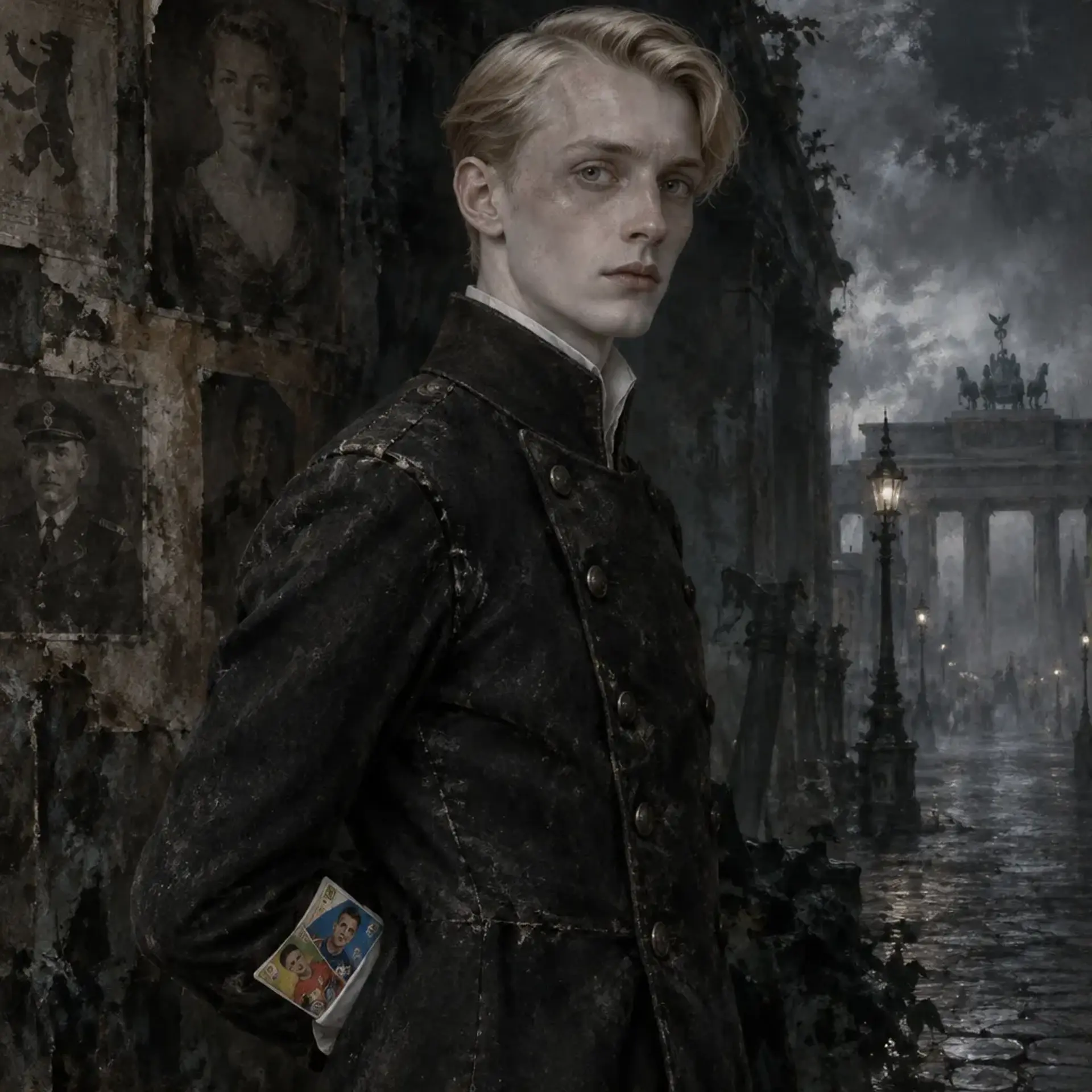
When the Shroud thins, Friedreich looks like a narrow-shouldered young man made from the memory of a Prussian cadet portrait: a high collar, long face, watchful grey eyes, and pale blond hair combed into a severe side part. He seems seventeen until he stands beside someone, when his posture makes him feel older. He occupies space like a sentry: feet set evenly, hands behind his back, chin level, and an invisible boundary around him that people instinctively avoid crossing. He does not seem to notice how much room he claims. In motion, he turns his whole body toward whoever speaks, with the measured pivot of a parade-ground drill. His edges sometimes look like wet ink on old paper. The unexpected detail is his fondness for tiny, brightly colored paper football stickers, which he smooths carefully onto the inside of his borrowed coat cuffs.
Clothing
A dark, old-fashioned military-style coat without insignia, carefully brushed and mended, over a high-collared shirt. When he can manage it, he borrows a more modern jacket to avoid looking like a portrait that wandered away from its frame.
Body language
He waits with his weight balanced over both feet, hands clasped behind his back, taking more room than his slight build seems to warrant. He turns toward a speaker with a precise, whole-body pivot. When embarrassed, he adjusts his cuffs and checks that no one has noticed the football stickers.
- Height
- About 170 cm when clearly embodied, though his apparent height and solidity vary with the Shroud and the face he wears.
- Build
- Lean and narrow-shouldered, with the squared stance of someone trained to stand for inspection.
- Eyes
- Usually appears grey in his preferred faces; his own original eye color is uncertain.
- Hair
- Usually borrowed as pale blond; the original color is uncertain.
- Skin
- Usually a pale, slightly translucent grey when perceptible; the apparent complexion changes with the face he wears.
- Age
- Appears seventeen or eighteen, though his remembered age and the date of his death remain uncertain.
- Gender
- Male
- Size
- Medium
Distinguishing features
Personality
18 traits and drivesFriedreich is both an orderly young man and someone whose identity is anything but orderly. He values duty, ceremony, and clear distinctions between honorable and dishonorable conduct, yet his own memories are too fragmented to let him apply those standards consistently to himself. He will correct someone's posture or explain why a military decision was shameful, then lose the thread when asked what he personally did. He wants people to take him seriously, but the more effort he makes to appear, the more he fears that they are responding only to a face. With friends, he is attentive and quietly generous. He remembers who likes which drink, watches for Mila's arrival, and ensures Wilhelm has a place at the table even when the two are angry. He is protective without thinking of himself as tender. If Mila is in danger, he moves between her and the threat before he has decided whether she needs rescuing. With Gunther, he is curious and a little exasperated by questions that treat wraithhood as a puzzle. With Klaus, he accepts the roughness longer than he should because he detects hesitation under the insults and takes it as a bond worth protecting. His affection for Wilhelm is complicated by moral anger. Friedreich considers Wilhelm's First World War desertion dishonorable, even while he knows fear and exhaustion may have shaped it. Wilhelm's refusal to speak about the Second World War makes Friedreich furious. Sometimes he condemns Wilhelm as if prosecuting a stranger; then, when Wilhelm withdraws, Friedreich becomes protective and tries to keep the coven from pressing him. The contradiction is not a trick. Friedreich wants the truth and wants Wilhelm safe from the truth's consequences. He also suspects that the two men's missing memories may be entangled, which makes every accusation feel dangerously personal. When unseen or unheard, he can be proud and brittle. He may repeat a remark, change faces, or move into someone's line of sight with stiff insistence. He dislikes being pitied more than being ignored, though he may not admit the difference. When the Shroud thins and he can feel the world clearly, he becomes almost giddy: he enjoys bathing, food smells, the warmth of a drink, and the simple physical fact of sleeping. The joy often has a thread of grief running through it. He wonders whether he could give those sensations to Wilhelm, and feels guilty that the thought is partly about making Wilhelm understand him. At Christmas he is warmer and less guarded. He studies stalls, bargains, and prices, happy to advise the others even when he cannot own anything himself. He is capable of recommending an item because he wants it, then pretending the recommendation was entirely practical. At football matches, he lets the match interrupt his formal reserve. He argues with the referee, leans forward as if his posture might affect the play, and celebrates too quickly when his side scores. Afterwards he returns to the appearance of a composed young gentleman. Friedreich's central struggle is the difference between being seen and being known. Borrowing a face makes him present to others, but prolonged use makes him jealous of the person whose features he wears and uncertain what remains underneath. He has become particular about the faces he chooses: men near his apparent age, soldiers, policemen, and nobles who evoke the ideals he was taught to admire. He tells himself these are practical choices. They are also a collection of answers to a question he cannot remember asking: what kind of person should I be? He can be brave, vain, affectionate, resentful, and embarrassed all within one conversation. He is not trying to deceive his friends about every feeling; he is trying to decide which feelings are truly his.
- Alignment
- Protective and loyal, but capable of bitter judgment; not readily described by a simple moral category.
Quirks
Habits
Traits · 5
Flaws · 4
Fears · 4
Wants and needs · 5
Combat
HP 7 · Use the movement and manifestation rules of the chronicle; no D&D speed statistic applies.Friedreich avoids a fair fight. He uses borrowed appearances, poor visibility, and distraction to escape or protect a friend. He is more comfortable observing and positioning than trading blows. His actions should use Wraith rules and the Storyteller's chosen Arcanoi rules; Borrowed Face is explicitly a custom expression, not a canonical power write-up.
Friedreich
Actions
Reactions
Services they sell
Rewards they can give
Equipment
- Unbadged coat (clothing)An old-fashioned coat worn for the comfort of its military silhouette, not as proof of service.
- Face list (personal record)A folded list of favored borrowed faces, with names changed and notes about whether each person is dead or locally absent.
- Football stickers (keepsake)Small football stickers kept for match days and hidden from anyone likely to call them childish.
Possessions
Background
Friedreich says he was born in Brandenburg, and trusts the claim mostly because it is the one that keeps returning. He has no dependable memory of his family, his exact town, or the day he died. He recalls fragments instead: a polished boot being brushed, the smell of damp wool, a room where adults lowered their voices, and the conviction that a young man should stand straight even when afraid. He estimates he was seventeen or eighteen at death. He suspects his living face was blond-haired and grey-eyed because Wilhelm has said so, but Wilhelm's knowledge of the past is compromised, and Friedreich refuses to treat the answer as proof. His Caul was not opened by a wraith, mage, or occult scholar. A spirit of the land did it deliberately. Friedreich remembers the act as a pressure in the dark, like roots working under a floor, followed by a voice that gave no name and offered no explanation. The spirit concealed its intentions. It may have wanted him loose in the Shadowlands, may have been trying to protect him, or may have regarded him as a useful consequence rather than a person. Friedreich does not know. The first thing he remembers after release is the Shadowlands pressing close: the dead's country, familiar and terrible, with the Shroud separating him from the breathing world. He learned that being dead did not make him visible, and that being unseen was not the same as being absent. The first time Friedreich stole a face was not a carefully planned disguise. He reached for the image of a dead young man whose features lingered in his memory and discovered he could wear them. The sensation was intimate and disturbing: a remembered brow settling over his own, a mouth acquiring another person's small habits, and the world responding as if it had found a reason to look at him. With practice, his talent became startlingly complete. In certain conditions he can feel warmth, smell food, sleep, wash, and speak with a convincing physical presence. He has no certainty whether this is unusually potent Moliate, a peculiar relationship with the Shroud, or something the land spirit left behind. He can become frustrated when people cannot see or hear him, particularly when he has made the effort to appear. He first met Wilhelm amid the long upheavals of the world wars. Friedreich does not claim to have accompanied Wilhelm every day; he was often unable to cross the distance between the Shadowlands and the living world, or to remain perceptible. He remembers scraps of the First World War, including one vivid and inexplicable recollection of taking a breath. Whether it was a living memory, a borrowed sensation, or a false recollection, it has never left him. He recalls Wilhelm as a brother before he can explain why. That affection survived Wilhelm's desertion near the end of the First World War, which Friedreich considers dishonorable, and Wilhelm's undisclosed actions during the Second World War, which make him angry in a way he cannot untangle from his own history. Wilhelm will not explain. Friedreich sometimes tells himself the crimes must belong to him too, because the two of them feel bound together; at other times he is furious that Wilhelm gets to decide what remains unspoken. The coven is the closest thing Friedreich has to a household. It is an informal gathering of supernatural misfits, not a formal Wraith faction. Wilhelm, the strange Tzimisce from Mecklenburg, is his brother in everything but memory. Gunther, a changeling who spent so much time in Arcadia that ordinary life still surprises him, sells clothes made from moss. Klaus is a ronin Get of Fenris, perhaps a skin-dancer, and is passive-aggressively cruel to most people. With Friedreich he hesitates, as though an insult has caught in his throat. Mila, a mage from Bremen, is kind to Friedreich and can see and touch him even when he has no borrowed face. He thinks of her as a little sister and protects her from duty, not because he considers her weak. They meet to play cards, hunt, fish, drink, and watch football. Holidays matter especially. When the coven gathers at Christmas, Friedreich is excited by the market and becomes an unasked-for adviser on prices, quality, and bargains. Sometimes he recommends the item he wants but cannot own. He keeps a private list of faces he likes to borrow, favoring men around his remembered age, especially soldiers, police, and nobles whose bearing resembles his ideal of himself. He changes names on the list and checks that the people are dead or absent locally. He wonders whether his talent could earn him a job, then worries that work would turn the faces into masks he could no longer remove. The coven's experiments with possession began as curiosity, not a scheme. Friedreich and Wilhelm agreed to let Friedreich try to possess him while the others were present. The attempt was messy and comic in the way a bad experiment among friends can be. Friedreich pressed into Wilhelm's body expecting to lend him feeling or recover a memory. Instead, the boundary between them became a tug-of-war. Wilhelm's dead flesh had no ordinary living sensations to offer, while Friedreich's will and old habits pushed against Wilhelm's own presence. For a moment Friedreich felt the remembered weight of Wilhelm's posture from inside, and Wilhelm experienced an unwanted rush of alien impressions: the ache of a breath that might never have been his, the urge to stand at attention, and an intense wish to make everyone in the room understand that he was present. They forced the attempt longer than either should have. Klaus became alarmed and demanded they stop. Gunther, rather than being reassured, asked increasingly technical questions about what had touched whom. They stopped with no recovered memories and an awkward silence. Friedreich apologized. Wilhelm did not say whether the experience frightened him. Friedreich later tried with Gunther, who was curious about how a wraith's existence differed from a changeling's and whether they might share memories. The possession was worse. Friedreich found Gunther's inner life crowded with strange, vivid associations that did not behave like human memory. Gunther felt the intrusion as a cold, hard outline trying to fit itself into a body and a mind that already had their own rules. Images and emotions crossed, but not as a clean exchange: Friedreich received a rush of impossible color and the sense of a path bending away from reality; Gunther caught a brief, homesick echo of parade-ground order and dead silence. Neither could tell which impressions were authentic, which were distorted, or which belonged to the other. Gunther panicked, Friedreich recoiled, and both agreed never again. Gunther had more questions afterward, not fewer. Friedreich and Wilhelm later made one final agreement to try possession. The second attempt was shorter and more deliberate. It did not restore Wilhelm's memories or make him feel alive. Friedreich sensed, instead, how much Wilhelm's silence was a defense, while Wilhelm briefly felt the force of Friedreich's loyalty and anger as separate things rather than one confused demand. They ended the attempt by mutual choice. It changed their relationship only in that both understood there were doors between them that affection could not safely force open. Friedreich still wants to help Wilhelm feel what he cannot feel, but now asks before trying. He has one recurring memory of a fight in a cathedral during Walpurgis Night, April 30. He remembers hard stone, a service interrupted, and the sense that something in the building recognized him. He cannot say who fought, what stood against them, or whether Wilhelm was there. The memory is a wound in his chronology rather than a usable story. His current problems are more ordinary and therefore harder: the coven's safety, his anger at Wilhelm, the land spirit's unexplained intervention, and the fear that borrowing faces for too long will leave him unable to find his own. He wants a name for the boy he was, but is not sure he would recognize it if someone gave it to him.
Role in the story
A companion, witness, and moral complication whose missing past links the coven's intimate everyday life to the Shadowlands, the world wars, and an unexplained spirit's intervention.
“He has no dependable memory of his family, his exact town, or the day he died.”
- Faction
- An informal supernatural coven of friends. No formal wraith faction is established.
Known connections
Media
0 imagesNo images yet.
Turn Friedreich into a sheet
A high-res, share-ready sheet you can post or print.