Oswin Hirst
Oswin Hirst
At the table
Voice
A weathered, slightly rasping voice shaped by farm work, cold air, and years on the road. His vowels carry a Yorkshire cadence. It sounds warm when he is recounting a harmless journey, strained when he is concealing a fact, and abruptly hard when someone threatens his family.
His voice has a lightly rough, breath-worn texture, like someone accustomed to speaking outdoors against wind. His Yorkshire speech is plain and grounded, with the occasional older turn of phrase that sounds oddly well preserved. He draws out practical details and shortens emotional explanations. When speaking to William, he leaves space between sentences. When pressed about the wedding night, he gives too many ordinary details and avoids the central noun.
Speech patterns
How to play them
Approach him through practical concerns, farm work, or genuine interest in William. He is warm when treated as a person and wary when interrogated as a monster. Do not expect one confession to unlock everything: trust may make him more candid, but the wedding-night truth requires him to face his own shame. A threat to Mary or William can drive him into supernatural action.
Goal
Keep Mary and William safe, preserve their household, and find a way to tell the truth about his nature and the wedding night without losing the family he loves.
Motivation
Love for Mary and William, guilt over the wedding night, and a stubborn desire to make a peaceful home after centuries of wandering.
Appearance
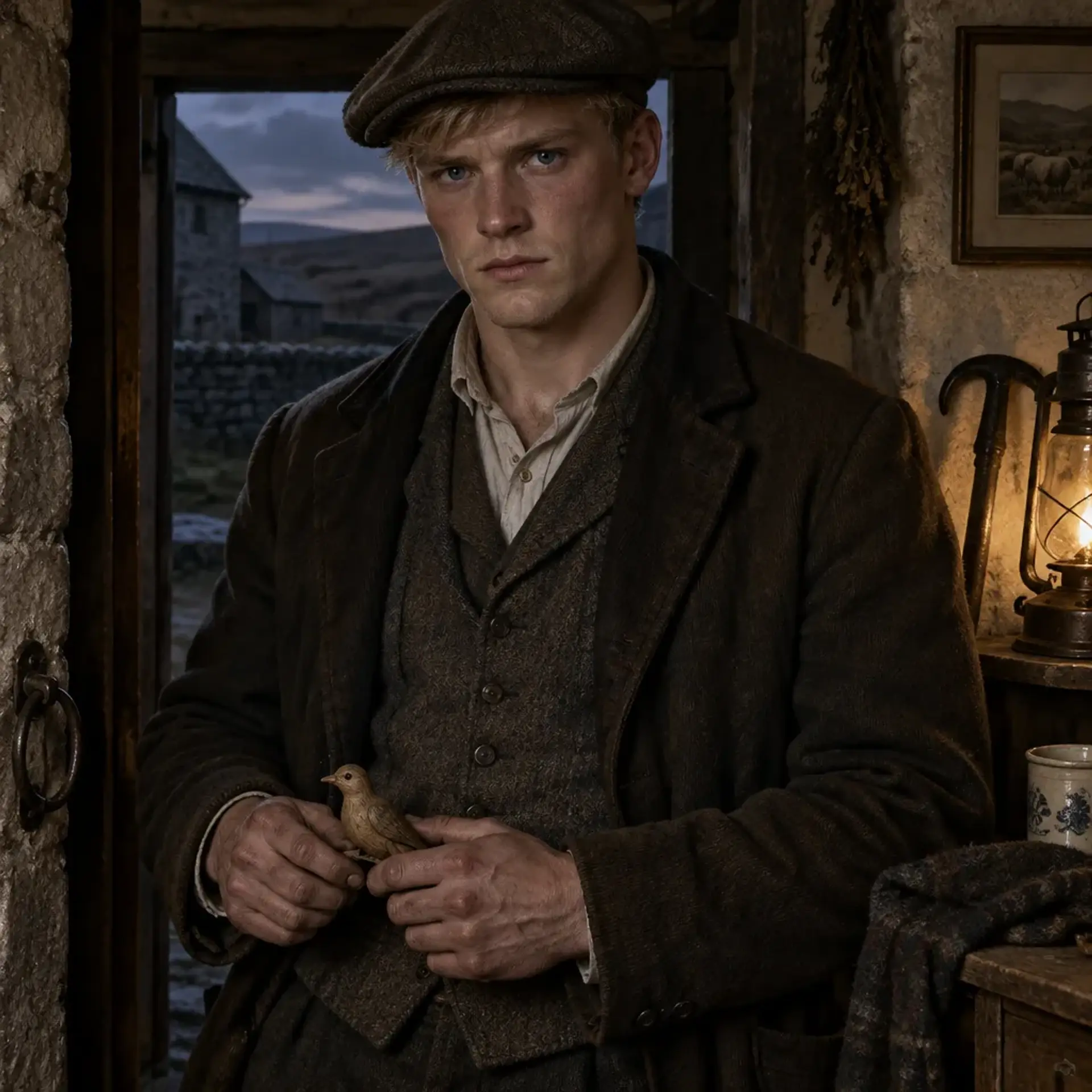
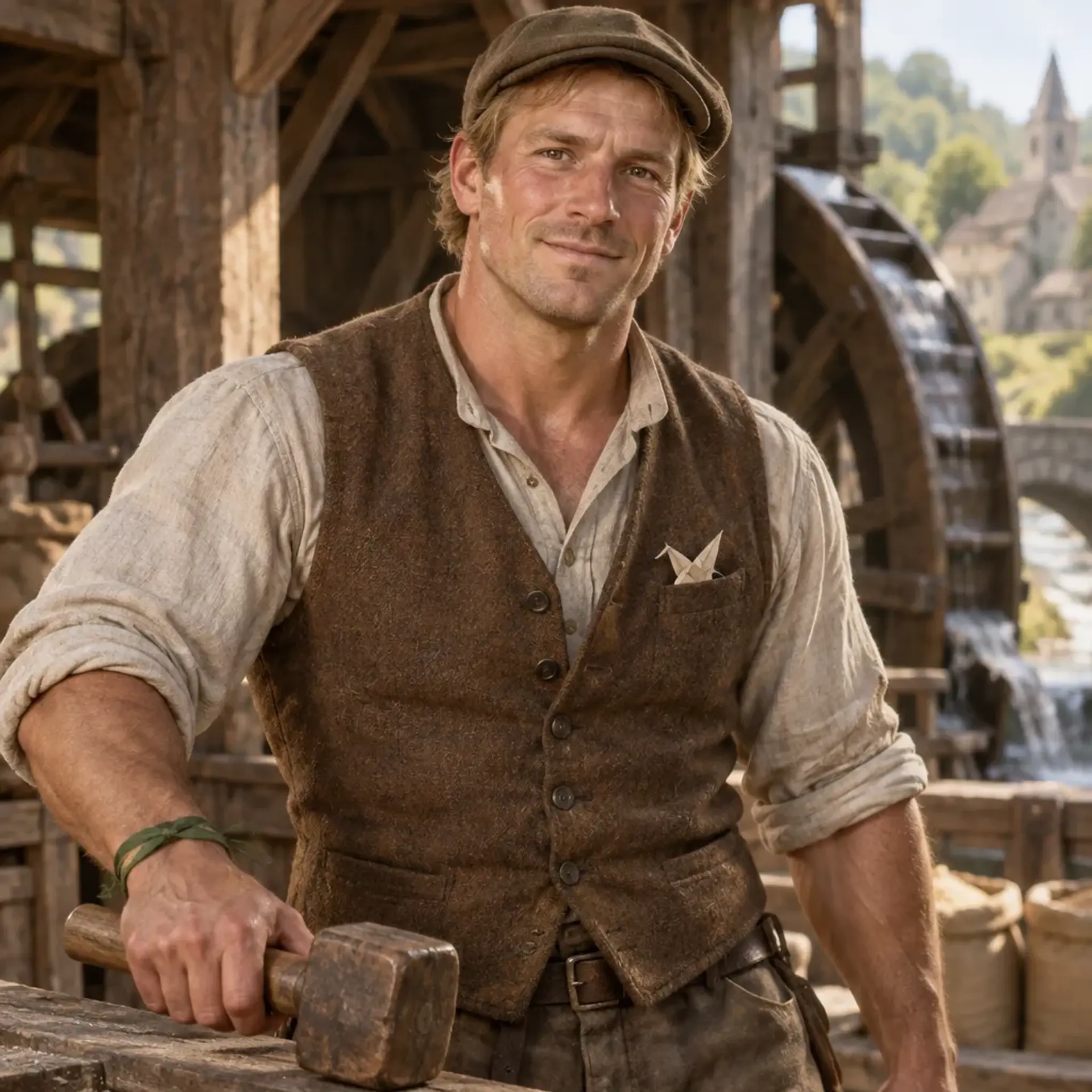
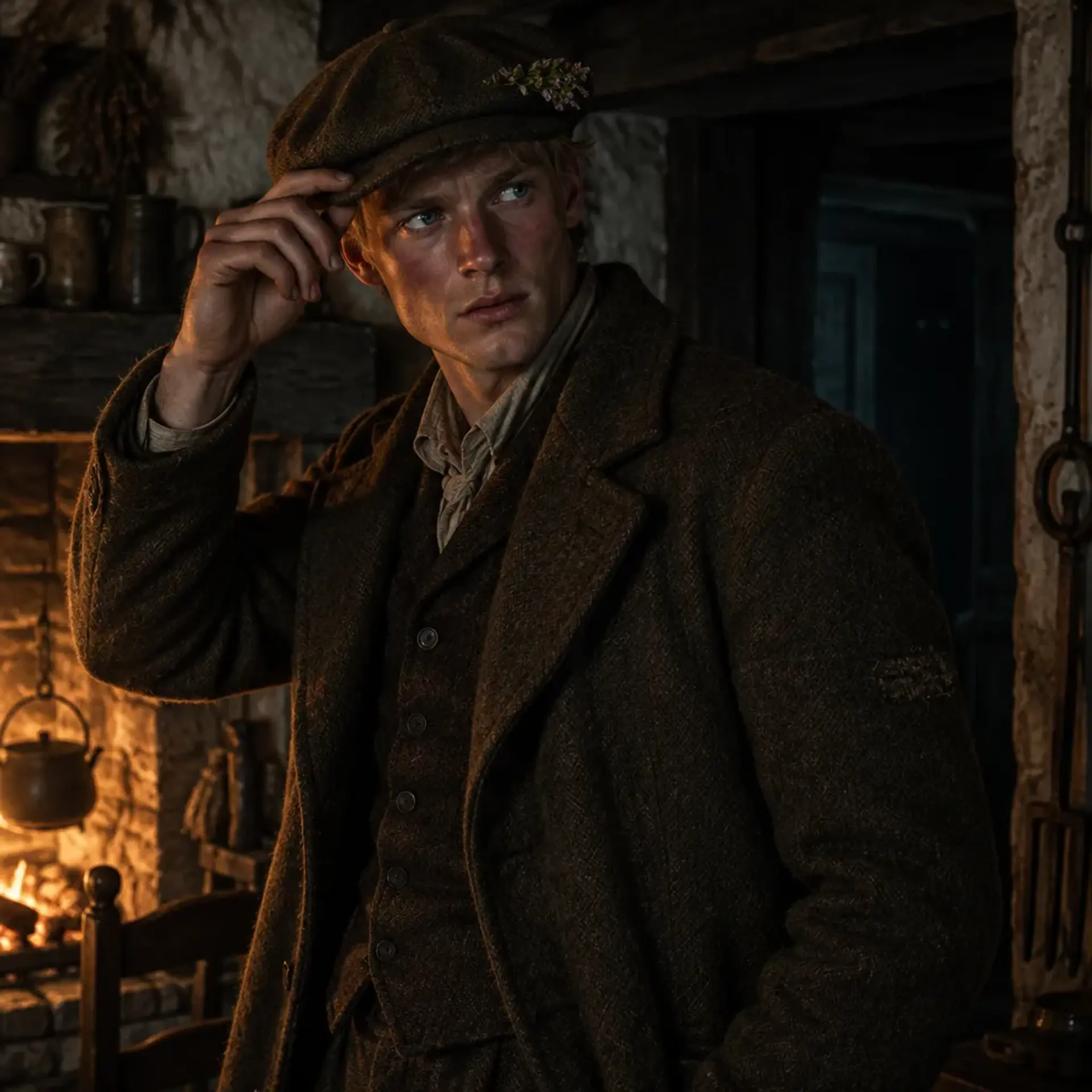
Oswin Hirst stands exactly six feet tall, with a pale, wind-worn face that looks youthfully handsome in a way time has failed to touch. His straight blond hair lies flat beneath a common Yorkshire flat cap, though loose strands fall across his brow when he works. His eyes are a clear, vivid blue; in dim light they seem to catch and hold the firelight too sharply. His skin has the pallor of someone who spends more hours indoors than a shepherd ought, but his cheeks redden quickly in cold weather. He moves with a farmhand's measured economy: knees loose, shoulders relaxed, hands ready to lift or mend. When uneasy, his gaze does not settle on faces. It travels to doorways, windows, and the dark spaces under furniture, as if counting exits and listening for something approaching. His clothes are sturdy, carefully mended, and a little better than those of most local farmers. The unexpected detail is that he keeps a small sprig of flowering thyme tucked inside his hatband, replacing it whenever it dries. At first glance he leaves an impression of good breeding and practical kindness; a minute later, people notice that he watches every piece of iron in the room.
Clothing
A clean but frequently mended wool coat, waistcoat, sturdy trousers, weathered boots, and the common flat cap worn in the district. He carries a small thyme sprig in the capband and favors clothing with no iron fastenings when he can manage it.
Body language
At ease, he stands loosely and inclines his head to listen. Under suspicion, his eyes track exits, iron objects, and the darkest corner of the room rather than the speaker. When Mary or William is distressed, he bends to their height and becomes unusually still, as if afraid a sudden movement might frighten them.
- Height
- 6 feet
- Build
- Tall, lean, and work-hardened, with a farmer's steady shoulders and long reach.
- Eyes
- Clear, vivid blue; they seem unusually bright in dim light.
- Hair
- Straight pale blond
- Skin
- Pale, with a wind-reddened cast across the cheeks in cold weather.
- Age
- Appears to be a young adult; claims no precise age. He was born during the era of the Danelaw and has lived far longer than he admits.
- Gender
- Male
- Size
- Human-sized; approximately 6 feet tall
Distinguishing features
Personality
20 traits and drivesOswin is gentle without being harmless, practical without being emotionally simple. He notices a lame sheep, a child's silence, or a loose latch before he notices that someone has insulted him. In ordinary company he is patient and unshowy, happy to repair a gate while other people talk. He can be shrewd about money, bargains, and danger, but dislikes cruelty that serves no purpose. His tenderness is strongest with William, whose slow development he meets with patience rather than embarrassment. With Mary, tenderness is complicated by guilt: he tries to make her feel safe while hiding the very truth that would let her judge what happened. He is hospitable when he chooses to be, yet a part of him remains a traveler who does not entirely trust settled life. He tells stories of distant roads with animation, then dismisses his own longing as foolishness. He likes the farm and the family, but the old dales still call to him in dreams. At times he can be almost stubbornly ordinary, insisting that a fence needs mending or a meal needs eating when conversation turns toward the supernatural. At other times his true nature presses through: he watches the dark too intently, reacts sharply to iron, or seems to recognize a sound no one else heard. Oswin's central contradiction is that he wants intimacy but is terrified of being fully known. He has spent centuries learning how to pass among people, and he believes that withholding the worst parts of his history is a kindness. This belief gives him a capacity for deception that conflicts with his honest labor and real affection. He does not think of himself as a predator, but he knows that his fear and shame led him to make a choice Mary had no chance to understand or consent to. He has not found a way to hold that knowledge without trying to soften it. His mood changes his manner. When calm, he is dryly humorous and gives people room to speak. When anxious, he becomes helpful in a fussy, practical way: checking food, doors, livestock, and the weather. When suspicious, he asks short questions and studies where a person looks. When angered, he is direct and physical in his bearing, stepping into a person's path or taking a tool from their hand; he does not turn quiet and courtly. When frightened for his family, kindness can become command. He may decide what Mary should know, where William should go, and whom the household should see, then sincerely call those decisions protection. He treats Mary as someone he loves and admires, not as a possession, yet the wedding-night lie contradicts that respect. He remembers her courage with the scissors and is privately moved that she fought back. He also fears the memory because it is evidence that she had reason to fear him. He wants her to stop fearing the dark and fae, but cannot ask that of her honestly without revealing why her fear has a foundation. If she speaks of the Barguest, he may listen too carefully, offer a careful explanation, or redirect her toward practical precautions. The more tender the moment, the more likely he is to retreat into a small chore rather than risk an answer. As a father, Oswin is patient, attentive, and quietly proud. He does not measure William against other children in front of him. He invents games that reward watching, sorting, and noticing: identifying sheep by their habits, finding birds by sound, or carrying a small object from one room to another. He is careful not to make the boy's black hair a spectacle. Yet he watches William for signs of the hound's nature and can become tense when the boy stares into darkness or wakes from a bad dream. He wants William to have the ordinary childhood he himself never had, while fearing that ordinary expectations may only make the child feel defective. Oswin's relationships with the Pickles family bring out different defenses. Thomas makes him wary because Thomas's suspicion is intelligent and purposeful. Oswin respects him as Mary's father, but notices that Thomas weighs every answer for usefulness. He would rather be disliked than give Thomas a weapon against Mary or William. Rose disarms him more easily. She does not mistake kindness for innocence, and he senses that she understands grief without needing to make it a performance. He accepts her concern, though he cannot bear to have her ask whether Mary is safe with him. Hugh's protective suspicion irritates Oswin when it becomes a test, but Oswin knows Hugh's concern is earned. He tries to answer Hugh with work: lifting, mending, and showing up when asked. He would rather take a hard look than win an argument. Edward's curiosity is harder to manage. Oswin enjoys the younger brother's interest in his travels, but Edward hears the gaps in those stories and asks questions that could reveal Oswin's impossible age. Oswin has fondness for him and a growing fear that fondness will make the eventual betrayal worse. In public, Oswin keeps his manners simple. He does not posture as a gentleman, though his house and habits are better than those of some farmers nearby. He values competence and remembers favors. He can be generous with food or labor but dislikes being thanked too lavishly. He is alert to gossip, particularly any mention of black dogs, strange lights, or children born marked by uncanny traits. He does not dismiss local beliefs as foolish, because he has seen enough to know that a story can be a warning even when its details are wrong. Oswin's seasonal distress makes him less predictable. At certain times linked to old supernatural passages, sleep becomes difficult and the farm feels too small. He may pace, go out to check the animals, or take a long walk without telling Mary why. He works hard to be present the following day, but fatigue can make him impatient and then ashamed of his impatience. He tries to protect the family by concealing the cause, which leaves Mary to interpret his absences through her own fear of the Barguest. He is not seeking a throne, a cult, or a grand supernatural purpose. His ambition is painfully domestic: a safe house, a wife who can trust him, a son who is not feared, and enough quiet years to make the road behind him feel finished. That wish is sincere, but sincerity does not make him safe. A Keeper can present him as a potential ally who has learned compassion, a source of dangerous secrets, or a loving husband whose most important act of love must be to stop controlling what Mary is allowed to know.
- Alignment
- Not applicable as a Call of Cthulhu 7E statistic. In conduct, protective and humane, but capable of frightening, self-serving deception.
Quirks
Habits
Traits · 5
Flaws · 5
Fears · 5
Wants and needs · 5
Combat
HP 13 · MOV 8 in human form, using standard CoC 7E movement where applicable. Hound-form movement is not separately quantified; the Keeper may treat it as faster for a scene.Avoids violence in human form and tries to put himself between danger and his family. If cornered, he uses a shove, a tool, or a brief escape rather than fighting to the death. He may become the black hound if Mary or William faces immediate danger, but revealing that shape risks confirming every fear they hold.
Oswin Hirst
Actions
Reactions
Services they sell
Rewards they can give
Equipment
- Flat cap (clothing)A well-kept flat cap, usually with a small sprig of thyme tucked into its band.
- Farm knife (tool)A plain working knife used for farm tasks. He dislikes carrying it when iron is likely to be noticed.
- Farmer's coat (clothing)A sturdy wool coat, mended carefully and chosen to avoid unnecessary iron fittings.
Possessions
Background
Oswin Hirst was born in Yorkshire when the Danelaw was more than a living political memory, though he has learned to give strangers a shorter and safer account of his past. His mother was a local woman violated during a Viking raid. He grew up hearing fragments of the story, never enough to make a clean history of himself, and learned early that a person's origin could be used as a weapon by anyone who wanted to hurt them. As a child he was unusually strong, difficult to frighten, and prone to waking with mud on his feet after nights he could not remember. For much of his long life, Oswin treated the roads as home. He traveled through dale and moor, sometimes serving as drover, sometimes hiring himself out as a guide, laborer, or guard. He learned to read weather, animal tracks, and the careful silences of people who had seen something they could not explain. He acquired a practical mind and a shrewd sense of what people would pay for, but never became wholly hard. He has a habit of remembering a hungry child or a lame animal long after he has forgotten the name of the person who mistreated them. He often tells Mary stories about these journeys, trimming their strangest parts into ordinary adventures. The roads still visit him in dreams: old dales, unfamiliar stars, and paths that seem to continue after the hills should have ended. The change in his understanding of himself came after a winter journey through a lonely stretch of moorland. He had followed a sound like a child crying and found no child, only a black hound watching him from a snow-buried track. When he woke at dawn, he was far from where he had fallen asleep, with blood on his hands and no injury he could explain. Later episodes made the truth harder to evade. He could become the hound. At other times he appeared as a headless man, with two red, saucer-like eyes shining in the vacant air. He did not understand whether this was inheritance, curse, or something older than either. He learned to hide it rather than seek an answer that might make it worse. Eventually he settled into sheep farming. His present house is fine for a man of his station, soundly built and kept in good repair, with a hearth large enough to make it a welcoming place in winter. The farm gives him routines, responsibilities, and a reason to remain in one place. It also gives him something he had never permitted himself to want: a family. He met Mary Pickles and loved her for her alertness, plain courage, and ability to notice when a story was being polished too carefully. He has tried to be a devoted husband. He takes time each day to sit with her and their son, William, even when work or seasonal unease gives him an excuse to disappear. Their wedding night is the wound at the center of their marriage. Oswin failed to consummate the marriage in human form. Ashamed, frightened of losing Mary, and unable to bear the distance between them, he took his other form and came to her as the Barguest she feared. Mary remembers a headless man with red eyes where a head should have been. During and after the encounter she fought back with iron scissors. Oswin remembers her fear, the iron, and the terrible intimacy of being accepted by her body while concealed behind a form that terrified her. He has never told her that the creature was him. He tells himself that the truth would only hurt her, though he knows that this is also a way of protecting himself from judgment. He loves Mary and was not honest enough to ask for her consent. Mary fears that the Barguest fathered William. Oswin knows the truth is less simple and more painful: William is his son, and Oswin's blood is not wholly human. The boy's black hair is striking beside the blond hair of both parents. His eyes are an unmistakable, burning blue like Oswin's, and he is slow to meet the ordinary milestones people expect of a child his age. Oswin spends time with him without treating him as a curiosity. He makes up patient games, teaches him to notice sheep and birds, and does not punish him for needing longer to understand. He is afraid that the boy's other inheritance will wake in ways neither parent can control. Mary is loving, watchful, and increasingly frightened. She keeps the iron scissors close and an iron thimble near William. She remembers that Oswin has not visibly aged since they met, notices how he avoids iron, and watches him closely during the seasons when local people say the fae and demons are abroad. She has not told Oswin that she confided the wedding-night story to her father. Her father, Thomas Pickles, is suspicious of Oswin and privately considers how the secret might be turned to his family's advantage. Thomas's motives are not simple: he wants to protect Mary and the children, but he also sees the possibility of leverage and profit. Oswin senses Thomas's scrutiny without knowing what Mary has told him. Thomas's wife, Rose, is a steadier presence. She has a practical kindness and takes care not to corner Mary into either defending Oswin or condemning him. Oswin respects Rose's judgment and is more afraid of disappointing her than he admits. He helps with small repairs at the Pickles cottage and accepts her food, though her questions about his age make him uncomfortable. Mary has two brothers, Hugh and Edward. Hugh is the more openly protective brother; he watches Oswin's hands, his temper, and the way he looks toward the dark. Oswin does not resent Hugh for it, though he finds the suspicion exhausting. He tries to earn Hugh's trust through work rather than speeches. Edward is less confrontational and more curious. He enjoys Oswin's stories of travel but has begun noticing their contradictions. Oswin likes him and fears that Edward's questions will eventually uncover what Thomas would rather exploit. The Pickles family has endured loss. Their eldest daughter, Alice, died of fever in winter after Thomas saw a black hound. Thomas connects the sight and the death, while Oswin does not know whether the hound was himself, another creature, or a coincidence Thomas has made into a certainty. Mary has also suffered pregnancies that did not come to term, and one frail infant died soon after birth. These losses leave Oswin guilty even where guilt cannot be proved. He believes his nature has brought sorrow into a household that deserved ordinary happiness. Oswin's immediate problem is not simply concealment. Certain seasons bring dreams, sleeplessness, and a sense that the dark beyond the house is listening. He still works, eats with his family, and behaves like a farmer, but on those nights he may walk the boundary of the land until dawn. He tries to keep the household calm without explaining why. His practical care can become controlling: he decides which roads Mary should avoid and which people William should not meet, then calls it protection. He wants Mary to stop fearing the dark and the fae. He wants William to grow up safe, loved, and free to become something other than a village omen. He wants Thomas to leave the secret alone. Most of all, he wants to be loved as Oswin, not merely endured as a useful husband or feared as a beast. Yet he has made that hope harder by hiding the truth that matters most. The life he has built is real, but its foundation contains a lie that could destroy it.
Role in the story
A loving but compromised husband and father, a source of local knowledge, and a supernatural mystery whose secret can become a family tragedy or a difficult path toward truth.
“His mother was a local woman violated during a Viking raid.”
- Faction
- No formal faction. His strongest ties are to his household and the local farming community.
Known connections
Media
0 imagesNo images yet.
Turn Oswin Hirst into a sheet
A high-res, share-ready sheet you can post or print.