Hugh Pickles
Hugh Pickles
At the table
Voice
A clear, slightly rough voice shaped by years of calling over mill noise. His words have a dry, practical edge; when recounting the Mayday, he slows down to separate what he saw from what he thinks it meant.
Hugh speaks in a matter-of-fact, workmanlike way, with short clauses and concrete details. He pauses to sort what he remembers from what he suspects. Under strain, his sentences become clipped and he repeats the names of people he is trying to protect.
Speech patterns
How to play them
Hugh is cooperative with people who ask specific, respectful questions. He will share what he saw, but not speculate as fact. Mentioning Mary makes him guarded; treating her as capable earns his trust. If pressed to condemn Oswin without evidence, he ends the conversation.
Goal
Discover what happened during the Mayday and learn whether Oswin Hirst poses a danger, without putting Mary in the middle of his investigation.
Motivation
Protect Mary and recover a trustworthy account of the Mayday before the village settles on a comforting, false explanation.
Appearance
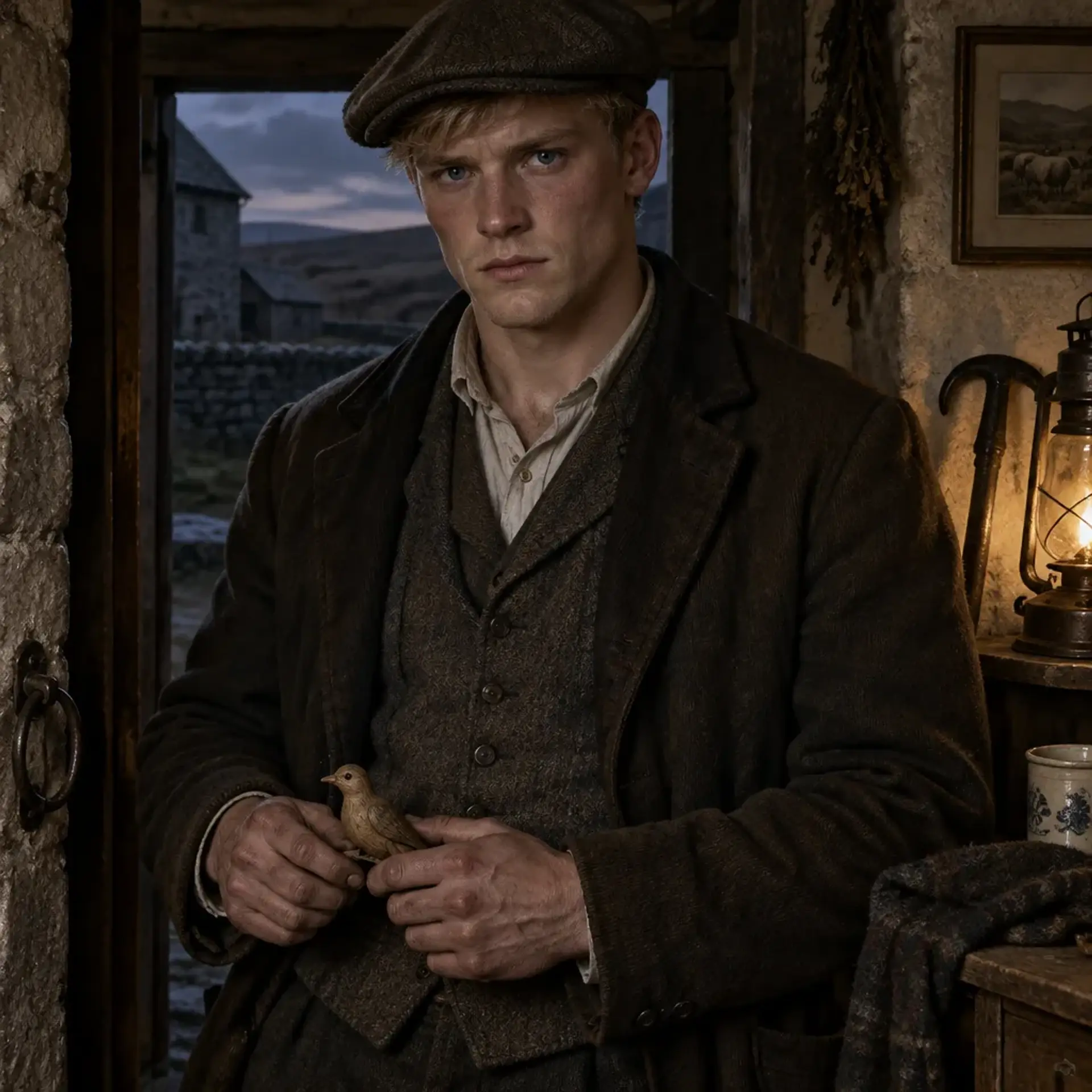
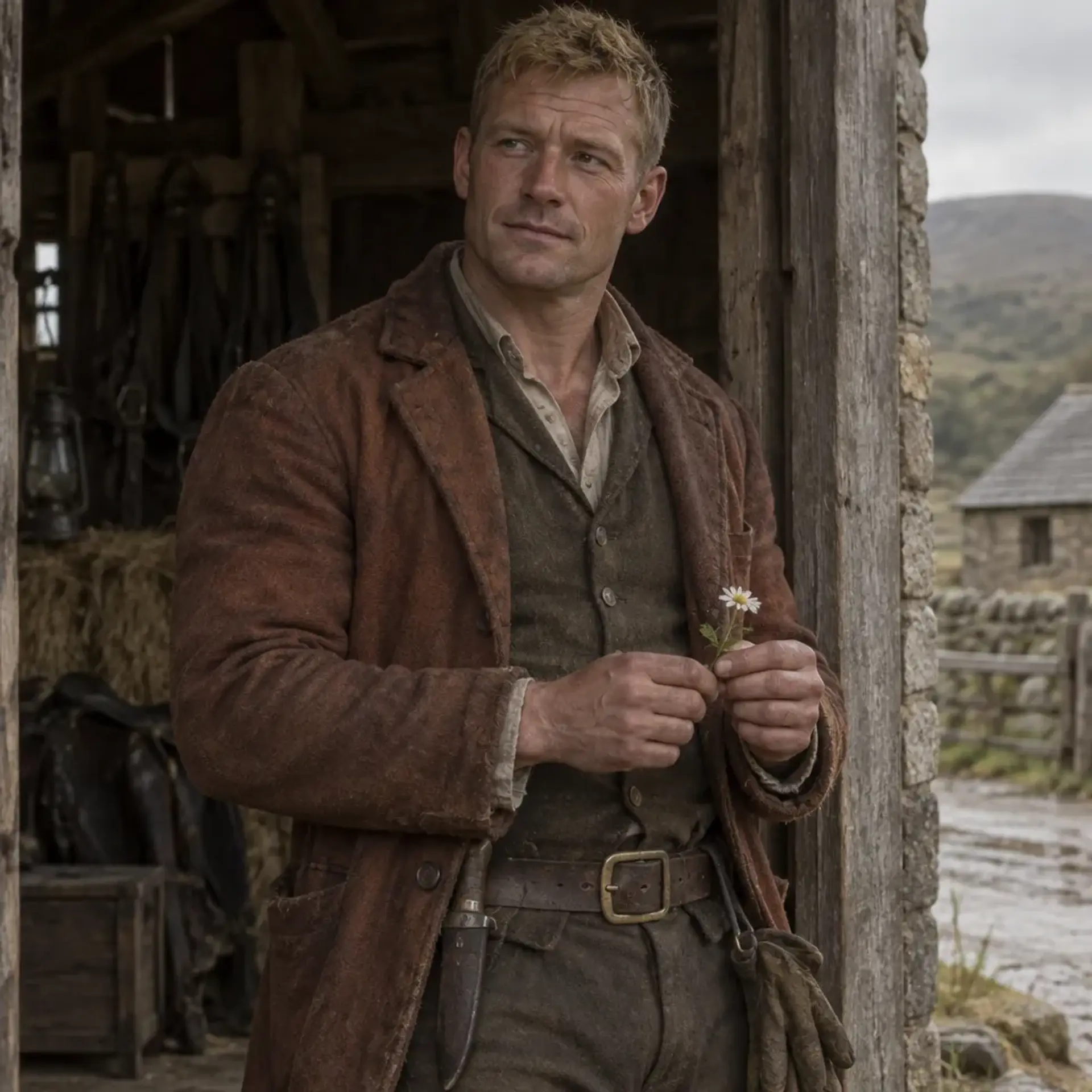
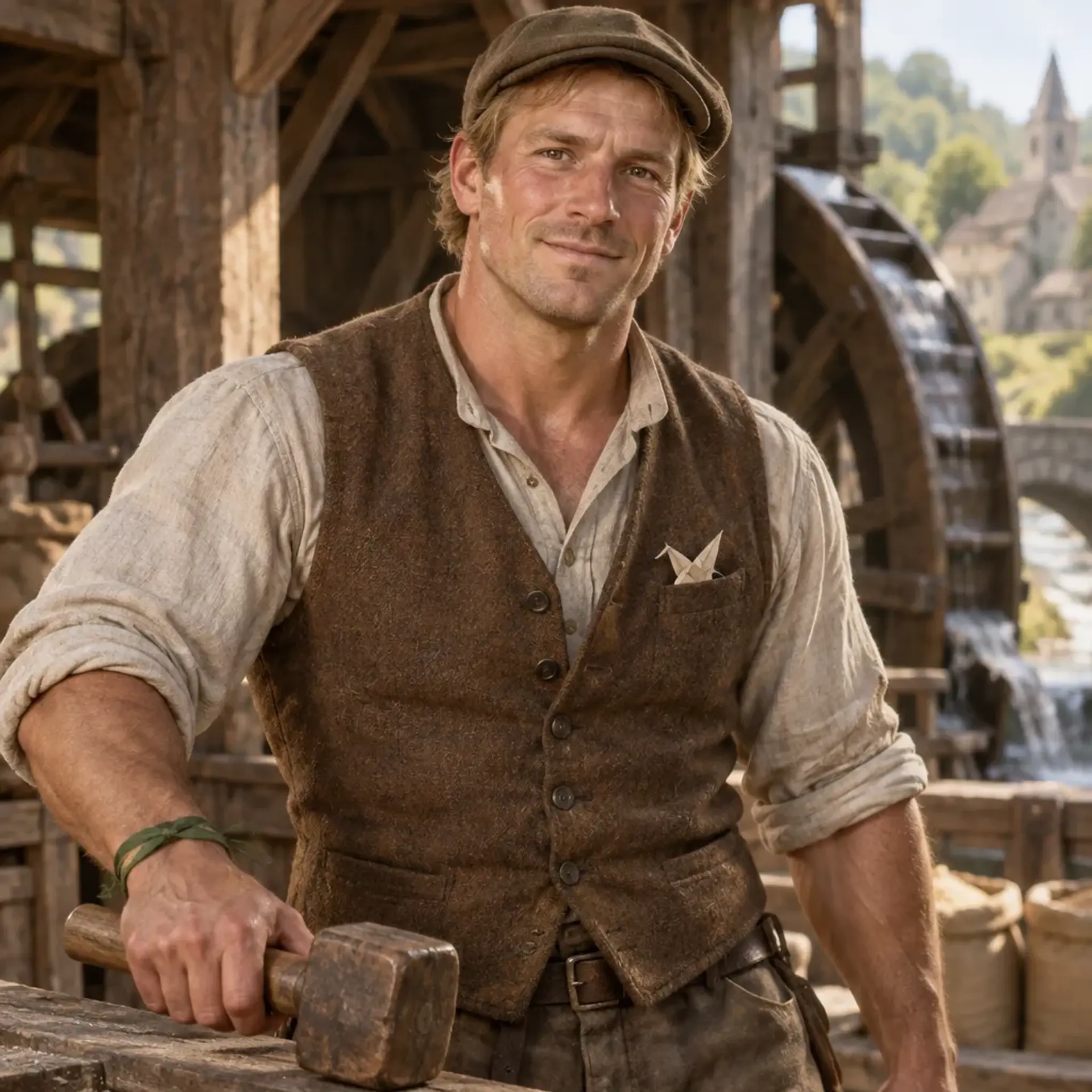
Hugh Pickles is a fit, fair-haired man of average height, with a sun-browned face and the thick neck and square jaw of someone accustomed to lifting crates. When he laughs, his upper teeth show in a broad, slightly uneven row; when he eats, he bites off mouthfuls with brisk, practical determination. He stands with his weight balanced on the balls of his feet, as if waiting for a cart to tip or a door to open. Despite his sturdy, work-worn appearance, he keeps a tiny folded paper bird tucked carefully into his breast pocket, a remnant of a childhood game. He moves quickly but without fuss, leaving the impression of a man who is always ready to lend a hand and already thinking about what might go wrong.
Clothing
A clean but mended linen shirt beneath a brown wool waistcoat, sturdy trousers, and scuffed boots. He wears a narrow strip of green cloth at his wrist, a Mayday ribbon he has never managed to throw away.
Body language
Hugh keeps his weight forward and his hands ready to catch or steady something. In a friendly conversation he leans in; when Oswin or Mayday is mentioned, his jaw sets and his gaze fixes on the speaker's hands.
- Height
- 5 feet 10 inches
- Build
- Fit and sturdy, with a laborer's shoulders and forearms.
- Eyes
- Hazel
- Hair
- Blond, cut short and usually flattened beneath a work cap.
- Skin
- Fair with a sun-browned, weathered complexion.
- Age
- 34
- Gender
- Man
- Size
- Medium
Distinguishing features
Personality
12 traits and drivesHugh is generous with labor but guarded with trust. He likes a clear task and dislikes a conversation that demands he guess at someone's motives. Around friends he can be dryly funny and unexpectedly playful; when frightened, he becomes brisk and controlling. He wants to believe the best of Oswin, yet watches him with the wary attention of someone expecting a sudden change.
- Alignment
- Neutral good
Quirks
Habits
Traits · 3
Flaws · 3
Fears · 3
Wants and needs · 3
Combat
AC 10 · HP 5 · 30 feetHugh avoids a fight, trying to get bystanders out of danger and put a barrier between himself and an attacker. If trapped, he uses his mallet to make space, then runs for help.
Hugh Pickles
Actions
Reactions
Services they sell
Rewards they can give
Equipment
- Workman's mallet (tool)A wooden mallet with a worn handle, used for mill work and only reluctantly as a weapon.
- Paper bird (personal keepsake)A small folded paper bird, creased soft from being carried and handled.
- Work cord (utility)A coil of sturdy cord, useful for tying cargo or securing a loose gate.
Possessions
Background
Hugh Pickles learned early that a village could be held together by small, unremarked acts. A gate lifted back onto its hinges before anyone asked. A sack shouldered from a cart when the driver’s knee gave out. A loose board replaced before somebody’s child put a foot through it. His father used to say that a man’s worth showed in what still worked after he had passed through a place. Hugh took the saying literally, and for years his name was called whenever something heavy needed moving or something stubborn needed mending. He and his sister Mary grew up in a low house near the lane to the mill, where the windows rattled whenever the wind came down from the hills. Mary was quicker to make friends and quicker to take offense. Hugh was the one who watched before joining in. Their mother called him thoughtful; Mary called him slow, usually when she had already decided what they were going to do. They quarrelled over chores, borrowed clothes, and who had eaten the last honey cake, then settled their differences by working together on whatever needed doing next. Mayday was the one village custom Hugh never treated as an ordinary day. It was a practical celebration, as far as he was concerned. The square needed sweeping, stalls needed hauling into place, ribbons had to be tied where the wind would not steal them, and the market awning had to be raised before the first traders arrived. The fiddlers could have their music, and the children could run themselves ragged, but the square would not be ready by wishing. Hugh liked that about it. Everyone had a task. If someone wanted help, they asked. If they did not ask, he could still see where a hand was needed. As a boy, he raced Mary through the work before dawn. She would take the ribbons, he would take the borrowed tools, and they would meet at the well to compare what they had managed to finish. Mary was better at talking the stallholders into lending things. Hugh was better at returning them in one piece. He remembers the years as clear mornings, cold fingers, and the smell of damp canvas warming in the sun. For a long time, Mayday meant that the village had made itself ready together. Hugh went to work at the mill as soon as he was old enough to be useful there. He learned the gears by sound and the mill hands by their habits. A man who kept rubbing his thumb over a knuckle was worried about money. A woman who set down a bucket too carefully was angry and trying not to show it. Hugh never thought of this as a special skill. It was simply easier to understand what people wanted when he watched what they did. Words could be polished, changed, or taken back. A hand reaching for a tool usually meant what it seemed to mean. That way of watching served him well at the mill. He knew which workers needed a joke, which needed quiet, and which were one bad day away from walking out. He could disagree without making a performance of it, and he was useful enough that most people learned to come to him with a clear request. He preferred that. He did not mind a difficult job, but he disliked being expected to guess what someone really wanted and then blamed for guessing wrong. If a person needed help, Hugh would rather hear the need plainly. Oswin Hirst was part of the same working village, never quite a close friend and never quite a stranger. Hugh knew him through jobs, errands, and the loose company of people who had spent years crossing the same square. Oswin had always seemed capable of making an occasion feel bigger than it was. That could be a gift. When a task dragged, he could get people laughing. When a gathering went flat, he could coax it back to life. Hugh had seen him charm a reluctant trader into lending a cart and persuade a roomful of tired people to stay for one more song. There were times Hugh found Oswin’s ease irritating. There were other times he was grateful for it. He could not say they had been close enough for Hugh to know what Oswin hid from the rest of the village, but he had thought he knew the shape of him. He had never considered that a person could seem familiar and still be a mystery. The Mayday that changed things began like the others. Hugh and Mary were in the square before dawn, carrying the last of the stalls into position. The sky was a dull blue, and the wet cobbles shone beneath the lanterns. Someone had brought a kettle. Someone else had misplaced the mallet Hugh needed. He found it under a coil of bunting, where a child had left it, and set to work without making a fuss. Mary was tying ribbons around the central post and complaining that Hugh had put it in the wrong place. By the time the first villagers arrived, Oswin was already there. Hugh does not remember seeing him come in. He remembers looking up from a stack of crates and finding Oswin in the middle of a knot of people, smiling as though he had been waiting for them all. The square seemed to turn toward him. People who had been arguing over stall space began laughing. A woman who had come to deliver bread stayed to dance. Even the sour old cooper, who complained about Mayday every year, appeared to have forgotten what he disliked about it. At first Hugh thought it was Oswin doing what Oswin did. He had a knack for drawing people in. The trouble was that the feeling did not pass. The laughter went on past the point where it was natural. People smiled without seeming to notice that they were smiling. A man stumbled against a stall and laughed as if he had meant to do it. Hugh saw Mary look toward him across the crowd. Her hands had stopped moving on the ribbons. He cannot settle on one moment when the cheer turned frightening. Perhaps it happened gradually, while the music played. Perhaps it had been wrong from the beginning and he had only understood that later. The fiddles sounded too bright. The square felt crowded even where there was room to move. Hugh watched shoulders lift and hands clap and faces turn toward Oswin. He tried to catch Oswin’s eye, but each time he looked, Oswin was attending to someone else, delighted by them, or appearing to be. Hugh told himself that there were ordinary explanations. Strong drink. A good tune. A crowd swept up in its own happiness. He had seen people lose themselves in celebration before. Yet he could not make the details sit right. The merriment seemed to have no cause and no edge. People did not tire of it. They did not pause to catch their breath or look toward their children. They behaved as if nothing outside the moment could matter. Mary caught his sleeve. Hugh remembers that plainly. Her grip was tight enough to hurt, and she did not look at him when she said they should go. He asked if she was feeling unwell. She said no, and for once did not make a joke of his question. Hugh looked around, trying to see what she saw. He found a child crying beside a stall, but the child’s mother was laughing with the dancers and did not seem to hear. That was when Hugh stopped searching for a sensible explanation and began looking for a way out. He got Mary through the edge of the crowd by making himself a nuisance. He shifted a barrel, asked a stallholder to move a cart, and called out that somebody had dropped a tray. It was not a plan so much as a series of tasks that gave people a reason to turn away. Mary followed close behind. They reached the lane beyond the square, where the music grew muffled. Hugh expected the village to feel different there. Instead, for a few moments, the laughter seemed to follow them around the corner. They walked until they could hear only their own footsteps. Mary was angry with him by the time they reached the mill lane. She said he had dragged her out as if she could not decide for herself. Hugh answered that she had taken his sleeve and asked to leave. She said she had asked him to come, not to treat her like a parcel. He had no good reply. He offered to go back and see what was happening. Mary told him not to be stupid. They argued until the ordinary sounds of the village returned around them, then went home separately. Neither of them spoke much about it in the days that followed. The village had plenty of explanations. People said the celebration had been a success, that everyone had enjoyed themselves, that Hugh and Mary had simply tired of the crowd. A few laughed when Hugh asked whether anyone else had noticed how long the dancing continued. Some could not remember anything unusual at all. Others described the day as a joyful blur, then changed the subject when he asked them to be precise. Oswin was still Oswin afterward, or seemed to be. He came to work. He spoke to people. He made the same easy jokes and gave Hugh no clear reason to accuse him of anything. Hugh watched for a sign that Oswin remembered the strange length of the laughter, but he did not know what such a sign would look like. A hesitation could mean guilt, embarrassment, or nothing. A smile could be a smile. Hugh found himself studying Oswin’s hands, his shoulders, the angle of his gaze, as if a plain answer might be hidden in the small movements. He wanted to believe that Oswin had been caught in whatever happened, rather than causing it. The thought that a man Hugh knew had deliberately done something to the village was difficult to bear. But the thought that Oswin might have been powerless did not make the memory easier. Hugh had seen the crowd turn toward him. He had seen Oswin at its center. He did not know whether that made him responsible or simply the person nearest the source. He and Mary kept in touch, as they always had, but the event made their old arguments sharper. Hugh asked whether she had spoken to anyone who remembered more. He suggested she avoid the square when Mayday preparations began. He offered to walk with her if she needed to go into town. Mary said she was not a child and did not need to be managed. Hugh knew she was right. He also knew what it had felt like to see her vanish into that crowd, laughing with everyone else, before she grabbed his sleeve. He could not make his worry obey good manners. Over time, Hugh began asking questions beyond his family. He kept them practical, or tried to. Had anyone seen Oswin before the first song? Did anyone remember how long the dancing lasted? Was there some reason the music had carried on after the fiddlers stopped? Most people did not welcome the questions. A few gave him small pieces of memory: a trader who had packed up twice and somehow found his stall still open, an old woman who swore she had heard the same verse repeated, a boy who remembered his father laughing while his face looked tired. None of it proved anything. Hugh kept the details anyway, written on scraps and tucked into the back of a drawer. The scraps have become a source of unease. Hugh has returned to them so many times that he no longer trusts every mark on the page. Did the old woman mention the repeated verse before or after he told her about it? Was the boy’s father smiling, or did Hugh supply that detail later? Some days Hugh can see the square clearly, down to the muddy hem of Mary’s dress. On other days the whole memory feels smoothed over, like a board worn by too many hands. He worries that he is forgetting what happened. He worries, too, that he may be remembering more than happened. He has stopped volunteering for Mayday work. People notice, because Hugh was once the first person called when a stall needed carrying or a post needed bracing. He gives a reason if asked, usually one that is true but incomplete. There is always a repair to finish at the mill. The morning is too busy. Someone else has the tools. He does not explain that the sight of ribbons being tied across the square makes his stomach tighten, or that a cheerful tune can send him listening for the moment when it stops sounding human. Sleep has become less dependable. Hugh wakes before dawn with the impression that he has missed an appointment, then lies still and tries to sort his dreams from his recollections. In some dreams, the crowd disperses and the square is empty. In others, everyone is still smiling when the lanterns burn out. He has begun to keep a lamp near his bed, though he tells Mary it is because the wick is easier to find in the dark. For all his caution, Hugh has not given up on the village or on Oswin. He still carries what needs carrying. He still mends what is broken. If someone asks for help with a clear task, Hugh will show up, and he will not ask whether they deserve the trouble. His trust comes more slowly now, but it has not vanished. He watches people closely, especially Oswin, and searches their faces for a change he cannot name. Beneath the fear and the questions is a stubborn hope that there is an answer that does not require him to condemn someone he once knew. What Hugh wants most is not a confession or a culprit. He wants to know what happened in the square, why Mary and he were able to leave when others seemed unable to notice the time passing, and whether the memory they carry belongs to them alone. Until he knows, he keeps his notes, avoids the Mayday ribbons, and pays attention to hands. When Oswin smiles, Hugh tries to tell whether it reaches his eyes. When Mary says she is fine, Hugh makes himself ask what she actually needs instead of deciding for her. He is learning, slowly, that watching is not the same as understanding, and that the people he wants to protect may have to face the mystery beside him rather than behind him.
Role in the story
A local witness whose clear observations and conflicted feelings can help the party investigate the Mayday. Hugh is not a trained adventurer, but his connection to Mary and Oswin makes him a valuable source of human context.
“A gate lifted back onto its hinges before anyone asked.”
- Faction
- No formal faction. Known among the mill workers and the people of Mary's village.
Known connections
Media
0 imagesNo images yet.
Turn Hugh Pickles into a sheet
A high-res, share-ready sheet you can post or print.