Oswin Hirst
Oswin Hirst
At the table
Voice
A steady, practical voice with a dry rasp from outdoor work and cold air. His northern English accent carries Yorkshire turns of phrase, though a listener attentive to his stories may hear older, hard-to-place phrasing surface and disappear. He does not use volume to dominate; he uses precise, unhurried statements. Under threat, his voice becomes blunt and decisive rather than hushed or ceremonious.
His voice is grounded and work-worn, with a northern English accent shaped by Yorkshire phrasing and a lifetime among shepherds. It has a dry rasp from cold mornings and outdoor work, but is not especially rough or loud. He speaks at a steady pace, placing emphasis on practical nouns and verbs. When telling a travel story, his rhythm becomes vivid and expansive; when asked about his age, iron, or the wedding night, sentences shorten and acquire careful qualifications. His name, Oswin, is spoken plainly, without a special vocal effect.
Speech patterns
How to play them
Approach Oswin through practical concerns, the farm, or William rather than demanding his history at once. He is generous with help and guarded with personal truth. A direct, specific question about the wedding night unsettles him; compassionate but firm insistence may make him admit that his story is incomplete. He responds badly to threats against his family and to casual handling of iron. Do not make his confession a shortcut to forgiveness: Mary has her own agency and may react with anger, fear, grief, or all three.
Goal
Keep Mary and William safe while finding the courage to tell Mary that he was the Barguest on their wedding night, without asking her to forgive him or deciding for her what she should fear.
Motivation
To give his family the ordinary, safe life he never had, while resisting the instinct to disappear whenever his past threatens to catch up with him.
Appearance
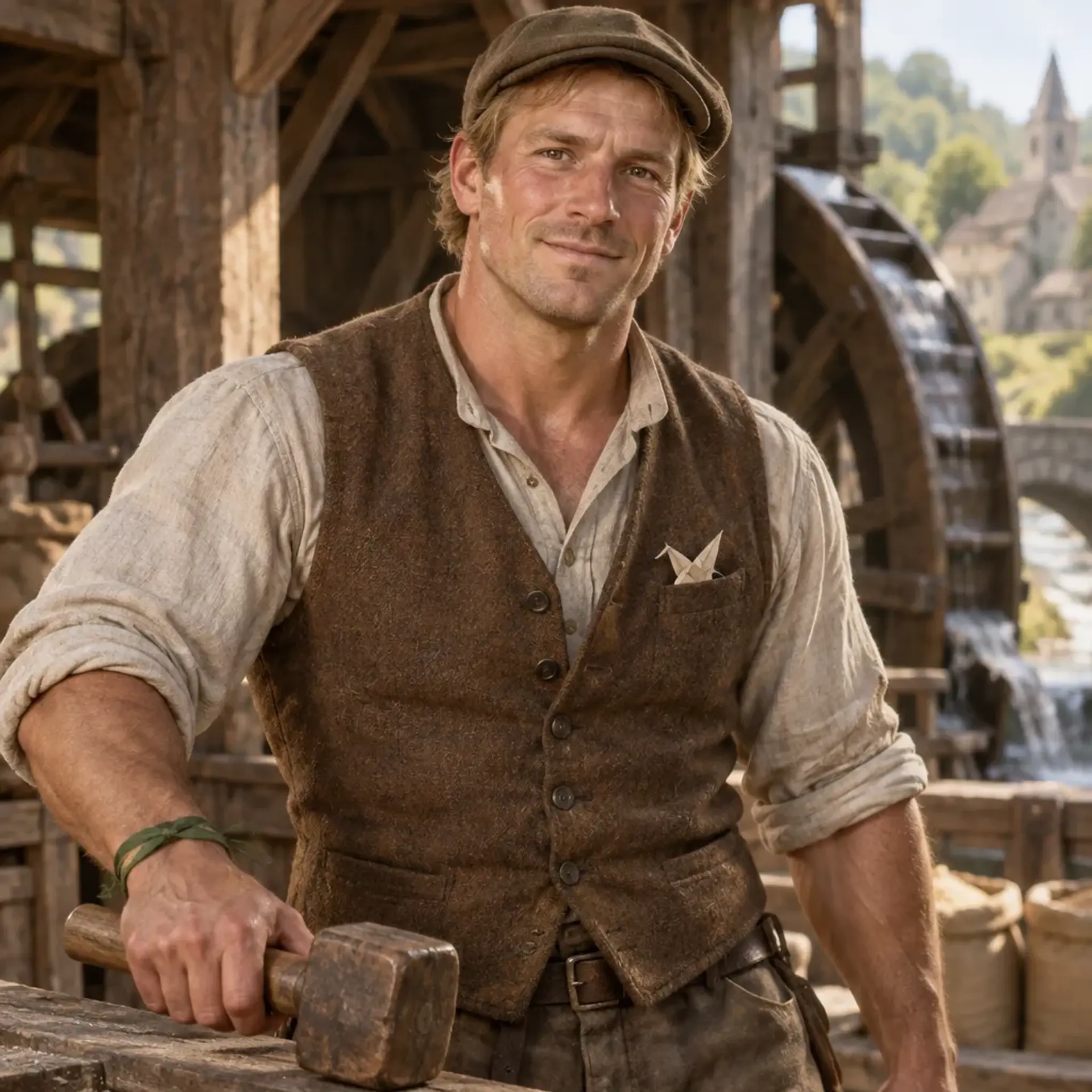
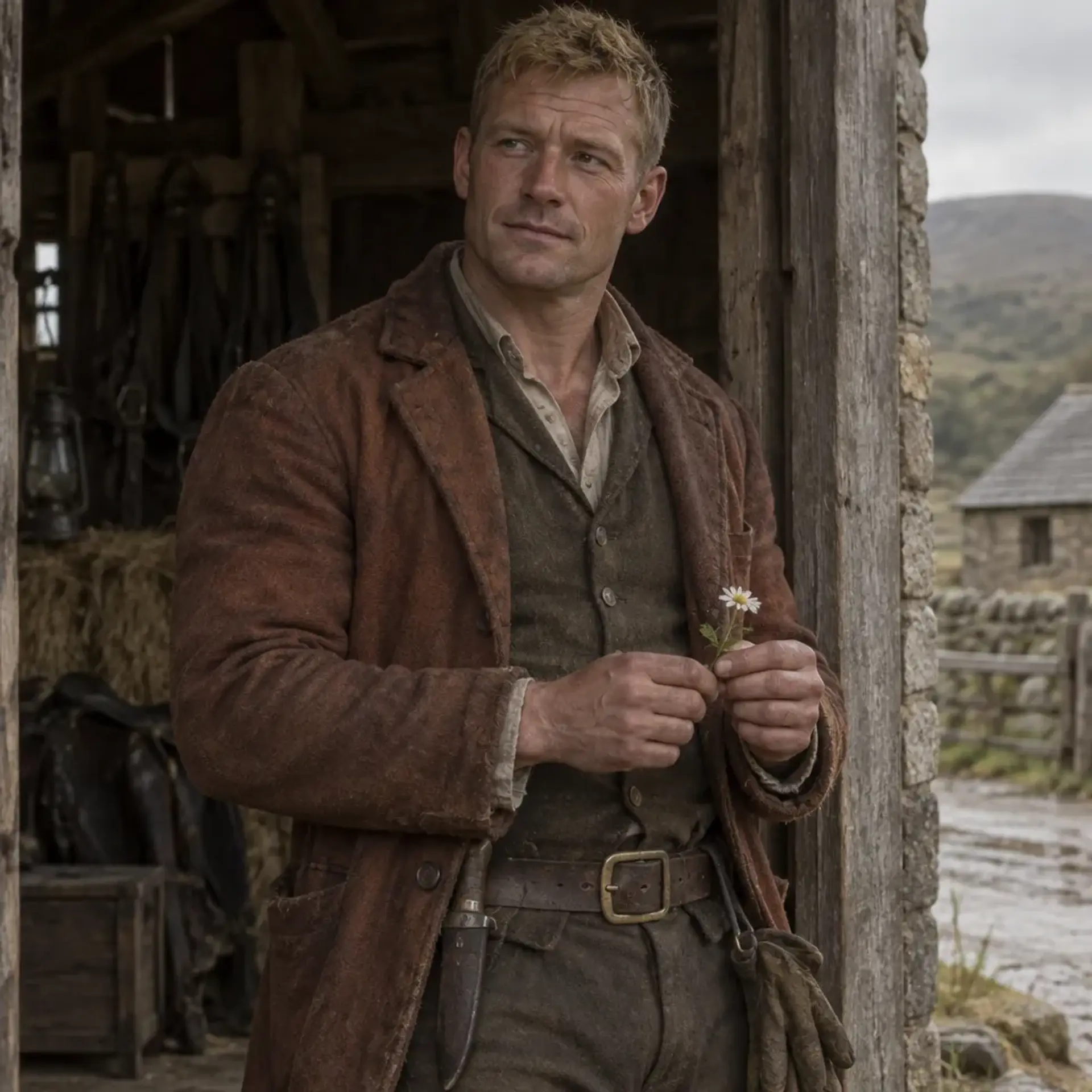
Oswin stands an even six feet, occupying a doorway as if it were built for him and seldom noticing that he makes a room feel smaller. His face is handsome in a plain, youthful way, with smooth pale skin, a straight nose, and an expression that can turn from patient warmth to an unsettling, watchful stillness. His blond hair lies straight and fine beneath a common flat cap, usually flattened at the sides by the wool. His eyes are a clear, burning blue, too bright in lamplight and unmistakably repeated in his son William's face. He moves with a shepherd's economy: shoulders angled to avoid knocking a pail, feet placed softly on uneven ground, hands ready to catch a slipping lamb. His palms are broad and rough, with wool grease caught at the creases and small, healed nicks from shearing and gates. He is careful not to touch iron. The unexpected detail is that he keeps a tiny carved wooden bird in his waistcoat and turns it over with almost ceremonial care when he thinks no one is looking. People remember the strange combination of a well-kept, youthful face, work-worn hands, and a presence that seems to anticipate where everyone will stand.
Clothing
A clean but well-used coat, wool waistcoat, plain shirt, sturdy trousers, work boots, and the common flat cap worn around town. His clothes suit a prosperous smallholder without suggesting gentility. He keeps the carved wooden bird in his waistcoat pocket and wears no iron jewelry.
Body language
He gives people room when he remembers to, but his height and habit of standing squarely in a doorway can make him seem to block an exit. Around Mary he watches her hands and face for signs of fear. With William he lowers himself to the child's level and waits rather than rushing him. When iron is brought near, the muscles around his mouth tighten and his hands fold inward.
- Height
- 6 feet (approximately 183 cm)
- Build
- Tall and sturdy, with a shepherd's practical strength rather than a fighter's showy musculature.
- Eyes
- Clear, bright blue, with an unnerving intensity in dim light.
- Hair
- Pale blond, straight and fine, usually flattened beneath a flat cap.
- Skin
- Pale, with a healthy outdoorsman's weathering at the cheeks and nose but little evidence of age.
- Age
- Appears to be a young adult, roughly 25 to 30. His actual age is centuries; he was born in the era of the Danelaw and does not disclose how long he has lived.
- Gender
- Male
- Size
- Medium-sized adult human; supernatural forms are custom and not assigned standard CoC 7E size statistics here.
Distinguishing features
Personality
18 traits and drivesOswin is kind in the way of someone who has learned that usefulness can be safer than charm. He repairs what is broken, notices who has not eaten, and will spend an entire afternoon helping a neighbor with a lambing shed without mentioning the cost. Yet his kindness has a controlling edge: he decides what others can bear to know and calls that protection. He wants Mary to feel safe, but refuses to tell her the truth that might let her make an informed choice. He is not unaware of the contradiction. He simply fears the consequence of honesty more than the consequence of continuing the lie. In ordinary company he is practical, dryly humorous, and alert to small needs. He is comfortable among animals and laborers, less comfortable with formal authority or people who ask for a precise account of his past. He can tell a lively story about a distant road or a strange fair, giving listeners vivid detail about weather, food, and the people he met, then become evasive when asked what year it was. He enjoys being remembered for the story, but not examined as its witness. With Mary, affection makes him gentler and more vulnerable, but also more watchful. He remembers the small things she likes and tries to ease her fear of the dark without explaining why he understands it. When she grows tense during a season associated with the fae, he looks for practical tasks to occupy her and the household. He will sit with her, check the latch, and speak calmly about the weather. If she asks why he avoids iron or why he never seems older, his warmth becomes careful and measured. He does not become openly cruel; instead, he gives partial answers that sound reasonable until a listener compares them. With William, Oswin is patient in a way he is not with adults. He does not hurry the boy's words or correct him for being slow. He turns chores into small lessons, lets William help with simple work, and treats his black hair as a feature rather than an omen. This tenderness is mixed with dread. Each sign that William may be unlike other children reminds Oswin of the inheritance he has concealed from Mary. If someone mocks or threatens the boy, Oswin's patience can vanish. He becomes still, positions himself between the threat and his son, and speaks with a bluntness that makes clear the conversation is over. Oswin is shrewd about land, weather, livestock, and human motives. He knows when a sheep is ill, when a fence will fail, and when a neighbor is concealing a debt. He reads a room quickly because his long life has made carelessness dangerous. Yet he can be naïve about the specific people he loves. He assumes Mary will be safer if she does not know, and has not understood that she has already told Thomas about the wedding night. He has mistaken her guardedness for a fear he can soothe rather than a judgment she is trying to make. His moods follow the demands of the household, but also the calendar. In good weather, when work is predictable, he is easy company and may laugh with genuine abandon. When the sheep are threatened or money is tight, he narrows his attention to the next necessary task. During certain seasons, his sleep breaks apart. He walks the boundaries, checks the flock more than once, and becomes distracted by sounds no one else notices. He resents being asked to rest because rest leaves room for dreams. If pressed during one of these periods, he may respond with clipped instructions, not because he is angry at the person asking but because he is struggling to stay present. His anger is not quiet courtesy, nor is it theatrical rage. It makes him direct. He names the offense, tells the person what must stop, and takes action if they ignore him. His physical presence can make this frightening even before any supernatural nature appears. When the danger concerns Mary or William, he may act first and explain later. That protective instinct is sincere but dangerous: he can mistake possession for care and silence for safety. Oswin is proud of the life he has built. He values a sound roof, a healthy flock, clean tools, and a meal shared at the end of work. He does not consider himself a lord or a hero. He dislikes grand declarations and distrusts anyone who promises a clean solution to a complicated problem. At the same time, he carries the restlessness of his wandering years. On some evenings he watches the road longer than necessary and remembers places where nobody knew his face. He misses freedom, then feels ashamed for missing it. His deepest conflict is not whether he loves Mary. He does. It is whether love can survive his refusal to let her see him clearly. He tells himself he is sparing her fear, but he also fears being rejected, exposed, or forced to leave. The truth of the wedding night would take away his ability to manage her response. That loss of control terrifies him. If Mary confronts him, he may first offer an explanation about the failed human attempt and the closeness he felt in the other form. He may try to make the explanation sound like context, but it cannot undo the fact that she did not know who or what was with her. A fair portrayal lets Mary set the terms of any conversation and does not treat Oswin's remorse as an automatic absolution. He can be compassionate toward strangers, but his kindness has boundaries. He will help someone in immediate need, especially a child or an animal, yet he is wary of people who demand stories or bargains. He dislikes being treated as a curiosity. If someone recognizes the Barguest, he may try to learn what they know before deciding whether to flee, confess, or threaten them. He prefers negotiation and concealment to violence, but he is capable of frightening speed and strength when cornered. Oswin is not simply a monster pretending to be a farmer, or an innocent man trapped by a curse. He has a history of choices, some compassionate and some selfish. He has endured centuries of loss and still chose a life with a family, but he also used a supernatural form to overcome a deeply personal failure without Mary's informed agreement. His tenderness, fear, deceit, and longing coexist. Players may find him worth helping, difficult to trust, or both. His future depends on whether he can stop treating the people he loves as people to be managed and begin treating them as people entitled to choose.
- Alignment
- Not applicable as a Call of Cthulhu 7E statistic. In ordinary life, protective and practical, but his secrecy has harmed the people he loves.
Quirks
Habits
Traits · 5
Flaws · 4
Fears · 4
Wants and needs · 5
Combat
HP 14 · MOV 8, human form. This is a standard-style CoC 7E movement notation; transformed movement is custom and should be set by the Keeper.Oswin is not a trained combatant. In human form he uses Brawl and, if necessary, a farm gun, but he prioritizes getting Mary and William away from danger. He avoids killing and will retreat if doing so protects his family. If the Keeper activates the custom Barguest transformation, establish its effects and statistics for the scenario rather than treating them as standard CoC rules.
Oswin Hirst
Actions
Reactions
Services they sell
Rewards they can give
Equipment
- Shepherd's knife (tool)Plain, reliable tool kept for farm work; Oswin dislikes carrying or handling it because it is iron.
- Farm gun (weapon)A practical firearm kept for emergencies. Use the scenario's specific weapon statistics if it appears in play.
- Wooden bird (personal keepsake)Small, smooth carving of a bird, turned over when he is anxious. Its maker and age are unknown.
Possessions
Background
Oswin Hirst's earliest memories belong to a world that no longer exists. He was born in the north of England during the age of the Danelaw, when raiding, settlement, and the shifting borders of human rule made the dales feel both inhabited and perilously open. His mother was a local woman assaulted by Viking raiders. Oswin grew up knowing little about his father, and less about why he never seemed to fit the pattern of a human life. He was not told that he was fae-blooded. At first there were only discrepancies: a fever that failed to take him, a winter journey he survived when others did not, and a childhood memory of walking through a dark wood beside a black hound that left no tracks. He understood his nature slowly, in scraps rather than revelation. As a young man he wandered, taking seasonal work and following roads, fairs, flocks, and rumors. He learned to mend fences, judge a frightened animal, and recognize when a village was about to turn on a stranger. He saw rulers change, boundaries shift, and familiar families vanish into names on stones. He never stayed long enough to explain why he did not age as other people did. For a time, wandering seemed a kindness: no one could compare his face across decades if he was always somewhere new. The dales kept drawing him back. He dreamed of their folds and streams even while he was far away, and in those dreams a headless shape waited at the edge of a field. The locals called such a thing a Barguest. Oswin had already discovered that he could become a black hound, and that another shape was possible: a headless figure with red, saucer-like eyes floating in the empty place where a head should be. He never understood whether the shape was his own nature, an inheritance, or something older using him as a door. He learned to keep it hidden, particularly from people he wanted to protect. Eventually he settled into the sheep farmer's life he once thought he could only borrow. He acquired a good house for a man of his station, earned a reputation as a capable and fair-minded shepherd, and began to believe that routine might hold him more securely than distance ever had. He met Mary Pickles, a Yorkshire woman with blond hair and blue eyes, and was drawn to her directness. Mary listened to his stories of the roads and his travels, and he found himself telling her more than he had intended. Her affection made ordinary things feel newly precious: a shared meal, a repaired gate, a child asleep in the next room. Their wedding night became the secret at the center of their marriage. Oswin failed to consummate the marriage in his human form. Rather than tell Mary the truth and endure the fear or rejection he imagined, he took his Barguest shape and went to her as the headless apparition. Mary experienced the event as an assault by a rogue Barguest. Afterward she struck the creature with iron scissors. Oswin remembers the scissors, Mary's terror, and the instant he understood that she had not known who he was. He also remembers that he had felt, in that altered form, a closeness he had never allowed himself in any other life. That intimacy does not excuse his deception. He has never told Mary that the creature was him, and the lie has become more difficult to undo with every year. Mary loves the husband she knows, but fears the thing she believes visited her. She keeps iron scissors close and an iron thimble near their son. She watches Oswin and William especially during seasons she associates with fae or demonic danger. Oswin knows she is afraid of the dark, and wants her not to fear the fae or him, yet he continues to conceal the truth that would make her fear justified. He has not noticed that she confided the wedding-night account to her father, Thomas Pickles. Their son William, called Black William or Blackby by locals, has black hair despite both parents being blond and Oswin's conspicuous blue eyes. William is slow to meet some expectations for his age. Oswin is tender and attentive with him, making time for him even after a difficult day or a sleepless night. He sees signs of the same uncanny inheritance that marks his own life and fears that the boy may be treated as a monster before he can understand himself. Mary believes William may be the Barguest's child. She does not know that the Barguest was Oswin. The household has suffered further grief. Mary's pregnancies have often ended in loss; one child was born sickly and died soon afterward. Oswin cannot explain the pattern, and every loss makes his silence feel more like a curse he has placed on Mary. He avoids iron tools and household objects where he can, though the farm makes such avoidance awkward. Thomas Pickles, Mary's father, has noticed. Thomas is suspicious of Oswin's youth, his resistance to iron, and the black hound he once saw. His eldest daughter, Alice, died of a fever in winter after Thomas saw that hound. Thomas believes there is a connection and intends to turn Oswin's secret to his family's advantage, though he has not yet revealed his suspicions to Mary in full. Mary's brothers, Hugh and Edward Pickles, are part of the family circle around the farm. Their loyalty is divided between their sister and their father, and neither knows the full truth. The family is close enough that a rumor can become a threat before Oswin has time to leave. Oswin has lived longer than he claims and has had other lives, but he has never before been bound so tightly to one household. The past still visits in seasonal dreams. At certain times of year he cannot sleep; he walks the boundaries, checks the sheep, and watches the dark for signs that something has followed him home. His present problem is not simply whether to confess. It is whether he can admit what he did without demanding forgiveness, and whether Mary and William can make their own choices once they know. He wants to keep the family together, but his instinct is to control danger by hiding it. Thomas may expose him for profit or protection. Mary may decide she can love Oswin and still refuse to trust him. William may inherit the hound's shape, the eyes, or something stranger. Oswin is trying, in small daily acts, to become a husband and father rather than a visitor passing through another borrowed life. Whether those acts can survive the truth is unresolved.
Role in the story
A seemingly settled sheep farmer whose domestic tenderness and supernatural nature are bound together by a grave betrayal. He can be an ally, a source of local history, a frightening antagonist if his family is threatened, or the focus of a mystery about Mary, William, Thomas, and the Barguest.
“His mother was a local woman assaulted by Viking raiders.”
- Faction
- No formal faction. His loyalties are to his household and the working people of the dales, though his secrecy places him at odds with the Pickles family.
Known connections
Media
0 imagesNo images yet.
Turn Oswin Hirst into a sheet
A high-res, share-ready sheet you can post or print.