Mary Hirst
Mary Hirst
At the table
Voice
A clear, work-worn voice with a slight rasp from cold mornings, smoke, and speaking outdoors. Mary has a quick, practical cadence, as though each sentence is meant to arrive before the next chore does. When she is relaxed, her words flow warmly and her laugh breaks through without warning. When she is frightened, her breath catches before her speech, but she makes herself continue. When angry, her voice becomes firm and sharply articulated, not subdued.
Mary speaks in a plain Yorkshire manner, with direct phrasing and a practical rhythm. Her speech is shaped by farm work: she notices weather, animals, and what needs doing before she reaches for abstract explanations. She rarely embellishes a statement unless recounting something that frightened her, when she repeats concrete details as if pinning them in place. She does not use a stagey whisper when angry. Her voice firms and her sentences shorten; she asks the same question again if she has not received an answer.
Speech patterns
How to play them
Meet Mary as a capable, cautious person rather than a frightened exposition source. She responds to patient practical help and to kindness toward William. Do not demand that she choose immediately between loving Oswin and fearing him. If questioned about the wedding night, she tests the listener's discretion before offering details. A character who treats William as a child rather than an omen earns her trust. Accusing Oswin without proof makes her defensive; dismissing her fear makes her withdraw.
Goal
Keep William safe, learn what truly happened on her wedding night, and preserve a home in which love does not require her to ignore danger.
Motivation
Mary wants a family that is safe without being built on a lie. Her love for Oswin is genuine, but it competes with her need to understand what happened and protect William from any danger, including danger inside the household.
Appearance
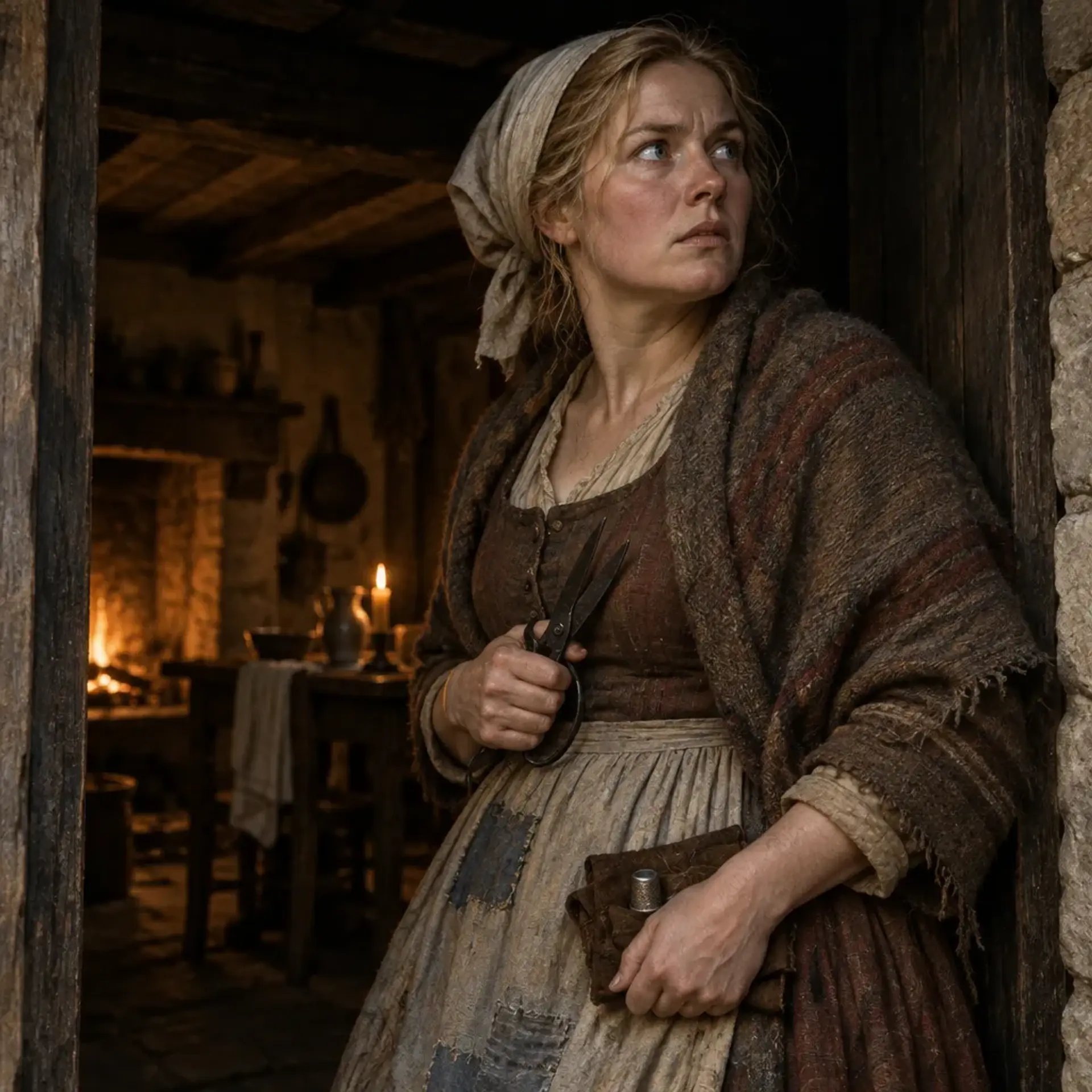
Mary Hirst is a fair-haired Yorkshire woman whose stillness can look like patience until one notices that she is tracking every door, window, and shadow in the room. Her straight blond hair is usually pinned back without much care; loose strands catch on the rough wool of her shawl and cling to her temples when she has been tending the hearth. Her blue eyes are clear and direct when she speaks to someone she trusts, but they keep sliding toward Oswin's hands, the dark beyond the lintel, and the places a head ought to be. Her face is softly weathered by outdoor work, with a firm jaw and teeth she presses together when she is holding back a question. She moves briskly, with the small, economical turns of someone accustomed to keeping a household moving while carrying a child or a pail. When she laughs, it comes suddenly and fully, showing a slight gap between her front teeth; the sound vanishes just as suddenly if a dog howls nearby. The detail people do not expect of a farmer's wife is her careful habit of studying a room's thresholds before she enters, as if every doorway were a boundary that might need defending.
Clothing
A plain working dress of sturdy wool or linen, a patched apron, a warm shawl, and a common bonnet or kerchief when outdoors. Her clothes are serviceable and carefully mended. A small pair of iron scissors is tucked into a pocket or sewing roll, and an iron thimble is usually kept close to William.
Body language
Mary stands with her weight ready to turn toward the nearest exit or toward William. When she is comfortable, her shoulders loosen and she leans in to listen. When Oswin avoids a question, her jaw sets, her eyes go first to his hands and then to his face, and her fingers close around whatever small iron object she has nearby. She does not fidget constantly; instead, she becomes very still.
- Height
- Approximately 5 feet 5 inches
- Build
- Sturdy and practical, with the strength of regular household and farm work rather than a trained fighter.
- Eyes
- Clear blue
- Hair
- Straight blond
- Skin
- Fair, weathered by outdoor work
- Age
- Young adult, approximately 24
- Gender
- Female
- Size
- Medium
Distinguishing features
Personality
21 traits and drivesMary is both tender and guarded. She can sit patiently with a frightened child or an exhausted neighbor, bringing food and practical help without insisting on gratitude. Yet when the subject turns to Oswin, William's parentage, or the dark beyond the farm, patience becomes scrutiny. She wants to believe the best of the people she loves, but she does not confuse hope with proof. She remembers the man who told stories of roads and distant adventures, the man who made time for her and still makes time for William. She also remembers the thing in the wedding room, and the fact that Oswin has never given her a truthful explanation. In ordinary moods, Mary is brisk, capable, and quietly humorous. She has no taste for grand speeches or elaborate displays of affection. Her care shows in repaired clothes, a warmed bowl set aside, and remembering which task a person hates most. She likes competence and dislikes people who turn simple work into a performance. If she is comfortable, she will tease a person gently and laugh at herself as readily as anyone else. Her laughter is not a mask; she has real pleasure in a good story, a thriving lamb, or William doing something new. But a sudden sound from outside can pull her out of happiness with unsettling speed. Mary's strongest contradiction is that she is brave in immediate danger and fearful in the long spaces between dangers. If William slips near a flock or a stranger raises a hand against him, she moves without stopping to calculate the risk. Later, when the house is quiet, she may spend half the night imagining what she missed. She is not cowardly, but she has learned to treat vigilance as a duty. She searches the edges of rooms, listens for changes in the wind, and notices when Oswin avoids an iron fitting. These habits make her observant and sometimes exhausting to live with. Her affection for Oswin is not an illusion. She sees his kindness, his patient attention to William, and the effort he makes to keep ordinary family routines. When he is open with her about mundane matters, she can be warm and easy with him. She can still seek his hand, share a joke, and feel the old comfort of his presence. Then a fragment of memory will return, or she will notice that he has not changed with the years, and tenderness will turn wary. She hates that she can love someone and fear him at once. She hates even more that the fear might be justified. Mary does not want to be manipulated by sentiment, but she is susceptible to it. Oswin's stories of his earlier travels awaken the young woman who once imagined that life with him would be an adventure. She can listen to those stories with shining interest, then suddenly realize that he speaks of the past as if it were recent and the years have not touched him. She may ask a question, then accept a half-answer because she wants the conversation to remain warm. Afterwards she is angry with herself. Her silence is not forgiveness; often it is postponement. As a mother, she is affectionate and fiercely attentive, but her care carries a shadow. William's unusual black hair and bright blue eyes have given local gossip something to feed on. Mary has heard the names people use for him. She tells herself that she keeps the iron thimble and scissors nearby only because they are useful. In truth, the objects reassure her that she has some defense against the thing she believes may have fathered him. She does not want William to feel cursed, and so she avoids explaining her precautions. That silence can make her seem distracted or oddly tense around him. She tries to compensate with touch, games, and a steady routine. William's slower development troubles her, but she refuses to let neighbors turn it into a verdict on his worth. She will correct someone who calls him stupid or cursed, and she can become startlingly sharp when they do. Yet she privately wonders whether his difficulties are signs of a hidden nature. Her mind swings between ordinary explanations and supernatural ones. A fever, a late milestone, or a restless night can become evidence in a case she does not want to prove. She needs reassurance, but shallow reassurance enrages her. Tell her that everything is fine and she will ask what you know that she does not. Her feelings toward Thomas are tangled. She respects the work and sacrifice that shaped her childhood, and some part of her still wants his approval. She also sees that his suspicion of Oswin is not purely protective. Thomas wants advantage for the family and is willing to use Mary's humiliation as the price. She has not yet accepted how calculated his plans may be. When he speaks as if he can rescue her, she listens despite herself. When he implies that she brought disgrace on the Pickles family, she becomes quiet and then avoids him. Her trust in him has not vanished, but it is no longer uncomplicated. Mary is more comfortable with useful truths than sweeping confessions. She asks where someone has been, what they saw, whether the gate was shut. She can discuss grief through the chores it has disrupted before she can speak of grief directly. Alice's death is one such subject. Mary rarely tells a stranger how much that winter changed her. She remembers the illness, the helplessness, and the way the family tried to carry on. Each later pregnancy loss brings back the lesson that love cannot guarantee survival. This makes her deeply sympathetic to people who are grieving, but impatient with anyone who treats grief as an inconvenience. When angry, Mary does not become meek or coy. Her voice gains force and her words become precise. She repeats a question if she believes someone is evading it. She is capable of cutting through a room's politeness with a blunt sentence, especially when someone endangers William. Afterwards she may regret the harshness without retracting the point. She can also be unfair when cornered, drawing conclusions from old fears and demanding that another person disprove them. If the other person turns away, she may interpret the withdrawal as confirmation. Mary has a private streak of stubbornness that can look like calm. She will continue a task while people argue around her, not because she does not care, but because work gives her ground to stand on. When she has decided that William must be kept safe, she does not easily yield to a husband's preference or a father's command. She can follow rules when they make sense, but she resents being told not to ask questions. Her life has made her practical, not submissive. She is also capable of mercy. If Oswin confessed everything, Mary would not instantly forgive him, but she would listen. The possibility of hearing a complete truth frightens her nearly as much as the prospect of continued deception. She wants to know whether he chose the creature's form out of shame, necessity, or desire, and whether he understood what that choice would mean to her. She wants him to see that the wedding night was not a private embarrassment he could bury. It was an event that altered her understanding of her own body and family. Her anger is bound up with grief for the trust she thought they shared. At different hours, Mary can seem like different people: a warm host, a sharp-minded farmer's wife, a watchful mother, a daughter still hoping her father means well, and a woman trying not to fear her husband. None is false. She has not settled the conflict by choosing one version of herself. Her central strength is that she keeps loving and acting even while uncertain. Her central danger is that uncertainty has begun to govern the household. She needs more than comfort. She needs the truth, a way to keep William safe without treating him as monstrous, and the power to decide what her marriage means after she learns what Oswin has hidden.
- Alignment
- Neutral good
Quirks
Habits
Traits · 5
Flaws · 5
Fears · 6
Wants and needs · 5
Combat
AC 11 · HP 9 · 30 feetMary avoids combat and tries to put a solid barrier, an open door, or another person between herself and danger. If William is threatened, she acts immediately, using her scissors or a thrown object to create a moment for him to escape. She does not pursue fleeing opponents. Against a suspected supernatural threat, she relies on thresholds, daylight, and help from others rather than assuming iron will work.
Mary Hirst
Actions
Reactions
Services they sell
Rewards they can give
Equipment
- Iron scissors (improvised melee weapon)Ordinary sewing scissors with iron blades. Mary carries them as a tool and a comfort, not as a magical weapon.
- Iron thimble (household object)A small iron thimble she keeps near William as a precaution against what she fears may be in his blood.
- Sewing roll (tool)A worn sewing roll containing needles, thread, scraps of cloth, and a private place to hide small items.
- Farmhouse shawl and bundle (travel gear)A shawl and a few household necessities, often gathered hastily when she thinks she may need to leave the house.
Possessions
Background
Mary Hirst grew up in a Yorkshire household where affection was real but seldom allowed to be idle. Her father, Thomas Pickles, expected his children to notice what needed doing and do it before being asked. Mary learned to mend, churn, keep accounts, judge weather by the smell of the wind, and recognize the difference between a sheep's ordinary distress and the panic that meant a predator had come near. She was not raised to think of herself as frightened. In her childhood, fear was a thing you folded away until the work was finished. Her brothers Hugh and Edward were noisy companions and, in their own ways, loyal ones. Her older sister Alice was the person Mary followed when she wanted to know how to do something properly. Alice's death after a winter fever left a silence in the family that Thomas tried to fill with rules. Mary remembers being told not to dwell on what could not be changed, and remembers equally well that nobody in the house stopped dwelling on it. Thomas became watchful and exacting; Mary began to understand that love could make people controlling because they could not bear another loss. She met Oswin Hirst through the unsettled, ordinary traffic of local life. He was handsome in a way that seemed almost too preserved, with a young man's face and the bearing of someone who had seen too much road to be surprised by a hard day. He spoke of journeys, strange places, and adventures as if they had happened a long time ago, though he never seemed to acquire the age those stories ought to have put on him. Mary liked that he could be gentle without making a show of it. He listened when she spoke, remembered small requests, and made a point of helping even when no one had asked. His tales gave her a glimpse of a wider world, and she loved the man she believed had come home from that world to build a life with her. There were oddities even then. Oswin avoided iron in ways he explained poorly. A hinge, a tool, or a piece of farm equipment could make him find an excuse to step away. He never quite laughed at local stories about the Barguest, though he pretended the stories were foolish. He did not seem to age. Mary noticed these things and made a private shelf for them in her mind, separate from the shelf where she kept her affection. She did not want suspicion to become the whole of her marriage. The wedding night broke that separation. Mary remembers a headless shape, a man-shaped darkness with two red, saucer-like eyes burning where a face should have been. She remembers terror, an encounter she cannot bear to describe plainly, and waking with the conviction that something had taken her in the night. Oswin would not tell her that the creature had been him. He let her believe that a rogue Barguest had entered the room, because the truth would mean admitting that he had failed to approach her as a human husband, then chosen to take another form. He tells himself that the transformation was necessary, that it was the only way he could consummate the marriage, but he knows he denied Mary the truth and her choice. Mary had a pair of iron scissors within reach. In the confusion afterward, she struck at the creature. She has never forgotten the sensation of the scissors in her fist or the terrible certainty that she had been forced to defend herself in her own bed. She has never connected that frightened act with the possibility that she injured the man she loves. Oswin has never given her the explanation that might make the memory intelligible, and his silence has become another presence in their house. William was born with black hair, startling against the blond hair of both parents, and blue eyes bright enough to seem lit from within. Mary recognizes Oswin in those eyes and fears the resemblance. The village calls the boy Black William or Blackby. He develops slowly compared with children his age, and Mary bristles when neighbors turn that fact into a joke or a warning. She believes the Barguest fathered him and worries that her son is some kind of devil's child. She loves him without reservation, but love does not stop fear from entering the room. Soon after he was born, she began keeping iron scissors near her person and an iron thimble close to William. She tells herself these are simply useful household things. There have been other pregnancies, and they have not ended well. One infant lived only briefly, sickly from the beginning. Each loss has made Mary more cautious about hope and more fiercely attentive to William. Her worry often fastens on seasons she associates with fae or demons. During those periods she watches Oswin and the boy, checks their bedding, listens for dogs, and finds reasons to keep a lamp burning. The habit tires her, but she has not found a way to stop. Mary is not ignorant of her husband's strange history. His stories do not fit the ordinary measure of a man's lifetime. He speaks as if roads and customs from an older world remain vivid in his memory. She has noticed that the years pass over him without leaving their proper marks. She knows he avoids iron, and she has watched his attention tighten when the black hound is mentioned. These observations trouble her, yet she has not assembled them into the whole truth. Part of her believes that if she names the danger, it will become impossible to keep her family together. Thomas Pickles is suspicious of Oswin. He has his own reasons: he saw a black hound around the time Alice died, and grief has made him look for a culprit or a pattern. Thomas wants to use what he suspects about Oswin to secure advantage for himself and the Pickles family. He would expose and humiliate Mary if he thought the scandal could buy him leverage. Mary has told him what she remembers of the wedding night, without understanding that she has given him a weapon. She does not know how far he intends to take it. Hugh and Edward remain close enough to be pulled into the conflict, though neither brother understands all the dangers. Now Mary is caught between the man she remembers, the creature she fears, and the child she loves. She wants Oswin to tell her the truth, but she also fears that truth will confirm her worst suspicions. She wants William to have an ordinary childhood, but ordinary routines cannot settle the question of his blood. She wants to trust her father, but Thomas's interest in the family has the hard edge of a bargain. Oswin tries to make their household safe and tender, taking time for Mary and William even when he is troubled by the seasons and his own past. His kindness matters to her. So does his evasion. Mary's present problem is not simply deciding whether Oswin is a monster. It is deciding what love can survive when one partner has hidden the truth about the beginning of their marriage. She may confront him, protect him, flee with William, or seek help from people who would call the boy an abomination. Every choice risks something precious. She remains in the house because she loves her husband, because she is afraid for her son, and because she has not yet accepted that staying and leaving can both be forms of courage.
Role in the story
Mary is the emotional and moral center of the Hirst household's mystery. She is not simply a victim to rescue or a clue to unlock: she has her own judgment, loyalties, and capacity to act. Her love for Oswin complicates any attempt to destroy him, while her fear for William may compel her to seek help against her husband. She can become an ally, an obstacle, or the person who forces the party to confront the cost of revealing a supernatural truth. The party's choices should preserve her agency and acknowledge that Oswin's deception has harmed her even if he loves her.
“Her father, Thomas Pickles, expected his children to notice what needed doing and do it before being asked.”
- Faction
- No formal faction. Her primary loyalties are to her household and the Pickles family, though Thomas's suspicions and ambitions put those loyalties in conflict.
Known connections
Media
0 imagesNo images yet.
Turn Mary Hirst into a sheet
A high-res, share-ready sheet you can post or print.