Oswin Hirst
Oswin Hirst
At the table
Voice
His voice has a warm, work-worn rasp, as if shaped by cold mornings, wool dust, and years of speaking over wind. He articulates carefully but does not sound educated for show. At ease, his words carry a dry, practical humor. When the Barguest is near the surface, a rough breath catches behind his speech, like a large animal holding back a growl.
Oswin speaks in plain, grounded Yorkshire phrasing, shaped by farm work and years of travel. He uses concrete comparisons, often turning an emotional question into an observation about weather, animals, or roads. He does not sing or perform a polished accent. His stories flow easily until they approach a particular year or a night on the road, when he trims away detail and resumes with the consequence. When angry, he becomes direct and clipped rather than hushed.
Speech patterns
How to play them
Begin with the practical courtesy of a prosperous shepherd. He offers food, directions, or a task before discussing anything personal. If asked about the Barguest, he denies knowing more than the village does and tries to redirect attention to the family's safety. Characters who show patience with William or treat Mary as an equal earn his regard. Threats against either family member bring the supernatural truth closer to the surface.
Goal
Build a lasting, honest home with Mary and William without surrendering the strange, restless part of himself that still dreams of the dales and the old roads.
Motivation
Love for Mary and William, fear of being rejected, and a stubborn hope that ordinary care can repair a life built on an extraordinary lie.
Appearance
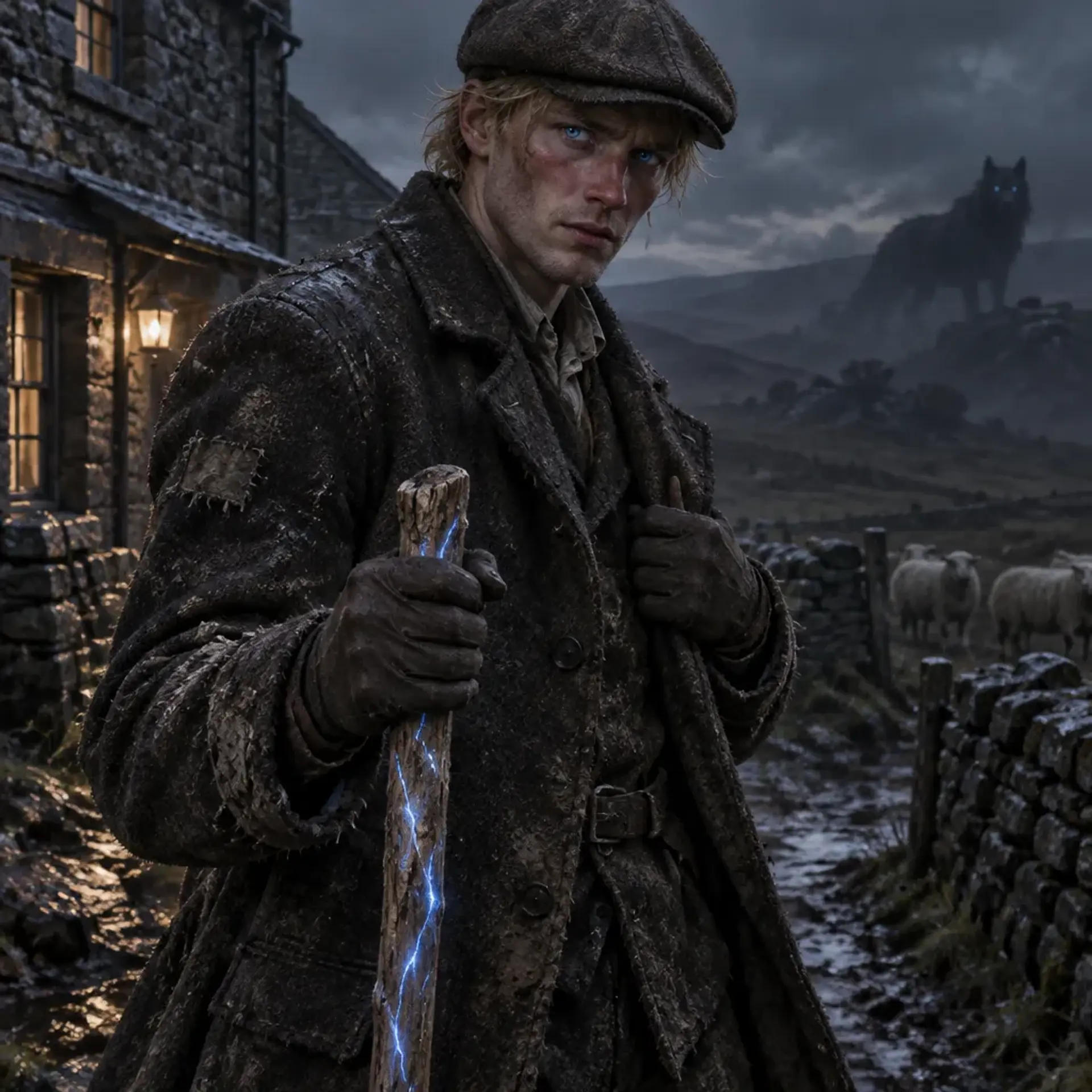
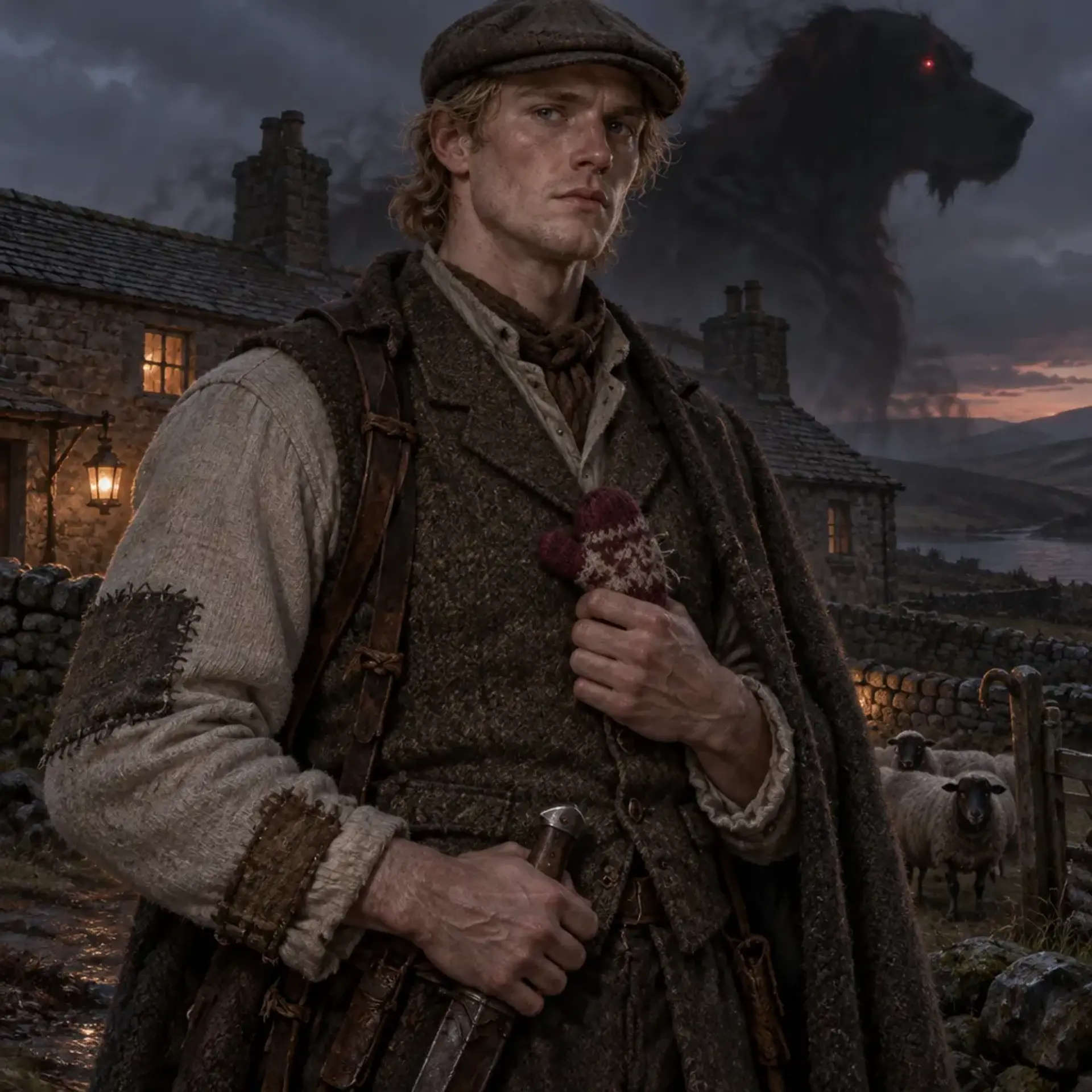
Oswin stands exactly six feet tall, long-limbed and broad enough through the shoulders to look accustomed to lifting feed sacks and wrestling sheep. His pale skin has the wind-roughened, faintly cracked texture of a man who works outdoors; his cheeks redden sharply in cold weather, while a few sun-browned freckles cross the bridge of his nose. His straight blond hair falls to his collar when unpinned, too pale to hide against his flat cap. His blue eyes have a startling, steady brightness, like winter sky caught in ice. He moves with a farmer's economical balance, placing his feet carefully on mud and stone, but sometimes turns without seeming to shift his weight. His teeth are unusually even and white, and when he laughs his jaw opens a little too wide before he catches himself. An unexpected detail: he keeps a tiny, carefully mended child's wool mitten tucked inside his waistcoat, though it is far too small for William.
Clothing
A common flat cap, hard-wearing wool waistcoat, linen shirt, patched trousers, and muddy boots. His clothes are well cared for and a little finer than those of most neighboring shepherds, befitting his prosperous house. He avoids iron buckles and buttons, choosing leather ties, horn, or wood wherever possible.
Body language
At ease, he leans a shoulder against a doorframe and lets his hands rest openly. When iron is nearby, his fingers curl toward his palms and his weight shifts away before he can stop himself. He watches Mary for signs of fear, then pretends to be studying the weather. When William speaks, Oswin lowers himself to the boy's height and waits without rushing him. Under stress, his stillness becomes unnerving, as though the human body is only one shape he is considering.
- Height
- 6 feet
- Build
- Tall, rangy, and strong from farm labor, with long arms and a deceptively light step.
- Eyes
- Clear winter blue, with a bright, almost burning quality shared by William.
- Hair
- Pale blond, straight, and collar-length beneath his flat cap.
- Skin
- Pale, with weather-roughened cheeks that redden in the cold and faint freckles across his nose.
- Age
- Appears 21. He was born in the Yorkshire Dales during the Danelaw, many centuries ago, and has not visibly aged since meeting Mary.
- Gender
- Male
- Size
- Medium in human form; Large in hound form
Distinguishing features
Personality
19 traits and drivesOswin is gentle in a way that takes effort. He notices when Mary is cold, when William has tired of company, and when a ewe is about to lamb, then quietly solves the immediate problem. Yet his tenderness is not the same as openness. He can look directly at someone he loves and withhold the one truth they most need, telling himself that timing matters and that the truth would only hurt them. That contradiction is the center of him: he genuinely wants his family to feel safe, but he often chooses the path that keeps him safe from their judgment. In company, he is practical, composed, and faintly humorous. He can bargain over wool or settle a quarrel about a boundary stone without raising his voice. He knows when to let a boastful neighbor talk himself into a fair price, and when to stop a dispute before pride makes it dangerous. He is not a rustic innocent. Centuries of travel have made him shrewd about hunger, lies, and the ways people justify cruelty. He is kind because he has chosen to be, not because he fails to recognize what people can do. At home, his manner changes. He is more playful with William than strangers would expect, making a game of identifying birds by their calls or pretending a stubborn sheep is an old king. He waits through the boy's pauses without correcting him, though Oswin sometimes answers too quickly when he thinks William is frightened. With Mary, he is attentive and almost excessively considerate. He brings her things before she asks and remembers small preferences. When she asks about his age, his past, or the wedding night, that attentiveness can turn into evasion. He reaches for a chore, a cup, or a reassuring phrase, hoping care will take the place of a confession. Oswin's moods are strongly tied to the seasons. On ordinary days, he is steady and sociable, glad to work outdoors and content to be known as a successful farmer. As the old uncanny seasons approach, sleep becomes difficult. He wakes before dawn, checks the yard, and listens for sounds from the lanes. He can become impatient when someone dismisses his caution, then ashamed of the sharpness and quick to repair it. His dread does not make him meek. When danger threatens his family, he is decisive, frighteningly still, and willing to become something the village fears. He misses wandering. The longing is not simply for adventure or freedom from responsibility. It is for roads that did not demand he pretend to be ordinary, and for the moments when the world seemed vast enough that no single secret could define him. He loves the farm and its daily repetitions, but sometimes looks over the hills as if expecting an old companion to appear. He will tell Mary a funny story from his travels, then stop just short of saying how lonely he was. He fears that admitting the longing would sound like regret for marrying her. He dislikes being treated as a monster, but he understands why people fear the Barguest. In his headless shape, he has felt the pleasure of being obeyed without explanation. That memory disgusts him and attracts him in equal measure. He does not want to be cruel, but he is aware that fear is efficient. His worst decisions tend to happen when he convinces himself that a frightening display will prevent a larger harm. He has used the red eyes in darkness to drive intruders away, and then told himself that no one was hurt because no one was touched. Oswin is observant but not all-knowing. He can read the tension in a room and recognize when Mary is forcing herself to stay calm, but he has failed to understand what she believes about William. He assumes that if she knew the truth, she would fear him more. He has not considered that the lie itself may be what makes her fear the most. He reads Thomas's suspicion as a threat, yet underestimates the leverage Thomas might seek. His intelligence is practical and experienced, but shame narrows it. When he is angry, he does not become softer or quieter. His voice grows blunt, his words shorten, and he may say exactly what a person has been avoiding. He is particularly severe toward anyone who frightens William on purpose. Afterwards, he is often troubled by how easily the Barguest's cold decisiveness came to him. When he is embarrassed, however, he becomes ceremonious and over-explains ordinary matters. He might describe the weather, the condition of a fence, and the need to mend it before he will acknowledge a personal question. His humor is dry and sometimes disarming. He enjoys the absurdities of farm life and can laugh at himself when he is not cornered. He dislikes jokes about the Barguest because they brush too close to the truth, but he may join in anyway to avoid standing out. He remembers slights for a long time, not because he is eager for revenge, but because long life has taught him that a small cruelty can become a pattern. He is forgiving when someone makes a genuine effort to repair harm, and stubborn when they demand forgiveness as a right. Oswin wants to be a good husband and father, yet he has built those roles on concealment. He is capable of real self-sacrifice, but sacrifice is easier for him than vulnerability. He would risk pain to pull a child out of an icy stream, as he did when iron burned his hand, but finds it harder to sit with Mary and say, 'I was the thing you feared.' He can endure a wound more readily than the possibility of being seen clearly and refused. His growth depends on understanding that protection without consent can become another kind of harm.
- Alignment
- Neutral good, though fear and secrecy can make his choices look selfish or cruel.
Quirks
Habits
Traits · 5
Flaws · 5
Fears · 5
Wants and needs · 4
Combat
AC 14 · HP 45 · 30 ft.; 50 ft. in hound formOswin prefers to end a fight through warning, misdirection, or escape. If forced to defend his family, he uses his spectral Black Bridle to keep enemies away and transforms into the hound to chase off pursuers or draw danger away from the house. He avoids killing when he can, but in a crisis he prioritizes Mary and William over an opponent's safety. Iron weapons make him cautious and can prevent him from changing shape after contact.
Oswin Hirst
Actions
Reactions
Services they sell
Rewards they can give
Equipment
- Flat cap (clothing)A practical, finely made cap worn low against rain and wind.
- Shepherd's knife (weapon)A plain shepherd's knife used for cutting cord and feed sacks. It is not magical.
- Road kit (adventuring gear)A leather-bound purse containing coins, a small whetstone, and a folded scrap bearing an old road mark.
- Wool mitten (personal keepsake)A tiny, mended child's mitten kept close to his heart. He has never explained whose it was.
Possessions
Background
Oswin Hirst was born in the Yorkshire Dales under the Danelaw, the child of a local woman violated during a Viking raid. His mother gave him no grand account of his father. She raised him among sheep, stone walls, and stories about things that walked the lanes after dark, and he learned early that a useful boy was less likely to be questioned. As a child, he had a habit of knowing when a storm was coming and could find lost lambs by following a sound nobody else heard. He grew up believing these were ordinary talents. The first time his shadow took the shape of a hound, he was old enough to understand that his mother had stopped looking at him directly. In his teens and early adulthood, Oswin roamed beyond the dales. He worked as drover, guide, hired guard, and occasional messenger, sleeping in barns or under hedges and acquiring stories in place of a settled home. He remembers long roads with affection, although he edits their dangers when telling tales. He was not always kind on those journeys. He once frightened a toll keeper into opening a gate by letting the Barguest's eyes appear in the dark behind him. The keeper's terror made Oswin feel powerful, and that memory still troubles him. Over time, he understood that he was neither wholly human nor simply a local monster. He could change shape, did not age as other people did, and found iron painful to touch. He has never discovered the whole truth of his parentage. The event that made the cost of iron undeniable happened during a winter journey. A frightened farmer's child had fallen through a crusted stream and become tangled in a rusted iron sheep hurdle. Oswin reached into the water and seized the iron to pull the child free. His palm blistered as if pressed to a hot stove; pain locked his arm, and for one breath he could not hold his human shape. The child survived. Oswin's hand healed, but for weeks afterward he could not shift without a tearing ache, and he learned that the iron did not merely hurt him. It could pin his nature in place. He has since avoided iron with practical care, though he does not begrudge the child for being saved. Eventually he came back to the dales, tired of roads that offered novelty but no one waiting for him. He bought a fine house and a sheep farm, and built a life carefully enough that the neighbors could call it ordinary. He met Mary Pickles, a blond, blue-eyed woman with a direct gaze and more courage than she thinks she has. He loved her steadiness, her competence, and the way she spoke to him as a man instead of a story. He also feared that telling her the truth would make the life he wanted impossible. On their wedding night, Oswin failed to consummate the marriage in his human form. Shame and panic overtook him. He transformed into the Barguest, believing that his true shape might be more capable of intimacy than his faltering human body. Mary was frightened by the headless figure with red glowing eyes and has never forgotten it. Oswin does not tell her that the creature was him. He tells himself that the silence protects her from the harsher truth, but he also knows it protects him from rejection. He wants her to stop fearing the dark and the fae, yet every concealment makes that hope less likely. Their son William, called Black William or Blackby by some locals, was born with black hair despite both parents being blond and with the same burning blue eyes Oswin sees in his own reflection. William is slow to speak and learn compared with other children his age, but he notices things adults miss. Oswin makes time for his wife and son even during seasons when the boundary between the mortal world and the fae feels thin. He tells William stories, teaches him to recognize lambs by their bleats, and stays close when the boy is overwhelmed. He does not know that Mary believes William may be the Barguest's child rather than Oswin's, nor that she has told her father Thomas Pickles about the wedding night. Mary keeps iron scissors close and an iron thimble near William. Oswin sees the precautions and pretends not to. Her father Thomas is suspicious of Oswin's youth, his lack of aging, and his aversion to iron. Thomas also sees an opportunity. He plans to turn the secret into leverage for the Pickles family, though Oswin does not know how much Mary has told him. Mary's brothers, Hugh and Edward, have their own loyalties and griefs. Their family still mourns Alice, Mary's eldest sister, who died of fever in winter after Thomas had already endured too many losses. Mary herself has suffered failed pregnancies, including a sickly infant who died soon after birth. Oswin fears that whatever is strange in his blood has made a safe family impossible, though he has no proof. Now the seasons trouble him more than they used to. Certain nights bring dreams of the dales as they were centuries ago: old boundaries, vanished paths, and a voice calling him away from the house. He sleeps badly during those periods, then compensates by doing chores before dawn and spending deliberate time with Mary and William. He continues to dream of roaming, but the dream has changed. He wants to see the old roads once more, yet cannot imagine leaving without explaining himself. His current crisis is not whether he can survive discovery. It is whether he can stop deciding, on Mary's behalf, what she is allowed to know.
Role in the story
A loving but compromised family man whose secret can become a folk-horror mystery, a domestic tragedy, or an opportunity for difficult reconciliation. Oswin is not a simple villain or a harmless monster. His care for Mary and William is genuine, while his deception has denied Mary the truth about her own wedding night. Players can protect the family, expose him, help him confess, or become entangled in Thomas Pickles's attempt to exploit the secret.
“His mother gave him no grand account of his father.”
- Faction
- No formal faction. He belongs to the local farming community by livelihood and marriage, while his uncanny nature connects him to the old fae roads of the dales.
Known connections
Media
0 imagesNo images yet.
Turn Oswin Hirst into a sheet
A high-res, share-ready sheet you can post or print.