Friedreich
Friedreich
At the table
“That is what I have been told,”
Voice
Friedreich's voice has a dry, breath-shaped rasp when he is manifested, as though his throat has only recently remembered its work. Years of imagined commands and real military service give it a clipped, projected quality, with hard German consonants and deliberate pauses. When amused, he lets the ends of sentences turn wry; when angered, he does not become quieter or gentler, but his words become more exact and impatient. In the new body he can laugh, cough, and catch his breath, and each still sounds faintly surprising to him.
His German is strongly marked by Prussian formality: precise consonants, careful word order, and the habit of making a statement sound like a report. His English is understandable but stiff, with occasional German constructions. He uses military and household vocabulary naturally, and describes supernatural experiences in practical terms until emotion breaks through. The name Friedreich is spoken with his own German accent; it does not imply a particular pitch or singing range.
Speech patterns
How to play them
Treat him with respect and include him directly in conversation. He responds well to practical invitations such as a card game, a market trip, a football match, or a hobby group. Do not assume that his body makes him a standard living human or that his face-taking is harmless. Ask before discussing the wars or attempting any spiritual contact. If a character earns his trust, he is loyal and unexpectedly funny; if they ignore him or threaten the coven, his patience can collapse.
Goal
Discover what the Brandenburg spirit intended, determine which memories and loyalties are genuinely his, and find a sustainable way to participate in ordinary life without losing himself to borrowed faces.
Motivation
To be recognized as Friedreich rather than as a ghost, a stolen face, or an instrument of the land; to keep the coven safe; and to learn whether his affection for Wilhelm predates their deaths or was built from shared suffering.
Appearance
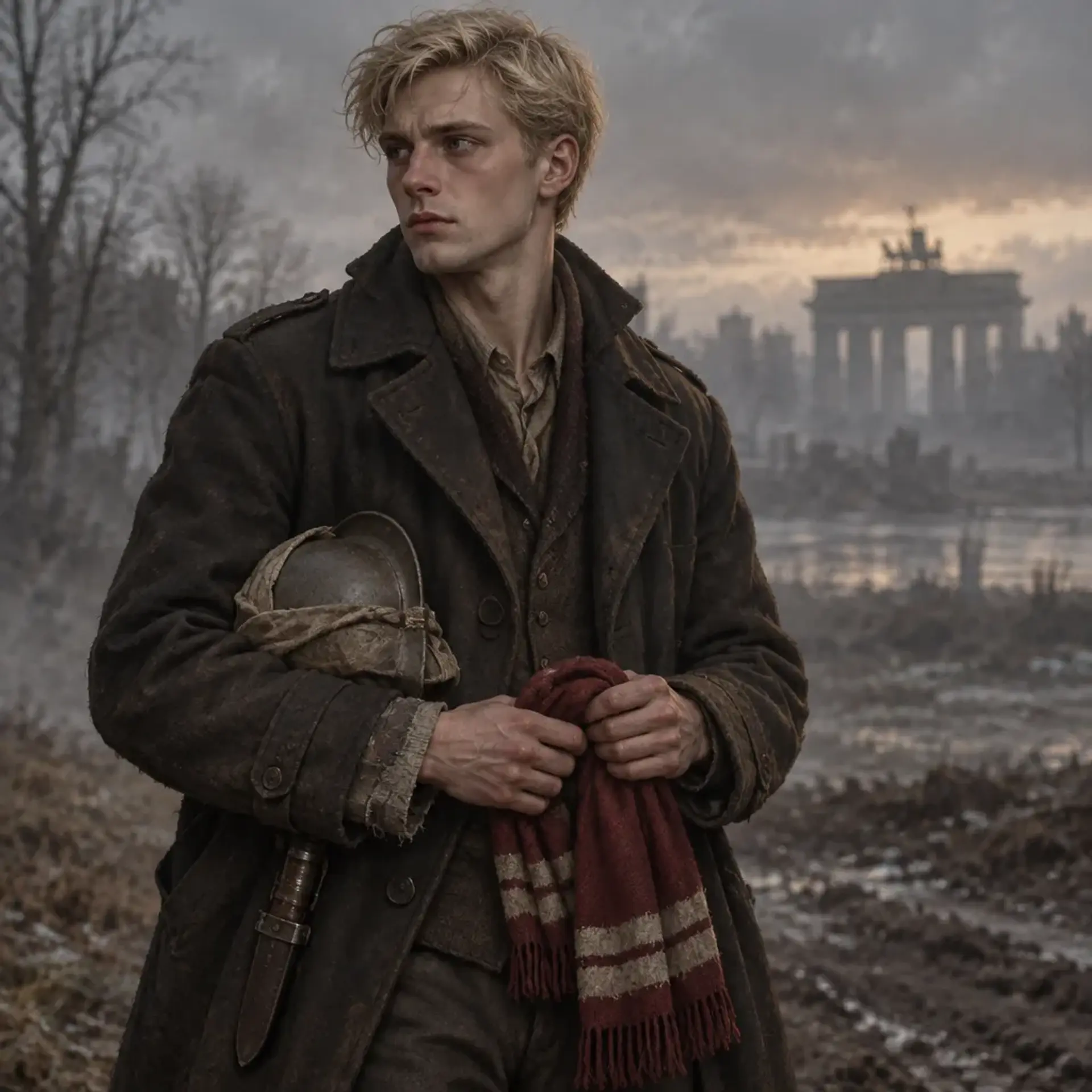
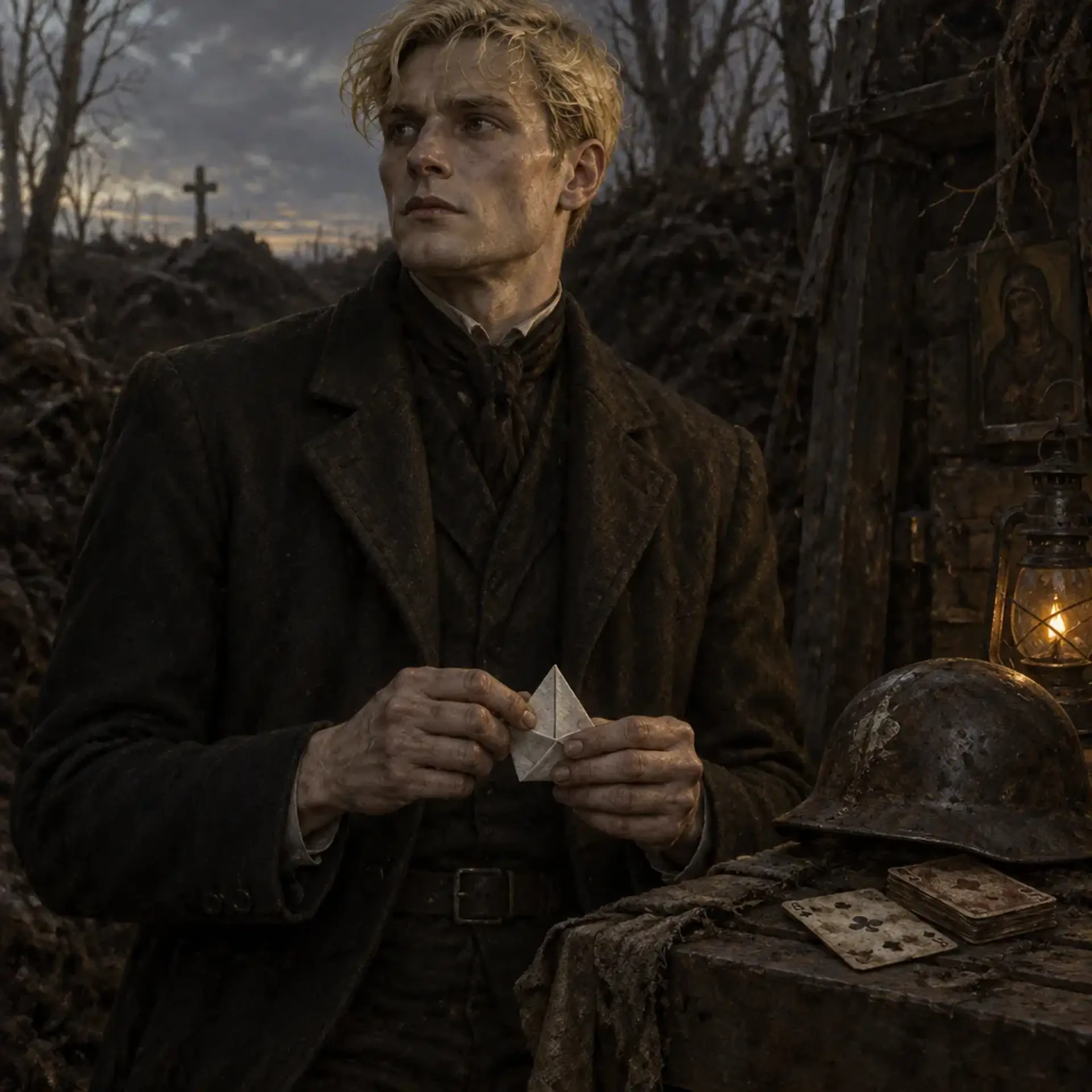
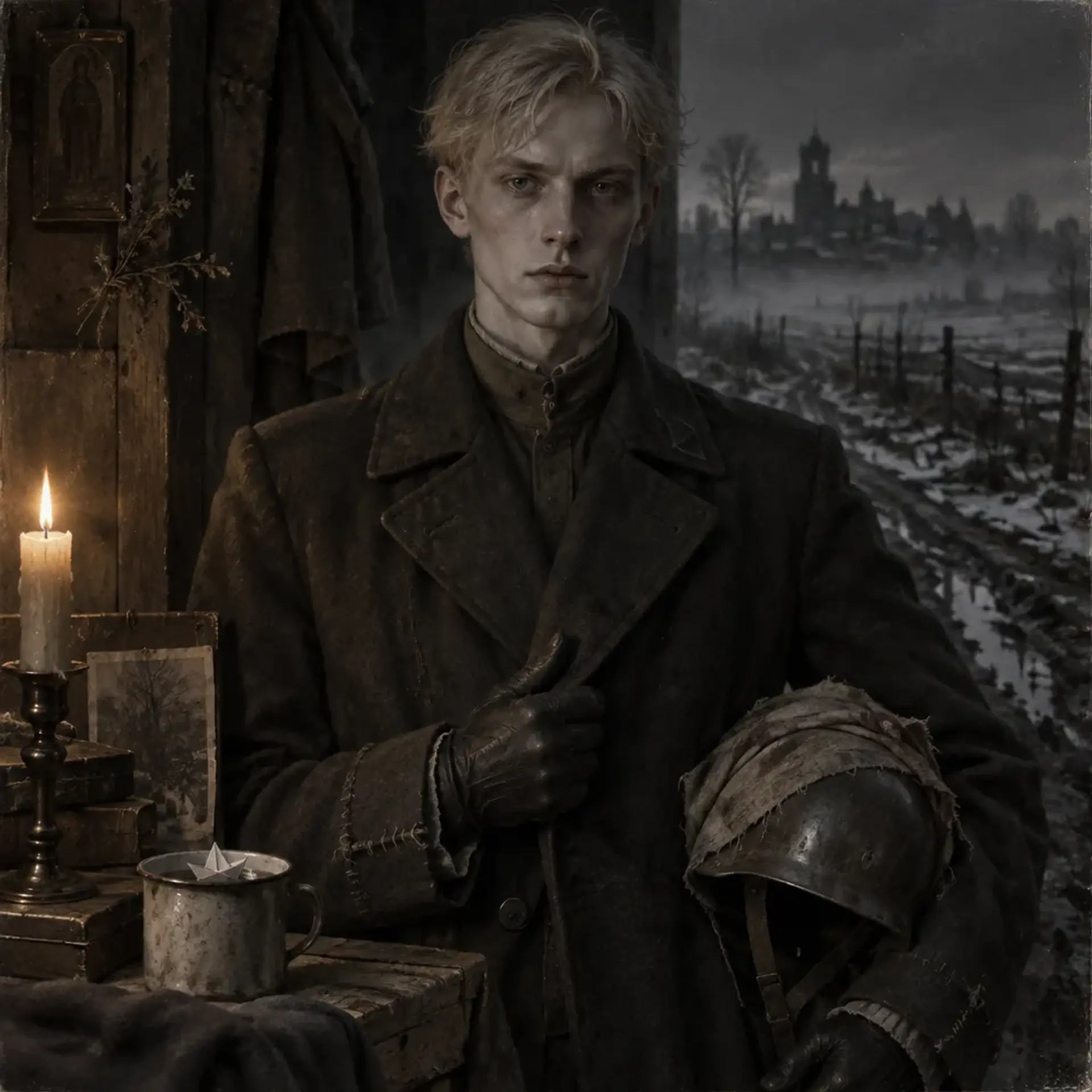
Friedreich's usual borrowed guise is a lean young Prussian man with a compact, drilled posture and a way of turning that seems to arrive a fraction before his feet. The faces he selects tend to be young German men with military, police, or Junker associations. His own remembered face is uncertain: Wilhelm says he had blond hair and grey eyes, and the new body bears those features, but Friedreich cannot tell whether this is recovered truth or the spirit's design. His hair lies flat as if pressed beneath a cap, with a stubborn cowlick that survives every attempt to smooth it. His eyes have the washed grey of winter daylight over Brandenburg fields. When he is embodied, his skin has the faint, dry warmth of someone who has just come in from cold weather; when his attention slips, his outline seems to lose depth, like a portrait seen through old glass. He wears a carefully brushed, old-fashioned coat with cuffs repaired in mismatched thread, and keeps one cracked leather glove polished as if it were parade equipment. He walks in measured, heel-first steps, but sometimes stops so completely that people mistake him for a mannequin. The unexpected detail: when nobody is watching, he folds paper napkins into elaborate little boats and leaves them floating in cups of water, a private imitation of the flooded fields he remembers from the land-spirit's memories.
Clothing
A dark, old-fashioned wool coat, high-collared shirt, neat trousers, and weathered boots. The coat is brushed and carefully maintained, but its cuffs are repaired with visibly different thread. He keeps one cracked leather glove immaculate and carries his old helmet wrapped in cloth rather than wearing it.
Body language
His posture is military by habit, not theatricality. He squares objects to table edges, turns his whole torso to address someone, and stands very still when uncertain. Under stress, he presses his thumb against the seam of his glove. When a borrowed face begins to overwhelm him, his expression lags behind his words as if he is waiting for the face to tell him what to feel.
- Height
- Approximately 178 cm in the new body; borrowed faces vary.
- Build
- Lean, narrow-shouldered, and more durable-looking than his youthful face suggests; his movements are economical, with a drilled stiffness that loosens when he is among friends.
- Eyes
- Grey, according to Wilhelm and the body created at the rite; Friedreich remains unsure whether this is his original eye color.
- Hair
- Blond in the new body and in Wilhelm's account; Friedreich has no independent certainty about his original hair.
- Skin
- Pale with a faint, earth-cool cast when embodied; more like winter skin than a corpse.
- Age
- Appears 17 or 18; died at approximately that age. His current body appears young adult, but the Walpurgis-night transformation has made his age and nature uncertain.
- Gender
- Male
- Size
- Medium-sized human form when embodied; otherwise uses the Storyteller's Wraith manifestation rules.
Distinguishing features
Personality
20 traits and drivesFriedreich is disciplined because discipline gives shape to a life whose first chapters are missing. He speaks of duty as if it were a solid object he can set on a table, yet the duty he feels toward his friends is plainly love. He is protective without being gentle in every moment: he may put himself between Mila and danger, then scold her for frightening him. He admires Wilhelm's endurance and resents his evasions; the same silence that makes Friedreich seek his company makes him suspect that Wilhelm is concealing the worst parts of their shared past. Friedreich can be amused, even boyishly delighted, by football, Christmas-market bargaining, or the novelty of tasting food. That delight can curdle into envy when he remembers that these pleasures depend on a face and body he cannot safely keep. With strangers he adopts a formal, almost old-fashioned reserve, watching for rules before he risks a joke. Among the coven he is more teasing and competitive, especially over cards, though he can turn rigid when a friend is threatened. When people fail to see or hear him, he starts by repeating himself with controlled precision. If the failure continues, his temper surfaces as a clipped order or a sudden withdrawal. The temper has not vanished; it has been worn down by years of distance, which makes its rare return feel more dangerous. He wants to believe his face-taking is a craft he can master. He keeps careful notes, checks that a person is dead or absent, and changes aliases to protect privacy. But he is also drawn to the sensations a borrowed face grants him: breath, sleep, bathing, food, drink, touch, and the possibility of flirting with someone he finds pretty. He knows these experiences can blur his identity and still finds excuses to use them. The Walpurgis transformation complicates his self-control. He now feels bodily life and a vast, impersonal memory of Brandenburg, yet cannot be certain whether the new certainty of purpose belongs to him or to the spirit. Friedreich's morality is earnest but compromised by the belief that protection justifies force. He has killed hunters who pursued the coven and a Get of Fenris who threatened Klaus. He can describe these acts as necessary, but he does not enjoy remembering them. His shame about violence is tangled with an older military ideal: he fears that refusing to act will make him a coward, while acting too readily may make him a weapon. He is loyal, curious, and capable of tenderness, but also envious, suspicious, and hungry for an ordinary life he cannot define. He does not want pity. He wants to be asked whether he is coming along.
- Alignment
- Protective, duty-bound, and increasingly estranged from human moral categories; not reliably lawful or good.
Quirks
Habits
Traits · 5
Flaws · 5
Fears · 5
Wants and needs · 5
Combat
HP 7 · Use the movement rules for the relevant Wraith state and chronicle; his custom embodied body has no separate canonical speed value.Friedreich avoids a fair fight where possible. He uses cover, ambush, and an ally's protection, and prefers to make an opponent hesitate by appearing familiar or by placing himself between danger and a friend. As a wraith, his physical effectiveness depends on his current manifestation and the chronicle's rules. His unusual post-rite body should not be treated as standard Wraith resilience. When cornered, he fights directly and without flourish, then becomes disturbed by how readily the land's memories can make violence feel like duty.
Friedreich
Actions
Reactions
Services they sell
Rewards they can give
Equipment
- Old helmet (personal relic)An old helmet from Friedreich's life, wrapped in cloth. It was used in the Walpurgis rite and is a powerful reminder of his uncertain past.
- Face list (record)A handwritten record of borrowed faces, aliases, known whereabouts, and intended uses. He changes names and avoids using a face when its original is believed to be nearby.
- Polished glove (clothing)A cracked leather glove that he keeps polished and handles when uncomfortable.
- Playing cards (keepsake)A small pack of playing cards used at gatherings and during the first possession experiment with Wilhelm.
Possessions
Background
Friedreich remembers Brandenburg as a sequence of commands, cold mornings, and the need to stand correctly when someone important entered a room. He does not remember his parents' faces, the name of his regiment, or whether Wilhelm was truly beside him before death. His first memories are of being young, German, and expected to obey. The gaps are not peaceful: they are missing boards over a deep drop. Wilhelm, a Tzimisce vampire from Mecklenburg who has also lost his life-before-death memories, sometimes supplies fragments. He once said Friedreich had blond hair and grey eyes. When Friedreich pressed him for more, Wilhelm became solemn, then dryly evasive. Friedreich suspects that Wilhelm's shame about the wars distorts everything he says, but the new body has those very features. The first time Friedreich took a face, he had been trying to make a living woman notice him. He had spent an afternoon repeating a name to himself, a young man he had seen in an old photograph and later confirmed dead. In a brief opening between the Skinlands and the Shadowlands, the face settled over him like a damp uniform. He expected to see a mask; instead, he felt breath catch in his chest, a tongue against his teeth, and the astonishing drag of cloth across skin. He laughed, then cried, because the woman looked directly at him and answered. He spent that evening eating a roll he could not truly digest and sleeping in a borrowed bed, convinced that he had found a way back to ordinary life. The face was not ordinary. By morning, he struggled to remember which of his thoughts had belonged to him. He built a list to keep that from happening again. It records faces, aliases, where a person was last confirmed to be, and what each guise is useful for. He chooses people believed dead or safely away from the local area, usually young German men whose appearance recalls his own uncertain past: a dead auxiliary policeman for errands, a missing conscript for crowded public places, a deceased minor Junker for formal company, and an absent railway guard for practical work. He changes names between uses and notes sensations as carefully as appearances: which face lets him taste coffee, which can sleep without dreams, which makes him feel handsome enough to flirt with women he finds pretty. He is testing whether he could keep a modest job or join a hobby group without becoming lost in somebody else's life. Friedreich's afterlife has not been gentle. He fought where he could during both world wars, though his memories of the first include the impossible recollection of drawing breath. He is furious that Wilhelm deserted in the First World War and at what Wilhelm did in the Second; Wilhelm's rare apology over the earlier desertion has never repaired the later silence. Friedreich has defended Wilhelm from other vampires, protected Gunther from hostile changelings, killed three hunters who pursued his chosen family, and killed a Get of Fenris who tried to kill Klaus. He does not tell these stories as victories. He describes them as duties finished, then avoids the faces of those he killed. His closest afterlife has been a loose coven of supernatural friends: Wilhelm; Gunther, a changeling who spent much of his existence in Arcadia and now sells moss-based clothes; and Klaus, a ronin Get of Fenris, or perhaps a skin-dancer, who refuses to say which. Klaus is casually cruel to most people and unexpectedly hesitant around Friedreich. Mila, a mage from Bremen, can see and touch Friedreich even when he has no borrowed face. He calls her his little sister and protects her out of duty, not because he thinks her weak. The group plays cards, hunts, fishes, drinks, and watches football. Holidays matter. Friedreich loves the Christmas market, where he advises friends on bargains and sometimes urges them to buy the things he cannot keep. He has also tried church services, partly because the ceremony gives him something to follow and partly because he misses being included. Curiosity about possession led to three painful experiments. First, Friedreich and Wilhelm agreed to try it during a card game. The cards were a focus, a shared task, and an excuse to make the attempt feel manageable. Friedreich pressed at Wilhelm's body and found its vampiric stillness like a locked house with someone awake inside. Wilhelm permitted the effort, but did not surrender himself. For a moment they felt the same hand and the same card; then Friedreich's memories crowded the room, while Wilhelm's body supplied no living warmth, hunger, or ordinary pulse to meet them. Wilhelm could not receive the human emotions Friedreich hoped to give him. He could only identify the intrusion and resist it. The experiment ended in nausea and a hard silence. The proposed test of whether Wilhelm could drink alcohol remained a joke they could not make themselves finish. Later, Gunther's curiosity about what a wraith and changeling might share led to another attempt. The contact was more confusing, not less. Friedreich encountered sensations and impressions that did not arrange themselves into human memory, while Gunther felt an alien pressure trying to use his body as if it were a borrowed room. Neither could tell whether a fragment was a shared memory, a passing image, or the other's fear. Gunther asked more questions afterward; Friedreich said, 'Never again,' and meant it. He and Wilhelm made one last agreement to try again. That attempt established no easy communion and recovered no lost history. It did leave Friedreich convinced that consent and affection do not make a body safe to enter. The account Klaus gave of Friedreich's Caul is stranger than any memory Friedreich can verify. Klaus said it was not a wraith, mage, or occultist who opened it, but an intentional spirit of land and people. He described a Wyrm-spoiled gift, Weaver-shaped adoption, and a trace of Luna, language Friedreich cannot confidently interpret as canonical truth. When Friedreich awoke, a willow-wisp remained where the repeated marching of his old self had been. He suspects Klaus knows more than he admits. Friedreich's time in the Shadowlands has included the usual dangers of a dead soul, including the pull of the Tempest, the threat of Spectres, and the alien authority of Stygia. His experiences are personal chronicle events, not claims about a universal history: a Spectre once mimicked a comrade's marching cadence to lure him off a safe route, and Stygian agents treated his face-taking as useful property rather than a person. He escaped the latter by wearing a dead man's face and pretending to be an obedient courier. Everything changed on Walpurgis Night, April 30, in the Harz Mountains. Mila, Gunther, Wilhelm, and Klaus tried to make Friedreich alive again. They prepared Brandenburg soil, human blood, metals, and his old helmet, then formed a naked human body that breathed softly as if asleep beside a great bonfire. Wilhelm used Vicissitude and Koldunic sorcery; Mila bent reality; Gunther supplied Glamour and gifts that could make miracles happen; Klaus brought knowledge of spirits and Garou rites. They intended to make a Risen, believing they could ease Friedreich out of death and keep him safe. None understood what they had set in motion. During the rite, Friedreich felt the earth welcome him with a familiar, demanding attention. The willow-wisp watched. Something inside the work bent his soul, psyche, and Shadow toward service. The body lurched upright, its formation a sensation of melting and being forced into a shape. He remembered his family, youth, and death, but also the land across thousands of years: frozen ground, flooding, fields changed by people, and the accumulated grief of place. A lesser spirit of Brandenburg, made from the land and its people, had answered the rite. It was not the same will that had once opened Friedreich's Caul, and it was not a fully thinking spirit; nevertheless, it had agency enough to seize the ceremony and use it. The coven's wills were caught in the same transformation. Friedreich understood, with horror, that the rite had made them kin by binding their identities to places and purposes they had not chosen. The exact nature of the others' changes remains uncertain, and this account does not claim their new states as canonical types. Bare, bloody, and breathing, Friedreich stood before his friends. Mila wiped blood from his eyes and mouth. Wilhelm came close, his eyes bright with relief, then faltered when Friedreich spoke. Friedreich did not kill them. Instead he performed what he understood as a duty to the Fatherland, completing the rite in a way no one present can fully explain. He claims it was brief, but each of them remembers the moment differently. By dawn, he was cleaning the ritual space, telling the others to rest and that the pain had happened only once. He called them brothers and sister. He could smell grass, feel dirt beneath bare feet, and watch his breath in the cold. He no longer needed to steal a face to be seen. His voice was rough with an almost teasing calm, and he did not smile. The coven says the rite was meant as a gift. Friedreich now wonders whether the spirit chose him deliberately and whether his old ideals were merely convenient material. He refuses to call the transformation proof of any historical ideology. Yet he has memories too old to be his own, and a new body that makes every remembered breath feel like evidence. The group remains together, but affection now shares space with suspicion. Friedreich's current problem is not simply learning to live again: it is determining which of his orders, memories, and loyalties are his, and whether his friends have been made into something that can still choose.
Role in the story
A deeply personal ally whose uncertain resurrection turns a familiar ghost story into a question of consent, identity, and inherited duty. He can be a guide to the Shadowlands, a protector of the coven, and a witness to the cost of supernatural experiments. His new body is not a simple cure: it makes him feel alive while raising the possibility that he and his friends have been bound to a spirit's purpose.
“He does not remember his parents' faces, the name of his regiment, or whether Wilhelm was truly beside him before death.”
- Faction
- The supernatural coven of Wilhelm, Gunther, Klaus, Mila, and Friedreich; no formal faction allegiance established. The Stygian authorities and the Shadowlands are powers he has encountered, not organizations he serves.
Known connections
Media
0 imagesNo images yet.
Turn Friedreich into a sheet
A high-res, share-ready sheet you can post or print.