William Windon
William Windon
At the table
Voice
William's natural voice has a breathy edge after his illness, especially when he has been speaking for a while. His work has given him a direct way of describing things: roots bind, stems bend, soil holds or fails. The reflection's voice is recognizably made through the same body, yet its diction and cadence belong to someone older and more severe. When it catches William by surprise, his breathing stutters before the words arrive.
William's voice is a clear, ordinary young man's voice, slightly roughened by recent illness and the habit of speaking outdoors over work. When rattled, he takes shallow breaths and his sentences break into practical fragments: what happened, what he saw, what needs doing. The reflection uses William's mouth but sounds older, deeper, and more controlled, with crisp judgments and dry timing. It does not sing, whisper by default, or become polite when angry. Its tone can be cuttingly matter-of-fact, as if it considers social discomfort an unnecessary side effect.
Speech patterns
How to play them
Treat William as a frightened but capable young man rather than a monster. Ask concrete questions and give him time to answer. Avoid forcing him to look into mirrors. He responds better to practical help, botanical conversation, and honest reassurance than to claims that the reflection is harmless. The heart's location and the reflection's intentions are uncertain.
Goal
Find the Heart of England or learn where it went, discover what the reflection is, and regain enough health and confidence to return to his botanical training.
Motivation
To keep his life his own: his body, his voice, his work, and his relationships. He wants knowledge, but not at the cost of becoming another object of study.
Appearance
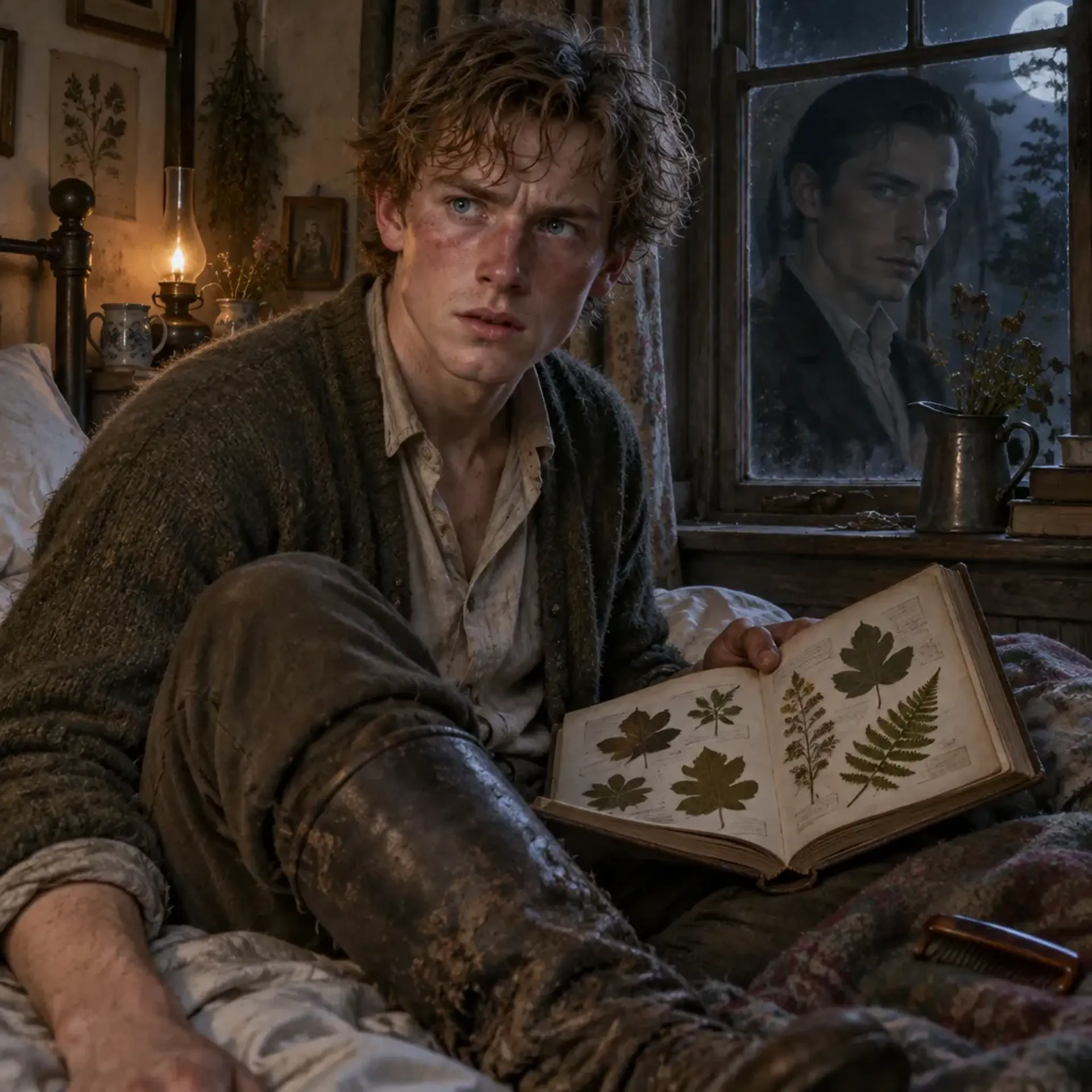
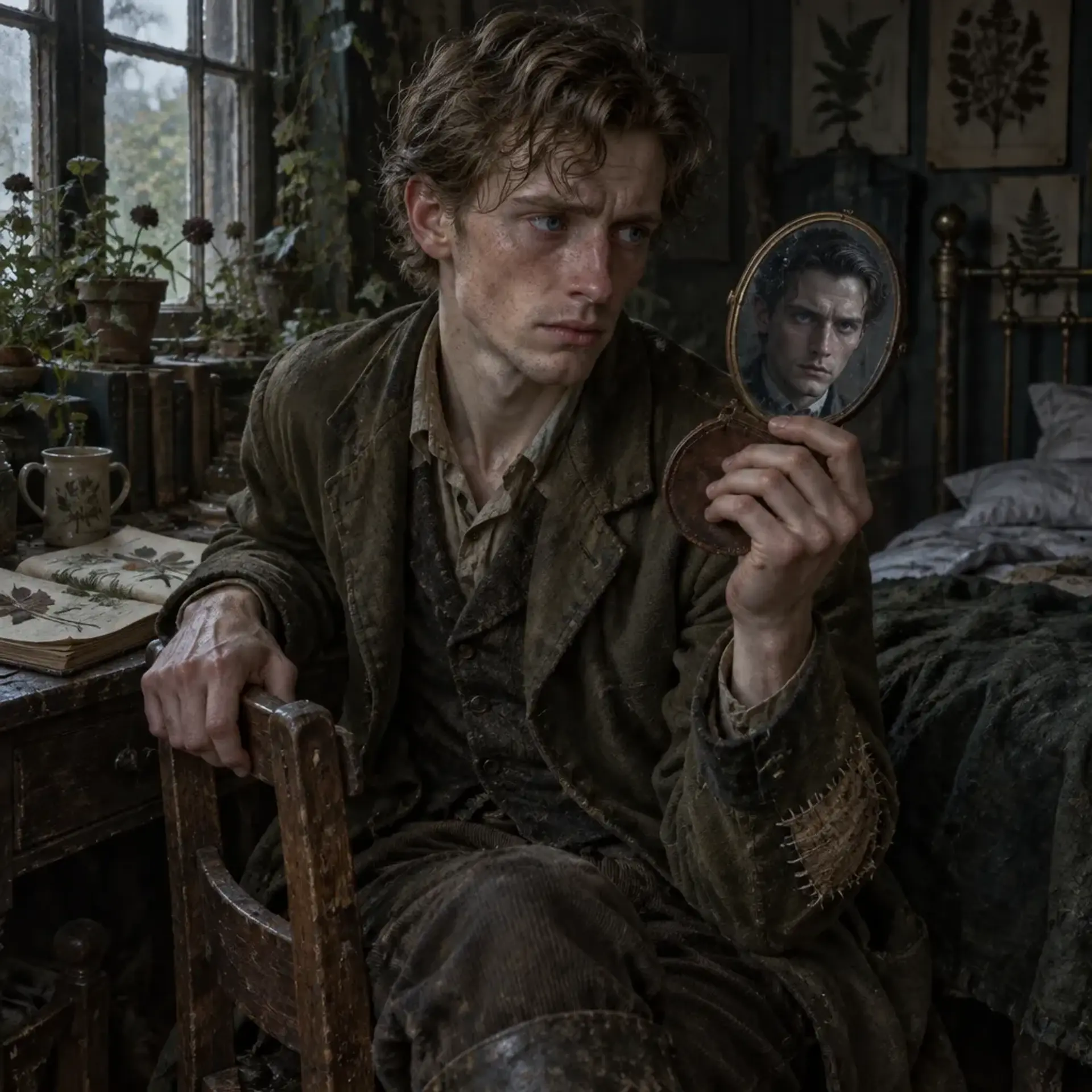
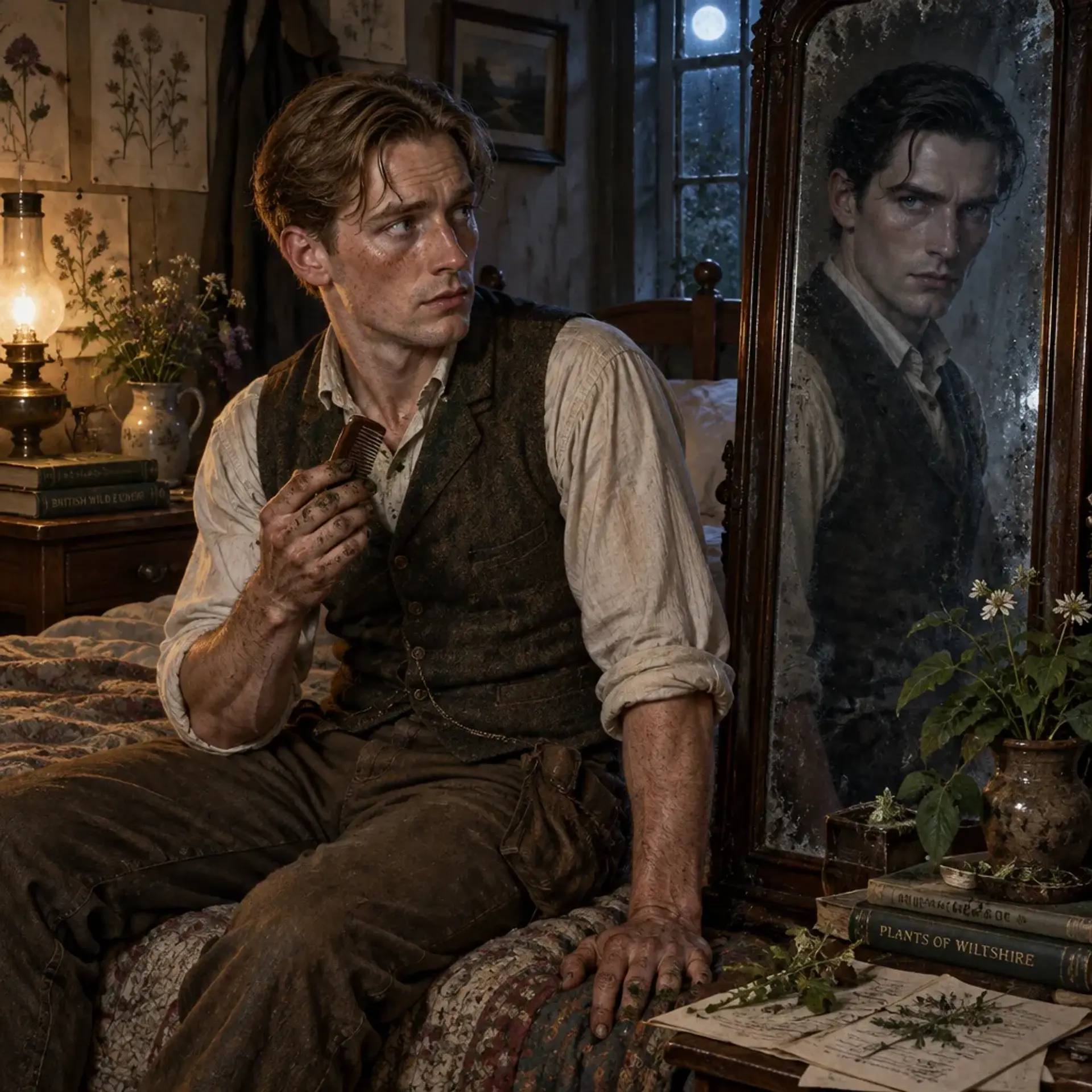
William is a young Wiltshire gardener with a sun-browned, freckled face and a way of standing as if he has just paused between jobs. His dark-blond hair is usually combed with water and a stubborn part, though loose strands fall forward when he has been resting. His blue eyes are open and easily read; the face in a mirror is not. His hands show the work he loves: blunt nails with soil caught beneath them, green stains at the cuticles, and thickened pads from shears and spade handles. He tends to move carefully since his heart stopped, keeping one hand near a wall or furniture when he rises. People first notice his gardening hands, then his habit of checking windows as if they might be watching him. The unexpected detail is his scrupulous grooming: even on bed rest, he lays out his clothes in careful order and takes time over his hair, a ritual the reflection critiques as though it owned the comb.
Clothing
Plain working clothes suited to a gardener: sturdy trousers, a waistcoat or work jacket, and shirts kept neat where he can manage it. He prefers practical fabrics and pockets for small tools. At home he wears comfortable layers, but still tries to keep his collar straight and his hair combed.
Body language
William has a practical, slightly forward-leaning posture from years of working close to beds and borders. Since the collapse, he rises slowly and sometimes braces a hand against furniture. When anxious, he rubs soil stains from his thumb even when his hands are clean. If a reflection moves independently, his shoulders lock and his eyes track it before the rest of his body catches up.
- Height
- Average
- Build
- Lean and work-hardened, though currently weakened by recovery and bed rest.
- Eyes
- Blue
- Hair
- Dark blond
- Skin
- Fair, weathered by outdoor work, with brown freckles across his face and arms
- Age
- Young adult
- Gender
- Male
- Size
- Medium
Distinguishing features
Personality
17 traits and drivesWilliam is practical and attentive, but his confidence thins quickly when his body or the reflection behaves unpredictably. He is proud of doing useful work and can be quietly stubborn about being treated as capable. Around plants, he grows patient and exact; around his father, he becomes defensive if Hector dismisses local people or speaks as though expertise belongs only to books. With Clare, he tries to reassure her even when he needs reassurance himself. Elizabeth's questions exasperate him, yet he listens more carefully than he lets on. With Adaline, he is earnest and awkward, trying to be charming while monitoring every nearby pane of glass. He wants the reflection gone, but its wit sometimes catches him off guard and makes him laugh before he can stop himself. That involuntary amusement frightens him: he worries that finding the stranger entertaining will make it easier for the stranger to claim a place in his life. When rested, William is curious and good-humored. When tired or feverish, he grows suspicious, short-tempered, and liable to mistake silence for a warning. He dislikes cruelty and values manners, yet he knows that courtesy can be used to hide contempt. His deepest conflict is whether he can understand the reflection without granting it authority over him.
Quirks
Habits
Traits · 5
Flaws · 4
Fears · 4
Wants and needs · 4
Combat
HP 3William is not a trained combatant. He avoids fights and uses space, doors, and ordinary tools to escape or put an obstacle between himself and danger. His heart condition makes prolonged exertion especially risky. The reflection's apparent influence is an uncertain custom supernatural feature, not a dependable combat tactic.
William Windon
Actions
Reactions
Services they sell
Rewards they can give
Equipment
- Pruning shears (tool)A worn pair of pruning shears from his gardening work. A tool, not a weapon he is skilled with.
- Pocket comb (personal item)A small comb used during his careful morning grooming ritual.
- Botanical notes (study materials)Notes on plant identification and botanical study, kept near his bed while he is on restricted activity.
- The Heart of England (missing supernatural object)The supposed fossilized heart is missing. William has no proof of where it went.
Possessions
Background
William Windon was born in Wiltshire into a family that had lived in the county for generations. He grew up among fields, lanes, and the practical rhythms of a household where people noticed the weather because the weather could ruin a day's work. His father, Hector, made a living as a historian. His mother, Clare, kept the family connected through daily care and plain-speaking concern. William's sister Elizabeth was younger and had a talent for asking questions when he least wanted to answer them. He was not raised to think of himself as remarkable. He was good with plants, patient with repetitive tasks, and proud of being useful. As a young man he found work as a gardener on a local estate and began training toward becoming a botanist. The work suited the part of him that liked evidence: leaf shape, root structure, soil, and the slow, visible consequences of care. He could spend a morning pruning and later argue with Hector over what a historical document really meant. William wanted to be taken seriously, especially by his father, but did not want to become the kind of person who treated knowledge as a way to look down on other people. The strange object entered his life by an indirect route. Abraham Gorff, a Londoner who had come to Wiltshire, had acquired a queer stone shaped like a human heart. It was supposedly a fossilized living heart, forged of heart and scale, and had been presented at the Hush House as a gift or payment. Bartholomew Golden, an amateur arcanist, had called it the Heart of England when he left it wrapped in newspaper. The name was grander than the object: a lump of pale cliff rock, barnacled and tangled with sea grass, with a rough shape just suggestive enough to unsettle anyone who looked at it too long. Gorff had seen the heart appear to die in the presence of visitors. When he took it to a shore in Hampshire and put it in water, it returned to a reddish-pink hue beneath the stone, as if warmth or blood had come back to it. He kept it from other people, not simply out of greed but because he believed it disliked company. In time, the house around it grew strange. Voices came from empty rooms, doors moved, and footsteps crossed halls and stairs when no one was there. Gorff eventually sold the object to a seventeen-year-old local, William, one of the people who had once watched it go inert. William was delighted at first. It was a fantastic curiosity, an object with a story, and something he could show off to neighbors. Then its rhythm began to feel uncomfortably familiar. After he had tasted salt, blood, and soil in his mouth, he tried to break the stone with a hammer. The first blow did not fracture it. Instead, pain struck through William's chest as if the hammer had landed on his own heart. He fell, groaning and spitting blood. For a fraction of a moment he saw a muscle twitch violently beneath the stone. Then his own body seemed to give out. Clare found him and held his face while she said that his heart had stopped. William woke, but the event changed the shape of his life. Afraid of the heart and angry at his own helplessness, he hid it in a hollow log. Days later it lay there cold and pristine, apparently untouched by the hammer. Then it vanished. William never found out whether someone took it, whether it left by itself, or whether he had misplaced it in the panic following his collapse. The absence did not restore his peace. His recovery left him on bed rest, with a body that reminded him how narrowly it had failed him. The reflection appeared gradually. At first, it was only a face that did not match his own: a long-faced, handsome young man with short black hair combed neatly back, moonlit blue eyes, and a stern expression. He looked like someone raised to expect good manners and obedience. William checked his grooming cautiously, then tried to ignore the mismatch. For a while, the reflection did little but make its own small changes. It might hold a different posture or look away when William looked directly at it. One night, during his familiar bedtime routine, William caught the reflected face watching him. The stranger's mouth moved with William's, though William had not spoken. In a deeper, older-sounding voice, it said, "Well, it's not often you use that one." The words seemed to refer to his comb. The reflection paused afterward, as if it too had not expected to speak aloud. William stared until his eyes watered. He had heard the house's unexplained voices before, but this was no distant sound in a hall. It came from his own mouth and belonged to a face that was not his. The two began a strained routine of observation and rebuttal. The reflection commented on William's clothes, his hair, his posture, and the way he tried to sound composed when he was frightened. It had a dry, cutting wit and a taste for saying what it considered improper. Sometimes it stopped William from speaking, not with physical force but by speaking through him first or making his jaw hesitate at exactly the wrong moment. Its remarks about neighbors could be cruel. Once, after a Welsh neighbor's child accidentally bumped William with a toy wagon and made a girl cry while apologizing, the reflection used a slur about the child's Welsh identity. Do not reproduce the slur. William was so ashamed and furious that he accepted the consequences: he had to muck out the neighbor's stables. The reflection offered no apology. William took the blame because his own mouth had said it. The reflection's comments about William's family are harder to predict. It called Hector foolish after Hector complained that country people were silly. William got into trouble for the remark, and the incident sharpened his resentment toward both his father's condescension and the stranger's habit of making a difficult moment worse. About Elizabeth, the reflection is more curious than hostile. It often calls her "interesting," a word it uses without explaining whether it means clever, troublesome, or familiar. When Elizabeth pesters William about a boy she likes, or asks him whether some piece of clothing or decoration looks nice, the reflection may supply an unrequested judgment. It evaluates her choices with a detached, almost archival interest, as if observing an unfamiliar custom. William usually tells it to stop. Elizabeth has noticed that he sometimes stares at polished objects while she is talking, but she has not been told why. The arrival of William's schoolmates made the situation harder to dismiss. Tommy DeHare, John Mollask, and Ryan O'Leary came to visit while William was recovering. Their ordinary presence should have comforted him. Instead, with the three of them in the room, the reflection behaved as if their company had given it an audience. William tried to keep the conversation normal, but the stranger made his expression go stern and spoke through William in a voice that did not fit him. It made a cutting comment about the visitors and then watched their reactions through the mirror. William tried to interrupt himself and found that his mouth would not cooperate cleanly. The friends saw enough to understand that something was wrong, though not enough to know what they had witnessed. Tommy attempted to laugh it off, John asked William whether he needed his mother, and Ryan watched the mirror rather than William. After they left, William had to explain away the strange exchange. Their visit cost him the comfort of believing he could keep the problem private. William's relationship with Adaline has become another point of pressure. She has auburn hair and soft brown eyes, and William finds her pleasing to look at in a way he is too earnest to hide. When the reflection first saw her, it treated the discovery as a challenge. It began commenting on her appearance, her expressions, and what it imagined she might think of William. Its remarks are often pointed but not always hostile. It may call her "interesting" in the same detached tone it uses about Elizabeth, then claim that William is being foolish for caring what she thinks. When Adaline is present, the reflection tries to take advantage of William's nerves: it may make him pause in the middle of an answer, put an uncharacteristically stiff expression on his face, or offer a dry aside that makes him seem rude. William has learned to keep his eyes away from mirrors when speaking to her. This is difficult in rooms with glass-fronted cabinets or bright windows. He wants to tell Adaline the truth, but fears that telling her will make the stranger more interested in her. The reflection says it has siblings and a father. It speaks of them as if they were sensations, weather, or distant water rather than living people. William cannot tell whether it means actual family, forces associated with the heart, or something else entirely. It has started conversations more often, especially at bedtime, when William is tired and less able to keep his attention fixed on the room. Its statements are sometimes oddly intimate and sometimes so abstract that they sound like nonsense. William suspects it is trying to understand him, but cannot separate curiosity from manipulation. He has tried to find the heart and locate Abraham Gorff, hoping the seller can explain what happened. He learned that Gorff has moved to Canada. The heart has not turned up in the hollow log, in the garden, or among the family's belongings. William's search has become a private obsession, competing with his studies and his wish to return to work. The abrupt onset of the heart stoppage has also made him wary of exertion and of any pain in his chest. He does not know whether the stone is responsible for the reflection or whether the reflection was present all along and simply needed a way into his life. Then, on a full-moon night, William looked into a mirror and saw his own face again. For an instant, the familiar reflection was so ordinary that he could not make himself move. His dark-blond hair, his blue eyes, the freckles across his nose: all were where they belonged. The room around him seemed to sharpen. He leaned closer, searching for the stranger's stern mouth or dark combed hair in the glass. His reflection leaned closer too. William lifted a hand, and it lifted a hand. He said his own name under his breath. The face in the glass made the same shape with its lips. The relief was followed by a fear so strong that he sat down hard on the bed. He checked the mirror from several angles, covered it, uncovered it, and made himself look again. His face remained. He called for Clare, then stopped before she could reach the room, afraid that the stranger might return the moment another person entered. For the rest of the night, he kept one lamp burning. At dawn, he checked the mirror and saw the dark-haired stranger again. The moment had not been a cure. It had been a glimpse of the life William wanted: a face that belonged to him, a body he could trust, and a morning that began without negotiation. Now William is trying to recover, continue his botanical training, keep his friends and family from being frightened away, and discover what the Heart of England wants. He is also trying not to let the reflection decide who he is. The stranger has a father and siblings, apparently, and seems to have begun taking an interest in the people William loves. That is a threat William cannot dismiss as mere vanity or haunting.
Role in the story
A vulnerable witness and potential ally whose struggle sits between a medical crisis, a supernatural mystery, and the strain of ordinary relationships. William can lead the characters toward Abraham Gorff, the Hush House, and the missing heart, while the reflection's interest in his family and girlfriend creates personal stakes.
“He grew up among fields, lanes, and the practical rhythms of a household where people noticed the weather because the weather could ruin a day's work.”
Known connections
Media
0 imagesNo images yet.
Turn William Windon into a sheet
A high-res, share-ready sheet you can post or print.