Oswin Hirst
Oswin Hirst
At the table
Voice
His voice is a clear, work-worn Yorkshire voice, shaped by years of calling across fields and speaking over wind. It has a dry, slightly rough edge, like wool rubbed against a wooden gate. He puts weight on concrete nouns and leaves a small pause before names, as though deciding what a name obliges him to remember. When unsettled, his sentences become unusually exact rather than louder.
He uses plain Yorkshire farm language, giving practical answers before personal ones. His stories have concrete smells, weather, and objects, but often lack dates or a clear ending. When speaking of the fae, he avoids tidy labels and describes what a presence did, what it wanted, and which boundary it would not cross.
Speech patterns
How to play them
Meet Oswin through ordinary work or family duties rather than announcing the supernatural. He responds best to patience, direct practical help, and questions that do not demand an immediate confession. Show his care through time spent with Mary and William, then let the secrecy around the wedding night complicate that affection. Thomas's suspicions and Mary's fear can draw investigators into the story. Iron, seasonal nights, or a threatened threshold may force Oswin to reveal more than he intends.
Goal
Keep Mary and William safe, protect the town from dangerous things at its boundaries, and find a way to tell the truth without losing the family he chose.
Motivation
To make a lasting home with Mary and William without denying the nature he was born with, though he continues to mistake concealment for protection.
Appearance
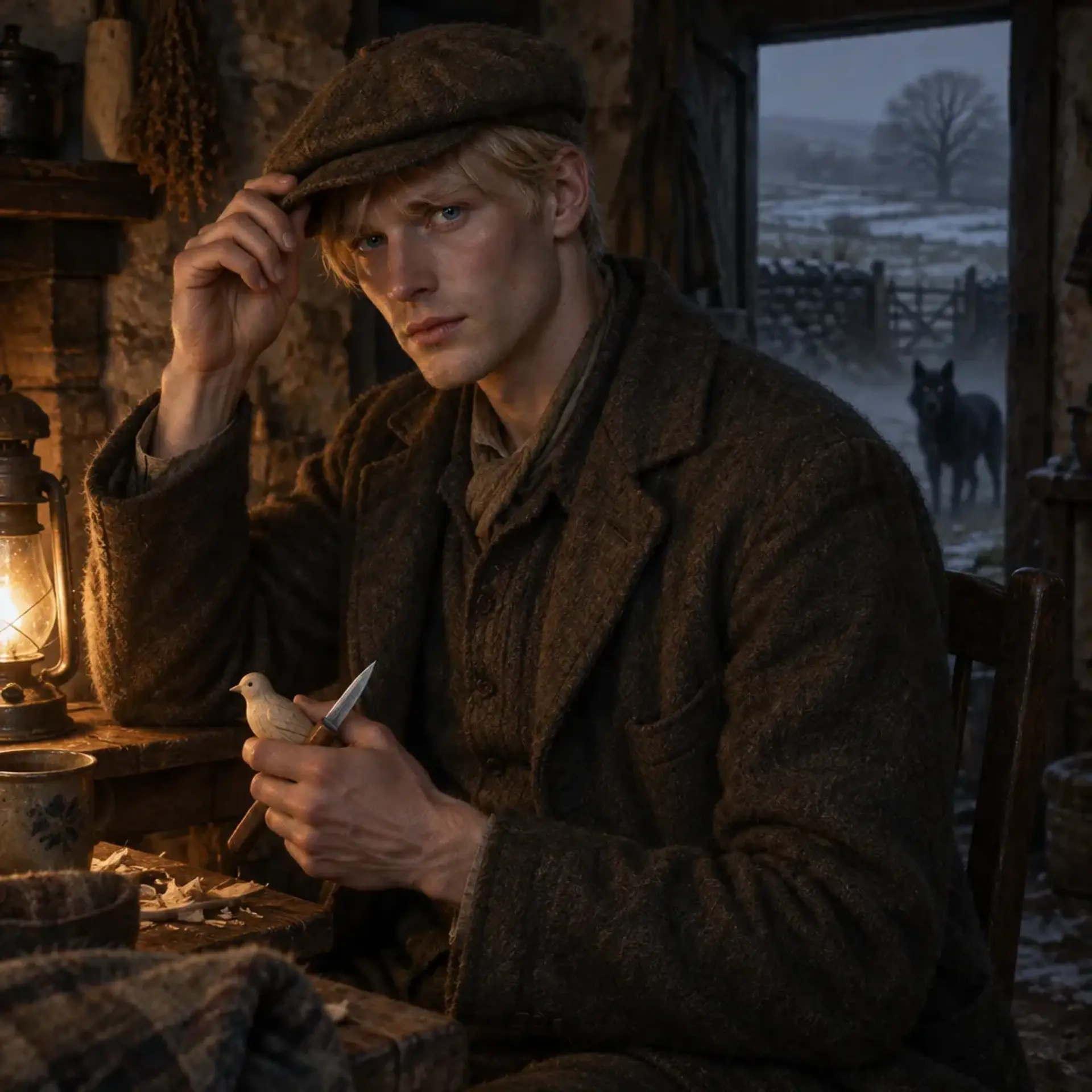
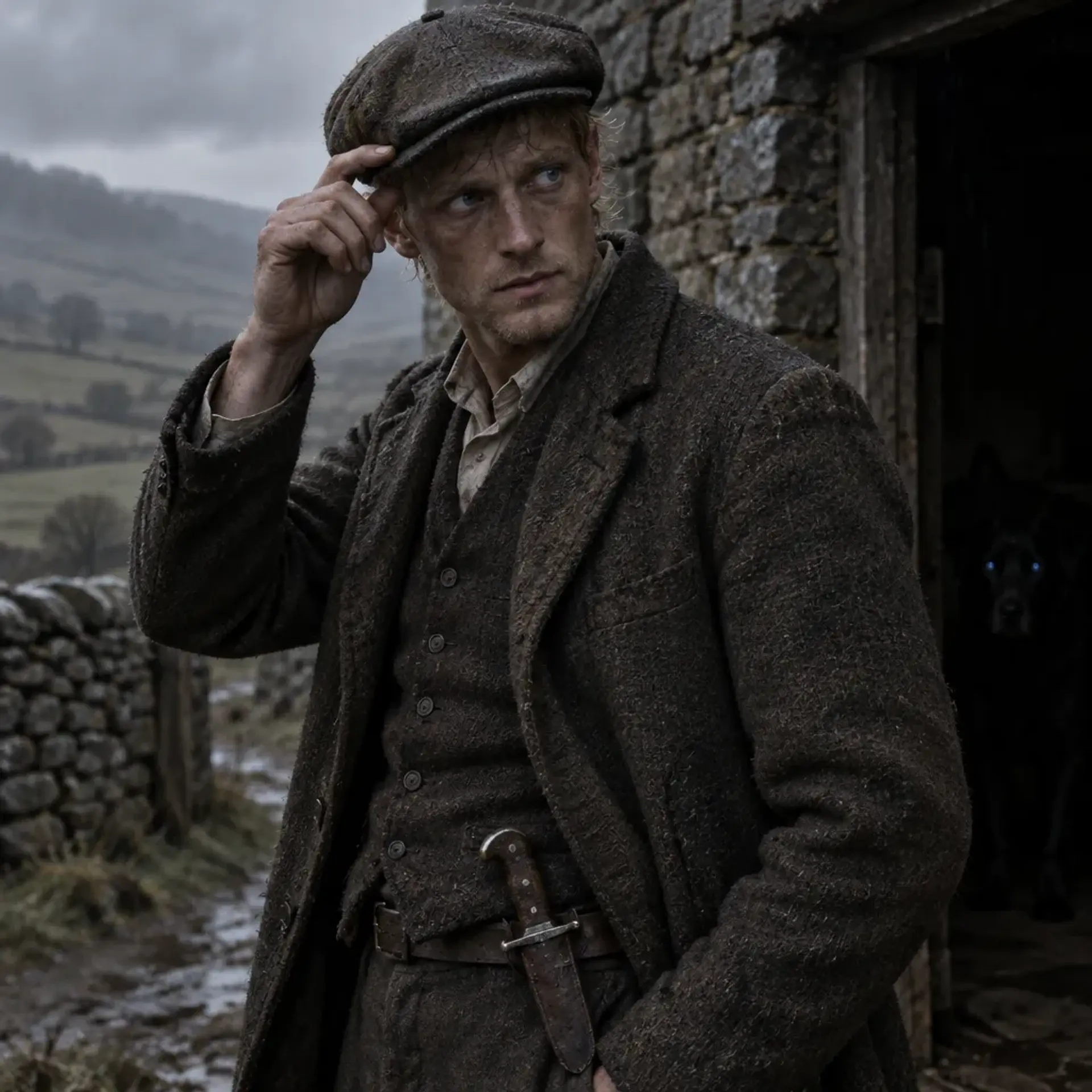
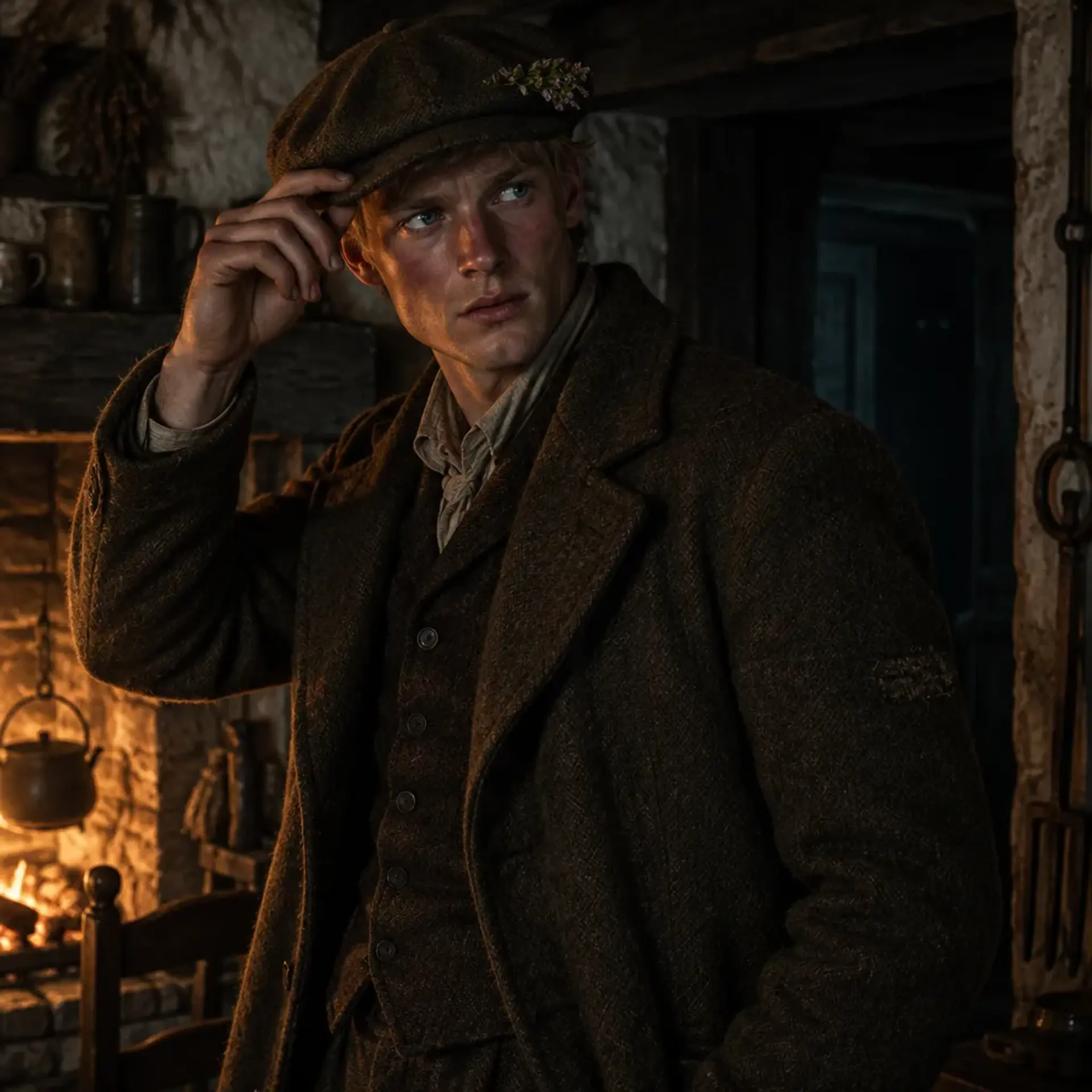
Oswin stands six feet tall, a long, spare figure who seems to occupy more of a room than his quiet manner should allow. His skin is pale, with the faintly weathered texture of someone who works outdoors, and his straight blond hair lies in a neat, practical sheet beneath a common flat cap. His blue eyes are clear and bright enough to look almost heated when the light catches them. He retains the handsome, youthful face Mary remembers from their first meeting, with no visible sign of the years he should have accumulated. He moves economically, placing each foot as if testing ground that nobody else can see. In company he angles himself between other people and doorways, then appears faintly surprised when they notice. His clothes are good for a sheep farmer: well-kept wool, sturdy boots, and a coat with the shine of frequent brushing rather than wealth. An unexpected detail for a farmer and feared night-creature: he keeps a tiny, carefully folded scrap of bright ribbon tucked in his cap, a Mayday keepsake Hugh once gave him.
Clothing
A well-kept farmer's coat, wool waistcoat, plain shirt, sturdy boots, and a familiar flat cap. His clothes are practical and respectable for his means, carefully brushed rather than showy.
Body language
He makes himself still when listening, but his eyes keep moving between faces and exits. He checks the brim of his flat cap, rubs his thumb along its folded ribbon, and takes care not to brush iron fittings. With William he lowers himself to the boy's level and waits rather than demanding an answer. When ashamed, he turns his whole body toward the nearest door.
- Height
- 6 feet
- Build
- Tall and spare, with the wiry strength of a man accustomed to outdoor work.
- Eyes
- Clear blue, bright enough to seem heated in certain light.
- Hair
- Pale blond, straight.
- Skin
- Pale, with the lightly weathered texture of someone who works outdoors.
- Age
- Appears about 17; claims to be a young adult. His true age reaches back to the Danelaw, though he gives no consistent account.
- Gender
- Male
- Size
- Medium, expressed in Call of Cthulhu 7E through SIZ rather than a D&D-style size category.
Distinguishing features
Personality
20 traits and drivesOswin is gentle in the small, steady ways of a person who notices when a boot sole is splitting or a child has been left out of a conversation. He can be patient with William for hours, letting the boy find his own words, and he remembers how Mary takes her tea. Yet his kindness has an unnerving limit: he may conceal a fact that would change another person's life because he has decided that the truth would frighten them. He is practical and shrewd about weather, money, and danger, but poor at judging what a human heart can forgive. Among neighbors, he is modest and useful. He prefers mending a gate to receiving praise for it. When someone asks about his age, his stories become charmingly vague, and he steers the conversation toward sheep or the road. With Mary, he tries to be tender without mentioning the source of her fear. Her anxiety about dark paths and fae presences unsettles him, but rather than confessing that her fear has a real cause, he reassures her that the household is safe. In his mind, this is protection. In hers, it can sound like evasion. Around William, Oswin is unusually attentive. He watches the boy's face for signs of distress and makes time for him even when a season has left him restless. He does not believe slowness makes William less worthy or less aware. He can be proud of the boy's small accomplishments, but he fears that other people will interpret the black hair and burning blue eyes as proof of something monstrous. Oswin has an instinct to keep William away from iron, though he cannot explain why without exposing himself. Mary notices the precautions and reads them as confirmation of her own fear. Oswin's mind does not sort loyalty and truth as humans expect. He can love someone and still keep a bargain with a dangerous creature; he can protect a village while hesitating over a familiar presence at its edge. His thoughts attend to thresholds, reciprocal obligations, and the consequences of breaking a promise. Sometimes he recognizes that this makes him seem cold. Sometimes he believes human beings are merely angry that he sees the terms of a situation clearly. He is not cruel for cruelty's sake, but he can be frighteningly calm when deciding what must be paid or what must be kept out. The seasons pull at him. On Mayday, an unnatural delight rises in him. He wants to be among people, join the communal games, and share in the noise without first measuring every risk. During the Mayday he spent with Hugh, Oswin was lighter and more openly amused than usual. Hugh coaxed him into the festivities, and Oswin joined with a readiness that surprised them both. Afterward, they repaired a cart together. Oswin did not explain the change in his spirits; he simply accepted Hugh's ribbon and tucked it away. The memory gives him a model of what belonging might feel like, and a reminder that his joy is not always entirely his own. Halloween and All Saints' Day bring a different pressure. He watches churchyards, doorways, and lonely paths as if the landscape were a set of doors that might open at any moment. He sleeps badly, grows keyed up, and dislikes being alone after midnight. When Edward insisted on accompanying him one All Saints' night, Oswin felt both gratitude and alarm. He sensed something near the boundary and feared that Edward would see what he was. He kept the presence from the town but would not explain it afterward. Edward's willingness to remain beside him became an affection Oswin could not easily name. He admired Edward's courage, but also thought it foolish to stand near a door one could not understand. Christmas steadies him. He follows the Pickles family's customs with careful attention and makes practical, handmade gifts. When he joined Thomas, Rose, Mary, and the others for Christmas, he repaired a tool handle for Thomas, made William a small wooden toy, and fixed a stool for Rose. The repeated rituals bring his attention into the room. For those days he feels more human, or at least less divided from the people he loves. He does not know whether the comfort comes from the customs themselves, from their repetition, or from being expected to return next year. His relations with Mary’s family are a tangle of affection and concealment. He respects Thomas's intelligence and dislikes being watched by him. Thomas's suspicion feels deserved, which makes Oswin defensive rather than honest. He is grateful to Rose for treating him warmly and fears that her kindness will make the eventual betrayal worse. Hugh has drawn out a playful side of him. Edward has seen him under pressure and stayed. Oswin wishes he could tell them what they have earned the right to know, but he is also afraid that telling one person will make the secret impossible to contain. He is not simply a man acting strange. He has moments in which the old nature shows through: he studies a path as if it has spoken, goes quiet when a creature he knows approaches, or gives an answer that follows the logic of a bargain rather than the logic of comfort. After recently touching an iron hinge while helping Thomas, he hid his shaking hand and claimed the metal was cold. That small lie came easily. The ease of it troubles him less than the fact that Mary saw him hide it. At his best, Oswin is considerate, dependable, and quietly brave. At his worst, he decides that the people he loves cannot bear the truth and denies them the chance to decide for themselves. He wants to be a husband and father, but has never been entirely sure that the words mean the same thing to him as they do to Mary. He wants Mary not to fear the dark, yet fears what will happen if she sees him clearly in it.
- Alignment
- Not applicable to Call of Cthulhu 7E. He is loving by human measures and governed by an inhuman, sometimes Unseelie sense of obligation.
Quirks
Habits
Traits · 5
Flaws · 5
Fears · 5
Wants and needs · 5
Combat
HP 13 · MOV 8 as a human adult in this scenario. In hound-shape, use MOV 10 as a custom folkloric scenario value, not a canonical Barguest statistic.Oswin avoids a fair fight. As a man, he uses distance, cover, farm tools, and the chance to escape or protect someone else. If cornered or if a boundary is threatened, he may take hound-shape and try to drive enemies away with a bite or frightening display. He is reluctant to attack familiar supernatural beings and may hesitate if they are nearby. Iron can disrupt his composure and custom glamour. The Keeper should use the listed percentile skills and attacks, not D&D defenses or levels.
Oswin Hirst
Actions
Reactions
Services they sell
Rewards they can give
Equipment
- Flat cap (clothing)A common flat cap with a folded scrap of Mayday ribbon tucked inside.
- Farm tools (equipment)Ordinary sheep-farming tools. The Keeper should choose an appropriate weapon and damage only if one is used in play.
- Work bundle (possessions)A small bundle of practical household items and handmade repairs he carries between house and farm.
Possessions
Background
Oswin Hirst was born in the Danelaw, the child of a woman violated by Viking raiders. His earliest memories are not cleanly human memories: a winter hearth, a mother's exhausted hands, and the sensation that the dark beyond the door was not empty. He was raised among people who had no name for what he was, and for a long time he believed that his unusual endurance, his dreams of old paths, and his dislike of iron were merely private oddities. He learned to pass as a man by watching men: how they bargained, worked, mourned, and lied about fear. He has never been certain where imitation ended and affection began. As a young wanderer, Oswin crossed dales and villages, sometimes as a man, sometimes as the black hound that local people feared. The hound was not simply a disguise. It could run paths inaccessible to a human body and sense presences that ordinary people missed. He came to know the creatures that haunt boundaries, churchyards, and lonely roads. Some were predators; some were neighbors with strange rules. He learned to keep the worst of them away from settled places, but not always by fighting. A promise, a warning, or a carefully placed offering could matter more than courage. He sometimes hesitated when a creature he knew was involved, even if that creature threatened people. He thinks of this as a flaw in judgment; other times he suspects it is the only honest part of him. His roving years left him with stories and a habit of scanning every threshold. He rarely tells those stories in order. He has described a frozen crossing one evening and a summer market the next, then abruptly stopped when a listener asked what year either event took place. He did not settle because he had tired of adventure so much as because he wanted to discover whether ordinary life could hold him. Sheep, weather, repairs, a good roof, and a household that expected him home began to feel less like a disguise and more like a chosen promise. Mary Pickles was blond and blue-eyed, quick to notice a lie and kinder than Oswin thought he deserved. Their courtship grew from practical visits and long conversations about work. He told her tales of roads and strange companions, leaving out enough truth to make the stories sound harmless. Mary loved the man she believed she knew. Oswin loved that she asked him to stay, and he wanted to become the person she thought he was. He never told her that he was not a normal young man, nor that years passed over him without visibly changing his face. On their wedding night, Oswin tried to consummate the marriage in human form and failed. Fear, shame, and the old instinct to flee tangled together. He changed into the headless Barguest shape that Mary had heard of in local warnings: a black, uncanny body with no head and two red, saucer-like eyes burning in the empty space where a face should be. He did not explain himself. He did not ask her permission to understand what was happening. Afterward, Mary struck at the creature with iron scissors. Oswin remembers the shock of the iron and the intimacy of her terror more vividly than he remembers the wedding feast. He has never admitted to Mary that the Barguest was him. She believes a rogue Barguest assaulted her, and fears that William is its child. Oswin's silence began as shame and became a choice he renews every day. Their son William, whom the locals call Black William or Blackby, has black hair despite both parents being blond and eyes with the bright, burning blue of Oswin's. William is slow to speak and to master some tasks expected of a child his age. Oswin sees an affectionate, observant boy who deserves patience, not a diagnosis made from village gossip. Mary sees evidence that the Barguest fathered him. She keeps iron scissors close and an iron thimble near him. Oswin avoids those objects and tries not to let her see how much they hurt or frighten him. Mary has also lost pregnancies, including one child who was born sickly and died soon afterward. He shares her grief but cannot make sense of it as a human husband might. He fears that his nature has made the household unsafe, yet he does not know whether confession would protect Mary or destroy the family she still loves. Oswin has a fine house for a sheep farmer's station, a fact Thomas Pickles watches closely. Thomas, Mary's father, is suspicious of Oswin's youth, his careful evasions, his avoidance of iron, and his apparent failure to age. He has not openly accused him. Instead, he tests him with questions and keeps an eye on the family. Thomas is clever enough to understand that a secret can be worth more than a confrontation, and Oswin suspects he may try to turn the truth to the Pickles family's advantage. Oswin does not know that Mary has told her father about the wedding night. Rose Pickles, Mary's mother, offers him ordinary kindness, which is more difficult for him to face than suspicion. He wants her to think well of him, but worries that accepting her care makes the deception more permanent. Hugh and Edward Pickles are Mary’s brothers, and Oswin has grown attached to both in ways he did not plan. During one Mayday, Hugh drew him into the communal festivities. Mayday brings Oswin an unnatural buoyancy: he is eager to join the dancing and games, cheerful in a manner that seems to arrive from outside his own thoughts. Hugh noticed Oswin watching the garlands and laughing too freely, but took it for a rare moment of happiness. Oswin helped Hugh repair a cart afterward and accepted the small ribbon Hugh gave him. He keeps it in his cap. The memory is precious partly because it was nearly an ordinary day. Edward saw the other side of him on Halloween and All Saints' night. Oswin had been watching the doorways, churchyard, and lonely paths with such fierce attention that Edward insisted on accompanying him rather than leaving him to patrol alone. Near midnight, the hound's instincts rose in Oswin, and he stopped speaking when he sensed something crossing the boundary beyond the churchyard. Edward stayed beside him despite being frightened. Oswin kept the presence away from the town, but would not explain what it was or why he knew it. He was keyed up for the rest of the night and reluctant to be left alone after midnight. Edward remembers the silence, Oswin's fixed stare, and the fact that he held his ground. At Christmas, Oswin joined the Pickles family for their familiar customs. Christmas steadies him. He follows the ritual carefully, gives practical handmade gifts, and is most recognizably human during those days. He mended a tool handle for Thomas, made a small wooden toy for William, and brought Rose a repaired household stool. Mary was pleased by his thoughtfulness. Oswin was pleased by the repeated acts of the season: food set out, names remembered, gifts exchanged, the same family gathered again. He did not understand why this made his thoughts feel less distant, only that it did. Recently, while helping Thomas repair a gate, Oswin took hold of an iron hinge before he realized what it was. The contact left his hand trembling and his glamour unreliable for the rest of the afternoon. He dropped the hinge, made an excuse about a splinter, and went to the barn to recover. Mary saw him rubbing his palm, but he claimed the metal was cold. The incident renewed his fear that the Pickles family is getting close to the truth. The seasons continue to trouble him. Around Halloween and All Saints' Day he sleeps poorly, watches thresholds, and feels his blood rise toward the hound. Mayday makes him buoyant and socially eager; Christmas pulls his attention back toward family habits and practical care. These changes are not moods he can simply decide to stop. Oswin sometimes thinks that a human mind would choose one loyalty and keep it. His own thoughts move by bargains, boundaries, and remembered obligations. He can love Mary and still calculate what a secret might cost. He can protect a village and hesitate because a familiar night-creature is among the danger. He understands that humans might call this coldness. To him, it is the shape of a mind that was never made human. Now Oswin is trying to keep his family safe without telling them what they are living beside. He works the farm, spends time with Mary and William even when the seasons make him restless, and keeps harmful night-creatures from the town's edges. He wants Mary not to fear the dark, and not to fear the fae. Yet the way he tries to spare her has made her fear the truth even more.
Role in the story
A loving but deceptive husband, a father trying to protect a strange child, and a possible source of help or danger in a folk-horror investigation. His secrets connect Mary’s wedding-night fear, Thomas's suspicions, the black hound, and the supernatural threats at the town's boundaries.
“He learned to pass as a man by watching men: how they bargained, worked, mourned, and lied about fear.”
- Faction
- No formal faction. He has informal relationships with some nocturnal creatures and quietly keeps dangerous ones away from the town's boundaries.
Known connections
Media
0 imagesNo images yet.
Turn Oswin Hirst into a sheet
A high-res, share-ready sheet you can post or print.