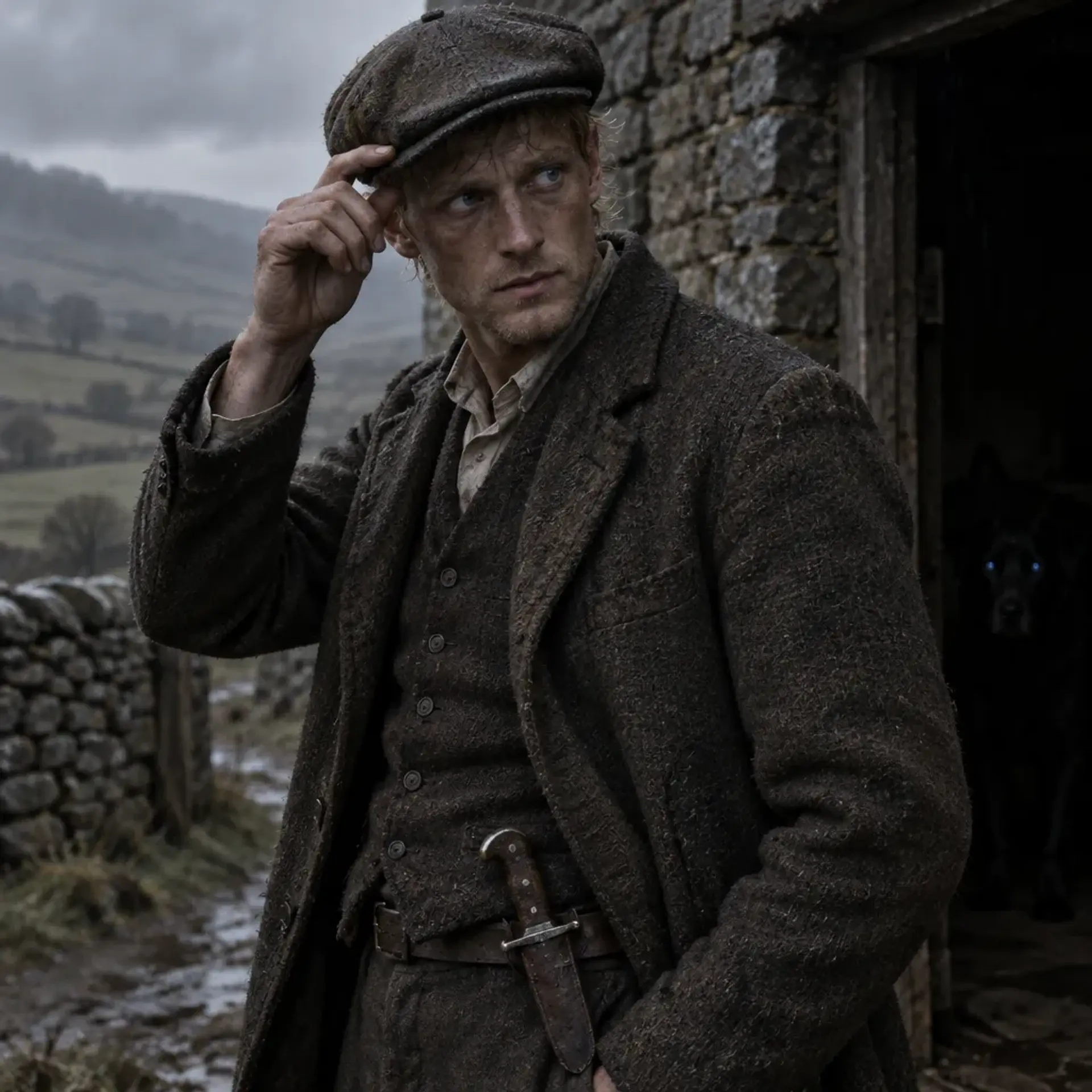
Oswin Hirst
Oswin Hirst
At the table
Voice
Oswin's voice has a dry, outdoor rasp from cold mornings, smoke, and years of calling to sheep across open ground. His Yorkshire vowels are broad but not performed for effect. He speaks at a measured pace, with the physical confidence of someone used to being heard over wind. When cornered by a personal question, his breath catches for a beat and he answers with a practical detail instead. His laugh is warm and brief, more common with Hugh and William than with anyone else.
He speaks in a grounded Yorkshire dialect, using plain words, dry humor, and concrete comparisons. His voice catches slightly on old place names from the dales, as if each one has a separate memory attached. When troubled, he does not become soft or ceremonious; he gives shorter answers and fills the space with practical questions.
Speech patterns
How to play them
Meet suspicion with practical kindness rather than threats. He is willing to discuss farming, family, and his travels, but avoids exact dates and any direct question about his age or the wedding night. Earned trust makes him more candid about his fear of iron and the seasonal nights, though a direct confrontation about Mary may make him flee or transform. Treat William kindly and Oswin will take a personal interest in the visitor.
Goal
Keep Mary and William safe while finding the courage to tell Mary what happened on their wedding night before Thomas turns his suspicions into leverage.
Motivation
To remain with the family he loves without forcing them to face the frightening truth of what he is.
Appearance
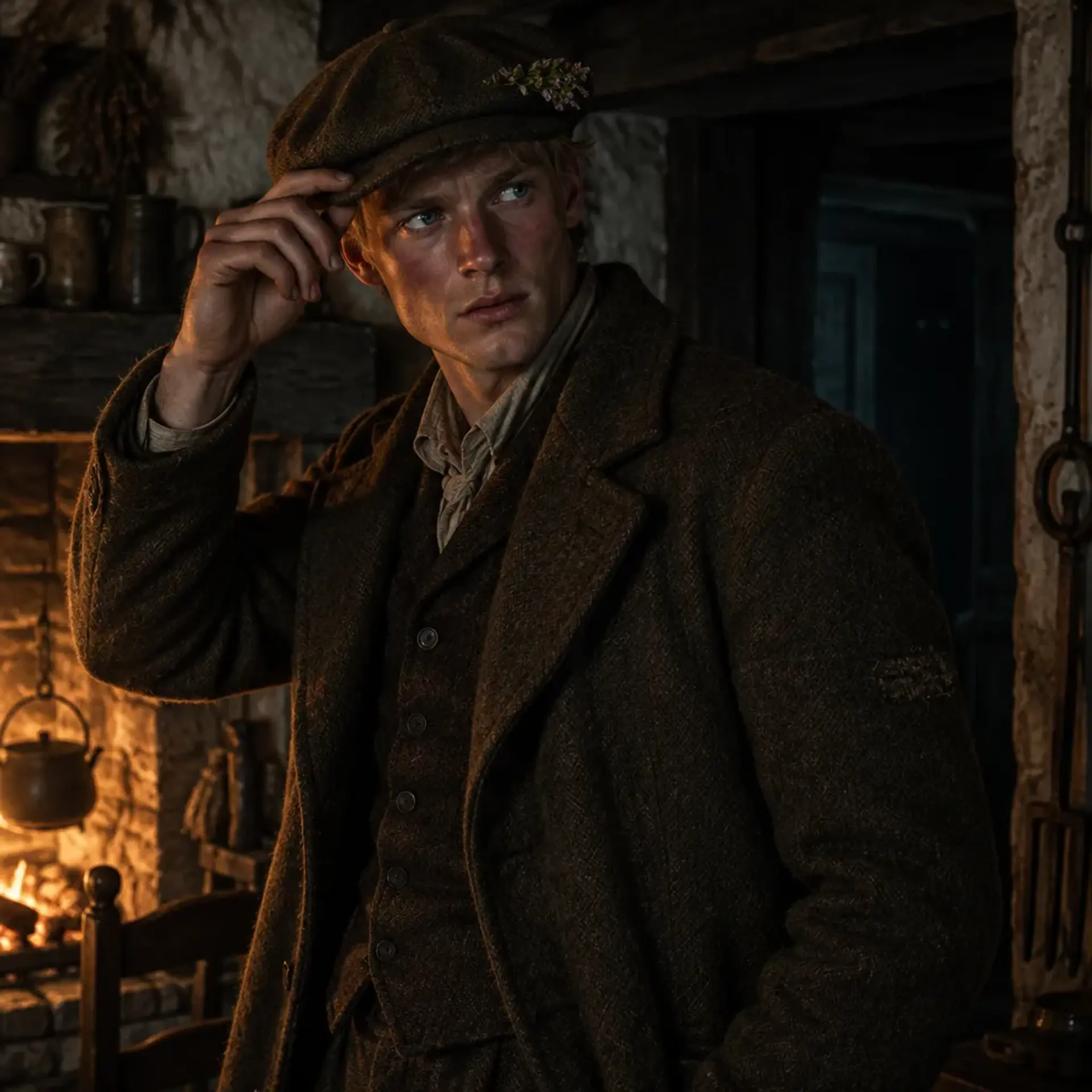
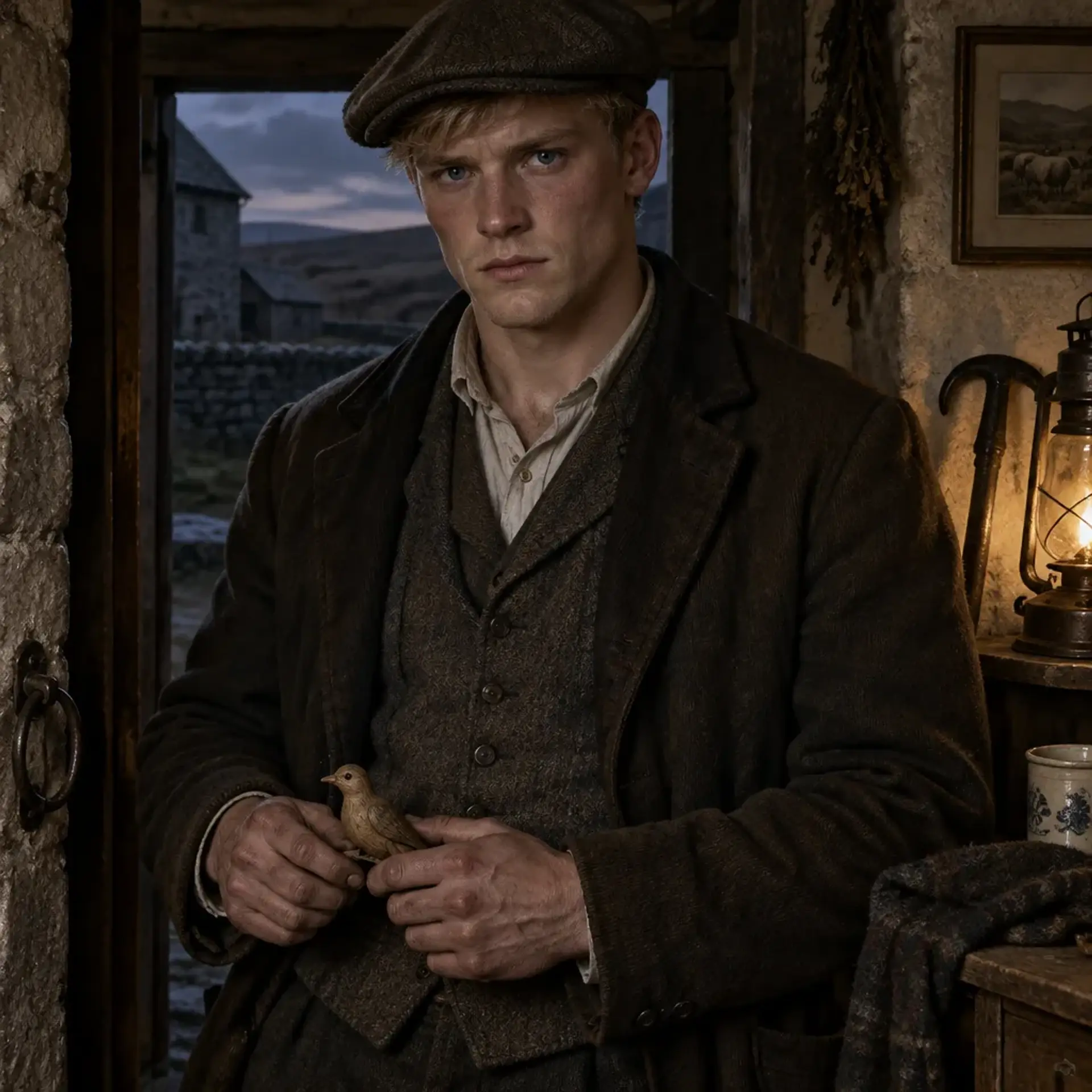
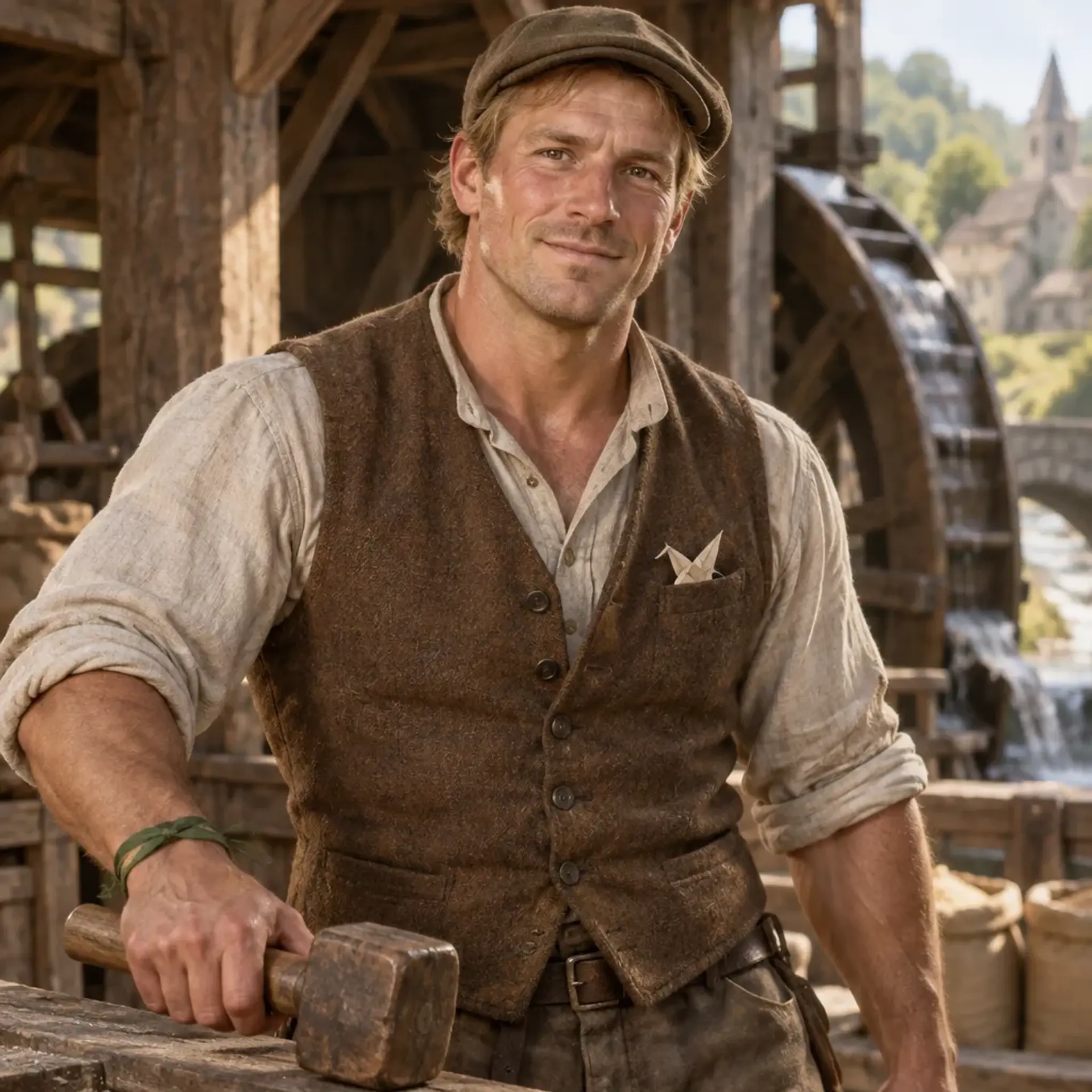
Oswin stands exactly six feet tall, with a handsome, youthful face that has scarcely altered since Mary first knew him. His skin is pale, with the faintly weathered dryness of a man who works outdoors. His straight blond hair lies smooth beneath a common flat cap, though damp weather makes it cling in thin, pale strands around his temples. His clear blue eyes are unusually bright, almost fever-blue when the seasons turn. He wears a sheep farmer's practical clothes, carefully mended rather than shabby, and carries himself with a relaxed, economical balance. When he waits, he places most of his weight on the balls of his feet, as if prepared to spring away down a path. Within a minute, people notice him unconsciously checking the cap's brim with two fingers whenever a doorway opens behind him. His hands are broad and work-roughened, marked by wool grease and small nicks from ordinary farm work. He has no visible sign of age to match the stories he tells. In hound form, he is a rangy, heavy black dog, his coat like wet soot and his eyes a fierce, burning blue.
Clothing
A common flat cap, plain wool coat, work shirt, waistcoat, sturdy trousers, and weathered boots. His clothes are practical and clean, mended neatly, without finery that would draw attention.
Body language
He stands easily but keeps his weight forward, as if the ground beneath him might become a path. He checks the brim of his flat cap when a door opens behind him. Around iron, his shoulders tighten and he angles his body away. With William, he lowers himself to the child's height and gives him time to answer. At the churchyard or a lonely doorway, his attention fixes so completely that conversation can seem to vanish.
- Height
- 6 feet
- Build
- Tall, lean, and strong from years of outdoor labor, with a springy, animal readiness in his balance.
- Eyes
- Clear, unusually bright blue; in hound form, the eyes seem to burn.
- Hair
- Straight pale blond
- Skin
- Pale, with a lightly weathered outdoor texture
- Age
- Appears to be in his early thirties; his actual age is uncertain and reaches back many centuries.
- Gender
- Male
- Size
- Medium
Distinguishing features
Personality
21 traits and drivesOswin is gentle without being soft, practical without being emotionally simple, and shrewd without taking pleasure in manipulation. On a working day he is patient, observant, and difficult to rattle; he can tell from a lamb's posture when it is sick and from a neighbor's tone when a bargain is turning sour. He rarely boasts and dislikes waste. Yet the same man who can calmly mend a fence in sleet may become rigid and watchful when a door opens behind him after dark. His kindness is genuine, but it is also entangled with an instinct to manage what other people know. He wants Mary to feel safe, so he hides the truth that most threatens her sense of safety. With Mary, affection and shame pull against each other. He notices the small things she needs and tries to provide them before she asks. He remembers what comforts her, and he takes pride in being a husband who comes home. When she asks about the wedding night, though, his warmth turns into careful evasion. He may answer the question she did not ask, offer to mend something, or focus on William. His fear is not merely that she will reject him. He fears that her love for the human face she remembers will be exposed as love for a lie. The more tender he feels, the more tempting it becomes to protect that tenderness by saying nothing. With William, Oswin is unusually patient. He does not rush the boy's words or treat his slowness as a defect to be corrected. He makes small tasks into games, lets William watch him work, and returns to the same explanation as many times as needed. William's black hair and blue eyes make Oswin feel both pride and dread. He wants his son to be ordinary enough to have a childhood and strange enough to survive whatever has passed down to him. When the boy is asleep, Oswin sometimes watches him longer than is comfortable, then feels ashamed and goes to check a door or window. Oswin's relationship with Hugh is easier. Hugh's openness gives Oswin permission to be more than a suspicious husband under observation. Hugh jokes with him, asks about his travels, and assumes there is a decent explanation for every odd pause. Oswin responds with dry humor and sometimes tells a story that is true in its outline but rearranged in its dates. Their May Day together showed Oswin a version of himself he had almost forgotten: laughing in a crowd, joining a dance, and enjoying a day without counting exits. Hugh thinks of that day as evidence that Oswin is happy with the family. Oswin knows it was also a struggle against the urge to run beyond the village. He is grateful to Hugh for making him stay without realizing what he was asking. Edward draws a different side of him. Edward notices what other people overlook and dislikes an answer that is too smooth. Oswin respects him, which makes him less comfortable in his company. On All Saints' night, Oswin walked with Edward because leaving him alone felt worse than risking discovery. When the hound appeared near the churchyard, Oswin's instinct was to protect Edward, even at the cost of exposing himself. He invented a partial explanation afterward. Edward accepted the practical truth that Oswin had drawn danger away from him, but the encounter left a question between them. Oswin does not resent Edward's watchfulness. He fears the day Edward decides that protecting Mary means forcing the truth into the open. Thomas Pickles makes Oswin careful. Thomas is suspicious, and Oswin senses a calculating attention behind his ordinary courtesy. He does not know that Mary told Thomas about the wedding night, but he knows Thomas has seen a black hound and does not trust the story of Oswin's age. Oswin tries to be useful around him, never obsequious. He believes that a man who wants leverage should not be given the satisfaction of seeing fear. At the same time, Thomas is Mary's father and William's grandfather; Oswin cannot simply treat him as an enemy. Thomas's ability to turn family knowledge into a bargaining tool is exactly what makes him dangerous. Rose Pickles is easier to be around, though Oswin suspects she sees more than she says. Her kindness is practical rather than sentimental. She notices whether the fire is laid, whether William has eaten, and whether Mary has been left alone with worry. Oswin values this steadiness. He sometimes finds her watching him when he thinks his attention is elsewhere. He cannot tell whether she has guessed anything supernatural or merely recognizes a man who is carrying a great deal of guilt. The seasons expose contradictions he normally keeps controlled. At Christmas he feels steadied by repetition. He follows the Pickles family's customs carefully, helps without taking over, and makes practical, handmade gifts. A familiar meal and a known sequence of small acts reassure him that life can be made durable. He is at his most openly affectionate then, though the sight of the whole family together can make him fear how much he stands to lose. May Day brings a delight he finds almost embarrassing. He enjoys the communal festivities, becomes more spontaneous, and is more likely to accept an invitation before considering the consequences. Hugh's company gives that joy a human shape. But it comes with a pull toward open country, a physical longing to pass beyond the village and run. Oswin can smile at a garland while listening to a path beyond the music. He is not simply tempted by freedom; he is frightened by how much of himself welcomes the call. Halloween and All Saints' night make him vigilant and difficult to reassure. He watches doorways, churchyards, and lonely paths with fierce attention. He sleeps poorly and hates being alone after midnight. His body seems to anticipate danger before his mind has named it. He may snap at a harmless suggestion, then show up the next morning with a repaired gate or a warm loaf as if practical care can mend the sharpness. These nights reveal how thin his control can become, and how frightened he is that Mary or William will see him enjoying the fear he claims to oppose. Oswin is not a monster pretending to be kind, nor a wholly human man burdened by an unfortunate appearance. He is someone whose affection is real and whose deception is real. He wants Mary to stop fearing the dark, but the dark contains a version of him that has already frightened her. He wants William to be accepted, but has kept his son's parentage inside a lie. He wants a quiet life, yet he remains drawn to the old roads and the seasons that call him out of it. His goodness is visible in what he does each day. So is his capacity to hurt the people he loves by deciding, without their consent, what truths they can bear.
- Alignment
- Not applicable as a Call of Cthulhu rule. In conduct, protective and pragmatic, though secrecy makes him capable of profound betrayal.
Quirks
Habits
Traits · 5
Flaws · 5
Fears · 6
Wants and needs · 5
Combat
HP 13 · Human: 8 move. Custom hound form: 10 move, a non-canonical custom value for this supernatural NPC.Oswin avoids violence and tries to put himself between danger and his family. If cornered, he uses grapples and blunt strikes to escape. If Mary or William faces immediate lethal danger, he may transform into the black hound. He does not fight to the death and will flee rather than expose his family to a prolonged confrontation. Iron is a serious threat to him.
Oswin Hirst
Actions
Reactions
Services they sell
Rewards they can give
Equipment
- Flat cap (clothing)A plain, well-worn cap he adjusts without noticing, especially when uneasy.
- Shepherd's knife (tool)A working farmer's knife used for ordinary chores. He keeps it sheathed and does not draw it lightly.
- William's mending things (personal)A small bundle of wool and a repaired wooden toy, usually carried when he expects to spend time with William.
- Mary's iron scissors and thimble (custom supernatural countermeasure)Mary keeps these, not Oswin. Their presence is a constant reminder of the wedding night and his vulnerability to worked iron.
Possessions
Background
Oswin Hirst tells people he was born in the Yorkshire dales, and in the broadest sense this is true. He was born during the days of the Danelaw, when raiders came through the valleys and his mother, a local woman, was taken by a Viking. She did not live long enough to tell him much of his father. Oswin grew up in a world where people explained inexplicable things with old names, and where the boundary between a dangerous animal and a dangerous spirit could be a matter of what someone had seen in the rain. As a child, he was difficult to place. He was stronger than he looked, quick to recover from sickness, and could find his way home through fog that disoriented older men. He did not know what he was. He only learned that ordinary rules seemed to fit him poorly. He grew into a handsome young man and remained one while the people around him aged. At first he took this for luck. Then he watched the faces of people who had known him as a boy grow lined and stooped while his own face stayed smooth. By then, he had already learned to hide the difference, leave a place before questions grew serious, and return under another explanation. For centuries he roamed. He worked as a drover, a shepherd, a hired hand, a guide, and sometimes as a traveler who did not explain where he had been. The dales remained his fixed point: their limestone folds, sudden mists, sheep tracks, and the old paths that seemed to belong to no map. He still dreams of them as they were in earlier centuries, though the landscape of his dreams is not always the landscape he wakes to. Some dreams contain a black hound watching him from a ridge. Others show a headless rider with two red lights where a face should be. He used to believe these were warnings about other things. Over time, he understood that they were also about himself. His transformations arrived in pieces. First came the sense of a second body in his sleep, a certainty that he had run for miles while his human body lay still. Then came the morning he woke outside a village with mud between his teeth and no memory of leaving his bed. Eventually he accepted that the black hound was not a visitor or a curse laid upon him by someone else. It was a form that belonged to him. The headless appearance came later, and more reluctantly. He has never liked what people see in it. He knows that a creature with no face and red lights in the empty space above its shoulders is the sort of thing that makes a story last. Oswin eventually settled into a normal life as a sheep farmer. His house is fine for a man of his station, solidly built, comfortable, and maintained with more care than display. He owns sheep, understands the practical costs of weather and feed, and knows how quickly a missed lambing can undo a good year. He wears a flat cap like other local men and makes himself useful rather than remarkable. He tells stories of his roving days in a way that makes them sound like the ordinary adventures of a long-lived traveler. He does not tell anyone how long he has lived. Mary Pickles was the first person in a long time with whom he wanted a home rather than a stopping place. She was blond, blue-eyed, and sharp enough to notice that his stories changed around the edges. He loved her steadiness and her humor, and was startled by how much he wanted to be known by her. On their wedding night, the human Oswin failed to consummate the marriage. He was ashamed, frightened of losing her, and too accustomed to solving problems by becoming something else. He took his true form, the headless figure with red saucer-like eyes, and consummated the marriage without telling her what he had done. Mary struck the creature with iron scissors afterward. Oswin remembers the pain, the shock, and the fact that she did not run. Mary remembers a Barguest that came to her bed and fears that it was the father of her child. Oswin has refused to tell her the truth. His silence began as panic and hardened into a daily deception. He tells himself he is sparing her terror, but he knows he is also protecting the life he wants to keep. Mary loves the handsome man she remembers and fears the creature that appeared in the dark. She carries iron scissors and keeps an iron thimble near William, a small defense against the fear she cannot say aloud without making it more real. William was born with striking black hair, though both parents are blond, and with eyes of burning blue that resemble Oswin's. He is slow to speak and learn compared with other children his age. Mary calls him her son but privately fears he is the Barguest's spawn. Oswin sees a child who deserves patience, affection, and a chance to grow without being treated like an omen. He takes time each day to be with William, even when he has been awake through the night. He is careful not to let the boy see how sharply he watches the doors in certain seasons. Oswin's hope is that William's unusual traits will become less frightening to Mary with familiarity. His fear is that the child will inherit not just his strangeness but the loneliness that came with it. Mary's family has become Oswin's family in the way he once thought impossible. Thomas Pickles, her father, is suspicious of him. Thomas has seen a black hound and has noticed Oswin's unchanging face and avoidance of iron. He is clever, patient, and interested in what Oswin's secret might buy for his family. Oswin does not know that Mary has told Thomas about the wedding night. Thomas has not confronted him openly; he watches, gathers details, and considers how to use them. Oswin is wary of him without knowing how much Thomas knows. Rose Pickles, Mary's mother, is less openly suspicious. She has a practical kindness and an eye for people who are trying too hard to look ordinary. She accepts Oswin's help with household work and watches what he does for William rather than what he claims. He respects her judgment and worries that she may understand more than she says. Mary has two brothers, Hugh and Edward. Hugh is sociable and quick to welcome Oswin into communal life, though he can mistake a guarded answer for an invitation to push harder. Edward is more reserved and observant. Oswin likes them both and fears that they will eventually have to choose between their sister's safety and their brother-in-law's secrecy. One May Day, Hugh persuaded Oswin to join him in the village festivities. Oswin arrived intending to stay only long enough to be seen, but the music, green branches, and crowded warmth worked upon him in a way he could not resist. He became buoyant and playful, joining Hugh in a rough village dance and helping children carry garlands. For a few hours, he felt less like a creature hiding in a human life and more like a man among neighbors. Then the familiar paths beyond the village called to him with an almost physical force. Hugh noticed Oswin staring toward the distant fields and clapped a hand on his shoulder, joking that he looked ready to run off with the fairies. Oswin laughed too quickly, stayed until dusk, and went home shaking with the effort of not leaving. Hugh remembers the day as one of Oswin's happiest. Oswin remembers it as proof that joy can also be a form of danger. On an All Saints' night, Edward and Oswin walked the lanes after rumors spread of a black hound near a churchyard. Edward had heard enough stories to be unsettled but wanted to find out whether someone was frightening the village. Oswin agreed because he could not bear to leave Edward alone on a night when the old paths seemed awake. He watched every doorway and patch of dark beyond the walls. Near the churchyard, Edward saw the hound shape move between gravestones. Oswin had changed before he could stop himself, then shifted back out of sight. Edward found him shaken and mud-streaked, and Oswin claimed he had followed the dog to draw it away. Edward did not believe the whole explanation, but he accepted the part that mattered: Oswin had put himself between the danger and his family. Since then, Edward has been quietly watchful of Oswin, neither an accuser nor a confidant. At Christmas, Oswin joined the Pickles family in the careful traditions Rose kept: familiar food, small gifts, and a place set for those who could not be present. Christmas steadies him. He made practical gifts by hand, repaired a wooden toy for William, and brought Mary a warm wool wrap he had mended himself. He followed each custom with serious attention, as though repeating the words and gestures could keep the world in its proper shape. Thomas watched him closely across the table. Rose saw him help William eat and did not ask why Oswin had gone still when a log cracked in the fire. For one evening, the family was nearly what Oswin wanted. That made the return to ordinary suspicion harder. The family's losses make the house's warmth fragile. Mary has suffered pregnancies that did not reach term, and one infant died sickly soon after birth. Oswin carries the grief quietly, but he knows his own nature may be connected to the children's suffering. He avoids iron, which makes ordinary household precautions feel like a daily judgment. He has never produced an undisputed, living heir who reached childhood without trouble. He wants Mary to stop fearing darkness and fae things, yet the fear is not baseless, and he cannot ask her to trust him while withholding the central truth. Halloween and All Saints' Day are the hardest part of his year. His blood seems to rise; sleep becomes difficult; he watches doorways, churchyards, and lonely paths with fierce attention. He does not want to be left alone after midnight. May Day brings an unnatural delight and an urge to run beyond the village. Christmas brings relief through repetition and family custom. These seasonal changes are not moods he can simply choose to put aside. He nonetheless makes time for Mary and William on the days he is most unsettled, because he believes love is a practice, not a feeling that excuses absence. Now Oswin is trapped between the family he chose and the truth he has hidden. He wants Mary to know the creature was him, but he fears that confession will make the marriage irreparable. He wants William to be loved without being treated as a demon, but William's black hair and unusual eyes make the secret harder to contain. Thomas's quiet attention is growing dangerous. Oswin still dreams of the dales, still longs to run, and still comes home. His greatest conflict is not whether he is human enough to deserve a family. It is whether he can stop using love as a reason to deceive the people he loves.
Role in the story
A loving but deceptive husband and father whose supernatural nature lies at the center of a family mystery. Oswin can be an ally, a source of local knowledge, or a frightening revelation. The tragedy is not simply that he is a Barguest, but that his effort to spare Mary fear has made her fear him.
“He was born during the days of the Danelaw, when raiders came through the valleys and his mother, a local woman, was taken by a Viking.”
- Faction
- No formal faction. He belongs to his household and the local sheep-farming community, while remaining an outsider to the ordinary passage of human generations.
Known connections
Media
0 imagesNo images yet.
Turn Oswin Hirst into a sheet
A high-res, share-ready sheet you can post or print.