Marta Eichenwald
Marta Eichenwald
At the table
“the other parent”
Voice
Marta's voice has a dry, slightly rough texture from years of ash in the air and early mornings speaking over farm tools. There is a faint nasal catch when her chest aches. She speaks at a working pace, clipping words when she is counting or giving instructions, then pauses to choose exact terms when people ask what the eggs mean. Her voice does not become softer when she is angry; it becomes more specific.
She speaks in plain, careful sentences, shaped by farm work, family record keeping, and years of conserving breath through ash coughs. Her vocabulary is practical: warmth, damp, spoilage, measure, enough. When discussing the eggs she names what she can observe and avoids interpreting it. In moments of alarm, words come faster and overlap as she gives instructions. Her Germanic island dialect gives some consonants a clipped edge, but she does not speak in a theatrical or prophetic manner.
Speech patterns
How to play them
Approach Marta as a person first and ask before inspecting her or the eggs. Offer practical help, especially food, privacy, or a safer room, and be precise about what you know versus what you suspect. She responds poorly to prophecy, ownership language, or attempts to separate her from the eggs. If the party protects her family's autonomy and does not force her to name the sire, she may share observations and accept help investigating the cause.
Goal
Keep the three eggs safe, learn what happened without surrendering her family to outside control, and preserve enough of an ordinary life to remain Marta Eichenwald rather than become a public omen.
Motivation
Love for her family, fear of being turned into a symbol, and a fierce responsibility toward the eggs she laid without understanding why.
Appearance
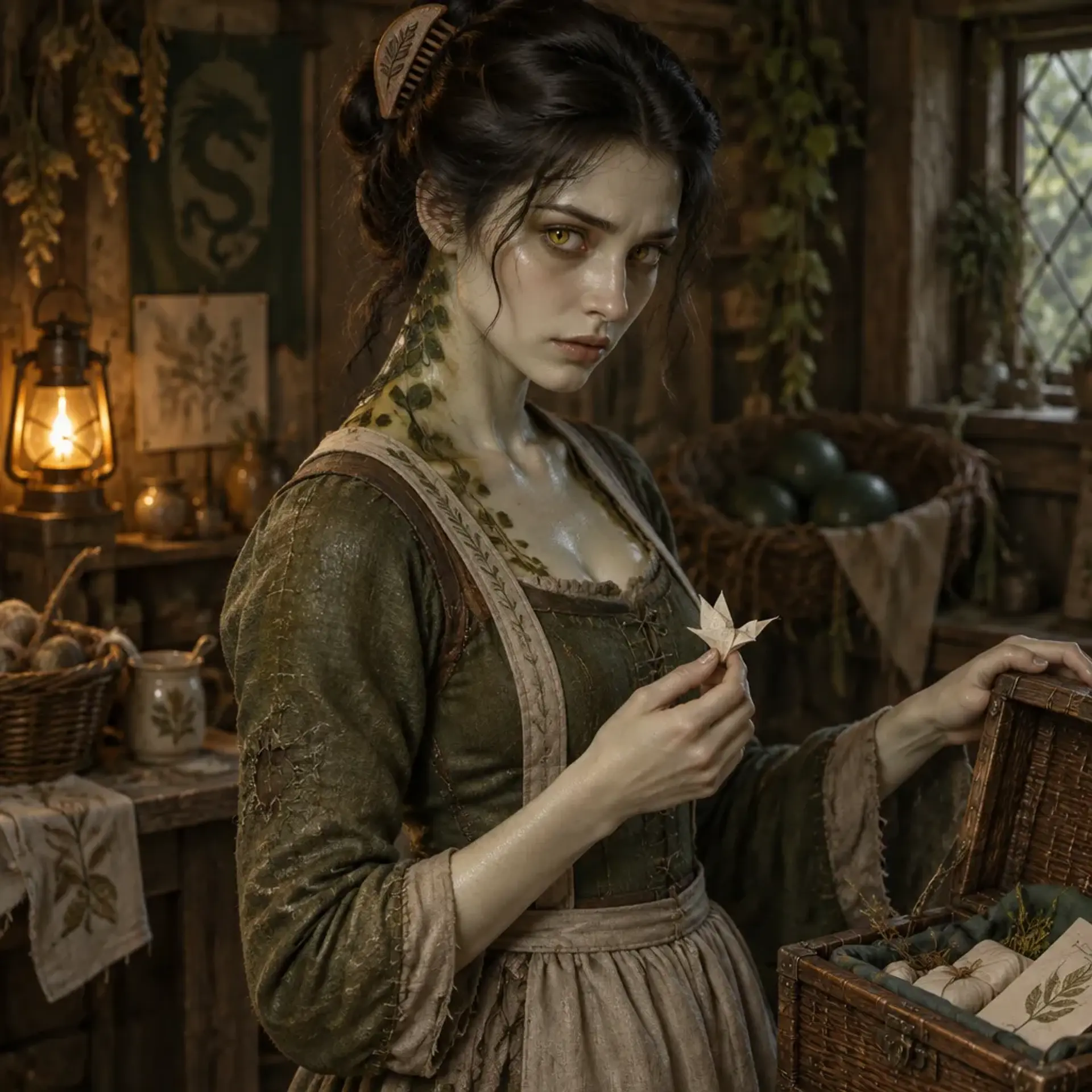
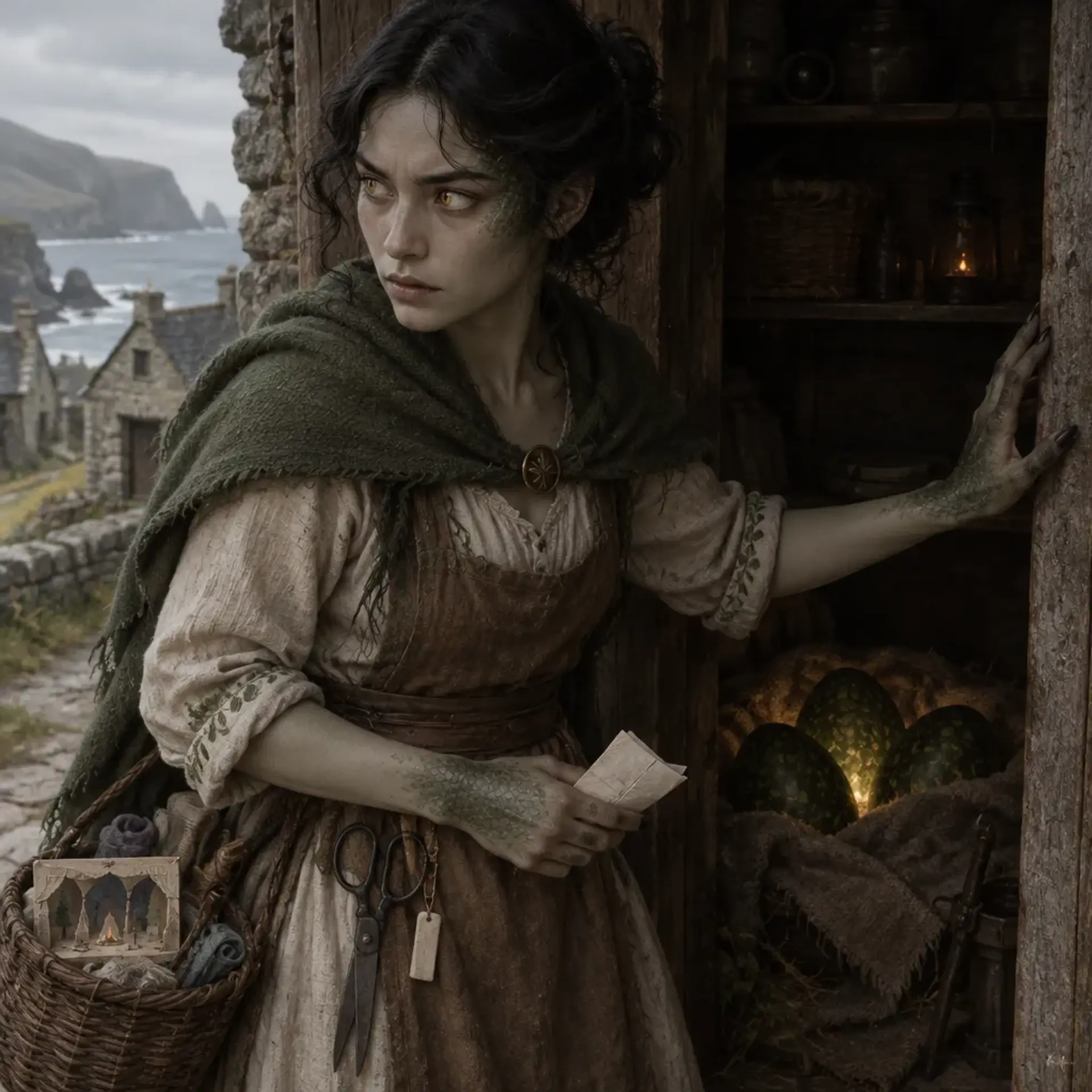
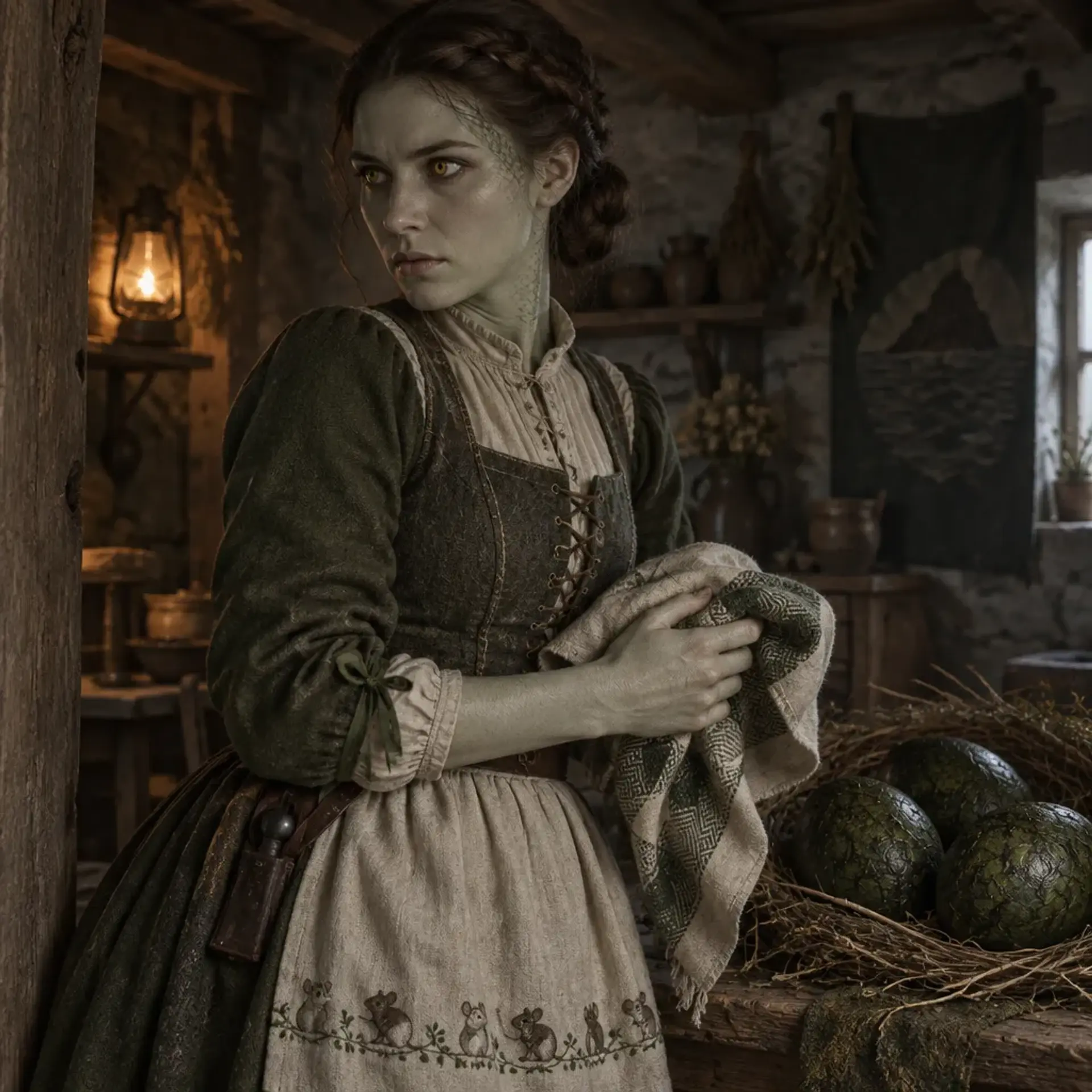
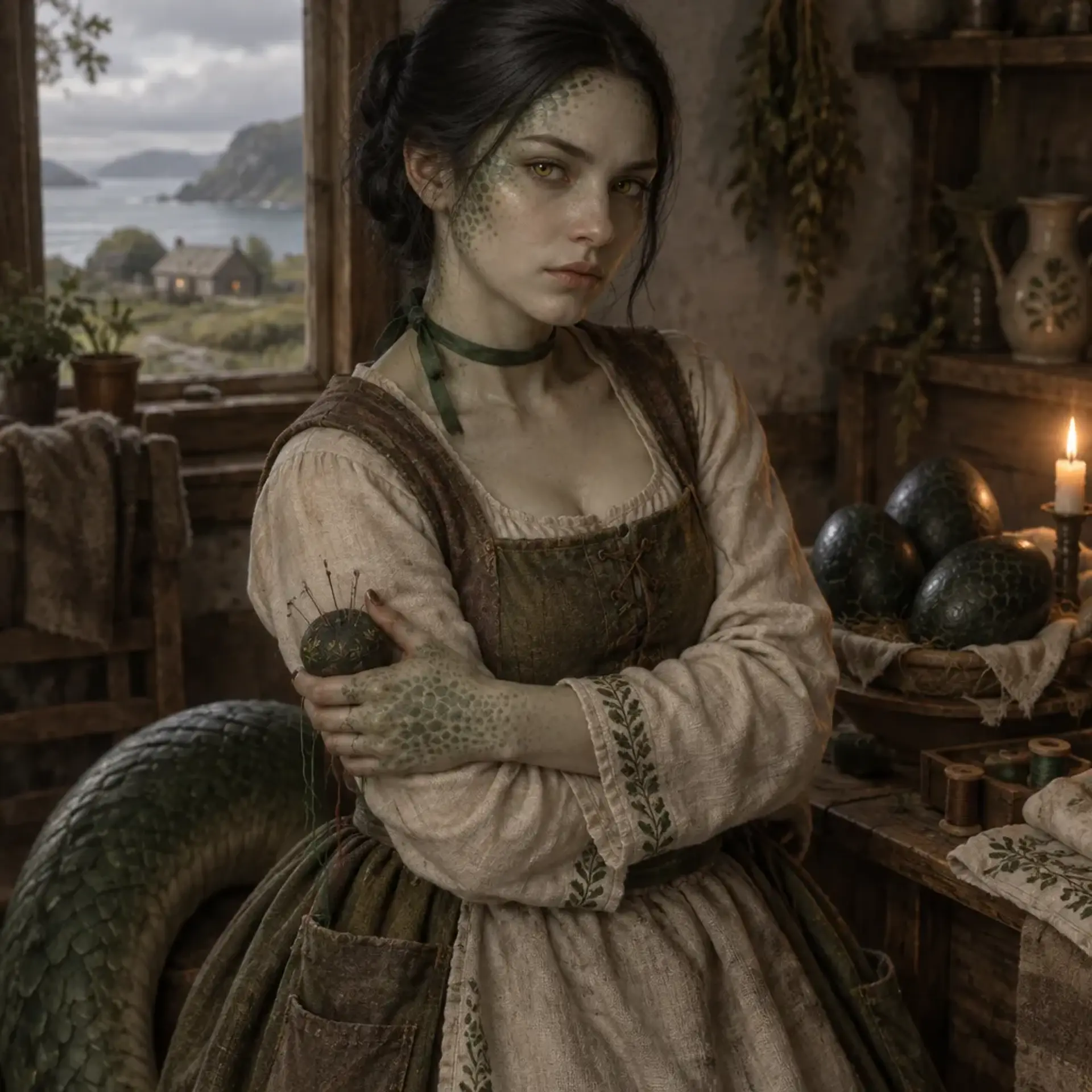
Marta was once the sort of woman whose face vanished from memory as soon as she left a room, and she misses that anonymity. Now she has a predator's long, economical frame, pale green-white skin, and narrow yellow eyes with round black pupils that hold steady a moment too long. Fine dark-green scales stipple her temples, ribs, and the backs of her hands; the newest ones have a damp, leaf-wax sheen. Her abdomen has drawn taut and lengthened subtly, her spine bends with an increasingly serpentine ease, and a heavy tail is beginning to push through the back of her skirts. Under her shoulder blades, two ridged swellings promise wings but currently make lying flat painful. Her chest aches from the changes, and she guards it with folded arms when strangers stare. She walks with a near-silent, heel-light glide that becomes a sudden, unnerving stillness when she senses danger to the eggs. Within a minute, most people notice that she smells faintly of wet stone, crushed nettle, and the sharp green odor of a split branch; she knows about the nettle and thinks it comes from the poultices. Her unexpected distinction is practical domesticity: even with a tail forcing her to alter every chair and doorway, she keeps a tiny, carefully mended pincushion tucked into her bodice and makes neat decorative stitches while listening to arguments about her body.
Clothing
Practical German-inspired dresses in sturdy brown, moss, and cream linen, cut with discreet side gussets and a slit at the back to accommodate her growing tail. She wears a fitted wool bodice over a linen shift, an apron with deep pockets, and stout boots. Tiny embroidered leaves at the cuffs and a narrow green ribbon at her throat are the flourishes she kept from her old wardrobe. The garments are carefully altered rather than replaced, partly because money is short and partly because she resents being dressed as a portent.
Body language
Marta keeps her elbows close to protect her sore chest and holds her shoulders carefully to spare the wing buds. When calm, her fingers worry a seam or pincushion. When threatened, her neck extends, her head tilts slightly, and her tail curls toward the eggs. She watches hands before faces.
- Height
- 5 feet 9 inches, with a slightly taller apparent stance when her neck and spine extend
- Build
- Predator-lithe, long-waisted, and growing more serpentine; strong enough for farm work but not trained for fighting
- Eyes
- Draconic yellow with round black pupils
- Hair
- Black
- Skin
- Pale white with a faint green cast
- Age
- Young adult, approximately 24
- Gender
- Female
- Size
- Medium
Distinguishing features
Personality
18 traits and drivesMarta is both modest and stubborn. She would rather mend a hem than accept praise, yet she will not let a stranger decide what happens to her household. In familiar company she is patient, practical, and quietly funny; when tired or in pain, she answers questions with a flat, defensive precision. She wants help but resents being handled. She is curious about the cause of the eggs, but fear keeps her from turning her suspicions into words. Her kindness is not softness: she shares food when she can, remembers who has gone hungry, and becomes immovable when someone treats the eggs or her family as possessions. In public, she tries to make herself small and ordinary. Near the eggs, she takes up space without noticing, standing like a barrier. She can feel tenderness toward Kaspar and fear of him at the same time. Sometimes she wishes the whole event had never happened; sometimes she feels a fierce, involuntary pride when she sees the three shells together. She mistrusts anyone who offers certainty, but is vulnerable to people who offer a clear plan and promise not to take control. Her emotions shift through practical acts: anger becomes a tightened apron knot, grief becomes mending, and panic becomes counting the eggs and checking their warmth.
- Alignment
- Neutral Good
Quirks
Habits
Traits · 4
Flaws · 4
Fears · 5
Wants and needs · 5
Combat
AC 10 · HP 9 · 30 ft.Marta avoids combat. She puts furniture between attackers and the eggs, calls for help, and uses a hoe or a jar of flour to make an escape. If someone reaches for an egg, her protective instinct may override good judgment. Her statistics are those of a level 2 noncombatant commoner, not a trained adventurer.
Marta Eichenwald
Actions
Reactions
Services they sell
Rewards they can give
Equipment
- Hoe (tool)A sturdy farm tool she carries for work and keeps near the door; it is not a purpose-made weapon.
- Clay jar (adventuring gear)Contains flour and ash for cooking or, in desperation, to make a cloud of dust.
- Folded egg bedding (household)A small cushion filled with wool, kept close to the eggs and adjusted to avoid overheating them.
- Mended pincushion (personal)A little wooden pincushion holding needles and colored thread, frequently handled without notice.
Possessions
Background
Marta Eichenwald grew up among the shipwrecked halfling families who made landfall on an island that looked blessed from the sea. They had crossed a dragon-haunted wilderness with children wrapped in sailcloth and seed jars tied to their waists. The island offered freshwater springs, black soil, and a sheltered inlet. Within a year, ashfall smothered the first crops. Then came a fever that left the survivors weak and coughing. The families learned to sift ash from grain, to bury spoiled roots, and to treat every green shoot as a promise that might be broken. Marta was not born to leadership or prophecy. She helped her mother patch clothes, learned to keep accounts for the family’s seed stores, and found comfort in plain routines. Her two older sisters, Hilda and Greta, both Low-blood Ashenbough, married and built households of their own. Hilda keeps a smokehouse near the shore; Greta tends a patch of medicinal herbs that has survived the ash. Their younger brother, Kaspar, was born High-blood. His adolescence arrived in fits: fevers, sudden appetites, green scales at his shoulders, and days when he could not bear the smell of meat. The family treated these changes as difficult but familiar. Marta was the steady one, neither especially devout nor especially strange. She preferred it that way. Four months ago, that changed. Marta became restless and sleepless. Certain smells made her nauseated; raw fish and bitter leaves became irresistible. She woke from dreams of a vast green canopy and a presence circling overhead. Her abdomen swelled and tightened, her skin grew sensitive, and she began to pace the room as if measuring a nest. No one could agree whether this was illness, magic, or some private High-blood transformation. The village healer, Sela, could find no ordinary pregnancy and no familiar curse. Marta refused to let the community turn her into a public spectacle, but the changes were visible and people made stories anyway. One evening, after a day of pain and feverish shivering, she laid three eggs. They were large enough to cradle in both arms, oval, and mottled nearly black-green, with a slick, hard shell that caught the lamplight like wet bark. Fine, pale veins showed beneath the shell in certain angles. They were warm to the touch, though no one could say whether that meant life. They made no sound. Marta insisted on a bed of folded wool, dry moss, and a copper warming pan set nearby but never touching them. The healer advised gentle, steady warmth and careful observation, not fire or guesswork. The eggs have not hatched, and no one can promise what they contain. Since their arrival, Marta has felt a tug toward them that frightens her with its certainty. She wakes if one is moved. She can sleep through a storm but not through someone approaching the room. She has begun to curl around them without choosing to, tail wrapped like a gate and chin lowered over the shells. Her body continues to change. Her back aches where wings are budding, her chest is sore, and her posture is becoming more serpentine. The eggs have attracted wonder, fear, and claims. A few villagers call them a blessing; others say they are a warning that the island’s sickness has a hidden cause. A shore preacher wants to display them as proof of divine favor. A trader offers to carry them to a safer settlement, but Marta suspects he wants a fee and a story to sell. Several High-blood Ashenbough react more intensely than the Low-blood families. Their bodies answer before their minds do. One stranger dropped to one knee at the threshold, shaking with a need to shield the eggs, then fled in shame. Another demanded to know who had laid them and stood watch all night without being asked. Kaspar has the most troubling response. He is terrified of Marta, yet he circles the house, watches the windows, and leaves offerings of fish and bitter leaves near the door. His stance and guarded approaches resemble the courtship behavior described in old accounts of green dragons: rude, challenging, and defensive, though in him they look more like panic. Marta’s own instincts are different. She is possessive, watchful, and ready to challenge anyone who comes too close, but she also feels a strange pull toward the idea of a second presence bound to the eggs. She will not give that thought a name. She has read and heard of green dragons: females beginning courtship, males meeting their challenges, and the fierce bond that follows a successful mating. The analogy fits too well, but she has no memory of a sire, no missing hours she can identify, and no proof of a dragon’s visit. She has three theories and speaks none of them aloud. Her oldest sister Hilda believes someone has interfered with Marta’s body and wants the healer to investigate. Greta fears investigation will bring officials who will seize the eggs. Sela, the healer, is loyal to Marta but has quietly kept a record of the changes, hoping it may help distinguish natural development from magic. Kaspar has begun to sleep in the woods, frightened that he might hurt his sister or the eggs. Marta’s immediate problem is not only what the eggs mean. The household needs food, the island’s crops are failing again, and the people who lost everything in the shipwreck are already fighting over scarce stores. Her presence has become political whether she wants it or not. She wants the eggs safe, her family together, and a life in which a person can be known for something besides what her body has done. She also wants the truth, although she is afraid that naming a possible sire will make the possibility real, invite his attention, or turn her family into a claim others can exploit.
Role in the story
A vulnerable but resolute local whose unexplained eggs have become a source of hope, fear, and political competition. Marta can anchor an investigation into the island's strange ecology or a mystery about dragon blood, magic, and consent, while remaining a person with family responsibilities rather than a quest object.
“They had crossed a dragon-haunted wilderness with children wrapped in sailcloth and seed jars tied to their waists.”
- Faction
- No formal faction. She is part of the Ashenbough High-blood community and the island's shipwrecked family settlement.
Known connections
Media
0 imagesNo images yet.
Turn Marta Eichenwald into a sheet
A high-res, share-ready sheet you can post or print.