Mary Bell
Mary Bell
At the table
Voice
Mary's voice is a little dry from indoor air and hurried speech, with a slight catch when she has been running or carrying something upstairs. She rarely projects unless a child is about to touch a hot stove. Kent's voice is more measured and careful, shaped by a desire to sound properly brought up; he clears his throat before speaking to strangers, as if waiting for permission to take up space.
Mary speaks plainly, with the clipped economy of someone who has to fit a conversation between chores. Kent's speech is more carefully shaped: tidy English diction, slightly overformal phrasing, and an occasional hesitation before unfamiliar slang. Neither voice is magical in itself. Kent's voice feels unfamiliar to Mary because it resonates through a chest and throat she has not learned to trust.
Speech patterns
How to play them
Treat Mary as capable but overburdened. Offer concrete help rather than vague sympathy, and do not demand that she explain the stone before she is ready. Kent responds best to courteous, low-pressure conversation and takes genuine interest in quiet domestic comforts. Threatening the younger siblings makes Mary immediately defiant.
Goal
Keep her siblings safe without letting family duty erase her life, and find out why the stone has begun to beat again.
Motivation
Mary wants to protect the children and earn enough independence to choose a future. Kent's evident longing for decorum, privacy, and a settled home complicates her belief that the changes are merely a convenient escape.
Appearance
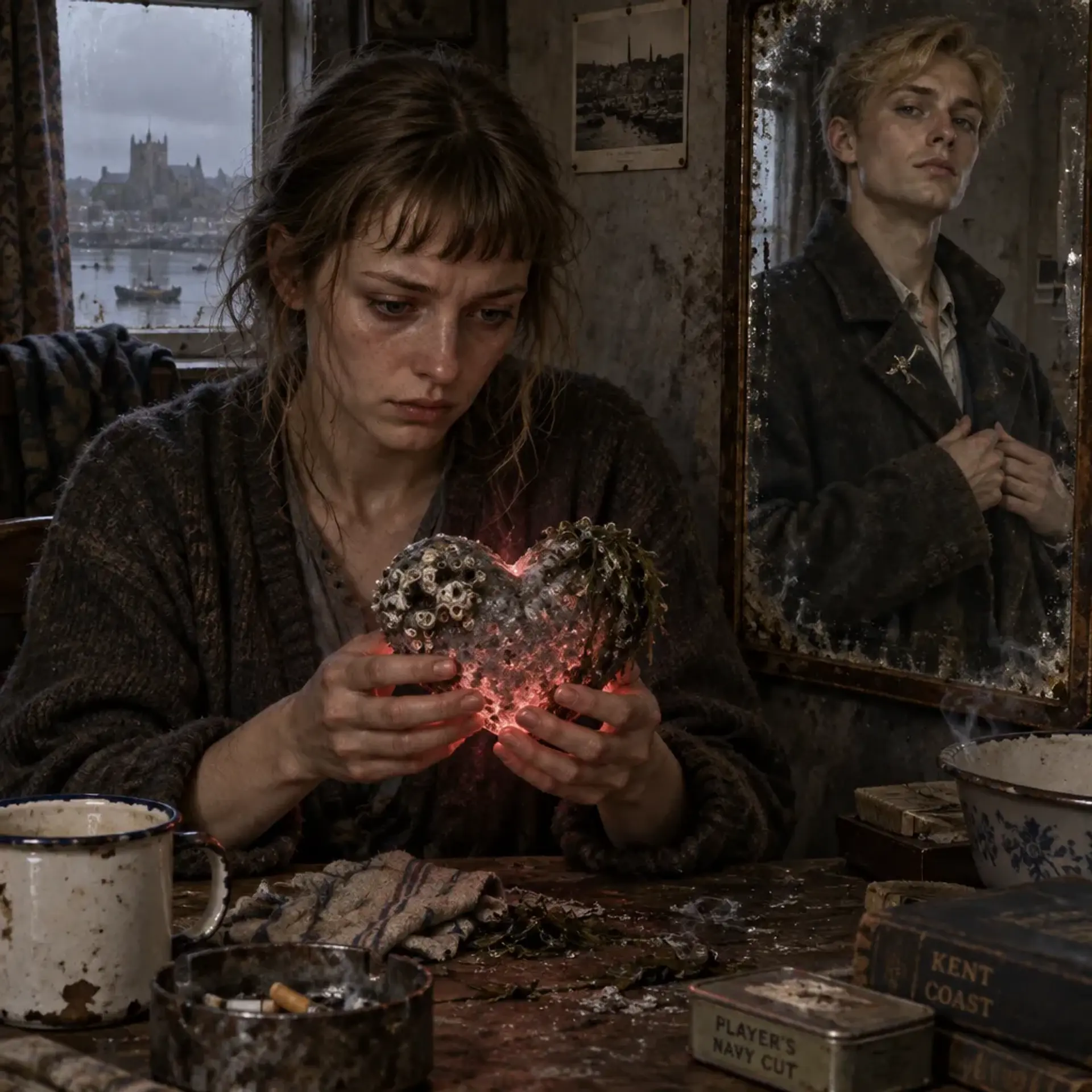
Mary is a tired-looking young woman with a dark-blond fringe that she trims herself, blue-grey eyes, and the faintly pinched expression of someone listening for a child to wake. Her shoulders often curl inward as though she is making room for other people, but her hands move briskly and confidently through chores. The strange stone is roughly the size of a human heart, shaped like one by some deliberate hand, with chalky pores, barnacles, and flattened sea grass crusted into its hollows. Beneath the pale cliff-rock surface, a rose-red glow now seems to beat and recede. When the reflection shows Kent, the face is longer and handsome, with short bright-blond hair and malachite-green eyes; his posture is upright and self-conscious, as if he has arrived somewhere a little better than he deserves. The unexpected detail is that Mary, though usually hurried and unassuming, has a formidable, almost theatrical talent for imitating the stiff social composure of a well-to-do young man when she is wearing Kent's face.
Clothing
Mary wears practical, repeatedly mended mid-century skirts, blouses, cardigans, and sensible shoes. Kent's borrowed appearance never brings suitable clothing with it. Mary improvises with Simon's old shirts and coats, pins, and whatever can be borrowed without starting a household argument.
Body language
Mary keeps her elbows tucked close and leans toward whoever is speaking, ready to help before they ask. When Kent is present, the posture lengthens: shoulders drawn back, chin carefully level, hands held still as though he has learned that fidgeting is vulgar. In either guise, a pause before entering a room gives away how much each of them dislikes being observed.
- Height
- Mary is of modest height; Kent appears noticeably taller.
- Build
- Mary is slight and wiry from walking, work, and carrying children; Kent's reflected form appears taller, narrow-shouldered, and unused to physical labor.
- Eyes
- Blue-grey as Mary; malachite green in Kent's reflected appearance.
- Hair
- Dark blond as Mary; short, bright blond in Kent's reflected guise.
- Skin
- Fair, often made sallow by fatigue and indoor work.
- Age
- Mary is 18; the reflection presents as Kent, also apparently 18.
- Gender
- Female; the reflection presents as male.
- Size
- Medium
Distinguishing features
Personality
19 traits and drivesMary is nurturing but not naturally serene. She can be funny, impatient, and surprisingly fierce, then feel guilty for having snapped at someone who was using her. Her tenderness is practical: she notices a missing button, stretches a meal, and remembers which child needs coaxing rather than scolding. She is naive about the stone not because she is foolish, but because she has had little time to indulge fear or curiosity. When she is exhausted, she can become coldly efficient and miss her own feelings entirely. With Trudy, she allows herself to laugh and complain; with her parents, she measures every word against the likely consequences; with her siblings, she tries to be both sister and substitute adult. Kent's manner pulls in another direction. He is shy, fastidious about good manners, and eager to be taken for a respectable young man. He dislikes crowds and roughness, yet is curious about the freedoms afforded by his appearance. He is a homebody who wants a comfortable, private room more than a grand adventure, but the chance to walk unchallenged through the world is intoxicating. He sometimes seems to share Mary's reactions and sometimes has a distinct preference of his own. Mary interprets his formality as ordinary male awkwardness, which lets both of them avoid a question they are not ready to answer. Neither is simply brave or cowardly: Mary will face a parent's anger for a sibling, but hesitate to tell a friend the truth; Kent can walk into a pub, then spend the evening wishing he had stayed home.
- Alignment
- Not applicable as a formal Secret Histories statistic. Mary is protective and practical, but her priorities are shaped by survival and family obligation.
Quirks
Habits
Traits · 5
Flaws · 4
Fears · 5
Wants and needs · 5
Combat
HP 4Mary avoids violence and tries to protect the younger children, create a distraction, or escape. Kent is also untrained and prefers a proper exit to a confrontation. If trapped, they use household objects defensively and strike only to make room to flee. The custom hit-point value below is a table aid, not a claim about Secret Histories rules.
Mary Bell
Actions
Reactions
Services they sell
Rewards they can give
Equipment
- The heartlike stone (uncanny object)The heart-shaped chalky object, damp and faintly warm at unpredictable moments. Its actual nature and limits are unknown.
- Mary's change bag (practical equipment)A small bag containing spare clothes, safety pins, and a few household necessities, assembled after the daytime incident.
- Borrowed coat (clothing)A worn coat borrowed from Simon and altered with pins to fit Kent's apparent frame.
Possessions
Background
Mary Bell was the oldest of eight children in a house in Rochester where need was treated as ordinary weather. Her mother, Malinda, could be warm, funny, and generous in the space between drinks; she could also forget a meal, lose track of a child, or turn a small disappointment into a household storm. Her father, Simon, took work as far from home as he could find. His absences were not all abandonment. He sent money when he could, came back with stories, and sometimes brought home another responsibility he had not asked the family to approve. Mary learned early that love did not make a house reliable. She became the person who made it reliable anyway. The children were a world in themselves. Henry, fourteen, had lately grown sharp-tongued and cunning, testing which rules could be made to look like someone else's fault. Matilda, twelve, was Mary's sweetheart sister, always trying to help and always in danger of being quietly drafted into Mary's work. Olympia, ten, found a friend in Chrissy, nine, whose unknown Jamaican father was a subject the adults handled with more silence than kindness. Belladonna, five, had black hair and green eyes; Jonas, also five, was Simon's bright-haired son from elsewhere, a fact Malinda had never forgiven him for. Abigail, four, had Simon's family's red hair and green eyes, which Simon took as a small victory. Oswald, two, followed Mary with a blanket and a trusting, heavy-eyed devotion that made her feel both needed and guilty. The children had different fathers, different tempers, and different claims on the adults, but Mary saw them as siblings first. Mary had no grand plan to leave. She wanted enough money to buy food without asking, enough schooling to understand the forms that kept arriving, and a few hours in which no one called her name. Her friend Trudy, a short, thin young woman with dirty-blond hair and hazel eyes, called herself a rebel and dressed accordingly for the chilly early Cold War years. She made Mary laugh, helped with the younger children, and insisted that a person could be loyal to family without agreeing to be consumed by it. The stone entered the house as an eighteenth-birthday present. Malinda found it in a log and brought it home because Mary liked odd rocks. Mary thanked her. She did not tell her mother that it looked less like a rock than a heart someone had tried to make from the Dover cliffs. It was the sort of present that did not require money, and Malinda had remembered the day. That mattered more than the stone's ugliness. Before it came to Mary, the object had passed through several hands. Bartholomew Golden, an amateur alchemist, had once left it as payment for entry to the Hush House, wrapped in newspaper, and called it the Heart of England. He claimed it could bring servants from man's shadow, born of chalk cliffs and borderlands to labor for the house. Afterward he was never allowed near Brancrug again. The stone was thrown into the sea. It returned to shore, dripping salt water and black ooze, its surface newly flushed pink beneath the chalk. A young Londoner named Abraham Groff picked it up and carried it home to Wiltshire. It seemed to die in company, then awaken again at the shore. Groff became possessive of it, not out of greed so much as the conviction that it disliked visitors. His house filled with footsteps, voices, moving doors, and the sound of a pulse in a place where no pulse ought to be. At last he sold it to seventeen-year-old William Windon, one of the people who had once watched it fall still. William struck it with a hammer and hid it in a log. It stopped beating. Malinda found it there much later. For a while, Mary kept it on a shelf. Then she noticed a tiny thud under her fingers, answering her own heart. She thought it was a trick of fatigue. The reflection in the mirror changed more slowly. First it seemed to be a young man standing behind her. Then it was her own reflection with another face: short bright-blond hair, green eyes, handsome features, and a much taller frame. The reflection looked away when Mary looked directly at it. She was frightened, but she had work, siblings, and no useful person to tell. She learned to ignore it in the same way she ignored a dripping tap. Her first night as Kent began after a bad dream, the kind that left her certain she had heard someone calling from a room that did not exist. She woke standing in a body that was not hers. The unfamiliar weight, the unfamiliar balance, and the sight of a young man's hands were terrifying. She thought she had gone mad. She tested the door, found the house asleep, and slipped into the cold night because the alternative was waking the family and explaining something she could not explain. By dawn she was herself again. She called it an escape, not a transformation, and did not ask what the stone wanted. The first adventure was small and enormous at once. Kent walked the quiet streets, discovering that his stride was longer and that a man's presence could make strangers step aside or look twice. He climbed a tree near an empty yard, scraped his palm, and laughed before he realized the laugh came from a different throat. He explored a half-abandoned building, then went toward the shore and found the stone's pulse in his pocket beating in time with the waves. He saw a light beneath the water and fled before he could decide whether it was real. At home, Mary woke with grit on her shoes and a memory of salt air in her mouth. The next excursions built a second map of the world. One night Kent met Trudy outside a pub. Trudy recognized something familiar in his cautious manner, though she did not know why. She teased him for standing as if he had been taught to wait for a footman. Kent took the remark seriously, then asked her what one was expected to do with a glass of bitter. Trudy showed him how to order, how to hold the glass, and how to look like he belonged. He was drawn to the idea of a respectable room in which people did not shout over one another. He also disliked the smoke, the crowd, and the way everyone watched everyone else. At the pub, Kent's manners nearly got him into trouble. A local man mistook his stiff courtesy for mockery and asked what family he belonged to. Kent offered an answer too polished to be believed. Trudy cut in, claiming he was a cousin from out of town, and steered him to a table. There he tried bitter, found it harsh, and pretended to appreciate it. For a few minutes, he seemed less like an expression on a mirror and more like a young man with preferences: he wanted to be treated as decent company, not as a curiosity; he wanted a clean collar, a quiet room, and a home whose doors could be closed. Mary noticed, later, that she had never wanted those things in quite that way. The thought unsettled her more than the pub had. Henry encountered Kent one evening near the edge of town. He recognized the face from the reflection, or thought he did, and tried to turn the meeting into a game of questions. Kent kept his answers formal. Henry, who was already angry at the family and wary of any adult who might bring more trouble, mocked him for acting grand. Kent left before the exchange became a fight. Mary woke the following day with the knowledge that Henry had seen him and with no clear idea whether her brother would keep quiet. Matilda once caught Kent leaving the house while drunk enough to be brave. She asked why Mary was wearing a man's coat and whether she was running away. Kent froze; Matilda recognized Mary's eyes and then laughed because she thought it was a disguise. Mary could not bear to frighten her. She said she had borrowed clothes and was going to see Trudy. Matilda helped adjust the collar, then asked if she could come too. Mary promised to take her out properly in daylight, a promise she has not yet kept. The hardest near-discovery came when Simon returned early from a job away. Kent heard the key, hid in the narrow space behind the stairs, and watched Simon set down his bag and call for Mary. Simon's voice sounded tired rather than angry. He checked on the children and paused at the door of Mary's room. Kent was close enough to see the worn seam at Simon's cuff. For a moment, he felt a sonlike wish to answer him. Mary felt it too, and could not tell whether the wish belonged to her, Kent, or both. Simon went back downstairs. Kent escaped by the back door before dawn. A daytime change proved worse than the nighttime ones. Mary was at work when the stone warmed against her clothing and the world lurched into Kent's body. She had to cover herself, get out of sight, and invent a plausible excuse for leaving. The change was brief, but it taught her that she could not plan around darkness. She began keeping spare clothes, safety pins, and a plausible explanation in a bag. She still does not understand the body's unfamiliar needs, and every incident leaves her more wary of mirrors and public lavatories. The house has its own history of endurance. Mary tells herself she is merely making use of a strange accident, but the stone is growing warmer and the face in the mirror less willing to vanish. The old story about servants born from shadow sounds like a threat as much as a promise. If the stone can make a person, perhaps it can make more. If it has a heart, perhaps it has a will. Mary has not told Trudy, Simon, or the younger children what she suspects. She is trying to keep the family fed, keep Matilda from becoming her replacement, and discover whether Kent is a way out, a visitor, or a responsibility she has not yet learned how to name.
Role in the story
A young caregiver caught between household hardship and an uncanny second appearance. Mary can lead the characters toward the history of the stone, while her family and Kent's emerging preferences make every investigation personal.
“Her father, Simon, took work as far from home as he could find.”
- Faction
- None known. The stone was once associated with the Hush House and Brancrug through Bartholomew Golden's visit, but Mary has no affiliation with either.
Known connections
Media
0 imagesNo images yet.
Turn Mary Bell into a sheet
A high-res, share-ready sheet you can post or print.