Mary Bell
Mary Bell
At the table
Voice
Mary's voice carries a slight rasp from cold mornings, smoke, and calling children in from another room. She does not sing her words; she runs them together when busy and gives a name a firm, practical stress when she needs someone to listen. Kent's voice comes from the same uncertain circumstance but sounds more carefully placed, as if he is choosing each phrase for the impression it will leave. When frightened, Mary may speak too fast; when deeply angry, she stops explaining and states exactly what she will not allow.
Mary speaks plainly and quickly, with the clipped efficiency of someone used to being interrupted by a task. She uses dry humor when comfortable and repeats herself when tired. Kent's speech is more deliberate and mannered, with careful word choice and the restrained confidence of someone trying to appear well brought up. The difference is not theatrical: it comes through in pauses, vocabulary, and what each considers embarrassing.
Speech patterns
How to play them
Begin with ordinary practical conversation and respect Mary's time. Offer help with a concrete task rather than demanding a confession. Do not corner her about the stone in front of the children. Treat Kent's manners as genuine, not as a joke, while remaining alert to the possibility that Mary and Kent do not share all the same intentions.
Goal
Keep her siblings safe and preserve enough freedom to discover what the stone and Kent are, without letting either consume the life she is trying to build.
Motivation
Mary wants to give her brothers and sisters the dependable childhood she never had. She also wants a life that belongs to her, though she is still learning to admit that wanting one does not make her selfish.
Appearance
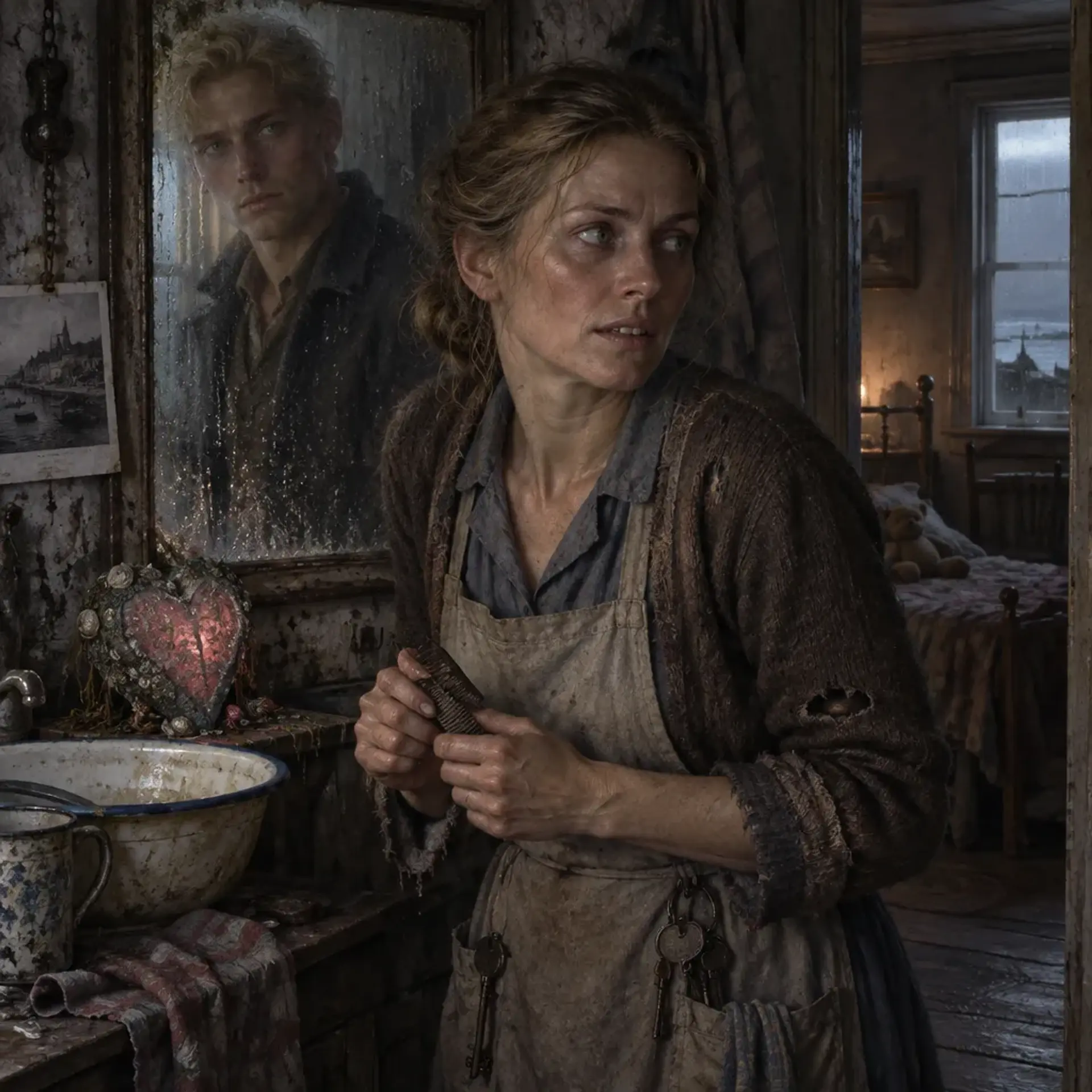
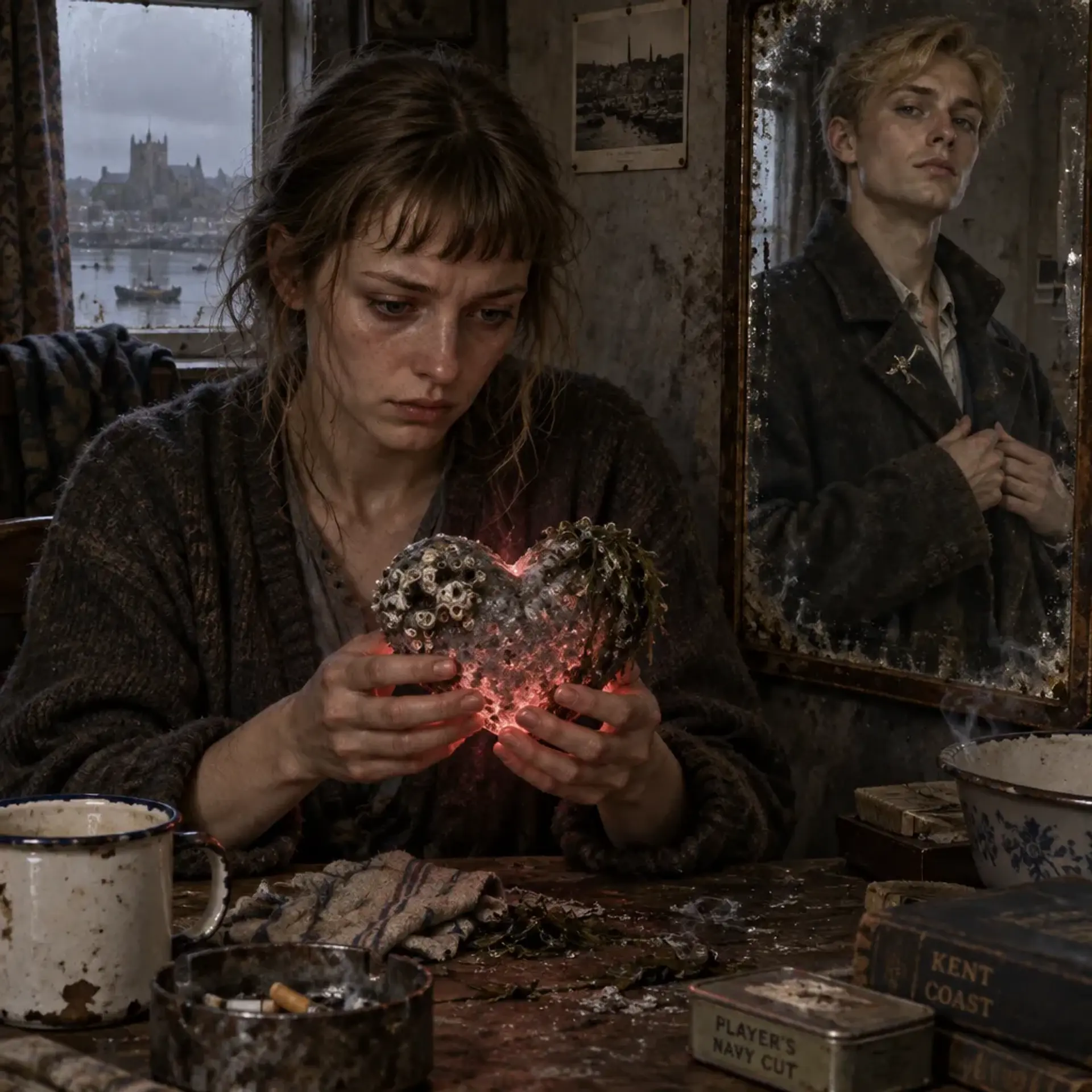
Mary is a compact, dark-blond young woman whose blue-grey eyes look pale in daylight and almost pewter in a dim room. Her hair is usually pinned back with whatever is at hand, but loose strands cling to her temples when she has been working. The skin across her knuckles is rough from washing, scrubbing, and cold weather; her fingertips often carry a fine chalky residue. She moves quickly through familiar rooms, turning sideways through narrow gaps without breaking stride, but stops dead when she hears a child wake. She checks the stone in her pocket by pressing its outline through the fabric, a small, repeated gesture people notice before they know why. At times a mirror shows Kent instead: a taller, handsome young man with short fair hair and malachite-green eyes, composed as if he has arrived somewhere respectable by appointment. The contrast leaves an impression of a household reflection that has learned to look back.
Clothing
As Mary, she wears practical, repeatedly mended skirts, a plain blouse, sturdy shoes, and a cardigan suited to a cold house. As Kent, she scrambles together borrowed or second-hand men's clothes that are often slightly wrong in the shoulders or waist. He prefers a neat collar, clean cuffs, and the impression of being better dressed than his means allow.
Body language
Mary keeps her elbows close and moves with the practiced speed of someone used to carrying things through crowded rooms. Her eyes track children automatically. She rubs a thumb over the stone's outline through her pocket when uncertain. As Kent, the same body language lengthens: shoulders held straighter, hands placed carefully, and a slight hesitation before entering a room where he may be judged.
- Height
- Short-to-average as Mary; Kent appears noticeably taller.
- Build
- Short-to-average height and sturdy from constant household work, with a quick, economical way of moving.
- Eyes
- Blue-grey as Mary; malachite-green in the reflected appearance of Kent.
- Hair
- Dark blond as Mary; short fair blond in the appearance of Kent.
- Skin
- Fair, weathered by cold water and household work; her knuckles are rough and often dusted pale with soap or chalk.
- Age
- 18
- Gender
- Female; during episodes as Kent, she appears and behaves as an eighteen-year-old man.
- Size
- Medium
Distinguishing features
Personality
16 traits and drivesMary is dutiful but not naturally meek. She can be warm and playful with the children, then startlingly severe when an adult tries to pass their responsibilities onto Matilda. She is grateful for small kindnesses and angry at herself for needing them. In public she often makes herself agreeable; in the privacy of a task she can mutter fierce, funny judgments. As Kent, she is much more self-conscious about class and manners. He wants to be seen as respectable, is shy in unfamiliar company, and prefers the comfort of home to Mary's appetite for escape. He can seem stiff where Mary is brisk, but a flash of concern for the family sometimes surfaces before he can disguise it. Mary initially explains this as ordinary embarrassment or male awkwardness, and has not decided whether Kent's opinions are hers.
- Alignment
- Not applicable as a canonical Secret Histories statistic. In ordinary terms, protective and wary, with a tendency to keep peace until someone threatens her siblings.
Quirks
Habits
Traits · 4
Flaws · 4
Fears · 4
Wants and needs · 4
Combat
HP 0 · Ordinary walking and running pace; no verified Secret Histories movement statistic supplied.Mary avoids fights and tries to get between danger and a younger sibling only long enough to make an escape. She uses doors, furniture, noise, and distraction rather than trading blows. Kent favors retreat and propriety, but when cornered may act abruptly and with more force than Mary's habits predict. The supernatural effects are unreliable and should create complications or opportunities, not replace ordinary resolution.
Mary Bell
Actions
Reactions
Services they sell
Rewards they can give
Equipment
- The heart-shaped stone (unexplained object)A chalk-like stone shaped approximately as a human heart, encrusted with barnacle scars and remnants of sea grass. It sometimes warms, weeps salt water, and beats faintly.
- Kitchen knife (tool)A small household knife used for food and ordinary work, not carried as a weapon.
- Workday necessities (personal effects)A folded handkerchief, spare hairpins, and a few coins kept for the train or bus when possible.
- Mismatched men's clothes (clothing)Borrowed and second-hand clothes that can pass for a young man's outfit during an episode as Kent.
Possessions
Background
Mary Bell was the eldest of eight children in a crowded, isolated household in Rochester, Kent. Her parents, Malinda and Simon, were not monsters in the storybook sense. They were simply unreliable in ways that accumulated into harm: Malinda drank, Simon left for work whenever he could, and the children learned to eat, dress, and quiet one another with little adult help. Mary was expected to make the house function. She learned to keep a pan from boiling over while helping a younger child with a button, to read a schoolbook between chores, and to judge the mood of the room from the way a door shut. The family was complicated long before the strange stone appeared. Simon came home from one of his early trips with Jonas, a bright-blond, blue-eyed boy of five whose arrival made a silent fact of his father's absence impossible to ignore. Malinda's anger was not simple jealousy. She had her own history of affairs and two daughters whose fathers were unknown, but Simon's return with Jonas made the family's old bargains visible to all the children. Mary remembers that first evening as a sequence of ordinary humiliations: Simon setting down a small suitcase, Malinda asking whether he meant to keep the boy, Henry staring at the floor, and Mary being told to find another blanket. Jonas cried for a mother he did not know. Mary sat with him until he slept, then went back to washing up. From that night she understood that adults could make a decision and leave children to build a home around its consequences. The other children became Mary's private country. Henry, fourteen, was growing sharp-tongued and cunning, testing how far he could push before anyone stopped him. Matilda, twelve, was her closest helper, pale-haired and bright-eyed, and Mary refused to let their parents turn her into a second unpaid housekeeper. Chrissy, nine, and Olympia, ten, had their own fierce friendship. Belladonna, five, watched the adults with a wary seriousness beyond her years. Abigail, four, was a red-haired spark who could make Simon soften. Jonas, five, carried his own uncertain place in the family. Oswald, two, followed Mary with a blanket and a trust she feared she could not always repay. On Mary's eighteenth birthday, Malinda found an odd rock lodged in a log and gave it to her. It was shaped roughly like a human heart, chalk-white beneath barnacles and threads of dried seagrass. The gift was small, awkward, and more meaningful than either of them admitted. Mary did not want to tell her mother it was ugly. Malinda was drunk enough to forget the exchange, but for one evening she had remembered that Mary liked stones. Mary kept it partly from gratitude and partly because the object seemed to have been waiting for her. The stone had already passed through several hands. Bartholomew Golden, an amateur alchemist, had brought it to a secluded house called Hush House as payment for entry, wrapped in newspaper. He claimed it was a fossilized living heart, forged of heart and scale, able to bring servants from man's shadow out of chalk cliffs and borderlands. He was forbidden to return to Brancrug. The stone was cast into the sea. It came ashore black with ooze, salt-weeping, and newly red-pink beneath its crust. Abraham Groff, a young Londoner, carried it home to Wiltshire. It beat beneath his coat after a train journey, then seemed dead whenever other people examined it. At a Hampshire shore, seawater brought its color back. Groff grew frightened by voices, footsteps, and doors moving in his house. He sold it to William Windon, a local boy of seventeen, who hid it in a log after striking it with a hammer. When Mary received it, its story was no more than gossip and a peculiar shape. At first, the only impossible thing was the beat. Mary felt the stone throb in time with her own pulse. Then a mirror showed a young man where her face should have been. She assumed it was exhaustion, a trick of glass, or some private joke played by the house. The reflection had a life of its own: it turned its face away when she stared, and sometimes wore an expression she had not made. Mary was too tired to investigate. There were meals, washing, children, and a part-time job to help pay for the family's needs. Her first night as Kent began after a bad dream. Mary woke with the sense that she had come back from somewhere cold. In the mirror stood a tall young man with short fair hair and green eyes. The next moment she was looking out through his eyes, feeling a stranger's shoulders and the unfamiliar fit of his clothes. She panicked, tried to call for help, and heard a man's voice come from her mouth. Then she realized she could move beyond the bedroom. She did not understand what had happened, but she did understand the opportunity: for once she could leave without being called back to a chore. That first outing was more bewildering than liberating. She found clothes that could pass in the dark, slipped out, and walked until the tightness of home loosened. She climbed a tree, explored an abandoned building, and went to the shore. The air tasted of salt and coal smoke. She learned that Kent's body moved differently, took up more room, and drew different looks. People addressed him as a young man and expected him to know how to behave. Mary improvised, sometimes awkwardly, sometimes with surprising confidence. By dawn she was herself again, back among the familiar sounds of the house. She filed the event away as a strange practical escape, not as a double life. The pub outing came later. Mary, as Kent, went into a local pub expecting only warmth and a chance to sit without being asked to serve anyone. The room smelled of damp coats, beer, and tobacco. She was cautious, trying to look as though she belonged. Henry was there. He saw Kent and did not recognize his sister, though he watched him with the suspicion of someone who knew the Bell household's silences too well. Mary tried to make ordinary conversation and nearly gave herself away by knowing a small family detail too quickly. Henry asked why Kent was looking at him as if he were about to be scolded. Mary laughed it off, then found herself unexpectedly interested in the way Henry spoke when he thought nobody at home could hear him. For a moment, a thought arrived that did not feel like Mary's: the boy was rude, but he was not beyond saving. The thought was more protective than contemptuous, and it stayed with her after she returned home. Trudy, a short, wiry young woman with dirty-blond hair and hazel eyes, became Mary's friend outside the family. She called herself a rebel and dressed accordingly for the early Cold War years, making deliberate choices that drew notice. She saw how exhausted Mary was and began helping with the children without making Mary beg. One afternoon, Trudy met Kent near a bus stop and treated him as a shy acquaintance rather than a mystery. She talked about clothes, work, and how people decide what sort of person they think they are looking at. Mary could not answer every question without risking discovery. Trudy noticed the pauses but did not press. The conversation made Mary realize that Kent could meet people who had never learned her family role. The house did not always let Mary keep the two lives separate. Once, Simon came home earlier than expected while she was out as Kent. She had to find an excuse and avoid the rooms where he might see her. Another time, a drunken Malinda encountered Kent at home. Her first reaction was alarm; her second was to assume he was a visitor who had been allowed in. Kent kept his posture formal and tried to reassure her without sounding familiar. Malinda asked where Mary was, then spoke about Mary's birthday as if she had only just remembered it. Mary returned to herself afterward with the peculiar ache of having heard her mother say kind things to a stranger that she could not say to her daughter. The incident left her angry, ashamed of being angry, and more protective of the stone. The younger children have begun to make the strange arrangement harder to conceal. Oswald follows Mary around, and once reached toward Kent's coat as though he recognized the comfort of her presence beneath a different face. Abigail is curious rather than frightened and asked why the handsome visitor knew where the cups were kept. Belladonna watches him closely. Matilda has caught Mary moving oddly after an episode and has quietly covered for her, though neither has named what they understand. Henry is the most dangerous witness because he notices patterns. Mary wants to give each child a childhood, but every night away and every unspoken event adds another secret to the pile. The stone remains a burden as much as a gift. It is sometimes cold, sometimes warm, and after rain it smells faintly of low tide. Mary has not taken it to Hush House, nor does she know whether it can summon anything. She knows only that its heartbeat is not always synchronized with hers, and that Kent sometimes seems to look at the world with preferences of his own. Mary's present problem is practical and immediate: protect her siblings, keep earning money, keep the stone from being taken, and decide whether she can trust the person in the mirror enough to ask what he wants.
Role in the story
A young caretaker whose limited chances for freedom are entangled with a returned coastal object and an unsettling second appearance. She can be a sympathetic ally, a source of domestic stakes, or the center of a mystery about inheritance, identity, and what a house can remember.
“Her parents, Malinda and Simon, were not monsters in the storybook sense.”
- Faction
- None known. Mary's loyalties are personal and centered on her siblings and Trudy.
Known connections
Media
0 imagesNo images yet.
Turn Mary Bell into a sheet
A high-res, share-ready sheet you can post or print.