Oswin Hirst
Oswin Hirst
At the table
Voice
A dry, clear voice with the slight rasp of someone accustomed to cold air and long days outdoors. His breath catches softly before he speaks, then his words arrive in a steady, workmanlike cadence. When he slips into old languages, his articulation grows unnaturally fluent and his expression goes still. The name Oswin is spoken plainly, with no theatrical emphasis.
His speech has the worn, practical rhythm of a Yorkshire shepherd: clipped explanations, plain words, and old local turns of phrase. He speaks Common easily, with traces of older diction appearing when he is tired or startled. His voice begins with a small intake of breath, as if he is testing the air before committing to words. He sounds warm when discussing his family, brisk when explaining farm work, and unnervingly intent when addressing the dead. He does not become softer when angry; instead, his consonants sharpen and his sentences grow precise.
Speech patterns
How to play them
Meet direct concern with warmth and practical explanations. He will discuss shepherding, local history, church doctrine, and natural philosophy freely, but deflect questions about his age, iron, or the black hound. If the characters show concern for William rather than treating him as an omen, Oswin becomes more candid. If they threaten Mary or the boy, the patient farmer gives way to a territorial and frightening guardian.
Goal
Keep Mary and William safe, preserve their ordinary family life for as long as possible, and find out whether his nature is harming Mary's ability to carry children.
Motivation
To preserve the tender, ordinary human life he built with Mary and William while resisting the predatory logic of his Unseelie nature.
Appearance
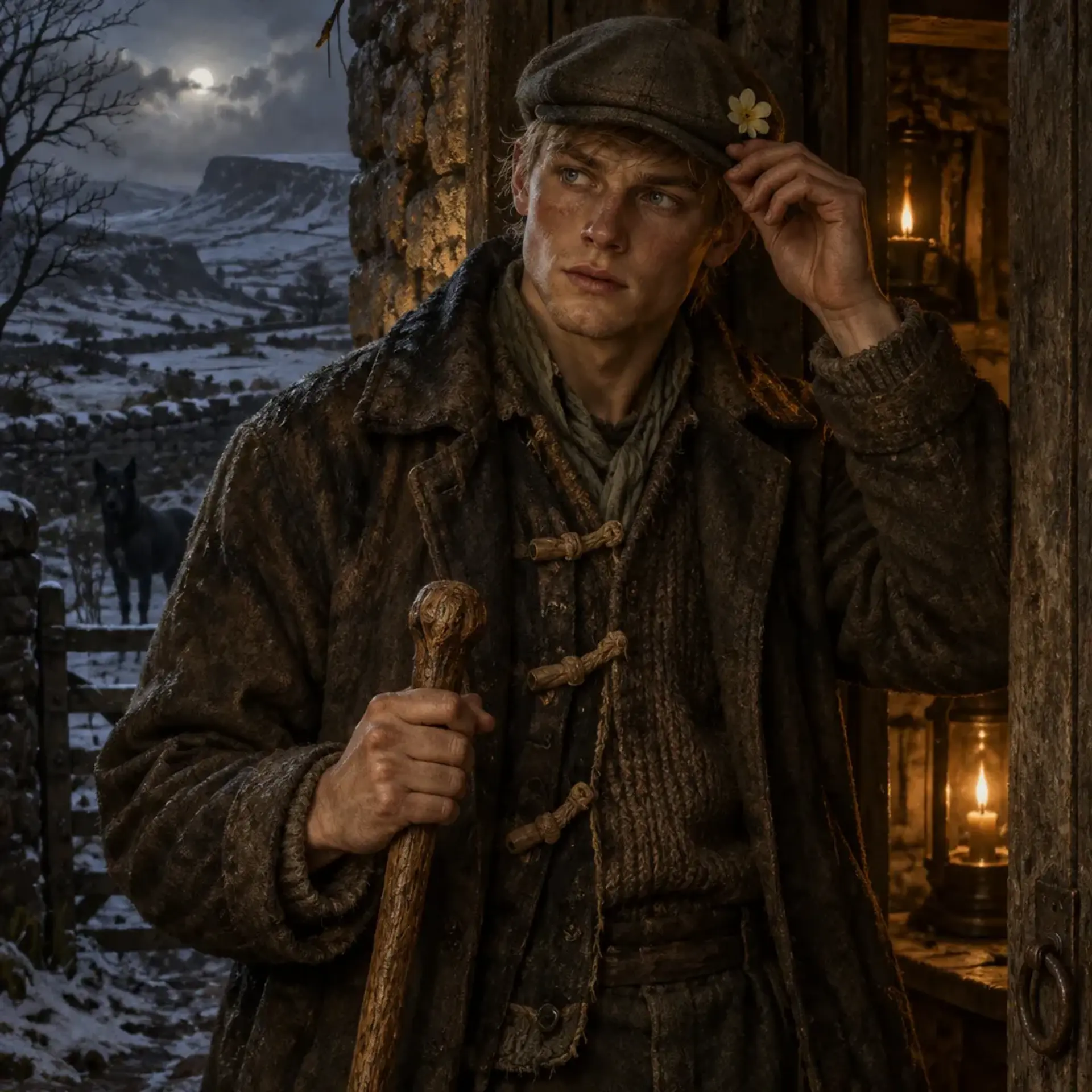
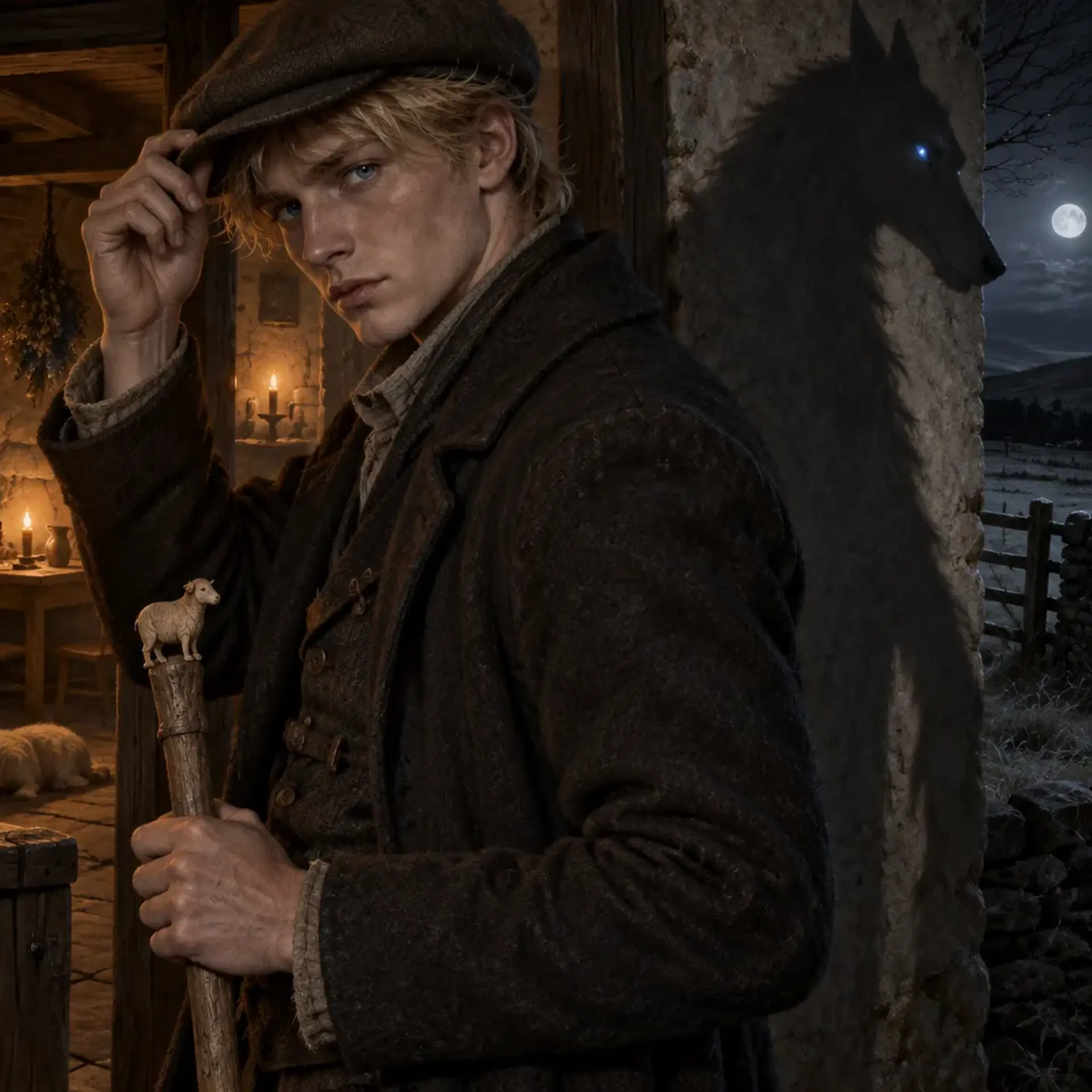
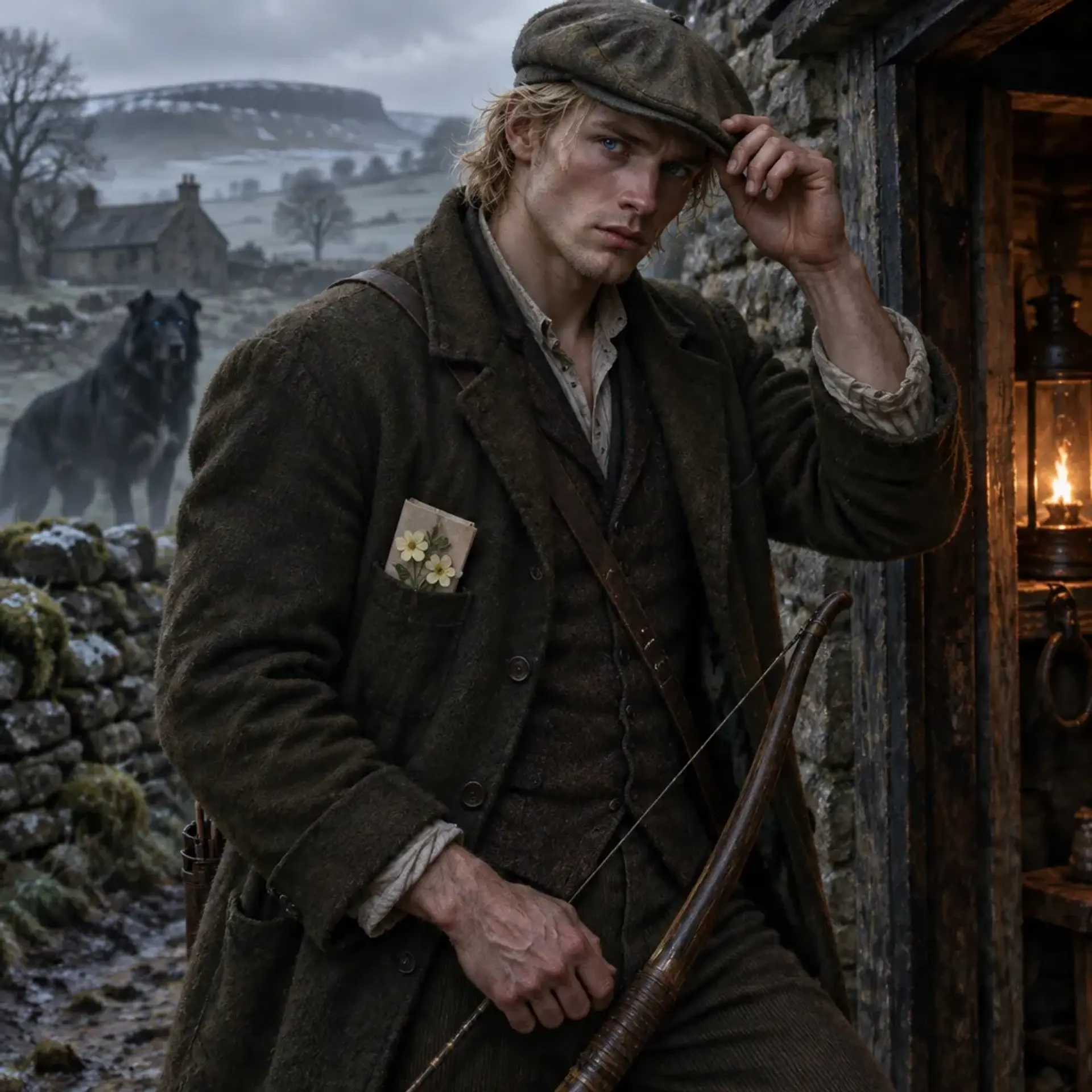
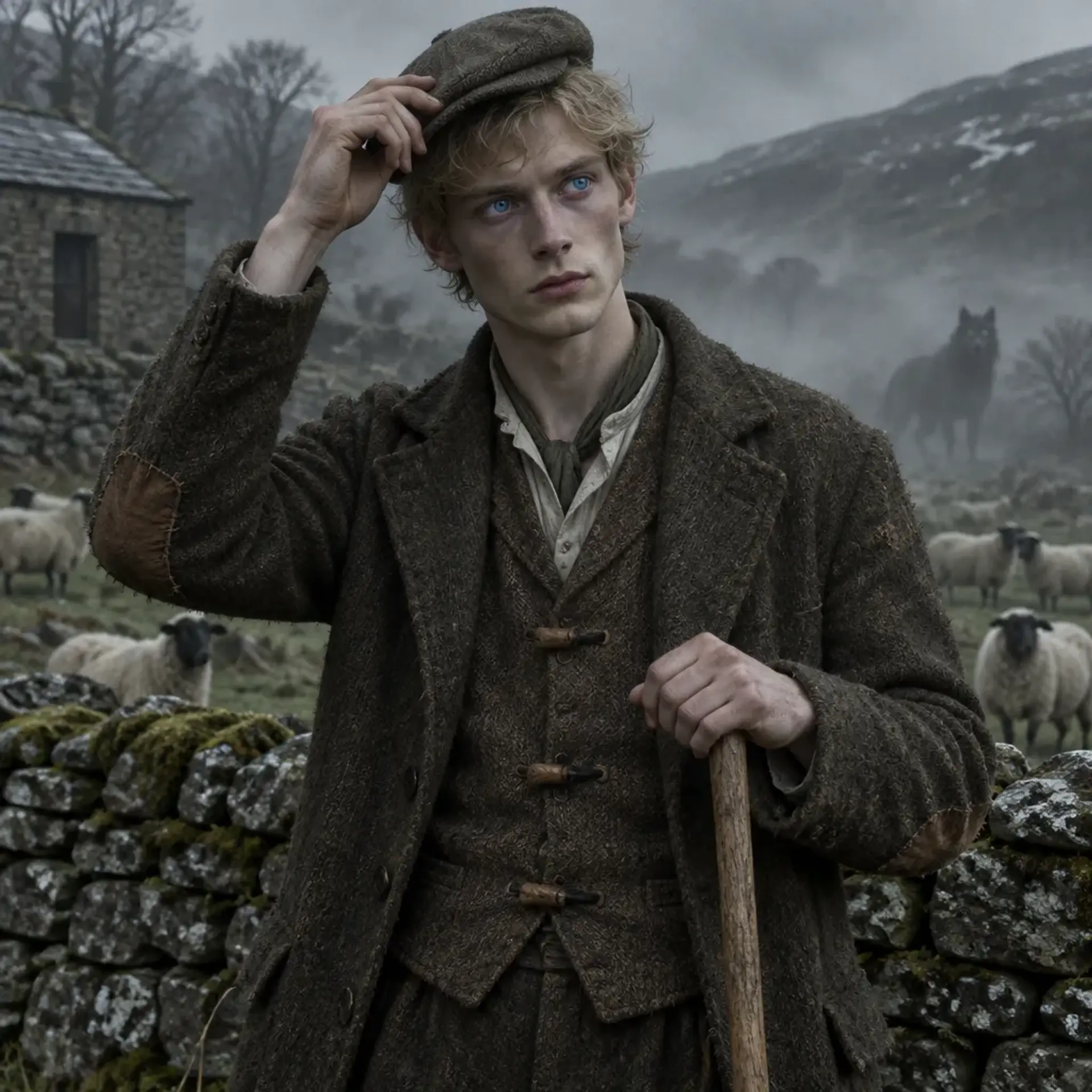
Oswin stands exactly six feet tall, with the long, spare proportions of a young shepherd used to walking steep ground. His pale blond hair is straight and fine, usually pressed flat beneath a plain Yorkshire flat cap; loose strands catch against his coat like dry grass. His blue eyes are startlingly bright, almost fever-blue when the May season takes him, and seem to hold a reflection of a fire that is not in the room. His face is handsome and youthful, with smooth skin and an expression that can move from patient warmth to remote, animal attention without warning. He walks economically, placing each foot as if testing whether the ground intends to keep it. In a crowd he seems modest and unremarkable until he stops moving: then people notice that he is watching every doorway and listening to sounds no one else has heard. The unexpected detail is his flat cap: he removes it with grave courtesy before entering even the smallest cottage, as if greeting a judge.
Clothing
A clean but well-worn wool coat, patched at the elbows, a plain waistcoat, sturdy trousers, and a common flat cap. His cap is cared for more meticulously than the rest of his clothes. He wears no iron buckle or visible iron ornament, choosing leather ties and wood toggles.
Body language
He stands with his shoulders loose and his weight poised over the balls of his feet, as if ready to step around an unseen obstacle. In company he gives people his full attention, but his gaze sometimes fixes on an empty corner and follows something crossing the room. When resisting a fey impulse, he presses his thumb into the seam of his palm. Iron makes his hand recoil as if burned.
- Height
- 6 feet
- Build
- Tall, lean, and deceptively strong, with the economical musculature of a shepherd who walks hills and handles animals every day.
- Eyes
- Bright, burning blue
- Hair
- Pale blond, straight and fine
- Skin
- Pale, with a cool cast that seems almost translucent in winter light
- Age
- Appears about 17; his true age is measured in centuries. He was born in the days of the Danelaw.
- Gender
- Male
- Size
- Medium (Large in Barguest Shape)
Distinguishing features
Personality
20 traits and drivesOswin is kind in the practical, attentive way of someone who notices a cold hand, a lame lamb, or a child left out of a conversation. He gives Mary and William his time, not merely gifts, and remembers what unsettles them. Yet there is a second current beneath that gentleness: he can become fascinated by fear, bargains, and the moment when a person realizes they have no power over him. He despises that current and struggles to keep it from steering his choices, but it is not an outside voice he can simply ignore. It is part of the mind he has now. With his family, he is patient, even self-effacing. He lets William set the pace of their walks and invent names for sheep. He tells Mary that darkness is only the absence of light and that old stories are poor guides to a safe life. He means to comfort her, but also to cover the truth. When Mary watches him too closely, his affection becomes careful and rehearsed. He does not raise his voice or threaten; he offers tea, work, and a reasonable explanation. The more afraid he is, the more ordinary he tries to appear. With strangers, he is courteous and shrewd. He listens before he speaks, notices who controls a room, and prefers a bargain with clear terms to a show of force. He can be generous to a traveler and ruthless with someone who endangers a child. He does not see those responses as contradictory. To him, protection is a promise, and a promise can become a claim. That way of thinking frightens him because it is also how the Unseelie mind understands love. His moods are shaped by the calendar. In the cold season, and especially at Christmas, he comes closest to the person he remembers being: a young man who wanted a hearth, a meal, and the safety of familiar voices. At church during the Christmas service, the old fae pressure loosens. He can sit with the Pickles family and feel the small, human embarrassment of being teased by Thomas or the comfort of Rose passing him a dish. He knows that this human feeling is real, even if it does not last. All Saints' night and Halloween are different. The dead are active, and they approach Oswin as though his long familiarity with thresholds makes him a clerk for their unfinished business. He dislikes the requests, calls them drivel, and often answers anyway. He is not unmoved by the dead; he is tired of being needed by them. The night he sat with Edward in the graveyard after Alice's winter fever remains a turning point. Edward was grieving and angry, and Oswin stayed because leaving would have been a cruelty. The dead crowded the churchyard and made their demands. Oswin listened, then chose to remain beside Edward rather than follow a voice that called him toward the graves. He remembers that choice as proof that he can still choose a human duty over an old summons. May Day tests that belief. The first three days of May bring a joy too intense to be safe. Oswin laughs easily, notices music in distant wind, and feels that every boundary is an invitation. The feeling is not merely happiness; it is the certainty that the world has opened for him and that anyone who loves him should come along. He plans for the season by arranging farm work, avoiding the woods, and asking Hugh or Edward to keep him occupied. In one May, Hugh accompanied him through town while the householders set primroses at thresholds and guarded their wells after sunset. At the edge of the celebration, Oswin heard the hidden revelry and began smiling with a delight that made Hugh step back. Oswin led him away from the bluebells and the dancing presence beyond them, but for a short stretch he spoke of Hugh as something precious he had found and meant to keep. Afterward he apologized, plainly, and did not ask Hugh to pretend it had not happened. The apology did not prevent a later failure. During another May, Oswin slipped away through a boundary into the Otherworld. He had prepared for the season and believed he had it contained. A sound like a feast reached him from the wood, and he followed it. He came back at dawn, but the human world had lost a day. He has never said what he promised to secure his return. The memory leaves him both ashamed and homesick: the Otherworld was beautiful, and some part of him wanted to stay. Oswin can be compassionate toward night-creatures, even those feared by the town. He recognizes their habits and histories, and he knows some are not hunting people so much as defending a territory or pursuing a debt. This makes him an effective protector but an unreliable judge. If an old companion is involved, he may waste a crucial moment trying to bargain. He can also be merciless when a creature threatens Mary or William, and afterward he is troubled by how little remorse the act required. He is practical and observant, but not emotionally simple. He can believe in church doctrine, respect a new scientific argument, and still know that a dead woman is standing outside the window. He reads natural philosophy partly because it gives Mary language for a world that otherwise seems full of devils. He does not think facts make the supernatural disappear. He thinks facts can give a frightened person somewhere to stand. His central contradiction is that he wants to be loved as a man while hiding the very truth that would let Mary decide whether she can love him. He tells himself that disclosure would burden her, that Thomas might exploit the truth, and that William needs a calm household. Each argument contains some truth. Together they have become a habit of cowardice. Oswin's kindness is genuine, but it cannot erase the harm of deception. If Mary learns the truth, he will not be able to control whether she stays. The thought frightens him more than iron, the dead, or the fae courts, because it is a choice that belongs to her.
- Alignment
- Neutral, with a strong and sometimes frightening Unseelie cast to his instincts.
Quirks
Habits
Traits · 5
Flaws · 5
Fears · 5
Wants and needs · 5
Combat
AC 14 · HP 38 · 30 ft. walking; 50 ft. in Barguest ShapeOswin avoids a fight if a warning, bargain, or path away from town will solve the danger. If forced to fight, he uses faerie fire or fear to separate enemies, then attacks whoever threatens civilians. He shifts into hound form to pursue, block a narrow route, or draw danger away from his family. He does not willingly attack the dead unless they threaten the living, and he may hesitate if a night-creature recognizes him as an old companion.
Oswin Hirst
Spells
Actions
Reactions
Services they sell
Rewards they can give
Equipment
- Walking stick (weapon)A stout, carefully maintained shepherd's stick, useful for walking and defense.
- Shepherd's clothing (clothing)A plain wool coat and flat cap. The cap is unusually well cared for and has no iron pin.
- Pocket commonplace book (tool)A small book of natural philosophy and church notes, with observations about seasons and local creatures written between the lines.
- Seasonal charms (folk materials)A pouch of primroses and rowan twigs used as folk precautions around doors and field boundaries.
- Purse (gear)A leather purse containing modest coin and no iron pieces; he avoids handling iron currency where possible.
Possessions
Background
Oswin Hirst was born in the Yorkshire dales when the old borders of the Danelaw were still more than a memory. His mother never gave him a story he could bear to hear twice. She had been taken during a Viking raid, and Oswin grew up with a fatherless beginning, a mother who flinched at boots on a threshold, and a landscape that appeared to remember older laws than any king's. As a boy he was human in the ordinary ways that matter: he hated cold porridge, feared being left alone, and once spent a whole afternoon trying to make his mother laugh after a hard winter. He remembers her hands warming his ears by the hearth. That memory, small and entirely mortal, is the thing he returns to when his mind begins to consider people as livestock, bargains, or passing weather. His first crossing into the Otherworld was not a heroic quest. As a young man, he followed a lamb that had strayed into a hollow at dusk and found a green country under a sky with no sun. A feast was set beneath trees whose leaves shone like wet eyes. The hosts called him kin, and he stayed because they offered him food, warmth, and an answer to every loneliness he had ever carried. Time there did not pass in a useful direction. He learned languages he now refuses to speak, learned how the dead bargain, and learned that the fair folk could be affectionate without being kind. He came back to the dales altered. He had been gone for what he thought were several nights; in the human world, years had passed. He still appeared young. His long exposure to the dead, the fae, and devils gradually taught him what he had become: a human life caught and reshaped into a creature with a fae nature. For a time he wandered. He escorted travelers around dangerous moors, negotiated with things that hunted the roads, and drove night-creatures away from settlements when their appetites threatened the living. Some of those creatures became acquaintances. A few became friends, in the wary sense of beings who have spared one another many times. Oswin knows the paths they use and which names not to call after dark. He does not always kill what comes near a village. Sometimes he hesitates, because the thing in the ditch has shared a fire with him or once warned him that a child was lost. That hesitation has cost him blood and trust. He settled into a sheep farmer's life because he wanted its repetitions: lambing, mending stone walls, carrying feed, eating with people who expected him to be there tomorrow. His house is finer than most for his station, earned by years of work and by wealth gathered on roads he rarely describes. He met Mary Pickles and loved her with a tenderness that surprised him. He married her, and for a while the quiet ordinary days seemed strong enough to contain his past. He has not aged in the years since he met her. He conceals that fact with small glamour-work, careful grooming, changing stories about his birth year, and an occasional borrowed gray hair. He wants Mary to think of him as a man rather than a warning. He cites church doctrine and the new natural philosophies he reads, insisting that darkness is only darkness and that old tales do not deserve to rule a household. Their son William, whom the neighbors call Black William or Blackby, has black hair despite both parents' blondness and Oswin's burning blue eyes. William is slow to speak and learn compared with other children his age. Oswin loves him fiercely and makes time for him even when work, seasonal danger, or restless dreams would pull him away. He patiently shows William how to identify sheep by their bleats and how to feel for a lamb's breath in cold weather. He also watches the boy for signs of an inheritance he cannot explain. Mary fears that William may be the Barguest's child, or the devil's spawn, and does not know that her fear is close to a truth but wrong about its shape. She keeps iron scissors near the bed and an iron thimble close to William. Oswin avoids them. Mary's father, Thomas Pickles, is suspicious of Oswin and has begun to assemble the pieces: the unchanged face, the careful avoidance of iron, the way dogs fall silent around him. Thomas intends to use the secret for his family's advantage, though he is too clever to make a direct accusation before he knows what leverage will work. Oswin respects Thomas's practical intelligence and fears what he might do with it. Mary's mother, Rose, is kinder but observant. She notices that Oswin can be gentle with a frightened child and utterly still beside a corpse. She does not share Thomas's appetite for advantage, yet she knows there is a secret in her daughter's house and wants Mary safe. Mary's brothers Hugh and Edward each know a different version of Oswin. Hugh has seen him at his most exhilarated and least human. During a May Day when the town's celebrations had brought hawthorn over doorways and primroses across thresholds, Hugh found Oswin at the edge of the wood, smiling with a joy too bright to be reassuring. Oswin was listening to music no one else could hear. Hugh tried to bring him home; Oswin instead led him away from a patch of bluebells where something had begun to dance. He protected Hugh, but for several minutes he spoke of him as a useful and beloved possession. Later, when the May fever passed, Oswin apologized without trying to excuse it. Hugh has never forgotten either the protection or the word possession. Edward's bond with Oswin was made in grief. On All Saints' night, after the Pickles family had lost their eldest daughter Alice to a winter fever, Oswin sat with Edward in the graveyard until dawn. Thomas had seen a black hound before Alice died and had never stopped associating the beast with the loss. The dead were active that night. They asked Oswin questions, requested small acts, and crowded the churchyard boundaries. He answered several, despite saying he wanted no part of their drivel. Edward saw him speak to the air and turn toward a grave before anyone had named its occupant. Oswin did not tell Edward what the dead said about Alice. He stayed beside him anyway, and Edward has since kept the memory as both comfort and accusation. Christmas is the season in which Oswin can most nearly pass for human. One year, he spent the holiday with the Pickles family, attending the church service before sharing a meal at Rose's table. The old fae pressure loosened while he stayed within the church and kept the feast's customs. He laughed at Thomas's dry jokes, listened to Rose talk about the winter garden, and let William sleep against his shoulder. For a few hours, Mary saw the husband she believed she had married, and Oswin felt the return of something almost like his old mortal self. He was careful not to let that peace become a promise. The first three days of May remain dangerous. Oswin plans ahead, arranges work, checks the boundaries, and tries to keep his family away from the woods. Yet the season strikes him like a hammer to a nail. His glee becomes enormous, his curiosity sharp and predatory, and the sound of revelry can draw him out. During a past May, despite his preparations, he slipped through a fae boundary and vanished into the Otherworld. He returned at dawn with wet grass on his clothes and the conviction that he had only been gone for an hour. In the human world, a full day had passed. He would not say what he had promised in exchange for finding the way back. Recently, while repairing a gate latch, Oswin caught his palm on an iron staple and reflexively closed his fingers around it. The pain struck behind his eyes and down his arm. He dropped the staple, staggered against the gate, and could not change shape for several minutes. Hugh saw the incident and said nothing, but Thomas later found the blackened grass where Oswin had stood and began asking about the new gate. Oswin now has to decide whether to tell Mary the truth before Thomas turns suspicion into a plan. He is also dealing with the repeated failure of Mary's pregnancies to reach term and the death of one sickly infant soon after birth. He suspects that his nature is involved, but does not know whether confession would protect Mary or destroy her trust. He dreams of the dales of his youth, wakes in the wrong season with mud on his boots, and keeps making the same choice: to return to his wife and son before the night can ask him for anything else.
Role in the story
A loving but deceptive family man who is also the feared black hound of local folklore. Oswin can serve as a guide, a source of supernatural knowledge, a seasonal hazard, or the center of a family mystery involving Mary, William, and Thomas Pickles.
“His mother never gave him a story he could bear to hear twice.”
- Faction
- No formal faction. He is a sheep farmer, a quiet boundary-keeper for the local settlement, and an uneasy ally to several night-creatures of the Yorkshire dales.
Known connections
Media
0 imagesNo images yet.
Turn Oswin Hirst into a sheet
A high-res, share-ready sheet you can post or print.