Oswin Hirst
Oswin Hirst
At the table
Voice
A weathered, clear voice with a dry rasp from cold air and farm work. He takes a short listening pause before speaking, as if checking whether someone unseen has already answered. His Yorkshire cadence is plain and grounded; his old Norse and older English knowledge sometimes colors his word choices. When the dead address him, his replies become easy and conversational. During the first days of May, his voice grows quick and delighted, carrying an unsettling conviction that every strange sound is an invitation.
Oswin speaks in a plain Yorkshire cadence shaped by farm work and long years among different peoples. His voice has a dry, slightly rough edge, as if accustomed to cold air and smoke. He takes a small listening pause before answering, especially when someone says a name near a doorway. His words are usually practical, with old turns of phrase surfacing when he is tired. Around spirits, he speaks with unnerving ease. When May stirs his fey nature, his speech grows quick and bright, full of invitations and vivid descriptions that make dangerous places sound welcoming.
Speech patterns
How to play them
Approach Oswin as a courteous, practical farmer who prefers to help before he explains. He will offer food, directions, shelter, or warnings, but changes the subject when asked about his age, iron, or the shape of the black hound. Earn his trust by treating William kindly and respecting Mary's concerns. Do not threaten the family or force Oswin to choose between them and the town; he may answer with unnerving, fey literalness. Thomas's probing questions make him guarded, while Rose's kindness softens him. If the characters show that they can protect a boundary without exploiting the dead or the fey, he may share what he knows.
Goal
Keep Mary and William safe while preserving their family, prevent dangerous night creatures from entering the town, and find a way to tell the truth without losing the life he has built.
Motivation
Love for Mary and William, guilt over the people he abandoned during his roving years, and a stubborn desire to preserve a human domestic life despite his fey instincts.
Appearance
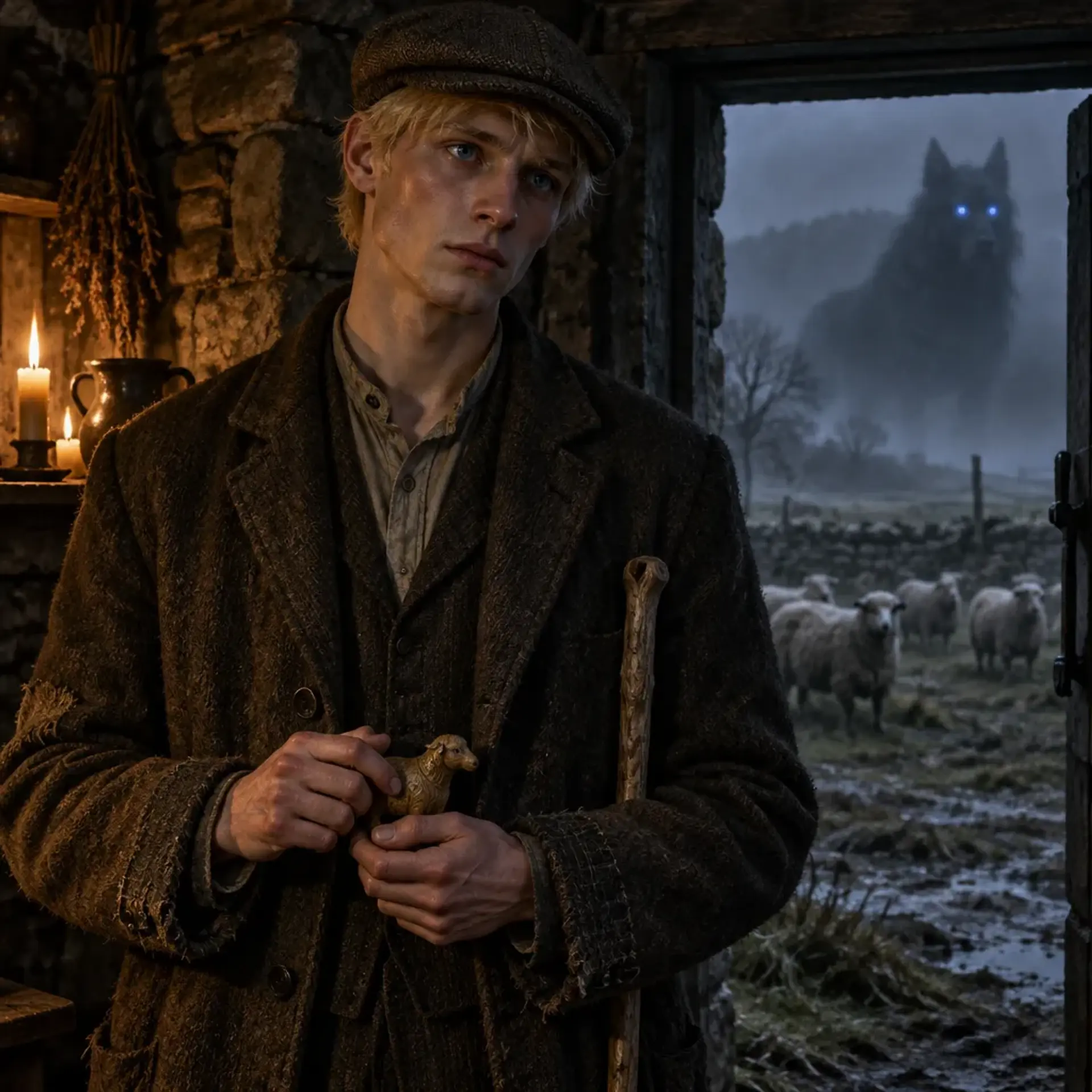
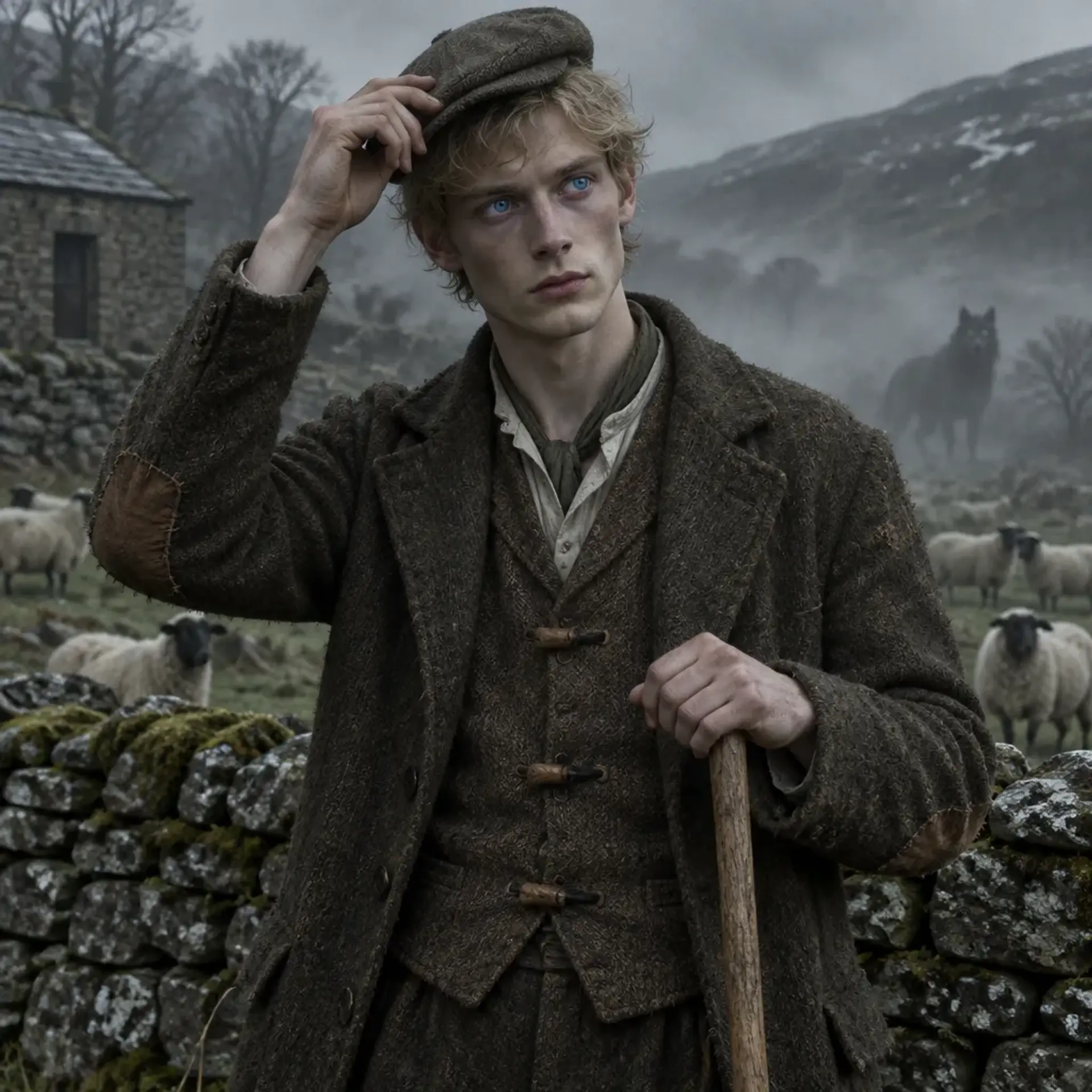
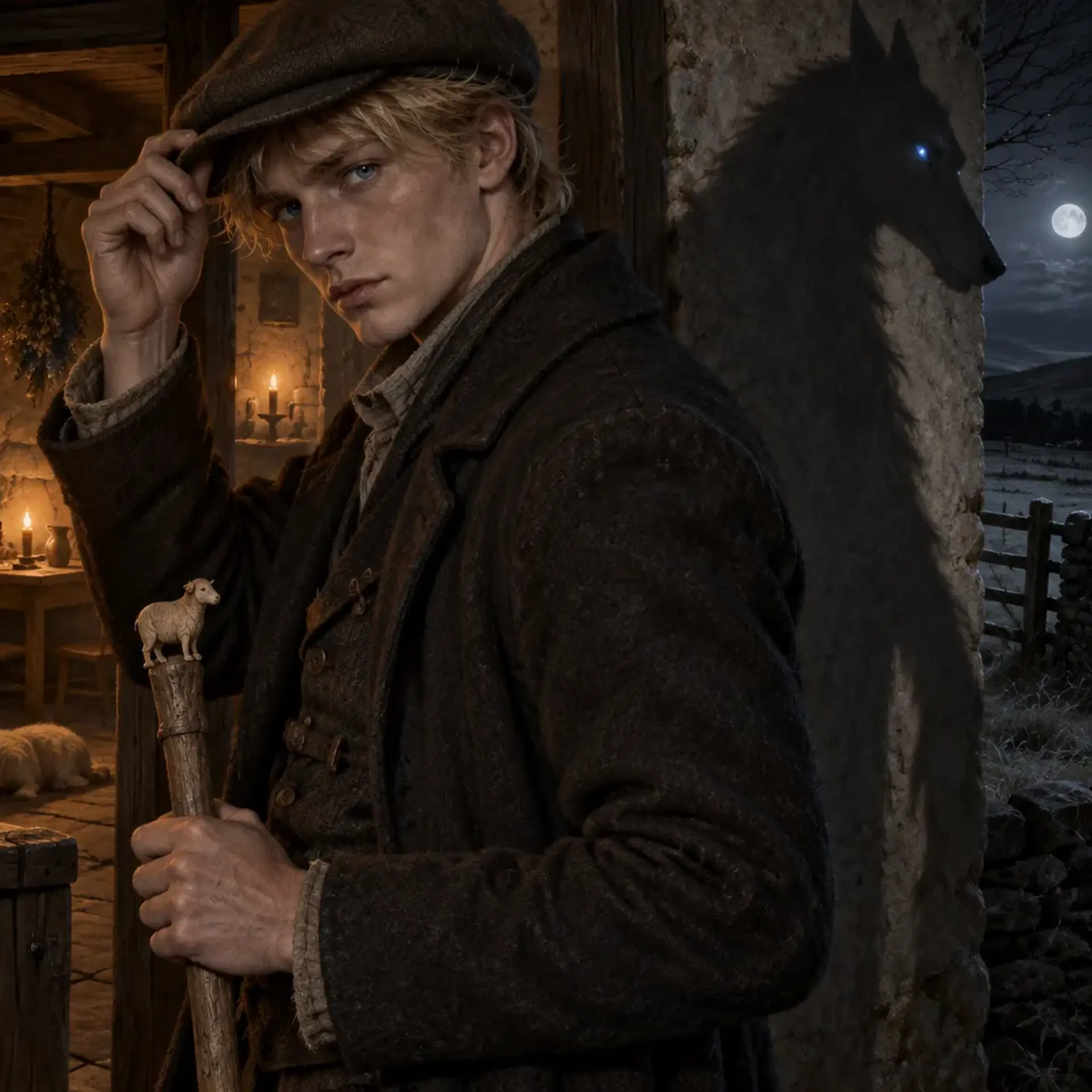
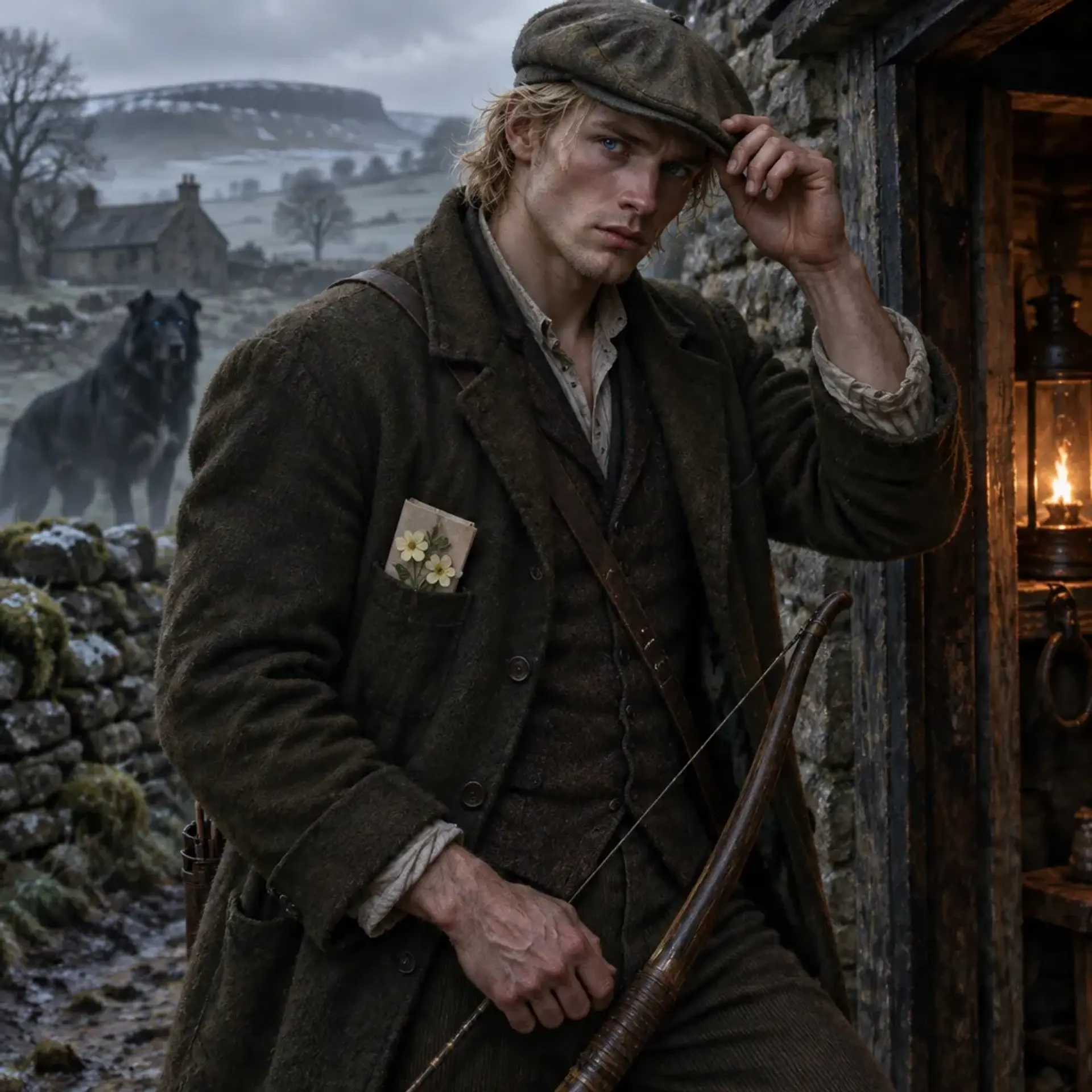
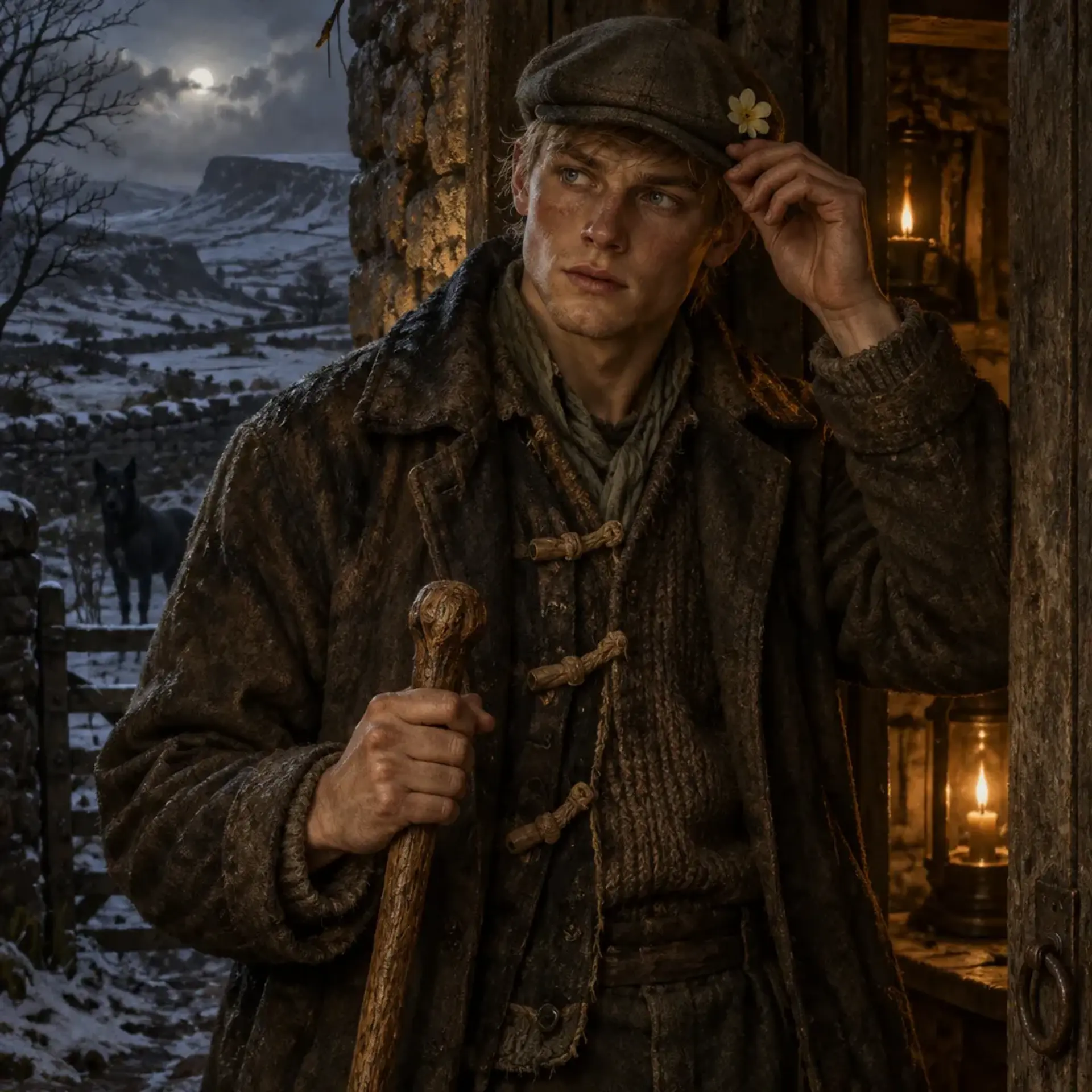
Oswin stands six feet tall, with the unlined, handsome face and sturdy young body Mary remembers from the first time they met. His pale blond hair lies straight and fine, usually flattened under a common flat cap; bright blue eyes seem to hold a small, steady flame when he is angry or standing near the dead. His skin is fair, with the weather-roughened texture of someone who works outdoors. He moves economically, placing his feet as if the ground might suddenly become a threshold. Within a minute of meeting him, most people notice that he repeatedly checks the cap's brim with two fingers, then pauses before speaking as if listening for someone just behind them. He wears a farmer's sensible layers, but keeps the cuffs away from iron buckles and tools. His still-youthful face beside his weathered clothes gives the impression of a portrait that has been carried through several generations. The detail people least expect of a sheep farmer is how carefully he tends a small collection of pressed primroses between the pages of his scientific pamphlets.
Clothing
A flat cap, practical wool layers, a weathered coat, sturdy trousers, and farm boots. He favors wooden toggles and cloth ties over metal fastenings. In cold weather he wears a sheepskin-lined coat, and a pressed primrose is usually hidden inside the cap.
Body language
He stands with his weight centered and his shoulders relaxed, but his feet angle toward the nearest exit or boundary. His hands often hover near his cap, and he turns his head slightly before answering, as though distinguishing a living voice from one at a distance. When a dead person speaks, his gaze fixes on empty space. During May his movements grow quick and open, his smile too broad and his gestures almost childlike; afterward, he folds inward and avoids meeting anyone's eyes.
- Height
- 6 feet
- Build
- Lean, strong-shouldered, and fit from farm work, with the unaging proportions and supple movement of a young man
- Eyes
- Bright, burning blue
- Hair
- Pale blond, straight
- Skin
- Fair, weathered by wind and outdoor work
- Age
- Seventeen in appearance; born in the age of the Danelaw and far older than he admits
- Gender
- Male
- Size
- Medium
Distinguishing features
Personality
24 traits and drivesOswin is kind in the deliberate, practical way of someone who has learned that small acts keep a household alive. He mends a gate, feeds a traveler, and makes time for William without announcing that he is doing anything generous. Yet his kindness sits beside a cold, fey practicality. He can speak calmly of a dead person's request as if it were a chore, or decide that a stranger's fear is less important than keeping a dangerous creature beyond the boundary. He tries to resist this way of thinking because he remembers being human, but under pressure he sometimes treats grief, promises, and even time as negotiable things. With Mary he is patient and affectionate, but he is also evasive. He wants her to feel safe, and so he uses church doctrine and new science to explain what he cannot explain honestly. He mistakes reassurance for trust. When Mary presses him, he does not become louder; he becomes busier, finding a task that gives him a reason to leave the room. He listens to her carefully, then often answers the fear beneath her words rather than the question she asked. This is tenderness and manipulation at once. With William he is openly gentle. He gives the boy simple jobs, waits for answers without hurrying him, and celebrates small successes. He never calls him Blackby, though he does not challenge the locals as forcefully as he should. He fears the boy may be claimed by something inhuman, but this fear makes him watch too closely. When William shows an unusual trait, Oswin tries to hide his alarm behind a lesson, a story, or a game. With Thomas he is restrained and shrewd. He recognizes Thomas's suspicion and responds with careful half-truths, but he has not realized how much Mary has already revealed. Thomas's attempts to make use of Oswin's nature offend him less than they should; Oswin understands bargains and sometimes respects a person who admits wanting something. With Rose he is more at ease because she offers kindness without demanding an explanation. Hugh's directness earns his respect. Oswin is grateful that Hugh once pulled him away from a Mayday boundary, though he finds it difficult to admit how close he came to following the call. Edward's knowledge of the graveyard night makes Oswin cautious, but also gives him a rare companion who understands that the dead are not merely a story. The seasons expose the contradictions most clearly. On ordinary days, Oswin is steady and grounded, attentive to weather, flock, and family. Around All Saints' Night and Halloween, he sleeps poorly. The dead become active and ask him to carry messages, settle disputes, or remember names they fear will be lost. He tries to ignore them, then feels guilty when a plea resembles the voice of someone he once loved. He can be irritable from exhaustion, but his irritation is usually directed at the dead's demands rather than at the living. The night he went with Edward to the graveyard after Alice's death, he answered the spirits with easy familiarity and spoke tenderly at Alice's grave. Edward saw that Oswin was both at home among the dead and afraid of what that familiarity meant. May is worse. The month arrives like a hammer to a nail, drawing his fey nature to the surface. The first three days bring a glee that is not ordinary happiness. He laughs too quickly, finds beauty in dangerous places, and becomes convinced that every invitation is worth accepting. During the Mayday he spent with Hugh, Oswin delighted in the strange behavior of the livestock and proposed following a crow toward the hills. Hugh recognized that this was not normal cheer and physically kept him near the farm. Oswin was ashamed afterward, but also remembered the delight with painful longing. During an earlier Mayday, he slipped away into the Otherworld and returned only after days had passed. There, time, attachment, and consequence felt like soft things that could be set aside. He hates that part of himself, yet sometimes misses the freedom of it. Christmas steadies him. At a service, surrounded by familiar words and the presence of people who know him as a husband and farmer, he feels more human. During Christmas with the Pickles family, he helped William eat, listened to Rose, and endured Thomas's scrutiny without turning it into a contest. His fey nature did not vanish, but it seemed to loosen its grip. He values the season's rituals and is not certain whether their power comes from faith, community, or the simple fact that he chooses to remain among the living. Oswin's life is therefore a continual negotiation between care and concealment, practical affection and inhuman detachment, memory and appetite. He can be patient for hours with a frightened child, then dismiss a stranger's concern as irrelevant. He can long for the human life he remembers while instinctively following a call from beyond the hedge. He does not want to become a monster, but he is no longer certain that wanting is enough.
- Alignment
- Neutral, with a protective instinct that grows less human and more capricious during the faerie month of May
Quirks
Habits
Traits · 6
Flaws · 6
Fears · 6
Wants and needs · 6
Combat
AC 14 · HP 38 · 30 ft.Oswin avoids a fair fight. He uses darkness, terrain, and misdirection, preferring to frighten intruders away from the town rather than kill them. He opens with faerie fire or a disabling spell, uses misty step to break contact, and changes into Barguest Shape to pursue or drive off a threat. He avoids attacking people he recognizes and may hesitate if a night creature with whom he has friendly relations is present. During the first days of May, his instincts become dangerously bold and he may chase a threat beyond safe boundaries.
Oswin Hirst
Spells
Actions
Reactions
Services they sell
Rewards they can give
Equipment
- Oak walking stick (weapon)A plain wooden walking stick used for farm work and as a defensive weapon.
- Farmer's flat cap (clothing)A flat cap with a pressed primrose sewn inside the lining.
- Pamphlets (personal effects)A small collection of pamphlets on natural philosophy and church teaching, used to make his explanations sound ordinary.
- Boundary bundle (folk charm)A cloth-wrapped bundle of primroses and rowan sprigs for warding or marking boundaries according to local custom.
- Farm knife (tool)A sheathed utility knife with a wooden handle; he avoids iron blades whenever possible.
Possessions
Background
Oswin Hirst was born in the Yorkshire dales during the age of the Danelaw, the child of a local woman and a Viking raider. His first memories are human ones: peat smoke caught in his hair, his mother's rough palm guiding his hand over a sheep's fleece, and the sound of winter wind worrying the shutters. He remembers being hungry, frightened of the dark, and comforted by ordinary things. He keeps those memories close because they prove, to him, that there was once a human life inside the thing he has become. His childhood ended in a season of flight and loss. He does not tell the whole story, but says that after his mother's death he wandered beyond the familiar paths and found a place where the hills opened onto a country that was not the one he knew. There, dusk did not pass into night so much as deepen into a color with no name. A stream ran uphill beneath a moon that seemed close enough to touch. Tall figures watched him from the far bank, beautiful and terrible, and offered him food with no promise of what it would cost. Oswin crossed and returned, though he cannot say how much time passed. He learned languages there, including several he now calls forbidden. He understands them better than he can bear to speak them. Years of crossing between the living world and the Otherworld changed him. He learned the habits of the dead and the night creatures haunting the dales. He can see the dead clearly and speak with them as readily as with a neighbor, but calls their requests “dribble” and avoids graveyards when he can. He has friendly dealings with some creatures that others fear, and keeps worse ones from wandering too near the town. Sometimes a familiar voice or a creature's plea makes him hesitate when he should act. His loyalties are real, but not always arranged in a human order. He roved for what seemed to him a long while, crossing lonely roads and helping or bargaining with people whose names he has forgotten. He remembers one past Mayday particularly well. The first three days of May had filled him with an unnatural gladness, bright and absolute. He left his companions while they slept and stepped through a boundary marked by hawthorn. On the other side, a court of fey welcomed him as though he had only been gone a moment. He danced beneath a sky that held a dozen pale dawns, and returned to the dales to discover that days had passed. His exhilaration curdled into horror when he realized how easily he had abandoned those who trusted him. Since then, he pins a primrose inside his cap as a reminder to stay on the human side of a May threshold. Oswin eventually settled into sheep farming, built a fine house for a man of his station, and met Mary Pickles. He loved her steady courage, her sharp practical sense, and the way she laughed at his stories even when she suspected he had embellished them. They married, and for a time he allowed himself to believe that tending a flock, mending fences, and sharing a table could make a life ordinary. He remains devoted to Mary and makes a point of spending time with her and their son William even when work or the season gives him an excuse to avoid the house. Mary has never been told the truth. Oswin explains the unnatural things she notices with church doctrine, new scientific pamphlets, or a farmer's common sense. He wants her not to fear the dark or worry about faeries, and he tries to make the world small enough for her to feel safe in it. His explanations have become harder to sustain. He has not visibly aged since she met him. He avoids iron. Her pregnancies have repeatedly failed, and the only surviving child, William, was born with black hair despite both parents being blond. The boy has his father's bright blue eyes and is slow to develop for his age. Locals call him Black William, or Blackby. Oswin loves him fiercely, but fears that his son carries a mingling of human, hellish, and fey blood. He does not know that Mary believes William may be the Barguest's spawn. Mary keeps iron scissors close and an iron thimble near William. She watches father and son especially carefully when the fae seasons approach. She also remembers Oswin's old stories of roaming adventures, and notices that his face has not changed. Her father, Thomas Pickles, is suspicious of Oswin and sees his hidden nature as a possible source of advantage for the family. Thomas is clever enough not to confront him openly. Oswin knows Thomas is watching, but not that Mary has told her father about the night that first made her fear the Barguest. Oswin's relationship with Thomas is courteous and tense. He answers questions with practical truths that omit the dangerous parts, while Thomas tests those omissions with careful questions of his own. Rose Pickles, Mary's mother, is warmer. She offers Oswin food and speaks to him as a son-in-law rather than a puzzle, though he suspects she has noticed more than she says. Hugh Pickles treats him as a capable neighbor, and Oswin respects Hugh's directness even when it makes evasion difficult. During one Mayday, Hugh and Oswin spent the afternoon laying rowan branches and primroses at a boundary hedge after livestock began refusing to cross it. Oswin's cheerfulness became so intense that he laughed at a crow's cry and proposed following it into the hills. Hugh grabbed his sleeve and dragged him back toward the farm. Oswin thanked him only later, when the May fever had passed. Hugh has since learned not to let Oswin walk alone in the first days of May. Edward Pickles is more guarded and more willing to face unpleasant facts. On an All Saints' Night, Edward accompanied Oswin to a graveyard after the Pickles family lost Alice to a winter fever. They went at morning's edge, seeking the place where her fevered body had been laid. The dead crowded close to Oswin, asking him to carry messages and settle old obligations. Edward saw Oswin answer a voice no living person could hear, then stop beside Alice's grave and speak her name with a tenderness that frightened him. Oswin led Edward away before the dead could persuade him to stay. They have never discussed everything Edward saw, but Edward no longer dismisses Oswin's warnings about certain nights. Christmas steadies Oswin. One year, he spent the holiday with the Pickles family, sitting through the service and then sharing a simple meal with Mary, Thomas, Rose, Hugh, and Edward. The church's familiar words and the warmth of the house made him feel almost human again. He helped William eat, listened to Rose's stories, and did not look toward the dark windows when something moved outside. Thomas watched him throughout the evening. For once, Oswin did not resent the scrutiny; he was grateful for the company. He believes the season's customs and the church service help him keep his nature from slipping, though he cannot tell whether it is faith, ritual, or the company of people who love him. His most recent brush with iron came while repairing a gate. A loose iron hinge slipped and cut across his palm. The contact burned with a cold, soundless pain that seemed to ring through his teeth. Oswin dropped the hinge, then forced himself to pick it up again because Mary was watching. He made an excuse about a splinter and spent the night restless, his hand unmarked by morning. Mary found the iron tool set farther from the house than before. Thomas noticed the same thing and said nothing. Now Oswin dreams of the dales as they were, of the Otherworld as it is, and of a future in which William is accepted rather than feared. He keeps the night creatures beyond the town's boundaries when he can, maintains his farm, and tries to preserve the small domestic life he has made. His immediate problem is that Mary is afraid, Thomas is calculating, and the next May is coming. He wants to protect his family without turning their love into another bargain with the unseen.
Role in the story
A protective but unreliable guide to the supernatural dangers of the Yorkshire dales, and a family man whose concealed nature threatens the trust he is trying to preserve. Oswin can become an ally, a source of local lore, or the center of a painful conflict when Mary and Thomas uncover more of the truth.
“He remembers being hungry, frightened of the dark, and comforted by ordinary things.”
- Faction
- No formal faction. He is a sheep farmer and an informal guardian of the dales' boundary paths, with uneasy ties to the local dead and several night creatures.
Known connections
Media
0 imagesNo images yet.
Turn Oswin Hirst into a sheet
A high-res, share-ready sheet you can post or print.