Friedreich
Friedreich
At the table
Voice
His voice seems to come from a narrow chest that has learned to project across parade grounds and crowded halls: dry, forward, and slightly grainy, with consonants set firmly in place. A faint rasp catches on words about tobacco, damp weather, or war, though he does not know whether the rasp is his or borrowed. While wearing another face, he reproduces that person's voice with unnerving accuracy, but his old-fashioned phrasing can still give him away.
His speech is precise and carefully placed, shaped by remembered household formality, military drill, and decades of trying to make people understand him when they may not perceive him. He favors complete sentences, practical distinctions, and exact corrections. When he is happy, the formal cadence loosens into quick, eager observations; when angry, he uses short, direct clauses and does not soften the accusation.
Speech patterns
How to play them
Treat Friedreich as a person rather than a trick or a witness summoned for convenience. Address him directly even when he is not visible, ask before he borrows anyone's face, and do not mistake his formal bearing for emotional distance. He warms quickly to shared meals, football, cards, and practical holiday errands. If he is wearing a face for too long, invite him to state his own name and let him choose whether to continue. Questions about Wilhelm should be direct but not baiting; Friedreich is already angry and will notice evasions.
Goal
Recover enough reliable memory to understand his own part in the wars, confront Wilhelm without losing him, and find a way to keep his identity intact while using Borrowed Visage.
Motivation
To be recognized without having to steal a face, while preserving the family he has made among the living and the dead.
Appearance
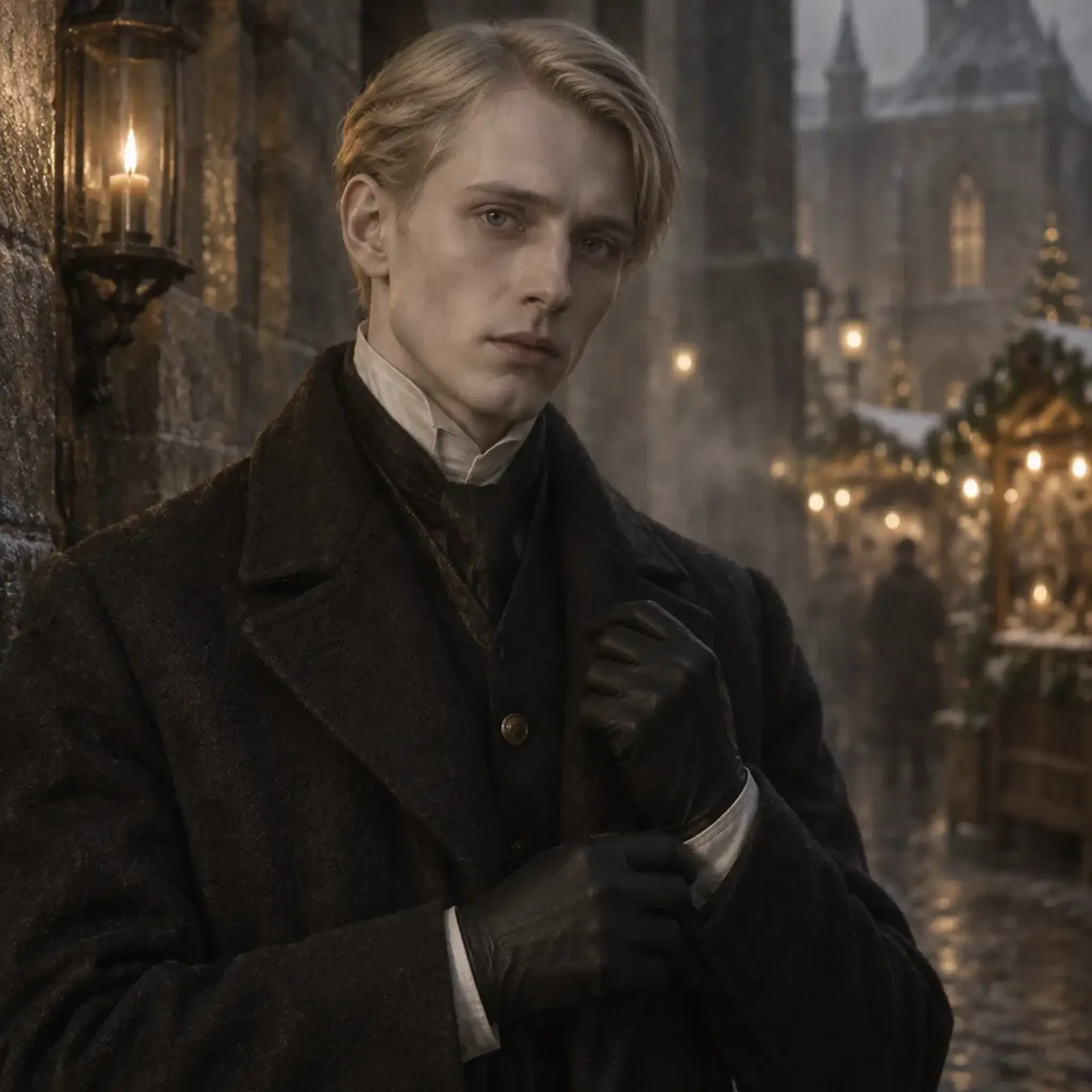
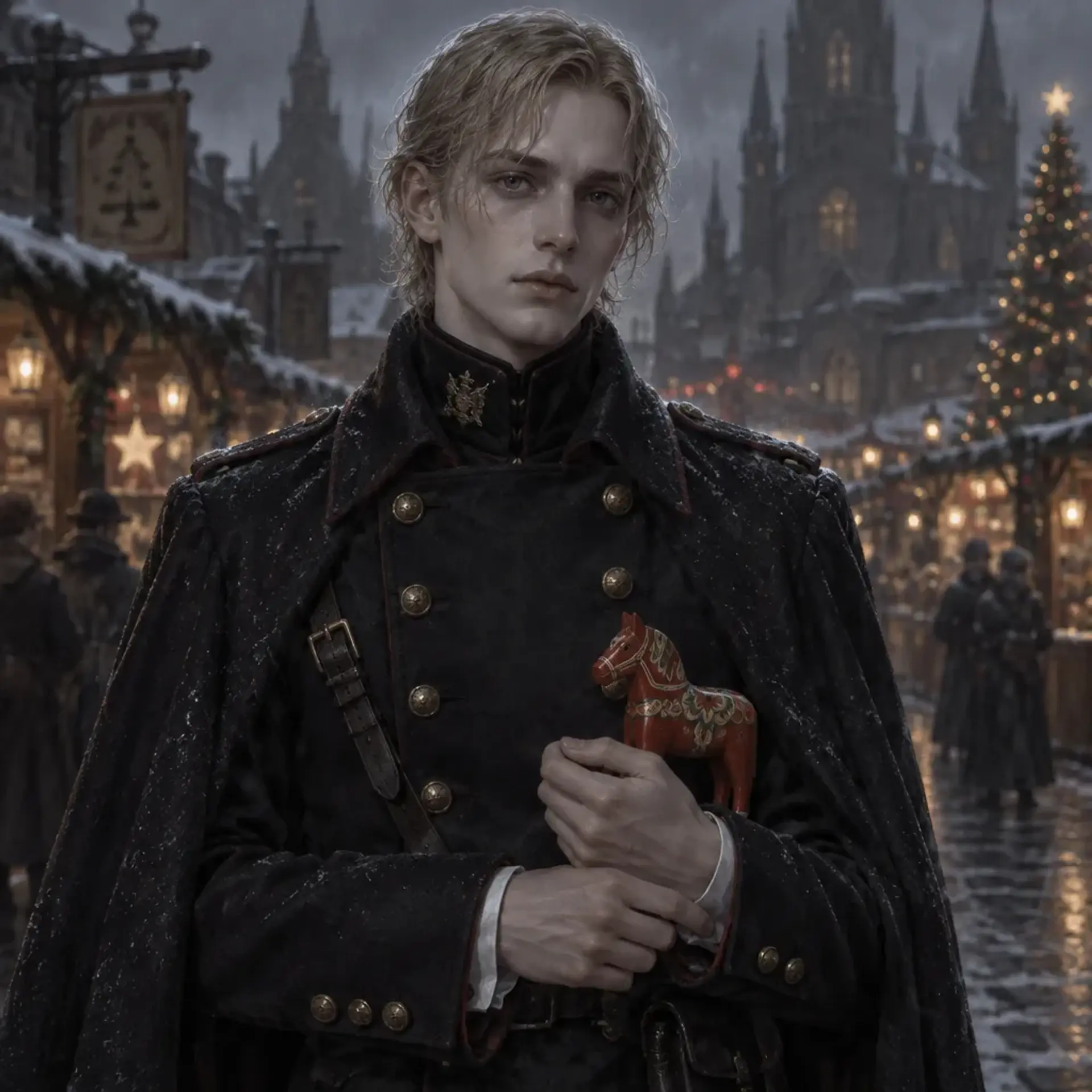
Friedreich's unmasked shape looks like a young Prussian cadet seen through rain-streaked glass: narrow shoulders held unnaturally square, a long face with a smooth, unfinished quality, and pale skin that seems to have been rubbed with ash. His apparent blond hair lies in stiff, damp-looking locks, and his gray eyes are what Wilhelm remembers, though Friedreich cannot verify either detail for himself. The edges of his coat and hair sometimes lose definition, like ink feathering into wet paper. He moves in measured, heel-first steps, then occasionally turns too sharply, as if responding to a drill command no one else heard. Within a minute, people notice the smell of wet wool, old tobacco, and cold iron around him. He does not know he carries it. He repeatedly checks the left cuff of his uniform, smoothing a crease that is not there. An unexpected detail for a dead military-minded young noble: at Christmas markets he becomes absorbed in choosing small, brightly painted wooden animals, and will argue earnestly over which one has the most convincing legs.
Clothing
A dark, old-fashioned Prussian-style coat with a high collar, dull brass buttons, and a carefully maintained left cuff. The uniform is an impression rather than reliable evidence of his actual service. In casual company he sometimes wears a borrowed modern jacket over it, though he dislikes how the cut changes his silhouette.
Body language
He stands as if awaiting inspection, hands behind his back, but the posture breaks whenever he checks his cuff or leans toward food to catch its smell. When angry, his movements become crisp and over-controlled; when pleased, he forgets the drill and points out market goods with boyish urgency. He watches faces for recognition and looks away too quickly when he finds it.
- Height
- About 5 feet 8 inches when clearly embodied; his Shadowlands outline does not always hold a stable measure.
- Build
- Slim, upright, and cadet-straight, with the slight stiffness of a body that remembers uniforms better than comfort.
- Eyes
- Gray, according to Wilhelm; Friedreich is not certain.
- Hair
- Pale blond, as Wilhelm remembers; its truth is uncertain.
- Skin
- Ash-pale and slightly translucent, like paper held over a winter window.
- Age
- Appears 17 or 18; his actual years since death are uncertain to him.
- Gender
- Male
- Size
- Medium
Distinguishing features
Personality
20 traits and drivesFriedreich is built around a contradiction he cannot resolve: he believes identity should be earned through conduct, yet his most powerful way of meeting the world is to borrow somebody else's face. He has a strict, old-fashioned sense of duty, but much of that code is assembled from fragments, family stories, and the idealized military bearing he thinks he once possessed. He wants to be honorable more than he wants to be accurate about the past. When he discovers a fact that complicates the version of himself he prefers, he does not immediately reject it; instead, he files it away, interrogates it, and returns to it until the uncertainty begins to feel like an insult. With strangers, Friedreich is courteous, watchful, and almost painfully composed. He begins with titles, careful introductions, and questions that sound like a discreet inspection. He is not trying to dominate every room. Formality is a handrail: it gives him a pattern to follow when he is unsure whether anyone can see or hear him. If people acknowledge him without making his condition the center of attention, he loosens quickly. He will offer useful advice, ask about their plans, and remember details more carefully than they expect. If someone treats him as a curiosity, he can become cuttingly polite. His politeness is not softness; it is the last orderly layer over anger. Among the coven, he is much less formal, though the old habits survive as jokes and rituals. He treats Wilhelm as a brother, Gunther as a friend whose experience he wants to understand, Klaus as an irritating comrade, and Mila as a younger sister he has somehow acquired. He enjoys football, fishing, cards, hunting, and drinking in the company of people who will argue with him and still save him a place. Holidays matter because they turn separate lives into a repeated gathering. Friedreich gets visibly excited when more of the group arrives. He will pretend that his interest in the Christmas market is purely logistical, then spend twenty minutes comparing painted animals or recommending a scarf he cannot wear. His relationship with Wilhelm is the deepest contradiction in his life. Friedreich is angry at him for deserting in the First World War and for crimes committed in the Second. He also feels an old, instinctive attachment that survives every accusation. He wants Wilhelm to explain himself, but he is not sure whether he wants the truth or wants Wilhelm to say that there was a reason which would let Friedreich keep loving him without feeling foolish. Wilhelm's shame and refusal to speak feel to Friedreich like another abandonment. He can be tender with him one moment and severe the next. He may sit beside Wilhelm through a long silence, then break it with a question he has asked a dozen times. When Wilhelm will not answer, Friedreich interprets the refusal personally, even if the vampire's silence comes from shame rather than indifference. Friedreich's protectiveness toward Mila is sincere, but not perfectly wise. He does not believe she is weak. He believes that the person who can see danger should take responsibility for it, and he has cast himself in that role. When she is threatened, his attention narrows and he becomes decisive. When she is merely making an ordinary risky choice, he can overstep, disguising anxiety as practical advice. If Mila calls him on it, he is likely to protest that he was only doing his duty, then eventually admit that he dislikes being unable to help her. He is learning that care is not the same as command. Gunther draws out a gentler curiosity. Friedreich is fascinated by the changeling's life in Arcadia and by the moss clothing he sells, but he tries not to make Gunther into a puzzle. His own gift gives him a temporary impression of appetite, warmth, smell, sleep, and touch. He wonders if he might share those sensations with Gunther, or whether that hope is selfish. He sometimes watches Gunther at work and imagines what it would mean to feel fabric as fabric rather than as a borrowed echo. He has not attempted a serious transfer. His fear of hurting his friend is stronger than his curiosity, though not always by much. Klaus's passive-aggressive meanness makes Friedreich wary, but Klaus's hesitation around him matters. Friedreich is inclined to read the pause generously. He may tease Klaus about having a conscience, then defend him from outsiders who assume the worst. This can frustrate the others, especially when Klaus's behavior genuinely warrants criticism. Friedreich believes people should be judged by repeated conduct, not just their sharpest remark, partly because he hopes the same rule will be applied to him. Being unseen is a particular wound. Friedreich has learned to make a joke of it, or to repeat a person's name with elaborate courtesy, but the frustration underneath is real. If a conversation moves on while he cannot be perceived, he may become brittle and accuse the group of forgetting him. He knows that the failure may be supernatural rather than personal, but knowledge does not stop the sting. On unbinding days, when the living world loosens its hold and he becomes clearer, he feels relief so powerful that he sometimes acts as if he has been granted a holiday. He greets people first, insists on joining errands, and takes sensory details seriously: the smell of coffee, the sound of wet tires, the roughness of a paper bag. His Borrowed Visage is both his talent and his temptation. He prefers men around his apparent age, especially military men, police, and nobles who seem to embody order, service, or authority. He tells himself this is aesthetic and practical, but it is also a way of approaching the self he imagines he might have been. He may choose a face because it makes him feel familiar, then discover that he has begun copying its posture or emotional habits. The resulting envy is not simple jealousy of the living. It is grief at the ease with which another person can be seen. His Shadow knows this and whispers that he should keep the face, take more, or punish anyone who refuses to recognize him. When he is frightened, Friedreich becomes meticulous. He checks his cuff, corrects his posture, and asks for exact details. When grieving, he often turns practical, finding food, arranging transport, or making sure someone has a coat. When genuinely happy, he forgets to maintain the role of the composed young officer and becomes openly enthusiastic, especially about holidays. When angry, he does not grow quieter or more polite. His speech becomes clipped, his gestures sharper, and his accusations unusually plain. He may say something cruel about Wilhelm's silence, then regret the cruelty without withdrawing the accusation. Friedreich is neither a pristine noble spirit nor an uncomplicated tragic boy. He has blind spots, vanity, and a hunger to be thought good. He can romanticize military ideals while condemning the real violence attached to them. He can borrow a face without fully confronting what that means to its owner. He wants to be loved as himself, yet often makes himself easiest to love by performing a familiar role. What keeps him sympathetic is that he knows, at least in flashes, that this contradiction is dangerous. He keeps asking questions, keeps returning to his friends, and keeps trying to distinguish what he remembers from what he merely needs to be true.
- Alignment
- Protective and dutiful, but capable of cold judgment and resentment.
Quirks
Habits
Traits · 5
Flaws · 5
Fears · 5
Wants and needs · 5
Combat
HP 7 · Walking pace when embodied; in the Shadowlands use the Storyteller's normal movement rules for wraiths.Friedreich prefers not to fight until he has made himself perceptible or acquired a face that will unsettle the opponent. He uses Embody or Borrowed Visage to create an opening, then closes distance and uses a cold grip or tries to escape. He protects friends by drawing attention away from them, especially Mila and Wilhelm. He is not a trained soldier by mechanical assumption; his formal bearing is not a substitute for sound tactics. The ratings and dice suggestions here are a custom, table-ready adaptation and should be adjusted to the Storyteller's Wraith rules.
Friedreich
Actions
Reactions
Services they sell
Rewards they can give
Equipment
- Cadet's coat (personal relic)A spectral coat with a high collar and a left cuff he habitually checks. It is a focus for identity and memory, not armor.
- Market card (memento)A small, worn card from a holiday market. He keeps it as proof that he once chose a gift for someone rather than simply giving advice.
Possessions
Background
Friedreich remembers Brandenburg as a smell before he remembers it as a place: wet horse, stove smoke, polished leather, and the faint sourness of a crowded hallway in winter. He believes he was born into a minor Junker household, or at least into a household that taught its boys to stand like they had inherited land. His memories do not agree on the size of the estate, the names of his parents, or whether he was truly a cadet. What he has are fragments: a stiff collar scratching his jaw, a tutor tapping a map with a riding crop, and someone telling him that a family name is a debt one pays by behaving correctly. He died young. He cannot say precisely when, or what killed him. A glimpse of a black carriage, fever heat, and the taste of a copper coin recur, but none has the certainty of memory. He knows he became a wraith, a dead soul caught in the Shadowlands, and that the living world became difficult to reach. He describes the change as being shut outside a house while the people inside continued setting the table. His Shadow, the dark and self-destructive side of a wraith, is not a separate stranger he can safely ignore. It uses his shame about cowardice and his hunger for recognition to urge him toward faces that make him feel real. The person who opened his Caul was a wraith named Marta, an old psychopomp who found him caught in a loop of marching through a flooded courtyard. Friedreich remembers her hands, not her face: one gloved hand held out, the other gripping a rusted lantern. She told him that the Caul was the enclosing numbness of his death, and that he could choose whether to remain sealed inside it. That is Friedreich's recollection, not a claim that every wraith's experience is the same. Marta helped him emerge into the Shadowlands, taught him the difference between a memory and a compulsion, and warned him that every borrowed identity would charge him a price. She vanished after a dispute with a ferryman over whether a lost child should be taken onward or returned to a haunting. Friedreich has never learned what became of her. His first attempts to be seen were humiliating. He formed a face that was too smooth, then a face that looked like a dead schoolmaster, and finally discovered that people reacted more strongly when he took the appearance of someone they already expected to see. His gift developed with alarming ease. With a studied face he can make his voice, shape, and presence convincing enough to speak with the living and, under the right conditions, experience the bodily impressions that he misses. He has eaten a sugared almond at a Christmas market while wearing a stranger's face and wept because he could taste it. He has also slept under a borrowed identity and woken with the dead person's habitual expression still on him. The ability feels like a miracle and a trespass at once. Wilhelm entered his afterlife in the chaos around the First World War. Friedreich recalls the vampire as a German Tzimisce from Mecklenburg, though neither of them can recover a trustworthy account of their lives before death. They were together as often as Friedreich could manage. One memory insists that Friedreich drew a breath during the war, a sudden, bodily inhalation in a place thick with smoke. He cannot establish whether it was a true breath, an echo, or a borrowed sensation. He regards Wilhelm as a brother without knowing why. Their closeness survived long stretches of danger, silence, and missing history, but it did not survive unchanged. Friedreich is furious that Wilhelm deserted in the First World War and later committed crimes during the Second. Wilhelm will not explain himself. He is ashamed of the first war and will not speak of what he did in the second. Friedreich fears that the worst acts belong to a shared past he has lost, and resents Wilhelm for withholding the only testimony that might settle the question. The Second World War left him with broken impressions rather than a coherent account: a station platform, orders barked into a telephone, people driven from their homes, and Wilhelm's face turned away. Friedreich was present as much as a wraith could be, but he does not claim innocence merely because his memory is incomplete. His anger is partly moral judgment and partly the terror that Wilhelm's crimes might reveal something about the boy Friedreich once was. Their arguments circle the same ground. Friedreich asks what happened; Wilhelm says he cannot or will not answer; Friedreich accuses him of making silence another desertion. Then Friedreich sits beside him, because anger has not managed to make him stop loving him. Over time Friedreich found a loose circle of supernatural companions who call their gatherings a coven, though the word is more joke than formal organization. They play cards, fish, hunt, drink, and argue over football. Gunther, a changeling who spent much of his life in Arcadia and now sells clothing made from moss, fascinates Friedreich. Gunther does not experience the embodied sensations Friedreich can imitate, and Friedreich sometimes wonders whether his own gift could somehow be shared. He has not found a safe way to try. Klaus, a ronin Get of Fenris, or perhaps a skin-dancer, is cuttingly passive-aggressive toward most people. With Friedreich, he hesitates before the worst remark. Friedreich takes that pause as a kind of kindness, although Klaus might describe it as caution. Mila, a mage from Bremen, is consistently able to see him. She visits during holidays, treats him as a person without making a spectacle of his condition, and receives the protective attention he would give a younger sister. He does not think her weak; he thinks looking after one another is a duty. Holidays have become the anchor of his calendar. When more members of the coven visit, Friedreich is delighted. At Christmas markets he advises everyone about what is a fair price, which stall is selling poor workmanship, and what they should buy for someone else. Sometimes he recommends an object because he wants it himself and cannot have it. He admits this only when pressed, usually by calling the purchase an investment in morale. On certain unbinding days, when the living world seems less firmly fastened away from the dead, he can be seen more clearly even without a face. He waits for those days, then pretends he was not waiting. A fragment from Walpurgis Night, April 30, returns in the form of a fight inside a cathedral during a service. He remembers candle smoke, stone dust, a clash near the altar, and a terrible instant when he believed he could breathe. The people involved and the reason for the fight are still uncertain. He is trying to find a reliable account rather than turn the fragment into a heroic legend. His current problems are immediate: long-term face theft makes his sense of self blur; his Shadow feeds envy and anger; his questions about Wilhelm have become harder to postpone; and his friends cannot always see or hear him. He wants the coven to remain a family without pretending that affection erases harm.
Role in the story
A recurring ally and emotional bridge between the Shadowlands and a cross-supernatural circle of friends. Friedreich can offer access, historical fragments, and a deeply personal route into questions of identity, complicity, memory, and chosen family. His borrowed-face talent can solve a social problem or create one, especially when the person whose face he wears has living connections. His unresolved conflict with Wilhelm can draw the characters into a search for evidence rather than a simple verdict.
“He believes he was born into a minor Junker household, or at least into a household that taught its boys to stand like they had inherited land.”
- Faction
- A loose supernatural coven of friends, not a formal faction. Wraith of the Shadowlands; no stated Hierarchy allegiance.
Known connections
Media
0 imagesNo images yet.
Turn Friedreich into a sheet
A high-res, share-ready sheet you can post or print.