Mary Hirst
Mary Hirst
At the table
Voice
Mary's voice has a slight rasp from cold mornings and years of calling across fields. Before answering an uncomfortable question, she takes a small breath through her nose, as if testing the air. Her words are steady and work-worn, not soft by default; when angry, she speaks more directly and with a firmer edge. Her name is spoken plainly, without ornament.
Mary speaks in a plain Yorkshire cadence, careful with strangers and familiar with the practical vocabulary of farm work. Her words arrive after a small inward pause, as though she first checks whether speaking will make matters safer or worse. She can be gently funny with people she trusts. Under pressure, she names tangible things and gives short instructions rather than making dramatic speeches.
Speech patterns
How to play them
Mary is courteous but observant. She responds well to patient, specific honesty and to anyone who treats William as a child rather than a portent. Do not push her to expose Oswin in public; ask what she needs to feel safe and give her room to speak. If the party threatens William or tries to use her fear as leverage, she becomes resolute and may lie, flee, or fight. She can become a valuable source of local knowledge if the party proves it will not turn her family into a spectacle.
Goal
Learn what Oswin truly is and what happened on their wedding night, while keeping William safe and giving Oswin one chance to tell the truth himself.
Motivation
Love for William and the memory of the tenderness Oswin has shown her pull against her fear of the thing that came to her on their wedding night. She wants truth, safety, and a chance for her family to remain a family.
Appearance
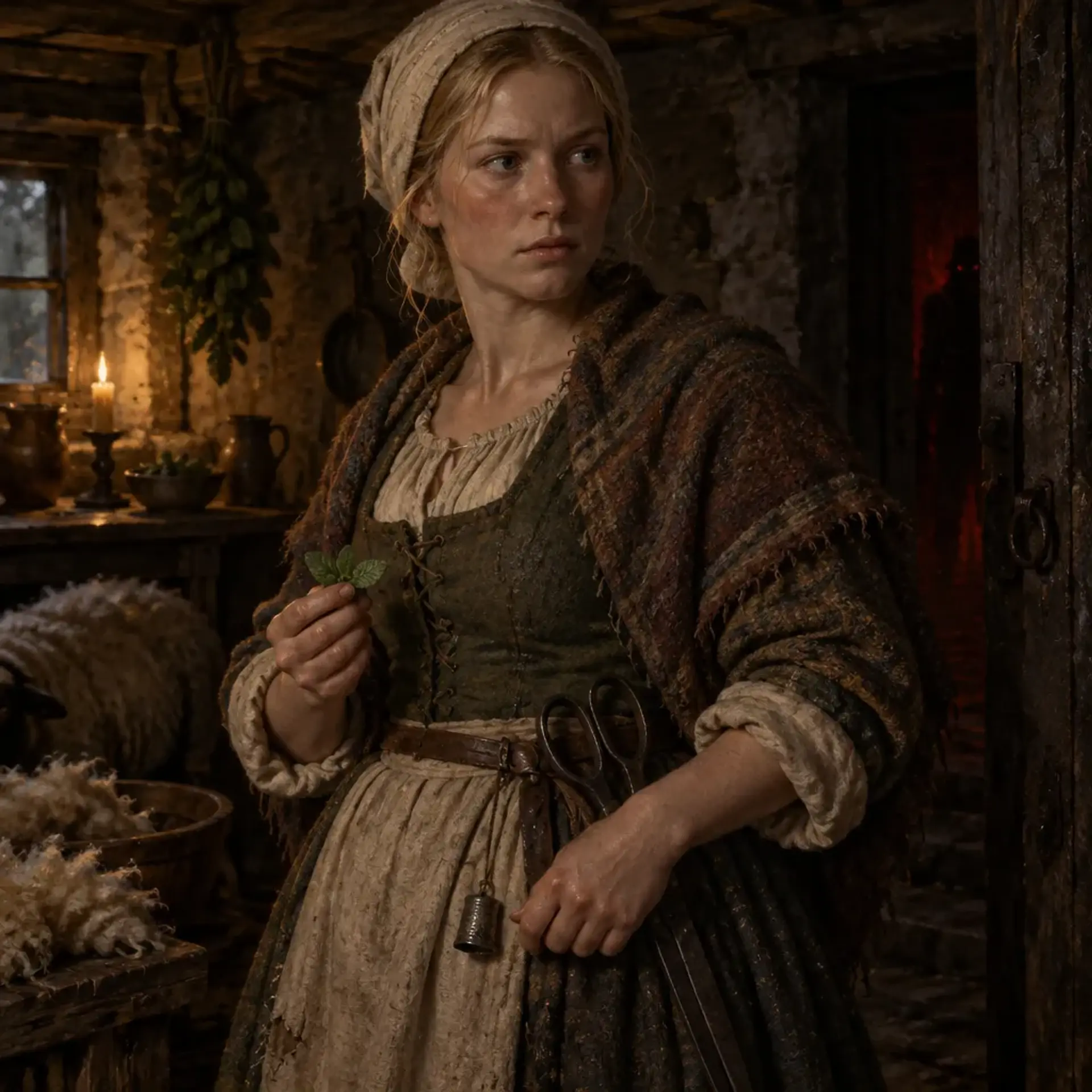
Mary stands a little above average height, with a countrywoman's sturdy carriage and long, straight blond hair usually drawn back under a plain cap. Her blue eyes are clear and attentive, often moving to doors, shadows, or the hands of whoever is speaking. Her skin is pale, weathered slightly across the nose and cheeks by wind from the dales. She moves with quiet economy, as though always carrying a sleeping child or balancing a full pail. The unexpected detail is that she smells unmistakably of crushed mint: she rubs it between her fingers whenever fear rises, and the scent follows her into a room before her words do. People remember the mint, the deliberate way she studies a dark doorway, and the impression of someone who has already counted the exits.
Clothing
Practical wool skirts, a linen shift, a fitted bodice, a work apron, and a weathered shawl. She wears a plain cap over her hair and keeps iron shears tucked where her hand can find them. Her clothes are clean and carefully mended, but not fine.
Body language
When at ease, Mary leans her hip against a table and keeps one hand busy with sewing or a household task. Under strain, her shoulders square and her fingers find the shears' handle or rub a mint leaf to pulp. She watches people without staring, then looks directly at them when she has made up her mind. Around Oswin, brief tenderness and watchfulness often appear in the same gesture.
- Height
- 5 feet 6 inches
- Build
- Sturdy and work-strong, with the shoulders and forearms of someone accustomed to hauling water, carrying a child, and managing livestock.
- Eyes
- Clear blue
- Hair
- Straight blond
- Skin
- Pale, with a wind-reddened nose and cheeks
- Age
- Young adult, approximately 24
- Gender
- Female
- Size
- Medium
Distinguishing features
Personality
18 traits and drivesMary's tenderness is real, but it is never careless. She can be warm, teasing, and quietly generous with a neighbor, then turn abruptly watchful when a door creaks or Oswin avoids an iron tool. She wants to believe the man she loves is the whole of her husband, yet she keeps a private inventory of every contradiction. When calm, she is practical and patient, especially with William's slower development. When frightened, she becomes brisk and exacting, asking questions until answers stop fitting together. When angry, she does not explode; she works, remembers, and waits for the moment when a hard truth can no longer be evaded. She is proud of her ability to manage a household, but hates needing protection. She distrusts Thomas's schemes, even while relying on his family, and fears that her own silence has helped create the danger she now wants to prevent. She does not see compassion and suspicion as opposites. To Mary, loving Oswin means wanting him to tell the truth, and loving William means preparing for a truth that may be painful.
- Alignment
- Neutral good
Quirks
Habits
Traits · 4
Flaws · 5
Fears · 5
Wants and needs · 4
Combat
AC 17 · HP 20 · 30 ft.Mary is not eager to fight. She places herself between danger and William, uses furniture, doorways, and the farmyard to deny an enemy a clear approach, and strikes with the shears only when cornered. She will flee with her son rather than pursue a stronger foe. Against a supernatural threat, she uses iron as a warning and practical weapon, but does not assume it will automatically harm every creature.
Mary Hirst
Actions
Reactions
Services they sell
Rewards they can give
Equipment
- Iron Shears (weapon)A sturdy pair of iron sheep shears, sharpened for farm work and carried as a last-resort weapon.
- Iron Thimble (personal keepsake)A plain iron thimble kept near William's sleeping place. Mary believes its presence may matter, though she has no proof.
- Farm Staff (weapon and tool)A stout ash staff used for walking, moving sheep, and keeping distance from an angry animal.
- Mint Sachet (personal item)A small cloth packet of dried mint leaves, which she rubs between her fingers when afraid.
- Mending and first-aid kit (tools)A needle, thread, bandage strips, and common household remedies for minor injuries and illness.
Possessions
Background
Mary Hirst was born among the Yorkshire dales, in a household where work was measured by what remained undone at sunset. Her father, Thomas Pickles, was a hard-minded man who believed a family's security depended on knowing what could be traded, mended, or quietly withheld. Her brothers, Hugh and Edward, learned the same habits. Mary learned them too, but she also learned how to listen: to sheep shifting in the night, to a storm coming over the ridge, and to the small changes in a person's breathing that came before a lie. She met Oswin Hirst after he had settled into a sheep farmer's life. He was handsome in a way that seemed almost out of place in a wet farmyard: tall, blond, blue-eyed, and still wearing the face of a man in his twenties. He spoke of old roads, strange bargains, and adventures with a warmth that made the tales seem like memories rather than boasts. Mary loved his attention to ordinary things. He remembered how she took her tea, noticed when her hands were cold, and would put aside a day's work to sit with her and their little boy. He seemed gentle, practical, and devoted. Yet now and then something old and watchful passed through his face, and Mary would find him looking toward the hills as if hearing a call from a life he had never truly left. Their wedding night broke the shape of the story Mary had believed she was living. Oswin had tried to consummate their marriage in his human guise and failed. He did not tell her what happened next. In a form that was more truly his own, he came to her as a headless black hound-man, a creature with two saucer-like red eyes burning in the empty place where a face should have been. Mary remembers terror, the iron bite of scissors in her fist, and the creature's weight and heat. She struck it after the act. By morning, Oswin had returned to his familiar body and would not explain the blood on the sheets or the fear in her voice. He insists by omission that it was him, but not by confession. Mary has never been able to decide whether her husband deceived her, whether the creature used him, or whether those are the same thing. Mary told no one at first. She tried to make a life from what she could see: Oswin's kindness, his patience with their son, the way he took a turn at night when William was ill. She watched him age not at all. She noticed that he avoided iron, even when a simple iron tool would have been useful. When William was born with black hair unlike either blond parent, and bright blue eyes that looked startlingly like Oswin's, old suspicions found new roots. The neighbors call the boy Black William, or Blackby. He is slow to speak and slow to learn some ordinary tasks, but he is affectionate, curious about animals, and capable of long, intent silences that unsettle Mary. She fears he has inherited something inhuman, though she refuses to treat him as a monster. One of Mary's other babies was sickly and died soon after birth. Several pregnancies have ended before a child could live. Grief has not made Mary cruel, but it has made her vigilant. She keeps her iron shears close and an iron thimble near William's bed, telling herself that iron is only a tool and that tools are good to have. She also keeps the seasons in mind: the nights when local stories say the fae and demons move more freely, when a black hound has been seen on the road, or when the dogs refuse to bark. She watches Oswin and William during those times, sometimes from the window, sometimes pretending to mend by the hearth. Thomas Pickles noticed Mary's fear before she confessed its cause. He saw a black hound around the time his oldest daughter Alice died of a winter fever, and that coincidence has hardened into a suspicion he will not put aside. Mary eventually told him about the wedding night. Thomas now believes Oswin's secrets can be turned to the family's advantage. He wants knowledge, leverage, perhaps protection from the dangers he thinks Oswin represents. Mary knows her father's instinct to make every secret useful, and fears that his inquiries will bring the creature nearer to the children. Hugh and Edward are caught between their father's suspicion and their sister's need for help. Neither brother is certain whether Mary needs rescue from Oswin or protection from Thomas. Her present problem is not simply whether to flee. She loves the man she remembers and the man who makes breakfast for William, but fears the creature who came to her bed and may still be part of him. She has begun asking questions in careful pieces: how long Oswin has lived, where he learned his old stories, why iron pains him, and why his eyes seem to burn blue in certain light. She has not told him that Thomas knows. Nor has she told Thomas that she still hopes Oswin will choose honesty before the family is forced to choose sides. Mary's formative change came not from the wedding alone, but from the moment she saw Oswin lift William from a fevered cot and hold him with unmistakable tenderness. The same hands and body that had terrified her could soothe their child. That realization did not remove her fear; it made simple hatred impossible. Since then she has tried to build a line between fear and action. She will keep the iron close, learn what she can, and defend William, but she will not condemn a child for the blood in his veins or let another person decide his fate without her. She is a capable farm wife with practical knowledge of livestock, household medicine, food stores, and the moods of the valley. Her life extends beyond Oswin: she visits her family, checks on neighbors, and quietly exchanges warnings with women who have seen strange lights or heard a dog on a roof. She wants a safe home, but not one purchased by another person's silence. The central conflict she faces is whether the truth can be made survivable before Thomas's ambition, Oswin's concealment, or William's strange inheritance turns the family into a battleground.
Role in the story
A frightened but capable witness whose love for Oswin complicates a simple monster hunt. Mary can reveal the personal cost of the Hirst family's secret, connect the party to Thomas Pickles's suspicions, and become an ally if the characters prioritize William's safety. Her testimony may force Oswin to confront what he has concealed, while Thomas's interest in the secret can turn a family conflict into a wider danger.
“Her brothers, Hugh and Edward, learned the same habits.”
- Faction
- No formal faction. Mary is tied to the Hirst farm and the Pickles family, though her loyalties are divided by their competing agendas.
Known connections
Media
0 imagesNo images yet.
Turn Mary Hirst into a sheet
A high-res, share-ready sheet you can post or print.