Oswin Hirst
Oswin Hirst
At the table
Voice
Oswin's voice has the dry, gently weathered texture of someone accustomed to speaking over wind and sheep noise. It is not as young as his face suggests. His breath sometimes catches before a sentence, especially after a poor night's sleep, and a rattling exhale can sound like chain links dragged over stone. When calm, he speaks with patient warmth and a Yorkshire plainness. When frightened or enraged, his consonants harden, his breath roughens, and a low animal vibration can slip underneath the words.
His speech is shaped by farm work and years of travel through Yorkshire. He speaks plainly, with compact practical phrases and occasional older turns of expression whose origins he cannot always explain. He often describes extraordinary events in ordinary terms. When rattled, his breathing catches high in his chest and his words break against a rough, involuntary rasp; when he is close to shifting, that rasp can become a low canine rumble. His name, Oswin Hirst, is pronounced plainly, without theatrical emphasis.
Speech patterns
How to play them
Meet him through practical concerns: livestock, weather, a damaged gate, or a need for help. He is kind when approached without accusation and will offer useful assistance before personal revelation. He responds poorly to iron being deliberately brought near him. If players mention Mary or William, his warmth becomes watchful. Give him room to speak in fragments; pressing him for a complete account of his past may expose memory gaps and trigger shame. He can be persuaded by evidence that protects his family, but he is unlikely to accept a demand to reveal himself in front of Mary.
Goal
Keep Mary and William safe, preserve their household, and find a way to help Mary understand the strange without forcing her to live in fear of it.
Motivation
Oswin is motivated by a need to remain part of a human family without denying the instincts and history that make him other. He wants Mary to find comfort in Christian teaching and emerging natural philosophy, but he also wants her to stop watching every dark doorway for a fae threat. His tenderness is real; so is his fear that tenderness cannot control what he is.
Appearance
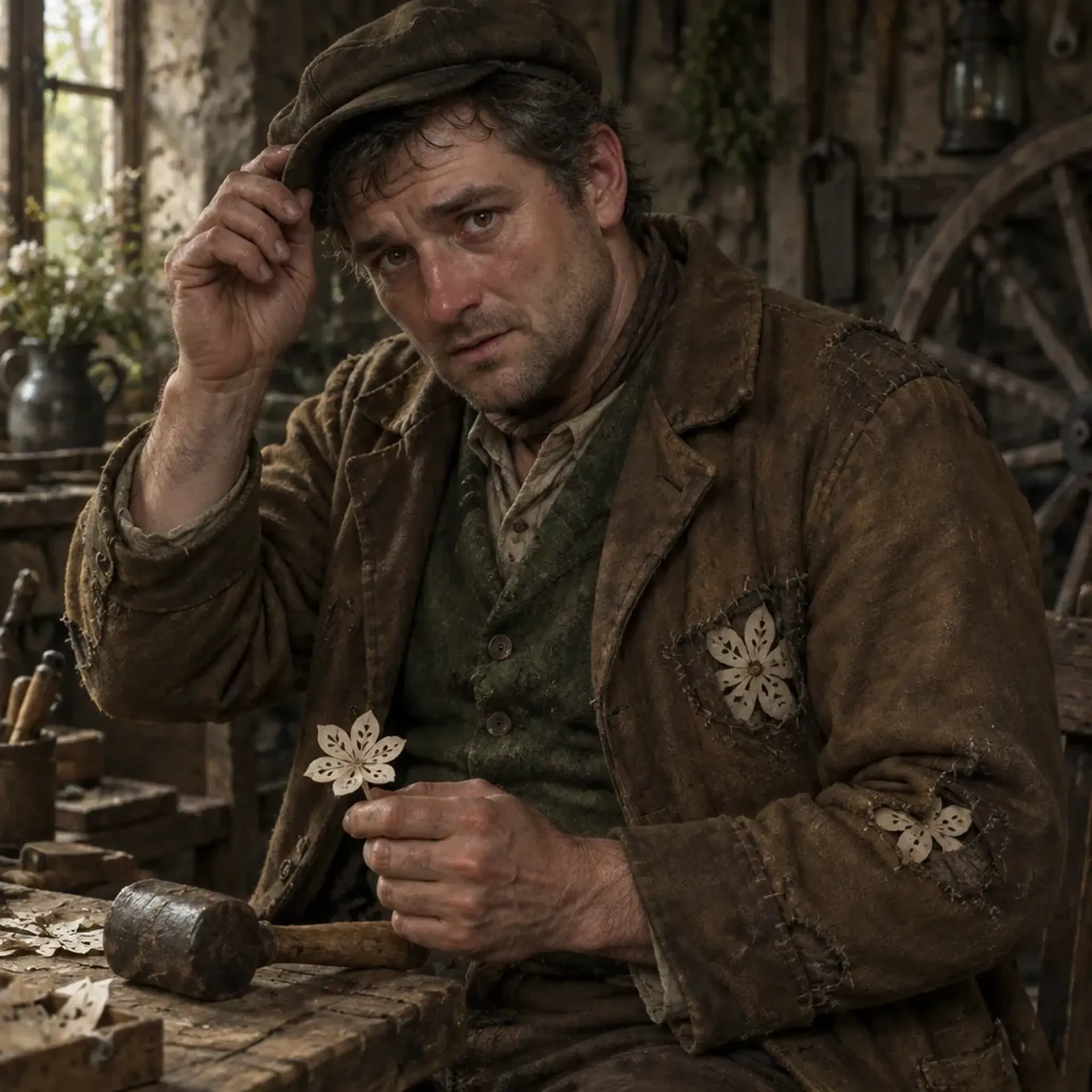
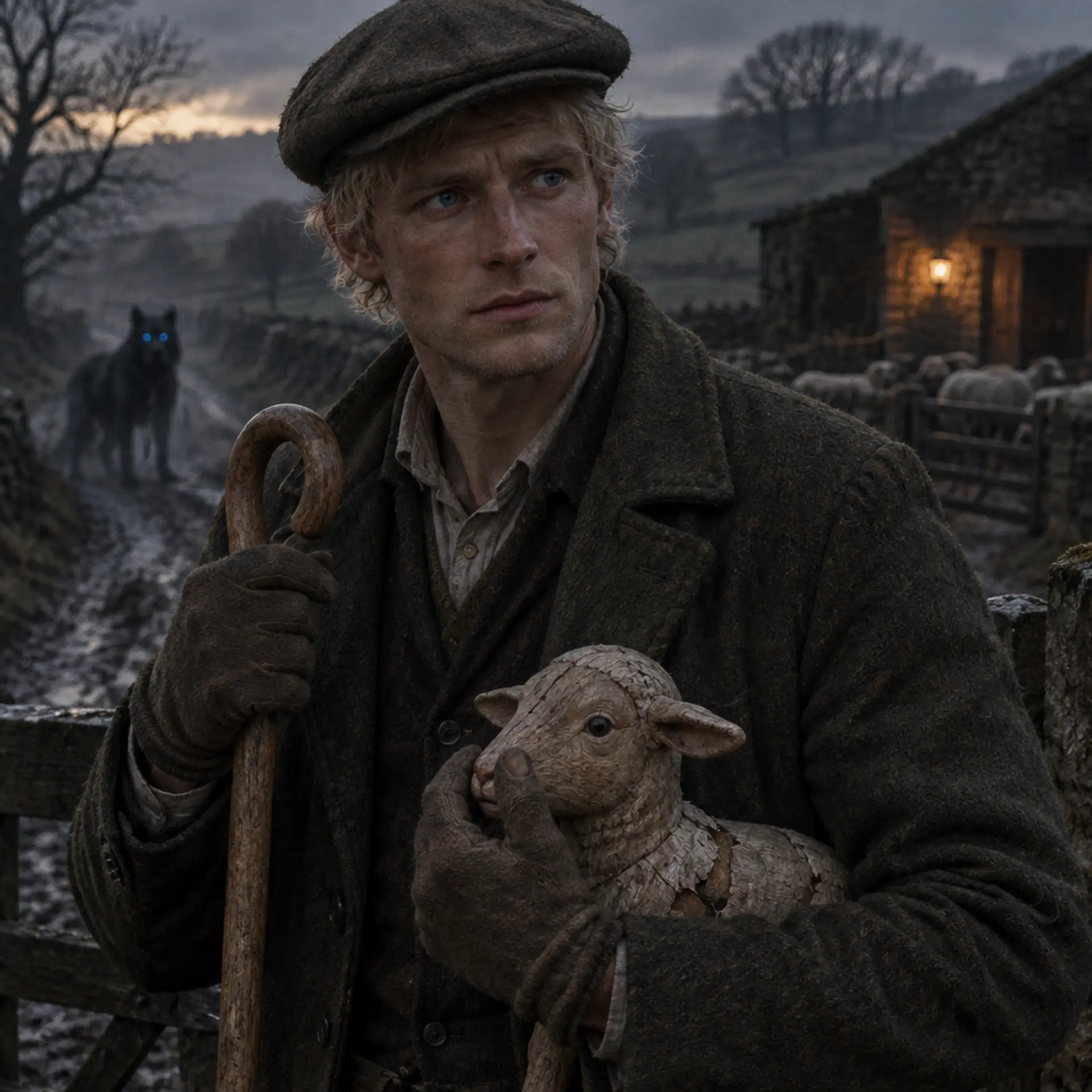
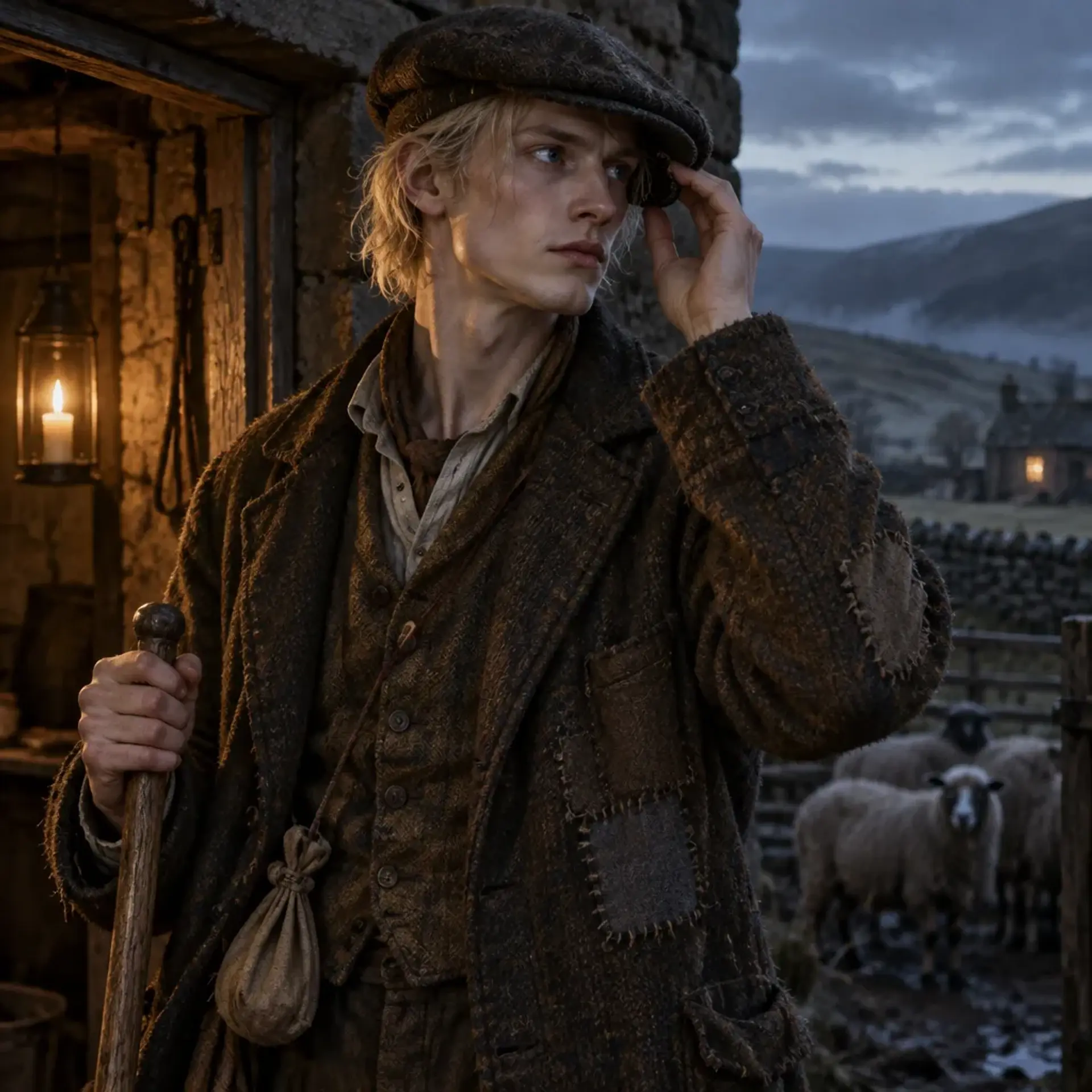
Oswin stands six feet tall, long-limbed and narrow through the waist, with the wiry strength of a man who has lifted feed sacks and turned stubborn sheep in bad weather. His skin is pale, almost translucent over the blue veins at his temples, and it takes on a faint grey cast after sleepless nights. His straight blond hair falls to his jaw when unpinned, fine as dry grass and stubbornly unchanged by the years. He has clear, burning blue eyes that seem too bright in lamplight; when his temper or the season rises, their reflected light resembles a coal seen through winter ice. His face is handsome in the unnerving, preserved way of a painted boy in an old chapel: smooth-cheeked, youthful, and increasingly out of place beside Mary's adult face. He walks with a measured farmhand's economy, placing his feet carefully as if the ground might have moved since he last crossed it. When startled, he becomes perfectly still, then turns his head with a dog's abrupt, listening angle. He wears a common flat cap, but the unexpected detail is a tiny, carefully mended patch of bright yellow embroidery inside its brim, hidden from view and made by Mary. He keeps touching that stitching with his thumb when he thinks nobody is looking. He leaves an impression of gentleness under strain, like a warm hearth with a dark passage behind it.
Clothing
A practical wool coat, patched waistcoat, work trousers, mud-dark boots, and the common flat cap worn by men in the area. He carries a small cloth pouch of household necessities and avoids iron buckles or tools when he can. The cap's inner brim bears Mary's tiny yellow stitch, almost always hidden.
Body language
He stands with his weight evenly placed, as if prepared to move in any direction. In conversation he is attentive and often warm, but his head turns sharply toward small sounds. When anxious, he rubs the inside of his flat cap. When angered, his shoulders pitch forward, his jaw works, and his breath becomes a low, rough rasp. When the Barghest nature rises, he may become unnaturally still before moving with abrupt speed.
- Height
- 6 feet 0 inches
- Build
- Tall, wiry, and work-strong, with long arms and the compact endurance of a sheep farmer.
- Eyes
- Clear, burning blue
- Hair
- Straight pale blond
- Skin
- Pale, with a faint grey cast after sleepless nights
- Age
- Appears about seventeen; has lived for many generations, though his memories have thinned and rearranged themselves.
- Gender
- Male
- Size
- Medium in human form; Large in giant black hound form, as a custom description
Distinguishing features
Personality
25 traits and drivesOswin is kind in the practical manner of a man who notices a loose hinge, a child without a warm shawl, or a neighbor lifting more than they should. He does not make a performance of goodness. He mends, carries, waits, and remembers to return borrowed tools. Yet the same attentiveness can feel unnerving, because he notices a sound from beyond the wall before anyone else hears it, or watches a person with the still, fixed concentration of a hunting dog. He is gentle with William when the boy is frightened, but when danger threatens, gentleness can be swallowed by a possessive protective reflex. He knows that this reflex is not always safe, and that knowledge makes him cautious around his own strength. He wants to be thought ordinary. He also dislikes being treated as if ordinary life is the only life that matters. If someone dismisses his old stories as foolishness, he may smile and agree, then provide a precise detail that makes the dismissal harder to maintain. He can be modest about his skill with sheep and strangely proud of his capacity to find a path through dark country. He is practical and shrewd with money, food, and labor, having learned through wandering that a person who cannot plan for winter will eventually owe someone dangerous a favor. However, his practical reasoning has gaps where human assumptions should be. He can regard a spirit's bargain as a normal negotiation and fail to realize that the person listening has no framework for it. He can speak of a death omen in the same tone he uses to explain a bad lambing. He is not trying to shock people; he sometimes simply cannot tell which facts should be hidden. Oswin's humor is dry, warm, and occasionally inconvenient. He will tease a friend who is taking himself too seriously, but he can be unexpectedly literal when someone uses a figure of speech. He dislikes being pitied and dislikes being admired even more, because both make him feel like an object to be interpreted. He is especially wary of people who want a story from him. In his roving days, a good tale could earn food, shelter, or trust, but it could also attract the attention of people who wanted to own the strange thing they had heard about. With Mary, he is affectionate without being lavish. He shows love through repeated presence: coming home when he said he would, staying beside her when the house is quiet, and spending his free hours with William even when he is exhausted. He wants Mary to be unafraid of the dark, but his efforts to reassure her can become evasive. He answers a frightening question with a sensible explanation before considering whether the explanation is true. He may tell her about the church's teaching or a new scientific idea because he hopes a framework will make the supernatural less frightening. If Mary challenges him with the evidence of his unchanged face or his avoidance of iron, he becomes defensive, then ashamed, then tries to repair the conversation with some ordinary kindness. He is not a believer in human institutions simply because they are human. He respects the church's rhythms and finds comfort in communal prayer, especially at Christmas, but he has seen too much to assume that every priest or doctrine can explain the Dales. He is interested in new sciences because observation feels honest to him. He likes accounts that name what can be measured and dislikes people who claim certainty without having looked. At the same time, he does not want science to become another weapon for calling Mary foolish. He wants her to have tools for understanding, not a reason to feel humiliated for being afraid. Oswin's emotions are shaped by an odd combination of long memory and missing memory. He may recall an old road, a particular winter smell, or the sound of a lost friend's laugh with startling clarity, yet forget the year in which he met that person. This makes him seem evasive when he is actually searching. He rarely tells a story from beginning to end. He speaks around the missing pieces, then moves on when he senses impatience. If given time and kindness, he may return to the same memory later with a detail that changes its meaning. He sometimes mistakes the strange and alien for normal because his childhood made the uncanny part of daily life. He does not always understand why a person is frightened by a white cat watching from a wall, by a chain sound in an empty lane, or by his description of a headless figure. He is capable of learning from another person's fear, but he needs the fear explained plainly. Mockery makes him close up. Honest questions can make him unexpectedly candid. He is proud of his farm and the house he has earned. The house represents a life he chose rather than a shelter he was granted for a night. He takes quiet pleasure in a full hayloft, a repaired roof, and sheep that have come through a hard season. When he speaks about the farm, his face looks more his age than it does when he speaks of his past. He knows the land by work and weather, not as a romantic landscape. A wet field is a problem to manage; a flock in trouble is a duty. But the same Dales that feed his family are also the country of the old powers that shaped him. He can look at a familiar ridge and feel affection, grief, and the urge to run all at once. The year has a strong hold over him. As nights grow dimmer and colder, Oswin becomes more watchful and less able to rest. He insists he is only checking the flock, but he is listening for sounds that belong to the supernatural world. He sleeps lightly, wakes before dawn, and sometimes walks the boundary of the farm without recalling why he left the bed. He is embarrassed when Mary sees this, because he knows it confirms her fear. He tries to keep his daytime manner steady, but the strain shows in his breath and in the way he pauses before answering. He cannot always tell whether a sound is real, remembered, or expected. Halloween and All Saints' Day do not make him simply frightened. They bring a rising excitement, a sense that the boundaries are thin and that the world is briefly honest about its dead. That excitement troubles him because it can feel pleasurable. He wants to protect his family, yet part of him longs to go out into the night and answer the hounds. He is capable of watching the churchyard with reverence and then suddenly turning toward a distant call with a hungry expression. He is ashamed of that hunger but does not pretend it is absent. Mayday is more difficult. The sight of the Maypole fills him with an unnatural delight that he cannot convincingly disguise. Ribbons circling the pole, voices moving in a common rhythm, and the turning of the dance seem to touch an ancient part of him. He becomes generous, buoyant, and eager to pull others into the celebration. He may insist that a wary person is missing a harmless pleasure, even when his own excitement has become alarming. The pleasure is not a simple wish for destruction. It is the release of a self that is usually restrained. Oswin knows that allowing it to lead him could cost him his family, so he plans farm tasks and family company around the day. He may ask Hugh to stay near him or invent a practical reason to remain within sight of the house. Those strategies work until the music, the dancers, and the season seem to make restraint ridiculous. Christmas steadies him. The cold is familiar, the rituals are repeated, and family life becomes tangible in a way he can trust. He likes the measured customs of the church and the warmth of a house where everyone knows what happens next. He will prepare food, attend to the fire, and let William sit close. On Christmas he does not feel that the dark is calling him by name. He can imagine, for a little while, that the household has made a place where he belongs without qualification. Oswin is sociable in small groups and difficult in large ones. He can talk easily while working beside someone, because shared labor provides a natural rhythm. He finds formal scrutiny unpleasant. Questions about his age, family history, and origins make him answer too quickly or too carefully. He is aware that the face Mary remembers has not changed, and he has spent years inventing explanations that sound clever but leave him uneasy. He may claim to be a younger relation, say that a person has mistaken him for someone else, or encourage a listener to accept a glamour-blurred recollection. He does not consider himself a skilled deceiver. He sees the lies as temporary shelter, but each lie makes the next conversation more dangerous. He is loving toward Mary and increasingly afraid of what she might discover. He notices that she carries iron scissors and keeps an iron thimble near William. He pretends not to notice because naming the objects would force them both to admit the fear between them. He wants to tell her the truth and wants to protect her from it. Those wishes cannot both be fulfilled by silence, but he keeps choosing silence because it allows one more ordinary day. His desire to be a good husband is sincere, although sometimes self-serving: if Mary can be made not to worry, then he will not have to face what her worry says about him. He is not simply innocent or deceptive. He has done harm by withholding what Mary needs to know, and he has also lived through a world where revealing the truth could invite violence, exploitation, or a superstition-driven mob. He wants to be judged by what he does for his family, but he fears that his nature will be judged before his actions. With William, Oswin is patient and attentive. He does not demand that the boy become quick, bold, or socially easy. He tries to make time for him even on days when work or seasonal unease would make avoidance easier. He names familiar animals, teaches simple tasks, and lets William watch without forcing him to perform. He sees the child's black hair and burning blue eyes as evidence of an inheritance that may be both gift and danger. He wants William to grow without learning to hate himself. Yet when William's fits of anger become threatening, Oswin's own instincts can take over. The frightening episode in which Oswin's face and shadow became hound-like remains a source of shame. He understands that William's fear was reasonable. He is trying to learn the difference between protecting his son and controlling him. His response to conflict depends on its scale. A quarrel about money or work brings out a calm negotiator who notices what each person actually needs. A personal accusation about his nature brings out the evasive young man who has had centuries to practice escape but little practice being known. A threat to Mary or William can make him frighteningly direct. A supernatural challenge can make him curious before he is afraid, because he recognizes the shape of a world that other people only glimpse. If he is in danger, he first seeks a path away, especially one that crosses flowing water. If escape is impossible, he becomes a decisive predator. He does not enjoy hurting people, but he can stop seeing an opponent as a person if his instincts decide the family is in danger. Afterward he may be sickened by what he did, or unable to remember it clearly. Oswin wants to be remembered as a farmer, husband, and father. He also knows that those roles do not erase the Barghest in him. He is not waiting for someone to cure him or reveal a clean explanation. He would accept an honest account of what he is, if such an account existed, but he suspects there may be no single answer. He wants time: time to learn what William is becoming, time to tell Mary the truth in a way she can survive, and time to keep living among the people he has chosen. The contradiction at the center of him is that he longs for the safety of ordinary life while carrying an instinct that regards ordinary boundaries as temporary. He may be tender, deceptive, practical, and strange in the same conversation. His kindness is not a disguise, and his supernatural nature is not a separate creature he can simply blame. Both are Oswin Hirst.
- Alignment
- Compassionate and protective, but governed by alien instincts and practical self-preservation rather than a human moral code.
Quirks
Habits
Traits · 6
Flaws · 6
Fears · 7
Wants and needs · 6
Combat
HP 5 · Ordinary human pace in human form; fast quadrupedal movement in hound form, resolved narratively under the custom Other rules used by the table.Oswin would rather withdraw, frighten a pursuer, or use the terrain than fight a person he knows. He protects Mary and William first. If cornered or confronted during a seasonal stirring, he may shift into Barghest form and attack decisively, then struggle to regain human judgment. Running water is a serious obstacle to his hound form. Iron can interrupt his composure. The custom statistics below are deliberately minimal because Other's exact rules were not supplied.
Oswin Hirst
Actions
Reactions
Services they sell
Rewards they can give
Equipment
- Flat cap (personal)An ordinary flat cap, worn soft at the edges; a small yellow patch is sewn inside the brim.
- Walking staff (tool)A plain wooden staff useful on rough paths and as an improvised defensive tool.
- Handling cloth (practical)A folded scrap of cloth used to handle or wrap objects he suspects may contain iron.
- Keys (household)A few household and farm keys; he tries to arrange his work so he need not hold iron directly.
Possessions
Background
Oswin Hirst was born in the Yorkshire Dales during the old Danelaw, to a woman whose name he can no longer hold in his mind. She had been taken and brutalized by Viking raiders. The village did not speak of the circumstances plainly, and the child grew up surrounded by explanations that changed with each teller: a bad winter, a curse, a stranger's blood, or simply the cruelty of men. His mother tried to give him a childhood anyway. She taught him to watch clouds over the fell, to make broth from what remained in the pot, and to listen for sheep that had strayed into limestone cuts. He was an ordinary child in the ways that mattered to the people who loved him. He sulked, played, caught fevers, and wanted his mother when thunder shook the rafters. She died slowly, with a cough that worsened through a long winter. Oswin remembers sitting beside her bed and being unable to understand why she could not hear the familiar sounds of the house anymore. He was very young. The years after her death did not feel like a single transformation. They felt like a chain of small permissions granted by need. A neighbor's hearth took him in. A shepherd let him sleep in a byre. Someone else sent him out to find a missing lamb. He found a black dog waiting in a hollow, and followed it because he thought it knew the way home. The dog was gone by dawn. Later he saw a headless figure beyond a wall, then a white cat watching him from a burial mound. Strange sights became part of the ordinary geography of his life. He did not think, as a child, that he had entered the company of wraiths, fae, and devils. He thought adults had failed to notice the things that were plainly there. The Dales themselves taught him this mistake: fog had a temper; a stream could refuse a crossing; a hill could be nearer at night than by day. He grew up learning how to travel between households, farms, and lonely tracks. He worked for food, guarded flocks, carried messages, and sometimes accompanied people who had business with the places they would not name. He became a roving man, though he could not have said when he stopped being a boy. Years passed around him without settling on his face. At first people thought he was lucky, then vain, then a liar. Oswin tried to explain his unchanging appearance with clever tricks: he claimed to be a younger cousin, kept out of old company, changed his cap and coat, and let people assume that a son had taken a father's name. Sometimes he used small acts of glamour, more instinct than craft, to blur recognition or make an acquaintance remember him as older. The lies worked until they did not. He also began to lose the order of his own life. A winter he remembered as recent proved to have been decades past. A dead companion appeared in one recollection as an old man and in another as a boy. His memories ebb and fade, with places remaining sharp while dates and faces dissolve. He knows he is a changeling now, and knows his nature is Barghest, but he did not learn it through a wise mentor or a clear revelation. He reached the conclusion by thinking about himself: his impossible age, his fear of iron, his ability to become the black hound, and the way his instincts sometimes outran thought. He still cannot say who made him this way, whether he was born a changeling, replaced, or gradually claimed by something that had always been waiting in him. That uncertainty troubles him less than the possibility that the answer would make his humanity feel borrowed. His roving days remain a private country inside him. He remembers wet roads, strange bargains, and a companion's laugh more vividly than the exact face of the companion. He remembers warnings about the Barghest: that a clear sight of it foretold death, that a passing glimpse might shorten a life, that its claws made wounds which never healed, and that it could not cross running water. He has never trusted every old tale. He has learned that people can use a superstition as a weapon, and that a creature can be both frightening and frightened. Still, when dogs gather and howl at a funeral, Oswin goes out to check whether the procession has turned toward his house. Eventually, he chose a settled life. He met Mary Pickles in Yorkshire and fell in love with the ordinary things she did without making a story of them: the way she mended a sleeve while listening, the sharpness with which she judged a bad bargain, and the way she laughed at his wandering tales when she thought he was exaggerating. He told her fragments of his roving years and hid the parts that would have made her look at him as a monster. Mary remembers the handsome young man she married. She also remembers that he has not visibly aged since they met, that he avoids iron, and that his stories sometimes describe events as if he stood outside the human understanding of them. Oswin does not know that Mary has told her father, Thomas Pickles, her fears about him. Thomas suspects Oswin's nature and sees a possible advantage in it. His cottage lies a good distance away, and he has begun to consider how a secret that frightens Mary might be turned to the family's benefit. Oswin has not yet grasped the full calculation. Thomas's suspicion is one pressure among many: the Pickles family has already been changed by grief. Mary had two brothers, Hugh and Edward Pickles, and the family lost their eldest daughter, Alice, to a winter fever. The death left Thomas more guarded, Mary more vigilant, and the household with an empty place nobody knows how to address without reopening it. Oswin has built a fine house for a man of his class and become a sheep farmer. The work gives him a schedule and a reason to be among people. He tends the flock, bargains carefully, repairs what can be repaired, and makes a point of spending time with Mary and their son whenever he has a day free, even when the season has turned dangerous. Their child, William, is called Black William, or Blackby, by locals because of his unusual black hair. Both parents are blond. William has his father's burning blue eyes, but his childhood is not easy. He is slow to meet some expectations for his age, cries readily, can erupt into anger, and sometimes stares past the people speaking to him. Mary fears that he is the spawn of the devil, or of the Barghuest, as she names the black hound in her private terror. Oswin knows William's strangeness may be the first visible mingling of fae and human blood, but he does not know how to explain that without making himself the source of Mary's fear. He wants her to be unafraid of the dark and to stop worrying about fae. He reaches for church doctrine and the new sciences as they develop, hoping that prayer, observation, and sensible explanations can offer her firm ground. Yet he sometimes mistakes the strange and alien for ordinary. He can describe a spirit's bargain as if it were a routine farm matter, and only afterward notice that Mary has gone pale. Mary's other pregnancies have often failed, and a small son died sickly soon after birth. Oswin mourns each loss, but his grief is complicated by the suspicion that his nature makes him an unsafe root for a human family. He does not know how many more children Mary can carry, or whether the next child would be human, fae, or something that makes the family less safe. He avoids iron with care, but recently he failed. During a hurried repair to a gate, an iron staple caught in his palm. The pain was immediate and disproportionate: his hand seized, his jaw locked, and a sound like a strangled bark forced itself from him. The flesh did not burn visibly, but the skin around the touch went grey and numb. He dropped the staple and hid his hand in his coat before Mary could see. For the rest of the day he could not bear the smell of the iron toolshed. The incident frightened him because it made his careful avoidance look like a rule rather than a preference. It also convinced Thomas that Oswin's weakness might be real and exploitable. The first Mayday that matters to the family came when Oswin was with Hugh. The village marked the day with a Maypole, ribbons, food, and a night that seemed to loosen every boundary Oswin had spent years trying to keep. Hugh noticed Oswin's expression change as the pole went up. Oswin's face did not become cruel; it became joyous in a manner that was too complete, as though the sight had answered a need older than his thoughts. He danced longer than his human endurance should have allowed, stepped in time to rhythms nobody else could hear, and urged Hugh to join him with an intimacy that felt both brotherly and strangely possessive. Hugh eventually saw Oswin standing apart, smiling at the turning ribbons while the dogs in the village strained against their ropes. When Hugh called his name, Oswin took several seconds to answer. Later, Oswin insisted that the Maypole was merely a pleasant custom and could not explain why he had wanted to circle it until dawn. Mayday is now the terrible day he anticipates with unnatural delight. His body feels lighter, his hearing sharpens, and the human calendar seems to lose authority. He keeps himself near family and farm duties as a restraint, but the desire to run the ridge roads and answer the old revelry can make him tremble. In the dimmer, colder part of the year, his habits change before the weather turns fully. He checks doors and shutters after sunset, listens for a chain sound that might not be there, and sleeps in short, shallow intervals. Night hours stretch in his perception. The part of the night after the household has gone quiet is worst: he hears the sheep shift in the field and counts each animal by breath, then finds himself counting the empty spaces too. He cannot settle his mind when the old seasons press near. He may walk to the edge of the property and stand facing the dark, not because he intends to leave but because something in him expects to be called. Halloween and All Saints' Day bring a different rising of his blood. He feels alert, hungry, watchful, and almost exhilarated by the closeness of the dead and the living. He guards William and Mary, yet his attention can keep returning to the road, the churchyard, or a distant dog's howl. The thought of being seen clearly in Barghest form troubles him, but the thought of being unseen and unaccountable can tempt him. One Halloween, after Alice's death, Oswin was left alone with Edmund to mourn her. He sat with Edmund through the evening while the family was elsewhere or unable to bear the room of grief. Oswin expected the duty to be simple: share silence, keep the fire, and make sure Edmund ate something. Instead, the dark made the memory of the dead feel near enough to touch. Oswin heard chains that Edmund could not hear and twice rose to look out the window. Edmund asked him to stay. Oswin did stay, pressing his palms flat to his knees and speaking of Alice as if her ordinary habits were a form of protection: how she might have complained about a cold room, how she would have noticed the fire smoked, how she had once laughed at a story he could no longer recall in full. The vigil became a real bond between them. It also left Oswin ashamed, because he had wanted to run toward the sound outside. Christmas, by contrast, is calm. The house's repeated tasks, the shared food, the church's measured customs, and Mary's presence seem to place him securely in the human world. During one Christmas with his family, William was restless and refused to sleep. Oswin wrapped him in a blanket and carried him from the hearth to the window, naming the familiar lights, the roofs, and the sheep huddled in the field. Mary watched from the table, wary but moved by how patiently Oswin stayed with the boy. William finally rested against his father's shoulder. Oswin did not hear the chains that night. He later remembered it as one of the few evenings in which the house felt wholly like a home rather than a shelter built against something outside. His relationship with William is loving and not always safe. During one fit of anger, William screamed and struck at Mary. Oswin's human expression vanished. His shoulders dropped forward, his teeth showed, and a low canine rumble came from his chest. For one instant his shadow had the size and head of a great hound. He caught William by the upper arms with a grip too strong for a frightened child, then stopped himself. William froze, stared into his father's blue eyes, and began to cry in a different way, silently and with his mouth open. Oswin released him at once and knelt on the floor, shaking. William backed into Mary's skirts and would not let Oswin touch him for the rest of the evening. Oswin has not forgotten the look on his son's face. He understands that love does not excuse an inhuman response, even when instinct came first. Mary watches the seasons now. She keeps iron scissors near her and an iron thimble close to William, uncertain whether either will protect him or make matters worse. Oswin sees them and pretends not to. He wants to reassure her, but every explanation he considers opens another door. His current life is a precarious bargain: farm, family, and ordinary hours on one side; the old Dales, the Barghest's shapes, and the calls of the season on the other. He does not want to abandon Mary and William. He also does not know whether the thing that made him can ever be separated from the thing that loves them.
Role in the story
A loving but secretive husband and father, a source of local knowledge, and a dangerous supernatural figure whose family life complicates the village's fear of the Barghest. He can be an ally, a mystery, or a tragic threat depending on how the characters handle his secrets and the seasonal pressures.
“She had been taken and brutalized by Viking raiders.”
- Faction
- No formal faction. He belongs to the Hirst household and the local farming community, while his nature links him unwillingly to the uncanny beings of the Yorkshire Dales.
Known connections
Media
0 imagesNo images yet.
Turn Oswin Hirst into a sheet
A high-res, share-ready sheet you can post or print.