Oswin Hirst
Oswin Hirst
At the table
Voice
Oswin's voice carries the dry grain of a man who works outdoors and speaks over wind. His breath sometimes whistles faintly through his teeth after long cold walks. He uses an even, practical rhythm when discussing farm matters, but old memories make his speech unexpectedly vivid and fast. His voice roughens and his words become blunt when alarmed. The first sign of the hound in him is often not a growl but a breath drawn too sharply, as if he has scented blood.
He speaks in a grounded Yorkshire manner, shaped by work, weather, and years of adjusting his story to whoever is listening. His voice has a dry rasp from cold air and sheepfold dust, with clipped practical phrasing when discussing work. In comfort he tells long, vivid travel stories, but dates and names slip. In anger he does not soften or hush; he becomes direct, his consonants hardening and his sentences shortening. When the hound nature rises, his breath catches in the throat and his words can break into a low, involuntary growl.
Speech patterns
How to play them
Meet him as a practical, attentive farmer, not as a monster to be unmasked. He responds to kindness toward William and to concrete offers of help. He becomes guarded when asked about age, iron, or the seasons. If shown that Mary is in danger, he may cooperate even with people he distrusts. If threatened with exposure, he bargains first, then withdraws, and only transforms when he believes someone he loves is about to be harmed.
Goal
Keep Mary and William safe while finding a way to live openly enough that his secrecy no longer poisons the household.
Motivation
To make a home durable enough to outlast fear, and to prove through daily care that his inhuman nature does not make his love false.
Appearance
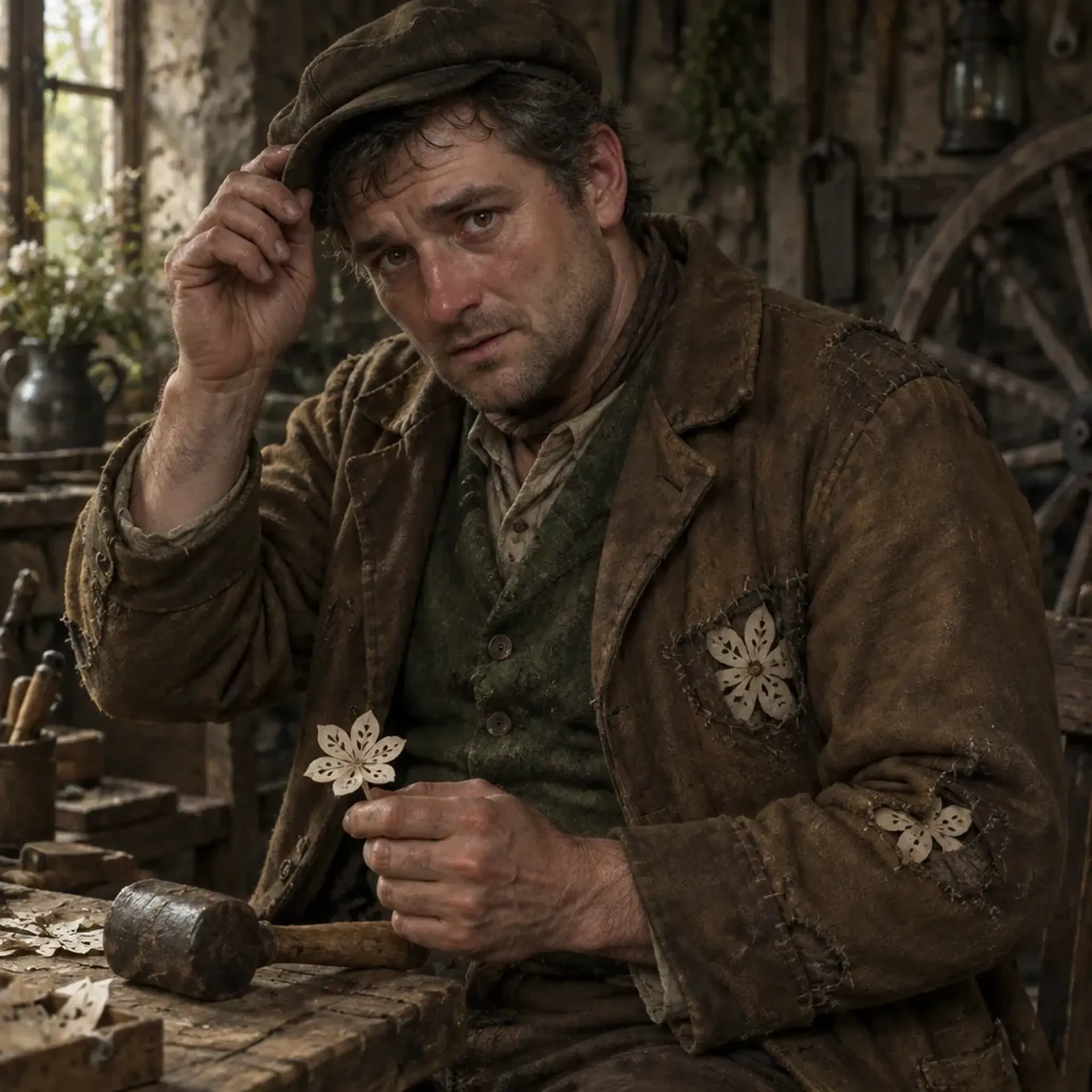
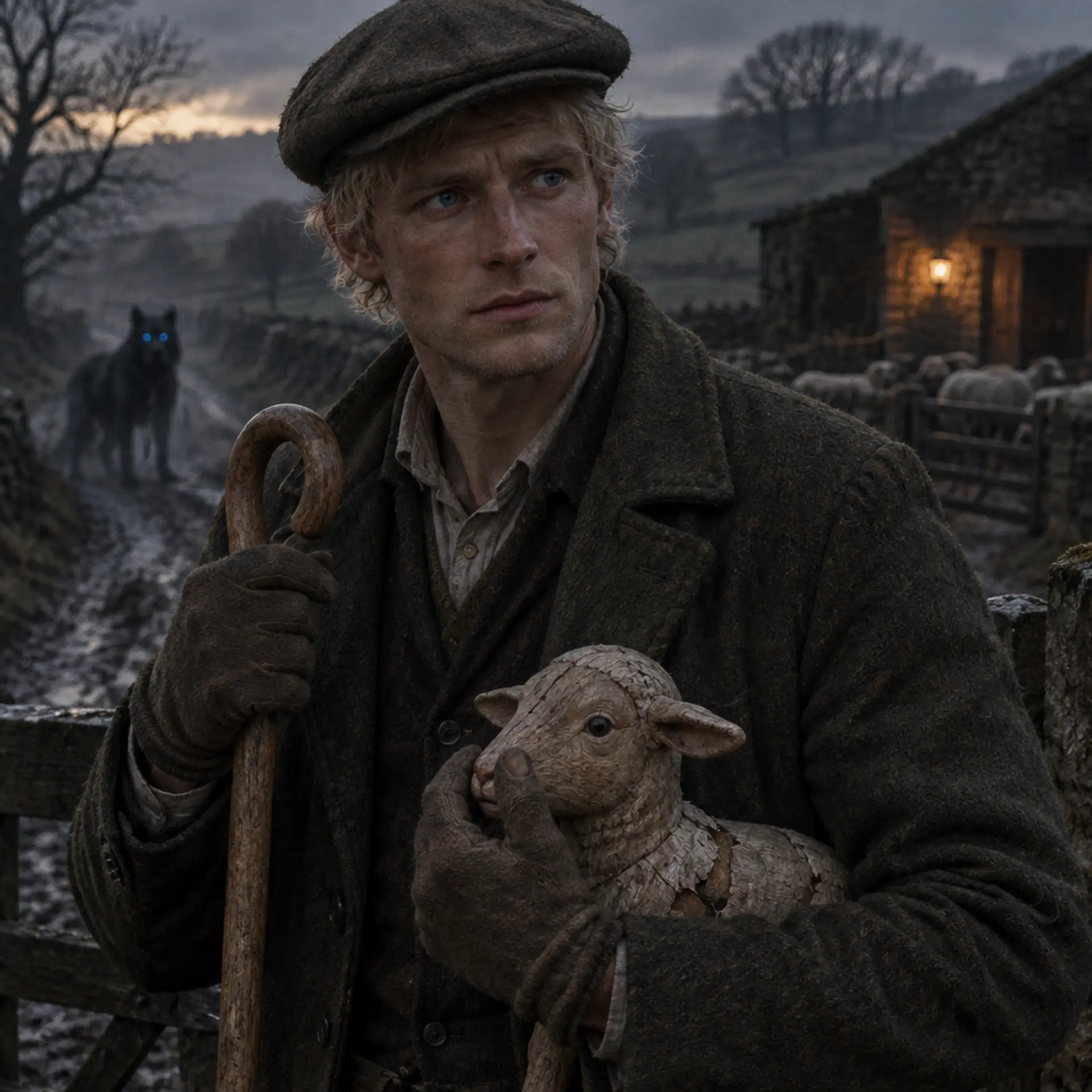
Oswin stands exactly six feet tall, with the long, spare frame of a man accustomed to walking wet hills and lifting feed sacks rather than showing off strength. His pale skin has the faint, weathered translucence of someone who looks young until one notices how carefully he studies a room. His straight blond hair falls neatly beneath a common flat cap. The hair is too fine and even for a man who spends his days around sheep, and he has learned to roughen it with wool grease and dust when he needs to look older. His bright blue eyes catch light like flame reflected in a deep well. He wears a pleasant, youthful face that Mary remembers from their courtship, and that unchanged face has become a private accusation. He takes up space without seeming to notice: he steps between a child and a doorway, leans into a conversation as if the room were a hillside, and leaves people feeling that he has quietly placed himself between them and danger. The detail most people do not expect of a sheep farmer is his habit of carrying a small, carefully repaired wooden toy lamb, its paint rubbed away at the nose from his thumb. His movements are smooth until startled, when they become unnaturally abrupt, like a hound scenting a sudden change in the wind. In hound shape he is massive, black as a winter ditch, with oversized fangs and claws, eyes like saucers of blue fire, and the suggestion of a chain-rattle following him even when no chain is present.
Clothing
A common flat cap, practical wool coat, work shirt, sturdy trousers, and boots muddied by the fields. His clothes are good quality for a prosperous sheep farmer but deliberately ordinary. He keeps gloves handy around iron tools and wears a small wooden charm inside his shirt.
Body language
He angles his body toward exits and toward whichever family member seems most vulnerable. His stillness is more noticeable than his gestures. When alarmed, his head turns before his shoulders, as if locating a scent. He presses his thumb to the worn nose of the wooden lamb when trying to stay present.
- Height
- 6 feet
- Build
- Tall, lean, and long-limbed, with the hard-wearing strength of a working farmer rather than a trained fighter.
- Eyes
- Bright, burning blue
- Hair
- Pale blond, straight
- Skin
- Pale, with a faint weathered cast
- Age
- Appears about seventeen; his actual age is several centuries, though he cannot give a reliable count and remembers his earliest years in fragments.
- Gender
- Male
- Size
- Medium in human form; Large in custom hound form
Distinguishing features
Personality
21 traits and drivesOswin's kindness is genuine, but it is not simple. He can be warm without being transparent, protective without being gentle, and honest about small practical matters while concealing the single truth that would change his family's understanding of him. He has learned to notice what people need before they ask: a gate mended, a cup placed within reach, a child given a task rather than a lecture. That instinct makes him an excellent neighbor and a difficult husband. He often acts as if helping is the same as being trusted. It is not. With Mary, he tries to be companionable and steady. He listens closely, remembers her preferences, and makes time for ordinary evenings even when the dark outside has begun to trouble him. But when she asks why his face has not changed, or why he refuses a particular iron tool, he becomes artful. He answers with a joke, a story about a rash, or a practical complaint about the work. The evasion is not contempt. He is sincerely afraid that the truth will turn the house he loves into a place of accusation. Yet his care becomes patronizing when he decides that Mary cannot bear to know what he knows. He wants her not to fear the dark, but he sometimes treats her fear as a problem to manage instead of a judgment she is entitled to make. He is especially gentle with William. He does not demand that the boy speak quickly, behave like other children, or stop crying on command. Oswin will sit beside him through a fit, put a familiar object in his hands, and wait for the moment when the boy can look at him again. He understands, in his own way, that fear can make a child seem difficult. He can be patient for an astonishing length of time. That patience has a hard edge: if a stranger mocks William or calls him a devil, Oswin's civility vanishes. His face can go still, and his attention fixes on the offender with such complete focus that the person feels measured as prey. Oswin likes people, but he does not always understand them. He can enjoy a village gathering, share food, and laugh at a joke, yet misunderstand the social meaning of a promise or a mourning custom. His long life has left him with knowledge and with gaps. He knows how to read a frightened animal, the condition of a hillside, and the direction of a storm. He can be poor at noticing that a neighbor is embarrassed, that Mary wants an answer rather than reassurance, or that an old story has hurt someone who lost a child. His mind regards some supernatural events as ordinary and some ordinary human expectations as strange. He may explain a haunting matter-of-factly, then be baffled when a person is more upset by a small lie. His practical nature is inseparable from his shrewdness. He knows the price of sheep, the habits of buyers, and how to make a household appear more prosperous or more modest as needed. He dislikes waste, but he is not miserly. He will spend freely to protect the roof, the flock, or his family, then resist spending on anything he considers an empty display. The fine house is part comfort and part camouflage. It establishes a credible place for him in the village: a successful farmer has reasons to be private, to travel, and to own good clothes. He can be charming in negotiation because he listens for what the other person values. This same skill makes him seem calculating when he is frightened. He has a restless streak that survives his settled life. He remembers roving days with affection, though not always with accuracy. He misses open roads, nights under unfamiliar skies, and the relief of leaving before anyone asks where he was born. He does not want to abandon Mary and William, but a part of him still believes that staying is a temporary bargain. When the seasons turn, this old impulse grows stronger. He checks the hills and listens for a call that might be memory, instinct, or an actual summons. He resents the pull and is also glad to feel it, because it confirms that something in him remains connected to his first world. The yearly cycle changes him in visible ways. As the nights grow dimmer and colder, he sleeps badly. He becomes vigilant, inspects latches, and may rise in the small hours to walk around the sheepfold. The hour before dawn feels to him like a border crossing. He can seem distracted at supper, attending to a sound beyond the walls, and he is impatient with unnecessary noise. He still tries to keep his promises to Mary and William during these weeks. He will sit by the fire and listen to a story, even when every part of him wants to pace outside. That effort is meaningful, but it is not always enough to make him pleasant company. Mayday produces a different and more unsettling change. Oswin's mood lifts with an unnatural brightness. The sight of a Maypole, ribbons, or people moving in a circle awakens delight that appears too deep for a simple village celebration. He may joke, dance, or volunteer for tasks with a vigor that surprises people who know his usual reserved manner. He experiences this joy as welcome, even when it frightens him afterward. He feels, for a few hours, that he has remembered the shape of something he lost. He cannot say whether the feeling belongs to his own childhood, to the fae, or to the Barghest nature within him. Halloween and All Saints' Day bring heat rather than cheer. His blood seems to quicken. He is more reactive to noises, more likely to stand watch, and more difficult to persuade that a night sound is only a branch or a cart. He hates being told that he is imagining things because he knows that sometimes he is not. He also knows that his heightened suspicion can frighten Mary and William. His response is not to get quieter when angry. It is to become blunt and physically alert, speaking in short statements, moving toward the perceived danger, and expecting others to move when he tells them to. If challenged, he can argue fiercely. If he recognises that he has frightened his family, shame follows and he tries to repair the harm through acts of service. Christmas calms him. The fixed sequence of preparation, food, prayer, and family company gives him a kind of shelter. He appreciates the faith of the church even though he cannot make all of its teachings fit his experience. He wants Mary to find comfort in doctrine and in the new sciences because he wants her to have a world that is explainable and safe. He does not mock her belief. He sometimes joins a prayer with such sincerity that Mary cannot tell what he believes. During Christmas he is at his most recognisably human: attentive, domestic, and able to enjoy the quiet without searching the shadows. Oswin's humor is dry and often misplaced. He can make a grim observation sound like a practical joke, then be surprised that someone finds it cruel. He enjoys a clever bargain and a story with a good ending, but dislikes being the center of attention. He can be sentimental about small objects and dismissive about grand gestures. The wooden lamb he carries is an example. He treats it as a useful comfort, not a sacred relic, though he touches it whenever he is close to losing control. He is neither fearless nor naturally noble. He fears iron, exposure, and the possibility that his nature will one day overtake his choices. He also fears that his memories are thinning so steadily that he will forget what he is trying to protect. His bravery is most reliable when someone else is in danger. Alone, he can avoid a hard decision for years. In company, especially when a child is frightened, he moves before fear can stop him. This makes him admirable and dangerous: the same swift protective instinct that saves a person can put a clawed hand on a shoulder when a human hand would have been better. His relationship with Thomas Pickles is marked by wary courtesy. Oswin can see that Thomas is suspicious, but he does not understand how much Thomas's grief over Alice shapes his suspicion. He views Thomas as a practical older man who wants security for his family. He underestimates the extent to which Thomas may treat Oswin's secret as leverage. With Hugh, he is easier, though the Mayday incident left a small crack in their trust. With Edward, he is more formal and careful. He knows the Pickles family has endured too much loss to welcome another inexplicable danger into its midst. Above all, Oswin wants to be kind in a way that matters to the people receiving it. His failure is that he often decides what kindness means before asking. He would rather take a frightening burden onto himself than share it, because secrecy feels like protection and because he has survived alone for so long. He is beginning to learn that a household is not a flock to guard from the edge of the field. Mary and William are people who may choose what risks they will face. Whether Oswin can accept that before his lies do lasting harm is the central struggle in his life.
- Alignment
- Protective and compassionate in intention, secretive and sometimes frightening in method; he follows personal loyalties rather than a formal moral code.
Quirks
Habits
Traits · 5
Flaws · 5
Fears · 6
Wants and needs · 5
Combat
HP 28 · Human: ordinary walking pace. Hound: fast running pace, custom and not assigned a canonical numeric value.Oswin avoids fighting in human form and tries to end danger by placing himself between an attacker and his family. If cornered, he uses a staff or farm tool, favors quick disabling strikes, and looks for an escape route. In hound form he becomes fast and terrifying, but his priority is usually to drive off a threat rather than kill it. If William or Mary is in immediate danger, restraint can fail. Running water may stop his pursuit in hound shape.
Oswin Hirst
Actions
Reactions
Services they sell
Rewards they can give
Equipment
- Shepherd's staff (tool)A stout wooden staff used for walking, guiding sheep, and defending himself.
- Wooden lamb (personal keepsake)A small, carefully repaired toy sheep with paint worn from its nose. It steadies him and is also a gift he means for William.
- Farmer's clothing (clothing)A flat cap and work gloves that help him look like an ordinary local farmer and avoid accidental contact with iron.
- House keys (utility)A bundle of household keys on a wooden fob; he dislikes iron keys but uses them when necessary.
Possessions
Background
Oswin Hirst was born in the Yorkshire Dales during the age of the Danelaw, to a woman whose life had been broken by Viking violence. His mother gave him a plain name and tried to make him a plain child. For a few years, he was one. He learned to carry water, to follow sheep without frightening them, and to sleep beside a hearth that smoked in bad weather. His mother died slowly, through a wasting illness that left him watching the strength go out of her hands. He remembers the roughness of her wool blanket better than her face. After her death, the people who might have taken him in were poor, frightened, or gone. He began spending nights outside the settlement, first because there was no warm bed, then because the moors seemed less lonely than the houses. The Dales of his childhood were not empty. Oswin grew up among things he did not know to call wraiths, fair folk, devils, or the dead. He accepted a pale figure standing beside a spring as an ordinary neighbor. He took food from a low stone shelf where no household admitted leaving it. He heard chains dragging over a ridge and thought someone was moving a cart. He learned that some doors should not be opened after dark, but he did not understand why. When creatures watched him from the dark, he assumed they were watching everyone. This was not courage so much as a child's inability to imagine that the world had rules other than the ones he could see. His change into a Barghest changeling was not a dramatic curse placed by a named enemy. It happened by degrees, without his knowledge. His childhood memory grows indistinct where the transformation must have begun. He recalls being lost on a winter night, then recalls a black animal running beside him, then remembers waking miles from home with frozen clothes and blood under his nails. There are years in which he appears to have lived among the wraiths and fae of the Dales, but he cannot distinguish memory from the stories he later heard. He only gradually concluded that he was not an ordinary human. He noticed that iron made his skin prickle, that his body moved too quickly when someone was threatened, and that a dog’s hunger sometimes seemed to rise inside him. The name Barghest came to him from local stories. He recognised himself in the black hound, the burning eyes, the terrible claws, and the rattling chain, but even now he cannot say whether the name explains what he is or merely gives other people a word for their fear. For centuries, Oswin wandered. He travelled between lonely farms, market towns, old roads, and places where people said a traveler had vanished. At times he protected people from the very things that shared his nature. At times he became the thing they feared. He rarely stayed long enough to be remembered clearly. He learned to pass as a young man by changing his clothes, his manner, and the stories he told. He acquired practical skills and a sharp understanding of what people will pay for, what they fear, and what they hide from their neighbors. He was not always cruel, but he was often careless with human time. A promise that seemed small to him could shape another person's entire life. In more recent years he settled into a sheep farmer's life in Yorkshire. He bought a fine house appropriate to a prosperous farmer, maintained flocks, repaired fences, and learned the rhythms of ordinary work. The house is large enough to impress the village, and its comfortable rooms make his claim of a simple life plausible. He wears a flat cap like other local men and spends real time with his family even when he is exhausted or unsettled by the season. He loves these routines partly because they are good and partly because they reassure him that he can choose what he is. He met Mary Pickles and married her without telling her what he was. She is blond and blue-eyed, quick to notice when a story has a missing piece, and more devout than he first understood. Oswin wanted to offer her safety. He also wanted to believe that the church's doctrine and the developing natural sciences could explain away the dark things of the Dales. He tells himself that he is protecting Mary by translating the uncanny into superstition, illness, weather, or old ignorance. The contradiction is that he knows the uncanny is real. When Mary asks about his unchanged face, his avoidance of iron, or his stories of adventures that belong to another century, he offers explanations that sound almost reasonable and never quite answer her. Their son William, called Black William or Blackby by locals, has black hair despite both parents being blond, and eyes of burning blue that resemble Oswin's. William is slow to meet some expectations for his age, cries readily, and has fits of anger that leave him frightened afterward. He can also become distant, staring past the people in a room as though listening to a conversation from elsewhere. Oswin recognises signs of the otherworld in him, but he cannot tell whether William inherited a nature, was touched by it before birth, or is simply a child who needs patient care. He gives William time without insisting that the boy perform normality for him. He takes him outside, shows him sheep, and lets him handle the wooden toy lamb. Mary watches this tenderness and fears its intensity. To her, William's oddities and Oswin's secrets suggest that the boy is the spawn of the devil, or of the Barguest itself. Mary has suffered pregnancies that ended before a child could be carried to term, and another baby was born sickly and died soon after birth. Grief has made the household careful around hope. Oswin does not know that Mary has told her father, Thomas Pickles, her belief that Oswin is not what he claims. She keeps iron scissors close and an iron thimble near William. Oswin notices both objects and pretends not to. Thomas is suspicious, and his cottage lies a good distance from the Hirst home. He believes Oswin's nature may be used to secure advantage for the Pickles family. Whether he wants money, protection, leverage, or simply control is not yet clear. Mary's brothers Hugh and Edward remain part of the family's life, each carrying his own share of grief and distrust. The family's losses include Alice, Mary's elder sister, who died of a winter fever. Thomas was present through the illness and has never fully recovered from the helplessness of watching her die. The household's seasonal customs grew more anxious afterward. Every year, when the evenings grow dimmer and colder, Oswin begins to sleep badly. He checks the doors, walks the pasture boundaries, and listens for the chain-rattle that sometimes sounds from empty lanes. The shortening days seem to make the world thinner. In the small hours of night, especially in the weeks when the village expects uncanny things, he becomes alert and restless, his eyes following sounds no one else hears. He may wake Mary by standing at the window, not moving, as if waiting for someone to approach the house. Mayday is the season that unsettles him in the opposite way. The approach of the Maypole brings an unnatural delight to him, bright and bodily. He laughs too readily, eats eagerly, and seems to recognize the tune of a celebration he cannot remember learning. He has tried to explain this as enjoyment of the community, but his excitement makes Mary uneasy. One Mayday, Oswin went with Hugh to the village gathering. Hugh had expected an ordinary afternoon and was embarrassed by Oswin's sudden, exuberant participation. Oswin danced around the Maypole with the effortless timing of someone returning to a rite, not learning a village custom. For a few breaths he seemed not to see Hugh at all. When Hugh caught his sleeve and called his name, Oswin turned with a hound's startled intensity, baring his teeth before he recognised him. He covered the moment with a laugh and helped Hugh carry a tired child home. Hugh remembers the laugh as the wrong part: it came a heartbeat too late. Halloween and All Saints' Day stir his blood in a darker fashion. He grows watchful, quick to anger, and prone to long walks beyond the house. He says the nights carry old echoes. On the Halloween after Alice's death, Oswin was left alone with Edmund, one of the family members keeping vigil and mourning her. The house was full of grief and the smell of winter herbs. Edmund spoke about Alice's fever, about how quickly a healthy child could be taken. Oswin tried to comfort him, but the sounds beyond the windows pulled at him. A chain seemed to drag around the house, though no one could find its source. Oswin paced until Edmund ordered him to sit. When Oswin did, he held both hands together so tightly his knuckles whitened. He stayed with Edmund through the night and did not transform, but he stared at the dark door as if something on the other side had called him by a name he had forgotten. Edmund remembers that night as evidence both of Oswin's care and of the danger underneath it. Christmas, by contrast, is calm for Oswin. The hearth, food, and repeated family rituals give him a sequence of actions that does not ask him to explain himself. One Christmas, after a hard year of miscarriages and fear, he spent the evening with Mary and William in the warm front room. He carved a small sheep from a scrap of wood while William watched, and Mary read aloud from a church book. When William began to cry at a gust rattling the shutters, Oswin did not tell him the sound was foolish. He set the wooden lamb in the boy's hands, moved the chair closer to the fire, and stayed until William's breathing steadied. For that night, Oswin felt almost able to believe that a good husband and father was a complete account of him. A more recent encounter with iron tested that belief. During a hurried repair after a gate collapsed, Oswin reached for an iron hinge pin before remembering what it was. The metal touched his palm. His skin blanched, then reddened in a pattern like frost under the surface. He dropped the pin, and the sound it made on stone was followed by a brief, awful rattle that nobody else could place. He told Mary it was a burn from the cold metal. She looked at the mark, then at his unchanged face, and said nothing. The injury healed slowly and left him avoiding the gate whenever he could. The most frightening moment between Oswin and William came on a dim autumn evening. William had become distressed by an unseen presence near the sheepfold and was crying, then shouting, then striking at the air. Oswin's fear rose faster than his judgment. He shifted partly into the hound: his fingers curled like claws, his teeth lengthened, and his eyes burned bright. He put himself between William and the dark, but the sound that came from him was a warning growl, not a human reassurance. William stopped crying. He looked at his father and reached for him, then recoiled when Oswin moved too quickly. The child hid behind a feed bin and sobbed. Oswin returned to human shape and stayed on his knees, hands open, unable to make himself approach. Later William placed the wooden lamb between them and sat beside it. Oswin understood that protection without gentleness could become another terror. Mary saw enough of the aftermath to strengthen her suspicion. Oswin's current problem is not simply keeping his nature secret. It is deciding whether secrecy is still protecting his family or only postponing a worse betrayal. Mary is gathering evidence. Thomas may try to exploit what he learns. William may be growing into an inheritance neither parent understands. Oswin still dreams of the Dales, of his mother, of roads and nights whose names have faded. Sometimes he wakes certain that he has been a child again; sometimes he wakes with the taste of blood and the conviction that he has been a hound for centuries. His memories ebb and return without warning. He is trying to build a human life on ground that remembers him differently.
Role in the story
A loving husband and father whose concealed folkloric nature is becoming impossible to hide. Oswin can be a source of shelter, local knowledge, and formidable protection, but the party may have to decide whether his secrecy is a danger to his family or the only thing keeping them safe. His story works as a family mystery, a folk-horror ally, a tragic antagonist if cornered, or a guide to the uncanny Dales.
“His mother gave him a plain name and tried to make him a plain child.”
- Faction
- No formal faction. He is tied by marriage to the Pickles family and by work to the local sheep-farming community. His deeper allegiance is to the old, half-remembered ways of the Dales, though he does not understand them as a faction.
Known connections
Media
0 imagesNo images yet.
Turn Oswin Hirst into a sheet
A high-res, share-ready sheet you can post or print.