Carl The Communist
Carl The Communist
At the table
“when describing shared danger and”
Voice
A dry, grain-edged voice shaped by furnace smoke and years of calling instructions across a factory floor. It carries without a shout, with a slight rasp on hard consonants and a blunt, steady cadence. His laugh is unexpectedly abrupt, like a hammer striking a loose plate.
His sentences have the practical rhythm of a shift foreman calling instructions over machinery: short clauses, concrete nouns, and no wasted ornament. He explains politics through tools, roofs, pumps, and meals. He says names carefully and remembers them. When grief catches him, he stops mid-sentence, takes one breath through his nose, and begins again with a detail he can prove.
Speech patterns
How to play them
Carl listens first when someone describes a concrete harm. He is suspicious of grand declarations, but respects people who name their own risks and share credit. He can be persuaded by a workable plan that protects ordinary people; flattery and threats make him more immovable. If the party treats workers as people rather than scenery, he will offer help even when he disagrees with their politics.
Goal
Stop the sale of the river pumps and win worker control of essential foundry infrastructure without provoking a massacre.
Motivation
He believes no person should have to beg for the means to live when their labor sustains the whole city. Beneath the conviction is a personal need to prove that Shesh's sacrifice bought something lasting.
Appearance
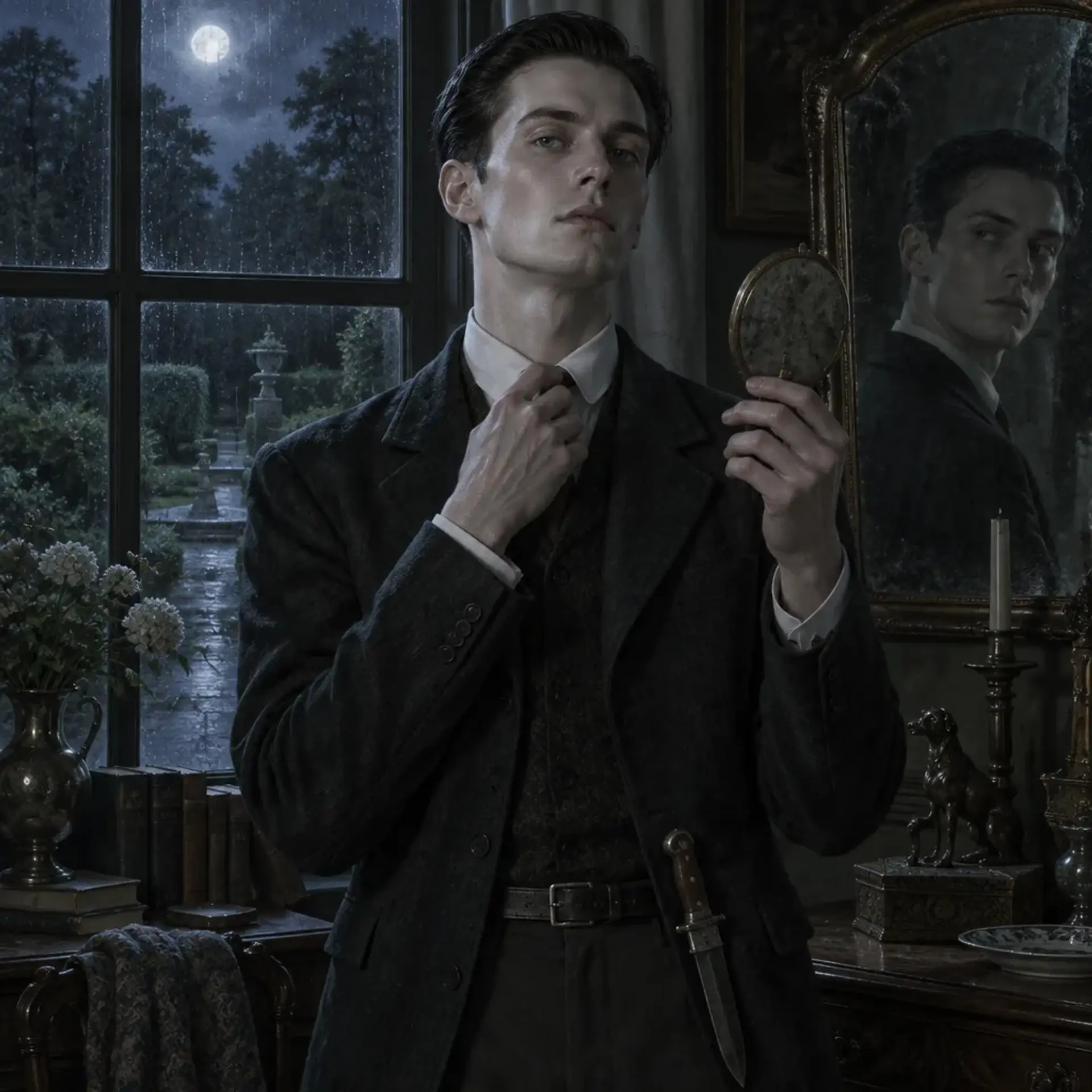
Carl is a compact, weather-worked man who seems to occupy more space than his height suggests. He plants himself squarely in doorways and turns his shoulders sideways only when someone else needs room. Years of foundry heat and open-air marches have left his skin a deep, ruddy brown, dry at the knuckles and glossy across the bridge of his nose. His close-cropped white hair stands in bristly wisps, and his beard is trimmed with the uneven care of someone who uses a knife and a cracked mirror. His cheeks are broad, his mouth quick to twitch, and his eyes are dark amber, alert to who is being ignored. An unexpected detail: he keeps a tiny, carefully folded paper butterfly tucked into his hatband, made by his granddaughter from a theater handbill. He moves with a measured, heel-first gait, like a man still listening for the factory floor to shudder beneath him.
Clothing
A patched charcoal work coat with a high leather collar, a rust-red wool scarf, thick trousers, and boots resoled with copper rivets. He wears a plain iron badge stamped with the Common Table's mark, not as decoration but as a signal that anyone in trouble can find him.
Body language
Carl stands with his feet braced as if the ground might shift. He points with an open hand rather than a finger, but when bargaining turns dishonest he sets both palms flat on the table and leans his whole weight into the silence. He touches the folded paper butterfly in his hatband when someone mentions leaving home.
- Height
- 5 feet 4 inches
- Build
- Short, broad-shouldered, and densely muscled, with the heavy forearms and sturdy stance of a lifelong metalworker.
- Eyes
- Dark amber
- Hair
- Close-cropped white
- Skin
- Deep, ruddy brown, weathered and freckled with pale heat speckles on the forearms
- Age
- Seventy-two years old
- Gender
- Male
- Size
- Medium
Distinguishing features
Personality
14 traits and drivesCarl is warm with frightened people and merciless with those who use procedure to hide cruelty. He can laugh easily in a kitchen, but turns exacting at a bargaining table. He wants the workers to decide together, yet secretly hates waiting for consensus when danger is close. He is proud of his strength and wary of being treated as a symbol instead of a tired old man.
- Alignment
- Neutral good
Quirks
Habits
Traits · 4
Flaws · 3
Fears · 3
Wants and needs · 4
Combat
AC 17 · HP 180 · 30 ft.Carl avoids fighting if a crowd can be moved to safety or a bargain can be struck. If violence becomes unavoidable, he puts himself between attackers and vulnerable people, uses Call the Line to break a surround, and targets weapons, knees, and escape routes rather than pursuing kills. He fights defensively and calls out useful instructions to allies. His statistics represent a legendary organizer with custom high-level features, not a canonical level-20 Commoner class.
Carl The Communist
Actions
Reactions
Legendary Actions
Services they sell
Rewards they can give
Equipment
- Iron-shod walking staff (weapon)A dense hardwood staff capped with iron, polished smooth where his palms grip it.
- Foundry coat (armor)A fitted work coat reinforced with leather and hidden metal plates, custom equipment represented by AC 17.
- Silent shift bell (tool and improvised weapon)A brass shift bell with its clapper removed; he uses its weight as a blunt projectile and its shell as a signal.
- Worksite first-aid roll (supplies)A wrapped bundle of clean bandages, needle, salve, and a small bottle of spirits.
Possessions
Background
Carl learned ironwork from his mother, then spent thirty years beneath the furnaces of the grand duchy's foundry district. He was not born a theorist; he began organizing because a foreman docked a week's wages after a cracked cooling pipe scalded three apprentices. His first petition was laughed out of the counting hall. His second brought a crowd. During the Winter Shutdown, the duke's guards sealed the foundry gates with hundreds of workers still inside. Carl led a chain of men and women through a drainage culvert, carrying the injured out one by one. His closest friend, Shesh, died holding a jammed sluice wheel long enough for the last children to pass. That night changed Carl from a careful negotiator into a man willing to break a law that protects the powerful. He later helped establish the Common Table, a workers' mutual-aid assembly that feeds families, settles disputes, and coordinates strikes. He argues fiercely for shared control of the foundries, but still visits the widow of the foreman he publicly denounced, because that man once taught him how to read a furnace. His granddaughter, Tessa, wants to leave the district for a life in the traveling theater; Carl supports her in public and dreads the day she goes. Now the duke is preparing to privatize the river pumps, which would leave the foundry quarter without clean water. Carl is trying to build a coalition broad enough to stop him without turning the district into a battlefield.
Role in the story
A powerful local ally, moral counterweight, and political catalyst. Carl can unite laborers, expose the duchess's plan, and provide shelter, but his choices can also decide whether the district's resistance remains organized or erupts into open revolt.
“He was not born a theorist; he began organizing because a foreman docked a week's wages after a cracked cooling pipe scalded three apprentices.”
- Faction
- Organizer and founding speaker of the Common Table, a workers' mutual-aid assembly. He has no formal allegiance to the rebels, though many regard him as their moral center.
Known connections
Media
0 imagesNo images yet.
Turn Carl The Communist into a sheet
A high-res, share-ready sheet you can post or print.