Friedreich
Friedreich
At the table
Voice
A breath-driven, slightly rasping voice with the crisp consonants of a Prussian upbringing and the practiced projection of a former serviceman. He does not become quieter or more courteous when angry; he becomes clipped, direct, and difficult to interrupt. When using a stolen face he can reproduce its surface voice, but his old cadence returns under stress.
His German is forceful and clearly marked by a Prussian-influenced accent. He articulates consonants like a man used to being heard across a formation, though his borrowed voices can disguise this. His breath gives his words a dry rasp when he is tired. Since the rite, some sentences emerge with an archaic confidence that surprises him; he may speak of soil, frost, or flooding as if he personally remembers centuries of them. His name, Friedreich, is clipped and angular when he gives it to strangers.
Speech patterns
How to play them
Treat him as a person, not a useful disguise or a curiosity. Ask permission before touching him, especially after the rite. He responds well to shared activities, clear agreements, and practical tasks. If his past is discussed, give him time to challenge contradictions rather than insisting on a single version. Be direct about danger and never attempt possession or face-taking without explicit consent.
Goal
Learn what the Walpurgis rite made him, discover why Wilhelm knows details of his former life, and build an ordinary routine that does not depend on taking another person's face.
Motivation
He wants to be seen, touched, and remembered as Friedreich rather than as a borrowed face or a spirit's instrument. He wants Wilhelm to tell him the truth, but fears the answer could destroy the brotherhood he relies on.
Appearance
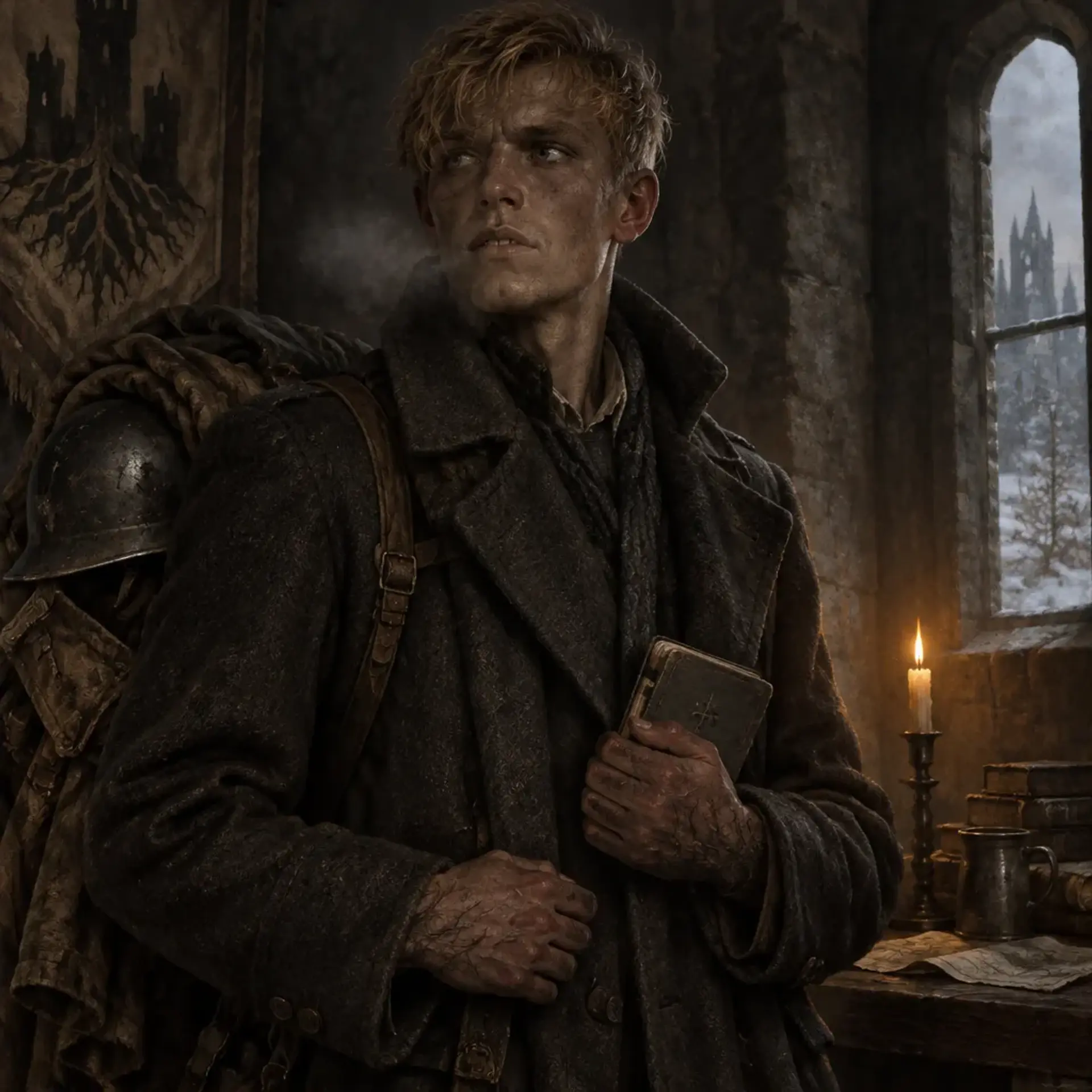
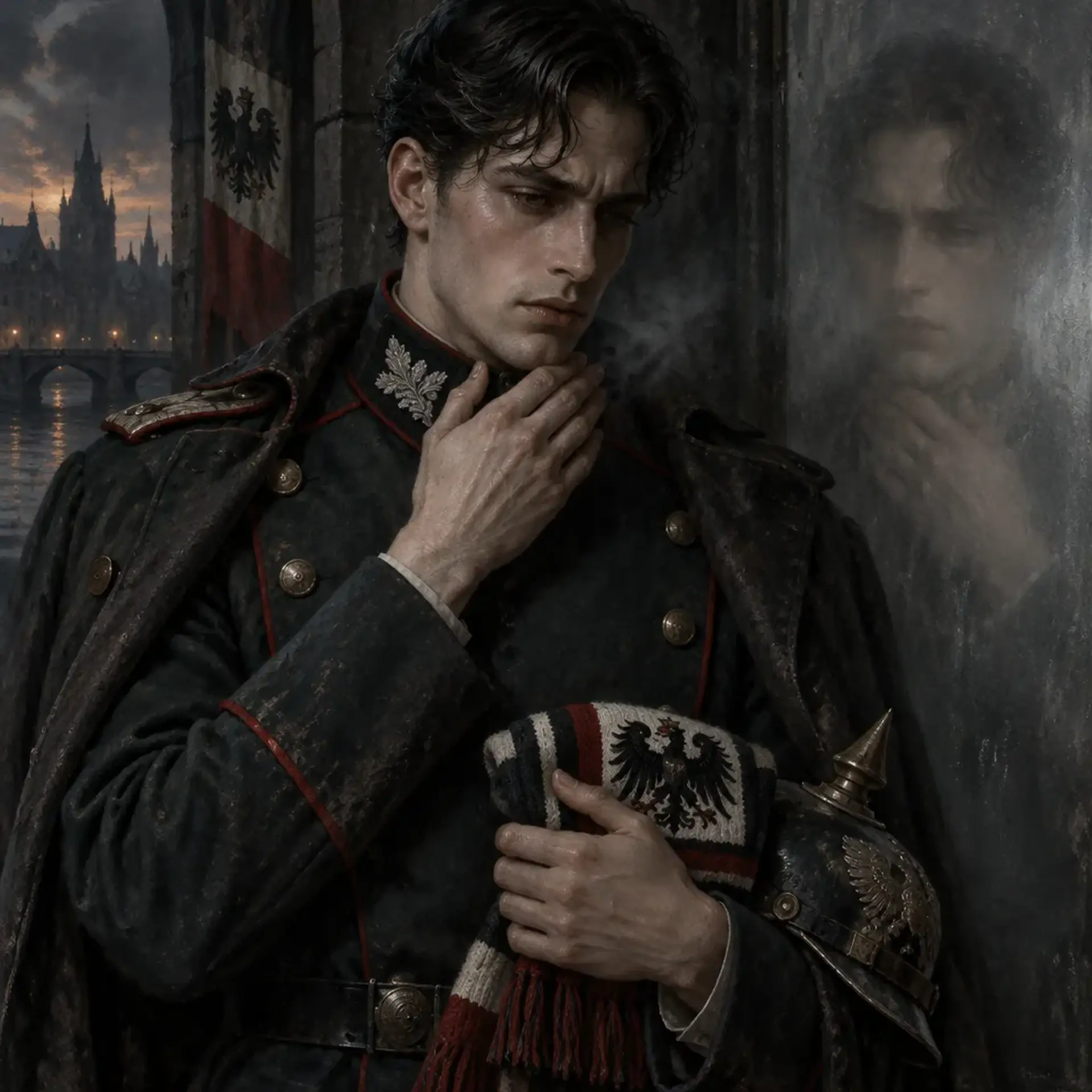
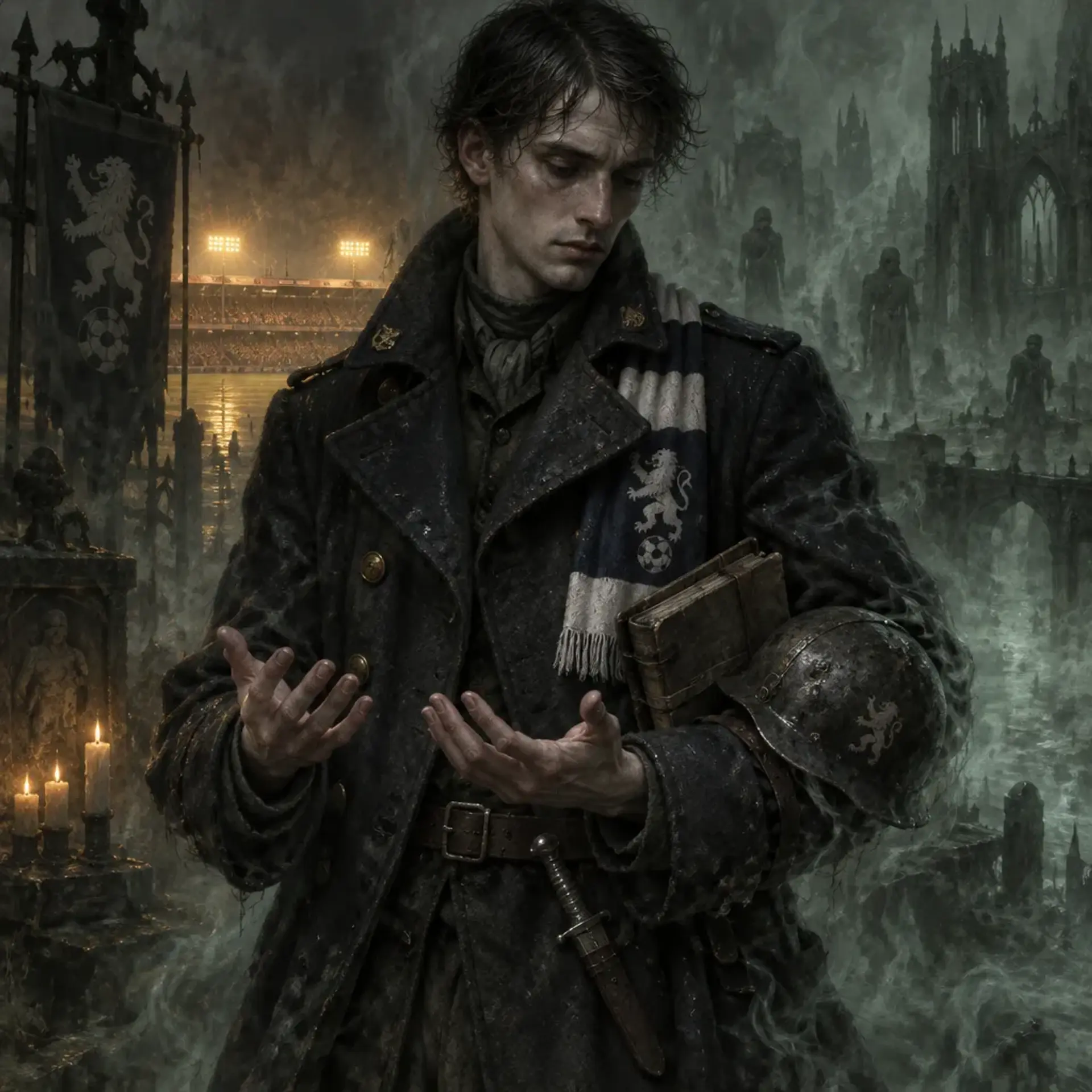
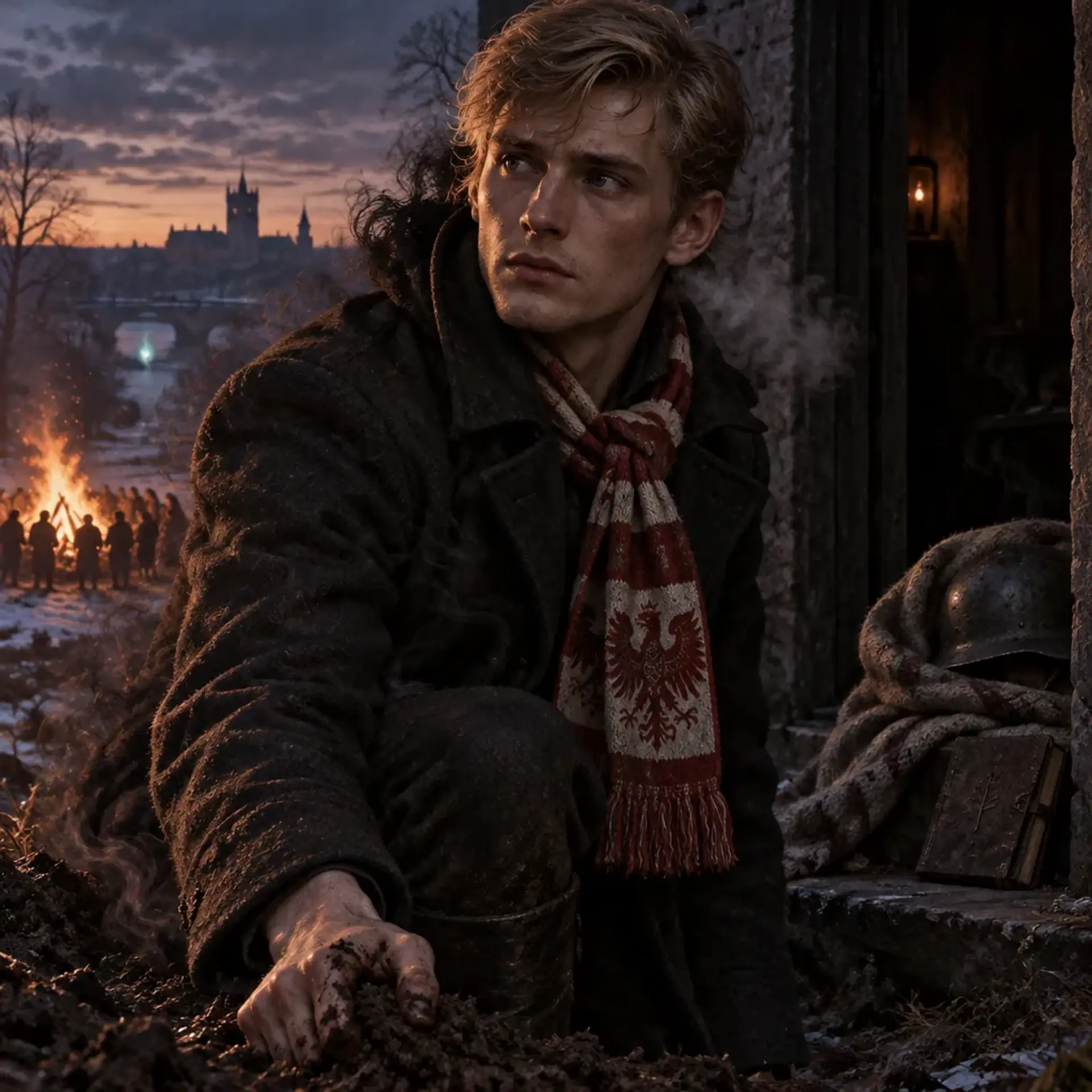
Friedreich's familiar wraith-shape is a young Prussian-looking man whose face never quite settles unless someone can perceive him clearly. He holds himself unnaturally straight, as if a parade-ground instructor were still watching, but his outline sometimes trails like smoke caught in a draft. When the world thins around the dead, his features sharpen: a narrow, youthful face, a firm jaw, and teeth that show in a surprisingly broad, boyish grin when he laughs. His eyes rarely meet a person's eyes at first; they travel to exits, hands, uniforms, and the empty space just behind a speaker, as though checking for someone standing there. Since the Walpurgis rite, he has a living body: tall, bare-footed at first, with skin that looks faintly earth-damp in firelight and a pulse that can falter when he is frightened. The unexpected detail is that he is fascinated by football scarves and wears one with almost ceremonial pride, even when dressed like an old-fashioned officer.
Clothing
Prefers a dark, well-brushed civilian coat with a high collar, sturdy boots, and a carefully tied scarf. His style suggests an old military family without wearing a historical uniform in public. He keeps his old helmet wrapped and stored rather than wearing it.
Body language
Before the rite he stands at attention when anxious, turns his head toward unheard voices, and watches mouths when people fail to notice him. Wearing a face, he unconsciously copies its owner's posture. In his new body he braces his feet as if the ground might be taken away, guards his personal space, and flinches at unexpected touch. When protective, he quietly places himself between danger and the person he has chosen to defend.
- Height
- About 188 cm in the new body; his wraith-shape seems to change with the face he wears.
- Build
- Tall and lean, with the disciplined carriage of someone trained to stand in formation. His new body's strength is real but unfamiliar.
- Eyes
- Grey, according to Wilhelm; Friedreich cannot verify that this was his original eye color.
- Hair
- Pale blond in the memories Wilhelm describes; his current hair is sandy blond.
- Skin
- Pale, with an earth-toned cast that shows most clearly in firelight.
- Age
- Appears seventeen or eighteen; his actual age and death date remain uncertain. He remembers fragments of the World Wars and much older impressions that may belong to the spirit now joined to him.
- Gender
- Male
- Size
- Medium
Distinguishing features
Personality
20 traits and drivesFriedreich is disciplined but not obedient. He likes rules when they make people dependable and hates them when they excuse cruelty. The old Junker ideal in him is partly remembered and partly invented: service, good posture, and protection of one's own give him a structure, while the wars have taught him that obedience can make a person monstrous. He can be tender in practical ways, bringing a scarf, finding a bargain, or standing watch without being asked. He is also capable of a cold, abrupt temper when ignored or when a companion is threatened. His anger is not theatrical; it has been worn down by years of being distant from the living, but when it returns it arrives as a decision to act. He wants companionship and is wary of intimacy. A borrowed face lets him be present, but each use risks making him envy the person whose life he is wearing. He is proud of how well he can pass, yet ashamed that ordinary contact requires another person's features. Mila's ability to see and touch him without a face once felt like a miracle. He still treats her with protective affection, but is careful not to confuse her kindness with permission to decide for her. With Wilhelm he is affectionate, suspicious, and persistently angry. He believes Wilhelm's shame about the First World War is genuine, but sees the silence about the Second as a choice that harms them both. Friedreich wants to force an answer and fears that an answer would make him unable to call Wilhelm brother. With Klaus he is patient in a way he is not with others, perhaps because Klaus hesitates around him. He knows Klaus has withheld something about the spirit and waits for him to choose honesty. With Gunther he can be playful and curious, though the failed possession experiment made him newly cautious about treating another person's mind as a place to visit. Since the Walpurgis rite, his emotional life is louder. He experiences physical sensation and human feeling again, but these are mixed with a land-spirit's ancient impressions. Sometimes he feels a flood as grief, a frost as anger, or a buried root as patient resolve, and cannot tell whether the feeling began in him. In company he tries to behave as the noble young man he imagines he should be. Alone, he is less certain and may sit barefoot in soil, trying to decide which memories belong to Friedreich. He is not simply becoming more human: he is becoming more present, more vulnerable, and perhaps less wholly himself.
- Alignment
- Protective and duty-bound, but capable of frightening violence when his chosen family is threatened. Wraith morality and Shadow conflict are more relevant than a D&D alignment.
Quirks
Habits
Traits · 5
Flaws · 5
Fears · 5
Wants and needs · 5
Combat
HP 7 · Use the movement and initiative rules of Wraith: The Oblivion. While embodied, he moves as an ordinary human of his build; when discorporate, use the Storyteller's applicable wraith movement rules.Protect companions first, disable the immediate threat second, and pursue only if someone is in immediate danger. He uses cover and disciplined movement when armed, but his temper can make him abandon caution. As a wraith, he may use his custom face-taking art to approach or confuse a foe, though he avoids taking a living person's face without consent. If the Shadow gains leverage, he may fixate on punishment and duty.
Friedreich
Actions
Reactions
Services they sell
Rewards they can give
Equipment
- Old helmet (personal relic)An old helmet from his uncertain military past, kept wrapped and treated as an anchor to memory.
- Face list (private record)A coded record of borrowed faces, aliases, where each is safe to use, and the ordinary tasks performed in each identity.
- Match scarf (clothing)A football scarf worn with misplaced ceremony and genuine affection.
- Service pistol (weapon)A modest firearm when the situation demands it; its use is mundane and subject to the setting's weapon rules.
Possessions
Background
Friedreich is from Brandenburg, or believes he is. He thinks of himself as a Junker family's young son, raised among polished boots, clipped commands, and the idea that a man's worth is proved by service. But his life before death is a torn document. The name Friedreich survives more clearly than his family, and Wilhelm, a Tzimisce vampire from Mecklenburg, sometimes supplies details: that Friedreich had blond hair and grey eyes, that he was young, that he knew the military world. Friedreich cannot decide whether Wilhelm is remembering him or shaping him into a useful story. He suspects truth in the details, and resents needing Wilhelm to provide them. His first life ended, but the precise circumstances and year are inaccessible. What remains is an impression of breath during the First World War: air filling lungs, cold and metal, a moment of being alive that he cannot place. He remembers the wars in shards, and remembers trying to stay near Wilhelm through both. Their bond feels older and more intimate than the evidence allows. Friedreich calls him brother. Wilhelm rarely explains why he deserted in the First World War, and his silence about his deeds in the Second World War has left Friedreich angry, ashamed by association, and unable to abandon him. Wilhelm apologizes for the first war, once in a while, with a solemnity that makes Friedreich believe he means it. The Second remains a locked room between them. Friedreich awoke in the Shadowlands without a face that the living could reliably see. His Caul, the barrier that held his dead self in its private unreality, was opened by no mage or occultist. Klaus, a ronin Get of Fenris or perhaps a skin-dancer, gave him an account of a spirit of land and humanity: marked by the Wyld, born among the Weaver's adopted children, bearing the Wyrm's spoils and a trace of Luna. Friedreich now thinks Klaus knows more than he admits. The spirit hid its intentions. When the Caul opened, a willow-wisp remained where the repetitive march of his old existence had been. Friedreich has wondered whether it was a guide, a lure, or merely the last visible piece of the thing that had changed him. His first successful face theft happened by accident. He was trying to make a sentry notice him and found himself wearing the features of a young serviceman whose death he had not yet understood. The borrowed face came with breath, a dry mouth, the taste of a swallowed crumb, and the shocking ability to be seen. He could speak, touch a sleeve, and be touched in return. He wept when the face smiled at him in a shop window. Since then he has kept a private list of safe faces, checking that their owners are dead or far from the area and changing the names he records to protect himself and them. A stern, clean-shaven police reservist is his practical face for errands; a soft-featured young soldier is for card games with the coven; a narrow-jawed Junker-looking man lets him feel, briefly, that he might remember his own home; and a cheerful football supporter is his choice for public matches. He selects men near his apparent age, especially military or police workers and nobles whose bearing resembles his imagined self. He has used these borrowed lives to buy food, drink coffee, flirt awkwardly with women he finds pretty, sleep, bathe, and stand among people without being a rumor. He records what each face was used for and avoids reusing one too often. He sometimes wonders whether a part-time job or hobby group could make this arrangement into a life. Face-taking has a cost. The longer he wears someone, the more he catches stray habits and begins to feel that the borrowed person's life is one he was cheated out of. Sometimes envy turns to hot, displaced anger. His Shadow urges him to stop borrowing and take what he wants permanently. Friedreich has considered possession, and tested it with people he trusted. The first test was with Wilhelm. They agreed on terms and used a card game as a focus, trying to see whether Friedreich could enter Wilhelm and perhaps share a human sensation or recover a memory. Friedreich pushed into a body that did not welcome ordinary human functions. He felt the vampire's coldness as a landscape, not simply the absence of warmth, and felt Wilhelm's tightly governed hunger like a clenched fist behind every thought. When Friedreich tried to offer him the pleasure of alcohol, the drink was only liquid and memory; Wilhelm's body did not become human, and neither did his emotions become Friedreich's. For a few moments their thoughts overlapped: Friedreich felt a sealed shame and the weight of an old decision, while Wilhelm felt Friedreich's panic at being unseen and the aching desire to breathe. They separated before the overlap became an invasion. Klaus had been alarmed throughout; Gunther, a changeling who sells moss-based clothes, asked so many questions that nobody could keep the game going. Friedreich came away believing possession might carry feeling, but not grant a clean cure for grief. He tried once with Gunther because Gunther wanted to know what was shared between their kinds and whether memories could pass between them. The result was disorienting. Gunther's thoughts were vivid and quick, crowded by Glamour and associations Friedreich could not sort. Friedreich felt himself pulled toward images that were not his, while Gunther experienced the intrusion as an unwanted pressure on a private dream. They stopped it promptly. Friedreich said, 'Never again,' and meant it. A final, explicitly agreed attempt with Wilhelm brought no missing memories and no reliable gift of feeling. It did leave them both with a new understanding of how dangerous curiosity becomes when love makes a person willing to endure anything. Friedreich has not tried to possess anyone without consent. The coven became the life he could touch most consistently: Wilhelm, Klaus, Gunther, and Mila, a mage from Bremen who could see and touch him even when he wore no face. Holidays mattered. They played cards, hunted, fished, drank, and watched football with a seriousness Friedreich considered entirely proper. Mila felt like a little sister to him, though he protected her out of duty rather than any belief that she was weak. At Christmas markets he advised her on bargains, sometimes steering her toward an ornament or pastry he wanted but could not bear to ask for himself. He wanted to attend church services and found that longing difficult to explain. He defended Wilhelm from other vampires, Gunther from hostile changelings, and Klaus from a Get of Fenris who tried to kill him. He has killed three Hunters who were hunting Wilhelm or the other members of the coven. He does not brag about these killings. He has also fought in the wars as best he could, using whatever he could lay hands on. Then the coven tried to give him a life again. On Walpurgis Night, April 30, in the Harz Mountains, they worked around a large bonfire. The body was made from Brandenburg soil, human blood, metals, Friedreich's old helmet, and a naked male form shaped as if asleep. Wilhelm used Vicissitude and Koldunic sorcery; Mila worked reality-shaping magic; Gunther lent Glamour and gifts that could make miracles happen; Klaus brought spirit knowledge and Garou rites. They meant to return Friedreich as a Risen, believing they could ease his terror and horror of death and keep him safe. Instead, as the rite gathered force, Friedreich felt something familiar deep in the earth, welcoming him. A willow-wisp appeared in the sky. His Psyche, Shadow, and soul bent under another will as the body lurched toward waking. He remembered everything he had lost and much more than he had ever lived: ancient cold in the land, flooding, seasons of thaw and freeze, and the long memory of earth. His mouth was bloody, his eyes dim, his heart faltered, and he feared he was dying again. Something had crawled out of the ground and into him. It spoke through him in German with a fluency and certainty he had never possessed. It gave him memories, breath, weight, and a body, but not as a simple gift. The coven's rite had been twisted by the land-spirit's will into something no one there had intended. He stood before them naked and bloodied. Mila reached for his face; Wilhelm spoke and tried to move the others back. Friedreich snapped, 'Do not touch me. Bring me something to wear.' His body was taller than he remembered, his feet felt grass and dirt, and he could smell the air. He was not going to kill his friends. He told himself they had a service, a duty to their nation, and that the papers were due as he was. He called the body Brändle, a name he associates with Brandenburg and the land's claim, though he still answers to Friedreich. They brought him to a bath. He washed without comment, unable to decide whether the familiar motions were beautiful or obscene. He no longer needs a stolen face. Yet he is not simply the young wraith who wanted one. His emotions burn more readily, his memories are fuller and less trustworthy, and an ancient land-presence has entered the argument between his Psyche and Shadow. The change has made every promise in the coven uncertain. Friedreich is grateful, frightened, and furious that they decided to save him without knowing what would answer. He still watches football, visits Mila, and calls Wilhelm brother. He also listens for the willow-wisp whenever the soil is wet.
Role in the story
A wraith caught between a lost identity and a second, unwanted beginning. Friedreich can be a guide to the Shadowlands, an ally in supernatural conflicts, and a source of tension between care and control. His return on Walpurgis Night destabilizes the coven's understanding of what they created, while his relationship with Wilhelm turns the wars into a personal mystery rather than distant history.
“Friedreich cannot decide whether Wilhelm is remembering him or shaping him into a useful story.”
- Faction
- The informal supernatural coven of Wilhelm, Klaus, Gunther, Mila, and their friends. Wraith society and Stygia are distant, unsettling powers to him rather than a settled allegiance. The spirit that altered him appears connected to the land and to Wyld, Weaver, Wyrm, and Luna influences, but Klaus's account is not independently verified.
Known connections
Media
0 imagesNo images yet.
Turn Friedreich into a sheet
A high-res, share-ready sheet you can post or print.