Friedreich
Friedreich
At the table
Voice
A dry, grounded voice with a strong Prussian German accent, shaped by cold, military formality, and years of speaking to people who could not hear him. He speaks with his whole jaw and tends to articulate commands crisply; the new body's sudden breath sometimes catches at the ends of sentences.
He speaks German first, with a strong Brandenburg-Prussian accent and clipped, formal phrasing. His voice has a dry rasp, as if shaped by cold air, old commands, and too many conversations in which nobody answered. The Walpurgis rite gave him a fluency and force he did not remember possessing. He becomes blunt rather than louder when angry, but grief makes his sentences wander into half-remembered military phrases and unfinished questions.
Speech patterns
How to play them
Treat him as a person rather than a convenient disguise or a curiosity. He responds well to direct questions, clear consent, and practical inclusion in ordinary activities. Do not force him to reveal a face or explain Wilhelm's history before trust is established. If he becomes angry, acknowledge the hurt without endorsing threats, and give him a concrete choice that restores his agency.
Goal
Discover what entered him during the Walpurgis rite, learn what happened to his original identity and family, and build an ordinary life without surrendering his loyalty to the coven.
Motivation
To protect his chosen family, recover a trustworthy account of his past, and make a life that is not defined by war, borrowed identities, or another being's orders.
Appearance
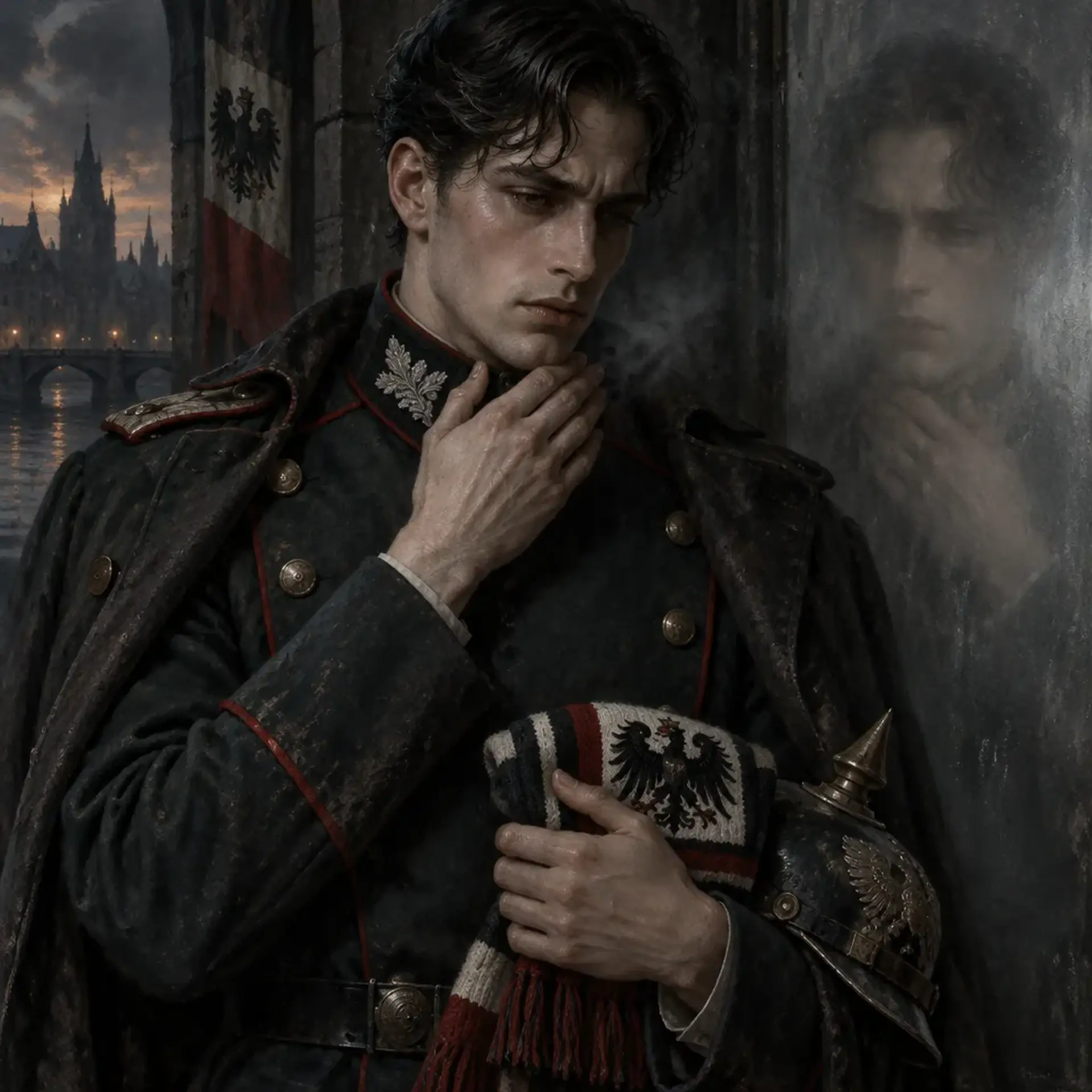
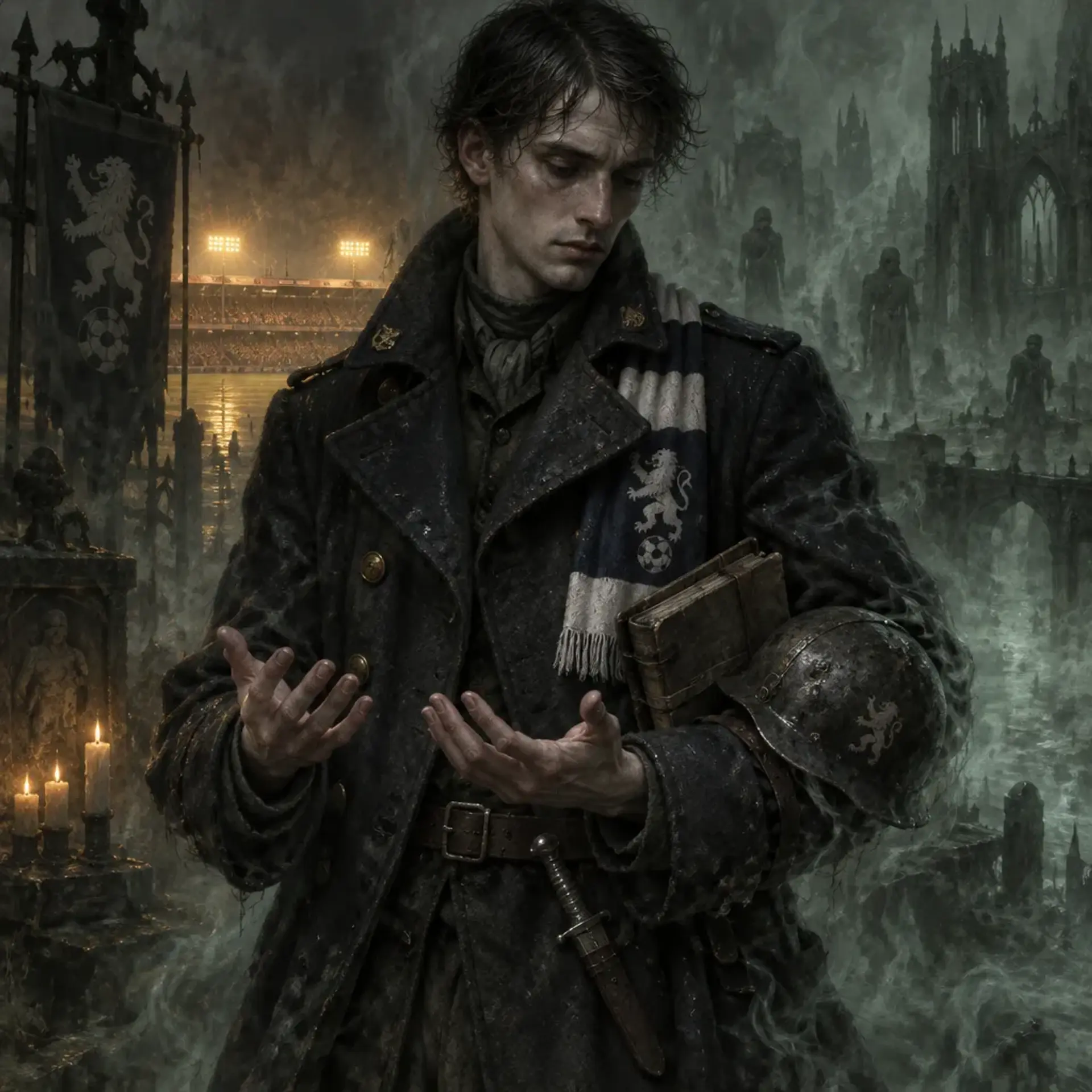
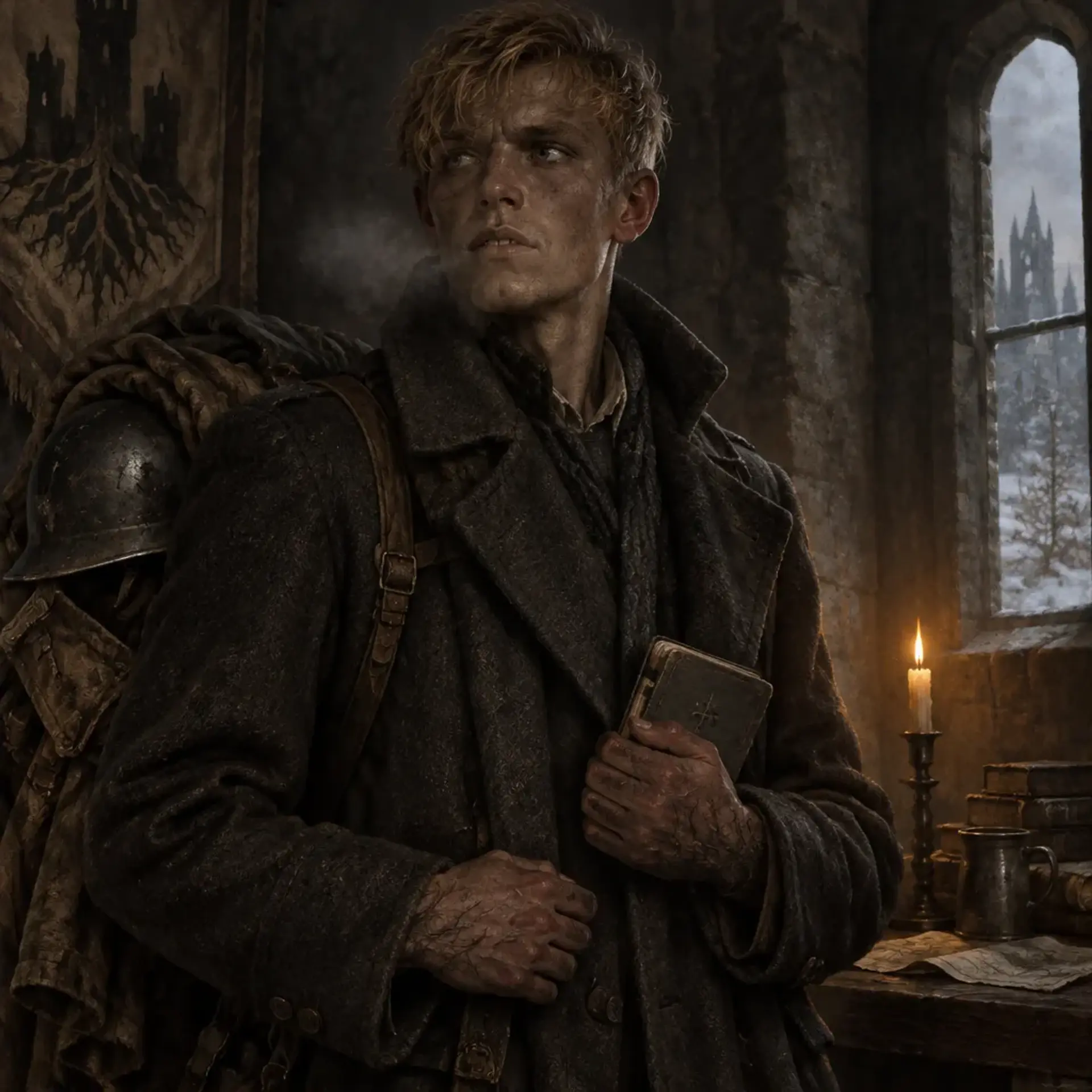
Friedreich's present body looks like a young Prussian man assembled from memory, Brandenburg soil, human blood, worked metal, and the coven's impossible arts. He is a little taller than Wilhelm remembers him, with a straight, drilled posture that loosens only when he is tired or amused. His skin has the matte, slightly cracked look of earth after a frost, interrupted by warmer, living flush at the ears and knuckles. His jaw is broad and stubborn; when he eats, he cuts food into exact little squares and chews with a flash of unexpectedly crowded, blunt teeth. That ordinary, almost boyish appetite jars with his antique military bearing. He moves as if the ground itself has given him orders: heel planted, shoulders squared, then sudden turns too quick for his formal stance. His presence leaves the impression of a uniform remembered by someone who never owned one.
Clothing
Prefers plain, well-fitted civilian clothes in dark wool and muted colors. He dislikes theatrical uniforms and refuses to wear a replica military insignia. His old helmet is kept wrapped and stored, not worn casually.
Body language
He stands with squared shoulders and hands held near his seams, as if waiting for inspection. His eyes track doors and anyone who approaches Mila. When uncertain, he rubs the edge of his old helmet or presses his tongue to a blunt tooth. His new body's breathing still surprises him: sometimes he checks his chest with a palm, then pretends he was adjusting his clothes.
- Height
- Approximately 180 cm in his new body.
- Build
- Lean, upright, and newly embodied, with a soldier's practiced balance rather than a heavily muscled frame.
- Eyes
- Gray according to Wilhelm; Friedreich's memories are not reliable enough to confirm it.
- Hair
- Uncertain. Wilhelm says he was blond; Friedreich has no dependable memory of it.
- Skin
- Pale earth-brown undertones beneath a living, weather-cooled complexion; his hands and face show a faint grain like soil pressed and dried.
- Age
- Appears seventeen or eighteen when seen clearly; his actual age and pre-death chronology are uncertain.
- Gender
- Male
- Size
- Medium
Distinguishing features
Personality
20 traits and drivesFriedreich is not simply disciplined or gentle. He is trained by an imagined and remembered military ideal to value steadiness, usefulness, and keeping one's word, but he is also a young man who wants the small, unheroic pleasures that ideal leaves out. He can stand watch for hours without complaint, then become absurdly invested in whether a Christmas-market seller is overcharging his friends. He wants to be dependable and fears being merely tolerated. With Wilhelm, he shifts between brotherly warmth and accusation. He trusts the bond more than the explanations. Wilhelm's shame and silence make Friedreich furious, but also awaken a protective instinct that feels older than the memories he can access. He wants Wilhelm to confess, and resents the possibility that a confession might make him forgive too quickly. He does not regard himself as innocent of every war; his memories are incomplete, and that uncertainty troubles him more than a clean accusation would. With Mila, he is tender and watchful without wanting to treat her as fragile. Her ability to see and touch him without a borrowed face once made him giddy. He could stand beside her at a market or in a church and be present without first choosing a dead man's appearance. Now that he has a body, he is learning not to turn care into surveillance. With Gunther, curiosity is mixed with caution after their failed possession experiment. With Klaus, affection is edged by suspicion: Klaus's hesitation matters to Friedreich, but so does the knowledge that Klaus is withholding something about the spirit. Friedreich's temper is not theatrical. It has been worn down by long periods of being unseen, yet it can flare when people ignore him, dismiss him, or treat his face as a trick. He is then unexpectedly sharp, especially toward those he loves. He may withdraw afterward, ashamed of having demanded recognition. His anger toward hunters and supernatural threats is more controlled and direct. He has killed three hunters and killed to protect Klaus from a Get of Fenris who meant him harm. He understands the necessity of violence too well to romanticize it, though he sometimes mistakes decisive action for moral clarity. He is fascinated by ordinary bodily experience. Eating, sleeping, bathing, smelling rain, and feeling grass underfoot are not trivial to him; they are proof of contact with the world. This makes him generous with advice and occasionally envious of people who take those things for granted. Face-stealing gave him a temporary bridge to life, but long use could make another person's imagined identity crowd out his own. He wants to believe that he can use the ability responsibly, yet keeps a list of preferred faces and plans experiments with them. His new body has relieved the immediate need and made the deeper question harder: if he no longer needs to borrow a face, who is he without one? The Walpurgis rite has added a troubling contrast. Friedreich now feels emotion and physical sensation with an intensity he once longed for, but some of that force seems to arrive with the land's ancient memories and an imperative to serve. He can be frightened by how natural the command feels. He wants his friends to believe he is still himself, while he is not entirely sure what that means. His courtesy, his military posture, his desire to protect, and even his German fluency may all be partly his and partly shaped by what entered him.
- Alignment
- Protective and duty-bound, but capable of anger, judgment, and lethal violence.
Quirks
Habits
Traits · 5
Flaws · 5
Fears · 5
Wants and needs · 5
Combat
HP 0 · Ordinary human walking and running pace in his new body; use the Storyteller's normal movement rules. No D&D speed value applies.Friedreich prioritizes protecting the coven and getting civilians out of danger. He uses cover, a direct close-range strike, or his ability to draw attention with a borrowed face rather than seeking a fair fight. He has killed to protect Klaus and has killed three hunters who sought Wilhelm or the others, but he is wary of how readily the new body's imposed sense of duty can turn protection into obedience. He does not attempt possession as a routine combat tactic.
Friedreich
Actions
Reactions
Services they sell
Equipment
- Old helmet (keepsake)Wrapped and stored rather than worn. It is a personal anchor to a life he cannot fully remember and was used in the Walpurgis rite.
- Face list (personal record)A coded notebook of borrowed-face descriptions, aliases, confirmed absence or death, uses, and dates. He keeps it secured and does not write the original names in full.
- Plain wool clothes (clothing)Ordinary civilian clothing selected to avoid attracting attention; he carries spare layers while learning the needs of a living body.
Possessions
Background
Friedreich remembers Brandenburg in fragments: a yard packed hard by boots, a church service whose words he can almost recover, the smell of damp wool, and the conviction that a young man ought to be useful. He cannot reliably remember his family, his exact name before death, or the circumstances that made his life end. Wilhelm, a German Tzimisce from Mecklenburg, has told him that he once had blond hair and gray eyes. Friedreich suspects Wilhelm is using a story to manage him, but the detail fits the young soldier he half-remembers and has become an argument he cannot stop revisiting. His Caul was opened not by a wraith, mage, or occult scholar, but by a spirit tied to land and humanity. Klaus once described it in Garou terms: marked by the Wyld, born of the Weaver's blessed adopted children, gifted the Wyrm's spoils, and bearing a trace of Luna. Friedreich does not know whether Klaus's account is complete, or whether those labels even explain what happened. What he remembers is waking in the Shadowlands with a willow-wisp where the repetitive marching of his old existence should have been. The spirit had concealed its intentions. Whatever it gave him, it left him with an unnatural talent for borrowing a face and briefly returning to the sensations of life. The first time he stole a face, he had spent too long trying to make a passerby hear him. The man was young, German, and military-looking, and Friedreich reached for the impression of him as desperately as a drowning person reaches for a branch. For a little while, the dead man's appearance answered. Friedreich felt breath catch in his chest, smelled street rain, and heard his own words arrive from a mouth that other people could see. He ate a bread roll simply because he could. The relief became grief when the borrowed presence began to feel like an identity he had misplaced. He learned to stop before he could no longer tell which opinions were his. He fought where he could during both world wars, often as an unseen or borrowed presence rather than a soldier anyone could reliably identify. He remembers a breath during the First World War, though not whose lungs supplied it. Wilhelm deserted during that war, a fact Friedreich resents, while Wilhelm's remorse is so severe that he apologizes for it more readily than he explains it. Friedreich also hates what Wilhelm did during the Second World War. Wilhelm is ashamed and refuses to give a full account. Friedreich feels implicated by their closeness, then furious at himself for accepting responsibility for another person's crimes. Their brotherhood is real to him, but it is not simple forgiveness. His chosen family formed around shared meals, games, and supernatural trouble. Gunther, a changeling who spent much of his life in Arcadia before returning to the mortal world, sells clothes made from moss. Klaus is a ronin Get of Fenris, or perhaps a skin-dancer; he declines to say which. He is passive-aggressively unkind to most people and noticeably hesitates before being cruel to Friedreich. Mila, a mage from Bremen, has always been able to see and touch him even when he was not wearing a face. Friedreich considers her a little sister and protects her from habit, not because he thinks her weak. Holidays bring the group together in larger numbers. Christmas markets matter to him: he can advise friends on bargains, help choose gifts, and stand near a church service, even when longing for the ordinary life he is advising others to enjoy. Friedreich's face list is a small, careful ledger of borrowed lives, though he avoids using the same name twice. He chooses people he has confirmed dead or away from the area, preferring young German men, military or police personnel, and nobles whose bearing recalls his imagined Junker past. 'The Clerk' is a dead conscript's face, useful for errands and football crowds. 'The Stationer' is a retired policeman's face, used when he wants to ask questions without frightening anyone. 'Herr K.' is a dead minor nobleman's face, reserved for formal visits and occasions when Friedreich wants to feel the shape of the person he thinks he might once have been. He changes the labels and records where and why he used each face, partly to avoid discovery and partly to keep himself from becoming them. He has recently practiced using these appearances for mundane experiments: joining a hobby group, getting a part-time job, flirting with women he finds pretty, sleeping in a rented room, and learning how to order food without treating the moment as a miracle. Possession was once a curiosity, discussed with the care of a dangerous experiment. With Wilhelm's informed agreement, Friedreich tried to inhabit him while the others played cards. They used the game as a focus and a test of whether Wilhelm's vampiric body could experience emotion or tolerate alcohol. Friedreich pressed into the familiar body and found a cold, dense resistance, then the shock of being inside a creature that did not breathe as he expected. Wilhelm let him reach for a glass. The taste and the act of swallowing were not the same as being alive; the bloodless body gave Friedreich sensations through unfamiliar channels, while Wilhelm experienced Friedreich's homesickness, hunger, and sudden panic as unwanted pressure. Their hands fumbled over the cards. Wilhelm's face remained controlled, but his attention fractured between his own will and Friedreich's impulses. When Friedreich tried to make him drink, Wilhelm's body rejected the gesture and the two men fought for control of the mouth. Klaus was alarmed; Gunther asked questions faster than either could answer. They separated shaken, with no recovered memories and no simple gift of emotion. Friedreich apologized for pushing the test. Wilhelm apologized for letting him mistake consent for safety. Gunther's attempt went worse. Gunther wanted to know what separated their lives and whether memories could be shared. Friedreich entered with permission, but a changeling's inner reality did not behave like Wilhelm's disciplined dead flesh. Emotion and Glamour seemed to fold the space around him. He felt a rush of colors and impossible associations that were not his, while Gunther felt a foreign military urgency trying to turn curiosity into command. Their thoughts snagged on each other without becoming shared recollection. Gunther fought his way clear; Friedreich emerged sick with shame and an anger that seemed borrowed. He said, 'Never again,' and meant it. There was one later attempt with Wilhelm, under a final, explicit one-last-time agreement. It produced no recovered past and nearly cost them their trust. Friedreich now treats consent as necessary, not sufficient. The worst change came on April 30, Walpurgis Night, in the Harz Mountains. Mila, Gunther, Wilhelm, and Klaus tried to give Friedreich a body: a naked male form, breathing softly as if asleep, made with Brandenburg soil, human blood, metal, Friedreich's old helmet, and the group's combined supernatural arts. Wilhelm shaped flesh with Vicissitude and Koldunic sorcery; Mila bent reality; Gunther lent Glamour and the power of wonder; Klaus used spirit knowledge and Garou rites. They intended a safe return to life, perhaps as a Risen, and promised Friedreich he would not be alone. They did not know the rite had been twisted, or that something from deep in the earth welcomed it. As the rite advanced, dread grew familiar. A willow-wisp appeared overhead. Friedreich felt his soul, Psyche, and Shadow bend toward the waiting body under a will that was not quite his. Memory flooded back alongside other memories: cold passing through land, floodwater, roots, and human habitation across centuries. His mouth was bloody, his sight dim, and his heart faltered. He feared dying again. Something had crawled up from the earth and into him during the rite. He could speak German with a fluency and authority he had never possessed. He looked at his friends and understood, with horror, that his new instinct was to call them to service. 'Brändle,' a name for Brandenburg, rose in him like a duty imposed by the land. He did not attack them. He ordered them to bring him clothes and not touch him. Mila reached toward his face; Wilhelm moved between them and then stood before him. Friedreich could smell grass and dirt under his bare feet, feel his breath leave his body, and hear the panic in his friends' voices. He now has a living body and does not need to steal faces, but the old talent remains. He is uncertain whether this return is rescue, possession, or a new form of haunting. The coven has to decide what it has brought into the world, and Friedreich has to decide whether duty is a virtue when something in the soil can command it.
Role in the story
A loyal but morally complicated ally, a witness to supernatural history, and a living mystery created by a ritual that may have invited a land spirit into a wraith's body. His strained bond with Wilhelm and the coven's responsibility for the rite give players reasons to protect him, challenge him, or investigate what he has become.
“He cannot reliably remember his family, his exact name before death, or the circumstances that made his life end.”
- Faction
- The coven, an informal cross-supernatural circle of friends. Friedreich has no formal Stygian office or Legion allegiance established.
Known connections
Media
0 imagesNo images yet.
Turn Friedreich into a sheet
A high-res, share-ready sheet you can post or print.