Eber
Eber
At the table
Voice
A dry, slightly rough voice shaped by salt air, smoke, and years of talking over tools. His delivery is practical and well articulated; when explaining a mechanism, he accelerates into precise, enthusiastic detail. His altered jaw gives certain consonants a faint catch, and he pauses before swallowing rather than pretending the motion is effortless.
His voice has a dry, slightly rough edge from years of breathing smoke and salt air around the boatyard. He speaks with the practical cadence of someone used to giving instructions over rain and hammering: compact phrases, clear nouns, little ornament. When excited about a device, his words speed up and tumble into detailed explanations. His jaw shifts carefully around sounds because of his altered teeth, and he never tries to hide the small pause he takes before swallowing.
Speech patterns
How to play them
Start with practical help rather than questions. Let Eber show a repair or demonstrate a tool before asking about his history. Respect his right to refuse medical attention, and do not treat his stones or inability to chew as a joke. He warms to people who include low-blood and high-blood Marshwake equally in their plans. If pressed about the dragon-tainted wilderness, he answers cautiously and tests whether the questioner wants to help the community or study it.
Goal
Determine why the island's plants and springs are changing, while building practical tools that let high-blood and low-blood Marshwake live with dignity and independence.
Motivation
Make useful things, defend his people's right to define themselves, and find an explanation for the changes in the island before fear turns the Marshwake against one another.
Appearance
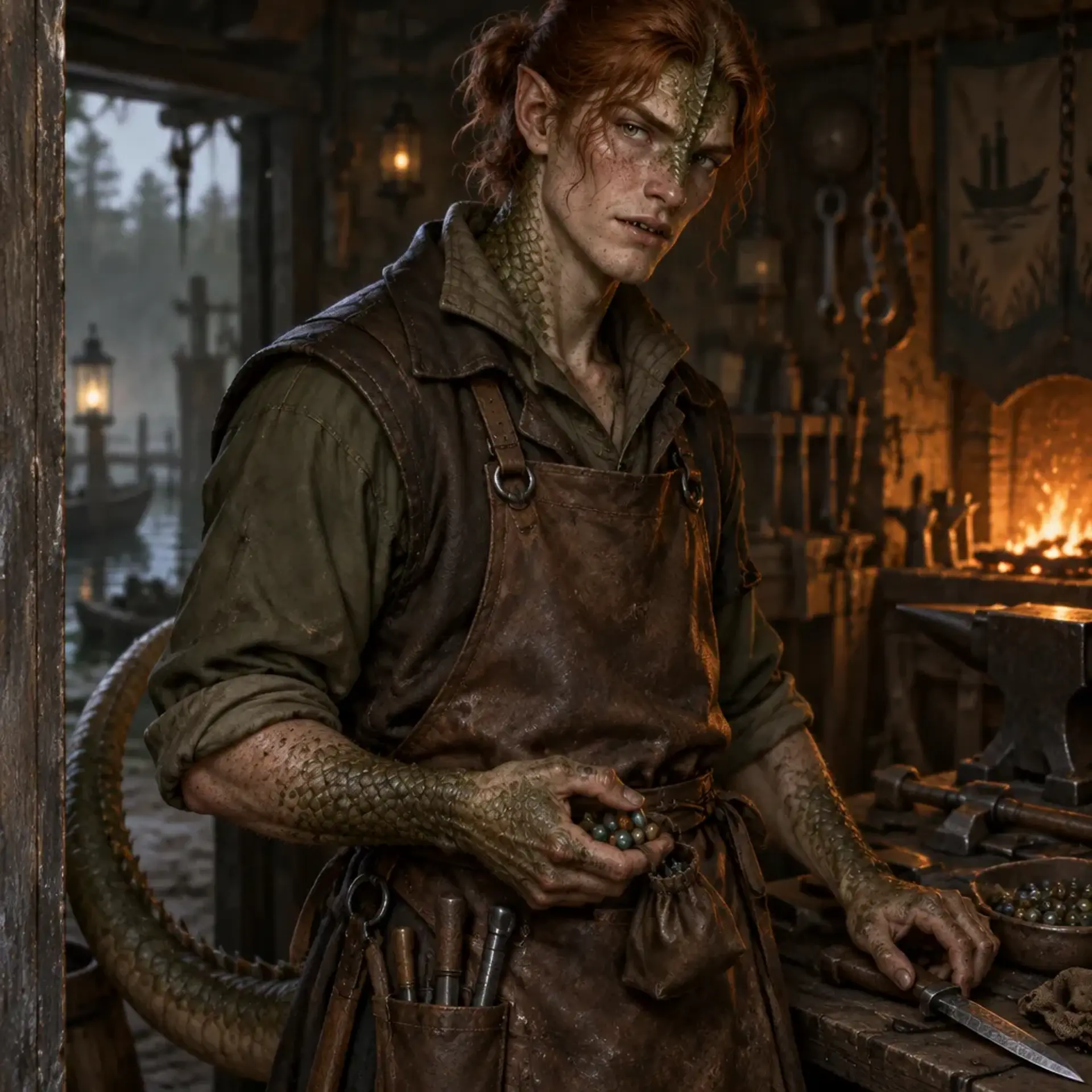
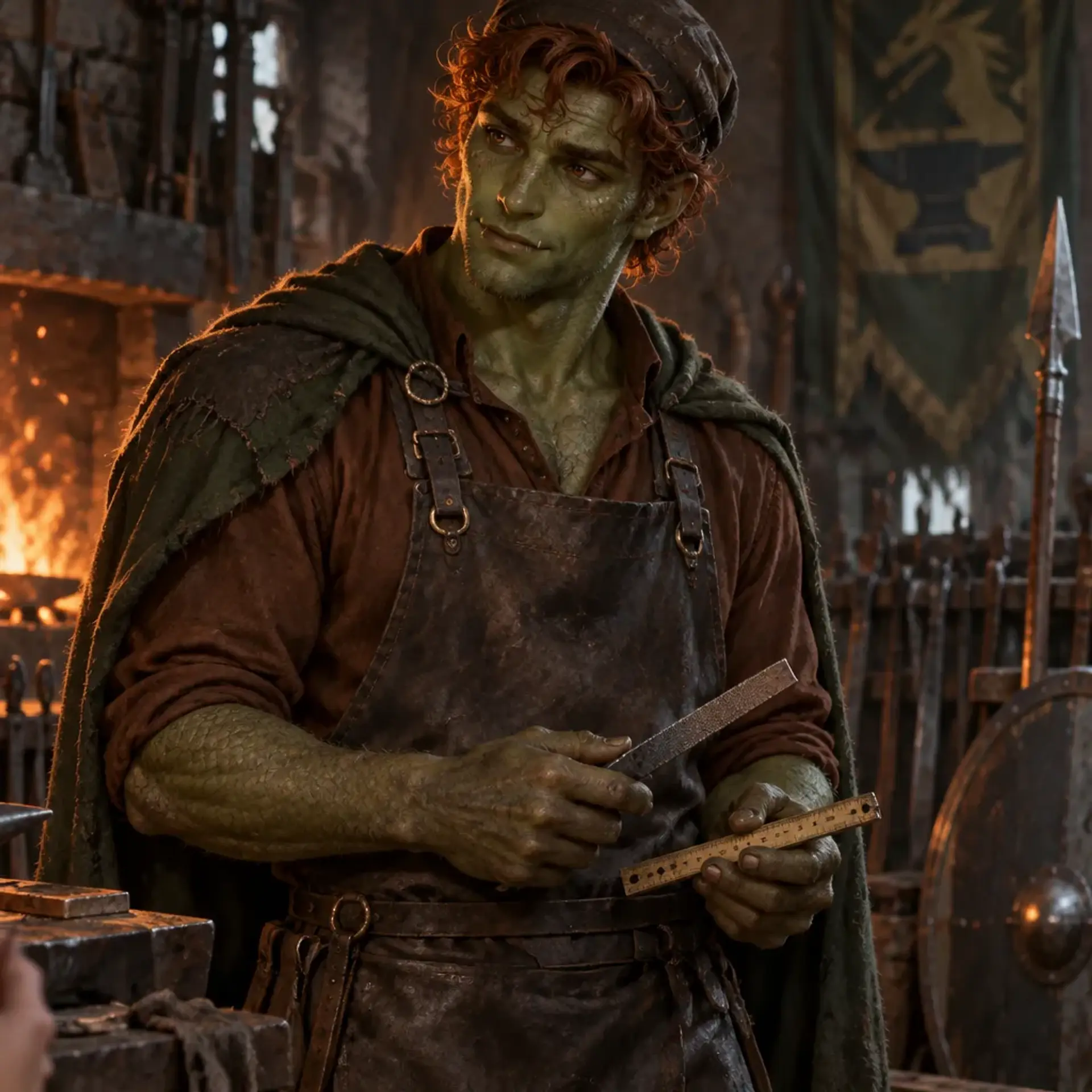
Eber stands five feet ten inches, startlingly tall beside the compact Stout-halfling relatives who raised him. Olive-green scales overlap his shoulders, forearms, ribs, and the long line of his tail; their edges are soft and flexible rather than hard, with darker dapples that vanish against wet leaves. His fair skin shows through in a freckled band across his nose and cheeks, a family feature made more striking by his green dragon teeth. His hair is a vivid, unruly red, clipped short at the temples and forever escaping its tie. Pointed ears angle back when he is concentrating. He walks with a careful, rolling balance, tail counterweighting every turn, and keeps his jaw slightly slack because chewing is impossible. He is fastidious about cleaning tools and utterly neglectful of his own grooming: solder stains and frizz usually win. An unexpected detail for a young mechanic is that he carries a tiny bundle of dried marsh flowers and presses one into the hands of anyone who looks frightened.
Clothing
A patched, sleeveless work coat cut long in the back to clear his tail, a leather apron with deep tool pockets, and a soft linen shirt whose collar has been altered to sit comfortably beneath his scales. His trousers are custom-made, repeatedly let out at the seams. He wears a broad belt with a tool loop and keeps a cloth pouch of smooth digestive stones tied at his hip.
Body language
His tail makes small, involuntary corrections whenever he changes direction, and curls close around his legs when he feels cornered. He keeps his hands busy with a washer, a bit of wire, or the edge of a tool. When he is listening sincerely, he tips his head and holds unnervingly still; when embarrassed, he touches the side of his jaw as if checking that it remains his.
- Height
- 5 feet 10 inches
- Build
- Long-limbed and lean, with a boatwright's shoulders, sturdy forearms, and a tail that helps him balance. His frame is still adjusting to its growth, and his movements have the careful economy of someone who learned to account for every extra inch.
- Eyes
- Deep green, with a fine amber ring around each pupil
- Hair
- Red, bright and untidy
- Skin
- Fair skin with freckles, overlaid with olive-green scales across much of his body
- Age
- 19
- Gender
- Male
- Size
- Medium
Distinguishing features
Personality
16 traits and drivesEber's first instinct is to fix what is in front of him: a cracked hinge, a leaking roof, an awkward silence. That practical reflex can look like calm, but it often conceals a nervous mind trying to gain control of a situation. He is proud of his skill and embarrassed by how much help his body sometimes requires. He will explain a clever repair with bright enthusiasm, then bristle if someone calls him gifted, as though praise might turn him into a curiosity. Around children and frightened strangers, he is gentle and patient; around officials or healers who claim authority over the Marshwake, he becomes exacting and difficult to distract. He wants closeness but resents being fussed over. His parents' care is precious to him, yet every widened doorway and specially prepared meal reminds him that his transformation changed the whole household. He tries to repay affection with labor: mending a net before dawn, replacing a neighbor's stove latch, or making a brace for an elder's aching wrist. When someone insists he rest, he may agree and then quietly keep working from a stool. Eber is curious without being indiscriminate. He loves mechanisms, unfamiliar tools, and stories about how people solve ordinary problems. He is much less comfortable with questions about his blood, appetite, or teeth. He dislikes being stared at, but he also knows that pretending he is unchanged will not help anyone understand the younger high-blood generation. In a good mood he makes dry jokes about the impossible dimensions of old halfling furniture. When tired, he becomes literal and clipped, and may not notice that he has hurt someone's feelings. When angry, he does not withdraw: he asks pointed questions and keeps asking until the other person admits what they want. His kindness is active rather than sentimental. He is likely to repair a stranger's broken lantern before asking their name, but he may fail to notice when that stranger wanted sympathy more than a solution. He does not believe every problem can be fixed with a tool, though he behaves as if it might be possible. Beneath his caution is a stubborn hope that the Marshwake can decide what their inheritance means instead of letting fear, tradition, or outside curiosity decide for them.
- Alignment
- Neutral Good. He wants to protect people, but he distrusts institutions that claim to know what is best for them.
Quirks
Habits
Traits · 4
Flaws · 4
Fears · 4
Wants and needs · 4
Combat
AC 18 · HP 17 · 30 ft.Eber prefers to keep distance, use cover, and disable threats rather than kill them. He opens with Faerie Fire if allies can exploit it, uses Fire Bolt against exposed enemies, and casts Cure Wounds or Sanctuary when someone is in immediate danger. He fights with a light hammer only when cornered, relying on his scale armor and shield to hold ground while retreating toward a defensible position. He saves his ancestry's menace for a pursuer threatening an ally or blocking an escape.
Eber
Spells
Actions
Reactions
Services they sell
Rewards they can give
Equipment
- Scale mail (armor)Well-fitted medium armor altered to accommodate his tail; its overlapping plates are reinforced with an infusion when he has prepared it.
- Shield (armor)A sturdy shield with a simple carved wave pattern, also capable of bearing his Enhanced Defense infusion.
- Light hammer (weapon)A compact hammer used for boat repairs and self-defense.
- Tinker's tools (tool)A set of tinker's tools with custom-length handles and a hinged case.
- Digestive stones (personal)A short pouch of smooth, carefully selected stones for his stone-gizzard adaptation.
- Balance gauge (tool)A copper-and-glass instrument that clicks when a repaired hull or mechanism sits level.
Possessions
Background
Eber was born in a house built for people half his height. His family, descended from Stout halfling refugees, lived in the close-set homes of Third Survey, a fishing settlement tucked between hot springs and a rain-heavy forest. His father, Tovik, is a respected boatwright whose hands can read a hull's balance by touch. His mother, Mella, keeps the settlement's smokehouse and knows which island roots ease fever. They expected their son to inherit a craft, not a body that would make the old workbench feel like a child's toy. For the first eleven years Eber was small, freckled, and stubbornly ordinary. He spent evenings under his father's boats, collecting bent nails and asking how a thing could be repaired without making it ugly. Then, during a storm season, he disappeared for a day in the brackish channels while searching for a missing goat. He returned feverish, with a burning ache in his jaw and a greenish cast spreading under his skin. Over the next months, his limbs lengthened, scales emerged, his ears sharpened, and a tail grew in painful increments. His teeth changed too. He tried to chew a piece of dried fish, broke the fish, and nearly broke a tooth. From then on, swallowing was the only way he could manage solid food. The family healer, Salla, found that small smooth stones eased the cramping after meals. No one could explain why. Eber learned to choose river pebbles by weight and texture, rinse them, and swallow them with food. He hated the attention and hated more that his parents watched every meal as if he might vanish. His father rebuilt the family table, widened doorways, and made him a stool with a tail notch. His mother quietly began cooking separate soft meals. Their care kept him safe and also made him feel like a problem they were forever solving. At fourteen, Eber joined his father in repairing a fishing boat after a volcanic tremor split its keel. The old tools were too small for his hands, so he modified them: a ratchet brace, a spring-loaded clamp, and a little brass gauge that clicked when a hull sat level. The work gave him a way to make his changing body useful. He later apprenticed with the settlement's tinker, Varka, learning to mend cookstoves, pumps, lamps, and fishing reels. He took to artificing because it joined patient observation with practical kindness. A repaired water pump mattered more to him than an impressive weapon. His formative break came when a visiting healer named Pello arrived with a polished case and a theory: the high-blood changes could be arrested if he studied Eber's blood and digestive stones. Eber agreed to a short examination, trusting the healer's calm manner. Pello's tests became painful, and his questions shifted from relief to inheritance, dragon behavior, and whether Eber could be induced to produce a stronger draconic response. Eber's parents stopped the sessions. Eber, furious at being protected and frightened by what he had allowed, destroyed the healer's notes and fled into the forest for two nights. He returned with a fever and a new conviction: no one should be treated as a specimen, even by someone who promises a cure. Now nineteen, he works from a cramped shed behind the boatyard, where he repairs gear for fishers and builds tools that can be used by both low-blood and high-blood Marshwake. His latest project is a hand-operated food grinder that can turn tough roots and dried fish into a soft meal without requiring anyone to swallow stones. It works, but its gears seize under pressure. His family is proud, worried, and sometimes too protective to admit either feeling. Eber has another problem. The island's green growth is changing around old dragon-haunted ground: vines are taking root in ash fields, and strange, bitter plants are appearing near the hot springs. Some elders think this is a natural consequence of the Marshwake blood. Others whisper that the wounded green dragon whose blood began their people's transformation is not truly gone. Eber has found a fragment of old scale lodged in a spring channel, and it warms when he holds it. He has not told his parents. He wants to discover whether the island is changing on its own or whether someone is stirring the dragon's legacy. He also wants to make sure the answer does not become another reason for outsiders to claim authority over his people.
Role in the story
A young inventor and community-minded guide whose bodily transformation makes him a living symbol of the Marshwake's uncertain future. He can help the party understand the island's practical dangers, but his hidden scale fragment may draw them into a deeper mystery about the green dragon blood that reshaped his people.
“His father, Tovik, is a respected boatwright whose hands can read a hull's balance by touch.”
- Faction
- No formal faction. He is part of the Marshwake community of Third Survey and works cooperatively with the local boatwrights and fishers.
Known connections
Media
0 imagesNo images yet.
Turn Eber into a sheet
A high-res, share-ready sheet you can post or print.