Mary Bell
Mary Bell
At the table
Voice
Mary's voice carries the dry edge of someone accustomed to speaking over a boiling kettle, an argument, or a crying toddler. She can sound brisk without meaning to be unkind. When she is tired, her words flatten and the end of a sentence may disappear into a sigh. As Kent, the sound is fuller and less familiar to her, shaped by a young man's breath and a restrained, careful manner. He speaks as though good manners might keep the world from asking too many questions.
Mary's speech is direct and economical, shaped by calling over household noise and making herself understood the first time. Her voice has a slight rasp after a long day and a warm lift when speaking to the little ones. Kent's words come from a different chest: more measured and formal, with a careful politeness that sounds learned from observation rather than ease. His voice is not a grand or theatrical one; he sounds like a young man trying not to make a poor impression.
Speech patterns
How to play them
Offer Mary practical help, particularly with the children, and give her time to trust you. Do not demand that she explain the heart or the changes. Treat Kent's appearance as a person in front of you rather than a joke, while recognizing that Mary may be frightened by what is happening. These details are custom narrative guidance, not canonical Secret Histories procedures.
Goal
Find out where Henry sold the heart, protect her siblings from its influence, and claim enough room in her own life to choose what happens next.
Motivation
Love for the children keeps Mary in the house; the strange freedom of Kent's appearance tempts her to find a life outside it. She wants both, though she cannot yet see how to have them.
Appearance
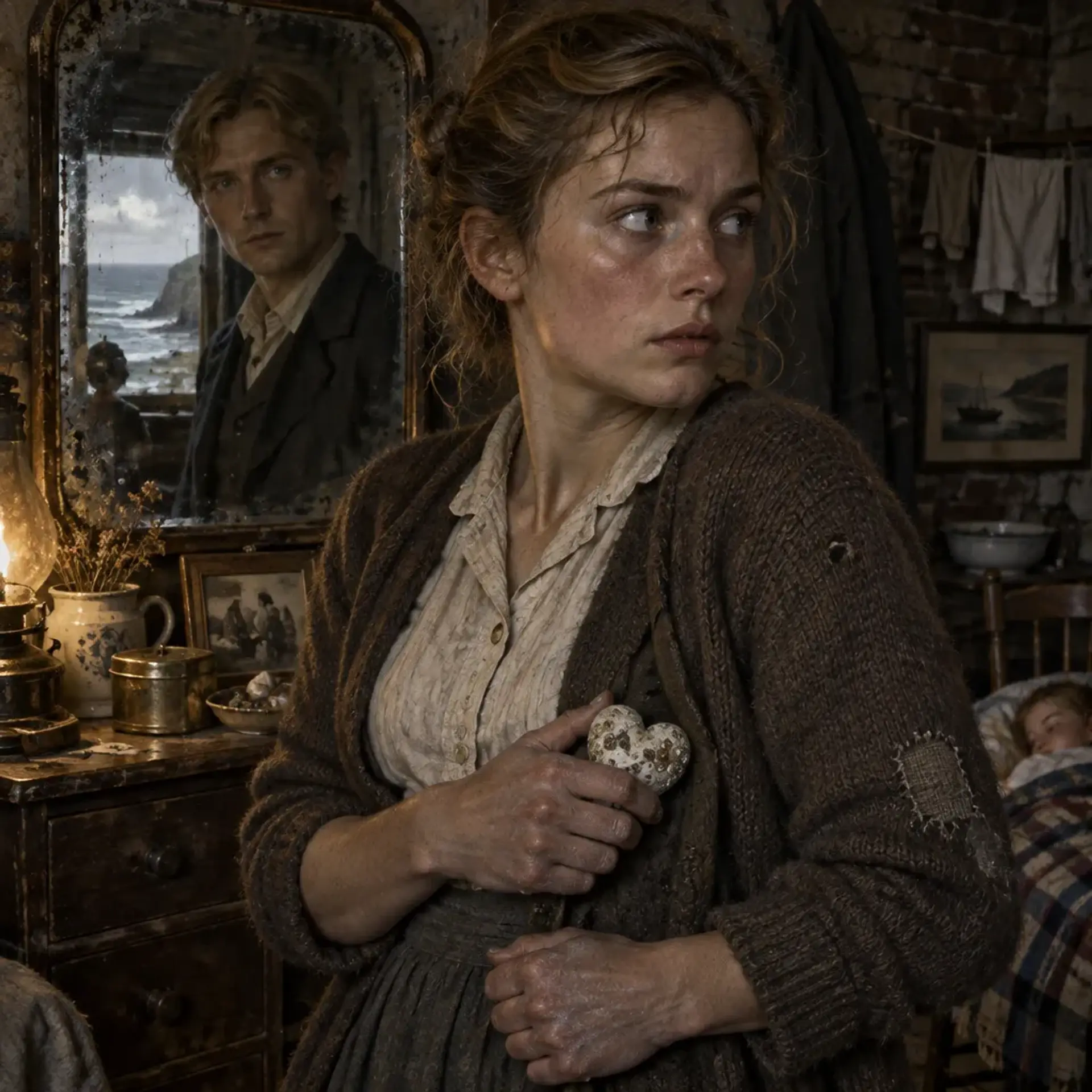
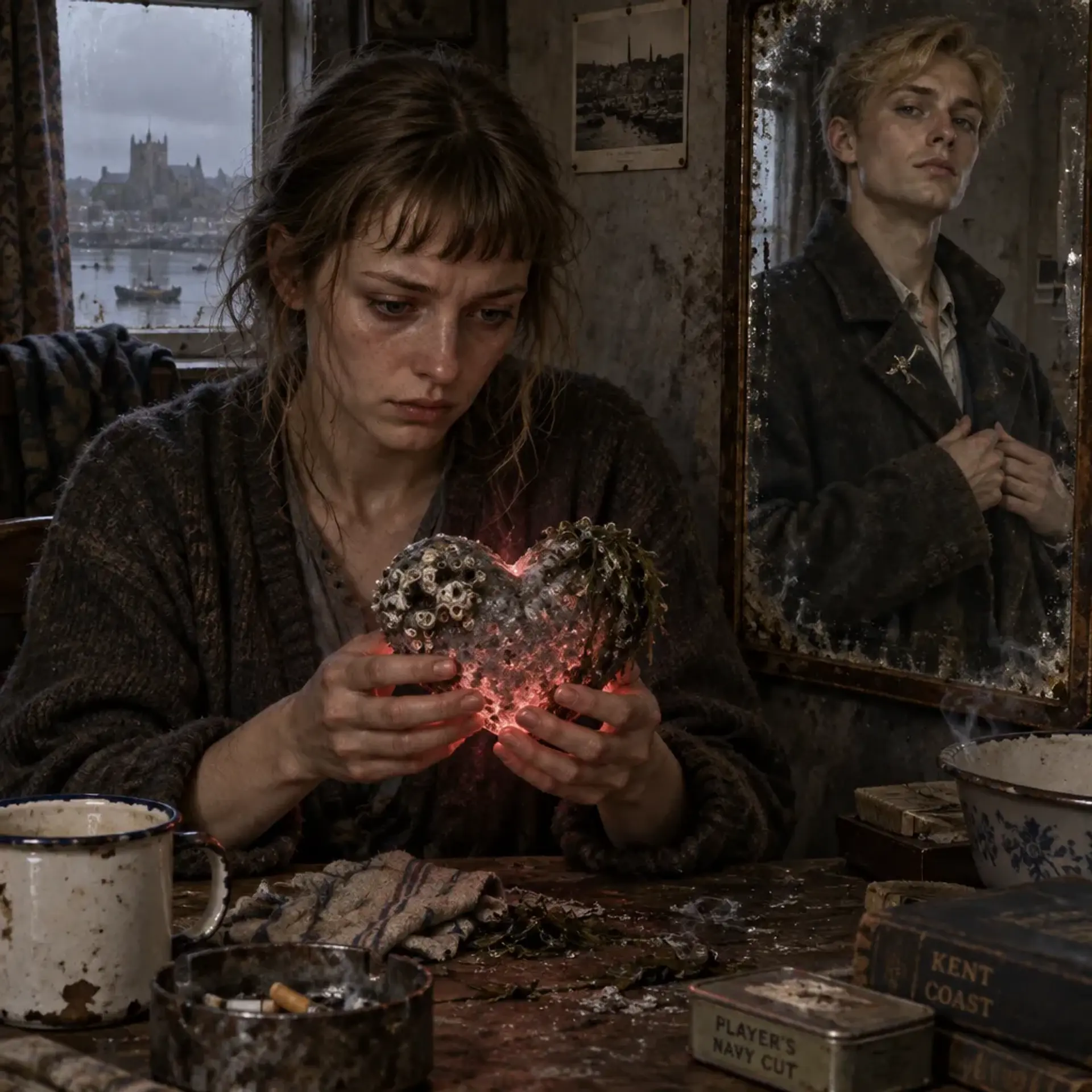
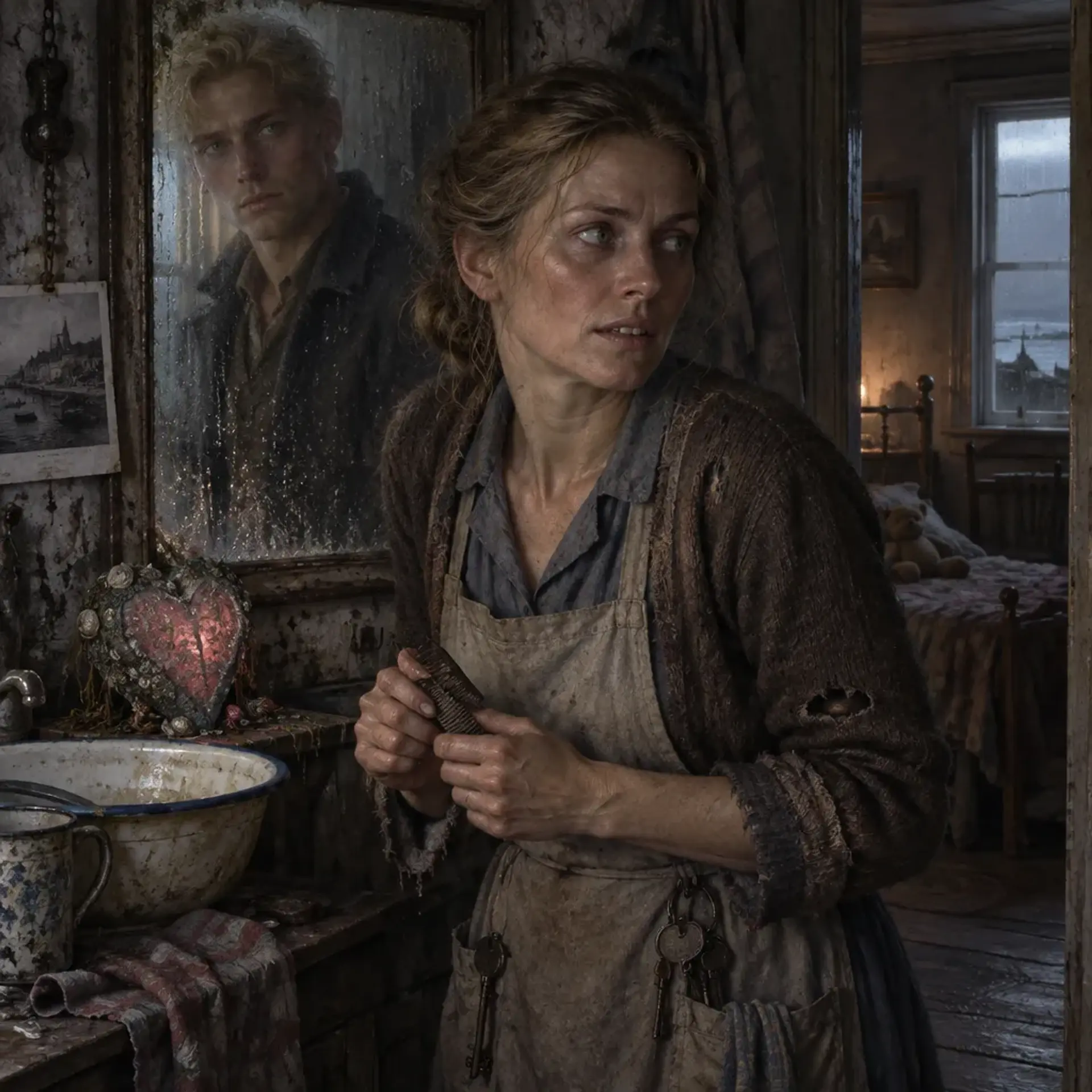
Mary is a young woman with a tired, watchful face and dark-blond hair that she pins back in a hurry, leaving wisps at her temples. Her blue-grey eyes seem to count chores, doors, and moods before settling on a person. She moves with the economical, slightly forward-leaning pace of someone forever carrying something or expecting to be called back. Her most noticeable possession is a small, cracked hair comb kept in her pocket; one tooth is worn nearly smooth where she rubs it with her thumb. Her jaw is firm, and a small overlap in her front teeth shows when she laughs, which she does more freely with children than adults. When Kent's aspect takes hold, Mary's face and body give way to those of a taller, handsome young man with short bright-blond hair and malachite-green eyes. The change is startlingly complete, not a resemblance or a reflection trick.
Clothing
Mary wears serviceable, mended postwar clothes, an apron at home, and a cardigan with pockets large enough for keys and scraps of string. Her shoes are worn at the toes. When Kent appears, she improvises with Simon's old clothes, a borrowed jacket, and whatever can be adjusted without drawing notice; nothing fits quite right.
Body language
Mary keeps her shoulders slightly forward and her hands occupied, often rubbing the worn tooth of her pocket comb. She watches doorways while listening. When she is comfortable with a child, her posture opens and she crouches to meet their eye level. As Kent, she holds himself straighter than Mary does, smooths his cuffs, and seems uncomfortable with rough familiarity; when uncertain he gives a small, formal nod rather than meeting a gaze for long.
- Height
- Mary is of ordinary height; Kent's form is noticeably taller
- Build
- Mary is wiry and under-rested, with the practical strength of someone who carries children and buckets. Kent's borrowed form is taller and more solidly proportioned, with a young man's frame unfamiliar to Mary.
- Eyes
- Blue-grey as Mary; malachite-green as Kent
- Hair
- Dark blond as Mary; bright short blond as Kent
- Skin
- Fair, weathered by household work and time outdoors
- Age
- 18
- Gender
- Female; Kent's borrowed appearance is male
Distinguishing features
Personality
16 traits and drivesMary is dutiful but not naturally meek: she can organize a kitchen full of children with brisk authority, yet hesitates to ask anyone to do the same for her. She is grateful for small kindnesses and suspicious of grand promises. With the younger children she is warm, inventive, and willing to play; with her parents she is guarded, sometimes tender and sometimes angry in ways she swallows before they can become words. She wants to be thought dependable, but resents that dependability has become an excuse for everyone to leave more work on her. She is curious about the heart and about the world beyond home, though she tells herself these interests are foolish when there is washing to do. As Kent, she becomes more self-conscious, formal, and concerned with appearing respectable. He is shy and domestic-minded, drawn to comfort and proper manners rather than swagger, but possesses a quiet curiosity that can lead him to the shore, a tree, or an abandoned building. Mary sometimes mistakes his habits for ordinary male behavior because she has no better framework for them. She is brave when someone else needs her and much less brave when the choice concerns her own future.
- Alignment
- Not applicable as a canonical Secret Histories statistic; personally protective and compassionate, but capable of lying or trespassing when home feels like a trap.
Quirks
Habits
Traits · 4
Flaws · 4
Fears · 4
Wants and needs · 4
Combat
HP 1Avoids a fight. Mary protects children, puts furniture or a door between herself and danger, and runs for help. She may use a household object to create an opening, but has no established combat training. No canonical Secret Histories combat statistics are asserted here.
Mary Bell
Actions
Reactions
Services they sell
Rewards they can give
Equipment
- Pocket comb (personal item)A small cracked comb, worn smooth on one tooth from nervous handling.
- The fossil heart (unexplained object)A human-heart-shaped lump of chalky stone, barnacled and sea-grass-stained, sometimes wet with salt water and black ooze. Henry later steals and sells it.
- Work clothes (clothing)A mended cardigan and apron useful for household work and for concealing unease during an unexpected change.
Possessions
Background
Mary Bell is eighteen and the eldest of eight children in a crowded, isolated household in Rochester, Kent. Her parents, Malinda and Simon Bell, have left her with the work of keeping the younger children fed, washed, and out of danger often enough that she has learned to measure a day by what might go wrong. Her siblings are Henry, fourteen; Matilda, twelve; Olympia, ten; Chrissy, nine; Abigail, four; Jonas, five; Belladonna, five; and Oswald, two. The household's tangled parentage is no secret to its children, though adults pretend otherwise. Simon is Jonas's father and has brought the boy home; Chrissy and Belladonna have different, uncertain fathers. Simon's absences and Malinda's drinking have made Mary the dependable adult more often than either parent admits. Mary loves the children, but love has become a kind of unpaid shift. She tries to stop Matilda being groomed into taking her place as household labor and to give little Oswald time with his blanket and his favorite person, even when there is almost none to spare. Henry has begun to grow sharp and cunning, angry at his parents and sometimes at Mary, who can neither excuse his cruelty nor abandon him. A small birthday gathering for Mary's eighteenth birthday gave Malinda a rare, earnest moment of attention. She found a peculiar stone lodged in a log and brought it home as a gift because Mary liked rocks. Mary did not want to call it jewelry or make a fuss; she was grateful that her mother had remembered at all. The object looked like a human heart roughly carved from Dover chalk, crusted with barnacles and sea-grass. It had once been wrapped in newspaper and offered at Brancrug by the amateur alchemist Bartholomew Golden as payment for entry, with a claim that it could call laborers from the hearts of chalk cliffs and borderlands. Golden was forbidden to return. The heart was thrown into the sea, washed ashore wet with salt and black ooze, then picked up by Abraham Groff, a young Londoner visiting Wiltshire. It beat beneath his coat after a train journey. In company it went inert; near the Hampshire shore and in water it flushed red-pink again. Abraham grew frightened by voices, footsteps, and doors moving in his home. He sold it to William Windon, a local seventeen-year-old, after William had once seen it and struck it with a hammer, stopping its beat. William hid it in a log. Malinda found it there, and its path to Mary was anything but a proper chain of custody. In Mary's room the heart began to beat in time with her own. At first she thought it a trick of nerves. Then her reflection stopped being hers. In mirrors she saw a handsome, taller young man with short bright-blond hair and vivid malachite eyes. He had an expression of his own: sometimes startled, sometimes avoiding her gaze, sometimes looking faintly disapproving. Mary was exhausted and busy enough to decide that a frightening mirror was still less urgent than supper, laundry, and the children. The first night she became Kent followed a bad dream and a day in which her parents had argued over money. She woke with a man's shoulders, unfamiliar weight, and a voice that seemed to come from a different chest. Panic lasted only until she realized she could leave the house without anyone calling her back to stir a pot or fetch a child. She got dressed in whatever Simon's old clothes she could find, tied them awkwardly, and slipped out before dawn. Her first adventure was not grand: she walked to the station, rode a short distance, got off near the river, and spent hours on a shore looking at the tide pools. She climbed a tree, explored an abandoned building, and discovered that she could take up space without being asked to make herself useful. She also discovered the discomforts of being a young man without preparation: clothes that fitted badly, unfamiliar bodily needs, and strangers making assumptions she had never had to navigate in quite the same way. She was back in her own body by dawn, cold, exhilarated, and unable to explain why the experience felt less like a dream than a door briefly left open. The next important change came on a day at home. With the younger children underfoot, Mary was trying to keep Abigail from the stove, stop Oswald eating a button, and settle an argument between Chrissy and Olympia. The change came while she was awake. She had to turn her back, wrap herself in an oversized cardigan, and pretend she was dizzy while the children stared. Matilda fetched water; Jonas asked whether Mary was ill; Abigail thought it was a game. Mary got through it by giving each child a simple task and keeping her own fear out of her voice. She later told herself that the children must not be made to carry one more frightening thing. Another incident involved Malinda. One evening Malinda was drunk, grieving a quarrel with Simon, and unusually affectionate in an unstable way. Mary had become Kent and was trying to get past the kitchen without attracting attention. Malinda looked at him, failed to recognize him as her daughter, and asked why a strange young man was in her house. Mary froze. Rather than bolt, she let Kent's awkward reserve and middle-class manners do the work: she said he had come to deliver a message and that Mary was upstairs. Malinda rambled, offered him a cup of tea, then began talking as though he were an old acquaintance. Mary sat through a humiliating, tender, and frightening half-hour while Malinda confessed that she had once imagined taking Mary to the seaside and never managed it. When Malinda reached to straighten Kent's collar, Mary flinched. Malinda noticed the flinch but not the truth. At last Mary excused herself and slipped upstairs. The next morning Malinda remembered the conversation only in fragments and was embarrassed by her own drinking. Mary did not tell her what had happened; she could not decide whether the episode was a lie, a kindness, or a betrayal. Mary has a friend outside the house, Trudy, a short, skinny young woman with dirty-blond hair and hazel eyes who calls herself a rebel and dresses in conspicuously alternative clothes for early Cold War England. Trudy noticed Mary's exhaustion before Mary could admit it. She helps with the children when she can, brings small treats, and has occasionally taken Mary out for a walk under the excuse of errands. One encounter began when Trudy found Mary asleep on a bench after a long shift and walked her home. Henry was waiting nearby, suspicious of Trudy and resentful that Mary had been allowed a life beyond the family. He made a cutting remark about Mary wanting to run away. Trudy answered that everyone was allowed to want a door. Mary made Henry come with them to buy bread, turning the confrontation into a practical errand before it became a fight. Later Trudy lent Mary a jacket that could pass for a young man's coat, though neither of them spoke plainly about why Mary needed it. Trudy suspects something is wrong and is careful not to force a confession. Mary met Henry again during one of her early excursions as Kent, producing an awkward encounter in which her brother treated the stranger with wary familiarity. Kent's manner came through: he was shy, wanted to be regarded as respectable, and made a stiff, almost fastidious effort to behave like a gentleman. He preferred a warm room and a proper cup of tea to bravado, though he was curious enough to explore a shore or climb a tree if no one was watching. Mary has not decided whether Kent is a person, an instinct, a haunting, or something the heart has done to her. She knows only that the heart beats, her reflection can look away, and some nights she gets out of the house in a body that is not hers. The immediate danger is that Henry later stole and sold the heart. Mary does not know where it went, whether it can be found, or what will happen if it is separated from her. She must keep her siblings safe, preserve her secret from a household already full of hurt, and discover whether the strange freedom she has found is a gift, a debt, or the beginning of a second life.
Role in the story
A young caretaker caught between the demands of a difficult family and an uncanny second appearance. She can be an ally, a witness to the heart's history, or the center of a mystery about identity, freedom, and what the chalk borders remember.
“Her siblings are Henry, fourteen; Matilda, twelve; Olympia, ten; Chrissy, nine; Abigail, four; Jonas, five; Belladonna, five; and Oswald, two.”
Known connections
Media
0 imagesNo images yet.
Turn Mary Bell into a sheet
A high-res, share-ready sheet you can post or print.