Oswin Hirst
Oswin Hirst
At the table
Voice
A clear, work-worn voice with a dry rasp from cold air and long days outdoors. He projects without shouting, the way a shepherd calls across a field. When tired, consonants blur and his breath catches as though he has run uphill. His laugh is short and unexpectedly boyish, which can make his unchanging face more unsettling.
He speaks in plain Yorkshire English, with the practical cadence of someone used to giving instructions over wind, livestock, and tools. He favors concrete comparisons and cuts off elaborate explanations with a question about what needs doing. When the Other Side presses close, his phrasing becomes exact and transactional: he asks what was promised, who witnessed it, and what each party intends to take.
Speech patterns
How to play them
Begin with useful, grounded help: offer directions, repair a tool, or discuss livestock. He is warm with people who treat William kindly, but redirects questions about his age, iron, and the wedding night. If confronted with evidence, he bargains for time rather than confessing at once. He responds poorly to threats involving Mary or William, and may reveal his supernatural form if he believes intimidation will end a danger quickly.
Goal
Keep Mary and William safe, preserve his ordinary family life, and prevent the local night-creatures from crossing into the town.
Motivation
Love, guilt, and a fierce desire to keep a home. He wants to be a husband and father in human terms even as the Other Side claims a growing part of his attention.
Appearance
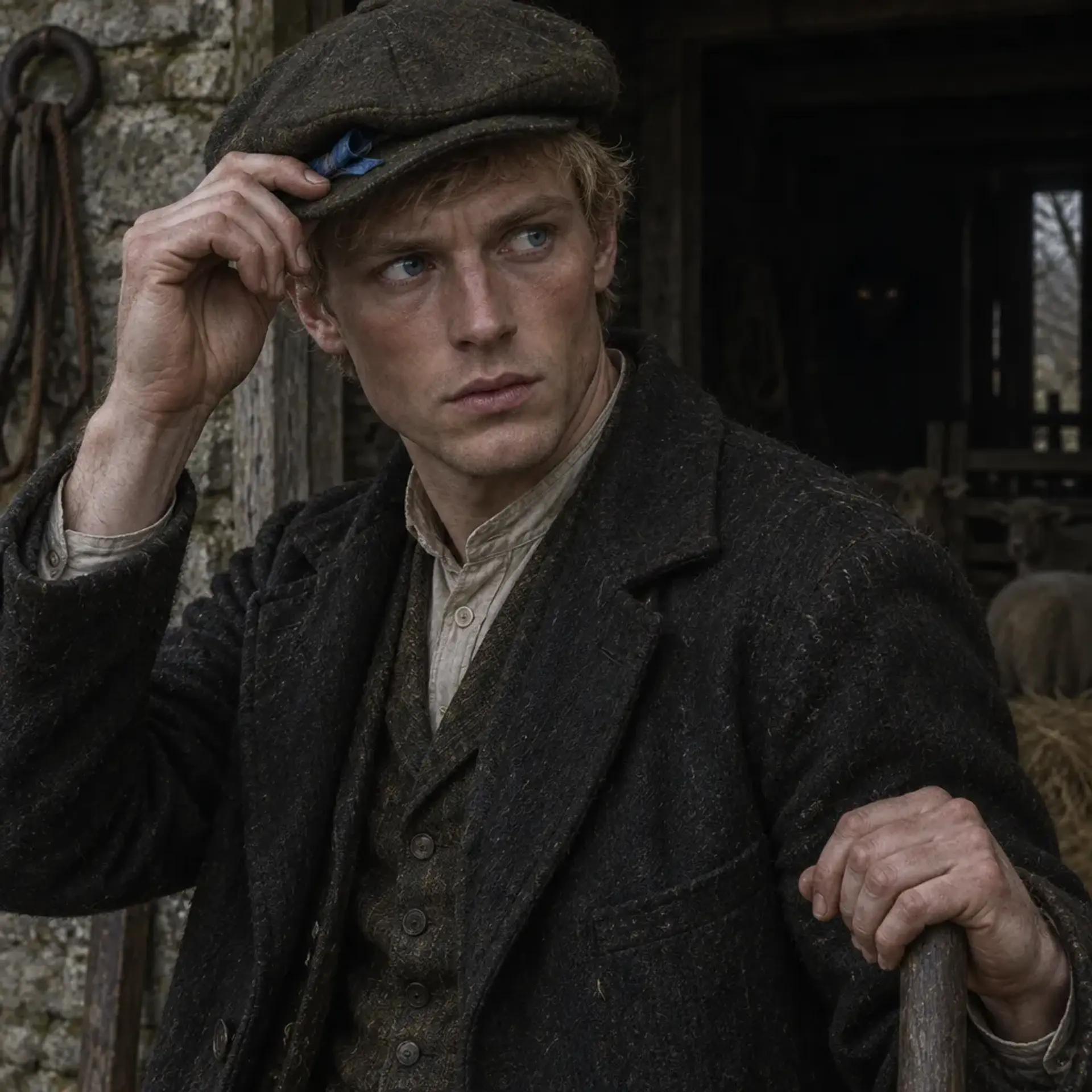
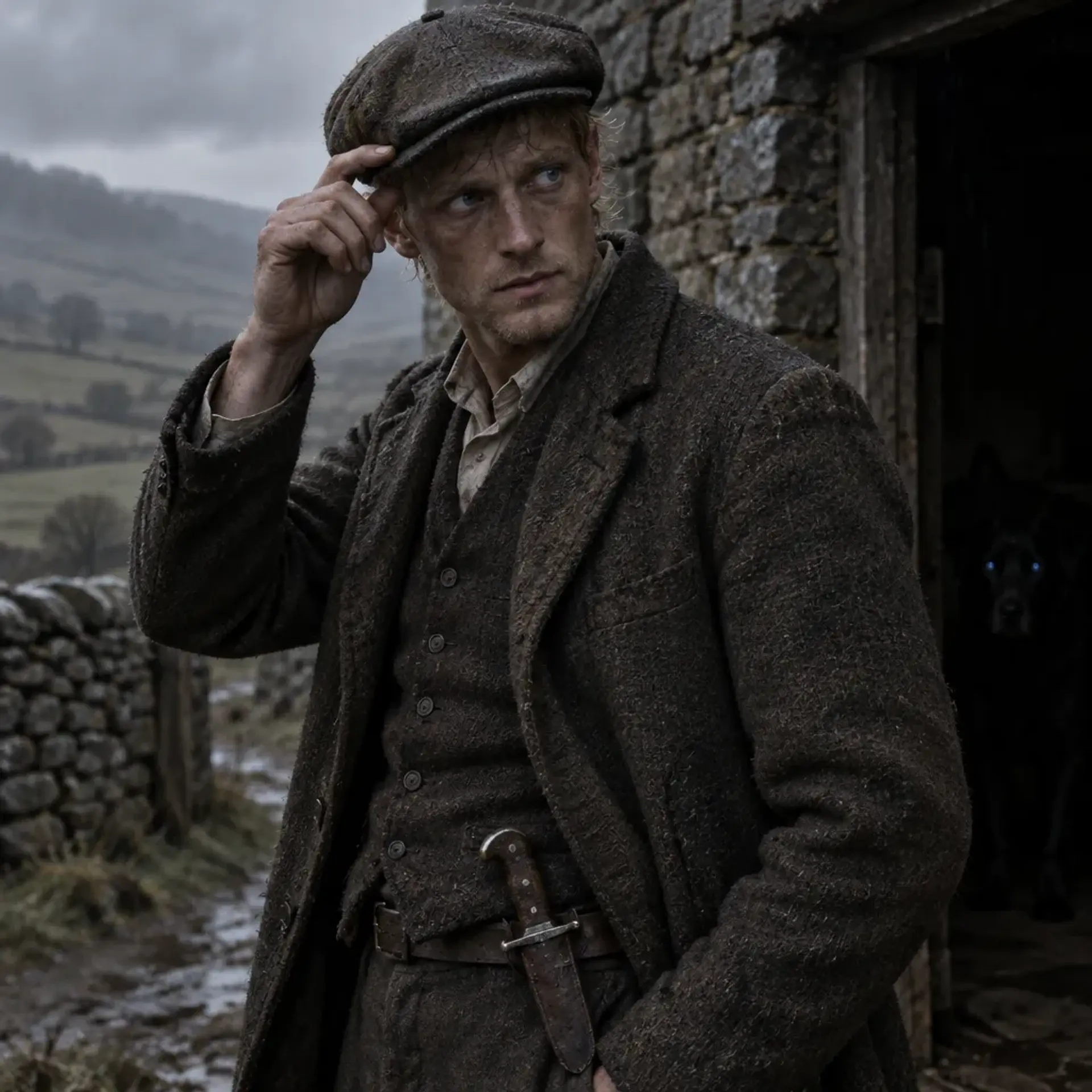
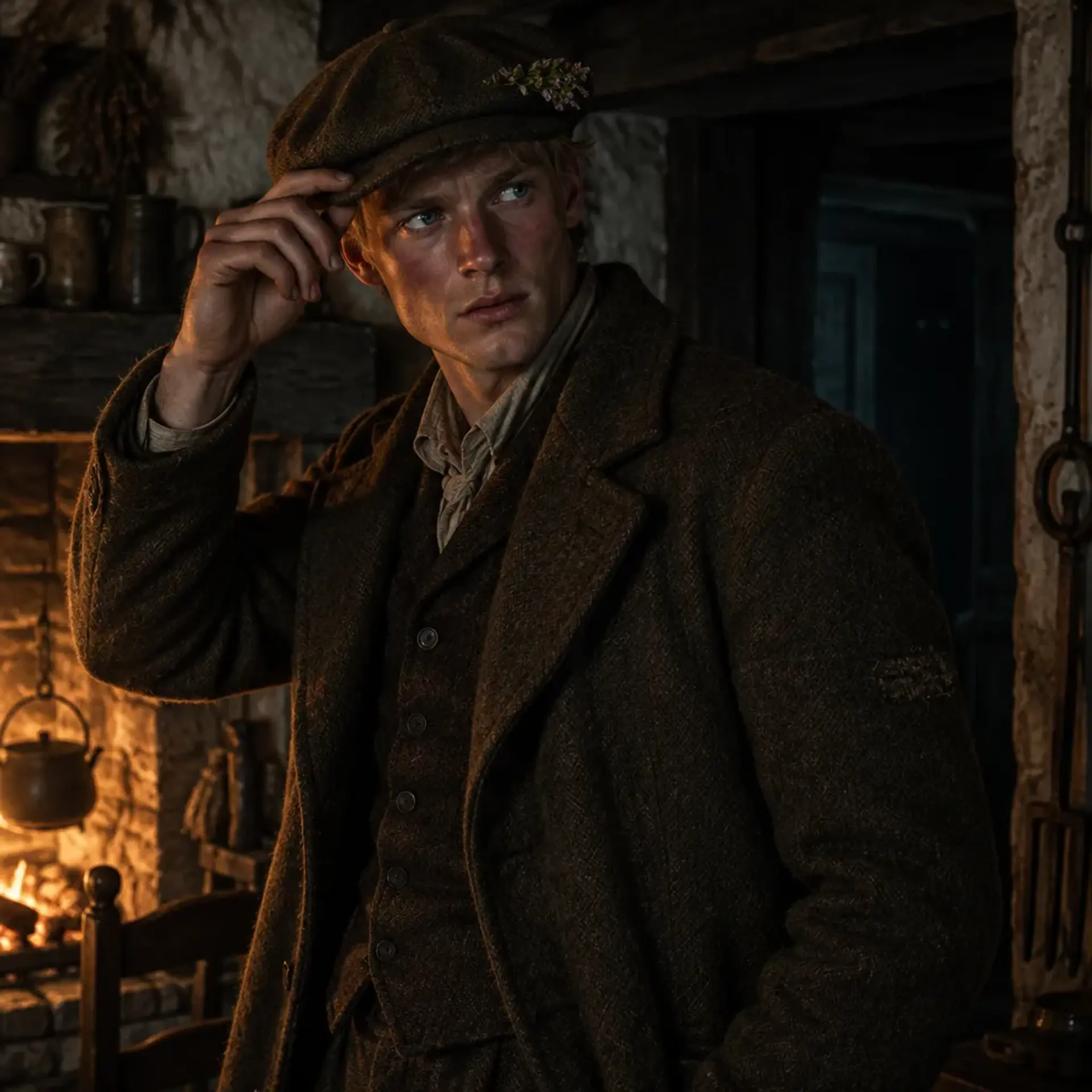
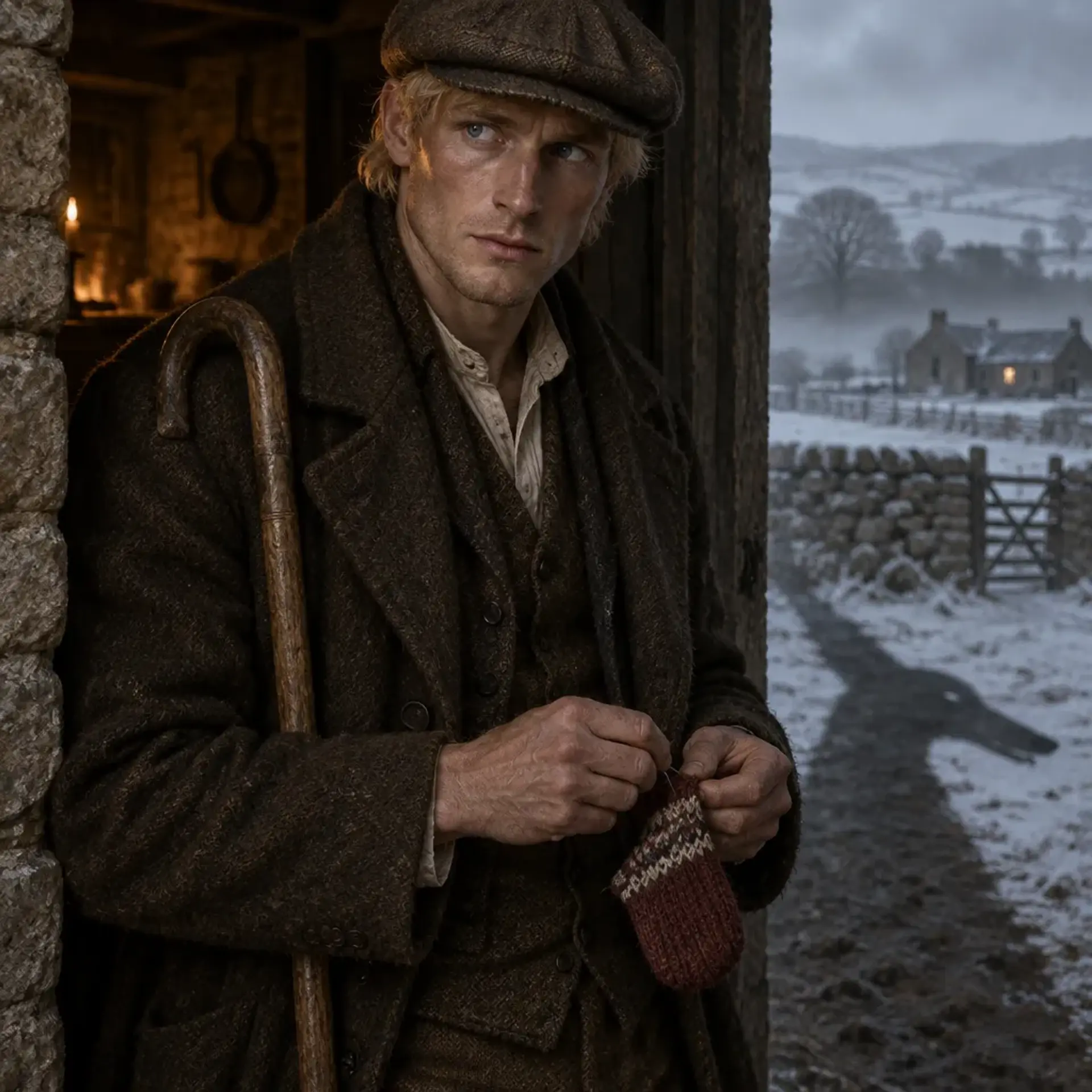
Oswin stands six feet tall, pale and long-limbed, with straight blond hair usually tucked beneath a common flat cap and clear, burning blue eyes. His face is smooth and handsome in a way that feels increasingly strange beside his wife's aging features: not youthful through vigor, but preserved, like a portrait left in a dry room. He wears his weight on the balls of his feet, as though the ground might shift or call him away. His walk is quiet and measured, but when he turns he pivots all at once, head and shoulders following together with houndlike precision. In lamplight his shadow sometimes seems to have a long muzzle. An unexpected detail for a hard-working farmer is his care with small domestic repairs: he can mend a child's torn mitten with patient, nearly invisible stitches.
Clothing
Practical wool and linen suited to a Yorkshire sheep farmer: work coat, waistcoat, sturdy trousers, boots, and the common flat cap seen around town. He favors old garments that fit him well and are easy to move in. He keeps iron buckles and tools at a distance when he can.
Body language
He waits with his weight forward, heels barely settled, and watches the edges of a room more than its center. His hands are often occupied with a cap brim, a loose thread, or a tool. When a subject unsettles him, he turns his whole body toward the nearest exit. If iron is close, his shoulders lock and he avoids looking directly at it.
- Height
- 6 ft (183 cm)
- Build
- Lean, long-limbed, and farm-strong rather than bulky.
- Eyes
- Bright, burning blue
- Hair
- Pale blond, straight
- Skin
- Pale, with a weathered pinkness across the nose and cheeks after work outdoors
- Age
- Claims to be in his late twenties. His true age is several centuries; he was born during the age of the Danelaw. He appears about 17, and has barely changed since Mary first knew him.
- Gender
- Male
- Size
- Average human; black-hound form is approximately the size of a large dog
Distinguishing features
Personality
20 traits and drivesOswin is kind in the tangible ways that matter on a farm: he notices a cracked bucket, a hungry child, or a neighbor who needs help carrying a sack. He is practical and shrewd, and rarely spends effort without first asking what the effort will protect. These qualities pull against each other. His care can be sincere and generous, yet the fae part of his mind sometimes treats affection as a claim of ownership. He may spend an afternoon patiently teaching William to feed a lamb, then become coldly furious when someone calls the boy a devil's child. He hates that fury and fears it is not entirely human. Among strangers, Oswin is affable but guarded. He prefers plain talk, useful work, and questions with answers that can be checked. He tells stories of his wandering years when people are comfortable, but edits out the most dangerous details. If someone laughs at a superstition, he often joins in, then quietly checks the stable latch and the threshold after they leave. He has learned that mockery can be a shield, though it also keeps Mary from trusting him. With Mary he is gentle, attentive, and evasive. He remembers what she likes and makes her practical gifts; he also refuses to tell her what she most needs to know. When she speaks of the headless red-eyed figure from their wedding night, he tries to guide her toward church doctrine or the new sciences he reads about. He tells her that fear makes shadows seem alive. He is not unaware of the cruelty in this. He believes that if she knows the truth, she will be unable to look at him without seeing the creature. His love makes him more honest in small matters and more dishonest about the one that defines their marriage. He is most recognizably human at Christmas. Familiar customs give his mind a shape to follow. He makes gifts by hand, helps Rose with practical work, and attends to the meal without trying to turn the day into an omen. At a Christmas gathering with the Pickles family, he gave William a wooden sheep and repaired Rose's sewing box before anyone asked. When the boy laughed, Oswin's face briefly showed uncomplicated joy. Thomas watched that moment with suspicion, as though he were studying a lock. Oswin noticed and did not challenge him; for once, keeping the peace seemed worth more than winning the exchange. Mayday is different. In the first days of May, the fae world presses on him with the force of weather. He can feel music where there is only wind and find the bluebells' presence almost impossible to ignore. When he went out with Hugh to inspect a flock, a lamb stood inside a ring of bluebells beneath a sky already darkening. Oswin heard an invitation in the air and began to walk toward it. Hugh grabbed his coat and called him back. For one breath Oswin resented Hugh as an obstacle and thought of how easily a human could be offered to the dancers. The thought frightened him more than the flowers did. Later he thanked Hugh, but did not ask him to forgive the thing he had almost become. Around Halloween and All Saints' night, he grows watchful and sleepless. He studies doorways, churchyards, and lonely tracks because he expects the dead and the not-quite-dead to take advantage of the season. Edward once accompanied him along the church road. They encountered a familiar black shape among the graves, a creature Oswin knew and had once guided away from a lost child. Oswin hesitated, caught between protecting the village and protecting something that felt like kin. Edward saw the hesitation and did not mistake it for cowardice. Together they coaxed the creature away without bloodshed. Since then Oswin has trusted Edward with more of his fear, though not with the wedding-night truth. When he is angry, Oswin does not become quiet or courteous. His words get shorter and his body becomes still, as if he is deciding whether a human response is worth the effort. The danger is not that he shouts; it is that he can stop recognizing the ordinary limits that keep anger from becoming a hunt. Iron makes him frightened in a more physical way. A recent cut from an iron hinge made his glamour fail in front of a shed, and Hugh was close enough to hear his strangled breath. Oswin blamed smoke and poor light, then spent the next night unable to sleep. His dreams still return to the dales and to his roving years. He misses the freedom of leaving before anyone can ask him to explain himself, but he would not trade Mary and William for that freedom. He wants Mary to stop fearing the dark, yet understands that her fear is based on a truth he refuses to tell. He wants William to have an ordinary childhood, though he knows the boy's black hair and blue eyes will keep drawing attention. Oswin's most difficult struggle is not choosing between good and evil. It is choosing, moment by moment, whether love means standing beside his family as they are, or shaping their lives until they can never leave him.
- Alignment
- Not applicable as a Call of Cthulhu 7E statistic. Oswin tries to behave with human kindness, but his fae instincts can be alien and predatory.
Quirks
Habits
Traits · 5
Flaws · 5
Fears · 5
Wants and needs · 5
Combat
HP 13 · MOV 8 in human form; hound-form movement is a custom Keeper ruling and should be set to fit the scene.Oswin avoids a fair fight. He uses darkness, familiar lanes, a sudden change of form, and the threat of what he might become to break an opponent's nerve or create an escape. He does not casually attack villagers, and he will endure danger rather than let violence reach Mary or William. Iron is a serious vulnerability: he retreats from it and may lose his glamour under direct contact.
Oswin Hirst
Actions
Reactions
Services they sell
Rewards they can give
Equipment
- Flat cap (clothing)Worn flat cap, ordinary and useful, which he often handles when he needs to steady himself.
- Shepherd's staff (tool)A practical shepherd's staff. It is a tool and walking aid, not a magical weapon.
- Seasonal protections (folk custom)A small bundle of primroses or rowan sprigs during the days around Mayday, used according to local protective custom.
Possessions
Background
Oswin Hirst was born in the Yorkshire dales in the time of the Danelaw, the child of a local woman and a Viking who vanished from her life. His earliest memory is not of magic, but of being human: his mother's rough wool sleeve against his cheek as she carried him through sleet, her breath catching whenever distant hooves sounded on the road. He remembers hunger, a hearth that smoked, and the embarrassment of needing comfort after he had insisted he was old enough to fetch water alone. He remembers being afraid of the dark for ordinary reasons. That memory matters to him because it is proof that his tenderness did not begin as an imitation. As a young man he roved between farms, market settlements, and lonely tracks, doing seasonal work and following stories of lights in the hills. He learned how to read people, weather, livestock, and the dangerous silences that precede a bad night. Then he began to meet what the living called fairies, dead men, and devils. Some were only frightening; some were courteous; a few were hungry. In the Other Side, time had no dependable pace. He remembers a country of blue grass, pale streams, and halls where every guest was expected to repay hospitality with a secret. A beautiful host offered him food and asked him to name the person he loved most. Oswin refused to answer. The host smiled as if refusal were an answer, and Oswin spent what felt like three days finding his way home. The human world had moved on by years. His exposure changed him by degrees. He first noticed that iron made his skin sting, then that his reflection could be coaxed into showing a different shape. He learned that he could become a black hound, the very beast people feared on the roads, and that a more dreadful guise, a headless man with red eyes suspended in darkness, could make witnesses remember him for the rest of their lives. He did not choose these changes as a young man chooses a trade. They settled into him like another set of instincts. In time he understood that his mind was no longer wholly human. He could be patient and generous, then suddenly regard a promise as a trap to be exploited or a frightened stranger as prey to be tested. He works to resist that inward tilt, but cannot always tell when it has begun. Oswin eventually stopped wandering and built a sheep farmer's life in a fine house for his station. He has a new wife, Mary Pickles, and a young son, William. He gives them his daylight whenever the farm allows it, even during seasons when his sleep has failed him. He repairs tools, checks the lambing sheds, and makes practical gifts by hand. Yet his youthful face has scarcely altered since Mary met him. She has noticed. She has also noticed his avoidance of iron and his watchfulness around thresholds. Their wedding night is the wound at the center of their marriage. Oswin failed to consummate the marriage in his human form. Ashamed, terrified of rejection, and unwilling to confess the failure, he took his headless Barguest shape and completed the act. Mary remembers a headless figure with glowing red eyes in the empty space above its shoulders. She fears that a rogue Barguest bedded her and that William is its child. Oswin has never told her that the creature was him. He tells himself he was trying to spare her fear, but he knows that silence protects him as much as it protects her. Mary has confided the story to her father, Thomas Pickles, without Oswin knowing. William has black hair, though both parents are blond, and the same burning blue eyes as Oswin. The village calls him Black William or Blackby. He is slow to speak and understand compared with other children his age, and Oswin fears both what the boy may be and what other people will decide he is. Mary's pregnancies have often failed; one sickly infant died soon after birth. Oswin cannot promise her another living child, and will not explain why he suspects that his blood cannot reliably make a human heir. Mary keeps iron scissors close and an iron thimble near William. Oswin knows about the scissors but pretends not to. Thomas Pickles watches him with shrewd suspicion. Thomas is not merely frightened: he hopes to learn enough of Oswin's nature to secure advantage for his family, and he is clever about concealing that ambition. Rose Pickles, Mary's mother, is gentler but sees how carefully Oswin turns every conversation away from the wedding night. Mary's brothers Hugh and Edward each have their own uneasy history with him. Hugh is practical and blunt; he tests Oswin's claims against what he sees on the land. Edward is more willing to go out at night, and has learned that Oswin's warnings are sometimes the only thing between a curious man and a terrible mistake. A recent incident has made the secret harder to keep. While repairing a gate, Oswin caught his palm against an old iron hinge. The pain was immediate. His glamour slipped: his face stretched into the headless outline, his eyes burned red in the shed's darkness, and his shadow showed the shape of a black dog. Hugh was close enough to hear him choke. Oswin blamed the lantern's smoke, but Hugh has not accepted the explanation. At Mayday, when Oswin's fae nature rises with brutal force, he went with Hugh to check a flock after villagers reported strange lights near the boundary. Oswin had warned him not to draw water after sunset and had scattered primroses by the gate. When a lamb was found standing in a ring of bluebells, Oswin nearly followed the sound of unseen dancing. Hugh seized his coat and called him by name until he came back to himself. Oswin later thanked him, then admitted he had briefly thought Hugh would make a pleasing offering to the dancers. He said it with horror, because part of him had meant it. On Halloween and All Saints' night, Oswin sleeps poorly and watches doorways, churchyards, and lonely paths. One year Edward accompanied him along the old church road. They found a black shape pacing the graves, not Oswin's hound form but a familiar local creature that had once spared a lost child. Oswin hesitated rather than drive it away. Edward saw that restraint cost him; the creature's presence tugged at him like kin. They guided it away from the village without violence, and Edward kept the encounter private. He now knows Oswin's protection of the town is not simple command over the things beyond it. Christmas steadies Oswin. During one family gathering at the Pickles home, he followed every familiar custom with exact care, brought Mary a repaired sewing box, made William a wooden sheep, and helped Rose prepare the meal. He was, for several hours, almost entirely the man Mary remembers. Thomas watched him closely. When William laughed, Oswin looked stricken with happiness and grief, as if he had been given something he had no right to keep. Oswin dreams still of the dales and of the roads he traveled before settling down. Christmas customs and ordinary work anchor him. Mayday pulls at him like a hook. Around Halloween and All Saints' Day he is keyed up and reluctant to be left alone after midnight. He wants Mary and William safe, wants Thomas not to discover how much can be bargained from him, and wants to remain capable of loving them without turning that love into possession. His current problem is that these aims are beginning to conflict. The creatures he has kept beyond the town's boundaries are moving closer, and one of them knows what happened on his wedding night.
Role in the story
A loving but deceptive husband and father, a source of local folklore knowledge, and a dangerous supernatural guardian whose family may be more threatened by his secrets than by the creatures he keeps away.
“He remembers hunger, a hearth that smoked, and the embarrassment of needing comfort after he had insisted he was old enough to fetch water alone.”
- Faction
- No formal faction. He is a sheep farmer and an uneasy mediator between the village and the local creatures of night.
Known connections
Media
0 imagesNo images yet.
Turn Oswin Hirst into a sheet
A high-res, share-ready sheet you can post or print.