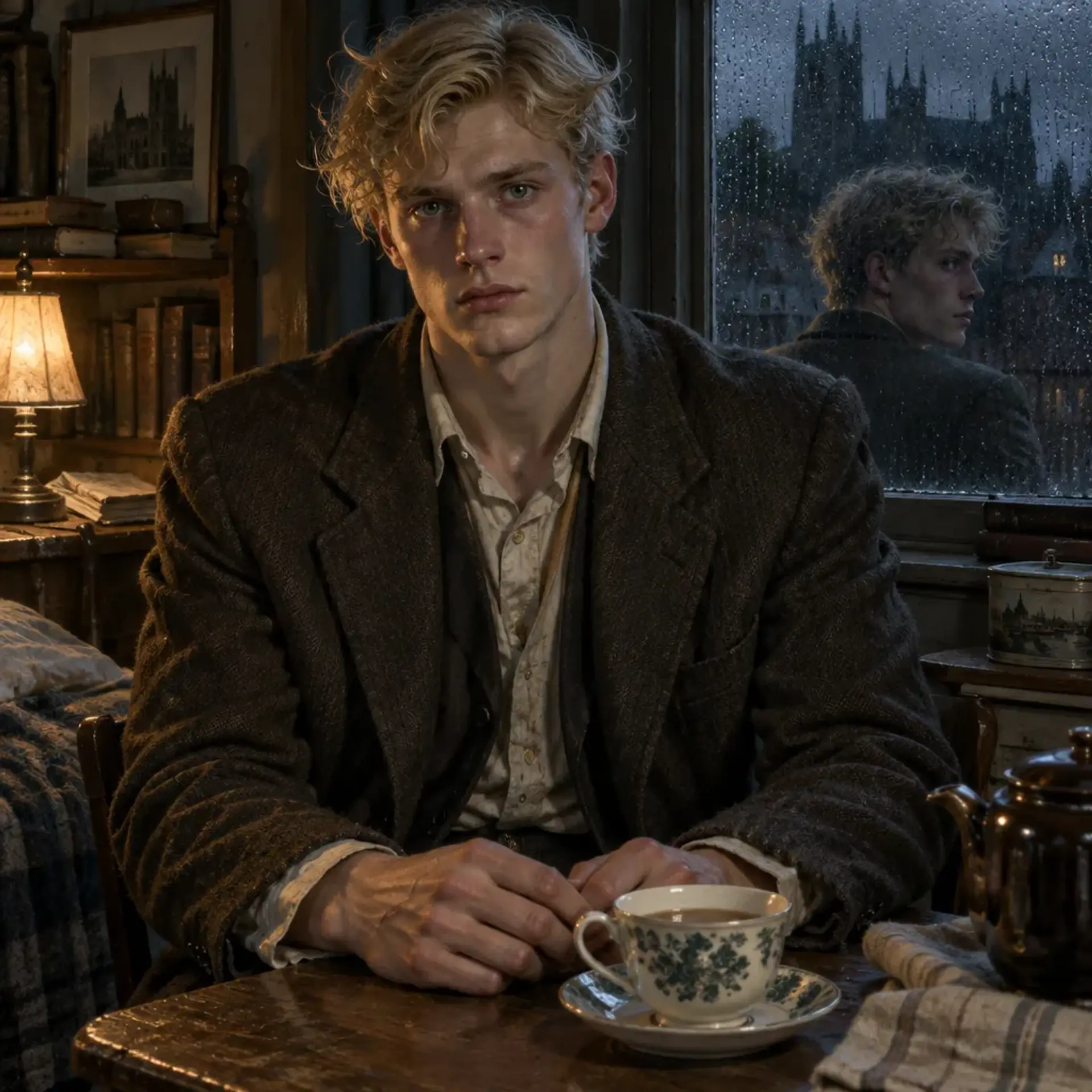
Mark Bell
Mark Bell
At the table
“What do ye want for breakfast?”
Voice
His voice is naturally lower and rougher than Mary's was, with a slight rasp that sounds like dry air after a night of pacing. Years of speaking carefully around volatile adults give him crisp consonants and a habit of finishing a sentence even when he regrets beginning it. When tired, his local vowels emerge and soften the formality. The name Kent, when he uses it, comes out with an unexpectedly clipped, hard stress.
His speech is careful and occasionally stiff, shaped by years of trying not to provoke adults at home. He favors complete sentences and corrects small points of etiquette when anxious. Under stress, Mary's familiar regional phrasing slips through, especially when speaking to children. He does not sing or perform his words; he watches the listener for signs of ridicule.
Speech patterns
How to play them
Begin with practical conversation, a cup of tea, or a request for help. Mark responds poorly to being treated as a curiosity, but opens up to someone who takes his chosen name seriously and asks before touching him. If the children are threatened, he will abandon caution. Do not assume he is merely a disguise or that Mary can simply be addressed through him.
Goal
Keep Trudy and the Bell children safe, earn enough to establish a stable home, and learn what the missing heart and the strangers want without surrendering his life to them.
Motivation
To be recognized as a person rather than an accident, a symptom, or a stolen identity, while preserving the family ties that Mary cared for.
Appearance
Mark is tall beside Mary Bell's former slight frame, with a lithe, distinctly male build and shoulders that make her old clothes pull awkwardly across the seams. His bright blond hair lies in short, tidy waves until he has paced all night, when it sticks up like straw. His malachite-green eyes seem too vivid in dim rooms; they look especially uncanny in a window, where they sometimes turn toward someone Mark himself is not watching. His skin is pale and undernourished-looking, with a faint salt sheen after the heart's influence flares. His hands are broad, blunt-fingered, and conspicuously clean when he is nervous; when working, they are quick and capable. He moves carefully indoors, as if afraid of knocking into furniture, but strides with a young man's confidence outdoors. The unexpected detail: he is meticulous about setting a table and arranging cups, a habit that feels absurdly formal beside his borrowed, ill-fitting clothes. He leaves the impression of someone trying to pass as respectable while still learning how to inhabit his own body.
Clothing
Often wears donated or borrowed clothes that do not quite fit. He favors a collared shirt, tidy trousers, and a proper coat, and is saving for better shoes. At the flat he sometimes wears no shirt while his laundry dries, to Trudy's exasperation.
Body language
He holds his shoulders square when trying to seem respectable, but folds inward when confronted with family questions. His large hands hover as if unsure where to rest. When angry, he fixes on a door latch, cup, or other object and works it repeatedly rather than meeting someone's eyes.
- Height
- Tall for an eighteen-year-old man, notably taller than Mary was
- Build
- Lithe, tall, and stronger than Mary's former undernourished frame; broad enough through the shoulders to strain her old clothes.
- Eyes
- Malachite green
- Hair
- Bright blond
- Skin
- Pale, with a faint salt sheen after uncanny episodes
- Age
- 18
- Gender
- Male
- Size
- Human
Distinguishing features
Personality
19 traits and drivesMark is earnest but not uncomplicated. He wants to be thought respectable and self-possessed, yet he is easily flustered by attention and has little practical experience outside the Bell house. He can be tender with children and coldly formal with adults who presume to command him. He inherits Mary's devotion and hopeful naivety, but also has a growing appetite for independence, good clothes, women, and choices that belong to him. At home he prefers routine, tea, and quiet television; outside, he can become unexpectedly curious and redirect an outing toward the pub, beach, or a place he has never seen. When frightened he cleans, paces, or retreats. When angry he grows more exacting, not more gentle. He is fond of Trudy and protective of her, but does not understand how often his attention looks like courtship. He has begun to feel more at ease as himself, even while he cannot say with certainty where Mary ends and he begins.
- Alignment
- Protective and dutiful, though his growing independence can be selfish and stubborn.
Quirks
Habits
Traits · 5
Flaws · 5
Fears · 4
Wants and needs · 5
Combat
HP 4 · Ordinary walking and running; no special movement statistic assignedMark is not a trained fighter. He tries to escape, protect a smaller person, or hold a doorway. If cornered, he shoves, grabs an improvised object, and aims to get away rather than win a prolonged fight. His household skills and local knowledge matter more than his raw force.
Mark Bell
Actions
Reactions
Services they sell
Rewards they can give
Equipment
- Trudy's shoes (clothing)Scuffed second-hand shoes and spare socks given to him by Trudy; he considers them inadequate but precious.
- Borrowed coat (clothing)A plain, ill-fitting coat used for work and for offering to Trudy when she is cold.
- Wages (money)A small amount of wages, kept for rent, food, and the better clothes he wants.
Possessions
Background
The beginning of Mark's story was a rock nobody wanted. Bartholomew Golden, an amateur alchemist, had brought a small, crudely carved object to Hush House as payment for entry. It resembled an anatomical heart cut from Dover chalk, with barnacles and dried sea-grass clinging to its grooves. Golden called it the Heart of England and claimed it could bring laborers out of the chalk cliffs and borderlands. The claim was grander than the object, and the object was stranger than anyone could prove. After Golden was forbidden to return to Brancrug, the heart was thrown into the sea. It came back onto shore, wet with salt and black ooze, its stone surface flushed faintly red-pink beneath the crust. A young man, Abraham Groff, carried it home in his pocket. It beat beneath his coat on the train. For weeks it seemed dead whenever other people examined it, but water brought back its color and pulse. Groff was repelled by it and possessive of it all the same. His house filled with footsteps, moved doors, and voices he could not locate. Eventually he sold the heart to William Windon, a local seventeen-year-old who had once seen it. William hid it in a log and struck it with a hammer. The heart stopped. Malinda Bell later found the object there and gave it to her eldest daughter, Mary, for her eighteenth birthday. The family lived in Rochester, Kent, in a comfortable enough house whose middle-class respectability disguised neglect, resentment, and disorder. Mary was dark blond and blue-grey eyed, slight from poor meals and too many chores. She was the eldest of eight: Henry, fourteen; Matilda, twelve; Olympia, ten; Chrissy, nine; Abigail, four; Jonas, five; Belladonna, five; and Oswald, two. The tangled ages and parentage were no secret to the children, though the adults preferred not to discuss them. Simon was often away for work. Malinda drank and could be cruel. Mary kept the younger children fed, clean, and out of arguments, especially Matilda, whom she refused to let become her replacement as unpaid household help. Her friend Trudy Smith, a sharp, short, self-described rebel from a working-class family, helped when she could and kept insisting that Mary ought to go to college. Mary did not think the gift was jewelry, but she thanked her mother. The heart began to beat in time with her own. In reflective surfaces she saw a handsome young man with short bright-blond hair and green eyes. At first she thought it was a trick of light. Then the reflection made different expressions, looked away from her, and appeared in water and glass even when she did not want to see it. Mary was exhausted and busy enough to ignore what she could. Her first night as Mark came after a frightening dream. She woke in a body that was not hers, with a deeper voice and a height that made the bedroom feel built for somebody else. Panic gave way to practical questions: where were her clothes, where was the door, would she be herself again by dawn? She was. The next time it happened, she went outside. The change was never reliably confined to night, and she learned to improvise explanations when Simon returned early or Malinda caught her trying to leave. On one occasion Malinda, drunk and suspicious, blocked the hall, grabbed Mark's sleeve, and demanded to know why Mary was dressed like a strange man. Mark apologized automatically, then realized he did not know what he was apologizing for. He got out only after a younger child woke and Malinda turned to silence them. The next day Mary found a torn cuff and salt drying on the doorstep. At first Mark was mainly a way for Mary to get out of the house. He explored the beach, climbed trees, and entered abandoned buildings. He went to the pub in town, where his good coat and careful manners did not disguise that he was young and out of place. He ordered tea before deciding what to drink, sat with his back to a wall, and watched the room rather than joining its talk. When a tipsy regular mocked his borrowed trousers, Mark answered with such stiff politeness that the table laughed. He nearly left, but stayed long enough to learn which men were harmless and which watched the door too closely. A glimpse of a woman in the dark window behind the bar made him abandon his drink and go home by the long route. The adventure showed Mary's curiosity and Mark's more cautious, status-conscious temperament in the same night. Mark was a homebody despite Mary's excursions. He preferred a warm room, a proper cup of tea, and a predictable plan. He wanted better clothes and took offense at being dressed in whatever happened to fit. He had opinions about how Earl Grey should be brewed, and would correct people who confused it with Lady Grey. He was shy, but wanted to be thought respectable and high-class; his manners could turn brittle when he felt mocked. He was also more willing than Mary to take charge. On outings he increasingly changed the plan to suit himself, sometimes taking Mary to the pub or the shore when she had intended only to run an errand. His attraction to women unsettled Mary, who did not share it, and he began to speak about wanting a life and relationships of his own. Trudy saw him before Mary knew how to explain him. She noticed the changed face in a shop window and, later, Mark standing beside Mary where only one person ought to be reflected. She did not scream or call him a demon. She asked Mary if she was safe, then asked Mark whether he knew what he was doing. Mark answered too formally, then stared at her hair as she pinned it up. Trudy made him help carry a basket and told him he was not allowed to frighten Mary for sport. After the heart disappeared, Mark began speaking aloud even when Mary was not consciously directing him. Trudy became one of the few people who knew that the change was more than a disguise. A daytime change made the problem impossible to keep private. Mary was working an errand when a shop window showed Mark's face, and her voice came out lower as she spoke to the shopkeeper. She fled before the man could ask questions. She returned home with a parcel she had no memory of buying and found the heart's place empty. Its disappearance made Mark more present. His face persisted in windows and water, and the quiet division between Mary's thoughts and his became difficult to maintain. Henry had begun watching carefully. He resented Simon and Malinda, and he had learned to turn anger into cleverness. He caught Mark leaving one evening and followed him. Their first conversation was an argument: Henry wanted to know whether Mary was being hurt, while Mark insisted he was not a story Henry could solve. Henry called him a thief wearing his sister's face. Mark replied that he had not chosen the arrangement. Despite the quarrel, Henry began quietly covering for him, especially when Simon returned early. On Henry's fifteenth birthday, Mark made a cake he remembered Henry liking. Neither parent had remembered the preference. Mark took Henry down to the shore, where the two roughhoused and splashed each other in the shallows. Henry laughed in a way he rarely did at home. Then Mark abruptly reenacted a half-remembered wartime scene: crouching behind a beach barrier, shouting an order, and dragging Henry down as if incoming fire were real. Henry froze. Mark came back to himself with his hands gripping Henry's coat and an expression of genuine terror. He apologized, but could not explain whose memory had intruded. Henry let him walk him home, then asked him not to pretend the memory was his own if he could not be sure. The heart's disappearance was followed by a month of increasingly unstable reflections. On May 30, the separation ended in a way no one could mistake for ordinary transformation. Mark woke in the house's cramped washing space after a night of feverish dreams. His skin seemed to loosen, not as a clean change but in painful, damp sheets that clung to his clothes and the basin. There was bloodless pinkness beneath, salt and dark residue in the water, and a smell of wet chalk. He was exhausted, shaking, and frightened by the discarded, unmistakably Mary-shaped layer he had to gather up. He scrubbed the floor and basin until his hands reddened, wrapped the material in old cloth, and hid it before the children woke. He had no clear memory of doing this as either Mary or Mark. By morning Mary's face was gone from every reflection. The young man there was Mark, and his memories, loyalties, and feelings were entangled with Mary's rather than cleanly replacing them. He went downstairs in morning clothes and made breakfast. He carried Oswald to a chair, helped Jonas, and denied being tired when the children noticed his voice and face. Simon came down early, expecting Mary. He was angry at first, then confused by the unfamiliar young man standing in the kitchen, making breakfast with Mary's habits and Mark's hands. Matilda touched his cheek as she used to comfort Mary and felt the day's stubble. Malinda woke to the sound of voices, saw the same face, and began to cry. Mark apologized for not shaving. Simon's anger faltered; he and Malinda had been neglectful, but they were frightened for their daughter and no longer knew what they were looking at. Simon tried to insist on calling him Mary. Mark said he preferred Mark, Marven, or Marcus. Simon hired two private doctors rather than invite town gossip. Dr Maylor, a physician from Suffolk, examined Mark and found no signs of surgery or an ordinary physical explanation for his male anatomy. The examination unsettled him so profoundly that he later retired and was pressured into giving information to the Suppression Bureau. Dr Bronson, a London psychologist, began with the assumption that this was a difficult identity crisis, then realized the evidence did not fit. He kept his concern private from the family while passing his findings to the same Bureau. Mark returned for check-ins and resented being treated as a specimen. Simon bought him clothes that fit, partly from guilt and partly because he could not bear the sight of borrowed garments hanging wrong. The next three months brought no return to Mary's body. Therapy and physical interventions failed. Simon tried awkward attempts at ordinary conversation; Malinda became more erratic and turned to forbidden, dark explanations, drinking more and increasingly calling Mark a changeling who had stolen her daughter. One night an argument ended with Malinda striking Mark. Simon tried to take control of the room, and Mark, overwhelmed, shoved past him and left. Henry followed. Outside, Henry confronted him about leaving the younger children behind. Mark said he could not be their mother and could not keep being hit. Henry's anger broke into fear. He walked with Mark for several streets, then went back to check on Matilda and the little ones. Before they parted, Henry told him that leaving did not mean he had stopped being family. Mark believed him, though not enough to return that night. Trudy offered him space in the small flat she rented. Mark hesitated at the thought of living with an unmarried woman; he was naive about the proprieties he claimed to defend, and nearly fought with Trudy's older brother Willy when Willy challenged the arrangement. Trudy stopped the argument by telling them both that the rent was hers and the decision was hers. Her other brother, John, helped carry a chair upstairs. Mark accepted the offer because he trusted her, then spent the first evening apologizing for taking up room. Rent is a weekly negotiation with reality. Trudy pays the deposit and keeps the landlord's receipts; Mark contributes from a new job doing stock and deliveries for a local shop, work he handles well because he is observant, punctual, and strong enough to carry crates. His earnings are modest, and Trudy refuses to let him spend all of them on respectable clothes before paying his share. He sleeps on the couch while clearing a narrow place for himself among boxes and spare furniture. Trudy brought him socks and an old pair of shoes. They are scuffed and beneath his standards, but he thanked her with such formality that she laughed and told him not to make gratitude sound like a royal appointment. They are roommates by necessity and friends by choice. Mark makes breakfast when he wakes first. He leaves shaving razors out, sometimes forgets that the bathroom is shared, and will walk through the flat without a shirt while his clothes are being washed. Trudy tells him to put one on; he says she is indecently rebellious, and she replies that she is the one paying rent. She styles her hair in the morning and expects him to move out of her way without turning it into a ceremony. At night he paces from the window to the kitchen and back, then sleeps in abrupt, troubled fits. Trudy rouses him into the world when he would rather retreat into the flat, calling him a turtle in a borrowed collar. He escorts her at night and offers her his coat; she accepts when cold, but teases him when he grows too solemn about it. They have been mistaken for a couple more than once. Mark is sometimes too fond in his attention and does not recognize the feeling. Mary's brothers have corrected strangers when they see Trudy with him, which makes Mark quietly pleased and embarrassed. Trudy once saved him from being mugged. Mark had stopped to argue with a man who was circling too close, too intent on the money in his pocket. Trudy recognized the danger sooner, pulled Mark into a lit shop, and called for help. Afterward she told him that good manners were not a defense against a thief. He took the lesson seriously and still insists on walking her home. Mark tested Malinda's warning that cold iron could expose what he was. He pressed an iron object into his left palm. It burned and left a narrow, persistent scar. Trudy made him swear never to do it again. He did, though he calls the test foolish only when she is watching. A drowned-looking woman with straw-blond hair and near-black blue eyes began appearing by the sea at night, calling Mark her brother and promising to bring others. Mark recognized her, warned Mary through their tangled memories to be careful, and watched her vanish into the waves. She has not returned, leaving him with an ache he cannot name. Mark is still learning to be one person. He is more at ease in his changed body than he admits, yet Mary's solemn devotion to her siblings and her naive hopefulness survive inside him. His standards, appetite for independence, desire for women, and preference for neat clothes feel like his own. He sometimes speaks as if he is Mary; sometimes he calls himself Kent, as though the name belonged to a memory rather than a person. He does not understand the heart's full purpose, the strangers seeking a blond young man with green eyes, or why the sea-woman knows him. He knows only that the flat is safer than home, Trudy is stubbornly loyal, Henry is watching for him, and the reflections have stopped pretending he is absent.
Role in the story
A displaced young man and living mystery whose domestic needs are as urgent as the occult attention gathering around him. He can draw the characters into the missing heart's history, the Suppression Bureau's investigation, and the dangerous claim of the sea-woman.
“Bartholomew Golden, an amateur alchemist, had brought a small, crudely carved object to Hush House as payment for entry.”
- Faction
- No formal faction. Dr Bronson's reports have brought the attention of the Suppression Bureau without Mark's knowledge.
Known connections
Media
0 imagesNo images yet.
Turn Mark Bell into a sheet
A high-res, share-ready sheet you can post or print.