Friedreich
Friedreich
At the table
Voice
A dry, close sound with a slight intake before the first word, like a man preparing to call a drill across a cold field. His breath is an imitation unless he is strongly embodied. The voice is clearest when he uses a face he knows well; his own unborrowed voice has a papery edge and a faint echo, as though heard in a stone passage. Anger makes his consonants clipped and his questions pointed. With friends, he uses a deliberately casual warmth that sometimes breaks into formal phrasing.
His voice carries a faint catch before the first word, as if a breath is required and then remembered rather than taken. In a borrowed face, it can match the source's pitch and accent, but his phrasing remains crisp and orderly. Brandenburg and old military vocabulary surface when he is anxious; Mecklenburg belongs to Wilhelm, not Friedreich. When angry, he does not grow soft or quiet. His sentences shorten, his consonants sharpen, and he begins asking direct questions that sound like testimony.
Speech patterns
How to play them
Treat Friedreich as a person before asking him to perform a trick. Give him time to answer and use his name; being ignored frustrates him more than open disagreement. He warms quickly to shared routines, especially football, cards, and holiday errands. Do not assume a face grants consent to enter someone's life. If he is wearing a borrowed face, ask whether he wants to be addressed as Friedreich. He responds best to frankness, practical kindness, and invitations that do not make him feel like a curiosity.
Goal
Find out who or what he was before death without allowing the answer, or a borrowed face, to erase the brother and friend he has become.
Motivation
To be seen and included without having to become someone else, and to make a family out of the coven even when its members frighten, disappoint, or confuse him.
Appearance
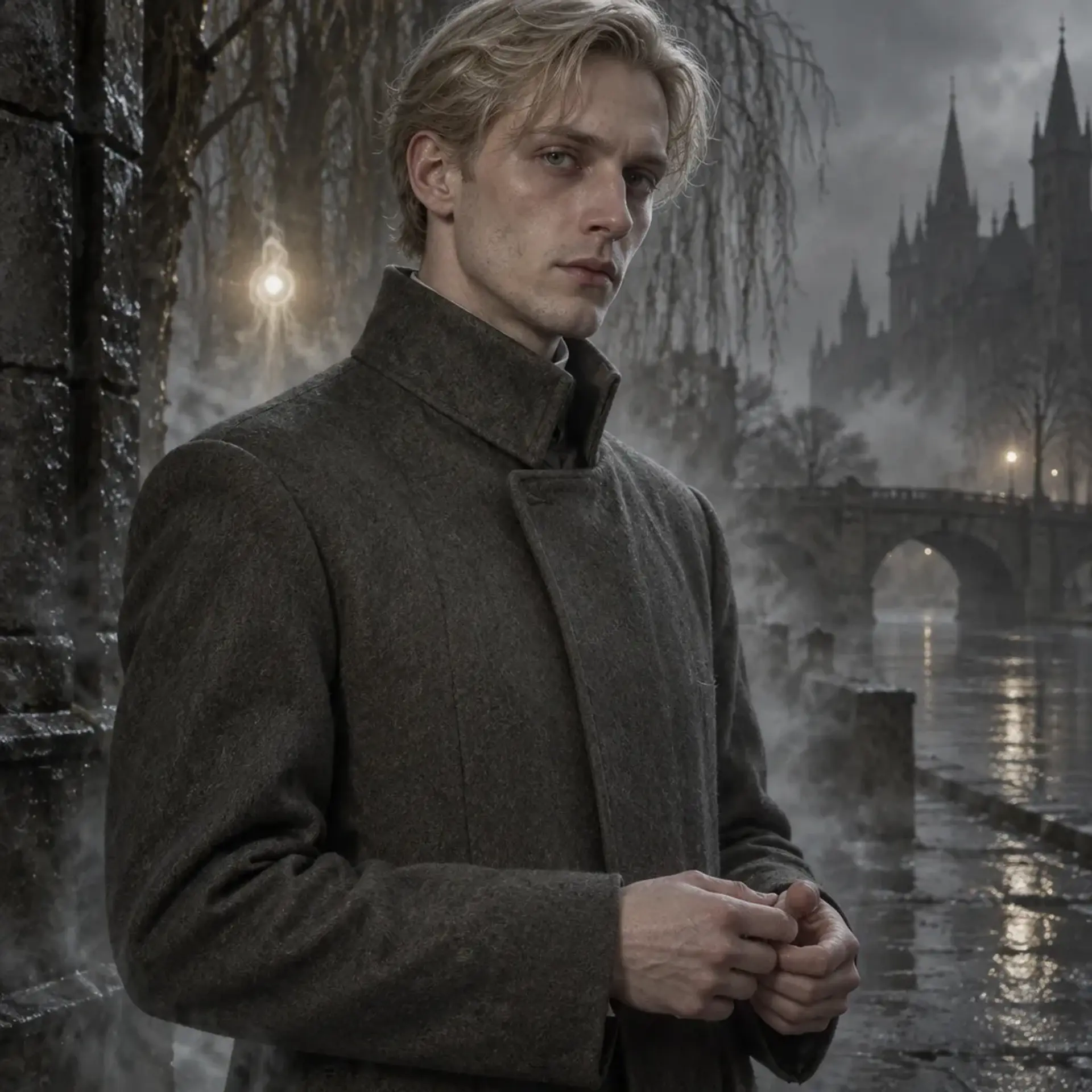
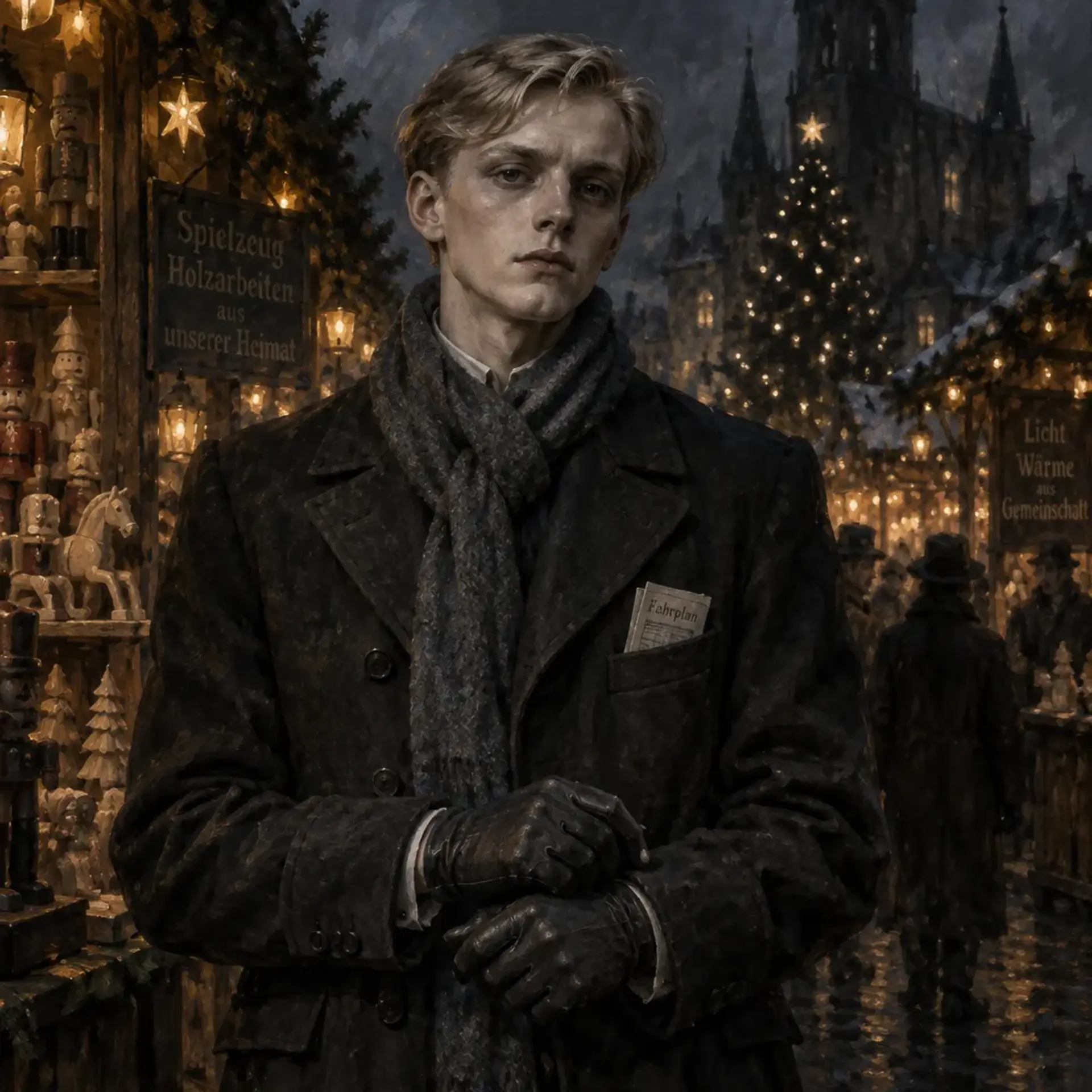
Friedreich first appears as an absence shaped like a young man: a narrow Prussian silhouette, upright and still, with the suggestion of a uniform that cannot quite settle into focus. When he steals a face, the effect is startlingly complete. Skin takes on the right texture, a damp gleam gathers at the hairline, a borrowed mouth works around words with practiced ease, and the face seems to have weight in the room. His movement remains his own: measured heel-to-toe steps, a soldier's precise turn, then a slight delay as if he is waiting for the world to acknowledge him. He favors young men around his apparent age, especially soldiers, policemen, and minor nobles whose bearing resembles the person he imagines himself to have been. His hands are unexpectedly marked by a careful, almost fussy habit of arranging small things: cards, market purchases, bottle labels. When unmanifested, these hands blur at the edges like smoke seen through wet glass. People remember the instant after he speaks, when the borrowed face seems to have been waiting just a little too long for their reply.
Clothing
A dark, old-fashioned military-style coat with no insignia, a high collar, and cuffs that never quite remain sharply defined. He sometimes borrows a face and dresses to match its era, but favors practical wool, plain trousers, and well-kept boots. The costume is partly memory and partly an attempt to look as if he has a right to be seen.
Body language
He stands with his shoulders squared and his chin fractionally raised, then tilts his head as if listening for a voice coming from the next room. When annoyed, he presses his thumb against each fingertip in sequence, a drill-like habit. In a borrowed body he overcorrects: he remembers to blink and breathe, but sometimes does both in the same deliberate rhythm. When welcomed by the coven, his posture loosens and his movements acquire a youthful, eager impatience.
- Height
- About 170 cm when fully embodied; his apparent height and outline waver when the Skinlands do not acknowledge him.
- Build
- Lean and narrow-shouldered, with the controlled posture of someone taught to make a uniform look correct. His apparent body has little weight when he is not strongly embodied.
- Eyes
- When no face is held, his eyes are a pale, unfocused gray, like winter light through dirty glass. A borrowed face reproduces the original person's eyes.
- Hair
- Usually pale blond when strongly embodied, based on Wilhelm's account and the few moments Friedreich can see himself clearly. Borrowed faces retain their own hair.
- Skin
- When visible without a borrowed face, his surface is a waxy, winter-pale gray with the faint translucence of old glass. Borrowed faces reproduce the original person's complexion and texture.
- Age
- Appears seventeen or eighteen, though his death date and true age are uncertain. He has lost much of his mortal memory and does not know how long he has existed as a wraith.
- Gender
- Male
- Size
- Human-sized when embodied; otherwise a wraithly presence whose apparent outline is not a dependable physical measurement.
Distinguishing features
Personality
21 traits and drivesFriedreich is courteous because courtesy gives him a reliable script, not because he is naturally placid. He can be warm and eager with his chosen family, then unexpectedly formal when he fears he is being treated as a curiosity. His apparent youth gives him a restless appetite for ordinary life: a good meal, a flirtation, a place on the sofa during football, the right to complain about cold weather. At the same time, his military bearing makes him dislike mess, indecision, and people who abandon a commitment. He wants to be gentle with Wilhelm and cannot stop prosecuting him for the wars. He protects Mila because he believes she is family, but he must remind himself that her longevity and power do not make her a child. He is amused by Gunther's questions until they concern Friedreich's nature too closely; then amusement becomes defensiveness. Klaus's barbs can make Friedreich bristle, but Klaus's hesitation around him also makes Friedreich wonder whether he is being pitied. When his face is recognized as borrowed, he can be honest about it. When no one notices him, he may become sharp, theatrical, or reckless, then feel ashamed and retreat. He is both a dutiful soldier in manner and a young person who wants to sneak off to the market; both a brother who forgives and a judge who demands an account. His wish to feel life is sincere, but it can turn selfish when he asks friends to risk their own bodies in experiments. The failed possessions taught him that longing does not make access harmless. He now tries to ask permission and accept refusal, though the urge to try again can return when Wilhelm speaks of lost memories or when Friedreich sees Mila touch his unborrowed hand.
- Alignment
- Not applicable as a Wraith: The Oblivion statistic. In ordinary terms, protective and duty-bound, but capable of resentment and possessive envy.
Quirks
Habits
Traits · 6
Flaws · 5
Fears · 5
Wants and needs · 5
Combat
HP 6 · Human walking pace when embodied; otherwise movement through the Shadowlands follows the chronicle's normal wraith rules.Friedreich avoids open fights. He uses Embody to become tangible when needed, tries to control or disarm a target, and withdraws into the Shadowlands if the situation turns against him. He does not treat face theft as a combat bonus. In a dangerous scene, his Shadow may urge him to keep a disguise and lash out at anyone who sees through it.
Friedreich
Actions
Reactions
Services they sell
Rewards they can give
Equipment
- Short knife (weapon)A plain short knife carried as a practical last resort. It is not a supernatural weapon.
- Face list (personal record)A pocket notebook containing coded descriptions of verified faces, the circumstances in which he used them, and reminders of which identities he must not confuse with himself.
- Cards and keepsakes (personal effects)A few playing cards and small market tokens he keeps because they help him take part in the coven's ordinary rituals.
Possessions
Background
Friedreich remembers Brandenburg in fragments that refuse to make a biography. There is a low winter sky, a room with a stove that smoked, the hard shine of boots, and the sense that someone expected a boy to stand straight. He thinks he was born into a minor Junker household, or perhaps only learned to imagine that past from the uniforms and formal manners that feel instinctive to him. He cannot reliably name his parents, his village, or the year he died. He insists on Friedreich because it is the name that remains when everything else falls away. He suspects he died at seventeen or eighteen. On rare days when the boundary between worlds thins, people can see him more clearly, and his apparent age settles into focus. The rest of the time he is a presence that must borrow the world's attention. His first successful face theft began as a desperate, humiliating accident. He had followed the living through a railway station, trying to make someone notice him. A young man in a dark coat stopped beneath a lamp, and Friedreich reached for the shape of his face without understanding what he was doing. The man's features unfolded over Friedreich like a wet paper mask. Suddenly Friedreich could feel the cold rail under his palm, smell coal smoke, and hear his own words leave a mouth. He laughed, then cried, then fled when the stranger looked at him as if he recognized him. Later Friedreich learned the man had died far from the station and was not nearby to reclaim anything. He keeps a list of faces he has verified as dead or absent from the region, changing the names in his notes to protect the living and, he tells himself, to protect himself. His preferred faces are: Emil, a young infantryman with a blunt nose and a dry, patient expression, used when Friedreich wants to look like a reliable brother; Jost, a tram conductor with a small crease at one eye, useful for ordinary errands and conversations with strangers; Anselm, a minor estate clerk whose careful posture lets Friedreich pass among people who expect deference; and Rudi, a young policeman with a broad, square face, chosen when Friedreich wants the world to make room. He does not use any one face constantly. The practice is partly caution and partly fear that he will forget which face was borrowed. The first face let him eat, drink, and flirt with living women he found pretty, though the intimacy was more performance than a recovered human life. The experience gave him a tender, dangerous hope: perhaps he could keep a job, have a room, and do ordinary things rather than hover at the edge of other people's days. His history with Wilhelm is a bond neither can explain. Friedreich calls Wilhelm his brother, though he has no proof of blood, kinship, or even a shared mortal past. He was with Wilhelm through both world wars as much as a wraith could be. During the First World War he sometimes recalls a breath, perhaps his own, perhaps a memory caught from someone else's lungs. He remembers Wilhelm as a shock trooper and remembers the shame Wilhelm carries over deserting near the end of the war. In the Second World War, Friedreich was close enough to know Wilhelm committed terrible acts, but not close enough to understand the details. Wilhelm refuses to say exactly what he did. Friedreich is furious at him and feels implicated, as though an older brother's crime stains the younger one. He is also furious that Wilhelm's silence makes the past impossible to judge or mourn. The contradiction keeps him loyal and keeps him from trusting Wilhelm. Friedreich has experimented with possession because he wants to know whether closeness can restore what death has taken. The first attempt was with Wilhelm during an evening with the coven. Friedreich asked to enter Wilhelm and share feelings, perhaps even recover memories; Wilhelm agreed out of curiosity and a desire to offer something to his brother. They chose a quiet place, agreed on a stop signal, and Friedreich tried to ride the vampire's body. It was not like wearing a face. Wilhelm's blood was a locked, cold machinery, and the body rejected Friedreich's presence with an animal insistence. Friedreich found himself pressing against instincts that were not his, while Wilhelm experienced a foreign pressure behind every thought and a brief, appalling sense of being watched from inside his own skull. For a few seconds Friedreich felt the dead shroud Wilhelm chews on, the hunger beneath it, and a burst of anger without an object. Wilhelm felt a faint echo of Friedreich's yearning for breath, touch, and brotherhood, but no recovered memories. They both forced the attempt too long, until Wilhelm's body convulsed and Friedreich was thrown free. Klaus was alarmed and ready to intervene. Gunther asked too many questions, trying to understand what separated a wraith's existence from a vampire's. Friedreich was ashamed that he had frightened them and resentful that the experiment had given him no answers. He tried once with Gunther, who was curious about whether their lives and memories could be shared. Friedreich entered a changeling's body and met a vivid, alien tangle of sensation, dream, and identity. The body felt alive in a way Wilhelm's did not, but the experience was not simple pleasure. Gunther's emotions arrived with mythic force; familiar sensations became strange, and Friedreich could not tell whether a thought was his own or a story the body had made room for. Gunther felt a cold observer pressing against his life and a brief distortion of his own sense of self. He asked questions even as he panicked. Friedreich broke away, shaken, and said, “Never again.” The phrase became a boundary rather than a joke. Later, Friedreich and Wilhelm made one last agreement to attempt possession, this time with a strict count and an immediate stop. Friedreich tried to offer Wilhelm the texture of human sensation: the feel of a cup, the warmth of a room, the small relief of breathing. The attempt was more controlled but no more successful. Wilhelm felt a muted impression of warmth and then the crushing pressure of Friedreich's longing. Friedreich felt Wilhelm's hunger and shame in jagged flashes, but no secure memory of either man's life. They ended it before either lost control. They have not repeated it. The coven is the closest thing Friedreich has to a household. It includes Wilhelm, the German Tzimisce from Mecklenburg who calls himself a Nachzehrer; Gunther, a changeling who spent much of his life in Arcadia and sells moss-based clothes; Klaus, a ronin Get of Fenris or perhaps a skin-dancer, whose passive-aggressive barbs often stop short when Friedreich is present; and Mila, a mage from Bremen who can see and touch Friedreich even when he is not wearing a face. Friedreich regards Mila as a little sister and protects her from duty rather than condescension. He likes the coven's cards, hunting, fishing, drinking, and especially football. He watches the game as if the rules can hold the world together for ninety minutes. Holidays bring extra visitors and make him visibly eager. At Christmas markets he advises everyone on bargains, sometimes urging a friend to buy an object he secretly wants but cannot keep. He recognizes that generosity and envy can occupy the same thought. Klaus told him that the spirit responsible for opening his Caul was not a wraith, mage, or occultist. Klaus described a land spirit marked by the Wyld, born of the Weaver's blessed adopted children and gifted the Wyrm's spoils with a trace of Luna. Friedreich remembers a vague image of a blond young man with clear blue eyes, then the spirit's purpose ceased to be visible. When his Caul opened, only a will-o'-the-wisp remained of the repetitive marching cadence that had filled his existence before waking. Friedreich believes Klaus knows more than he admits. He has not forced the issue because he fears that the truth might make his life a design imposed by someone else. He also remembers a fight in a cathedral during a Walpurgis Night service on April 30. He cannot yet say whether it was in life, in the Shadowlands, or in a Harrowing. He recalls stone grit under his borrowed palms, an uproar of feet, and a face he cannot place. Harrowings have since returned that imagery in altered forms: a church with no doors, a parade ground where every soldier wears his face, and a Christmas market where every stall sells something he wants but cannot take home. His ongoing problem is not simply invisibility. Each long spell of face-stealing makes him more convincing to others and less certain of the original Friedreich. His Shadow presses him to pick one face and keep it, claiming that being seen is worth any cost. He resists by changing faces, returning to his friends, and keeping records. He is still trying to learn whether his name belongs to a real boy, a memory, or a stubborn act of self-creation.
Role in the story
A companion, witness, and moral pressure point whose borrowed faces let the chronicle explore identity, visibility, consent, and the residue of wartime guilt. He can help the characters enter a scene socially, but his incomplete memory and dangerous longing for sensation create complications rather than a convenient disguise service.
“There is a low winter sky, a room with a stove that smoked, the hard shine of boots, and the sense that someone expected a boy to stand straight.”
- Faction
- An informal supernatural coven with Wilhelm, Gunther, Klaus, and Mila. Friedreich is a wraith of the Shadowlands, not a formal member of a vampire, Garou, or changeling faction.
Known connections
Media
0 imagesNo images yet.
Turn Friedreich into a sheet
A high-res, share-ready sheet you can post or print.