Eber
Eber
At the table
Voice
A young man's voice with a dry, slightly rasped texture, shaped by workshop dust and a habit of speaking only after he has chosen his words. It carries plainly across a workbench. When relaxed with Ignatz, it gains a quick, teasing rhythm; when embarrassed, he becomes precise and factual rather than soft-spoken.
His voice has a lightly rough edge from years around sawdust, forge smoke, and workshop dust, with a clear, careful articulation learned from listening to his father's instructions. He speaks in short, practical clauses when uneasy, then unexpectedly gives a sharp, well-aimed joke. His family names come out softer and quicker than his work talk. He does not sing his words or deliberately lower his voice when angry; anger makes his consonants crisp and his sentences direct.
Speech patterns
How to play them
Treat Eber as capable before offering help. Give him time and a practical task to share; do not stare at his meals or make his body a spectacle. He responds to honest questions, useful work, and small acts of inclusion. A person who mocks his eating will meet a cutting answer; one who threatens his family will find him unexpectedly brave.
Goal
Learn to live comfortably in his changed body, preserve his family's closeness, and uncover whether the pressure building in Greenwake threatens the people he loves.
Motivation
Belonging without pretending to be unchanged. Eber wants a place among his family that is neither a child's seat nor a problem to solve.
Appearance
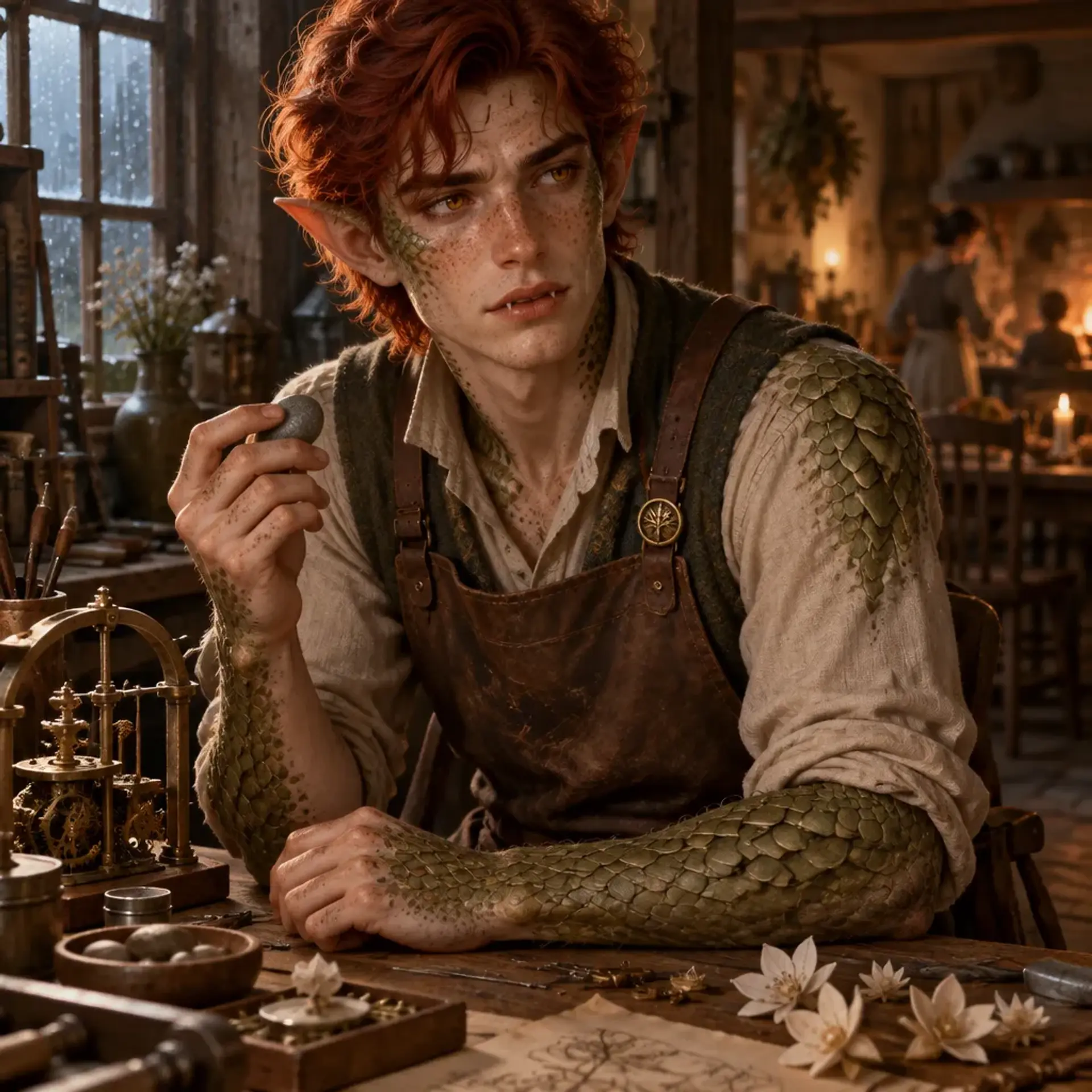
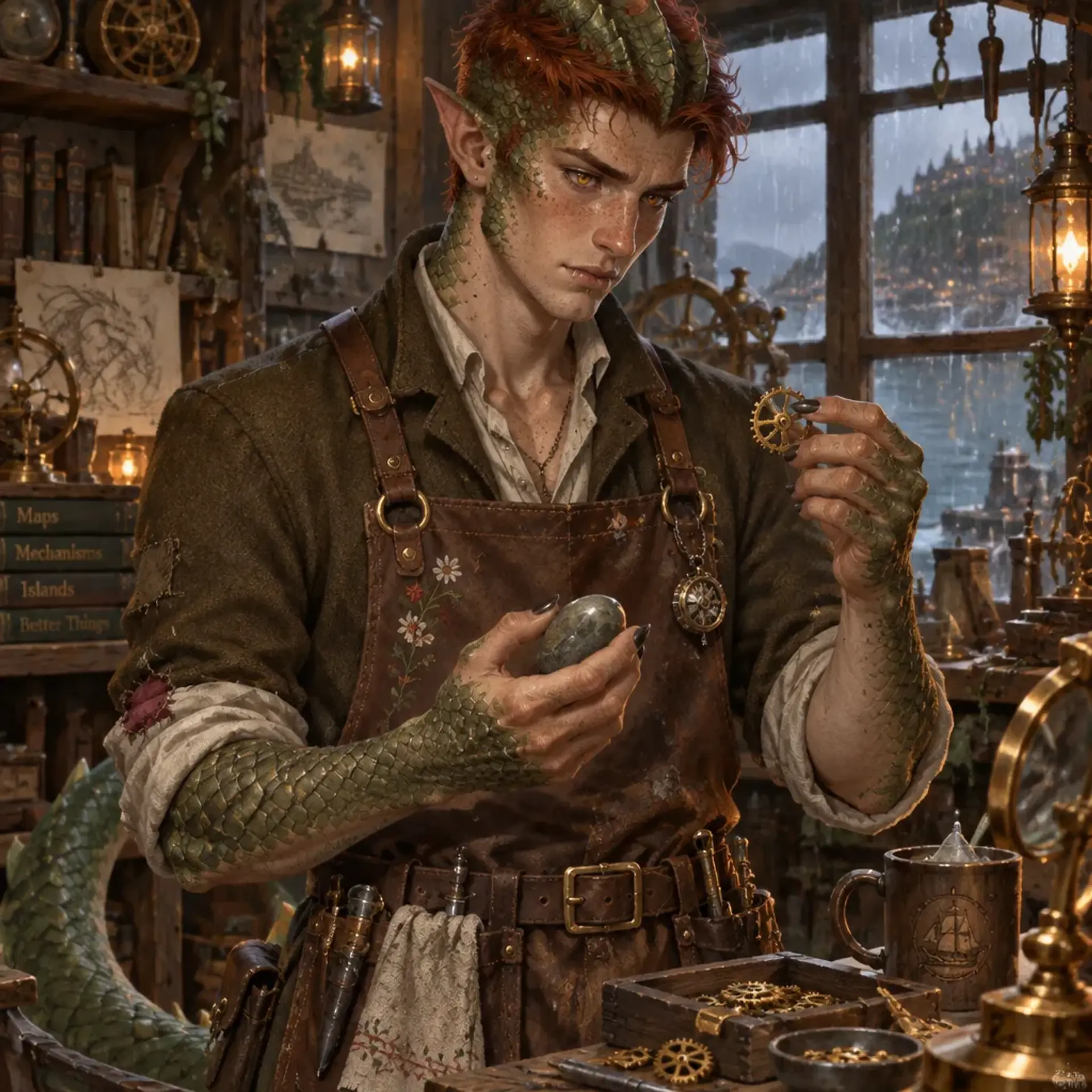
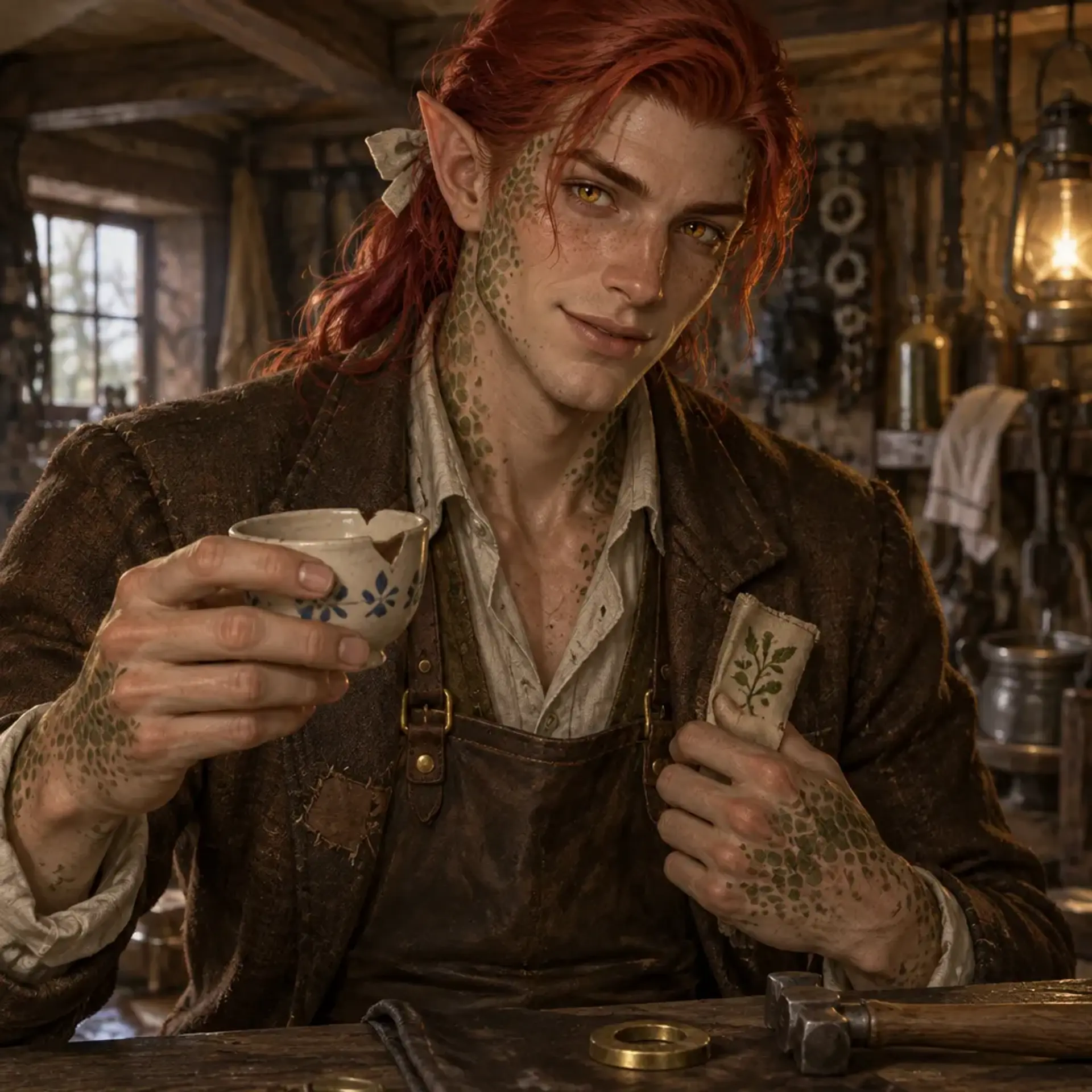
Eber stands five feet ten inches, a startling height among his stout halfling-descended family. Olive-green scales cover his fair, freckled skin in flexible, fine overlapping plates, most visible at his throat, temples, knuckles, and along his jaw. His auburn hair changed to an unusually vivid red during adolescence; he ties it back with a strip of linen when working. His pointed ears angle slightly backward, and his deep amber eyes have narrow draconic pupils that seem to measure every room. His green-dragon teeth are strong but poorly suited to chewing, with smooth, rounded edges and a forward set that makes his closed-mouth smile look like a held secret. He moves carefully through doorways and around furniture, shoulders angled to avoid knocking things over; when he forgets himself, he can cross a room with startling, silent speed. His most unexpected detail is that he wears a tiny embroidered kitchen napkin pinned inside his work jacket, a gift from his mother, and checks that it is there whenever he is anxious. People remember the contrast: a young man built like a forest predator who handles a chipped family cup as if it were precious glass.
Clothing
German-influenced village craftsman's clothes: a fitted brown wool jacket, linen shirt, sturdy dark trousers, leather work apron, and thick boots. His sleeves are repeatedly let out and patched. A small embroidered kitchen napkin is pinned inside the jacket, carefully laundered and mended. He wears no finery, but keeps a polished brass washer in his pocket.
Body language
Eber keeps his shoulders slightly hunched beneath beams and doorframes, though he is not timid. He checks the napkin pinned inside his jacket with his thumb, often without noticing. His amber eyes linger on exits, hands, and reflective objects. With family, he leans close and then catches himself, as if uncertain whether his size makes affection cumbersome. When cornered, he goes very still, chin tucked, like a hunter deciding whether to flee or spring.
- Height
- 5 ft. 10 in.
- Build
- Tall and strong for his family, long-limbed and flexible, with a compact, predatory balance rather than a bulky frame.
- Eyes
- Deep amber with narrow, draconic pupils; formerly brown.
- Hair
- Unusually vivid red, formerly auburn.
- Skin
- Fair skin with freckles, covered in flexible olive-green scales, particularly across the throat, temples, hands, and jaw.
- Age
- 19
- Gender
- Male
- Size
- Medium
Distinguishing features
Personality
17 traits and drivesEber is at once the family's youngest child and a young man who can lift what his father cannot. He longs for the old closeness, but recoils when tenderness turns into careful supervision. He wants to be trusted with real work, yet notices every glance that checks whether he is eating safely. In a crowd he is watchful and economical with words; with Ignatz or a small child he can become unexpectedly playful, quick with a game or a handmade toy. When anxious he retreats to the workshop and turns feelings into solvable problems. When angry, he does not grow meek: his answers sharpen, his posture lengthens, and he becomes difficult to distract. He is clever without being cold, but his new solitary habits can make him seem calculating. He is generous with tools and guarded with himself. He admires his parents' communal warmth, resents that his body has made their ordinary rituals difficult, and feels ashamed of both reactions. His humor is dry, his loyalty fierce, and his courage most visible when someone else is in danger. He is not convinced that blood determines character, though he worries that his own inherited instincts may be stronger than his choices.
- Alignment
- Neutral good. Eber wants to protect the people he loves, but his growing distance and calculating instincts sometimes make kindness look like suspicion.
Quirks
Habits
Traits · 4
Flaws · 4
Fears · 4
Wants and needs · 5
Combat
AC 12 · HP 11 · 30 ft.Eber avoids fighting and has no formal soldier's training. He uses cover, doorways, and workshop clutter, preferring to escape or protect a family member rather than win. If forced into a fight, he keeps a hammer between himself and the attacker, throws a stone to interrupt pursuit, and looks for a chance to retreat. He does not have a breath weapon, spellcasting, or an official dragonborn trait.
Eber
Actions
Reactions
Services they sell
Rewards they can give
Equipment
- Workshop hammer (tool and weapon)A broad-headed hammer used for fitting and setting small workshop pieces; suitable as a simple improvised weapon.
- Work apron (clothing)A leather apron with pockets for files, wedges, and small fittings.
- Gizzard stones (personal necessity)Several clean, smooth pebbles carried in a cloth pouch for his specialized digestion.
- Brass washer (keepsake)A polished brass washer he rubs with his thumb when thinking.
- Kitchen napkin (keepsake)A small embroidered napkin from Wilma, carefully pinned inside his jacket.
Possessions
Background
Eber is the youngest of eight children in a family whose stout halfling ancestors survived a shipwreck, hunger, dangerous forests, and a volcanic eruption before settling around the springs and fishing grounds of Greenwake. Only three generations have passed since those survivors reached the island. Their descendants still share labor, meals, gardens, and news along close timber-lined lanes, though high-blood children increasingly challenge the old assumption that family means everyone fits around one table. His father, Trogi, is sixty-eight, black-haired gone grey, green-eyed, and still found at the family workshop despite repeatedly announcing that he is ready to retire. He is calm, practical, and quietly patriarchal, though he has an absurd private wish for a beard after admiring one on a visiting man. His mother, Wilma, has whitening blond hair and hazel eyes. She tends the garden and chickens, is warm and shrewd, and can faint at the thought of violence, though she will competently butcher a chicken or fish when necessary. She and Trogi still fish together at the local stream. Their home is full of the ordinary care Eber misses most: a hand laid on a shoulder, a plate nudged closer, somebody asking whether he has eaten. Windle, forty-two, is their balding, hazel-eyed eldest and a low-blood craftsman with a wife and two young children, Otto and baby Anika. He works in the workshop and is expected to inherit its management. His steadiness hides a fear that his children could one day undergo Eber's changes. Karl, forty, is another low-blood son, black-haired and warm-eyed, who loves gears and tools. His marriage to Leanora, a rough sailor descended from the famed dragon hunters Wilks and Nailia, is rocky. Their son Hansel has black hair and eyes; Ragni, Leanora's pale-skinned, white-haired child with milky-blue eyes, is also part of the household, and the uncertainty surrounding the child's parentage is never discussed plainly. Yonda, thirty-eight, is Eber's only sister, a beautiful, sociable low-blood woman who treats him tenderly but urges him to spend time with people. She has five children: Willow, Trude, and Liesel, and the boys Hans and Birke, whose vivid green or light-responsive yellowing eyes suggest high-blood traits. Alder, a low-blood brother with cropped black hair and green eyes, works part time as a town guard but often chooses merriment over responsibility. His twenty-two-year-old son, Black Alder, is a high-blood cousin with black hair, amber serpent eyes, and green scales on pale skin. He visits with stories of adventure that Eber listens to more eagerly than he admits. Kasper, thirty-five, is a brown-haired, brown-eyed low-blood brother, a clerk and gifted watch repairer who is equally likely to be found among the chickens or in the garden. He and his wife are content with two daughters, Wonda, who loves gardening, and Ilse, who follows her everywhere. Then there are Eber's high-blood brothers. Rodrick, twenty-one, is taller and bigger than Eber, with auburn hair, yellow eyes, fair skin, reddish-tipped green scales, and a predator's build. He works in the shop, carries heavy things, tends chickens, and seeks a life beyond the family business. His sorcery has begun to show through his green-dragon heritage. Rodrick can be blunt and arrogant, and he calls his teasing honesty. Eber remembers a gentler boy with dark brown hair and light brown eyes; that memory makes every careless insult sting. Rodrick stops when Eber becomes truly angry, though neither brother knows how to talk about why. Ignatz, twenty, is the brother Eber trusts most. He has ashy light-blond hair, draconic green eyes, fair skin, grey-green scales that are growing more vivid, a flexible tail, and newly sharp claws and teeth. As children, they played beside the river and in the woods. Ignatz supported Eber through adolescence even when he did not understand what was happening. One day Ignatz killed a chicken with his bare hands after a sudden hunting urge overtook him. He was horrified afterward and has largely confined himself to the workshop. Soon after both brothers changed, they slept together on kitchen pallets, too large for their old beds and frightened of what their bodies might do. Ignatz stayed close, pretending the arrangement was about warmth; Eber pretended to believe him. Their parents worried over the shortage of food, clothing, bedding, and safe space for their high-blood sons, but the kitchen became a small refuge. Eber remembers his mother's footsteps checking on them and the two brothers holding still until she had gone. Eber's own adolescence came later. His hair, once ordinary auburn, flared into an unnatural red; his brown eyes turned molten amber; olive scales spread across him; his body lengthened beyond the proportions of his family. Unlike Ignatz, he has no tail or wings. His teeth altered without becoming brittle, but he discovered he could no longer chew. At first he tried to hide it, swallowing food whole until he choked. Wilma found him and sat beside him, frightened but steady, while Trogi tested small stones and soft foods with the patient care he normally gave a delicate clock. The family learned that Eber needed smooth pebbles swallowed with meals to help his changed digestion. The solution worked, but it made every shared meal a reminder that his body had crossed a boundary his family could not follow. That was the formative change: not the scales, nor the height, but the first family supper after he returned from choking. Everyone was kind. They softened his food, found stones, and insisted he take the best seat. Their concern felt like love and exile at once. Eber saw his mother's hands pause before serving him and his father's eyes checking his breathing. He began eating slowly, facing the wall or a window, and learned to leave the table before anyone could mistake his silence for hunger. His solitary habits grew from that embarrassment, then became a comfort. He collects bright metal scraps and polished stones, not because he is greedy, he insists, but because he likes objects that keep their shape when people change. The family workshop is a place of repair: hinges, tools, gears, clocks, and the small mechanisms that keep an isolated village functioning. Eber has a sharp eye for workmanship and a knack for noticing when a tool has been moved. He is useful there, but the workyard was made for halfling bodies. He bends to clear beams, breaks handles by accident, and has learned to wrap cloth around tools so he can grip without crushing them. Trogi wants him to have a place in the shop; Windle worries about its future; Karl delights in teaching him mechanisms; Kasper lets him inspect broken watches. The workshop is home, livelihood, and a constant measure of how little the old house was built for him. Beyond the family, Greenwake itself is changing. Low-blood elders preserve shared food and remembrance customs, while many high-blood youths see their dragon inheritance as proof they should rule. A fivefold dragon goddess has gained quiet admirers, and secret rites are said to be drawing ambitious people together. Elders blame the green dragon whose blood altered their ancestors; some suspect one of her daughters or an unfinished ritual. The village keeps wary distance from the island's golden serpentine beings, unable to decide whether they are protectors or rivals. Rumors say a returning green dragon patriarch is exploiting the village's divisions. Eber does not know which stories are true, but he has noticed people buying polished green stones and asking about the family's old records. He is caught between two instincts. One is the boy who wants to sit shoulder-to-shoulder with his parents, share their food, and be the baby of the family again. The other is a newly solitary, clever mind that notices what others overlook and would rather watch from the edge than be comforted in public. He resents being too large, too strong, and too physically different to fit the rhythm of his parents' lives. He also feels guilty for resenting them, because they have never stopped making room. He is trying to learn what his changed body requires without letting the body decide what kind of person he becomes. Today he wants to help his family, understand the strange pressures gathering around Greenwake, and find a way to eat at the same table without pretending nothing has changed.
Role in the story
A family-centered local NPC and possible witness to the changing politics of Greenwake. Eber can introduce the party to the workshop household, reveal the human cost of the village's inherited draconic traits, and notice clues others overlook. His private record may connect an apparently domestic mystery to the secret rites and the returning green dragon patriarch.
“Only three generations have passed since those survivors reached the island.”
- Faction
- The Greenwake Kin, especially the family workshop household. Eber has not joined the dragon-worshipping circle or any political faction.
Known connections
Media
0 imagesNo images yet.
Turn Eber into a sheet
A high-res, share-ready sheet you can post or print.